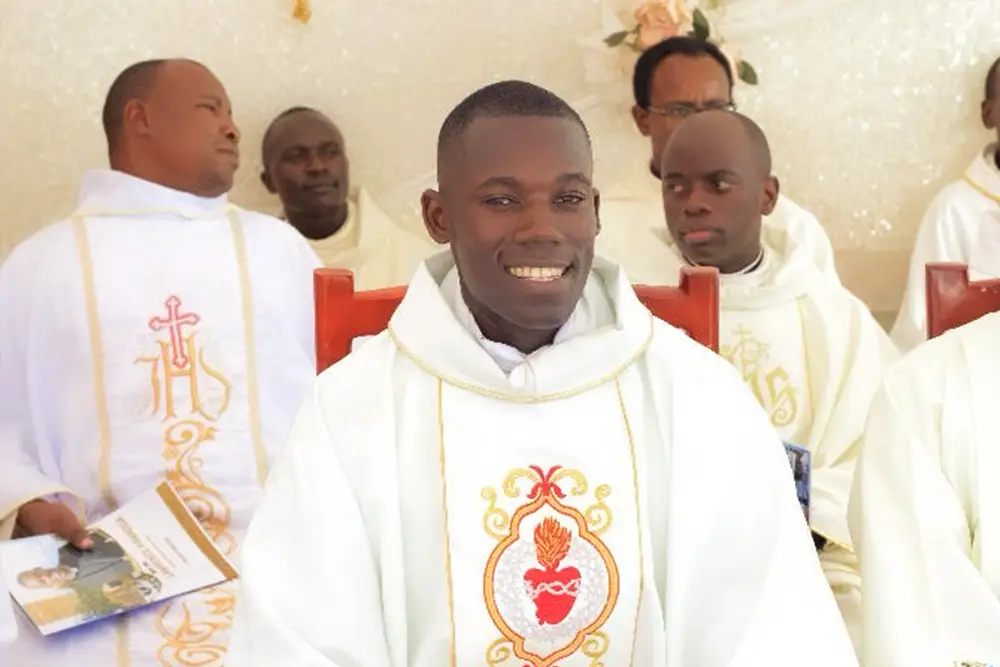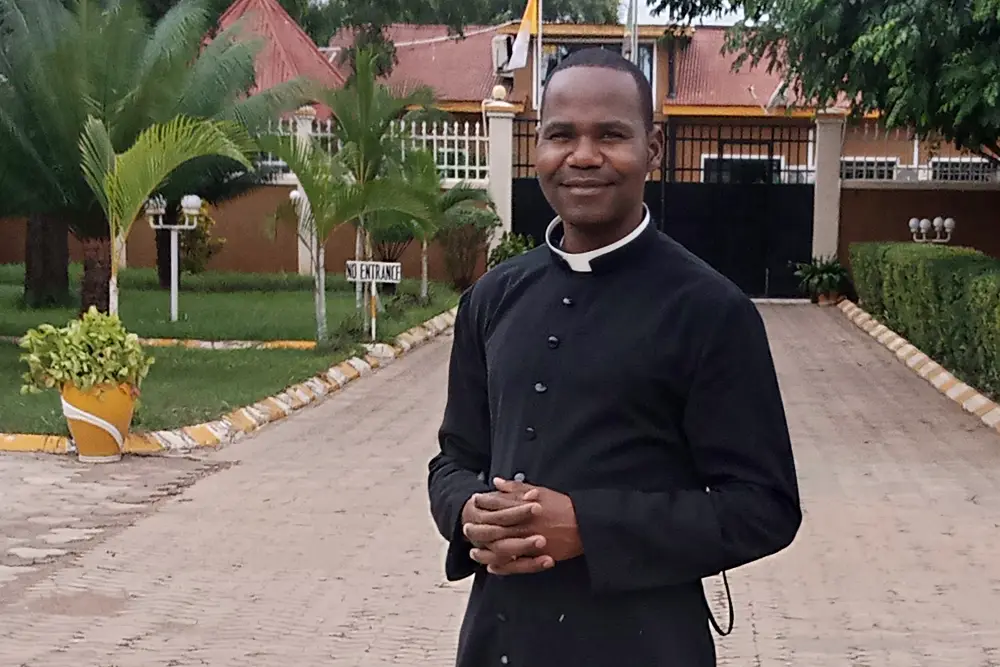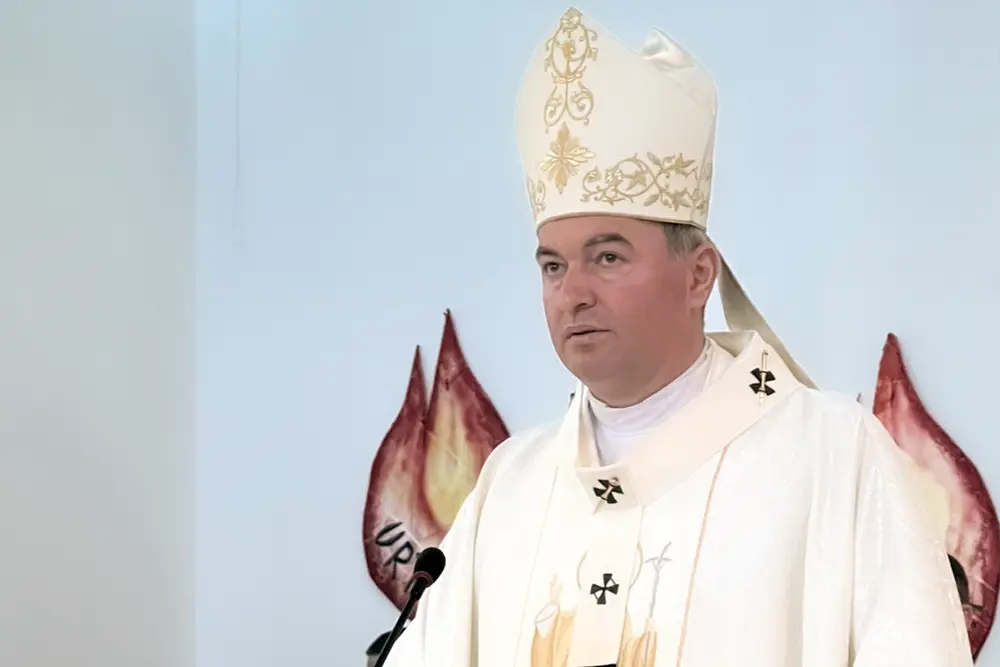
Arjan Dodaj is the Metropolitan Archbishop of Tirana-Durrës, Albania. He was born in Laç-Kurbin on January 21, 1977. In 1993, at the age of 16, after completing his primary and secondary education in his hometown, he emigrated to Italy and settled in Cuneo, where he began working.
He worked as a welder for more than ten hours a day and found his path to the Christian faith in the Fraternity of the Sons of the Cross. He had been raised atheist, but upon encountering Christ, he received the Baptism and discovered his priestly vocation.
I contacted Monsignor Arjan Dodaj through some students from the Fraternity of the Sons of the Cross, whose members study at the Pontifical University of the Holy Cross, in Rome, thanks to the help of the CARF Foundation.
Monsignor Arjan Dodaj has shared his conversion testimony and vocation with the CARF Foundation.
"All stories are moving, if we think that each story has to do with a person, with a human being, with his world and his life. However, there are stories that are more shocking than others, at least for some of us who have had the opportunity to live and see with our own eyes certain situations that have changed the existence of some countries in particular.
I still remember, in fact, as a 12-year-old boy, the boats that arrived in Italy from Albania in the 1990s, packed with people crammed into the holds and on the decks, occupying every available space to escape the poverty, insecurity, and uncertainty that reigned in the Balkan country. It may have been the first time Italy experienced the phenomenon of mass immigration, a phenomenon for which it was unprepared and which is now commonplace.
I escaped on a ship from my homeland... Now I have returned as a bishop.
Today we tell the story of someone who experienced all of that firsthand. One of those boys we saw on the boats on television is now a bishop. His name is Monsignor Arjan Dodaj, born in Laç-Kurbin, on the coast of Albania, who arrived in Italy as an immigrant at the age of 16, after crossing the Adriatic Sea by boat.
He fled his country on a warm, starry September night in 1993, seeking a better future and a way to help his family, who were living in poverty. Today he is the Metropolitan Archbishop of Tirana-Durrës, in his native country.
While working as a welder and gardener for more than ten hours a day, he met the community of the Sons of the Cross, whose members study at the Pontifical University of the Holy Cross thanks to the support they receive from the CARF Foundation—Roman Academic Center Foundation. There he rediscovered the Christian faith, which had been banned in his country during the communist regime, although it had remained in his heart as a distant memory, thanks to the songs his grandmother whispered in his ear.
—Thank you, Monsignor Dodaj. It is an honor to be able to interview you for our Spanish-speaking readers. As an Italian, your story touches me very personally.
Thanks to you, it is a pleasure, because for me, as for many Albanians who knew Italy through Italian television that we could see in our country, there was only one desire: to go to Italy.
A humble and simple family
—What struck me most about her story was that faith that remains hidden, or rather sown and buried in the heart, without one even realizing it, and that then blossoms many years later…
Yes, and it's all thanks to my family, a very humble and simple family, originally from northern Albania. I was born in Laç, a city known especially for a sanctuary much loved by all Albanians, dedicated to Saint Anthony and located on the mountain behind my town.
This sanctuary is a place that has always been with me throughout my life. In fact, when I was a child, the school I attended was at the foot of the mountain. Right next to it ran the path along which, especially on Tuesdays, near the saint's feast day, and also on other celebrations I was unaware of at the time, many people walked to entrust themselves to the intercession of Saint Anthony.
A communist country
—And that's despite living in a communist country…
Yes, despite the strict prohibitions of the communist system in a country that, in fact, declared itself atheist by Constitution.
My family was humble: my father worked in a factory and my mother on a construction site. Besides me, there were my two sisters. We grew up together in a simple and charitable environment, with much love and a strong sense of belonging to that great gift that is family.
In the village near Laç lived my maternal grandparents, whom I had more opportunities to get to know, since they were not far away. There I had, in a way, my first approach to the religious dimension, which they lived with great discretion but, at the same time, with a deep sense of the existence of God. Even if unconsciously, I dare say that I could breathe for the first time the experience of faith precisely when I saw my grandparents.
Every day, my grandmother would stand in front of a structure in front of the house, which I didn't know was the village church. She would stand there, upright, with her rosary in her hand, and pray. My grandfather, on the other hand, always started his day with the rosary, and only then did he do anything else.
These practices were unfamiliar to me, and yet they conveyed something of their faith, of what they believed in in such an accessible way: the presence of God, invisible but visible to them in their hearts.
Escape from Albania
—In the nineties he decided to flee to Italy. Why?
At that time, we were beginning to emerge from behind the Iron Curtain that had surrounded our country. Pluralism appeared, and with it, the possibility of democracy. So many Albanians tried to find a better future in the West.
Personally, I tried to escape several times, especially to Italy. The first attempt was on August 8, 1991, after the first mass exodus that many Italians and Albanians remember: the one in March, when I was fourteen years old.
On that occasion, there was the incident of the famous ship Vlora, which was carrying some 20,000 people. The ship I had decided to take with many others suffered a breakdown and, I dare say, by some stroke of luck, never even left the country. I realized that it was going to be a journey full of suffering, poverty, and hardship.
After that, I made several more attempts to find a better future in the West, like many friends my age and numerous adults and families.
I wasn't just looking for a future for myself. I was also driven by the desire to support my family: my sisters and my parents, who had suffered so much from extreme poverty and persecution during the communist dictatorship.
The second leak
—And finally the opportunity arrived…
Yes. In 1993, through clandestine organizations. It was the night of September 15-16, 1993. I was 16 years old at the time.
Certainly, at my young age I wasn't aware of the adventure I was embarking on because, as I've already said, I only had one desire: to go to Italy. We Albanians only knew Italy through what we saw on Italian television channels.
The journey began at the lagoon in my town, Patok, where a boat from southern Italy docked. There were forty of us in total, and we had paid a considerable amount of money, something almost impossible for us.
For this reason, I was in debt, but, in order to leave, each of us had already paid one million six hundred thousand lire, the approximate equivalent of 850 euros, a considerable sum at that time and, especially, in a country like ours.
I left a piece of my heart
I remember that night of September 15th very well: the beautiful starry sky and the calm sea. As we moved further away from the shore, I watched the lights of my town go out. Somehow, I felt a piece of my heart slowly being torn away.
We arrived in Carovigno, in Apulia. There, we were picked up and taken to a ruined house in the middle of some olive groves. The next morning, along with some other people, I took the train to Bari and, that same afternoon, continued on to Turin. In Piedmont, other friends were waiting for us who would help us adapt to Italian life.
I work as a welder
—I can't even imagine how difficult it must have been…
Of course, and even more difficult because of the urgency of paying off the debt he had incurred in Albania.
When I arrived in Italy, thank God, I had some fellow countrymen who helped and supported me during the first few months. After Turin, I went to Milan, where I tried every possible way to find work. I wandered from place to place, and whenever I saw a crane, I'd go to a construction site to try and get a job. If I saw a restaurant, I'd try to get in as a dishwasher. But unfortunately, it wasn't easy.
Later, some friends told me that there was a possibility of finding work in Cuneo, in Piedmont. So I went there.
I settled in that city and immediately found help at a shelter founded by Franco Mondino: Casa Ristoro e Pace. I started working as a welder and then moved into construction.
My first period in Italy was full of difficulties, especially because of being away from my family and having to adapt to a completely new reality. But later, with the grace of the Lord, I came to understand and appreciate that exhausting time more and more.
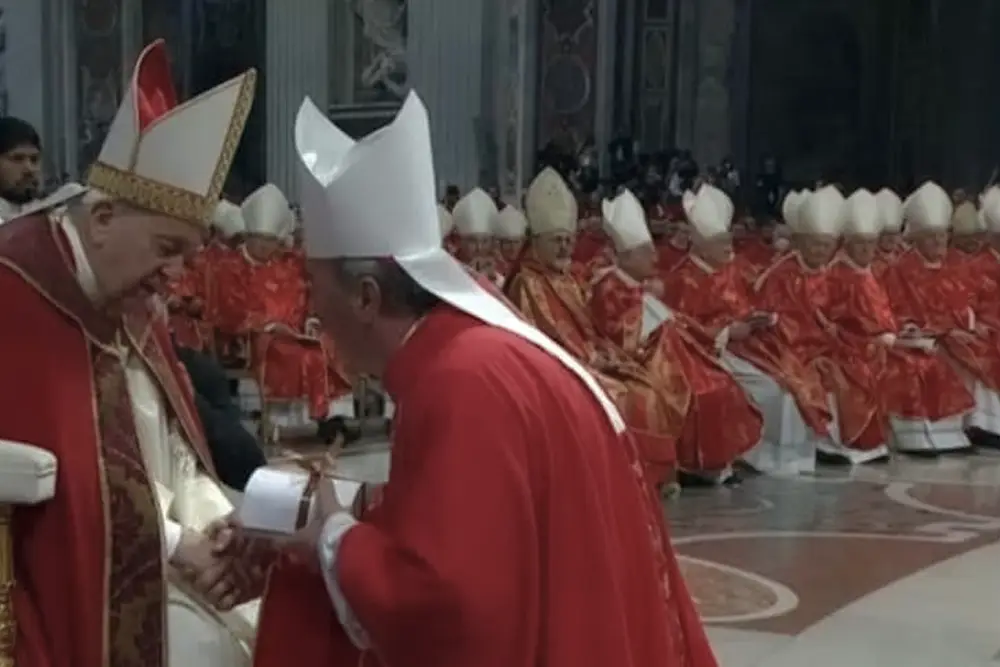
—Until the encounter with the Fraternity of the Sons of the Cross and with the Christian faith…
My encounter with the Fraternity of the Sons of the Cross, the priestly branch of the House of Mary, took place in 1993, precisely in Cuneo.
There I met a priest, Father Massimo Allisiardi, who was involved in the life of the community. At his invitation, I began attending his prayer group and became increasingly close to the founders of the House of Mary: Don Giacomo Martinelli and Nicoletta Reschini.
Through them I learned about the extraordinary event of Medjugorje, where, according to tradition and the experience of its faithful, the Virgin has been appearing for decades.
Within the context of total atheism in which I had been raised, it was extraordinary to first learn that God exists and that the Virgin Mary appears; then, to have a living experience of it. All of that was for me the beginning of a completely new life.
Thus, after a year of discernment, catechesis and spiritual life, I received the sacrament of Baptism. At that moment the desire for total consecration to the Lord in the priestly life was born and became clearer and clearer in me, together with other young men of the community.
—A radical change in his life…
Of course! I had to train and study. My studies were a consequence of that trip and the discernment of my superiors.
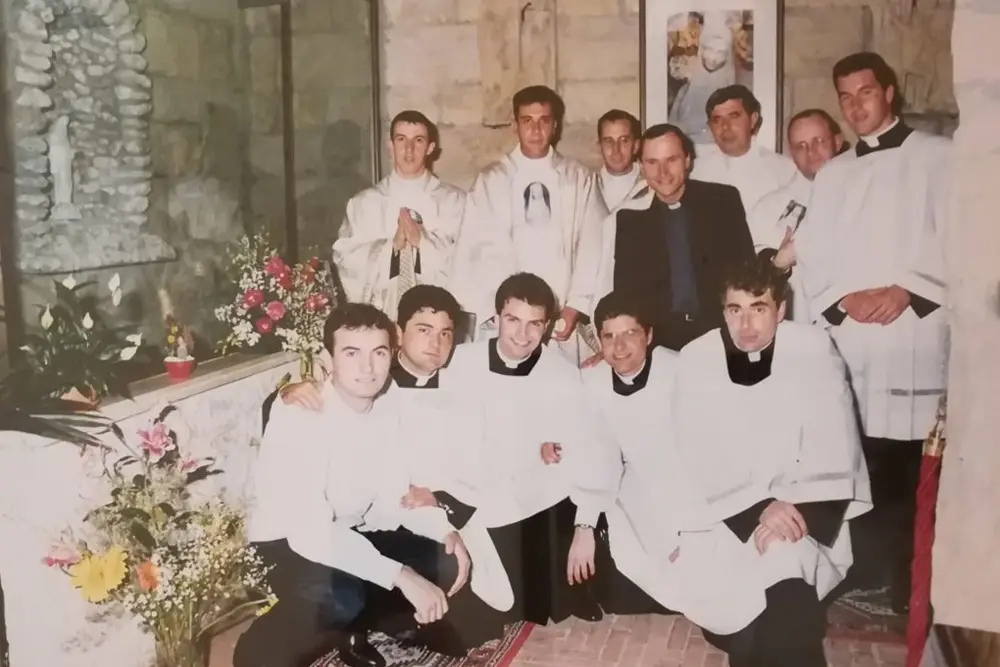
After three years as an external member of the House of Mary community, between 1994 and 1997, I was finally admitted and began my studies in Philosophy and Theology.
Certainly, within priestly formation, these studies are of fundamental importance, although they are not the only determining factor. For me, the decisive element was my encounter with the Church through that small reality in which God's providence had placed me: the charismatic experience that the Lord bestowed upon me in the House of Mary and in the Fraternity of the Sons of the Cross, recognized as a society of apostolic life.
I believe that this formation and conversion are not merely the result of how things happened, but a concrete and daily necessity. Each of us must develop and live out our vocational gift within a stable context of discernment and ecclesial and communal experience.
The Lord's call is daily, as is our response, which is always embodied in the concrete face of the Church.
I was ordained a priest on May 11, 2003 by Pope John Paul II in St. Peter's Basilica.
In the service of the Lord
And now you are the first bishop of the fraternity, a great responsibility!
Honestly, in the Fraternity I feel like one of the Lord's brothers, like all the others; in fact, the most unworthy.
For me, being a bishop is not an end point, but a call to even greater vigilance, to even greater service, and to an ever more humble response. I feel a greater need for the prayers of my brothers and my community, because everything the Lord has given me through this charism can enrich and serve his Church.
Therefore, I am not at all disconnected from the history that has shaped me.
On the contrary, I need to draw ever more from that vital source to serve wherever the Lord has called me. Therefore, I feel called to contribute the gifts the Lord has bestowed upon me and to transmit what He says to the Church through His Mother, the Pope, and His Magisterium, always with absolute respect for the identity of this particular Church of Tirana-Durrës.
Fidelity to the Church
The Sons of the Cross Fraternity has recently obtained official recognition: what is it specifically called to do?
Our Fraternity of the Sons of the Cross, like the community of the House of Mary, is a very young ecclesial reality. Its fruits are gradually being revealed, especially through fidelity to the Church.
Just as there is no fruit without a tree, every gift becomes a task of service to the Church, according to the specific plan the Lord has raised up. This also applies to our reality.
Featured quote
«For me, being a bishop is not an end point, but a call to vigilance, to even greater service, and to an ever more humble response. I feel a greater need for the support of the prayers of my brothers and my community.».
Caption: Monsignor Arjan Dodaj.
The challenges facing the Church in Albania
What are the challenges facing the Church in Albania?
These are the same points that Pope Francis presented to the bishops of the Church throughout the world. In particular, the call to live a true synodality, that is, a communal journey of the People of God.
But although the invitation is addressed to the whole Church, each particular reality is called to make it effective, taking into account its own characteristics. I believe that our Albanian Church bears the specificity of martyrdom. We must treasure that martyrdom.
The Albanian Church has not yet fully manifested what Tertullian says: Sanguis martyrum, semen christianorum —the blood of the martyrs is the seed of Christians—.
There are still many brothers and sisters who hope to become Christians through the grace of our martyrs. We, with an ever-growing awareness, are called to make their sacrifice visible.
Another unique feature of our Church is that it is both ancient and new at the same time. It is ancient because it is an apostolic Church. The first bishop of our diocese of Durrës was Saint Caesarius, a martyred bishop who, according to tradition, was one of the seventy-two disciples of the Lord.
It is also a Church evangelized by Saint Paul himself, as he affirms in the letter to the Romans: «From Jerusalem all the way to Illyria, I have fully proclaimed the gospel of Christ» (Rom 15:19).
However, it is also a new Church because, after five centuries of Ottoman occupation and fifty years of dramatic torture, persecution and annihilation at the hands of communism, it once again embraces the message of the Gospel.
It is a Church that needs to cultivate the Lord's message more and more, with kindness, patience, and love, especially among the many young people who are seeking Christ and his love.
Relationship with the Orthodox Church and Islam
And it is also a very complex reality, if we consider the very strong presence in the country of the Orthodox Church and Islam....
Yes, and we must also keep in mind that in our archdiocese there are many people who begin the path of catechumenate and approach the Catholic Church, becoming children of God through Baptism.
Here in Albania, the relationship with Islam and the Orthodox Church is very special, if not unique. Pope Francis himself presented it to the world as an example of fraternal cooperation.
It is clear that this is a gift that we can never take for granted, but rather we must cultivate, nurture and support it every day.
That is precisely why we often meet with various religious leaders in different committees to present valuable initiatives in the areas of culture, education, women, immigration, and charity.
These initiatives seek to promote in society, in institutions and, above all, in the hearts of people, that need for unity and communion which only the spirit of those who believe can make visible (cf. Acts 4:32).
Addressing the situation of migrants
You have been a migrant yourself and today this issue is more alive and painful than ever: on the one hand the tragedy of the loss of tens of thousands of lives every year in the Mediterranean, on the other the fear of losing identity, faith and economic and social security by being too open to welcoming so many people in need. How do you think all this can be addressed?
I believe there is no clear and definitive answer to this question, because we are always dealing with real people, with a story that is sometimes marked by wounds, suffering and pain, but also by great hope.
We are called to respond to the real desires that the human heart harbors, without ever losing sight of the responsibility to cultivate those same hopes in the host countries.
Of course, this doesn't mean erasing the culture of the host country. You don't offer a better welcome by losing your own identity. If we don't know who we are, we can't know who we are welcoming.
Therefore, it is necessary to rediscover the beauty and richness that comes from the encounter between cultures, as well as the defense of one's own identity. Only in this way will true enrichment occur, leading to complementarity. Otherwise, we risk living in a society that only seeks to normalize everything and everyone.
In the end, I can say that the answer lies in the love and service that spring from the faith of a people who, like Italy, know how to welcome and be generous at the same time; a people who recognize their identity in their historical roots, in art and culture and in many other things, but, above all, in the roots of the Catholic Christian faith.
At the Pontifical University of the Holy Cross
—At the Pontifical University of the Holy Cross, we have a small world shaped by everything you've mentioned. We also have the satisfaction that the Fraternity of the Sons of the Cross, your family of origin in faith, like many other realities of the universal Church, has the opportunity to receive adequate formation to face all these challenges on a global scale.
I am very grateful to the Lord for all those realities that, like the Pontifical University of the Holy Cross, arise from the prophetic work that Saint Josemaría Escrivá was able to offer to the Church through the prelature of Opus Dei.
Together, we ask for the grace that, in the Church and wherever we may be, we may always carry that grace that the Lord sowed in the hearts of the saints.
We too, inheriting these gifts of their self-sacrifice and their response, can participate in the prophetic sign they were able to proclaim. Thus, together, we can become a seed of prophecy and hope for all those we encounter.
Thank you.
Thank you very much to you, Monsignor.
Gerardo FerraraDegree in History and Political Science, specializing in the Middle East. Head of the student body at the Pontifical University of the Holy Cross in Rome.
 carf@fundacioncarf.orgLandline: +34 914 029 082Mobile: +34 638 078 51145 Conde de Peñalver Street.