«"These are not positive or negative stories. They are normal stories of people trying to do things, who are imperfect, who suffer, who see God enter their lives and respond in this way or that way, who enter the Work, who leave the Work.".
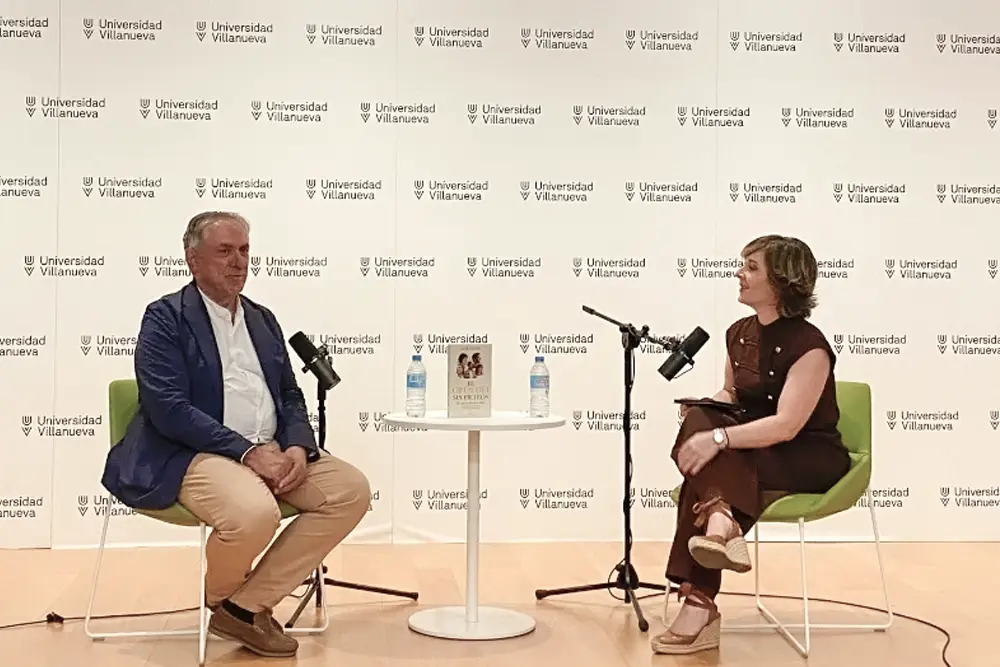
This is how Jack Valero explained the purpose of Opus Dei unfiltered, during the dialogue held this September 22nd at Villanueva University with María José Atienza, director of Omnes.
The book, published by Almuzara, brings together the stories of 18 people linked to Opus Dei and aims, according to its author, to answer some of the questions that are usually raised about the institution "from below", through the lives of its members.
Valero, spokesperson for Opus Dei in the UK, explained that after 33 years of answering questions about power, money, influence, and the role of women, he had perceived a limitation in always doing so "from a top-down perspective." That's why he decided to share the concrete experiences of very different people. The book features a taxi driver, a businessman, people who have traveled their entire lives, and others who have always stayed in the same place. "There's a bit of everything, a cross-section of what's out there," he noted.
Valero responded to this question by saying that his aim is "to help people find God in their ordinary, everyday lives." He explained that it's about helping each person discover that God is present in what they do and "to be a better person in everything you do." He added that this task is carried out with the understanding that people are imperfect and make mistakes.
One of the issues he emphasized most was freedom. Valero believes it is one of the aspects most difficult for those outside the institution to understand. In his experience, members intuitively grasp the possibility of making decisions about their lives: studying one degree or another, living in one place or another, participating in a demonstration or not, supporting one political party or another, or following certain priestly directives. "They understand it and live it accordingly," he stated.
Regarding the testimonies of former members who claim to have experienced a lack of freedom or pressure, Valero acknowledged that these experiences must be examined. "That's not good, but we're going to see where it comes from and what happened," he stated. In his opinion, those who joined did so seeking something good, although some later discovered that this vocation wasn't for them and left the institution.
He also stressed the need to listen to those who have suffered and "change the things that need changing." "If we try to do good and don't listen to those on the inside, we're doing something wrong," he added.
Valero wanted to focus particularly on the auxiliary numeraries. He didn't want to explain their vocation himself, but rather preferred that they themselves bear witness to it. That's why he decided to include the stories of Patricia and Nuala in his book. "I want them to explain what they are, how they do it, and why they do it," he stated, even placing their testimonies at the beginning and end of the work. For him, these testimonies have allowed him to understand this reality "from the ground up.".
She also acknowledged that there have been situations that "weren't handled well" and that these must be rectified, with apologies offered when necessary. However, she also insisted that these specific cases should not diminish or obscure the vocation of the auxiliary numeraries: "Because, while 43 people in Argentina felt they were mistreated, there are also 500 others who wrote a letter asking for respect for their vocation, for understanding of what they do and why they do it.".
Regarding those who have suffered within Opus Dei or who have felt displaced after leaving, Valero emphasized the importance of listening. He recounted that during his 33 years as director in England, he was particularly attentive to ensuring that those who felt Opus Dei was not their vocation could leave "happy" and grateful for their time there. He acknowledged, however, that his experience is "just a small sample" and that there may be different cases elsewhere.
She also mentioned the listening offices and other mechanisms put in place to address these situations. "Many things have changed; we have listened for many years," she affirmed, although she added that it is necessary "to continue listening.".
Regarding the accusations that the Opus Dei Valero, who is seeking political power or influence within the Church, denied the existence of a plan for conquest: "Opus Dei has no plan to improve the world, but it does have a plan to help people and inspire them to change the world." The institution, he explained, does not tell its members what to do, but rather encourages them to take their Christian vocation seriously and act freely in the world.
Therefore, he believes that attributing to the institution a coordination of political plans stems from a difficulty in accepting the freedom of its members. "If there is no plan, power is irrelevant," he stated. According to Valero, the people who appear in his book do not describe the institution in terms of power, but rather as a family, a means of training, and a place of support. He says that the word "power" is not even mentioned in the book.
He also explained that each member has their own independent finances. Three-quarters of the members are supernumeraries and support their own families, while the numeraries contribute to the institution what they don't need for their own expenses. Valero noted that the works promoted by members—universities, Schools, residences or social initiatives—can handle significant amounts of money, but he rejected the idea of the institution accumulating that money for itself.
Another element Valero highlighted in the book is precisely the imperfection of its protagonists. "I like that everyone is seen as they are, imperfect, because that's reality," she stated. In contrast to an idealized image of the institution's members, the 18 stories portray diverse individuals with difficulties, flaws, and varied experiences.
As she explained, all 18 people's answers to the question of what it means to them are different, yet compatible. Among the aspects that most caught her attention was their trust in God. She cited the testimony of a woman from the Netherlands who discovered that she didn't have to ask God to come and help her because "God was always there.".
For Valero, one of the pending tasks is learning to communicate this experience better. Catholics, he affirmed, «have a lot to say,» but sometimes they lack the confidence to express it. «It’s not about telling them what to say, but helping them say it better,» he explained. In his opinion, speaking about one’s faith from personal experience can help avoid both imposing one’s beliefs and creating a sense of superiority.
What is Opus Dei?
Opus Dei —Work of God, in Latin— is a hierarchical institution of the Catholic Church, a personal prelature, whose purpose is to contribute to the evangelizing mission of the Church.
Specifically, it aims to foster a profound awareness of the universal call to holiness and the sanctifying value of ordinary work. The institution was founded by Saint Josemaría Escrivá on October 2, 1928.
What is the institution's core mission and objectives?
Opus Dei aims to help people living in the world—the ordinary man, the man on the street—to lead a fully Christian life, without changing their normal way of life, their ordinary work, or their hopes and aspirations.
Therefore, in a phrase I wrote many years ago, one can say that Opus Dei is as old as the Gospel and as new as the Gospel itself. It is a reminder to Christians of the wonderful words found in Genesis: that God created man to work. We have looked to the example of Christ, who spent almost his entire earthly life working as a craftsman in a village. Work is not only one of the highest human values and a means by which people should contribute to the progress of society; it is also a path to holiness.
If one wishes to draw a comparison, the easiest way to understand the institution is to consider the lives of the first Christians. They lived their Christian vocation to the fullest; they earnestly sought the perfection to which they were called by the simple yet sublime act of Baptism.
They were indistinguishable from other citizens. The faithful are ordinary people; they hold ordinary jobs; they live in the world as what they are: Christian citizens who want to fully respond to the demands of their faith.
Who was Álvaro del Portillo and why is he going to be beatified?
Monsignor Álvaro del Portillo y Diez de Sollano (Madrid, 1914 – Rome, 1994). A civil engineer with doctorates in philosophy and canon law, he joined the institution in 1935. Ordained a priest on June 25, 1944, he collaborated closely with Saint Josemaría until his death in 1975. He also carried out numerous assignments for the Holy See, most notably his active participation in the work of the Second Vatican Council.
After the death of Saint Josemaría, he was elected to succeed him in governing the institution. He was ordained a bishop in 1991. His canonization process began in March 2004. Pope Benedict XVI declared him Venerable in 2012, and Pope Francis signed the Decree of the Miracle attributed to his intercession in 2013.
How do you see the future of Opus Dei?
Thirty-nine years is just the beginning for an institution. Our task is to collaborate with all other Christians in the great mission of bearing witness to the Gospel of Christ; it is to remember that this good news can bring life to any human situation. The work that awaits us is immense.
It is a boundless sea, because as long as there are people on earth, however much the technical methods of production change, they will have work they can offer to God, work they can sanctify. With God's grace, the Work wants to teach them to make that work a service to all people of every condition, race, and religion. By serving others in this way, they will be serving God.
Does it not have an economic or political orientation?
Each member has complete freedom to think and act as they see fit in this area. In all temporal matters, the faithful of Opus Dei are entirely free: the institution welcomes people of all political, cultural, social, and economic persuasions that Christian conscience can accept.
I never speak about politics. My mission as a priest is exclusively spiritual. Furthermore, even if I were to express an opinion on temporal matters, the members of Opus Dei would have no obligation to follow it.
 carf@fundacioncarf.orgLandline: +34 914 029 082Mobile: +34 638 078 51145 Conde de Peñalver Street.