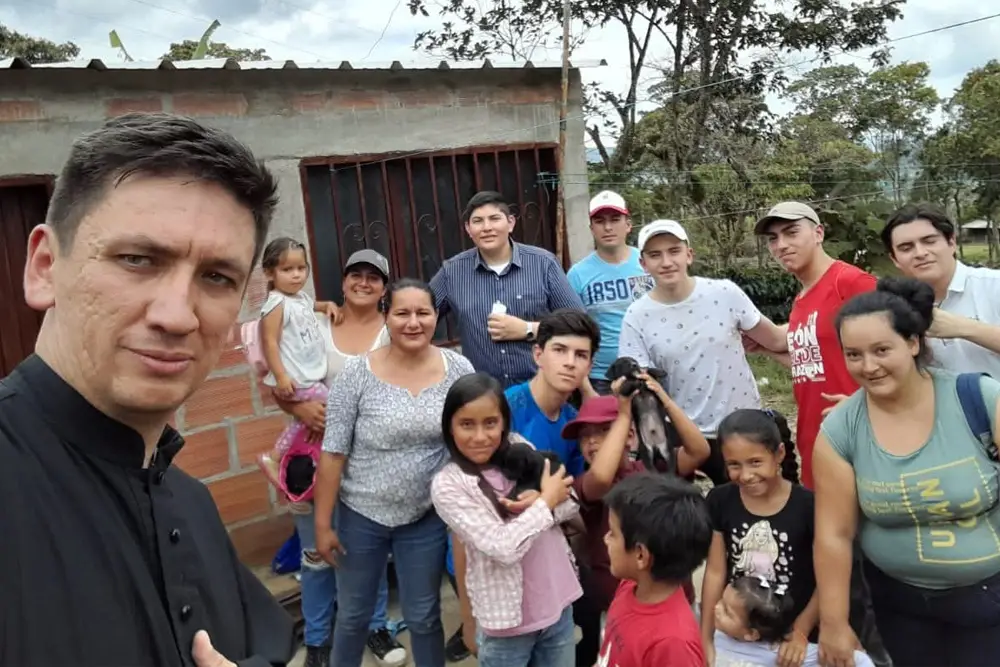
Jonathan Eduardo Flórez Ramírez is a 40-year-old Augustinian friar whose vocation has taken him from Bogotá, Colombia, to Rome, where he is currently studying for a Licentiate in Theology, specializing in Church History, at the Pontifical University of the Holy Cross, in Rome, thanks to the help of the CARF Foundation.
The first steps in the Church
I grew up in a family that, although not very Catholic, instilled in me from a young age human values and the first notions of the traditional Catholic faith, such as the prayers of the Lord's Prayer and the Hail Mary, as well as the custom of attending Mass on Sundays.
However, my connection to the Church began to manifest itself from a very early age. I felt a deep curiosity and a constant desire to participate actively in my parish. Therefore, after receiving my First Communion, I joined the altar server group. Over the years, this experience was strengthened when I joined the youth group and, later, when I took on the service of catechist, accompanying other children and young people in their formation.
A professional life that didn't fulfill me.
Upon completing my basic education at the age of 16, I enrolled to study Industrial Engineering at a public university in Bogotá. The university experience represented a significant cultural and intellectual shock, as it confronted me with diverse ideologies, complex social realities, and profound questions that shook the principles of faith upon which I had been raised.
I then lived through a period of intellectual and spiritual doubt in which I came to question the existence of God and everything I had believed up to that point.
After graduating as an engineer, I practiced my profession for several years at various companies. Although I had achieved financial stability and professional development, I experienced a constant emptiness inside that neither success nor material possessions could fill.
A providential encounter with the Order of Saint Augustine
That's how the desire to serve the most needy resonated within me once more. This led me to become involved in social ministry, thinking that in this way I could quench that thirst for meaning I carried inside.
Looking back, I can see how God uses simple acts and events. Thanks to a friend who was conducting an interview—or what I thought was an interview, since he was actually having a vocational meeting with the promoter—I came into contact with the Order of Saint Augustine.
Although at first I felt fear and uncertainty about the possibility of a lifelong calling, sharing that discernment process with other companions strengthened this concern in my heart.
However, the final decision meant giving up the economic and job security I had at that time. I must admit that, at first, it wasn't easy to take that step of surrender and complete trust, even though Jesus himself said: «Everyone who has left houses or brothers or sisters or father or mother or children or fields for my sake will receive a hundred times as much and will inherit eternal life» (Mt 19:29).
A motorcycle accident that changed my life
Today I can see how the Lord used a motorcycle accident to facilitate that process. Days before entering the Order's prenovitiate, I suffered an accident while driving that resulted in a fractured ankle and a two-month disability.
What at the time seemed like a tragedy ended up becoming a kind of «wild card» and anesthetic to cope with the changes and begin this new life. Inside, I thought that if religious life wasn't for me, I'd have two months to find out without my job security being affected.
However, the community life and spiritual growth I experienced during those two months were enough to trust in Providence, find the courage to definitively resign from my professional responsibilities, and fully respond to my faith and hope.
Entering the Order and being able to share life with 18 new brothers, from different parts of the country and with different cultures, expressions, customs and personal histories, was a demonstration of God's goodness and mercy towards his people.
Traveling through Colombia, bringing the Good News of Christ to different indigenous reserves and sharing the faith with diverse communities has taught me that when God gives, He does so in abundance, and that the call He makes responds to a project that transcends human mentality.
The educational and pastoral work of the Augustinians in Colombia
Today, the Augustinian Province of Our Lady of Grace in Colombia has five schools serving over 3,000 children and teenagers in their academic and personal development. It also has eight parishes open to those who need a close and consistent encounter with the sacraments.
Similarly, the Order continues its commitment to the education of young people through the Cervantes San Agustín University Foundation, founded in 2004. This institution offers undergraduate studies in Theology, Philosophy, Law, Psychology, Social Work, Business Administration and Database Engineering, among other disciplines.
In this way, Unicervantes not only seeks academic and professional excellence, but also to cultivate critical thinking, ethical values and social commitment to respond to the needs of the country.
The pastoral mission in Mocoa: reaching the most remote communities
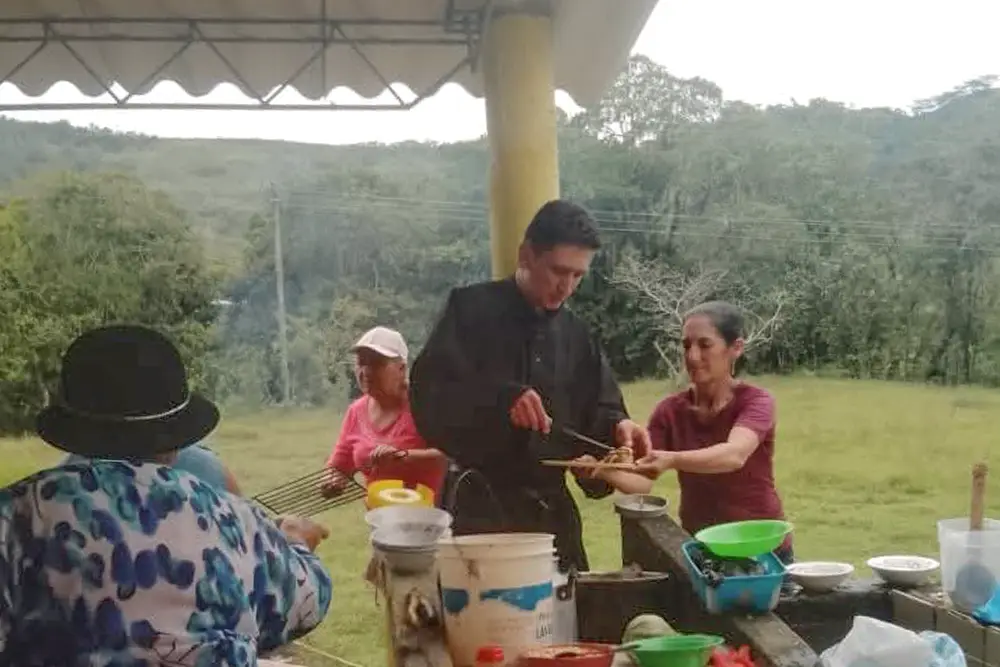
Regarding pastoral care in parishes, I wish to highlight the work and impact of our Jesus Eucharist Parish in Mocoa. From there, we not only serve a portion of the population in the city center, but, due to its extensive geographic reach, we also provide pastoral care to various indigenous communities of the Inga people, including Yunguillo, Tandarillo, San Carlos, Santa Marta, and La Condagua.
An important aspect is the distance and the means of transport needed to reach these places. To access some of these communities, you have to travel by car or motorcycle for approximately an hour and a half, descend a mountain on foot for about 15 minutes, cross the Caquetá River in small boats or «canoes,» and then walk for another ten minutes.
Another option for crossing this great river is to use a hanging device called a «tarabita», which moves by means of a pulley system from one end to the other.
As you can understand, due to the complex geographical conditions, the climate and the difficulties of accessing the reserves, our priests can provide pastoral care to each community once or twice a week.
Therefore, friars in formation are sent to accompany the most important moments of the liturgical year, such as Christmas and Holy Week. We constantly ask God to grant us new vocations to continue and improve our service to these communities, for «the harvest is plentiful, but the laborers are few» (Mt 9:37).
For this and so many other experiences that the Lord has allowed me to live in the midst of my community, I give thanks for this call and for the opportunity to continue my academic and religious formation in Rome, through the teachings received at the Pontifical University of the Holy Cross.
This opportunity is a demonstration of his support and generosity in training his servants and helping them to better respond to the challenges and obstacles facing the Catholic Church in Colombia.
Although the country possesses a deep cultural tradition and a vibrant faith manifested in popular religiosity, it also faces significant sociocultural challenges. Among young people, there is a rapid increase in secularization and religious indifference, which can lead to a loss of the transcendent meaning of life and an abandonment of sacramental practice, influenced by the trends of the contemporary world.
I give thanks to God, my community, and the friends and benefactors of the CARF Foundation for this journey and for the opportunity to continue my training to serve God's people in Colombia with dedication and hope.
I trust that the Lord will continue to guide my steps and my vocation.
The restlessness of the heart: from Saint Augustine to our days
Jonathan's story reminds us that vocation often arises from an inner restlessness that neither professional achievements nor material stability can extinguish. As he himself recounts, he discovered that his true fulfillment lay in responding to God's call and dedicating his life to serving others.
This quest has deep roots in Augustinian spirituality. Saint Augustine himself experienced this restlessness of the heart on his journey toward God, a quest that marked his life and continues to illuminate today those who, like Jonathan, discover the meaning of their vocation in service to others.
In a homily delivered on the occasion of the opening of the General Chapter of the Order of Saint Augustine, Pope Francis reflected precisely on that restlessness that characterized the life of the saint and that continues to be an invitation for all Christians.
HOLY MASS FOR THE OPENING OF THE GENERAL CHAPTER
OF THE ORDER OF SAINT AUGUSTINE
HOMILY OF THE HOLY FATHER FRANCIS
Roman Basilica of Saints Tryphon and Augustine
Wednesday, August 28, 2013
«You made us for yourself, and our hearts are restless until they rest in you.»The Confessions, I, 1, 1). With these words, which have become famous, Saint Augustine addresses God in the Confessions, and in these words is the synthesis of his entire life.
«Restlessness.» This word impresses me and makes me reflect. I would like to begin with a question: what fundamental restlessness did Augustine experience in his life? Or perhaps I should say rather: what restlessness does this great man and saint invite us to awaken and keep alive in our lives? I propose three: the restlessness of the spiritual quest, the restlessness of the encounter with God, and the restlessness of love.
The first: the restlessness of the spiritual quest. Augustine experiences something quite common today: quite common among young people today. He is raised by his mother, Monica, in the Christian faith, although he is not baptized, but as he grows up he drifts away, not finding in it the answer to his questions, to the desires of his heart, and is drawn to other paths.
He then joins the Manichean group, dedicates himself diligently to his studies, does not renounce carefree fun, the spectacles of the time, intense friendships, experiences intense love and embarks on a brilliant career as a rhetoric teacher that takes him to the imperial court of Milan.
Augustine is a successful man, he has everything, but in his heart remains the restlessness of searching for the profound meaning of life; his heart is not asleep, I would say it is not anesthetized by success, by things, by power. Augustine does not withdraw into himself, he does not settle, he continues searching for the truth, the meaning of life, he continues searching for the face of God. Certainly, he makes mistakes, he also takes wrong paths, he sins, he is a sinner; but he does not lose the restlessness of the spiritual quest. And in this way he discovers that God was waiting for him; even more, that He had never stopped seeking him first.
I would like to say to those who feel indifferent towards God, towards faith, to those who are far from God or have abandoned Him, and also to us, with our «distancing» and «abandonment» of God, small perhaps, but many in daily life: look deep into your heart, look into the depths of yourself, and ask yourself: do you have a heart that desires something great or a heart lulled to sleep by things?
Has your heart retained the restlessness of the search, or have you allowed it to be stifled by things that ultimately atrophy it? God awaits you, seeks you: what is your response? Have you become aware of this state of your soul? Or are you asleep? Do you believe that God awaits you, or for you is this truth merely «words»?
In Augustine it is precisely this restlessness of the heart that leads him to the personal encounter with Christ, leads him to understand that the God he sought far from himself is the God close to every human being, the God close to our hearts, more intimate to us than we are to ourselves (cf. ibid., III, 6, 11). But equally in the discovery and in the encounter with God, Augustine does not stop, does not settle down, does not close himself off as one who has already arrived, but continues the journey.
The restlessness of seeking truth, of searching for God, becomes the restlessness of wanting to know Him more and more and of going beyond oneself to make Him known to others. It is precisely the restlessness of love.
He longed for a quiet life of study and prayer, but God called him to be a shepherd in Hippo, at a difficult time, with a divided community and war at the gates. And Augustine allowed himself to be stirred by God, never tiring of proclaiming him, of evangelizing with courage, without fear; he sought to be the image of Jesus the Good Shepherd who knows his sheep (cf. Jn 10, 14), even more so, as I like to repeat, that «he perceives the smell of his flock,» and goes out to look for the lost ones.
Augustine lives what St. Paul indicates to Timothy and to each one of us: proclaim the word, insist at the opportune and inopportune time, proclaim the Gospel with a magnanimous, great heart (cf. 2 Tm 4, 2) of a Shepherd who is concerned for his sheep.
Augustine's treasure lies precisely in this attitude: always going out towards God, always going out towards the flock... He is a man in tension, between these two paths; not «privatizing» love... always on the move!
"Always on the move," Father said. "Always restless!" And this is the peace of restlessness. We can ask ourselves: Am I restless for God, to proclaim Him, to make Him known? Or do I let myself be captivated by that spiritual worldliness that pushes us to do everything for love of ourselves? We, consecrated persons, think of personal interests, the functionality of our works, careerism.
Bah! So many things we can think about... So to speak, have I «comforted myself» in my Christian life, in my priestly life, in my religious life, also in my community life, or do I retain the strength of restlessness for God, for his Word, which leads me to «go out» to others?
And we come to the final concern, the concern of love. Here I cannot help but think of his mother: Monica. How many tears that holy woman shed for her son's conversion! And how many mothers today also shed tears so that their own children may return to Christ! Do not lose hope in the grace of God! In the Confessions we read this phrase that a bishop said to Saint Monica, who was asking him to help her son find his way back to faith: «It is not possible that the son of so many tears should perish» (III, 12, 21).
Augustine himself, after his conversion, addressing God, writes: «My mother, your faithful servant, wept for me before you much more than other mothers usually weep for the bodily death of their children» (ibid., III, 11, 19).
Restless woman, this woman, who finally says that beautiful word: cumulatius hoc mihi Deus praestitit! [my God has granted me this superabundantly] (ibid.(9, 10, 26). That for which she wept, God gave her abundantly! And Augustine is Monica's heir; from her he receives the seed of restlessness.
Here, then, is the restlessness of love: to always seek, without rest, the good of the other, of the loved person, with that intensity that even leads to tears.
Images come to mind: Jesus weeping at the tomb of his friend Lazarus; Peter, who, after denying Jesus, finds his gaze full of mercy and love and weeps bitterly; the father waiting on the terrace for his son's return, and when he is still far away, runs to meet him; I think of the Virgin Mary who lovingly follows her Son Jesus to the Cross.
How are we doing with the unease of love? Do we believe in love for God and for others? Or are we merely nominalists in this regard? Not in an abstract sense, not just in words, but in the concrete brother or sister we encounter, the brother or sister who is right beside us!
Do we allow ourselves to be moved by their needs or do we remain locked within ourselves, in our communities, which are often for us «comfort-community»?
Sometimes one can live in a neighborhood without knowing the person next to them; or one can be in a community without truly knowing one's own brother: with sorrow I think of consecrated persons who are not fruitful, who are «bachelors».
The restlessness of love always impels us to reach out to others, without waiting for them to express their needs. This restlessness bestows upon us the gift of pastoral fruitfulness, and we must each ask ourselves: How is my spiritual fruitfulness, my pastoral fruitfulness?
We pray to the Lord for you, dear Augustinians, as you begin this general chapter, and for all of us, that He may keep in our hearts the spiritual yearning to always seek Him, the yearning to proclaim Him with courage, and the yearning of love for every brother and sister. Amen.
 carf@fundacioncarf.orgLandline: +34 914 029 082Mobile: +34 638 078 51145 Conde de Peñalver Street.