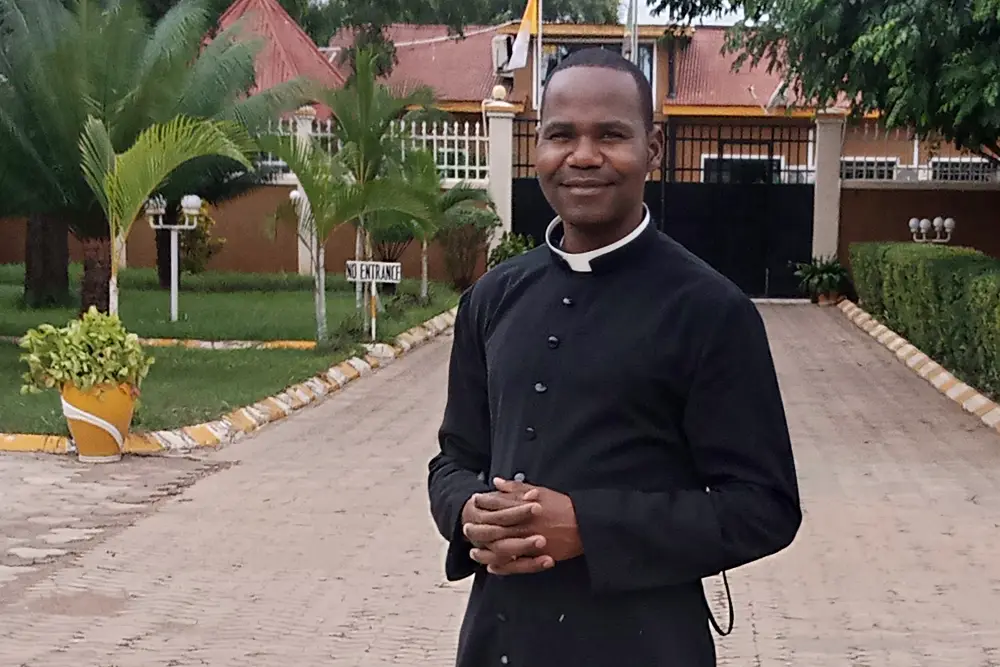
There are stories that remind us that faith doesn't always begin with momentous events. Sometimes, a vocation emerges in a humble family, in a home where the parents work the land, and in a life that gradually takes shape until it culminates in dedication to God. The story of Paul Charles Mahona, a priest in Tanzania, is one of them.
A Vocation in the Service of the Church
Paul studies Theology at the University of Navarra During the academic period 2025/2026-2026/2027. He lives at the Echalar II University Residence Hall in Pamplona, far from his homeland and his family, but with a clear idea of what he wants to do with the knowledge he is acquiring: to put himself at the service of the Church wherever his bishop considers he can be most useful.
«"My expectation is to be able to be a professor in a seminary or perform any other mission that my bishop considers appropriate and that is in accordance with God's will," he explains.
He doesn't speak of a specific destination or a professional project outside his diocese. His future, he assures, is open to whatever the Church needs of him.
Paul comes from a large family. His parents are farmers and were both baptized as adults. There are ten siblings: three of his sisters are married, as are four of his younger brothers. Currently, one younger brother and sister are still in school.
Paul wasn't baptized as a child either. He received the sacrament when he was in his first year of high school. Years later, that path of faith would lead to his decision to dedicate his life to the priesthood.
In 2014, after completing the required studies, he entered the seminary. In 2021, he finished his studies in Philosophy and Theology, and on July 28, 2022, he was ordained a priest in his diocese of Shinyanga.
Since then, his focus has been on pastoral service. His time in Spain allows him to continue his formation so that he can better respond to the needs of the Church when he returns to Tanzania.
A Church with vocations, but with difficulties in forming them
The Diocese of Shinyanga faces a specific challenge: it is not a lack of candidates for the priesthood, but the difficulty of providing them with the training they need.
«"There are many seminarians, but the diocese has difficulty accommodating them and financially supporting their studies and training," Mahona points out.
Behind these words lies a concrete need: vocations require places to train, professors, resources, and financial means to complete the journey to ordination. The existence of numerous seminarians is an opportunity for the local Church, but it also entails a responsibility that a diocese facing financial difficulties cannot always shoulder alone.
The training that Paul receives in Pamplona This aligns with that vision of service. He does not rule out teaching at a seminary after completing his studies, a particularly significant possibility in a diocese that needs to accompany and prepare those who are considering dedicating their lives to God.
The situation in his own country is also among the concerns Paul carries with him. The priest recalls the mass killings that occurred in Tanzania in October 2025, during the general elections to choose the president.
«"My country was affected by mass killings of people in October 2025, during the general elections to elect the president. This situation occurred because of the riots and protests of the population against the president and the government in general, due to the failure of the constitutional reform and the lack of a true democracy.".
Their testimony highlights that the life of the Church does not unfold apart from social and political difficulties. Christian communities carry out their mission amidst the specific circumstances of their countries, with their problems, needs, and the hopes of their people.
According to data provided by Mahona, approximately 31% of the population of Tanzania is Catholic and around 61% is Christian.
«"Spain needs a new evangelization"»
His stay in our country has allowed him to observe a reality that worries him: the distancing of many people from faith.
«"In Spain, many people have drifted away from the true faith," he states. In his opinion, this distance is evident in the low attendance of the faithful at churches and the lack of young people involved in church life.
Mahona believes that many people become so absorbed in their daily lives and responsibilities that they stop setting aside time for prayer. It's not simply about attending religious services more or less frequently, but about rediscovering a personal relationship with God amidst the activities of everyday life.
His diagnosis is clear: "Spain needs a new evangelization.".
Drawing on his experience in Tanzania, he proposes an exchange between two realities that can learn from each other. He maintains that Spaniards can discover in their homeland the value of a strong faith, the constant search for God, and the effort to overcome adversity with divine help.
It does not present faith as a solution that automatically eliminates difficulties, but as a guiding principle that accompanies people in their lives and work. Its message invites us to ask ourselves what place God occupies when obligations, worries, and the rush of daily life end up taking over everything.
The priest and the challenge of educating young people
Mahona also reflects on priestly identity in a society that, as he perceives it, has changed the way it views those who receive ordination.
«In the 21st century, priests are often considered laypeople,» he explains. In his view, many people no longer recognize them as servants of God, but as ordinary members of society, just like everyone else.
His reflection also raises the need to support new generations and recover an educational task that he considers fundamental.
«We need to evangelize young people especially,» he insists. To do this, he argues that they should be accompanied and guided so they learn what is and isn’t acceptable. He believes it’s important to instill respect and consideration for elders from a young age, as well as help them overcome the selfishness that can develop in childhood.
Paul does not place all the responsibility on families. He also demands that public authorities respect and guarantee their freedom, along with that of educational institutions, to provide a well-rounded education for individuals.
His proposal emphasizes education, guidance, and the transmission of values from the earliest years of life. For him, evangelizing young people requires being present in their growth, guiding them, and helping them develop a freedom that is not confused with the absence of limits.
A training to serve
Paul Charles Mahona continues his studies in Pamplona with his sights set on the future of his diocese. He could become a seminary professor or receive another assignment from his bishop. He doesn't yet know what his next destination will be, but he does express his willingness to accept whatever he considers to be in accordance with God's will.
His story brings together three realities: a family of farmers, a local Church with seminarians that it struggles to support financially, and a Spanish society in which he perceives that faith has lost its presence in daily life.
Based on that experience, his message is not an invitation to idealize Tanzania or to ignore its difficulties. It is a call to recover something that, in his view, is essential everywhere: the search for God, time dedicated to prayer, and an education that helps young people grow responsibly.
While studying at the University of Navarra, Paul is preparing to return to his Church and serve it. His aspiration is both simple and demanding: to teach, to accompany, or to take on whatever task is entrusted to him. Wherever he ends up serving, he wants the training he receives to help sustain the faith of those who will come after him.
Pope Leo XIV: "The seminary is always a sign of hope for the Church"«
The story of Paul Charles Mahona highlights the importance of priestly formation that prepares future priests to respond to the needs of their dioceses. This is an idea also emphasized by Pope Leo XIV in his address to several Spanish seminary communities in February 2026.
In his speech, the Holy Father recalled that formation does not consist solely of acquiring knowledge, but must be rooted in a personal relationship with God and orient one's whole life towards service to the Church.
«"That is the foundation of all priestly formation: to remain with Him and allow oneself to be formed from within; to see God act and to recognize how He works in one's own life and in the lives of His people," he affirmed.
The Pope also stressed that the path of formation requires accompaniment and prayer, and that seminarians are not alone in their vocation:
«"Always do it with the certainty that you do not walk alone: Christ goes before you, Mary Most Holy accompanies you, and the whole Church sustains you with her prayer.".
The words of Leo XIV resonate with Paul's purpose: to use his years of study to return to Tanzania and place himself at the service of his bishop. For priestly formation does not end with academic learning, but finds its ultimate meaning in dedication and service to others.
Marta Santínjournalist specializing in religion.
 carf@fundacioncarf.orgLandline: +34 914 029 082Mobile: +34 638 078 51145 Conde de Peñalver Street.