What does the Gospel message have to do with cultures? What light does the life of Christ offer us on this? What criteria can be deduced from this for the mission of the Church and the apostolate of Christians?
We are in the midst of a profound and vertiginous cultural change, accompanied by a great technological development and no lesser conflicts for political, economic and ideological reasons. This challenges us as Christians, called to participate in the shaping of the world, while at the same time announcing the Gospel message as a seed of light and definitive life.
In this context, we will dwell on an important message of Leo XIV on the Guadalupe event (in 2031 we will celebrate 500 years), as well as in the Pope's teachings during some pastoral visits to Roman parishes.
Leo XIV describes the Guadalupian event as “sign of perfect inculturation”.” of the Gospel (cfr. Message to a congress on the Guadalupan event, 5-II-2026). And he stops to explain what this inculturation consists of.
This is the the way the history of salvation has taken place, across cultures, The Covenant with the Chosen People, as recorded in the Sacred Scriptures, beginning with the Old Testament. Little by little, God manifested himself as he accompanied the vicissitudes of the People of Israel. Then, «God revealed Himself fully in Jesus Christ, in whom He not only communicates a message, but communicates Himself». And, therefore, he teaches St. John of the Cross that after Christ there is no more word to be expected, there is nothing more to be said, for everything has been said in Him (cf. Ascent of Mount Carmel, II, 22, 3-5).
It is clear that to evangelize, as the term itself expresses, is to bring the “good news” (Gospel) of salvation through Jesus. However, the proclamation of the Gospel message always takes place within a history and a concrete experience. This began with Jesus of Nazareth, in whom the Son of God took on our flesh (we speak of his "Gospel"). Encarnacion): he took on our human condition with all that it entails, also through a specific culture.
Evangelization must continue to do the same: «it follows then that the cultural reality of those who receive the proclamation cannot be ignored, and it is understood that inculturation is not a secondary concession or a mere pastoral strategy, but rather an intrinsic requirement of the mission of the Church». While it is true that the Gospel does not identify with any particular culture, it is able to permeate (illumine and purify) them with the truth and life that come from God.
«To inculturate the Gospel," explains Leo XIV, "is, from this conviction, to follow the same path that God has walked: to enter with respect and love into the concrete history of peoples so that Christ can be truly known, loved and welcomed from within their own human and cultural experience». And he observes: «this implies to assume the languages, the symbols, the ways of thinking, feeling and expressing themselves of each people, not only as external vehicles of proclamation, but as real places where grace wishes to dwell and act».
That said, he adds what inculturation “is not”: is not a «sacralization of cultures or their adoption as the decisive interpretative framework of the Gospel message»; nor is it a «relativistic accommodation or a superficial adaptation of the Christian message». It is not, therefore, a matter of «legitimizing everything culturally given or justifying practices, worldviews or structures that contradict the Gospel and the dignity of the person». This would be tantamount to «ignoring the fact that every culture - like every human reality - must be enlightened and transformed by the grace that flows from the paschal mystery of Christ».
Therefore and in condensed synthesis: «inculturation is, rather, a demanding and purifying process, by which the Gospel, while remaining integral in its truth, recognizes, discerns and assumes the semina Verbi present in the cultures, and at the same time purifies and elevates their authentic values, freeing them from that which obscures or disfigures them. These seeds of the Word, as traces of the prior action of the Spirit, find in Jesus Christ their criterion of authenticity and their fullness».
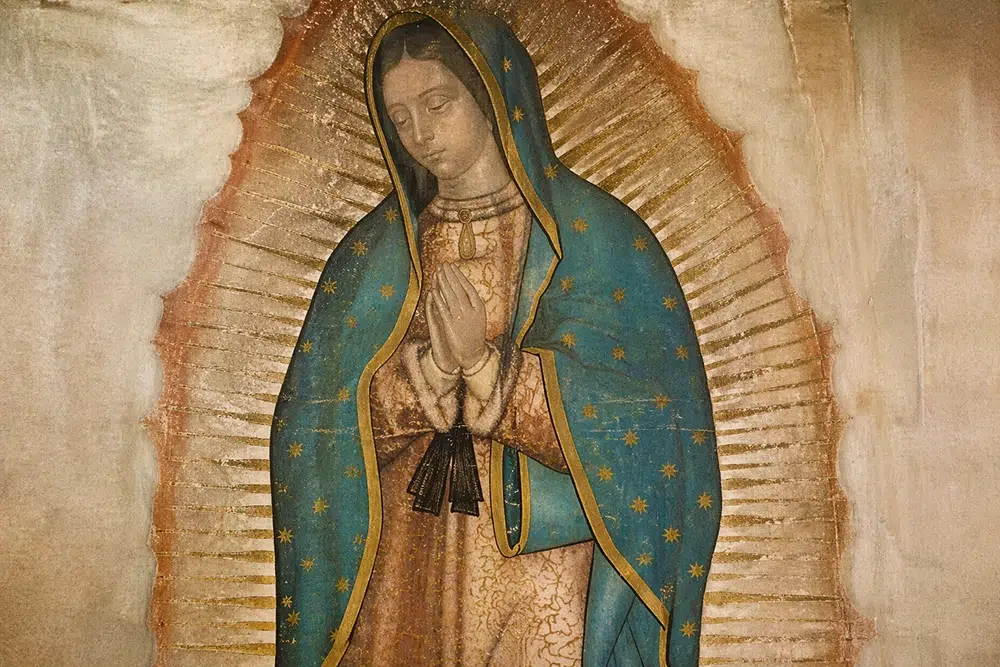
In this perspective, the Pope points out: «Saint Mary of Guadalupe is a lesson of divine pedagogy on the inculturation of salvific truth.». It does not canonize a culture, but neither does it ignore it; rather, it assumes it, purifies it and transfigures it, making it a “place” of encounter with Christ.
"The ‘Morenita’ manifests God's way of approaching his people; respectful in its point of departure, intelligible in its language and firm and delicate in leading her to the encounter with the full Truth, with the blessed Fruit of her womb».
What happened at Tepeyac, assures Pope Leo XIV, is neither a theory nor a tactic; rather, «it presents itself as a permanent criterion for discernment of the evangelizing mission of the Church, called to proclaim the True God through whom we live without imposing him, but also without diluting the radical newness of his saving presence».
Turning to the present situation, the Pope observes that today the transmission of the faith can no longer be taken for granted. We live in pluralistic societies with visions of man and life that tend to dispense with God. In this context, it is necessary «an inculturation capable of dialoguing with these complex cultural and anthropological realities, without assuming them uncritically...., The aim is to foster an adult and mature faith, sustained in demanding and often adverse contexts».
This implies that the faith should not be transmitted «as a fragmentary repetition of content or as a merely functional preparation for the sacraments, but as a true path of discipleship», so that «a living relationship with Christ may form the basis of the faith. believers capable of discernment, of giving a reason for their hope and of living the Gospel with freedom and coherence".
Pope Leo XIV concludes by restating the priority of catechesis for all ages and in all places: «Catechesis becomes an inalienable priority for all pastors (cf. CELAM, Aparecida Document, 295-300)». Catechesis -he insists- «is called to occupy a central place in the action of the Church, to accompany in a continuous and profound way the process of maturation that leads to a faith that is truly understood, assumed and lived in a personal and conscious manner., even when it means going against the current of the dominant cultural discourses».
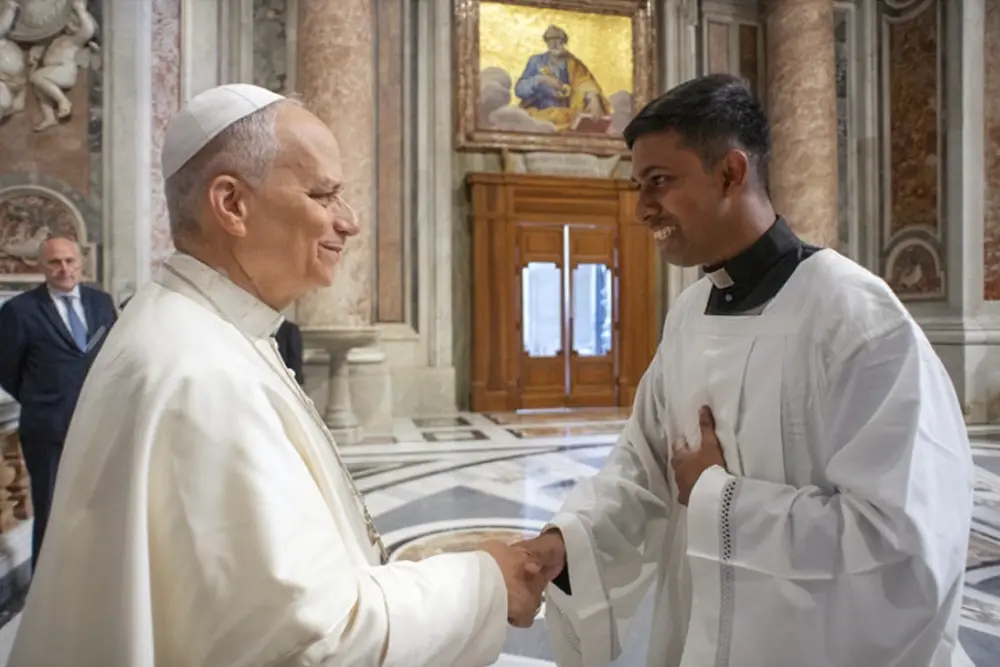
This approach to faith is lived by Leo XIV in his own ministry, as evidenced by his pastoral visits during the past few weeks. On the second Sunday of Lent, he appeared at the parish of the Ascension of Our Lord Jesus Christ in the Quarticciolo (Rome). In his homily (1-III-2026) he showed the power of faith starting from the journey of Abraham (cfr. Genesis 12, 1-4) and the scene of the transfiguration of Jesus (cfr. Mt 17, 1-9).
From Abraham we learn trust in the Word of God who calls him and sometimes asks him to leave everything. We too «will cease to fear losing anything, because we will feel that we are growing in a richness that no one can rob us of». The apostles were also reluctant to go up with Jesus to Jerusalem, especially because he had announced to them that he would suffer and die there, although he would also rise again. But they were afraid, and even Peter tried to dissuade him. But Jesus encouraged them by allowing them to contemplate his Transfiguration, which dispelled the inner darkness in their hearts. «Peter becomes the spokesman for our old world and its desperate need to stop things, to control things.».
In the midst of the vicissitudes of daily life with its difficulties, darkness and discouragements - the Pope addresses the faithful of the parish - we too can count on «the pedagogy of the gaze of faith, which transforms everything into hope, spreading passion, sharing and creativity as a remedy for the many wounds of this neighborhood».
Thirst for living water
The following Sunday, the Pope visited the Roman parish of St. Mary of the Presentation. In his homily (cf. 8-III-2026) he contemplated the Gospel passage of Jesus' encounter with the Samaritan woman (cf. Jn 4:1-42), insofar as it helps us to improve our relationship with God.
We too have a “thirst for life and love”. Deep down, a desire for God. «We seek him like water, even without realizing it, every time we wonder about the meaning of events, every time we feel how much we miss the good we desire for ourselves and for those around us.».

It is in this context that we find Jesus, like the Samaritan woman. «He wants to give her this new, living water, capable of quenching every thirst and calming every restlessness, because this water flows from the heart of God, the inexhaustible fullness of all hope». And he promises her a gift from God that will make her, herself, a fountain of water springing up to eternal life. In fact, that woman accepts what Jesus offers her and becomes a missionary.
We Christians must continue with the proposal of Jesus: a true and full just life, starting from the Eucharist. We must be «a sign of a Church that, like a mother, cares for her children, without condemning them, but rather welcoming them, listening to them and supporting them in the face of danger. Pope Leo XIV ended by encouraging those present: »Go forward in faith!«.
The face of God
A week later, the successor of Peter visited the parish of the Sacred Heart in Ponte Mammolo, where he celebrated Laetare Sunday (15-III-2026). In the current context of violent conflicts, the Pope's message was clear: «Beyond any abyss into which human beings may fall because of their sins, Christ comes to bring a stronger clarity, capable of freeing them from the blindness of evil, so that they may begin a new life».
Jesus« encounter with the man born blind (cf. 9:1-41) prompted the Pope to consider how we too must recover our sight. This »means first of all overcoming the prejudices of those who, when faced with a man who suffers, see only an outcast to be despised or a problem to be avoided, shutting themselves up in the armored tower of a selfish individualism".
Jesus« attitude is quite different: »He looks at the blind man with love, not as an inferior being or an annoying presence, but as a beloved person in need of help. Thus, his encounter becomes an occasion for God's work to be manifested in everyone". In the miracle, Jesus reveals himself with his divine power and the blind man, on regaining his sight, becomes a witness to the light.
In contrast, there is the blindness of those who resist accepting the miracle. And further, to recognize Jesus as the Son of God, the Savior of the world. They refuse to see the face of God as he appears before them, clinging to «the sterile security offered to them by the legalistic observance of a formal norm. Perhaps, at times,» the Pope observes, "we too can be blind in this sense, when we fail to notice others and their problems.
Leo XIV concluded with a reference to St. Augustine. In preaching to the Christians of his time, he asks what the face of God is like, to tell them that they, who are the Church, are the face of God if they live charity: «What face does love have? What form, what stature, what feet, what hands? [...] It has feet, which lead the Church; it has hands, which give to the poor; it has eyes, with which one recognizes the needy» (Commentary on the First Letter of John, 7, 10).
Full message of the Holy Father Leo XIV to the participants in the Pastoral Theological Congress on the Guadalupan event, 24.02.2026
Dear brothers and sisters:
I cordially greet you and thank you for your work of reflection on the sign of perfect inculturation that, in St. Mary of Guadalupe, the Lord wanted to give to his people. In reflecting on the inculturation of the Gospel, it is appropriate to recognize the way in which God himself has manifested himself and offered us salvation.
He wanted to reveal Himself not as an abstract entity nor as a truth imposed from outside, but by entering progressively into history and dialoguing with man's freedom. «After having spoken of old to our fathers by the Prophets, on many occasions and in various ways» (Hb 1:1), God revealed Himself fully in Jesus Christ, in whom He not only communicates a message, but communicates Himself; therefore, as St. John of the Cross teaches, after Christ there is no more word to be expected, there is nothing more to be said, for everything has been said in Him (cf. Climbing Mount Carmel, II, 22, 3-5).
Evangelization consists, above all, in making Jesus Christ present and accessible. Every action of the Church must seek to introduce the human being into a living relationship with Him, who enlightens existence, challenges freedom and opens a path of conversion, disposing us to accept the gift of faith as a response to the Love that gives meaning and sustains life in all its dimensions.
However, the proclamation of the Good News always takes place within a concrete experience. To keep this in mind is to recognize and imitate the logic of the mystery of the Incarnation, through which Christ «became flesh and dwelt among us» (Jn 1:14), assuming our human condition, with all that it entails in its temporal configuration.
It follows then that the cultural reality of those who receive the proclamation cannot be ignored and it is understood that inculturation is not a secondary concession or a mere pastoral strategy, but an intrinsic requirement of the Church's mission. As St. Paul VI pointed out, the Gospel - and therefore evangelization - is not identified with any particular culture, but is capable of permeating all of them without being subject to any one of them (Apostolic Exhortation, "The Gospel is a gift of God"). Evangelii nuntiandi, 20).
To inculturate the Gospel is, from this conviction, to follow the same path that God has traveled: to enter with respect and love into the concrete history of peoples so that Christ can be truly known, loved and welcomed from within their own human and cultural experience. This implies taking on the languages, symbols, ways of thinking, feeling and expressing oneself of each people, not only as external vehicles of proclamation, but as real places where grace wishes to dwell and act.
However, it is necessary to clarify that inculturation is not equivalent to a sacralization of cultures or to their adoption as the decisive interpretative framework of the Gospel message, nor can it be reduced to a relativistic accommodation or a superficial adaptation of the Christian message, since no culture, however valuable it may be, can be identified with Revelation without further ado or become the ultimate criterion of faith.
To legitimize everything culturally given or to justify practices, worldviews or structures that contradict the Gospel and the dignity of the person would be to ignore the fact that every culture - like every human reality - must be enlightened and transformed by the grace that flows from the paschal mystery of Christ.
Rather, inculturation is a demanding and purifying process by which the Gospel, while remaining intact in its truth, recognizes, discerns, and assumes the semina Verbi present in cultures, and at the same time purifies and elevates their authentic values, freeing them from that which obscures or disfigures them. These seeds of the Word, as traces of the prior action of the Spirit, find in Jesus Christ their criterion of authenticity and their fullness.
From this perspective, St. Mary of Guadalupe is a lesson of divine pedagogy on the inculturation of salvific truth. In her, a culture is not canonized nor are its categories absolutized, but neither are they ignored or despised: they are assumed, purified and transfigured to become a place of encounter with Christ. The Morenita manifests God's way of approaching his people; respectful in its starting point, intelligible in its language and firm and delicate in its leading to the encounter with the full Truth, with the blessed Fruit of her womb.
In the tilma, among painted roses, The Good News enters the symbolic world of a people and makes its closeness visible, offering its novelty without violence or coercion. Thus, what happened at Tepeyac is not presented as a theory or a tactic, but as a permanent criterion for the discernment of the evangelizing mission of the Church, called to proclaim the Good News without violence or coercion. True God for whom one lives without imposing it, but also without diluting the radical novelty of its saving presence.
Today, in many regions of the American continent and the world, the transmission of the faith can no longer be taken for granted, particularly in large urban centers and in pluralistic societies marked by visions of man and life that tend to relegate God to the private sphere or to do without Him. In this context, strengthening pastoral processes requires an inculturation capable of dialoguing with these complex cultural and anthropological realities, without assuming them uncritically, in such a way as to awaken an adult and mature faith, sustained in demanding and often adverse contexts.
This implies conceiving the transmission of the faith not as a fragmentary repetition of content or as a merely functional preparation for the sacraments, but as a true path of discipleship, in which a living relationship with Christ forms believers capable of discernment, of giving a reason for their hope and of living the Gospel with freedom and coherence.
Therefore, catechesis becomes an indispensable priority for all pastors (cf. CELAM, Aparecida Document, 295-300). It is called to occupy a central place in the action of the Church, to accompany in a continuous and profound way the process of maturation that leads to a faith that is truly understood, assumed and lived in a personal and conscious way, even when this means going against the current of the dominant cultural discourses.
In this Congress, you wanted to rediscover and understand how to adequately disseminate the theological content of the Guadalupan event and, therefore, of the Gospel itself. May the example and intercession of so many holy evangelizers and pastors who faced this same challenge in their time -Toribio de Mogrovejo, Junípero Serra, Sebastián de Aparicio, Mamá Antula, José de Anchieta, Juan de Palafox, Pedro de San José de Betancur, Roque González, Mariana de Jesús, Francisco Solano, among so many others- grant you light and strength to continue the proclamation today. And may Our Lady of Guadalupe, Star of the New Evangelization, accompany and inspire every initiative towards the 500th anniversary of her apparition. From my heart I impart to you my Blessing.
Vatican City, February 5, 2026. Memorial of St. Philip of Jesus, Mexican Protomartyr.
Mr. Ramiro Pellitero IglesiasProfessor of Pastoral Theology at the Faculty of Theology of the University of Navarra.
Published in Church and new evangelization.
 carf@fundacioncarf.orgLandline: +34 914 029 082Mobile: +34 638 078 51145 Conde de Peñalver Street.