A priestly vocation from Peru: serving God on high
In the context of a rural Peru, a priestly vocation takes on its own nuances. Great distances, scarcity of resources and a strong cultural identity of the Andean peoples mean that the ministry of the priest must be lived from the discomfort and without urban schemes. In this environment, the priest is an expected and necessary presence, often the only stable reference of the Church in extensive and difficult to travel territories.
In this framework, vocation is understood as a personal call and as a response to a concrete need of the people. Being a priest in the Andes implies accepting a life marked by constant displacement, direct contact with poverty and a very close relationship with the faithful, who know their pastor by his word, his availability and his daily closeness.
Christiam's testimony is inserted precisely in this reality. His personal history is linked to the territory to which he was sent and to the communities he serves, where faith is lived with depth and simplicity, even in the midst of great need.
A priestly vocation that is born of the Word
The father Christiam Anthony Burgos Effio was born in Lima on August 26, 1992 and is a member of the Diocese of Sicuani, in the Andean region of the southern part of the country. He is the eldest of four siblings and grew up in a Christian family where faith was lived naturally.
The family faith was expressed in religious practices and also as a concrete way of understanding life, sacrifice and service. In this environment, the figure of the priest was respected and valued as someone close to the people, which helped the vocation to germinate without initial rejection, although with many questions.
During the years of discernment, Father Christiam learned to listen patiently to what God was asking of him, without making hasty decisions. The vocation matured in silence, prayer and contact with the concrete reality of the local Church, until it became a firm choice.
This gradual process was the key to later facing the renunciations inherent to the priestly journey and to assuming formation as a necessary time of interior and pastoral preparation.
His call to the priestly vocation came at the age of 16, during a Eucharist in which the Gospel of St. Matthew was proclaimed: "you are the salt of the earth (...) and the light of the world" (Mt 5:13-16). That Word was not a momentary impact, but the beginning of a constant restlessness that led him to seriously consider the priesthood as a way of life.
«I truly believe that the Lord used his word to put in me the restlessness of vocation, the desire to be able to serve him fully through his people, in the priestly ministry».
Marian accompaniment: a constant presence
From childhood, the faith learned at home and Marian devotion -especially the recitation of the Holy Rosary- accompanied his process. As time went by, he understood that God had been preparing his vocation in a silent and patient way.
Entering the seminary: a choice that requires renunciation
Priestly formation not only involved acquiring theological and human knowledge, but also learning to live in community, to obey and to serve without being the protagonist. These years were decisive in shaping a style of priesthood simple and close, especially suitable for the Andean reality.
In a context where many communities see the priest only a few times a year, interior preparation takes on special importance. Spiritual strength, constancy and the ability to adapt to difficult situations become indispensable tools for ministry.
This formative stage allowed Father Christiam to realistically assume the mission that awaited him, without idealizing it, but also without fear.
The decision to enter the seminary came when he had already begun his university studies and had defined personal projects. Betting on the priesthood meant leaving behind legitimate plans and assuming the uncertainty of a demanding path.
The most difficult test was the family one. For his parents, the decision initially meant the feeling of losing a son. That pain was transformed over the years into a process of shared faith, lived in parallel with the priestly formation of Christiam. Today, this initial renunciation is a reason for gratitude and profound joy.
The time spent in the seminary was the key to maturing humanly and spiritually, and to purifying one's vocation until it became a free and conscious response to God's call.
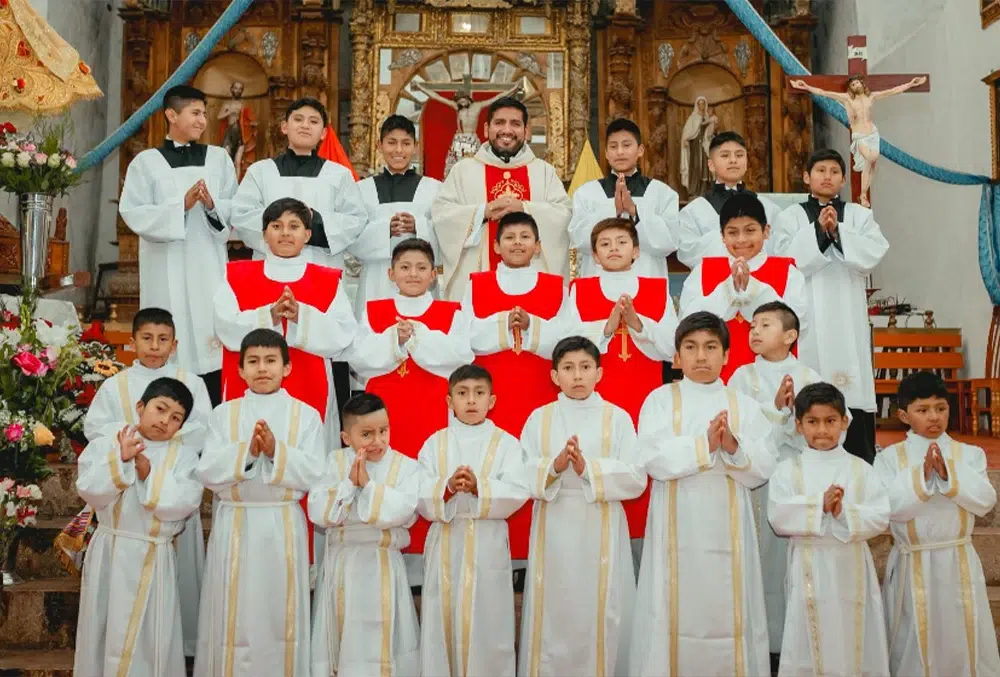
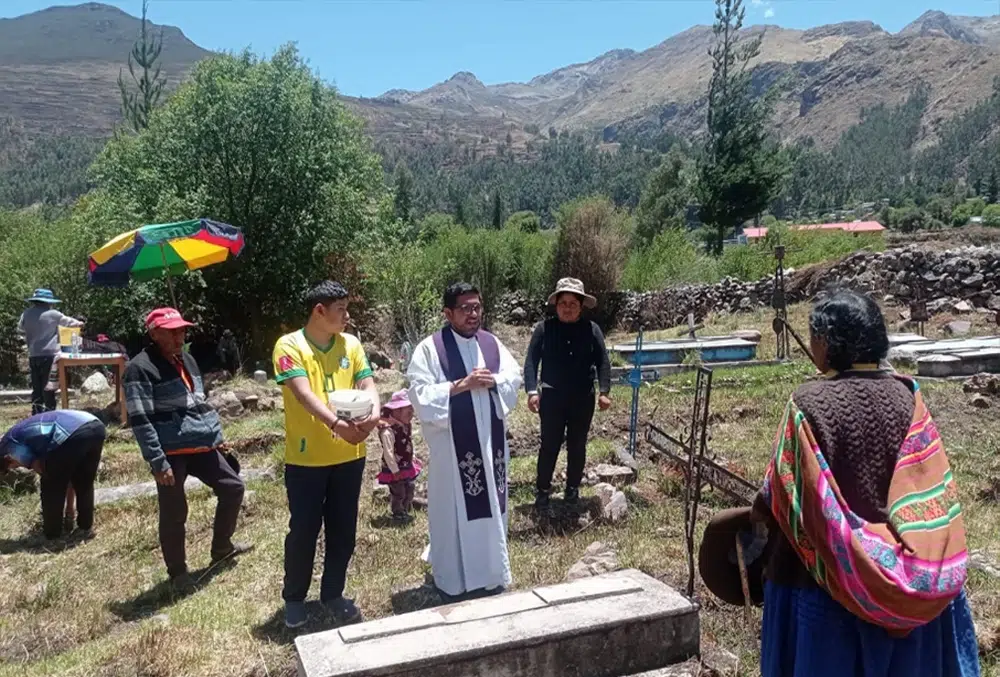
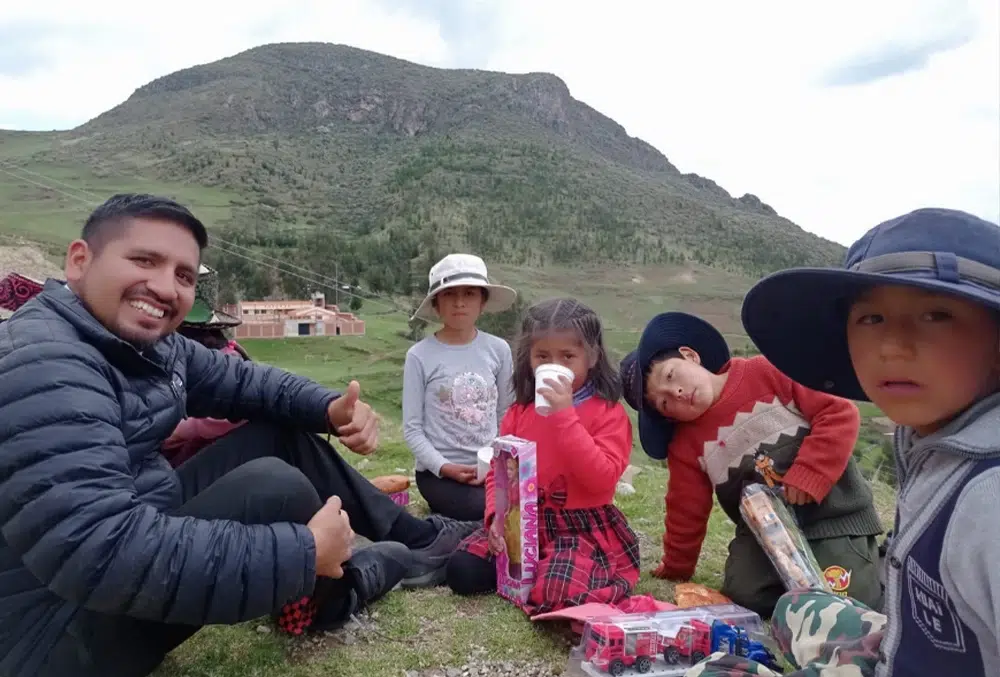
Father Christiam Anthony Burgos Effio with the altar boys of his parish.
Ordination and dispatch: vocation put to the test in the Andes
His ordination to the priesthood, celebrated on the eve of the feast of the Good Shepherd, marked the beginning of a definitive dedication. From that moment on, Father Christiam's ministry was tied to an extreme pastoral reality.
Its diocese covers more than 16,700 km² and has a very limited number of priests to serve dozens of parishes separated by great distances. In this context, the priest accompanies spiritually and often has to assume educational and social tasks.
Isolated communities and a sustaining faith
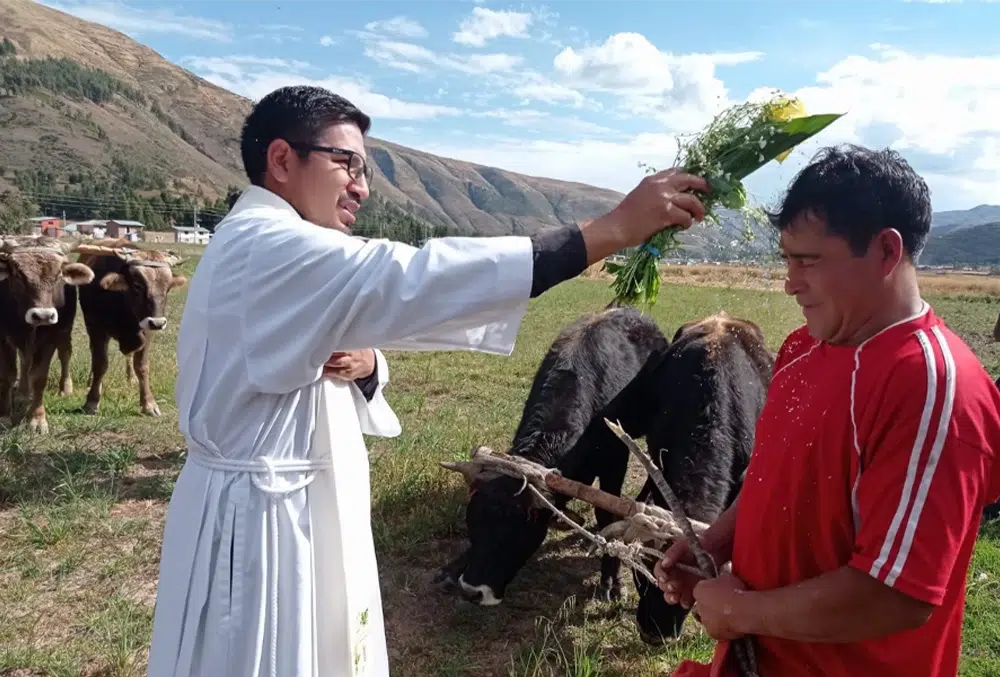
In addition to the parish, Father Christiam serves thirteen rural communities. Some, such as Paropata and Tucsa, are located at almost 4,900 meters above sea level and are only accessible on foot or by horse or mule. These are villages with serious material and sanitary deficiencies, but with a living faith that is expressed in deeply rooted customs.
In these communities, evangelizing also means sharing the work of the field, listening, teaching and sustaining hope. There, the priest discovers that, as he evangelizes, he is also evangelized by the simple faith of the people.
Don Christiam Anthony accompanies a community in a celebration of faith in the highlands of Peru.
Christiam is currently studying canon law at the University of University Pontificalof the Holy Cross, in Rome, thanks to the support of partners, benefactors and friends of the CARF Foundation. He lives this stage not as a personal merit, but as an opportunity to be better formed and to serve with greater dedication to the Church of Peru when he returns.
His priestly vocation continues to have a clear horizon: to return to the Andes and continue caring for the people God has entrusted to him.
Gerardo FerraraBA in History and Political Science, specializing in the Middle East. Responsible for students at the University of the Holy Cross in Rome.
Table of Contents
Nirmala: woman, Christian, nun, communicator from India
This Faculty aims to transmitting the faith of the Church in every century with the instruments available and also to train professionals capable of operating in the field of communication in ecclesial institutions, through a very solid and diversified program, which is based on theoretical and practical study.
Social communication students
The students of Social and Institutional Communication, in addition, in fact, focus very much on the cultural environment in which the Church proposes its message, in a spirit of ongoing dialogue with the women and men of every century.
For this purpose, they must be well acquainted, on the one hand, with the contents of the faith and the identity of the Church as an institution, through subjects of a theological, philosophical and canonical nature, and on the other hand, the concrete application of the theories, practices and techniques of institutional communication to the particular identity of the institution. Catholic Church, including through advanced laboratories in the different media (radio, television, press and media based on new technologies).
25th anniversary
The Faculty of Social and Institutional Communication, thanks to its unique characteristics in the field of pontifical universities, has already trained, in 25 years, dozens of communication professionals, Today they are making their contribution in various ecclesiastical and non-ecclesiastical sectors, thanks above all to the help of many benefactors, in particular the CARF Foundation - Centro Académico Romano Foundation.
CARF, which not only provides scholarships to young people from all over the world to study at the Pontifical University of the Holy Cross, but also offers its financial support to help the university realize its goals. regular scheduled academic activities (the usual courses), to support the entire staff of professors and officials, to finance extraordinary activities (such as congresses, publications and other activities of professors) and to subsidize the necessary tools and technologies (laboratories, classrooms, didactic instruments, etc.).
To know the reality of the School of Social Communication.
We set out on a journey to learn more about the reality of this Faculty and its mission in the world through the stories of its students, alumni and faculty.
Sister Nirmala Santhiyagu, from India
Today we find ourselves with the sister Nirmala Santhiyagu, from India, from the Congregation of the Missionary Sisters of St. Peter Claver. Nirmala is 35 years old and studies at the Pontifical University of the Holy Cross thanks to a grant from the CARF Foundation, which also helps another student from the same congregation..
Hello everyone! It is a pleasure for me, being a student in the first year of the Bachelor's Degree in Communication, to be able to approach this world through an interview so that you can get to know me and all my academic family, as I call it, of the Faculty better. This is very important, to be family here toois something I value very highly, since I was born and raised in a catholic family in Tamil Nadu, India, together with my parents and my three siblings».
Conveying training in a difficult environment
Well, it is a pleasure for me and for our readers as well. It is also very interesting that you, who come from India, as a woman, Christian and religious, study in Rome and then share your formation in an environment that is not always easy, and in a country about which the chronicles often give us dramatic stories of violence against women.
N: «Yes, in fact my congregation asked me to study Social and Institutional Communication to be able to collaborate more effectively with their communication team, working in the diocese of Indore, India. It is a very difficult time all over the world, also due to the emergence of COVID, but I think this kind of study is interesting and challenging at the same time, especially for a country like India. India, for the same reasons you mentioned».
I imagine that being born and growing up as a Christian in a country where Christians are a small minority must not have been very easy!
Well, in fact when I was little it was not as difficult as it is today. First of all, I was fortunate to have very loving parents who made sure that we children grew up in the Christian faith following their moral values. My family members played a vital role in the formation of my faith: I was always encouraged to participate in the Sunday catechism classes and in all the activities that were carried out for the formation of faith and morals in our parish.
In addition, I studied in a Catholic school run by nuns. and there I had more possibilities to value my Christian values, that is to say, to share what one has, to forgive others and above all equality: that is to say that we are all children of God and it doesn't matter the caste or creed. This is why I say that I was lucky, because I know that not all children, especially girls, have this opportunity to grow up as I did.
"I studied in a Catholic school run by nuns where I learned that we are all children of God and no matter the caste or creed."
The missionary activities of the Sisters of St. Peter Claver in mission countries such as India and Vietnam cooperate with diocesan pastoral activities in the Christian formation, both spiritual and moral, of children and young people, in the empowerment of women, in the education of poor children and above all to awaken missionary awareness among the faithful.
And since you were a child, did you have the opportunity to meet people of different religions?
Yes, as I grew up, either at school or in the family environment, I was able to cross paths with people of other religions, such as Hindus and Muslims, and there I learned to know the contents of their beliefs, coming to appreciate and treasure my Christian faith even more. Only in Christianity, then, did I find a God who allows you to be yourself, with all your weaknesses and abilities, and it was always exciting for me to know that I have a God who loves us, forgives us and wants his children to be happy here on earth, and then to be with him forever in heaven.
Well, it must be very enriching for a child to grow up in such an open environment.
N: Good, I must admit that children today in most parts of India do not enjoy the religious freedom that we had in our childhood days, there have been enormous changes in recent days due to the political influences of Hindu nationalism, which have not failed to affect other ethnic or religious groups.
But I remember, in my childhood days, the coexistence of different religions was very peaceful and uplifting: studying and playing together, irrespective of caste or religion; the respect we had for each other's beliefs, and so on. Even today, I cherish the wonderful experiences I had in my school days.
G: Was it in school that you felt the call to be a religious?
Well, not only there... I was actually very inspired by the activities of the nuns in my parish, as well as by my blood sister who was a nun herself. So I also wanted to be missionary. With the help of my parish priest, I joined the Congregation of the Missionary Sisters of St. Peter Claver where I am now. In 2007 I made my first religious profession. As the years went by, I rediscovered and confirmed my vocation to be the witness of God's love and in 2014 I said my “yes” to the Lord's call forever.
G: And how does that relate to communication?
N: It's all about communication, especially today! And the charism of the Sisters of St. Peter Claver is missionary animation, understood as the information and formation of the people of God about the missions. It is done by awakening in everyone cooperation in the mission, to provide the missionaries with the spiritual and material means necessary for the evangelization of peoples.
How wonderful! The whole town, the whole community involved in the mission!
The missionary activities of the Sisters of St. Peter Claver in mission countries like India and Vietnam cooperate with diocesan pastoral activities in the Christian formation, both spiritual and moral, of children and young people, in the empowerment of women, in the education of poor children and above all to awaken missionary consciousness among the faithful. And it must be said that, in the activities of empowerment of women and education of poor children, we are in constant contact with people of other religions.
A very important challenge, if we consider that Christians in India are a minority...
N: Yes, in fact the percentage of Christians in India is only 2.5%, but their presence is incredibly significant for the Indian society.Just think of St. Teresa of Calcutta! The contribution of Christianity is very remarkable, especially in the areas of reforming destructive traditions, modernizing the democratic system, social education and access to the media, medical care, social change and impact among tribals and the poor. dalits (those without caste), empowerment of women.
G: The poor get poorer and the rich get richer. A mission that involves everything...
In my opinion, the mission that awaits every Christian in this 21st century in India is not only to share the joy of the gospel, but also to promote the values of the gospel, to provide equal rights to all citizens. Although technology has improved the quality of life and work, the process of modernization has its negative social, moral and religious effects.
As people migrate from rural areas to metropolitan and industrialized areas, most people, with a low professional and educational level, end up being exploited, marginalized, victims of injustice and in extreme poverty, causing the disintegration of family ties. In this vicious circle, the poor get poorer and the rich get richer.
"The mission of every Christian in this 21st century in India is to promote Gospel values."
Sister Nirmala says that the percentage of Christians in India is only 2.5%, but their presence is incredibly significant for Indian society. "Just remember St. Teresa of Calcutta!" she says. Christianity's contribution is remarkable, especially in the areas of reforming destructive traditions, modernizing the democratic system, social education and access to the media.
Not to mention the contrasts between the different religious components....
We are faced with a growing fundamentalist trend, which sees modernity as the process responsible for the decline of values, claims a return to traditional values and redefines them in an ideology that supposedly replaces modernity and excludes diversity.
The current situation calls more than ever for interreligious dialogue. Because developments in the modern world have posed a challenge not only to India's social and political institutions, but also to ethical and religious beliefs and ideas. There is an urgent need for a general awareness of parity, which must be fostered among all.
G: And what is the situation of women in your country?
N: India has always been a patriarchal country.l, where women have traditionally been prevented from emancipation since ancient times. In fact, women's inferiority was codified by the Manu Code: during childhood they were the property of the father, in adolescence of the husband and, in the event of the husband's death, the property of the closest male relative. This ancient model is particularly important because it underlies old and new oppressions. Indeed, although the status of women has improved with the advent of modernity, the tradition is still deeply rooted throughout the country.
Of course, India was the first major country in the world to have a woman head of government (Indira Gandhi); and yes, there are many educated and emancipated women in the cities, and many modern marriages in which both spouses have equal rights. However, these are marginal episodes.
There is also the drama of high mortality among girls....
N: Sure. India is one of the few countries where men outnumber women, and this is partly due to the higher mortality rate of women. girls, to whom less attention is paid. Widows are allowed to remarry, but if they do, they are disapproved of and marginalized, so they mostly live in poverty. Child marriages have decreased, but still exist, especially in rural areas. In addition, there is a dramatic aspect of the female condition that has to do with dowry.
Nowadays, then, there is a real "stock exchange" of potential spouses: the higher their social status, the higher the dowry required. Often, after the marriage has already taken place, the groom's family asks for more objects or more money, and if the bride's family cannot give more, the bride is burned alive, simulating a domestic accident.
For some time now, many women have been organizing themselves into groups and committees, and hopefully one day these tragedies will come to an end, but Indian women still have a long way to go to achieve equal rights.
G: A path that goes through training and communication...
Of course! The reason for all these problems is illiteracy, lack of education, lack of access to means and instruction. Christian missionaries have worked for centuries to educate the poor and empower the marginalized. The Catholic Church has always invested in education in India and even today we have the best schools. Of course, there is much to be done, but we will not stop working in this direction.
Acknowledgments to benefactors
And it is very good that our European and Western readers and benefactors become more aware that they are contributing, helping you to be formed, to improve the condition of the entire people of India, not only of Christians, through the work of the Church, but also of the people of India.ia.
Of course, and for this we are very gratefulWe are all Church, and I am very sure that the academic formation made possible by the contribution of our benefactors will help us to live our religious life as authentic witnesses to the Gospel and good professionals, bearing much fruit for His Kingdom. Generosity always remains in the form of a gift, the formation we receive because of the generosity of so many people will equip us in turn to be generous to others.
Gerardo FerraraBA in History and Political Science, specializing in the Middle East. Responsible for the student body Pontifical University of the Holy Cross in Rome.
Table of Contents
From Uganda to Pamplona as a seminarian: a story of overcoming the odds
Timothy Katende, a 28-year-old Ugandan seminarian, is studying for his fifth year of the baccalaureate in Theology at the Ecclesiastical Faculties of the University of Navarre. He was orphaned as a child and was educated by his uncles and aunts: «the extended family is vital in my country». He is the first member of his diocese, Kiyinda-Mityana, to come to Spain to study theology.
As he unravels his present and future, Timothy visualizes the road he has traveled. Barely a month after his birth, he lost his mother and at the age of seven his father, which meant that he had to be separated from his brother to be raised by relatives in Maddu, a village in the diocese of Kiyinda-Mityana.
Timothy, the orphaned seminarian, grew up with his cousins.
"Growing up with my uncles and my four cousins who were around the same age as me helped me a lot. Also, in the village there was a good family atmosphere and I had many friends with whom I played soccer and went to elementary school. My aunt and uncle supported me a lot with the little they had, they gave me a lot of affection and sacrifice. I never lost contact with my brother," he says.
To Timothy, the role of the family is very important because that is where moral and social values are taught: respect for others, responsibility and care for cultural and religious practices. "The family is where one should feel most loved, respected and supported. In families, one teaches and learns one's responsibilities and obligations," he explains.
He entered the minor seminary at the age of thirteen.
Since he was a young boy, he collaborated in the parish as an altar boy, organizing the choir and transmitting the priest's announcements to the community.
"After the national exam to finish primary school, when I was 13, the parish priest told me about the minor seminary that was looking for young boys and asked me if I would like to go: I was thrilled!" he says.
Overcoming the access was one step, but paying for the studies and the material was even more difficult. The parish priest explained the situation at the Sunday celebration and the neighbors came out to help him. This was the beginning of a journey that continued after he passed six courses and entered the major seminary (Alokolum Major Seminary) in Gulu.
«The family is where one should feel most loved, respected and supported. In families, responsibilities are taught and learned.».
By unraveling its present and its future, Timothy, visualizes the road he has traveled. Just a month after his birth, he lost his mother and at the age of seven his father, which meant that he had to be separated from his brother to be raised by relatives in Maddu, a village in the diocese of Kiyinda-Mityana (Uganda).
"Growing up with my uncles and my four cousins who were around the same age as me helped me a lot. Also, in the village there was a good family atmosphere and I had many friends with whom I played soccer and went to elementary school. My aunt and uncle supported me a lot with the little they had, they gave me a lot of affection and sacrifice. I never lost contact with my brother," he says.
Freedom and obedience to study
"When I finished I was offered a scholarship to study French philology: I liked law and languages.... but it was already clear to me that I wanted to be a priest, I wanted to follow the path that God had chosen for me. And so he continued his formation with three years of philosophy, another of pastoral work in a parish and another of theology at the Kinyamasika Seminary. He was there when he was called to come to Pamplona.
"When I was told that my bishop, Msgr. Joseph Antony Zziwa of Kiyinda-Mityana diocese wanted to talk to me, I was a little worried. But then the fears dissipated. He asked me if I wanted to come to Pamplona to study. I told him that if there was the opportunity, I was willing. I did it freely and obediently».
First member of his diocese to come to Spain
This is how Timothy Katende began his Spanish adventure by becoming the first member of his diocese to come to Spain to study theology, as they usually travel to Italy or the United States.
The initial fears of entering an unfamiliar culture and a strange language, as well as "the concern for the bishop's trust and the responsibility to do well," were overcome by enthusiasm.
Telling my story
"Many of us find ourselves in the same situation, so we learn and help each other. This situation has made me mature," explains Timothy, who hopes to draw on his experience in the future. "
Since he arrived in July 2017 to learn Spanish, he has been living at the Bidasoa International Seminary and this year he is studying the 5th year and finishing Cycle I with the Degree in Theology at the Ecclesiastical Faculties of the University of Navarra thanks to the benefactors and friends of the CARF Foundation.
«Putting what I have learned at the service of my diocese is a way of thanking both the formators I have had and the benefactors who allowed me to be formed in Uganda initially, as now in Pamplona. I am very grateful to all those who support me in this journey».
His diocese, Kiyinda-Mityana is located in the central region of Uganda, in the ecclesiastical province of Kampala. «It is a rural diocese. Many children don't have the opportunity to go to school and sometimes those who manage to finish elementary school don't get far in their studies because of financial problems,» he says.
That is why he is clear that when he returns he wants to look for «vocations by telling my testimony and explaining that the responsibility has to be of the whole parish: there are many families willing to help others and the Church needs vocations».
Timothy explains that most schools lack necessary resources, such as access to water, chairs or blackboards in the classrooms, electricity, etc. There are even some schools without roofs.
In his diocese, 40 % of the population is Catholic., although the majority is Protestant Christian. But it is mostly Christian. However, Islam is growing more and more. Although now the population of Muslims is growing more and more.
The current uncertainty also surrounds his future ordination, but Timothy knows what he would like to do when he finishes his studies: «My dream is to return to a parish in my country and, apart from the work of a priest, I would like to support the vocations. Especially in my case, I have been able to study because of the benefactors and I have seen many who have not been able to continue because of lack of resources».
Marta Santínjournalist specializing in religion.
Table of Contents
Why do we recommend listening to 10 minutes with Jesus every day?
The 10 Minutes with Jesus (10mcJ) have one objective: to bring the life of Christ to the listeners. To show the beauty of Jesus' life, his doctrine and virtues, and to serve as a 'loudspeaker' to touch people's hearts and bring them closer to God.
In addition, 10 minutes with Jesus has decided that donations made through its YouTube channel will contribute to the study grants funded by the CARF Foundation for diocesan priests, seminarians and religious men and women serving the Church around the world.
How do I make donations on YouTube? The Super Thanks
YouTube has recently activated the possibility of entering donations via a button called Super Thankswhich allows content creators to earn revenue and interact with users who want to show them greater appreciation for their content than the simple Like or I like it, which we all know.
In each 10-minute video with Jesus, a Thank You button will appear. Clicking on it opens the option to donate different amounts.
What is 10 minutes with Jesus?
This content, called 10 minutes with Jesus, are audios recorded by priests with the aim of helping to pray. The project was born in 2018, at the suggestion of Maria Feria, a mother and teacher. In view of the summer vacations, Maria suggested to the chaplain of her school to record short spiritual talks to share during those vacations with her children and young people around her.
At the mother's insistence, Father José María García de Castro, a priest incardinated in the Prelature of Opus Dei, agreed. He set up a first audio, using his own cell phone and a simple and accessible language.
On that first occasion, Fr. José María thought of talking about everyday things and how to bring the Gospel closer to daily life. Specifically, he related the contents of a letter sent to him by a young man who had been collaborating with the nuns of Mother Teresa of Calcutta in a children's home in Nairobi, Kenya.
In the letter, the young man told the priest, among other things, about one of the moments that marked him the most during his stay in Africa. Specifically, when a Sister of Charity asked him to take in his arms a baby who would not stop crying and invited him to give him affection.
The young man was paralyzed because the baby was so hot from the fever, but the nun's words gave him security. She began to coo to the little one, to caress him, to smile at him, to give him kisses. The child stopped whimpering and smiled. A few seconds later, he fell asleep. However, the university student noticed that the child was not breathing and called the Sister of Charity, who confirmed his death.
"She knew that the child was dying and looking into my eyes she said to me: he has died in your arms and you have gone a few seconds ahead of the Love that God is going to give him for all eternity," the young man recounted in the letter that inspired Don José María to speak in that first audio of how each person in his day to day life can advance that Heaven, avoiding arguments at home, smiling at loved ones or being kind to others.
Maria Feria's children connected with the message. The priest recorded a second audio and a third and then many more.
10 minutes with Jesus continued to grow
Don José María contacted other priest friends of his to join this exciting project. This is how the first WhatsApp group was created and people from all over the world began to join as listeners to this initiative. By the end of the summer of 2018, thousands of people were receiving these audios daily. The priests decided to continue recording 10 minutes until today.
Currently the 10 minutes with Jesus team is all over the world. They do not know each other, they are united by the Internet and the love for Jesus Christ.
Today, 10 minutes with Jesus has become a mass phenomenon. This is due to its ability to adapt to people's needs and lifestyles. It offers convenient access to spirituality and reflection in a busy world. It adds an immense variety of channels to cater to a very diverse audience. And it has become a valuable tool for those seeking to strengthen their spiritual life in the midst of everyday life.
"We priests speak very strangely and we don't want to fall into that; here we speak clearly and in order to be understood."
Javier Sánchez-Cervera, parish priest of San Sebastián de los Reyes.
You can listen to 10mcJ in several languages
The 10 minutes with Jesus has a YouTube channel, where you have the possibility to enjoy the content. The channel has more than 147,000 subscribers and offers you access to all the content. Here you can find the audios translated into English, Portuguese, French and German.
"In spite of all the sorrows, the world has 400,000 priests who adore the Lord and are dedicated to Him, serving all souls regardless of their creed. And what better way to help the formation of diocesan priests and seminarians, as well as religious men and women to be trained in the universities supported by the CARF Foundation?"
Javier Sánchez-Cervera, parish priest of San Sebastián de los Reyes.
Channels where you can receive or listen to the 10 Minutes with Jesus
You can listen to 10 minutes with Jesus on a wide variety of platforms and apps. 10mcJ has a dedicated app that you can download to your Apple or Android device. In it, you can listen to the audios directly. With this tool 10 minutes with Jesus, brings to your device the content of more than 700 audios, updated daily and classified by themes, ages, priests and with links to more content related to the meditation of the day.
The APP works in the background, the audios can be listened to with the screen off or when opening other applications. In addition, it offers you different possibilities such as free access to the audio of each day and suggestions of other audios that can help you. It also allows you to search for meditations in the database. And it provides access to the Scripture quotations that accompany each meditation or any other relevant text.
On the other hand, it has a section to take your own notes as a spiritual diary. And it allows you to download audios to your device to listen to them offline.
There are also other channels available so as not to miss the 10 minutes with Jesus. The choice of platform will depend on your personal preferences and the device you use.
Whatsapp
Spotify
Apple Podcasts
Google Podcasts
Spreake
Telegram
Podtail
Ivoox
Alexa, connect the 10 minutes with Jesus Ask him directly!
"Currently the 10mcJ team is scattered around the world. We don't even know each other. We are united by the Internet and the love of Jesus Christ. Priests and lay people from the USA, Mexico, England, Spain, Colombia, Kenya, Philippines form the team that makes it possible for tens of thousands of people around the planet to spend 10 minutes a day in conversation with Jesus through WhatsApp audios, Spotify, Telegram, Instagram, YouTube, Ivoox, Apple podcast, Google Podcast in five languages."
Javier Sánchez-Cervera, parish priest of San Sebastián de los Reyes.
Look for your moment, think that you are with Him and give the play.
It is important to note that the promoters of this initiative also offer direct contact with the priests. That is, anyone who wants to contact one of the priests of the 10 Minutes with Jesus team can do so by filling out a form on the website.
Table of Contents
4 questions on the origin of the Christian priesthood
Before going deeper, it is important to understand the central idea: the Christian priesthood does not arise as a structure created by the Church, but as a real participation in the unique priesthood of Christ. Everything that follows in this entry explains how this reality was expressed and consolidated from the Apostles to the first ministries.
The Christian priesthood is not born of a human institution, but of the one Priest: Christ, whose mission continues to live on in the early Church and its ministers.
How is it explained that Jesus never referred to himself as a priest?
is, above all, a mediator between God and mankind. Someone who makes God present among people, and at the same time, someone who brings before God the needs of all and intercedes for them. Jesus, who is God and true man, is the most authentic priest.
However, knowing the course that the Israelite priesthood had taken in his time, limited to the performance of ceremonies in which animals were sacrificed in the Temple, but with a heart more attentive than usual to political intrigues and the lust for personal power, it is not surprising that Jesus never presented himself as a priest.
His was not a priesthood like the one seen in the priests of the Temple of Jerusalem. Moreover, to his contemporaries it seemed evident that it was not, since according to the Law the priesthood was reserved to members of the tribe of Levi and Jesus was of the tribe of Judah.
His figure was much closer to that of the ancient prophets, who preached faithfulness to God (and in some cases like Elijah and Elisha performed miracles), or above all, to the figure of the itinerant teachers who went through cities and villages surrounded by a group of disciples whom they taught and whose instruction sessions they allowed to approach the people. In fact, the Gospels reflect that when people spoke to Jesus they addressed him as “Rabbi” or “Teacher”.
But did Jesus perform properly priestly tasks?
Of course. It is proper of the priest to bring God closer to people, and at the same time to offer sacrifices on behalf of men. Jesus' closeness to humanity in need of salvation and his intercession so that we could obtain God's mercy culminates in the sacrifice of the Cross.
Precisely there arises a new clash with the practice of the priesthood of that time. The crucifixion could not be considered by those men as a priestly offering, but quite the contrary. The essential of the sacrifice was not the suffering of the victim, nor his own death, but the performance of a rite in the established conditions, in the Temple of Jerusalem.
The death of Jesus was presented before their eyes in a very different way: as the execution of a man condemned to death, carried out outside the walls of Jerusalem, and that instead of attracting divine benevolence, it was considered - taking out of context a text from Deuteronomy (Deut 21:23) - that he was the object of a curse.
Did we start talking about priests already at the beginning of the Church?
In the moments that followed the Resurrection and Ascension of Jesus to heaven, after the coming of the Holy Spirit at Pentecost, the Apostles began to preach, and with the passage of time they began to associate collaborators to their task. But if Jesus Christ himself had never designated himself as a priest, it was logical that such a denomination would not even occur to his disciples to use it to speak of themselves in those first moments.
The functions they performed had little to do with those that the Jewish priests carried out in the Temple. That is why they used other names that more descriptively designated their functions in the first Christian communities: apóstolos which means "sent", epíscopos which means "inspector", presbýteros "elder" or diákonos "servant, helper", among others.
However, when reflecting and explaining the tasks of those "ministers" who are the Apostles or who themselves were instituting, it is perceived that these are truly priestly functions, although they have a different meaning from what had been characteristic of the Israelite priesthood.
Ordination of the first priests of Opus DeiJosé María Hernández Garnica, Álvaro del Portillo and José Luis Múzquiz.
What is this new meaning of the Christian priesthood?
This "new meaning" can already be appreciated, for example, when St. Paul speaks of his own tasks in the service of the Church. In his letters, to describe his ministry he uses a vocabulary that is clearly priestly, but which does not refer to a priesthood with its own personality, but to a participation in the High Priesthood of Jesus Christ.
In this sense, St. Paul does not intend to resemble the priests of the Old Covenant, for his task does not consist in burning on the fire of the altar the corpse of an animal to remove it - "sanctifying" it in its ritual sense - from this world, but in "sanctifying" - in another sense, helping them to attain "perfection" by introducing them into God's realm - living men with the fire of the Holy Spirit, kindled in their hearts through the preaching of the Gospel.
In the same way, when writing to the Corinthians, St. Paul notes that he has forgiven sins not on their behalf, but in their name. in persona Christi (cf. 2 Cor 2:10). It is not a simple representation or a performance "in the place of" Jesus, since Christ himself is the one who acts with and through his ministers.
It can be affirmed, therefore, that in the early Church there are ministers whose ministry has a truly priestly character, who perform various tasks at the service of the Christian communities, but with a decisive common element: none of them are "priests" in their own right - and therefore do not enjoy the autonomy to perform a "priesthood" of their own accord, with their own personal stamp - but rather they are "priests" in their own right. participate in the priesthood of Christ.
Mr. Francisco Varo Pineda Director of Research at the University of Navarra. Professor of Sacred Scripture, Faculty of Theology.
Table of Contents
«The greatest danger is forgetting why and for whom we consecrated ourselves as priests.»
Father Miguel Romero Camarillo is a priest in love with the two countries that have marked his career: his native Mexico and Spain, the country that welcomed him so that he could complete his studies in Canon Law. In both, he has seen a faith which is falling apart, so he is dedicated to preventing this from happening by calling on believers to help revive the faith that has shaped our civilization.
He is currently parish priest of Santa María de la Asunción, in Tlancualpicán, in the Mexican state of Puebla. From there, he analyzes Catholicism in his homeland, one of the countries with the most Catholics in the world: «I think it has become a little cold; I believe that idolatry is catching up with us again. The cult of death, neo-Pentecostalism, the New Age, liturgical abuses, and even the ignorance of the clergy are gradually undermining the truths of the faith.» However, he also points out that there are many Catholics who «are committed to the Church and uphold the life of faith.» But as is so often the case, he adds, «the bad makes more noise.».
Miguel Romero celebrates Holy Mass in his parish.
Before becoming a priest, Miguel insists that he was a normal, ordinary person. He worked as an industrial chemical technician until, finally, after years of considering his vocation, he decided to take the step that God was calling him to take.
This vocation was cultivated within him from childhood, something that later proved fundamental when his family drifted away from the faith. «My paternal grandmother and my mother, in particular, played an important role. I remember things from my childhood, such as my mother reading me passages from San Francisco or we watched films about saints, or my grandmother told me about the writings of Saint Augustine,» he says.
Among those moments, he highlights something that happened to him when he was only six years old, which he remembers as if it were yesterday: «In preschool, they asked what the Holy Trinity was. And I, at six years old, answered correctly. The teacher's face was something to behold. I then had a strong desire to to be a priest".
A vocation before the Blessed Sacrament
However, shortly afterwards his family drifted away from the Church, although that seed had already been planted within him and would eventually sprout a few years later. It was at the age of 16 that Miguel decided to join a parish choir because «I felt that someone was calling me to be there.» He didn't know what he was really being called to do. It would take him five years to find out.
That desire, which I had since I was six years old to be a priest and then disappeared, reappearing with force at the age of 22. «During a Holy Hour, what had been stored away for 16 years was refreshed,» he says. Shortly afterwards, he entered the seminary, where he was ordained a priest in 2017. Just a few months later, his bishop sent him to Pamplona to study for a degree in Canon Law thanks to a grant from the CARF Foundation.
Miguel Romero during the Liturgy of the Word at Mass.
From his experience in the Bidasoa international seminar He says he has “fond memories” because, in addition to the education he received, it was a unique opportunity to do missionary work in Spain. «I helped many people and would like to do so again,» he says of his experience in Europe. In his opinion, «the world's faith is in danger and it seems that faith is disappearing, but I have not seen a place more bleak in this regard than my beloved Spain. There is a lack of love for the Cross.».
Even so, Father Miguel acknowledges that «there are many people fighting to prevent this from happening,» which is why he considers it urgent to «fight in our trenches and help our bishops to be men of faith, courage, and dedication.».
The connection between liturgy and law
With his love for liturgy and his acquired knowledge of Canonic Law, This priest wants to protect the great treasures of the Church. In his opinion, «faith is revitalized by proper liturgy, and liturgy guided by canon law is wonderful.» And that is where he believes the Church must strive to care for the liturgy with the rich rights acquired after so many centuries of Christianity.
When asked about the challenges facing priests today, Miguel Romero is clear: «The worst danger a priest can face is forgetting why and for whom he consecrated himself, or rather, to whom he entrusted his life.» He believes that «if we were aware of what we have done before God, the Church would reflect a different image.».
Finally, this Mexican clergyman thanks the CARF Foundation all the help they provide. «I appreciate their daily efforts to bring education to the most remote villages. Thank you for everything, and I hope one day to help them continue to spread the knowledge of the Church. Don't forget that this is God's work,» he concludes.