St. Charles Borromeo, patron saint of seminarians

St. Charles Borromeo was one of the most important persons of the Catholic Reformation, also known as the Counter-Reformation, in the 16th century. A man who was born into the opulence of the nobility and chose service and austerity.

His life shows how a priest, Armed with an iron will and faith, he can help transform the Church. He is remembered as a model pastor for his love of the Church. formation of seminarians and catechists.

The Borromeo family

Charles Borromeo was born on October 2, 1538 in the castle of Arona, on Lake Maggiore (Italy). His family, the Borromeo, was one of the oldest and most influential of the Lombard nobility. His father was Count Gilberto II Borromeo and his mother Margarita de Medici.

This maternal kinship would mark his destiny in a decisive way. His maternal uncle, Giovanni Angelo Medici, would become Pope Pius IV. From a young age, Charles showed remarkable piety and a serious inclination towards study, despite suffering from a slight speech impediment.

At the age of twelve, his family had already destined him for an ecclesiastical career, receiving the tonsure and the title of commendatory abbot. He studied Canonic Law and Civil Engineering at the University of Pavia.

A lay cardinal at the age of 22

The life of St. Charles Borromeo changed in 1559. After the death of Pope Paul IV, his maternal uncle was elected Pope, taking the name Pius IV. Almost immediately, the new pope called his nephew to Rome.

In 1560, at only 22 years of age and without having been ordained priest still, Charles was named cardinal deacon. It is essential to understand that, at that time, the cardinalate was often a political and administrative position. Pius IV also appointed him secretary of state of the Holy See.

It became, de facto, the most powerful man in Rome after the pope. He administered the affairs of the Papal States, managed Vatican diplomacy and oversaw countless projects. He lived like a Renaissance prince, surrounded by luxuries, although he personally maintained his piety.

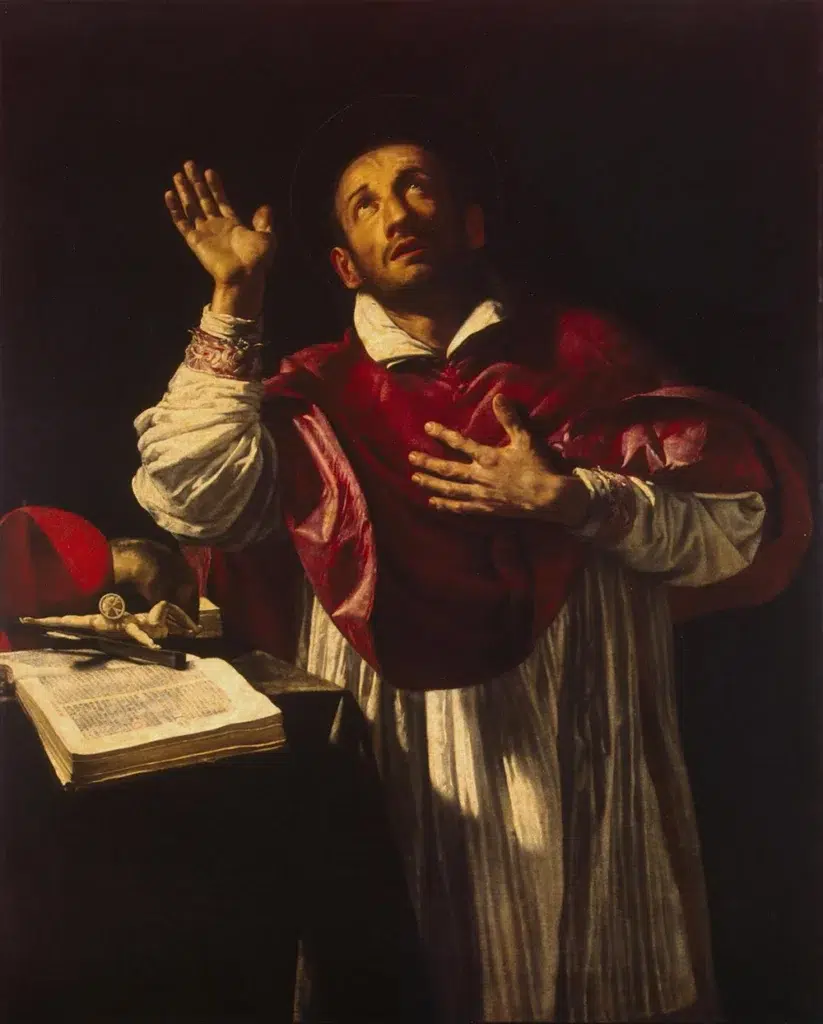
San Carlos Borromeo de Orazio Borgianni
St. Charles Borromeo from Orazio Borgianni.

Conversion and his call to the priesthood

The life of St. Charles Borromeo in Rome, although administratively efficient, was mundane. However, a tragic event shook his conscience: the sudden death of his older brother, Frederick, in 1562.

This loss caused him to reflect deeply on the vanity of the earthly life and the urgency of eternal salvation. Frederick was the heir of the family, and his death put pressure on Charles to leave the ecclesiastical life to ensure offspring.

Charles rejected this idea. He experienced a profound spiritual conversion. He decided that he would no longer be a lay administrator with a cardinal's title, but a true man of God. In 1563, it sought ordination and was consecrated priest, and soon after, bishop. His life changed radically: he adopted a lifestyle of extreme austerity, fasting and prayer.

The driving force behind the Council of Trent

The great work of the pontificate of Pius IV was the resumption and completion of the Council of Trent (1545-1563), which had been blocked for years. St. Charles Borromeo, In his position at the Secretariat of State, he was the diplomatic and organizational driving force that brought the Council to a successful conclusion in its final phase.

It was he who managed the tense negotiations between the European powers (Spain and France), the papal legates and the bishops. His tenacity was key to the council defining Catholic doctrine in the face of the Protestant reform and, crucially, establishing the decrees for the internal reform of the Church.

The council ended, St. Charles Borromeo did not rest. He dedicated himself body and soul to implementing his decrees. He chaired the commission that drafted the Roman Catechism (or Catechism of Trent), a fundamental tool for instructing the faithful and unifying teaching.

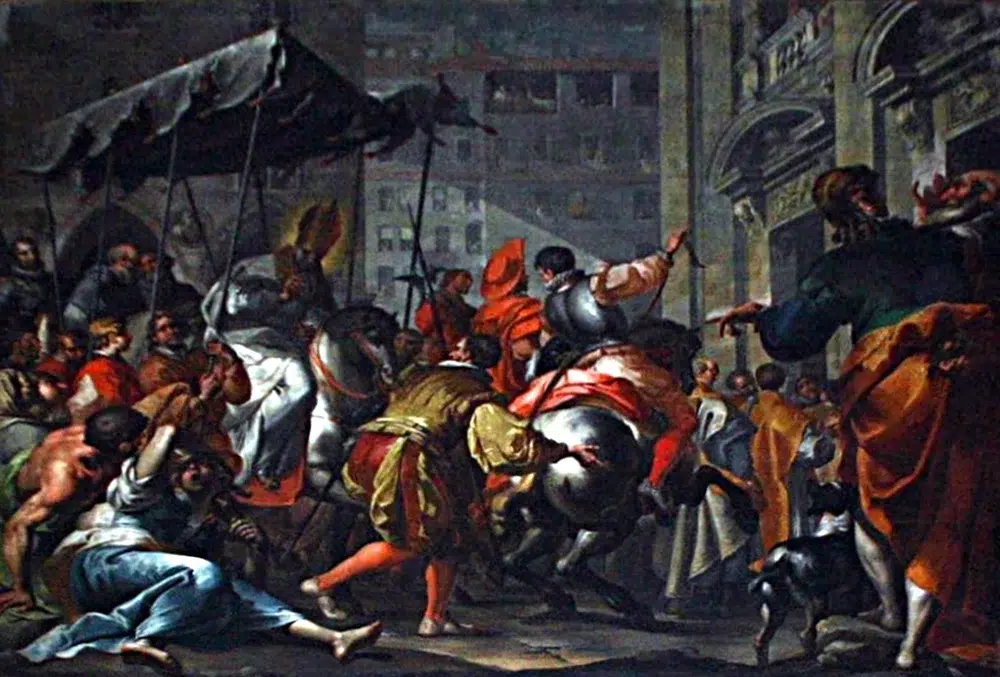
The triumphal entry of St. Charles Borromeo in Milan by Filippo Abbiati, Milan Cathedral.

St. Charles Borromeo: resident archbishop of Milan

While in Rome, St. Charles Borromeo had been appointed archbishop of Milan in 1560. However, as was the custom of the time, he governed his diocese "in absentia" through vicars. He was a "shepherd without a flock".

The very Council of Trent that he helped conclude forbade this practice and required bishops to reside in their dioceses. True to his principles, Charles begged his uncle, the pope, to allow him to leave the glory of Rome for the difficult Milan.

In 1565, Pius IV agreed. The entry of St. Charles Borromeo in Milan marked the beginning of a new era. For the first time in almost 80 years, Milan had a resident archbishop.

Milan's challenge: a diocese in ruins

The archdiocese of Milan which found Charles Borromeo was a reflection of the ills of the pre-Tridentine Church. It was one of the largest and richest dioceses in Europe, but spiritually it was in anarchy.

The clergy were deeply relaxed and poorly trained. Many priests did not keep celibacy, lived luxuriously or were simply ignorant of basic doctrine. The religious ignorance of the people was vast. The monasteries, both male and female, had lost their discipline and had become centers of social life.

The relentless reform of St. Charles Borromeo

St. Charles Borromeo applied the decrees of Trent with superhuman energy. His method was clear: to visit, regulate, form and lead by example.

He began by reforming his own archiepiscopal house. He sold the luxurious furnishings, drastically reduced his servants and adopted an almost monastic regime of life. His example as priest austere was his first reform tool.

He began pastoral visits, tirelessly touring each of the more than 800 parishes in his diocese, many in difficult-to-access mountainous areas in the Alps. He inspected the churches, examined the clergy and preached to the people.

To implement the reform, he convoked numerous diocesan synods and provincial councils, where he promulgated strict laws to correct the abuses of the clergy and laity. He was not afraid to confront the nobles and Spanish governors, who saw his authority as an intrusion.

The creation of the seminar

St. Charles Borromeo understood perfectly well that the reform of the Church was impossible without a well-trained clergy. The Council of Trent had ordered the creation of seminars for this purpose, but the idea was at a very theoretical level.

Charles was the absolute pioneer in its practical implementation. He founded the major seminary in Milan in 1564, making it the model for the entire Catholic Church. He went on to establish minor seminaries and schools (like the Helvetic, to train clergy against Calvinism).

He established strict rules for the spiritual, academic and disciplinary life of every seminarian. I wanted the future priest was a man of deep prayer, learned in theology and morally blameless. The figure of the seminarian modern, dedicated exclusively to his formation for ministry, is a direct inheritance of the vision of St. Charles Borromeo. For this reason, he is considered the patron saint of all seminarian.

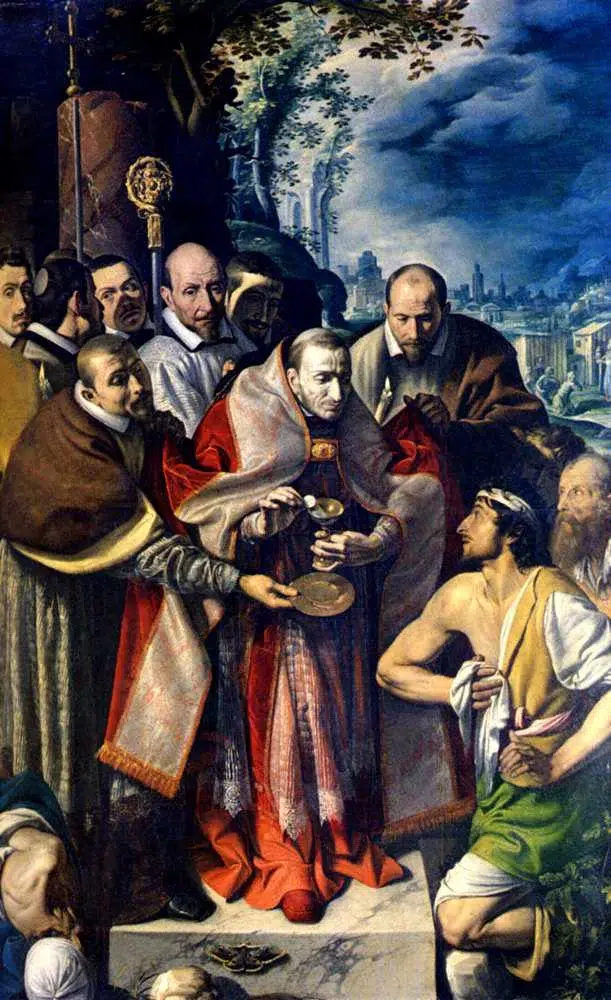
St. Charles Borromeo giving communion to plague victims, by Tanzio da Varallo, ca. 1616 (Domodossola, Italy).

A priest for his people

The defining moment of the heroism of St. Charles Borromeo was the terrible plague that devastated Milan between 1576 and 1577, known as the plague of St. Charles.

When the epidemic broke out, the civil authorities and most of the nobles fled the city to save themselves. St. Charles Borromeo he stayed. He became the moral, spiritual and, in many ways, civil leader of the disease-ridden city.

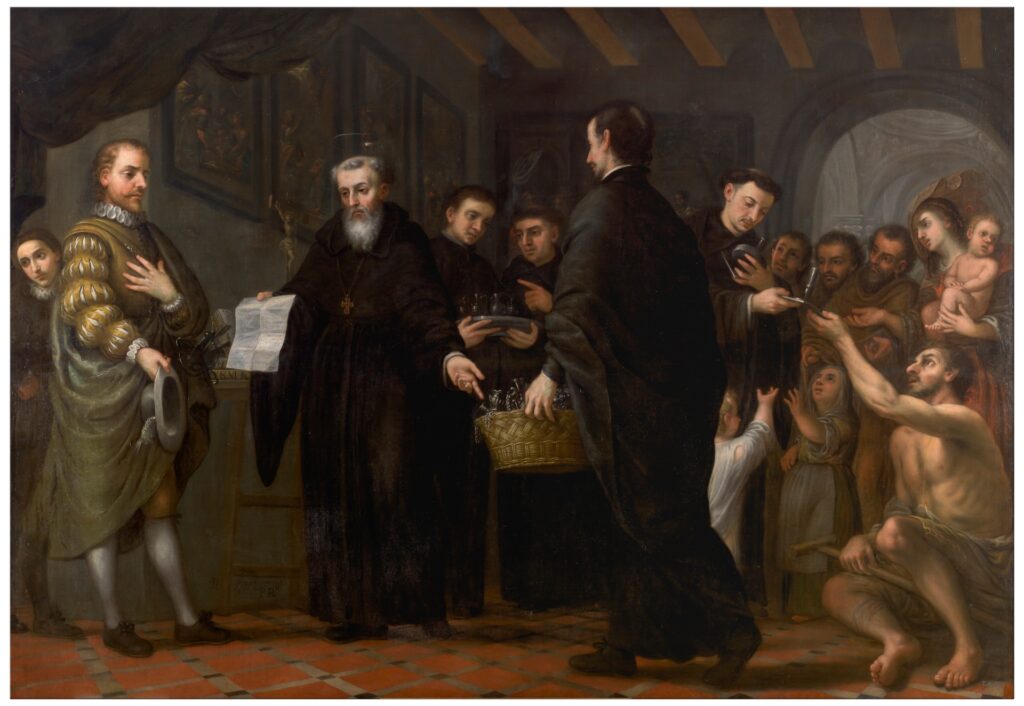
He organized field hospitals (lazarettos), gathered his faithful clergy and urged them to care for the dying. He himself went through the most infected streets, giving Communion and Extreme Unction to the plague-stricken, without fear of contagion.

He sold his remaining possessions, including the tapestries of his palace, to buy food and medicine for the poor. So that the sick who could not leave their homes could attend Mass, he ordered the Eucharist to be celebrated in public squares. His figure, leading barefoot penitential processions through the city, became an important figure in the city's history. symbol of hope.

Opposition and attack

The reform of St. Charles Borromeo was neither easy nor popular. His rigor earned him powerful enemies. He constantly clashed with the Spanish governors of Milan, who tried to limit his jurisdiction.

But the most violent opposition came from within the Church. The Humiliati, The friars, a religious order that had become morally lax and possessed great wealth, refused to accept his reform. In 1569, a member of this order, Friar Girolamo Donato Farina, attempted to assassinate him.

While St. Charles Borromeo While he was praying on his knees in his chapel, the friar shot him in the back with an arquebus at point-blank range. Miraculously, the bullet only tore his vestments and caused a slight bruise. The people saw this as a divine sign, and Pope Pius V suppressed the order of the Humiliati shortly thereafter.

Legacy, death and canonization

The constant effort, extreme penances and tireless work exhausted the health of St. Charles Borromeo. In 1584, while performing a spiritual retreat on Mount Varallo, he contracted a fever.

He returned to Milan gravely ill and died on the night of November 3, 1584, at the age of 46. His last words were Ecce venio (Here I come).

His reputation for holiness was immediate. The people of Milan venerated him as the priest martyr to charity and reform. The process of canonization was extraordinarily rapid for the time. He was beatified in 1602 and canonized by Pope Paul V in 1610.

St. Charles Borromeo is universally recognized as the patron saint of bishops, catechists and, in a very special way, of all the bishops and catechists. seminarian and spiritual director. His influence on the definition of the priest post-Tridentine - formed, pious and dedicated to his people - is incalculable.


Prayer, Mass and Christian mission

He especially noticed Jesus“ prayer on the day of his baptism in the Jordan River. There he, who had no sin to be washed, wished to go in obedience to the will of the Father. And he did not remain on the other side of the river on the bank, as if to say: I am the saint, and you are the sinners. He placed himself at the head of the penitents, ”in an act of solidarity with our human condition".

This is always the case, the Pope notes: "We never pray alone, we always pray with Jesus.”. A theme developed and deepened before by Pope Emeritus Benedict. Also for understand Christ.

The prayer of the Son of God

So says the Catechism of the Catholic Church and Francis takes it up: «The filial prayer, which the Father expected of his children, will finally be lived by the only Son himself in his humanity, with men and on their behalf» (n. 2599).

The Gospel of St. Luke relates that when Jesus was being baptized, as he was praying, a hole was opened as it were in heaven, and the voice of the Father was heard, "...".You are my Son; today I have begotten you."(Lk 3:22). The Pope observes that this simple phrase contains an immense treasure, because it gives us a glimpse of the mystery of Jesus and of his heart always turned to the Father:

"In the whirlwind of life and the world that will come to condemn him, even in the hardest and saddest experiences he will have to endure, even when he experiences that he has nowhere to lay his head (cf. Mt 8:20), even when hatred and persecution rage around him, Jesus is never left without the shelter of a home: he dwells eternally in the Father.".

Francis adds that the personal prayer of Jesus "at Pentecost will become by grace the prayer of all those baptized in Christ. And so he advises us that if we ever feel incapable of praying, unworthy that God should listen to us, we should to ask Jesus to pray for us, to show his wounds again to God the Father, on our behalf..

If we have that confidence, the Pope assures us, we will somehow hear those words addressed to us: "...".You are the beloved of God, you are a son, you are the joy of the Father of heaven.".

In short, «Jesus has given us his own prayerHe gave it to us as a seed of the Trinity, which wants to take root in our hearts. He gave it to us as a seed of the Trinity, which wants to take root in our hearts. Let us accept it! Let us accept this gift, the gift of prayer.. Always with Him. And we will not be mistaken.

So much for the words of Francis in his catechesis on Wednesday. From here we can go deeper into how our prayer relates to the Lord's prayer, and how that relates to the Mass, which always has something of a "feast" about it. And how, finally, this leads us to participate in the mission of the Church. Let us take a step-by-step approach, guided by the theologian Joseph Ratzinger.

Joseph Alois Ratzinger, voda de oración.

"Let us direct our thanks above all to God in whom we live, move and exist" Benedict XVI.

Our prayer as sons in the Son

The content of Jesus' prayer -prayer of praise and thanksgiving, of petition and reparation- unfolds from the intimate awareness of his divine filiation and his redemptive mission.

This is why Ratzinger observed - in the perspective of the point of the Catechism quoted by Francis - that the content of Jesus' prayer is concentrated in the word AbbaThe word by which the Hebrew children called their fathers (equivalent to our "daddy"). It is the clearest sign of Jesus' identity in the New Testament, as well as the clearest synthetic expression of his whole essence. Basically, this word expresses the essential assent to his being the Son. That is why the Our Father is an extension of Abba transferred to the us of his faithful (cf. The Feast of Faith, Bilbao 1999, pp. 34-35).

So it is. Christian prayer, our prayer, has as its living foundation and center the prayer of Jesus. It is rooted in it, it lives from it and it prolongs it without surpassing it, since it Jesus' prayer, who is our "head", precedes ours, sustains it and gives it the efficacy of His own prayer.  Ours is a prayer of sons "in the Son. Our prayer, like that of Jesus and in union with his, is always a prayer that is both personal and in solidarity.

This is made possible by the action of the Holy Spirit, who unites us all in the Lord, in his (mystical) body which is the Church: "In communion in the Holy Spirit Christian prayer is prayer in the Church". "In prayer, the Holy Spirit unites us to the Person of the Only Son, in his glorified humanity. Through her and in her, our filial prayer communes in the Church with the Mother of Jesus (cf. Acts 1:14)" (Catechism of the Catholic Church, nn. 2672 and 2673).

God is present at Mass

Well then, Ratzinger continues, from union with the prayer of Jesus, -that is, from the awareness of our participation in the divine filiation in community with Christ-, prolongs the prayer of Jesus in daily life. And then," he says, "the world can become a party.

What is a party? 

A feast, Benedict XVI would say years later, is "an event in which everyone is, so to speak, outside themselves, beyond themselves, and thus with themselves and with others" (Address to the Roman Curia, December 22, 2008).

But - we might now ask ourselves - what sense would it make to turn the world into a "party" in circumstances such as the present, in the midst of a pandemic, a complicated economic crisis, injustices and violence, even in the name of God, that leave traces of pain and death everywhere?

More questions: What do we as Christians mean when we say that we "celebrate" the MassAnd why does the Mass have to do with a feast? And we find this answer: not, certainly, in a superficial sense of the word feast, which is usually associated with the somewhat unconscious bustle and fun of those who distance themselves from problems; but for a quite different reason: because in the Mass, writes Ratzinger, we place ourselves around God, who makes himself present in our midst.

This gives us a serene joycompatible with the chiaroscuro of faith, with pain and even with death, because we know that even death does not have the last word. That last word is only love, which never dies.

This is how Pope Benedict explained, in this long paragraph that deserves to be transcribed, what happens in the Christian liturgy:

"He [God] is present. He enters into our midst. The sky has been torn open and this makes the earth luminous. This is what makes life joyful and open, and unites one and the other in a joy that cannot be compared to the ecstasy of a rock festival. Friedrich Nietzsche once said: 'The art does not consist in organizing a party, but in finding people capable of rejoicing in it.'. According to Scripture, joy is the fruit of the Holy Spirit (cf. Gal 5:22) (...) Joy is an integral part of the feast. The party can be organized; the joy cannot. It can only be offered as a gift; (...) The Holy Spirit gives us joy. And he is joy. Joy is the gift in which all the other gifts are summed up. It is the manifestation of happiness, of being in harmony with oneself, which can only derive from being in harmony with God and with his creation. Joy, by its very nature, must radiate, must be communicated. The missionary spirit of the Church is nothing more than the impulse to communicate the joy that has been given to us.». (Address to the Roman Curia, December 22, 2008)

The Mass, the central event of the Christian life

With respect to the EucharistIt should be remembered that the Jewish Passover meal already had a strong family, sacred and festive character. It combined two important aspects. An aspect of sacrifice, since the lamb offered to God and sacrificed on the altar was eaten. And an aspect of communion, communion with God and with others, manifested in the sharing and drinking of the bread and wine, after they were blessed, as a sign of joy and peace, of thanksgiving and renewal of the Covenant (cf. The Feast of Faith, pp. 72-74).

The Mass assumes the essence of all of this and overcomes it as "sacramental "updating (i.e., by means of signs that manifest a real divine action, in which we collaborate). of the death and resurrection of the Lord for our salvation.

In it we pray for all, the living and the healthy and the sick, and also for the deceased. And we offer our labors, sorrows and joys for the good of all.

Our faith assures us that God governs history and we are in his hands, without sparing us the effort to improve it, to find the solution to problems and illnesses, to make the world a better place. And so the Mass is the central expression of the Christian meaning of life.

Our faith also gives us a sense of death as a definitive passage to eternal life with God and the saints. We mourn, as is natural, those we lose sight of on earth. But we do not mourn them in despair, as if that loss were irreparable or definitive, because we know that it is not. We have faith that, if they have been faithful, they are better off than we are. And we hope one day to be reunited with them to celebrate, now without limits, our reunion.

From prayer and Mass to mission

Let us return to Ratzinger's line. Prayer is an act of affirmation of being, in union with Christ's "Yes" to one's own existence, to that of the world, to our own. It is an act that enables and purifies us to participate in Christ's mission.

In that identification with the Lord - with his being and his mission - which is prayer, the Christian finds his identity, inserted in his being the Church, the family of God. And, to illustrate this profound reality of prayer, Ratzinger points out:

"Starting from this idea, the theology of the Middle Ages established as the objective of prayer, and of the commotion of being that occurs in it, that man should be transformed into 'anima ecclesiastica', into. personal incarnation of the Church. It is identity and purification at the same time, giving and receiving in the depths of the Church. In this movement, the mother's language becomes ours, we learn to speak in it and through it, so that her words become our words: the gift of the word of that millenary dialogue of love with the one who wanted to become one flesh with her, becomes the gift of speech, through which I truly give myself and in this very way I am given back by God to all others, given and free" (Ibid., 38-39).

Therefore, Ratzinger concludes, if we ask ourselves how we learn to pray, we should answer: we learn to pray by praying "with" others and with our mother.

It is always so, in fact, and we can conclude for our part. The Christian's prayer, a prayer always united to Christ (even if we are not aware of it) is a prayer in the "body" of the Churcheven if one is physically alone and prays individually. Their prayer is always ecclesial, although sometimes this is manifested and carried out in a public, official and even solemn way.

Christian prayer, which is always personal, has various forms: from external participation in the prayers of the Church during the celebration of the sacraments (especially the Mass), to the liturgical prayer of the hours. And, in a more basic way and accessible to all, the “private” prayer of the Christian -mental or vocal-, before a tabernacle, before a crucifix or simply shelled out in the midst of ordinary activities, in the street or on the bus, at work or in family, social and cultural life.

Also popular piety of processions and pilgrimages can and should be a way and expression of prayer.

Through prayer we come to the contemplation and praise of God and his work, which we desire to remain with us, so that ours may be fruitful.

Prayer is necessary for the Eucharist to become part of our life.

Prayer, which always has a component of adoration, precedes, accompanies and follows Mass. Christian prayer is a sign and instrument of how the Mass "enters" into life and turns life into a celebration, a feast. 

From there we can finally understand how our prayer, always united to Christ's prayer, is not only a prayer "in" the Church, but also prepares and strengthens us for the Church's mission. participate in the mission of the Church.

The Christian life, converted into a "life of prayer" and transformed by the Mass, translates into service to the material and spiritual needs of others. And as we live and grow as children of God in the Church, we participate in her edification and mission, thanks to prayer and the Eucharist. None of these are mere theories or imaginations as some might think, but realities made possible by the action of the Holy Spirit.

As the Catechism of the Catholic Church says: the Holy Spirit "prepares the Church for the encounter with her Lord; he recalls and manifests Christ to the faith of the assembly; he makes present and actualizes the mystery of Christ by his transforming power; finally, the Spirit of communion unites the Church to the life and mission of Christ".


Author: Mr. Ramiro Pellitero IglesiasProfessor of Pastoral Theology at the Faculty of Theology of the University of Navarra.

Article published in: Church and new evangelization.


A hymn to Mary

A small image of the Virgin of Fatima covered just a small area to the left of the altar in St. Peter's Square on Saturday, October 11, in a clear hymn of love for Mary.

Mary, perhaps from the dome of St. Peter's Basilica, contemplated the entire square, and filled the hearts of all those who had gathered to accompany the Virgin Mary. Leo XIV in his petition to the Mother of God for world peace.

All together with Mary

«Tonight we have gathered in prayer with Mary, Mother of God, to pray for the salvation of the world. Jesus, as the first church in Jerusalem used to do (Acts 1:14). All united, persevering and with the same sentiment. We never tire of interceding for peace, a gift of God that must become our conquest and our commitment,» said Pope Leo XIV.

Silence filled the entire square; silence and order in the steps of the ceremony. It was the celebration of the Jubilee of the Marian Spirituality, that the Papa wanted to celebrate open to everyone, spiritually and geographically.

A universal prayer

The media of all kinds made it possible for the Church, spread throughout the world, to be “one heart and one soul” that evening, with the Bishop of Rome, and open the hearts of all believers to that unity of Faith, of Hope, of Charity, for which the Pope has prayed, and has reminded us to pray, since the first day of his pontificate.

canto a maría virgen de fátima roma papa león

«Let us contemplate the Mother of Jesus and the small group of courageous women at the foot of the Cross, so that we too may learn to stand, as they did, beside the infinite crosses of the world, where Christ continues to be crucified in his brothers and sisters, to bring them consolation, heart and help», the Holy Father reflected.

Had Heaven come down to St. Peter's Square?

The choirs were very good with the music chosen for such an event, and I would say the same about the texts of the Second Vatican Council read before the recitation of each mystery.

Leo XIV, kneeling before Mary

And not to mention the example of faith and piety given by all the people who filled the square with their devotion. Was every woman, every man, accompanied by his or her Guardian Angels? His responses in Italian to the words of the Our Fathers, Hail Mary and Glory Be, said in English, Italian, Spanish, French and Portuguese, manifested a recollection of spirit and a piety that opened the soul to a constant dialogue with the Blessed Trinity, Father, Son and Holy Spirit. Holy Spirit.

Leo XIV remained kneeling before the image of the Virgin during the entire time that the Marian Litany was being recited. He made his own the words that he pronounced in the meditation prior to the Exposition of the Blessed Sacrament:

«Our gaze as believers looks to the Virgin Mary to guide our pilgrimage in hope, contemplating her “human and evangelical virtues, the imitation of which constitutes the most authentic Marian devotion»." (Lumen Gentium, 65, 67).

The Pope read the entire meditation standing up, and he did so with great serenity and peace. He undoubtedly wanted the hearts of all those who listened to him in corners of the world to be at peace. Rome, The people of Italy, Europe, Asia, Africa, America and Oceania should open themselves to devotion to the Virgin Mary and make their own the words of the “testament” that Mary left to all human beings:

"Our hope is illuminated by the gentle and persevering light of Mary's words in the Gospel. And, among all of them, the last ones pronounced at the Wedding at Cana are precious, when, pointing to Jesus, she says to the servants: “Do whatever he tells you” (Jn 2:5).

Then she will speak no more. Therefore, these words, which are almost a testament, must be very dear to the children, like any mother's testament” (...) “Do whatever He tells you”: the whole of the Gospel, The demanding word, the consoling caress, the reproach and the embrace. What you understand and also what you do not understand. Mary exhorts us to be like the prophets: not to let a single one of their words fall into the void».

Sowers of peace

And he ends his meditation by reminding us that the Mr. counts on each one of us to sow peace in the world:

«Courage, go ahead. You who build the conditions for a future of peace, in justice and forgiveness; be meek and determined, do not be discouraged. The peace is a way and God walks with you.

The Lord creates and spreads peace through his friends who are peacemakers in heart, who in turn become peacemakers, instruments of his peace».

The ceremony ends with adoration of the Blessed Sacrament. Sacramento. A central act of Christian piety. And there Mary was teaching us to welcome her Son in the full donation of all the Love that brought him to earth: the Eucharist. And it is she, Mary, who prepares our soul, our body to receive the Lord, as she received him:

«Pray with us, faithful Woman, tabernacle womb of the Word. Holy Maria, Mother of the living, strong, sorrowful, faithful woman, Virgin bride by the Cross, where love is consummated and life springs forth, be the guide of our commitment to service (...) Virgin of peace, door of sure hope, accept the prayers of your children!.


Ernesto Juliáernesto.julia@gmail.com

Originally published in Religion Confidential.


«We will return on pilgrimage to Rome with friends, because it transforms the heart.»

This year, the pilgrimage to Rome with benefactors and friends had a very special motive: to participate in the Jubilee of Hope, The event was a unique opportunity to renew our faith and strengthen the bonds of friendship and spirituality that unite the entire CARF Foundation family.

During those days, the pilgrims discovered that the places full of history, The most emblematic Christian sites and be inspired by the beauty of Rome, the heart of the Church.

The pilgrims of the CARF Foundation, after the Mass in the Chapel of the Blessed Sacrament at St. Peter's.

Pilgrimage to Rome with the CARF Foundation

One of the most poignant moments was the Holy Mass in a Blessed Sacrament Chapel of St. Peter's Basilica, followed by the general audience with Pope Leo XIV in St. Peter's Square. In his message, the Holy Father recalled: «The Risen Christ is a safe harbor on our way».

Luis Alberto Rosales, director of the CARF Foundation, presented Pope Leo XIV with a book containing the 2024 annual report.

At the conclusion of the hearing, Luis Alberto Rosales, the general director of the CARF Foundation, personally greeted Pope Leo XIV and presented him with a book on the work of the Foundation, a symbolic gesture that reflects the commitment to the universal Church and to the vocations of seminarians and diocesan priests and religious men and women.

Visit to Villa Tevere and the PUSC

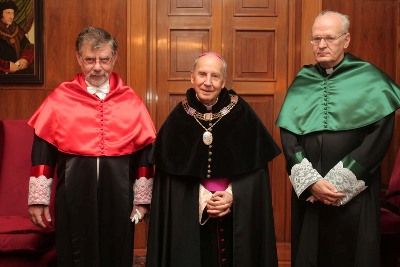
Meeting with the Prelate of Opus Dei, Father Fernando Ocáriz, at Villa Tevere.

Another moment of special significance was the visit to Villa Tevere, where the pilgrims participated in a discussion with the Prelate of Opus Dei, Msgr. Fernando Ocáriz. Their closeness, simplicity and sense of humor created an atmosphere of joy and family.

In addition, the pilgrims were welcomed at the Pontifical University of the Holy Cross by its rector, Mr. Fernando Puig, He welcomed them and shared the importance of the academic mission at the service of the Church. He also gave a lecture on Church Governance Today.

Among the attendees, Almudena Camps and Miguel Postigo were participating in this pilgrimage for the first time. «It is precious to be able to be in the Vatican close to the Pope. It helps to pray much more for him and for the Church; you feel the comfort of his presence,» they say.

Meeting with the seminarians and formators of the international ecclesiastical college Sedes Sapientiae.

Regarding the get-together with the Prelate, they emphasize that «it was a joy to be with him; his simplicity, his clear and accessible message, his sense of humor and closeness... That morning at Villa Tevere was very worthwhile: Mass, visit and get-together.

A day of conviviality in Sedes Sapientiae

One of the most endearing moments was the meeting with seminarians, which Almudena and Miguel described as «the most sublime moment of the whole trip».

«Meeting the seminarians, with their stories and their smiles, is unique. The food style buffet allowed us to greet many of them, and the Mass, with its choir and homily, was memorable».

Both agree that it has been a transformational journey, We will come back with more friends, because it transforms the heart. In short: a ten«.

roma peregrinación fundación CARF 2025
A moment of the video projection Witnesses at the Pontifical University of the Holy Cross.

Marta Santínjournalist specializing in religion.


Don Fernando, happy birthday!

Msgr. Fernando Ocáriz was born in Paris, France, on October 27th born in 1944, son of a Spanish family exiled in France during the Civil War (1936-1939). He is the youngest of eight siblings. On the occasion of his birthday we make a brief review of his life.

He holds a degree in Physical Sciences from the University of Barcelona (1966) and in Theology from the Pontifical Lateran University (1969). He obtained his doctorate in Theology, in 1971, at the University of Barcelona (1966). University of Navarra. That same year it was ordained priest. In his first years as a priest, he dedicated himself especially to youth and university ministry.

Consultant in various dicasteries

He has been a consultor to the Dicastery for the Doctrine of the Faith since 1986 (when it was Congregation for the Doctrine of the Faith) and to the Dicastery for Evangelization since 2022 (previously, since 2011, to the Pontifical Council for Promoting the New Evangelization). From 2003 to 2017 he was a consultor to the then Congregation for the Clergy.

In 1989 he joined the Pontifical Theological Academy. In the eighties, he was one of the professors who initiated the Pontifical University of the Holy Cross (Rome), where he was ordinary professor (now emeritus) of Fundamental Theology.

fernando ocáriz gran canciller prelado

Some of his publications are: The mystery of Jesus Christ: a Christology and Soteriology textbook; Children of God in Christ. An introduction to a theology of supernatural participation.. Other volumes deal with theological and philosophical topics such as Loving with works: God and mankindNature, grace and glory, with a preface by Cardinal Ratzinger.

In 2013 a book interview by Rafael Serrano was published under the title. On God, the Church and the world. Among his works are two studies in philosophy: Marxism: theory and practice of a revolution; Voltaire: Treatise on tolerance.. He is also co-author of numerous monographs, and author of numerous theological and philosophical articles.

Grand Chancellor of the PUSC and UNAV

The Prelate is also, by virtue of his office, Grand Chancellor of the University of Navarra and the Pontifical University of the Holy Cross. He is the fourth, after St. Josemaría (until 1975) -founder and first Chancellor of the University-, Blessed Álvaro del Portillo (1975-1994) and Javier Echevarría (1994-2016).

Monsignor Fernando Ocáriz has dedicated many years of study and work to theology. To the point that this activity has marked his way of being. He is a friend of reason, of logic and arguments, of clarity. He has published books and articles on God, the Church and the world, with that breadth of vision that a theological gaze provides.

He shows an open spirit in the debates: I have heard him say, for example, that «heresies are wrong solutions to real problems», thus encouraging to accept the existence of the problems, to understand those who detect them and to look for acceptable alternative solutions.

In addition to being a theologian, he is a university professor. A professor since he was very young, those who have attended his classes affirm that he usually achieves the most difficult thing: to make the complex understandable. He knows how to explain and how to listen. He has the patience of a good teacher, who every year has to start from scratch with students who arrive with little knowledge and many questions.

From the Roman watchtower

Much of the theological work of Fernando Ocáriz has been developed within the Congregation for the Doctrine of the Faith, where he has been a consultor since 1986. For twenty years he worked closely with the then Cardinal Ratzinger, prefect of that Congregation, on issues of dogmatics, Christology and ecclesiology. A work that requires science and also prudence. And, as usually happens to those who work in the Vatican, the work of consultant brings a deep ecclesial sense. Rome is a vantage point from which the Church is known in breadth and depth. One of the documents he presented at the Vatican was precisely the one dedicated to the Church as communion, in 1992.

In addition to being a teacher of university and Vatican consultant, Fernando Ocáriz has worked at the headquarters of Opus Dei, always in the field of theology, formation and catechesis. First with St. Josemaría, then with Álvaro del Portillo and finally with Javier Echevarría. He was the latter's closest collaborator for twenty-two years. In this sense it can be said that he knows well the reality of Opus Dei in the last half century.

Your personal signature

In addition to these data of his profile, what is Fernando Ocáriz like? He has a serene character and an easy manner, friendly and smiling, he is not a friend of verbiage. From him you can learn something about the art of writing. He often says that in order to improve a text it is almost always best to shorten it, to prune the excess, repeated, imprecise words. Something similar has been written by the Italian writer Leonardo Sciascia.

It is not surprising to learn that the Congregation counted on his help for the publication of the Compendium of the Catechism, the Catholic Church, excellent synthesis of a much longer text. What is written in this article, he would have said it more briefly.

At his age, he still plays sports, especially tennis. He maintains the qualities of the sportsman: no matter the effort, noblesse oblige, it is not worth giving up. Theologians can also have a sporting spirit. From the University of Navarra we have conveyed to him our desire to support him in whatever way we can. In the end, almost everything in this life is a team effort.


Juan Manuel Mora García de Lomas, consultant and professor of the PUSC. Published in Nuestro Tiempo.


Tithing: what is it and what is its meaning?

The purpose of the tithe was to fundraising for the material support of the Church and those most in need, today Pope Francis tells us "The enemy of generosity is consumerism".

Every Christian can contribute financially "what he has decided in his heart and not reluctantly or by force, because God loves a cheerful giver". 2 Corinthians 9:7

What is tithing

The word tithe comes from the Latin decimus and is linked to a tenth, the tenth part of something. The concept was used to refer to the 10% fee to be paid to a king, a ruler or a leader. Those who were to make the payment gave a tenth of their earnings or income to the creditor. It was a common ancient practice among the Babylonians, Persians, Greeks and Romans and among the Hebrews.

The meaning of tithing in the Bibleis the tenth part of all the fruits acquired, which must be given to God as recognition of his supreme dominion. Cf. Leviticus 27:30-33. The tithe is offered to God, but it is transferred to his ministers. Cf. Num 28:21.

The tithe and offering should be understood today, according to the Christian spirit of a heartfelt giving of love for helping the Church and the most disadvantaged in their needs.

"The generosity of the little things widens the heart, beware of consumerism".. In his homily at morning Mass at Casa Santa Marta on November 26, 2018, Pope Francis urged us to ask ourselves how we can be more generous to the poor, the current tithe is in "the little things." And he warned that the enemy of generosity is consumerism, spending more than we need to spend.

How tithing is reflected in the Bible

The Old Testament speaks of the willingness of heart to titheaccording to the phrase "let each one give as he has decided in his heart, not giving with sorrow but with joy.". The meaning of the tithe in the bible appears for the first time when Abram, gives it to the priest Melchizedek in a token of gratitude (Genesis 14:18-20; Hebrews 7:4). Over time, it was instructed for all the priests Levites and was even established as an obligation or law.

Then Jacob gives the tithe of all his possessions to the Lord. "And this stone, which I have set up for a sign, shall be God's house; and of all that thou shalt give me, I will set apart for thee the tithe." (Genesis 28:22)

Subsequently the Bible explains how each year, the Israelites set aside a tenth of what their land produced (Leviticus 27:30). If they decided to pay with money, then they had to add 20 % to its value (Leviticus 27:31). They also had to give "tenths of the cattle and herd" (Leviticus 27:32).

To calculate the tithe of their livestock, the Israelites chose every tenth animal that came out of their pen. The Law said that they could not examine whether that animal was good or bad, nor exchange it for another. Furthermore, they could not pay that tithe with money (Leviticus 27:32, 33).

But the second tithe, the one used for the annual feasts, could be paid with money. This was very practical for the Israelites who came from far away to attend the feasts (Deuteronomy 14:25, 26). Israelite families used these offerings on their special feasts. And there were specific years in which these offerings were used to helping the very poor. (Deuteronomy 14:28, 29; 26:12.)

Paying tithe was a moral obligation, the Mosaic law did not establish any punishment for those who did not comply with the law.. The Israelites had to declare before God that they had complied and then ask him to bless them for having done so (Deuteronomy 26:12-15).

Grupo de personas en un entorno antiguo, similar a un mercado o templo, entregando ofrendas de frutas y monedas a un hombre que las recibe. La escena evoca la práctica del diezmo en tiempos bíblicos.
In the marketplace of ancient Judea, people came to give their tithes.

Tithing in the Bible: the New Testament

In the days of Jesustithe was still paid. But, when he died on the cross, this was no longer a requirement. Jesus does not reject it, but teaches a new reference: to give no longer the 10% but to give oneself totally as master.r, not counting the cost. Therefore, he condemned the religious leaders because they were very strict in collecting the tithe and at the same time, neglected "the most important matters of the Law: justice, mercy and faithfulness" (Matthew 23:23).

Jesus' death annulled the Mosaic Law, including "the command to collect the tithe from the people" (Hebrews 7:5, 18; Ephesians 2:13-15; Colossians 2:13, 14). In none of the four times that the tithe appears in the New Testament are we taught to be guided by that measure. It is no longer limited to the law of 10 % but refers us to the example of Jesus Christ who gave himself unreservedly. Jesus lives a radical surrender and teaches us that we should do the same. That is why he transmitted to us the concept and the importance of the Works of mercySpiritual and corporal.

The Heart of Jesus is the model of total surrender. He gave himself to death on Calvary. Jesus gives us His grace to know how to give and to give as He gave Himself.. Everything belongs to God and we are stewards of our resources according to the Holy Spirit who enlightens our conscience. San Pablo teaches and lives the same self-giving, "For you know the generosity of our Lord Jesus Christ, who, though he was rich, yet for your sakes became poor, that you might be enriched by his poverty." (II Corinthians 8,9)

The Pope Francisco Pope gives catechesis on Jubilee, tithing and condemnation of usury. At the general audience on Ash Wednesday 2016.

Importance for the financing of the Church in Spain

The Catechism of the Catholic Church mentions the tithe only once, in reference to the Christian's responsibility towards the poor, already founded in the Old Testament. The fifth commandment, "to help the Church in her needs", that the faithful are obliged to help, each according to his or her ability, to the material needs of the Church (cf. CCC can. 222).

There is much confusion among the population about the sources of financing of the Catholic Church in Spain. The Catholic Church receives from the Spanish State, 0.7% of the taxes of those who freely check the corresponding box in the personal income tax declaration. This has been the case since the modification of the tax allocation system was signed in December 2006. And it can be considered a way of contributing a tithe or offering to the Church today.

In addition to the State's contribution via personal income tax, the Church is supported by the contributions and offerings of its faithful through other means:

Marking the Church box on the income tax return does not imply any cost for the citizen. You will not get back less or pay more. But it is a great help for thousands of people who need it. A small gesture for a great work. In the CARF Foundation's Reflection Days that we organized with different collaborators online, Silvia Meseguer explained the financing of religion in Spain.


Bibliography:

Catechism of the Catholic Church
infocatolica.com
Opusdei.org