Leo XIV’s apostolic visit to Spain in June 2026 was not merely a diplomatic or liturgical event, but a call for profound renewal within the Church and civil society.
Under the slogan «Look up!», he called on educators to be «new threads for weaving new networks» in the art of social dialogue, which involves encounter and listening, dialogue and respect. In the words of Benedict XVI, has pointed out that «faith is love, and that is why it creates poetry and music. Faith is joy, and that is why it creates beauty» (Catechesis May 21, 2008). And León XIV has wondered whether Europe could be itself without the influence of faith.
It is precisely in his address to the authorities that Leo XIV reveals to Europe—through its great history of mediation among languages, religions, and forms of knowledge, and of uniting historical action with the clarity of moral reason—the calling to «appreciate complexity and study it» with a vision for the future. This task involves overcoming polarization through discernment, «learning to move forward alongside others, to grow together,» rejecting ghosts, enemies, and prejudices, as well as naive enthusiasm and fruitless fears, and fostering critical thinking and the pursuit of the common good.
Spain’s contribution is framed in reference to the saints who have cultivated a «mysticism with open eyes»: St. John of the Cross, with his journey from the dark nights to the light; Saint Teresa of Ávila, following the path of the «inner castle» toward the heart itself, to discover how the universe becomes a home; St. Ignatius of Loyola, with his emphasis on discernment. Even today, eternity can permeate daily life, uniting, in the pursuit of holiness, the prayer and social responsibility.
In the capital, Louis XIV addressed Parliament as a servant of the human person and a defender of human dignity. He recalled that a just society is measured by its ability to protect life in its most fragile state: «from conception to its natural end.» He warned that the law loses its meaning if it becomes a commodity or if it ignores those who lack the strength to make their voices heard. He defended the family and the freedom to choose the type of education for their children.
In the ecclesial sphere, the Pope described the gathering at the Santiago Bernabéu Stadium as a «great goal scored by the Church of Madrid.» There, he presented one of his central theological themes: the Church as a «family that learns the art of polyphony,» where unity is not uniformity, but rather a harmony that values the diversity of charisms and the relationships among «real, flesh-and-blood people.» He praised the volunteers for embodying the «leaven of selflessness.» In a society tempted by profit, Leo XIV defended selfless dedication as the hallmark of the «City of God» that must permeate public life.
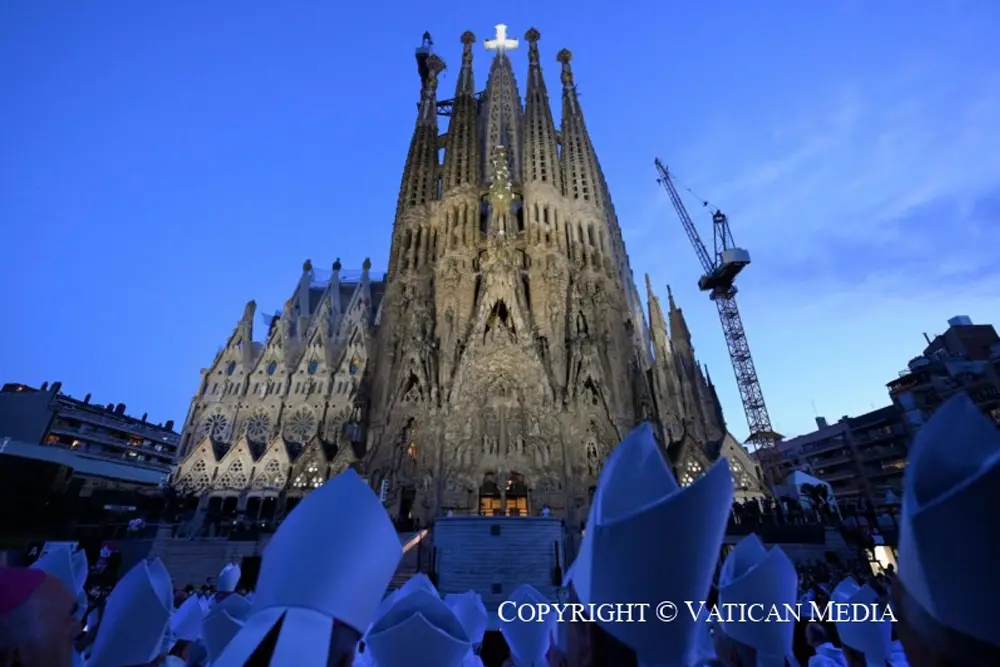
The Catalan phase focused on beauty as a means of evangelization. In the basilica of the Sagrada Familia, Pope Leo XIV described Gaudí’s temple as a «work in progress» that symbolizes the Christian life itself: an unfinished project that requires the cooperation of everyone as «living stones.» He affirmed that art and beauty are «eminent channels of evangelization» in this age of the image.
At the Abbey of Montserrat, the message turned toward inner reconciliation. As he contemplated the Virgin and Child, Leo XIV urged the faithful to «lay aside the armor» of judgment, criticism, and aggression. He proposed the «unarmed and disarming power of love» as the only force capable of healing the wounds caused by injustice and division.
The highlight of the trip, given its prophetic significance, was the visit to the Canary Islands. At the heart of migratory routes, Pope Leo XIV described the archipelago as a «place where the Risen One reveals Himself» through hospitality. He was unequivocal in affirming that «no human being is an island» and that the secret of the heart lies in the call to encounter.
In light of the tragedy of the small boats, Peter’s successor, Leo XIV, strongly condemned those who «speculate on despair» and turn the suffering of others into a business, warning them that they will have to answer to divine justice. To the migrants, he assured them: «Your life is not to be discarded; your dignity has not been washed away by the waters.».
A great lesson from the Canary Islands for the universal Church was the invitation to allow oneself to be evangelized by the little ones and the poor. The Pope asked Catholics to view integration not merely as a social task, but as a spiritual encounter in which one recognizes the «mysterious wisdom of God written in the flesh» of those who suffer.
Throughout his visit, Leo XIV showed a special fondness for the forgotten. Speaking to inmates at Brians 1 Prison (Barcelona) and later in his messages, he insisted that «life’s mistakes do not define one’s identity,» and that the past should not condemn the future. In hospitals and among the elderly, he proposed something akin to a “teaching on fragility,” in which old age and illness remind us of our mutual dependence and our need for God.
As he bid farewell at the port of Santa Cruz de Tenerife, and referring to the heart of Christ—which is the heart of the Gospel—Leo XIV called on everyone to open themselves to «this sea of love.» He repeated the motto «Lift up your eyes!»—pointing precisely to the Crucified One, who is the source of forgiveness, reconciliation, and peace.
The Pope's Visit Leo XIV He encourages young people to always seek the truth, rejecting other paths: «If it leads you away from God, it is not the truth!» He challenges them to be agents of social change as «the spark of a new humanity,» capable of changing history through love.
Ramiro Pellitero, Professor Emeritus at the School of Theology at the University of Navarra.
Published in "Religión Confidencial," June 17, 2026. Another version of this text was published under the title "Learning to Move Forward and Grow Together" in "Omnes,", omnesmag.com, July 1, 2026
Last June, that invitation traveled through three Spanish cities, centered on three themes: beauty, hospitality, and unity. In Barcelona, the beauty of the Sagrada Familia—which Gaudí built as a prayer in stone—showed that beauty is yet another path to God. In the Canary Islands, hospitality was directed toward the most vulnerable among us, seeking Christ in the eyes and hands of others. In Madrid, unity was presented as a sign of communion and a catalyst for a reconciled world. Three cities, three gestures, a single movement: look up.
Pope Leo XIV called on us to rise up. Saint Josemaría had shown us, nearly a hundred years earlier, where to look. And the Risen Christ, high on the Cross and from the tabernacle, continued to draw everything to Himself.
The call from Leo XIV The goal of forming individuals capable of engaging in dialogue, exercising discernment, and serving the common good resonates deeply with the mission of the CARF Foundation. For decades, this institution has promoted the formation of priests, seminarians, and religious from around the world through scholarships at the University of Navarra and the Pontifical University of the Holy Cross (Rome).
The goal is for them to return to their dioceses with a solid human, intellectual, and spiritual foundation to respond to the pastoral challenges in their countries. In a context marked by polarization and the search for role models, the formation of those called to serve the Church constitutes a concrete contribution to the culture of encounter, dialogue, and the promotion of the dignity of every person—values that Pope Leo XIV has repeatedly emphasized during his apostolic visit to Spain.
 carf@fundacioncarf.orgLandline: +34 914 029 082Mobile: +34 638 078 51145 Conde de Peñalver Street.