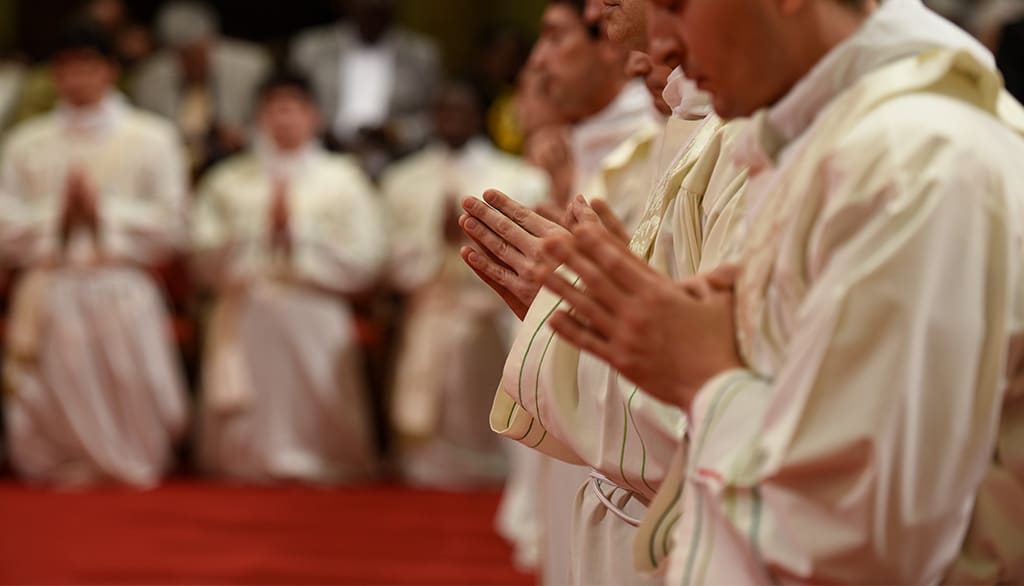
"In Venezuela the priest must donate his heart, be an image of Christ".

Seminarian in the diocese of CabimasLuis Fernando Morales is 31 years old and has been studying to become a priest in Pamplona for a year. He received his faith from his family and his grandmother played a very important role in the discernment of your vocation.

"I looked for the Lord in the wrong places"

She supported the whole family in the faith, encouraging Luis Fernando, his younger brother and his cousins to participate in the sacraments, to seek a personal encounter with Christ, to continue with catechesis.... 

In spite of this, during his youth he stayed away from the Church. He only went to church during the patron saint festivities or when his grandmother asked him to. He was looking for God in the wrong places, where He is not to be found and faith is very distorted. But the doubts about the existence of God and the faith of his family did not disappear.

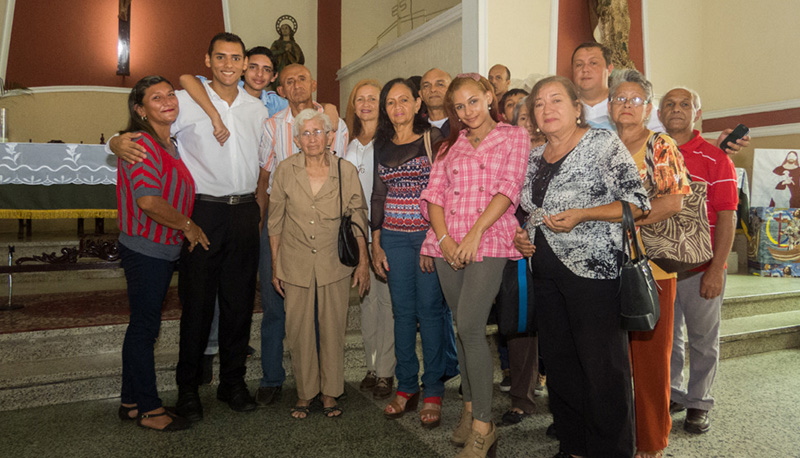
With his family on the day he entered the propaedeutic seminary.

The positive influence of a group of young people 

His grandmother's insistence contributed to his priestly journey. Together with a neighbor, he was invited to participate in a parish youth activity. They were going to represent a living Stations of the Cross and they needed someone to represent St. Peter. So they asked Luis Fernando, who, even though he was not even going to Massaccepted because it was a very good group of young people

The positive influence of this group was decisive. It began with his first steps in the faith and in front of Sacramental Jesus He experienced doubts, emotions, questions and answers. Eucharistic adoration marked his life. It was a before and after that transformed his faith. 

"I didn't know what God wanted from me."

His life went on and when he finished Industrial Education in the area of Electricity, he worked as a professor of Statistics and Electronics at the University Institute of Technology Readic UNIR. Although he was happy with his job, he felt that it was not fulfilling. He also did not feel complete with his girlfriend, even though they went to Mass together frequently. Every time the priest lifted the consecrated bread, he felt that God was calling him. He was with the faithful, but he saw that God was asking him to be in the presbytery. He could not quite discern what the Lord wanted of him. 

The adventure of the priesthood in Bidasoa

Until he finally made up his mind. She left her life to begin the adventure of being priest. He entered the propaedeutic seminary of the diocese of Cabimas at the age of 26. Then, after completing a year of introductory formation, he was sent along with his classmates to begin the first year of philosophy at the provincial seminary in Maracaibo (St. Thomas Aquinas Major Seminary). And almost three years later, his bishop sent him to the Bidasoa International Ecclesiastical College. 

His experience in Bidasoa is "indescribable".the greatness and the blessing that the Lord has granted me to be able to be able to to form as a priest in Bidasoa. I had received several references from my confreres in my diocese about their unforgettable experience, but this is an understatement," he says. He is also very grateful for the training The excellent education that you receive at the University of Navarra, taught by great professionals who teach with a good pedagogy and excellent didactic tools. 

Characteristics of a priest in the 21st century: a courageous man 

Luis Fernando also comments on what a 21st century priest is, in a society that is strongly influenced by secularizedHe must be a man of prayer who lives in visible communion with the Church. A priest must be a courageous man who is not afraid to swim against the tide to face the challenges presented by today's society. He must necessarily be someone capable of bringing the Love of Christ to the whole world. But, not only with words but also with his testimony and show coherence of life". 

The priest in the midst of young people in Venezuela

Young priests must be true shepherds with the scent of sheep, as the Pope Francis. "But, not a perfume smell or sheep-like appearance.... NO. It has to be an authentic sheep smell and for that, it is necessary for the shepherd to enter the sheepfold, to know his sheep, their difficulties, ailments, etc.. And from there, he will be able to care for and shepherd the true flock that the Lord has entrusted to him". 

Evangelization in Venezuela does not stop 

Despite the situation in Venezuela, the evangelization is possible. A difficult challenge, but not impossible because God always acts. "In my country, as in the whole world, we must first start by having coherence of life. At present, the Venezuelan people is very distressed by the difficult situation he is going through. People are looking for and need words of encouragement, encouragement and hope. For this reason, a priest in Venezuela must necessarily give all of himself, the priest has to donate the heart... must be an image of Christ". 

Despite the difficulties, Luis Fernando feels hopeful. because evangelization in Venezuela never stops. "In our culture, religious training begins with the home. In the population there is a clear awareness of the importance of God in our lives. This first approach to the faith almost always comes with the help of grandparents and parents. They are the first to kindle in children's hearts a love for the Eucharist, devotion to the saints and manifestations of popular religiosity". 

And after the familiesThe work of the dioceses. "The Church is the first to step forward to help meet the needs of the people. (food, medicine, education, clothing, even in the area of work). With the great help of organizations such as Caritas, and others, my diocese keeps working to the maximum to help all the people in need and bring to them the rays of hope and love of God that they so much want to feel". 


Marta Santín, Journalist specializing in religious information

Dean: his conversion with the Theology of the Body

Dean Spiller is a 32-year-old seminarian of the Archdiocese of Johannesburg, South Africa. He is studying in Rome "thanks to the kindness and generosity of my diocese and the CARF scholarship program," he says. He is a resident of the Ecclesiastical College Sedes Sapientiae and studies at the Pontifical University of the Holy Cross. Still surprised at his call to the priesthood, "a different path from those offered and exalted by the world," he recounts his vocation testimony.

"I have had the experience of following many different paths at various stages of my life. Some were my own decisions but other times, I was swayed by the proposals that others offered me. Shile some of these ways brought me momentary happiness, I always wondered: Is this my path, is this really the most important thing in life? After a time of searching, I finally realized that the paths that had led me to a certain true and lasting commitment had always turned out to be those in which Our Lord guided me. 

True happiness 

Once I realized that I really could not achieve true happiness without Jesus, I began to commit my decisions to prayer for him to guide my paths. At first it was not easy, I was dragging bad habits in my life, and little by little, with the help of His grace, some good friends, spiritual direction and the sacraments, I became more open to the Lord.

I started with small decisions like what music should I listen to, should I accept these movies that my friend has pirated, and ended with bigger ones: should I take my vocation seriously and be open to leaving everything I have and the people I love to discover God's will for my life? . This was, I believe, one of the most important steps towards a more authentic Christian life and one that ultimately made me open to this call."

A Catholic family 

My younger sister, Shannon, and I were raised Catholic. We were well off because of my parents' hard work to provide for us. Their love, commitment and sacrifice as well as showing interest in our lives were characteristics of my parents that influenced my vocational history.

My father's (John) family has always been Catholic, while my mother (Sharon), was not, although she often made sure to prepare us every Sunday to attend Holy Mass (and she attended most weeks as well). Finally, my mother converted to Catholicism about eight years ago, to the joy and excitement of all of us.

My mother, Catholic or not, has always been the most selfless person I have ever known. We have always been a close-knit family. The fact that my parents celebrated their 37th wedding anniversary this year is a testament to their love and commitment to our family and to each other. Their examples taught me the true meaning of love in all circumstances.

Lifestyle in my youth 

As a teenager, I attended a secular high school. During that time my sister and I attended catechism classes and were confirmed. To be honest at this stage, my level of interest in the classes was usually based on whether or not the girl in our class that I liked would be there that week (such are the ways of teenagers, although there is no doubt that the Lord used this to draw me closer to Him).

I attended the youth group at our parish on occasion, but it was more of a social event for me. I believe that in my confirmation I had a sincere desire to follow Our Lord, but my lifestyle and friends did not provide an environment for living a truly Christian life, so for many years I had two lives: one from Monday to Saturday and the other on Sunday.

After high school, I studied and completed aa degree in computer science and (oddly enough) psychology.. After college, I spent two years working as a consultant for a company associated with Microsoft, a time when I learned a lot about myself and grew a lot as a person in my interactions with clients, as well as in my friendships with my peers, who did not always share my beliefs.

I also noticed that when people are worried about their computers not working (or anything they don't understand), they are generally not easy to deal with. That taught me a lot about patience and understanding.

Another thing that was significant for me after I left high school was to join to the parish youth music ministry. Here I met some good people who had a good influence on me (not to mention teaching me how to play guitar and sing in a group). This ministry really resonated with me and soon I was practicing on my own for hours, as well as trying to write my own songs as prayers to Our Lord.

The Theology of the Body of John Paul II

During this time, I had been getting involved with a group in a nearby parish that was exploring and teaching the writings of Pope St. John Paul II on the human person, love and sexuality (often referred to as "Theology of the Body").

We met every week for almost 5 years, and soon began running programs for parishes, youth groups and high schools (instead of secular sex education programs).

After finding a place where I could be myself and share my yearnings with other young Catholics, I experienced a profound journey of conversion through this teaching and through the incredible community that was newly formed.

It was not just a spiritual moment like the ones I had experienced before at the retreats I had attended (after which I often quickly returned to my old lifestyle). With the companionship, continuous support and grace that I received in the sacramentsI was able to correct many of the behaviors that damaged my relationships and ultimately prevented me from having a deeper faith.

An album of songs 

 In light of all this, in addition to having recorded and released an album of Christian worship songs I had written in 2010, I decided that while the work I had been doing had helped me grow personally, I didn't feel that I was using all the talents I had in the most effective way to help others and do the Lord's work.

At this stage, I was offered a job in high school as a web administrator, graphic designer, religion teacher, teacher of retreats and musician. The job for me seemed like a stepping stone to what I was most capable of doing and I accepted after a short time of discernment. I also continued to play music in my parish at Holy Mass every Sunday.

My time at the school turned out to be very formative in several ways. Sharing the Catholic faith with these young people was a truly incredible experience.. It was there that I met my first official spiritual director.

Father Manu, a priest at work, came to the school weekly to talk to the children and hear confessions during youth group meetings. Soon I began to talk to him weekly and for the first time I experienced a steady and substantial growth in my spiritual life. Father Manu's constant care, prayer and advice really bore abundant fruit in my spiritual life.

Programs in parishes and schools 

After two years, "The Foundation for the Person and the family". offered me a job, an organization that our Theology of the Body group had established to make resources available at more affordable prices in our country. The work with schools and parishes had grown to such an extent that it was decided that a full time employee was needed to take the base forward and after considering it for a while, I took the job. 

During those two years we managed to do a lot of things: we present programs and talks to thousands of South Africans in schools, parishes and retreats on the topics of God, love, life, sex and sexuality.

We also organized a speaking tour by Christopher West (a Theology of the Body expert from the United States) to our country; instituted and led the first Rachel's Vineyard abortion healing retreat in the country; and rallied Catholics through our many community-building fundraisers and social events.

This work for me was truly rewarding, as well as incredibly eye-opening to the environment and struggles facing young people today. I was also able to experience firsthand the great wisdom and liberating power of the Church's teachings, especially when it comes to our bodies and relationships with others.

It was always amazing for me to be able to present the true meaning of Love, through my personal experiences, and to be able to answer important questions about difficult issues such as purity, chastity, pornography and homosexuality with the truth of the Gospel.

My vocation 

During this time, my spiritual director suggested that I should begin to pray about my vocation. This was a difficult time for me. I realized that for many years I had I was so afraid of having a vocation to the priesthood or religious life that I never allowed myself to explore this.

Now, however, I had reached a point where I could see the incredible power and value of the priesthood. By living chastity in the single life I became open to the idea that it could be a "good" for me, not just for other people.

Looking back, I can now see that I had unknowingly believed one of the lies the world had been telling me. It is said that in many of the devil's lies, half-truths are often hidden, and that this is how he makes us agree with him or give in to temptations.

It is true that everyone needs privacy. We cannot live without intimacy; the human person is created for love. The lie I believed for many years was that intimacy could only be found in romantic relationships (in physical intimacy and ultimately sex).

I thought that to really fulfill this requirement, I would have to have a girlfriend and get married someday. However, my life as a single man led me to see that, with God's grace, true friendships can be as fulfilling as any other relationship, and above all to live true friendship with Jesus, intimacy with him.

A nun I heard giving a talk said that intimacy means something that sounds like: "within me, to see," that is, to be known and loved at our deepest levels, and to know and love others deeply. We can live without sex, but we cannot live without intimacy.

Maybe this is something quite obvious to many people, but for me it was a turning point. This realization changed my life. I began to see the story of my spiritual journey in a different light. All the things I had tried and failed at, all the nights I had spent organizing youth meetings or practicing music, all made sense to me in light of this calling and way of life.

"Risking God." 

After a time of prayer and discernment and many conversations with some good priests, I decided to take the opportunity, to "risk God" as they say, and talk to my bishop about being accepted into the Archdiocese as a seminarian.

Although it was a difficult reality for my parents to accept, they gave me their blessing. While I knew it would be difficult for them, I never doubted that they would support me, such is their love and selflessness. Our Bishop is a good and prayerful man, and the fact that he sent me to Rome to study was an incredible moment for me, as well as another confirmation that I was doing this with God's blessing.

Before I came to Rome, we celebrated the birth of my sister's first daughter. We joke that Our Lord even sent my family a replacement while I am away (but still gave me time to meet her and become her godfather).

A University with hundreds of seminarians 

Months later, I am in Rome, living in a university with hundreds of seminarians and priests. I am absorbing the culture, grace and knowledge offered to me daily through the eternal city, the spiritual life of the university and the incredibly knowledgeable and saintly professors of the Pontifical University of the Holy Cross.

I am also humbled daily by the incredible generosity and service of everyone that makes it possible for us to be here. I am truly grateful to CARF and all my benefactors for their generosity and love, and I want them to know that I am praying for them as sisters and brothers. 

When God calls you and you don't listen

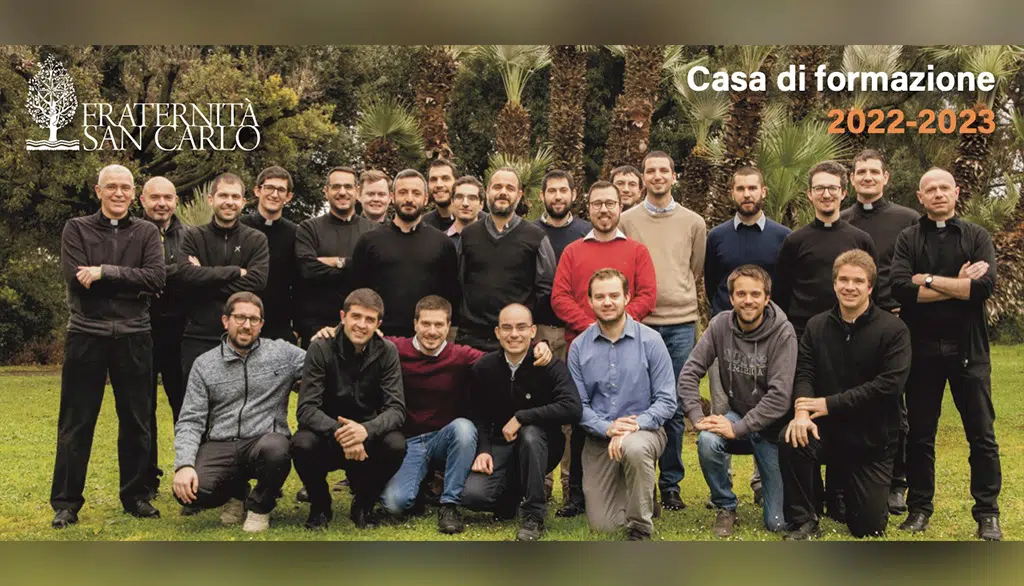
Simone Moretti prepares to be priest of the Fraternity of St. Charles Borromeo, belonging to the charism of Communion and Liberation, studies at the Pontifical University of the Holy Cross in Rome. He was born in 1988 into a Catholic family that educated him in the faith. Like many young people today, after receiving the sacrament of Confirmation, he left the Church. He did not see the connection between faith and concrete life. 

The encounter with the Lord 

However, the Lord did not leave him and went out to meet him again. He recovered him in an activity of Communion and Liberation (CyL) when he was still a teenager. That experience marked his life. One summer he was invited to a camp in the mountains by Juventud Estudiantil, the youth group of CyL. 

In this community, participating in camps, retreats and community life, he also saw and experienced an intensity of life that fascinated him. 

Discovering the Catholic Church through Communion and Liberation  

In time he realized that the source of this intense life was in faith. Participating in the life of the movement, he saw that the relationship with God, which had been fraying, regained its consistency and acquired vigor and strength. Through this encounter, he rediscovered his relationship with Jesus and returned to the Church, a place where Jesus Christ reached out to him and accompanied him

"What if God wants me to be a priest?"

It was in this atmosphere of faith, prayer and friendship that Simone first thought about the priesthood. One day, during Mass in the parish, he imagined himself in the priest's place during the homily, thinking about what he could say. After Mass, he had the feeling that the image was not accidental. 

With that idea in his head, he went to his mother, the one who had passed on his faith to him. And he asked her: "What if God wants me to be a priest, because I don't want to! Her wise answer pierced his heart: "Do you think God could ask anything of you against your happiness?". 

During the following years of high school, the joy and happiness of that encounter with Christ began to germinate, thanks also to a pilgrimage to the Black Madonna of Częstochowa, Poland, where he met for the first time some priests of St. Charles Borromeo, the fraternity of Communion and Liberation.

Physics studies

With that seed in his heart, he began his university studies in Physics while participating in activities and formation with other members of Communion and Liberation. In this reality of the Church, he forged some of his deepest friendships, all united by the bond with Christ. 

In those years he was able to experience how faith in Jesus had to do with everything: with study, with university classes, with friendships, and how it made everything more beautiful and true. As a phrase of Romano Guardini says, in the experience of a great love everything that happens becomes an event in its own sphere. 

The friend who left everything for Christ 

And then came another turning point in his life. God would not let go of his hand. Towards the last years of university, a friend told him that he intended to give his whole life to Christ. And that's when it crossed her mind and heart that he could do the same. At first, it didn't sit very well with him: he had other plans, a girlfriend....

He tried to continue with his life project, but the Lord kept knocking at the door of his heart. He would not leave him alone. So he broke up with his girlfriend and went to Spain to pursue a PhD in Physics, thinking that the sting of God would disappear. He then worked at the university and was a researcher and PhD in Physics in Spain.

But the sting of the Lord did not disappear.... 

sacerdote comunión y liberación

In search of a path

"During all this time, however, I kept asking the Lord to help me, to accompany me. Above all, I asked him to show me the way and give me the strength to follow it. His words often came to my mind: "What does it profit a man if he gains the whole world and then loses himself? 

Simone had everything she could wish for: a good job she liked, a good salary, another girlfriend, but the more she ignored the Lord's invitation, the more all the things she had lost their flavor. 

Finally, he gave upI decided to face this invitation from the Lord who was very patient with me and waited so long, never ceasing to call me gently. So I entered the seminar and I finally experienced the peace of responding to the Lord, the peace and joy of telling him every day "Here I am", betting everything on his fidelity and his grace".


Gerardo Ferrara
BA in History and Political Science, specializing in the Middle East.
Responsible for the student body at the Pontifical University of the Holy Cross in Rome.

Five ways to increase the number of seminarians and priests

1. Involve the entire community, movements and parishes.

On the feast day of the Sacred Heart of Jesus, the Church celebrates the World Day of Prayer for the Sanctity of Priests and seminarians. In 2019, on the occasion of this day, Pope Francis invited all Catholics through his prayer network to pray for priests and students studying in seminaries "so that, with the sobriety and humility of their lives, they may engage in active solidarity, above all, towards the poorest."

In the CARF Foundation this year we are launching this small campaign encouraging to pray for the holiness of all priests.

2. Young priests as models for seminarians.

A vocations ministry that serves as a fertile ground for new vocations begins with much prayer, especially in the adoration of the Blessed Sacrament with holy hours in the parishes, with the younger priests involved in youth ministry. In this way, by intensifying their interior life and their love for Jesus-Eucharist, and with priests as a model, many could consider the call to the priesthood. 

3. A father figure for future seminarians and priests.

Pope Francis assures us that "the paternity of the pastoral vocation consists in giving life, making life grow; not overlooking the life of a community". St. Joseph is a good model for both seminarians and their formators on the road to becoming a priest. With his total dedication, Jesus is the manifestation of the Father's tenderness. Therefore, "Jesus grew in wisdom and stature, and in favor with God and man" (Lk 2:52).

The Pope tells us that every priest or bishop should be able to say like St. Paul: "[...] through the Gospel, it is I who have begotten you for Christ Jesus" (1 Cor 4:15). St. Paul was very concerned about the formation of priests. In his first letter to the Corinthians he expresses vehemently: "Do you want me to come to you with a stick or with love and a spirit of gentleness? The formators and priests who accompany seminarians must be as a good father, who listens, accompanies, welcomes and corrects with gentleness, but with firmness. 

4. The Christian family as a seedbed of vocations.

The family is the first agent of pastoral care for vocations (in all areas of the Church). The Christian family has always been humus and "educational mediation" for the birth and development of vocations, whether celibate, priestly or religious. 

A family pastoral care that integrates the vocational dimension must also form parents in dialogue with their sons and daughters about their faith and the way they understand the following of Jesus. But above all, vocations are forged by the example of parents in their love for God and for each other.

5. Support the formation of seminarians.

Pope Francis mentions four pillars to support the formation of every seminarian: spiritual life, prayer, community life and apostolic life. He also delves into the spiritual dimension of seminarians, placing special emphasis on the "formation of the heart".

Having well-trained priests has a positive impact on the high cost for dioceses. Upon entering the seminary, an aspirant to the priesthood has ahead of him at least five years of ecclesiastical studies, equivalent to a bachelor's degree and a specialization. This is followed by two years or more of doctoral studies in which the completion of a research thesis is contemplated. 

Many dioceses, especially in poor countries, lack either the resources to support their seminarians, or priests with sufficient formation to be seminary formators and provide candidates with adequate accompaniment. This is where the CARF Foundation and your help. With your donation you contribute to the formation and maintenance of diocesan priests and seminarians for their studies in Rome and Pamplona with the commitment to return to their diocese of origin.

A "profession" with a future.

Benedict XVI, on the occasion of the celebration of the Year for Priests 2010, began a letter with an anecdote from his youth. When, in December 1944, the young Joseph Ratzinger was called up for military service, the company commander asked everyone what he wanted to be in the future. He replied that he wanted to be a Catholic priest. The second lieutenant replied: "You will have to choose something else. In the new Germany there is no longer any need for priests".

"I knew," says the Holy Father, "that this 'new Germany' was coming to an end, and that after the enormous devastation that that madness had brought to the country, priests would be more necessary than ever. Benedict XVI adds that "even now there are many people who, in one way or another, think that the Catholic priesthood is not a 'profession' with a future, but rather belongs to the past". Despite this current sentiment, the reality is that the priesthood has a future because, as the Pope himself says at the beginning of his letter to seminarians, "even in the age of the technological domination of the world and of globalization, people will continue to need God, the God manifested in Jesus Christ and who gathers us together in the universal Church, to learn with him and through him the true life, and to have present and operative the criteria of a true humanity".


Bibliography:

Pope Francis, Apostolic Letter Patris corde

European Congress on Vocations, Working Paper.

Pope Francis, Message for the 57th World Day of Prayer for Vocations.

Benedict XVI, Letter on the occasion of the celebration of the Year for Priests 2010.

"I saw my parish priest happy, and the Lord conquered my heart."

It comes from a family of five siblings, four boys and one girl. With a Catholic mother and Protestant father, a married couple in the food trade, he is very proud of his parents, both for the values they have passed on to them and for how hard they have worked to give them all a well-rounded education. "They have been a great support for all of us. They passed on very good values that have curdled in all of us," he says. Their mother is very happy with their vocation to the priesthood and his father respects him and supports his desire to become a priest. "My older siblings are not very church-minded and my mom motivates them to get closer to the faith. God has his time for everyone."

Serving society as a priest

Dani has always enjoyed studying and training to serve society. He studied Educational Sciences and worked as a teacher in a Christian-Protestant school. Since college, the Lord was preparing his path.

During his university years, his vocation to be a priest. "It all started when my pastor proposed that I enter the seminary, something I had not thought about, but it was a light and a door that opened in my life." After this invitation, the following happened several events in his life that aroused in him a determination to do God's will.

In a healing Mass

One day, while he was in the basilica of his diocese, in a healing mass The prelate surprisingly said, "I am very grateful to the bishop for his presence at the funeral for the sick: "There is a young man who is interested in entering the seminary to become a priest and is now in the midst of discernment." It was then that Dani understood that it was Christ who was calling him. "It was me who was telling me that," he says.

From that moment on, he started to reflect on his vocation and what a priest is. That was very significant in his life. The love he had for the Church grew and the testimony of his parish priest, very dedicated to the people, to the Church and to a life of service, was a determining factor.

I saw my parish priest happy

"I saw in my parish priest a very happy life, dedicated to the Lord and to others as a priest. This conquered my heart to to give myself completely to the Church and to the priesthood. Another event that occurred in his life and that marked him strongly: praying before the Blessed Sacrament in a church, he heard a person behind him praying. "When we went out into the street, he turned to me thinking that I was the parish priest. His words touched me strongly, it was for me like another sign from the Lord that I was called to the priesthood. Vocation is a mystery, but God calls you in everyday events".

Dani Alexander Guerrero with a group of young people.
In the seminary at age 22

After these events, he entered the seminary at the age of 22 in his diocese of Our Lady of Altagracia. At the age of 25, his bishop sent him to study in Spain to prepare himself to become a priest, and has been residing in the Bidasoa International Seminar and studies Theology at the Ecclesiastical Faculties of the University of Navarra.

When he told his friends that he was leaving everything to become a priest, they tried to dissuade him: "My friends tried to convince me not to enter the seminary, they gave me a thousand reasons, that I would no longer have a wife (I had had a girlfriend when I was 17), no family, no children, that I was going to leave my profession for which I had prepared myself. But my calling was stronger and none of these things stopped me. Now they have understood that I am happy with my decision and they support me."  

For Dani, one of the characteristics of a priest of the 21st century is to be close to the people and close to young people. "He must get involved in the actions and hobbies of young people and take advantage of that space to evangelize. And that he loves his Church very much. In his preaching he should speak the word of God and give testimony that he is a Christian and a holy priest. Through our witness we can encourage people to find God. Therefore, I believe that transmitting the faith through our witness and caring for people is the most important thing for priests today.

How to encourage young people

This young seminarian from the Dominican Republic considers that young people today are "very distracted with the things of the world, with networks, technology, fashion. All this has brought a lot of confusion to the youth of our society who follow erroneous ideologies. The young Catholics We have to give testimony of our faith, to transmit that it is possible to be young and Christian. Let them see in us a light. True happiness is in following Christ," he says.

The majority religion in the Dominican Republic is Catholic, although there are also many Protestants. For this reason, he is convinced that, in order to evangelize, the main thing to do is the doctrinal formation of the catechists. "The more prepared we are, the better we will be able to make Christ known to others. Many Catholics go to the Protestant church because of lack of formation. An ignorant Catholic is a future Protestant".

"We Catholics have to give witness to our faith, to transmit that it is possible to be young and Christian. Let them see in us a light. True happiness is in following Christ".

Dani Alexander Guerrero

For this reason, he is extremely grateful to the people who make it possible for so many seminarians from so many parts of the world to have the opportunity to study to become a priest in Bidasoa and in the Ecclesiastical Faculties of the University of Navarre or in the University of the Holy Cross in Rome. "Thanks to the benefactors of the CARF Foundation we are training with great enthusiasm to return to our dioceses with enthusiasm to be able to evangelize. May God repay you.


Marta SantínJournalist specializing in religious information.

The Bidasoa International Seminar and the CARF Foundation

How do Bidasoa and the CARF Foundation cooperate?

The relationship that exists between the Bidasoa International Seminary and the CARF Foundation is an example of cooperation and social commitment. Most of the seminarians are able to continue their studies thanks to the generous support of the benefactors of the CARF Foundation, who collaborate financially, according to their possibilities, for that no vocation be lost.

The Bidasoa International Seminar

It is an international seminary attached to the Faculty of Theology of the University of Navarra. It was erected by the Holy See in 1988 and has its seat in Pamplona, in the Navarre town of Cizur MenorThe property is located very close to the university campus.

The formation plan of the Bidasoa International Seminary is inspired by the documents of the Second Vatican Council, in particular Optatam totius y Presbyterorum ordinisthe Apostolic Exhortation Pastores dabo vobis and the Ratio Fundamentalis Institutionis Sacerdotalis of the Congregation for the Clergy.

Priests according to the heart of Christ

The purpose of the Bidasoa International Seminary is the vocational accompaniment of future priests and, therefore, "the discernment of vocation, the help to correspond to the call and the preparation to receive the sacrament of Priestly Order with its own graces and responsibilities". Pastores dabo vobis, 61.

seminario internacional bidasoa

Human, spiritual, pastoral and intellectual formation

At the Bidasoa International Seminary it is essential to enable seminarians to encounter Christ. The work of formation is oriented to the seminarian aspiring to be alter Christus in all aspects of his life, since he will participate through the sacrament of Priestly Orders, "of the same and unique priesthood and ministry of Christ". Presbyterorum Ordinis, 7. Aspirants to the priesthood must be convinced of the need to acquire a mature, balanced and sufficiently consolidated human personality that will make the gift received shine before others and enable them to persevere in following the Master, even in times of difficulty.

The pastoral formation received by the candidates of the Bidasoa International Seminary, by the spiritual director and the formators, is oriented to develop, in each one, the priestly soul; a heart of father and shepherd, soaked by the same feelings of Christ. 

This priestly formation is complemented by the scientific and teaching work carried out at the University of Navarra, where we seek to form by awakening a love for the truth. Especially in the seminarians who find themselves in the Bidasoa International Seminary, emphasis is placed on the importance of study, which prepares them for the future development of priestly ministry in today's world.

Seminarians protagonists of their formative process

During the 35 years of the Bidasoa International Seminary, the same years of existence as the CARF Foundation, almost a thousand seminarians from many countries have matured their priestly vocation accompanied by the formators of this seminary.

Based on the conviction of the importance of personal freedom as an indispensable means to achieve the necessary human, spiritual, intellectual and missionary maturity, they have tried to transmit to each seminarian that each one must be the protagonist of his formative process, knowing that responsible freedom is rooted in an atmosphere of trust, friendship, openness and joy.

This prominence is made possible by the fact that the seminarians, some of whom come from very distant parts of Spain, joyfully share the same formative experience of study, classes, prayer times, pastoral activities, get-togethers and excursions.

Seminarians in union with the bishop of their diocese

The international character constitutes a rich human and ecclesial experience, which helps to increase in each seminarian a catholic, universal and apostolic spirit. Likewise, the Bidasoa International Seminary fosters the union of each seminarian with his bishop and with the priests of his diocesan presbyterate.

Why the CARF Foundation is one of the main benefactors of the Bidasoa International Seminar 

The seminarians of the Bidasoa International Seminary come from different parts of the world. They are sent by their respective bishops in order to receive an adequate formation for their future priestly work in their dioceses. 

It is the bishops who request the scholarships from the University of Navarra, which in turn requests the help of the CARF Foundation. The objective of the foundation is to provide these young people with a solid theological, human and spiritual preparation in the Ecclesiastical Faculties of the University of Navarra and the Pontifical University of the Holy Cross (Rome). Every year, more than 5,000 benefactors make this possible.

In addition to the formation in the Ecclesiastical Universities, the seminarians need an environment of trust and freedom, a fraternal and familiar atmosphere that facilitates the clear and sincere opening of the heart and the integral formation; they find this environment in the Bidasoa International Seminary.

Throughout the 2022/23 academic year, the CARF Foundation allocated 2,106,689 euros in housing and tuition grants.

Annual meeting between benefactors of the CARF Foundation and seminarians of the Bidasoa International Seminary.

Every year, the CARF Foundation, in collaboration with the Bidasoa International Seminary, organizes a meeting between seminarians and benefactors. An intimate day, in which both parties, benefactor and beneficiary, have the opportunity to get to know each other, experience the Eucharist together and enjoy a lunch and a visit to the seminary and a musical festival that the students prepare as a way of thanking those who make it possible for them to be formed in Bidasoa.

The day ends with a long awaited moment, as those responsible for the Social Action Patronage (PAS) of the CARF Foundation, deliver the cases (backpacks) of sacred vessels to the seminarians who are in their last year. They include all the liturgical objects necessary to celebrate Mass in remote towns or villages where they barely have what they need, including a custom-made alb for each of the future priests.

Finally, adoration before the Blessed Sacrament is shared; and a visit to the wayside shrine of the Mother of Fair Love, located on the campus of the University of Navarra.

"I am very grateful to study at Bidasoa because I can see firsthand the face of the Universal Church. This is because we seminarians at Bidasoa come from more than 15 countries. Another thing that we are indirectly taught at the Bidasoa International Seminary is the attention to the little things, especially in the preparation of liturgical celebrations. This is done not because we want to be perfectionists, but because we love God and want to try to do and present the best of ourselves to God through the little things."

Binsar, 21, from Indonesia.