In this meditation by Father Ricardo Sada, he explores how the Holy Mass It renews the significance of Christ's sacrifice, revealing our identity as children of God and becoming the very heart of every Christian's life.
«We know that the Bible is the word of God; it is not merely human words, even though they were written by the sacred writers, but rather it is the revealed word, the word of eternal life.".
And St. Paul teaches us: "When the fullness of time had come, God sent his Son, born of a woman, born under the law.".
When the fullness of time had come—the pivotal moment in human history, when several thousand years had passed (we do not know exactly how many) since the Fall, and the people of Israel had been chosen so that the Messiah might be born among them, when everything was already in place—God sent His Son. His only Son, born of a woman, born under the law. Born of a woman, He took on human flesh in a woman’s womb and is therefore truly human, while at the same time being the true Son of God.
And why? St. Paul says: "So that we might attain the fullness of sonship." It is not something that remains merely in God’s Word; rather, it affects us deeply. And so the Church says: "Christ reveals man to himself." Christ reveals to us the profound mystery of man. What is man? Who are you? Or who am I?
We are a spirit incarnate, made for union with God forever, to live in intimacy with God because God unites us to His Son and gives us the life of His Son. And so He tells us, "This is who you are—you are a spirit dwelling in the flesh." But it is not just that; you are not merely body and soul, but because you have a soul, you are capable of being elevated to the divine order.
And so I think it’s important that we always adjust our understanding of what it means to be human and our understanding of who we are. You are not your body; you have a body. You are, above all, a soul; you are a spirit. You are a spirit. If you didn’t have a body, you would be an angel. But since you have a body, you are a human being.
But what matters isn't so much your body, even though we see, for example, that there are major—well, I don't know—medical advances, right? It's great that they bring relief to our bodies. But anyway, in the end, all bodies are going to—well—die; they’re going to decay and die, for one reason or another, but the soul lives forever.
And just as we often worry about our physical health and go to the doctor, who prescribes medication, and we follow a treatment regimen and all that, well, we can't think that the soul is any less important—quite the opposite, in fact.
That we are, above all, a spirit—a spirit in the flesh—but that spirit and that flesh, raised to the reality of the children of God, are divinized by grace, sanctifying grace. Grace is the life of Christ communicated to us as if it were a blood transfusion that, instead of blood, infuses us with divinity.
Well, let’s value ourselves properly. We are so much more than we seem to be. We were saying yesterday that man should be like birds because he flies and sings; well, here God tells us, "Look, there’s no limit to your ability to fly—your spirit can always fly." Just as the body is very limited—because it gets tired and can only lift so many kilograms or run at a certain speed—your soul is not; your soul can always rise higher and higher and higher and higher—you have no limits. You have no limits in love.
Well, that’s the mystery—the mystery of every person—and that’s why, during a retreat or a moment of prayer, what we’re always seeking is… let’s see… to go deep within yourself; that’s where the truth lives. God dwells within you; that’s where you have that encounter.
Well, Christ reveals man to himself and leaves us the sacraments. He is a sacrament. What is a sacrament? A sacrament is something tangible that possesses—or rather, contains—an invisible grace. And Christ is a mystery because the people who saw him saw a man who spoke, who made certain gestures, who performed miracles. But those who had faith also saw in him the Son of God, a sacrament.
And then He says, "I will leave you sacraments—as signs of my presence—so that you will not forget me, but will always remember me." And He leaves us the seven sacraments.
And I wanted us to talk a little bit about the Eucharist, but not the Eucharist as in the consecrated host, but rather the Eucharist as in the celebration of the Mass. What is called the Eucharist in Progress, that is, in the act itself, which is the sacrifice of the Mass, the holy sacrifice of the Mass. May our faith and our love grow as we reflect a little on the Mass.
Because it's a reality that, if we look at it superficially, can seem really boring. It's always the same. Like, "I could be doing much more interesting things." I’ve got, I don’t know, a whole world of fun on my phone and stuff, but this is so slow and I’m starting to doze off—plus, maybe I got here, I don’t know, there wasn’t any room, and I don’t like the way this priest talks or the way he preaches." And we say again, "Try to go deeper; try to get to the very heart of it.” And what are you doing when you’re at Mass? You’re taking part in Christ’s sacrifice on Calvary.
And all of us are called to strengthen our faith and also to pray, for example, for the priests. It’s very important because we priests celebrate many Masses. Yesterday a priest called me to ask if I could help him because he had so many Masses. I told him, "Hey, I’m sorry, but the other priest won’t be here, so I can’t make it—but let me know again.".
Maybe I was going to celebrate four or five Masses on a Sunday or a day when Mass is obligatory. We say, "Hey, after the third Mass, or the fourth Mass, doesn’t your faith start to waver a little? Don’t you feel tired? Or don’t you start to feel a little annoyed about celebrating Mass? Maybe you’re already losing your voice and it’s getting hoarse because you’ve talked a lot and given a homily at every Mass. And besides, since so many people have gathered, you’ve had to stand for a long time.".
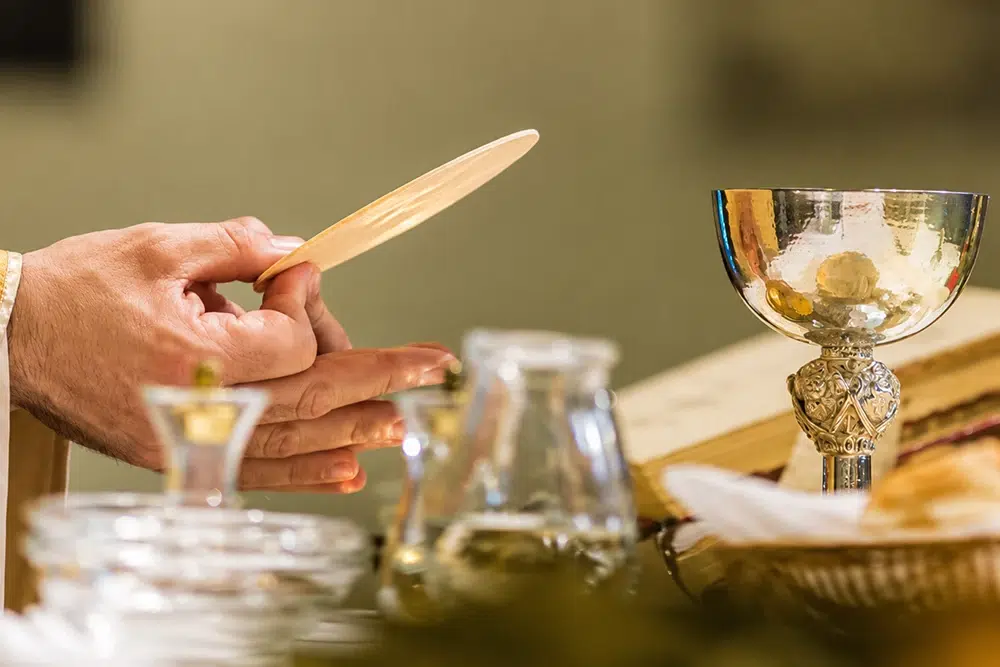
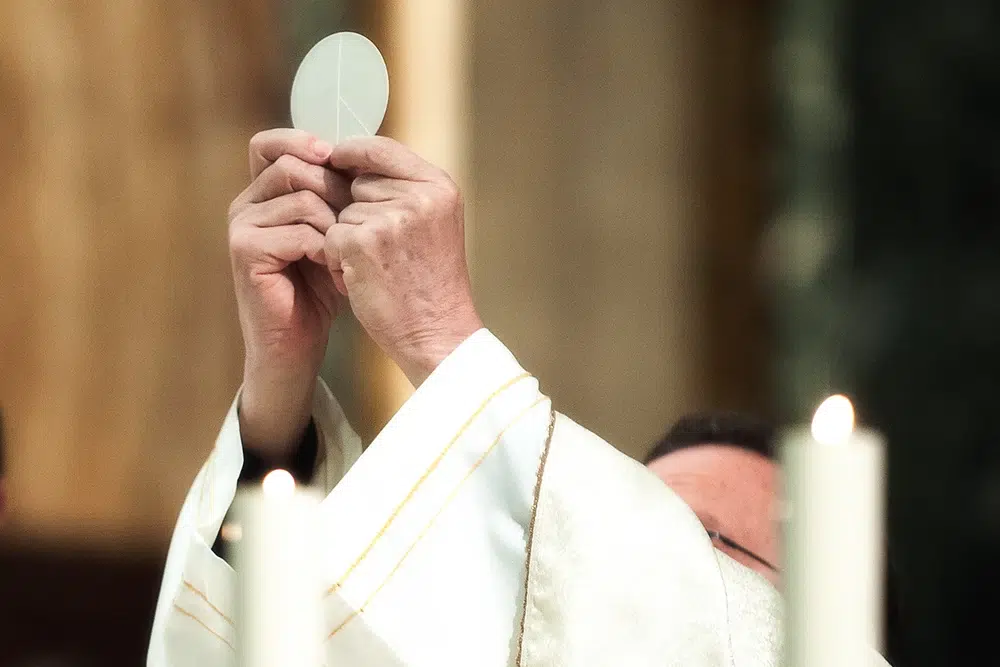
And I don’t know if we should pray that this priest never loses sight of the fact that he is making present the sacrifice of Christ. And that the most important thing is not the Liturgy of the Word—or, I don’t know, the series of parish announcements they’re giving us—but rather the double consecration. That moment when the bread and wine are consecrated separately, symbolizing the bloody separation of Jesus’ body and blood on Calvary. And divine wisdom has found a wonderful way to make that moment present.
None of us were there on the 14th day of the month of Nisan in the year 33, in Jerusalem, from 12:00 to 3:00 p.m. No, we weren’t. But it says, "Look, now I’m going to give you the opportunity to be there. You’re going to be present at the sacrifice on Calvary. You’re going to set out with your faith as if you were boarding a spaceship that transports you through time and space and places you in Jerusalem on that day and at that hour. And your faith will tell you, 'Here you are.'”.
"Here you are, and there is no other Christ who dies 'in the fullness of time.' When the Earth's axis begins to make everything revolve around the cross of Christ, everything is resolved there.".
That is why the priest, after performing the double consecration, says: "This is the sacrament of our faith." A mystery. Sacrament means mystery. A mystery—I see one thing, but there is so much more. "Of faith," because we are not creating special effects. We’re not playing a video or the sounds of the hammer as they nailed Christ to the cross, or the shouts of the soldiers or the crowd, or the seven words of Jesus, right? We’re not saying, "The blood is falling; right now, well, I don’t know, he’s saying this word or that one," right?
But faith tells us that in the double consecration, the body and blood of Christ are separated. Therefore, Christ is dead; he has just died. He has just died; he is dead. The recipient says, "This is the sacrament of our faith; we proclaim your death." Yes, you are dead. And the mystery is so profound that it then leads us to say, "But we proclaim your resurrection.".
He is risen. The risen One is the same One who was dead; that is why the risen One appears with the marks of the nails and the wounds in His hands and in His side. And we conclude by saying, "Come, Lord Jesus." You are coming to establish Your kingdom, Your definitive kingdom. It’s already here—your kingdom has already begun—but come and establish it in its fullness.
That’s why it’s so good that we hold the Mass in such high regard. I mean, let’s try to understand it—I’m not saying we’ll ever fully understand it, but at least a little better. With God’s help, and the Holy Spirit’s, let’s understand the Mass a little better and see it as an enormous, enormous sign of God’s love—an explosion of love.
And may we also understand how much this might resemble Christ’s suffering when we do not appreciate Mass or simply when we do not attend it—when we do not regard it as an absolute priority that gives meaning not only to Sunday but to the entire week.
What happens during Mass? Well, as we were saying, Christ dies, and therefore the gates of heaven—which had been closed because of the sin of our first parents—are opened to us. Once again, we can enter heaven because Jesus has paid the price for our redemption with his infinite love.
And besides, we save souls from Purgatory. That’s why this custom is so wonderful: whenever someone passes away, we always, always try to have a Mass celebrated, and then perhaps—if possible—a novena of Masses, or if not, once a month, or if not, once a year, because every Mass rescues souls from Purgatory. Perhaps that person—this relative of ours, whoever it may be—is still in Purgatory. Well, "I’m going to offer you, Lord, this Mass for my deceased grandfather.".
I’m going to help him get out of purgatory, or I’m going to help other souls get out of purgatory. And when I go to my judgment, perhaps there will be saints there who will say, "We’re going to speak very highly of you because you helped us get out of Purgatory." Because you also offered the Mass for us, the departed.
Mass—one Mass is worth more than individual prayers. Isn’t that right? Let’s not lose our sacramental awareness of the Mass; the Church is sacramental. And often people say, "No, but I already went, for example, to the Tepalcingo fair." Well, you went to buy things—or whatever it was you went for. "No, I went to see Jesús Nazareno." Well, but did you go to Mass or didn’t you? "I went to the procession." But did you go to Mass or didn’t you? Because everything else—we’re not trying to say it isn’t—isn’t the act of Christ, isn’t the action of Christ, which is of infinite value.
A book on the Mass says: "After the consecration, just as on the cross, everything has been fulfilled. He becomes incarnate in the priest’s hands, just as He did in Mary’s womb. We are all filled with grace, and the Lord is with us." There is Jesus, doing good, healing all kinds of ailments, performing all manner of wonders, giving sight to the blind, multiplying the loaves, calming the waves of passions and sorrows, and raising the dead to the life of grace.
Giving himself entirely as in the Upper Room, surrendering himself as in the Garden of Gethsemane, remaining silent as in Jerusalem, ascending as on Calvary, shedding his blood as on the cross, glorious and alive as on the day of his victory, pouring out his blessing upon all flesh, His Spirit and His grace. Oh, the depth of God’s mysteries! Who would not be overwhelmed at the very thought of this sacrifice, in which God never ceases to work what He once accomplished on Calvary, making Himself the temple, the altar, the priest, and the victim?
God gives in a way that befits who He is, doesn’t He? God gives infinitely. God performs miracles that are truly incredible. Not only because He remains present in the bread with His body and blood, His soul, and His divinity, but also because He makes His sacrifice a reality. Just how miraculous is that? If we stop to think about it, for example, how many tabernacles are there? I mean, here in this house there’s this one, there’s the one at the administration office, there’s the one at the school, and there are the ones at the retreat house.
Well, and in all those tabernacles there’s a ciborium that holds many hosts? And Jesus is present in each host, and He’s also present in every piece of every host—if you break the host, He’s present in each piece. Well, what if you multiply that by all the tabernacles in the world? That right there—what a miracle! I mean, what an incredible miracle.
Well, all of that, you see, comes from the great miracle of God’s love. And we could say the same thing right now, right here where we are, at this latitude, at this hour—there must be, I don’t know, 10, 15, 20 thousand Masses being celebrated at this very moment. And in an hour there will be another 10, 15, 20—where? Well, I don’t know—in Africa, in Australia, in Japan, or maybe even here, because there might be an evening Mass, and well, there must be many Masses being celebrated right now in Mexico, since it’s the evening Mass.
And what a miracle, isn't it? That the sacrifice on Calvary is being made present here and there, a hundred times, a thousand times—and who can do this? Well, only the power of God—a miracle of the highest order.
And so we’re going to say, "I can’t just… how can I put it… diminish God’s gift," right? It would be very sad if you saw it, for example, as a mere obligation. "I just have to go." It’s not that you’re doing God a favor by going to Mass; it’s He who is doing you a tremendous favor by inviting you. There’s an invitation, He says, "Come to my sacrifice; join me." Don’t be like Peter and the other apostles who left—they weren’t present at the sacrifice; only Mary, John, and the holy women were there.
The apostles—all the others, well, Judas had already gone off to hang himself, but the other ten ran off in fear. And Jesus tells us, "Come on, I’m coming again; I’m calling you again; I’m with you again; I want you to accompany me again; comfort me; take advantage of all the graces I’m going to pour out in this Eucharist.".
First of all, because you’re going to join in the praise I’m offering to the Heavenly Father, and therefore you’re fulfilling your first duty as a creature, which is to glorify God. "But I can pray just as well at home." Yes, but who are you praying with? You’re praying with Christ, united to Christ, together with the whole Church. And what you pray is a personal prayer. This is the moment of redemption, the fullness of time. This is where all blessings and graces are poured out upon the world.
Well, help us, Lord, to understand just a little bit; help all the faithful Christians, help all the priests, so that we don’t turn the Mass into something trivial, superficial, or purely human, right? As if it were a show where the priest is the main focus, right? The priest isn’t the main focus.
If the priest were what mattered, then we’d do what Protestant pastors do—who, when they finish their… I don’t know what it’s called—their Sunday service or their psalm readings and hymns, they go to the church entrance and start saying goodbye to all the parishioners.
No, the point here is that "I didn’t go to see Father So-and-so." No, no, I didn’t go to see the priest—he doesn’t have to come out to greet me—I went to see Christ, to be with Christ. And so, the priest is the least of it. "It’s just that I don’t like his tone of voice"—it doesn’t matter. As long as he’s a validly ordained priest, he’s making Christ’s sacrifice present.
Let this be the opportune moment, the greatest treasure. There is an author who says: "At the hour of your death, your greatest consolation will be the Masses you have devoutly attended throughout your life. Every Mass you attended will accompany you to the divine judgment seat, and there it will intercede on your behalf so that you may receive forgiveness." Indeed, your greatest consolation. Not so much—I don’t know—a single act of charity I performed, right? Because I am present at the very moment when Jesus is offering himself to the Father, and I joined in, participating with devotion. How wonderful that we have this awareness.
Well, let’s hope we can say, "Mass is the center of my life." That’s how St. Josemaría liked to put it: "In other words, let it be the center of your life." There’s nothing more important—not today, not tomorrow, not even when you finish college, or anything else—than being at Mass. Make Mass the center of your Sunday. "I just didn’t have time to go to Mass." Well, put it first, and you’ll see that you’ll always have time. If you put it first—that is, at the center—everything else revolves around Mass, just as the planets revolve around the sun.
Let’s try to break out of the routine and participate with enthusiasm. Maybe—I don’t know—I don’t have to sing, or I don’t have to, I don’t know, respond too loudly, but what I do have to do is be mindful of what I’m doing. Pay attention—inward attention. Outwardly, too—I’m not going to be spacing out, right? But I might just be staring off into the distance and having my head in the clouds. I’m going to try to, uh, truly participate, to take part in the sacrifice.
Make sure you’re prepared and on time. Right? I mean, I thought about what I’m going to do, where I’m going to be—I’m going to the sacrifice of Christ, I’m going to unite myself with Him, and I’m going to get there early. Man, because a lot of times if I’m late, I can’t find a place to sit, and then I’m going to be really uncomfortable. No, get there early—don’t be late—because you’ll end up way back there, among the crowd of people in the back, and people keep arriving late, so you’ll get distracted. Well, I got there early and ended up with a good spot.
I can also attend with a specific intention, saying, "Jesus, I’m going to offer this Mass to you for this need I have, for this person, or for the Church, or for the Pope, or for the souls in purgatory, or for this family member who has died." So, with the intention of offering it, we try, therefore, not to miss Sunday Mass.
And that’s what Mass is all about—that is, the importance I’m giving to God, right? And the importance that every Christian gives as well. Well, Mass is for me, for you, for each one of us; it’s your Mass—it’s the Mass in which you unite yourself with Jesus.
And Pope Saint John Paul II liked to say that what happened on Calvary also happens at every celebration. Not only Christ’s death, but also, for example, Mary’s presence. Mary is on Calvary; Mary is at every Mass; she is the only one who never misses Mass. There might be nothing more than an elderly woman at Mass, or perhaps no one at all; or maybe there was one person there, but they were a tourist and left.
Well, but there’s Mary—she’s always there at every Mass, just as she was at Calvary and beyond. The Pope also says that there Jesus repeats the words he spoke to John: "Behold your mother, and to her I entrust you." Between the consecration of the bread and the consecration of the wine, Jesus is crucified, but he is not yet dead.
And that’s when He says those words: "Woman, here is your son" and "here is your mother," because that’s when she’s giving it to me—right now I’m receiving it, and I have this joy—and I’ve tried to live this celebration with reverence, from the depths of my heart, because I’ve prepared myself; because maybe as early as Saturday I’m already thinking, "What time am I going to Mass tomorrow?" and "How can I hurry up so I have enough time and don’t have to rush?".
And "I’m going to try to get there a little early and say a few prayers," or I can say, "I’m going to have a missal or look online to see what tomorrow’s Mass is, what tomorrow’s Gospel is, and what the proper prayers for tomorrow are; I’ll reflect on them a little, and I’ll pray a little using those prayers.".
»But first and foremost, I am going to attune myself to the heart of Jesus, who offers himself to the Father and saves us. You are no longer purely earthly; you are no longer even purely psychological—you are of a divine nature, because when Jesus died, he gave us the ability to be children of God as well.".
Ricardo Sada Fernández, a Mexican priest of the Prelature of the Holy Cross and Opus Dei, is a computer engineer and holds a doctorate in theology. Ordained in 1981 and with extensive experience as a preacher and spiritual director, he is the author of several books and is known for his website www.medita.cc, which publishes daily audio meditations.
Table of Contents
 carf@fundacioncarf.orgLandline: +34 914 029 082Mobile: +34 638 078 51145 Conde de Peñalver Street.