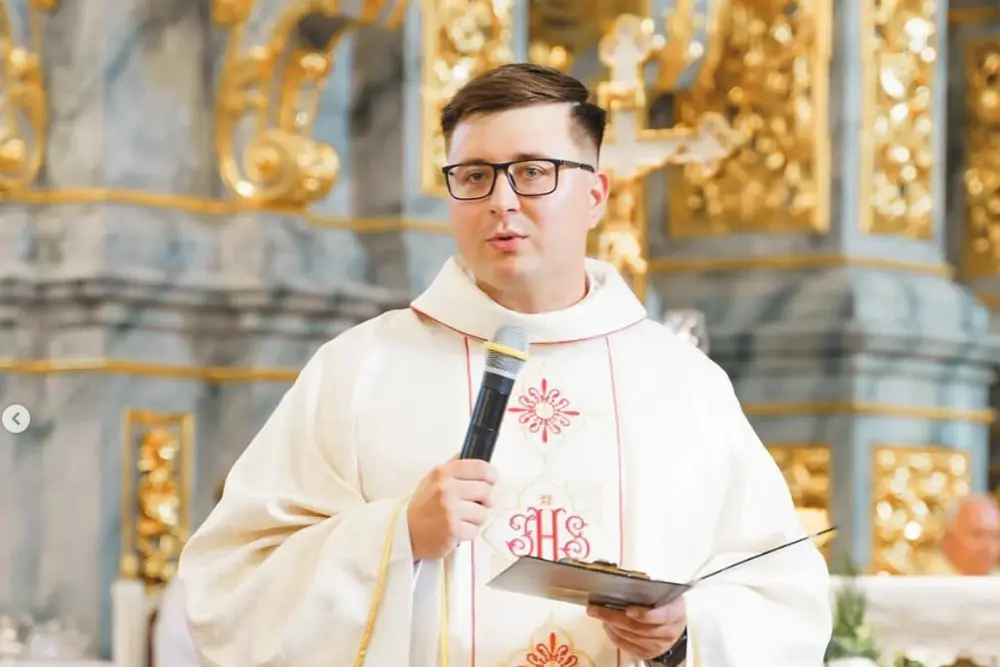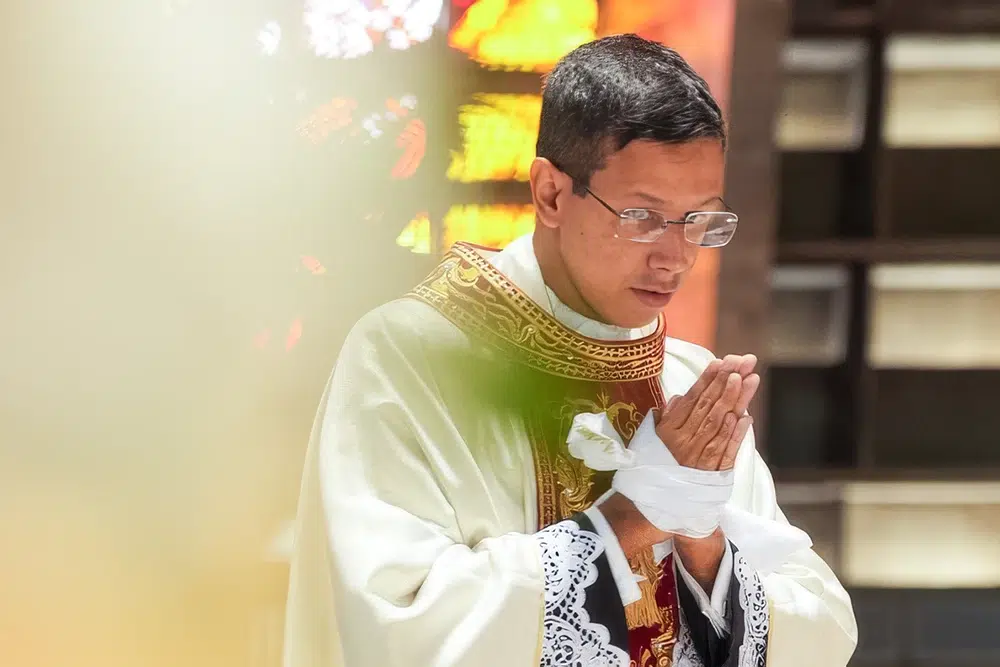
Lacton Lucas Carvallo's journey to to be a priest It all began at World Youth Day in Brazil, held in Rio de Janeiro, with Pope Francis leading an impressive apostolate that left no one indifferent.
Lucas belongs to the Diocese of São Sebastião in Rio de Janeiro. He is currently continuing his training at the Ecclesiastical Faculties of the University of Navarre, where he is pursuing a bachelor's degree in Dogmatic Theology thanks to the support of the benefactors, members, and friends of the CARF Foundation.
When Lacton reflects on the origins of his calling, his thoughts inevitably turn to an event that forever changed his life: the World Youth Day held in Rio de Janeiro in 2013, featuring a visit by Pope Francis.
At that time, he was considering the possibility of marriage and trying to discover what God’s plan was for him. However, during those days, he experienced something that transformed his heart. «During those days I felt God's presence so intense and personal that it really shook me to the core.
»It wasn't a fleeting feeling, but a gentle, persistent certainty that the Lord was looking at me with love and inviting me to something greater than I had ever imagined.".
He entered the seminary four years later
That experience opened a door that would never close again. The following year He attended a spiritual retreat in search of clarity about his future. There, through a simple yet profoundly enlightening sermon, he felt that God was confirming that inner calling.
But he didn't feel ready to take the final step. For two years, he continued to discern his vocation alongside his parish priest and the formators at his diocese’s seminary, who supported him with patience, a listening ear, and prayer.
Finally, in 2017, he entered the São José Seminary. Over the course of seven years, he received a solid human, spiritual, pastoral, and academic education, which he completed in 2024. «Those years were crucial in strengthening my relationship with Christ »and to understand the beauty of the priestly ministry," says Lacton.
Today, he looks back on that period with gratitude, and also on the opportunity he now has in Navarre to further his theological studies, so that he may better serve the Church in the future. «I am deeply grateful for this opportunity to deepen my faith and better prepare myself to serve the Church,», he says affectionately.
Faith has been a part of his life since childhood. He was born into a traditionally Catholic family, where religion was a part of everyday life. He particularly recalls the role his mother played, a key figure in his religious upbringing.
«My mother played a key role in my Christian upbringing: »She used to take my sister and me to church services when we were children, making sure we received the sacraments and that faith was part of our daily lives," she says with emotion.
However, as is the case with so many young people, His adolescence was also marked by a period of estrangement. He drifted away from sacramental practice and sought to fit in with his friends and experience what the world presented as freedom. «Even so, I never stopped believing; the seed of faith was still alive, though dormant,» he confesses.
Over time, he realized that Many of those experiences left me feeling empty inside. Looking back, he believes that his search and a certain rebellious streak helped him better understand human frailty and the need for a personal encounter with Christ.
That is why he is convinced that The 2013 World Youth Day was a turning point for him and for thousands of young people, because it rekindled «the flame of God’s love, reminding us that true joy comes from an encounter with the living Christ.».
To speak of his vocation is also to speak of Brazil, a deeply religious country with a Christian majority, where faith continues to permeate the culture, popular celebrations, and daily life.
His diocese, San Sebastián de Río de Janeiro also holds a special place in the history of Brazilian Catholicism: It was there that Latin America’s first cardinal was ordained, and the National Conference of Bishops was established, a decisive milestone for the country’s pastoral organization.
Although Brazil enjoys religious freedom and the Church is able to carry out its mission without restrictions, this young priest acknowledges that social reality poses enormous challenges.
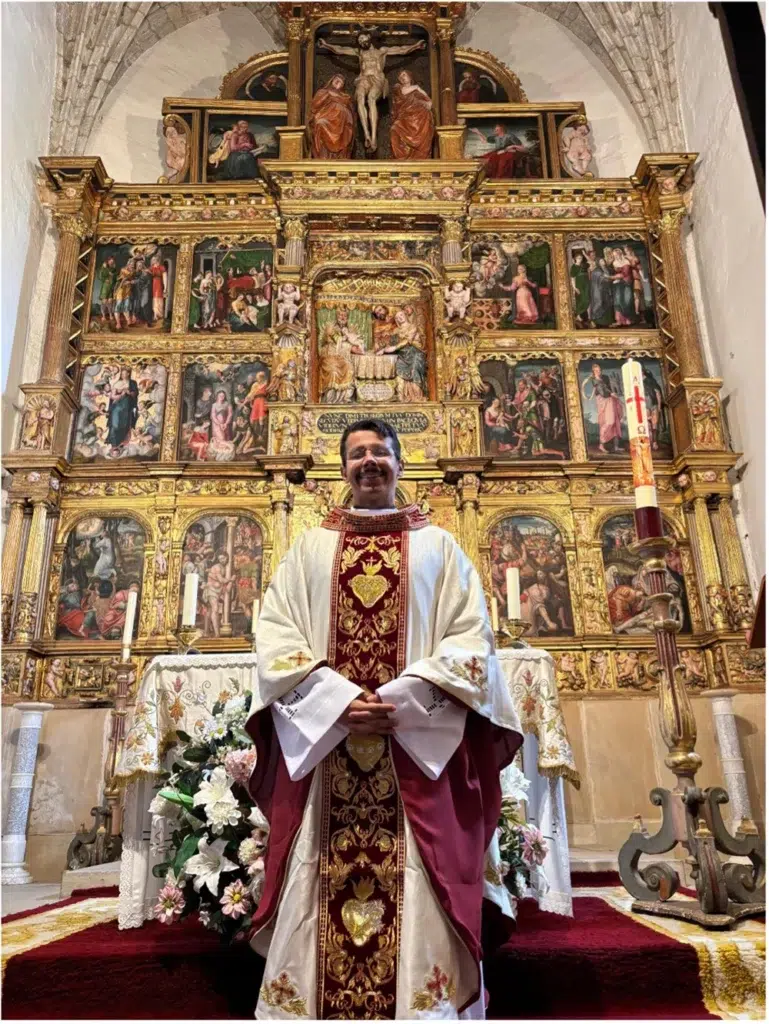
«We are facing serious social and economic problems: inequality, unemployment, corruption, a lack of political accountability, and poor public administration. Many people are closing their businesses, others are unemployed, and this directly affects the lives of families as well as »the Church's ability to meet the material needs of the faithful," explains Lacton.
Nevertheless, he emphasizes that the faith of the Brazilian people remains strong and that the Church continues to serve as a moral, spiritual, and social guide.
He arrived in Spain two months after his ordination
Lacton Lucas arrived in Spain two months after his ordination, filled with enthusiasm and eager to receive training so he could fully carry out his ministry upon returning to his diocese.
Because he is well acquainted with the needs of the local church. Although they have a considerable number of priests, he acknowledges that many more are needed given the large number of faithful and the scope of the pastoral challenges.
«The pastoral need is enormous: large communities, neighborhoods with urgent social needs, families in need of support, young people searching for meaning, the elderly in need of comfort...».
In light of this reality, highlights the selfless work of priests and bishops who, through listening, a supportive presence, and numerous charitable initiatives, strive to alleviate the suffering of the people.
Many parishes offer free medical and legal consultations, distribute food to families in need, support vulnerable individuals, and carry out evangelization and educational initiatives. «For many Brazilians, the »The Church remains a true refuge and a place of hope,", states.
Another challenge he notes is the growth of numerous Protestant groups and the the rise of secularism. «Yes, the proliferation of protest groups does affect us. This is happening, in part, because we remain a religious country and people have a thirst for the sacred,» he explains.
However, he warns that some people end up turning away from the Catholic faith due to a lack of solid formation, while certain groups use Sacred Scripture for proselytizing purposes.
Youth evangelization is alive and well
But his spirits remain high, and he views this reality with hope: «Many young people—in Brazil and in other countries—are inspiring other young people to come to know Christ through retreats, gatherings, worship groups, and community experiences.”. »Youth evangelization is alive and well, and that is a sign of hope.", he says enthusiastically.
Furthermore, he believes that relations with Protestant communities need not be contentious, as there is a shared search for God and a sincere desire to live out one’s faith. This closeness can also provide an opportunity for many to discover the richness of the Catholic tradition.
Because Lacton is clear about this: «To evangelize today, especially among young people, it is essential to show the beauty of the faith, »the depth of the liturgy, the power of the sacraments, and the joy of a life dedicated to Christ. It is also necessary to make use of digital media, to accompany people on their personal journeys, and to provide spaces for genuine encounter.".
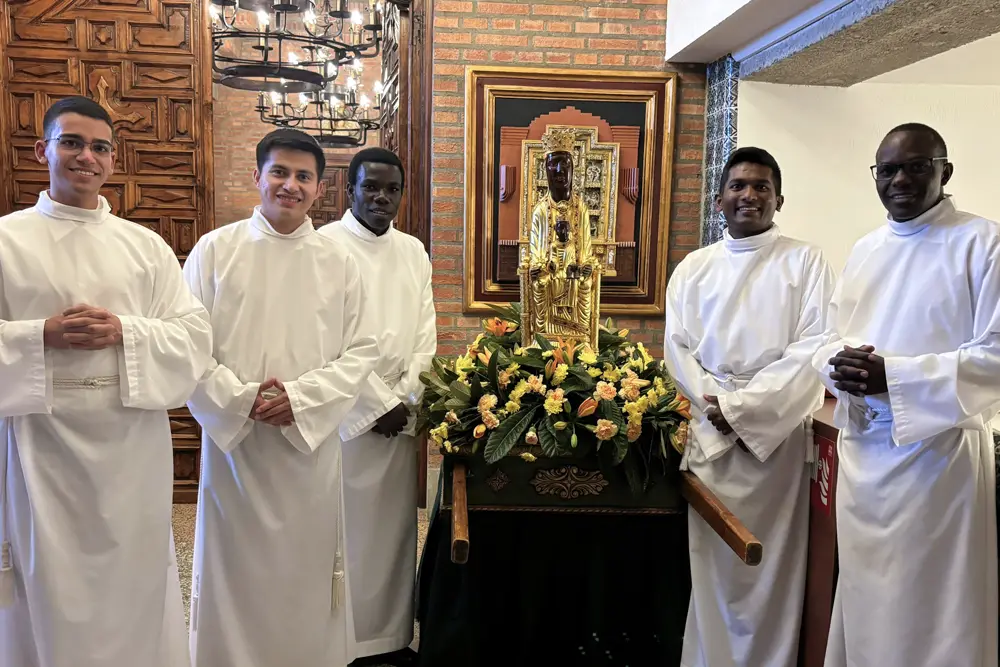
His stay in Spain has allowed him to view the reality of the Church from a different perspective. He is particularly struck by the beautiful processions and the deep devotion to the Virgin Mary that he encounters in many regions. «»Spain boasts an impressive spiritual heritage, the result of centuries of faith.", he says admiringly.
At the same time, he senses less involvement in church life than is typically found in Brazil. Many people receive the sacraments of Christian initiation and later drift away from religious practice. For this reason, he acknowledges that he has encountered a fairly secularized society, especially in some parish settings where pastoral involvement is limited.
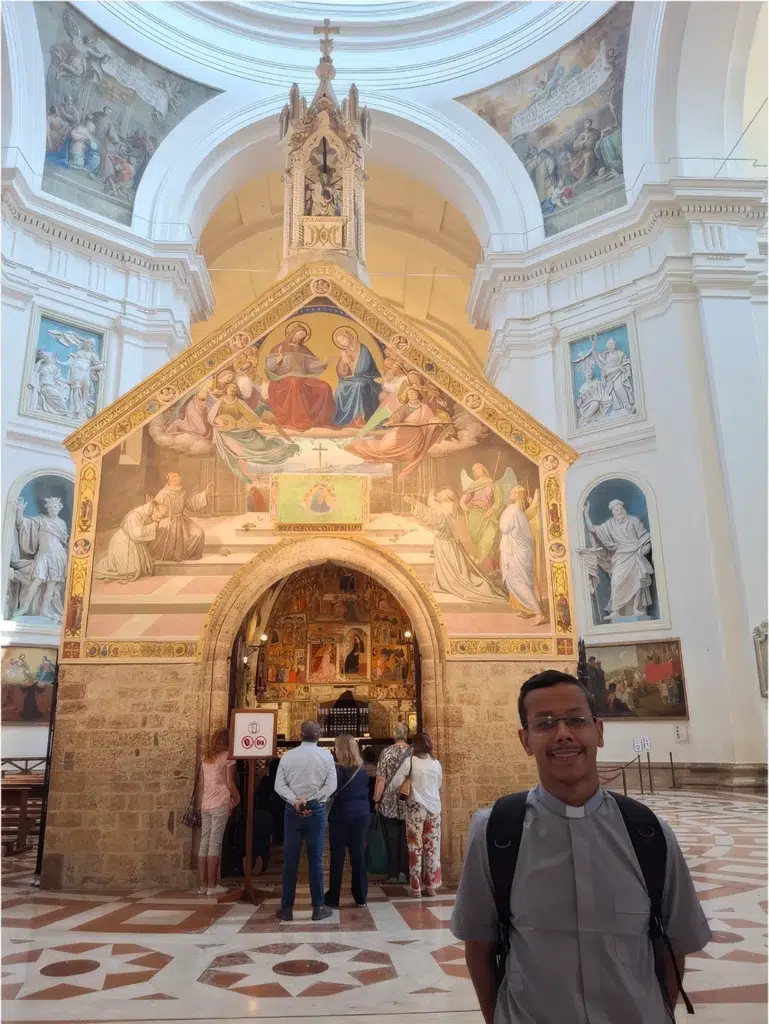
However, he hasn’t lost hope here either. «I also see young people seeking God, vibrant communities, and parishes working with creativity and enthusiasm. But I believe we still need a Church that reaches out, as Pope Francis urges us to do.».
To be a priest is to bring Christ’s presence into one’s life
When he reflects on the priest of the 21st century, his answer stems from his own experience as someone who has just begun his ministry. He is convinced that priests «must bring the presence of Christ through the witness of their lives» and be open to everyone and to be men deeply rooted in prayer «so that the world may see that Christ is the answer to all problems.».
For him, the priest is called to be a bridge: a bridge between God and humanity, between tradition and the modern world, between faith and culture. He must know how to listen, accompany, discern, console, and courageously proclaim the truth of the Gospel.
«To evangelize, It is essential to understand people’s hopes and desires, to comprehend their wounds, their quests, and their fears. »It is also necessary to make use of social media, maintain a presence in the digital world, and encourage greater participation by the laity—especially young people, who play an essential role in the Church’s mission,” Lacton concludes.
This young priest is convinced that Christ continues to call, accompany, and transform hearts.
Marta Santínjournalist specializing in religion.
Table of Contents
A summary in five sentences of Pope Francis’s speeches at World Youth Day in Rio de Janeiro, his first pastoral trip.
1. «I’d like to say one thing: what do I hope will come out of World Youth Day? I’m expecting a stir. There’s going to be a stir in here, there really is. There’s going to be a stir here in Rio, there really is. But I want a stir in the dioceses; I want people to go out into the world… I want the Church to go out into the streets; I want us to defend ourselves against everything that is worldliness, against complacency, against comfort, against clericalism, against being closed in on ourselves.» (Meeting with Argentine youth).
2. «The future demands that we set about today the task of restoring politics—restoring politics, which is one of the highest forms of charity. The future also demands a humanistic vision of the economy and a political system that increasingly and more effectively involves people, avoids elitism, and eradicates poverty» (Speech at the Municipal Theater in Rio).
3. «Even today, the Lord continues to need young people for his Church. Dear young people, the Lord needs you. Even today, he calls each one of you to follow him in his Church and to be missionaries. Dear young people, the Lord is calling you today. Not just the crowd. You, you, you—each and every one of you. Listen to your hearts to hear what he is saying to you.» (Prayer Vigil).
4. «The field, besides being a place for sowing seeds, is also a place for training. Jesus asks us to follow him throughout our lives; he asks us to be his disciples, to «play on his team.» Most of you like sports. Here in Brazil, as in other countries, soccer is a national passion. Right? Well, what does a player do when he’s called to be part of a team? He has to train—and train hard. That’s what our life as disciples of the Lord is like.» (Prayer Vigil).
5. «Where does Jesus send us? There are no borders, no limits: he sends us to everyone. The Gospel is not for a select few but for everyone. It is not just for those who seem closest to us, most receptive, or most welcoming. It is for everyone. Do not be afraid to go and bring Christ to every setting, even to the existential peripheries, and to those who seem farthest away, most indifferent. The Lord seeks everyone; he wants everyone to feel the warmth of his mercy and his love.» (Sending Mass).
 carf@fundacioncarf.orgLandline: +34 914 029 082Mobile: +34 638 078 51145 Conde de Peñalver Street.