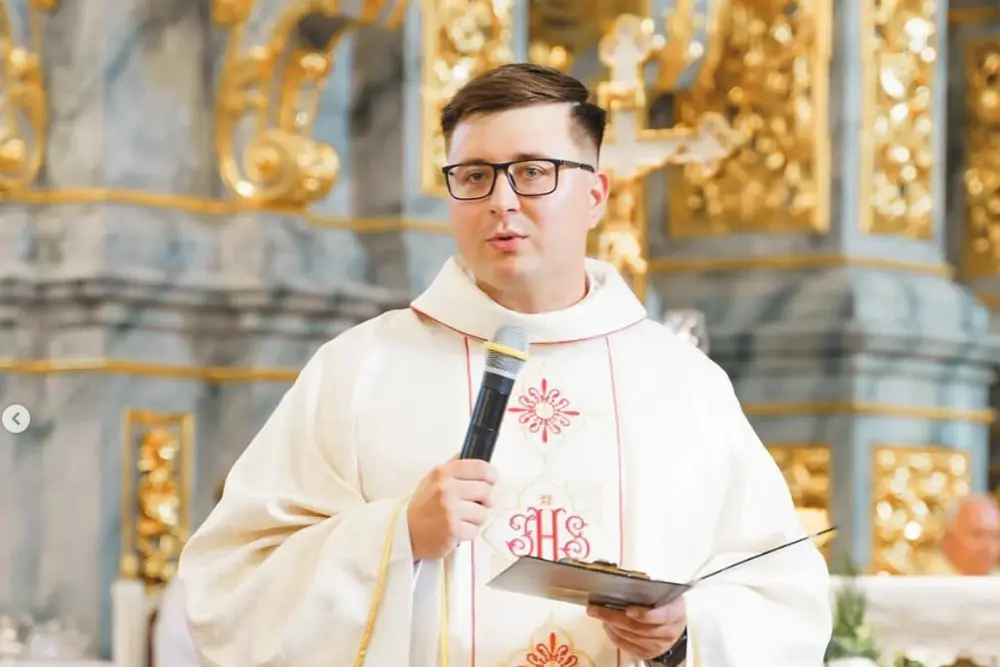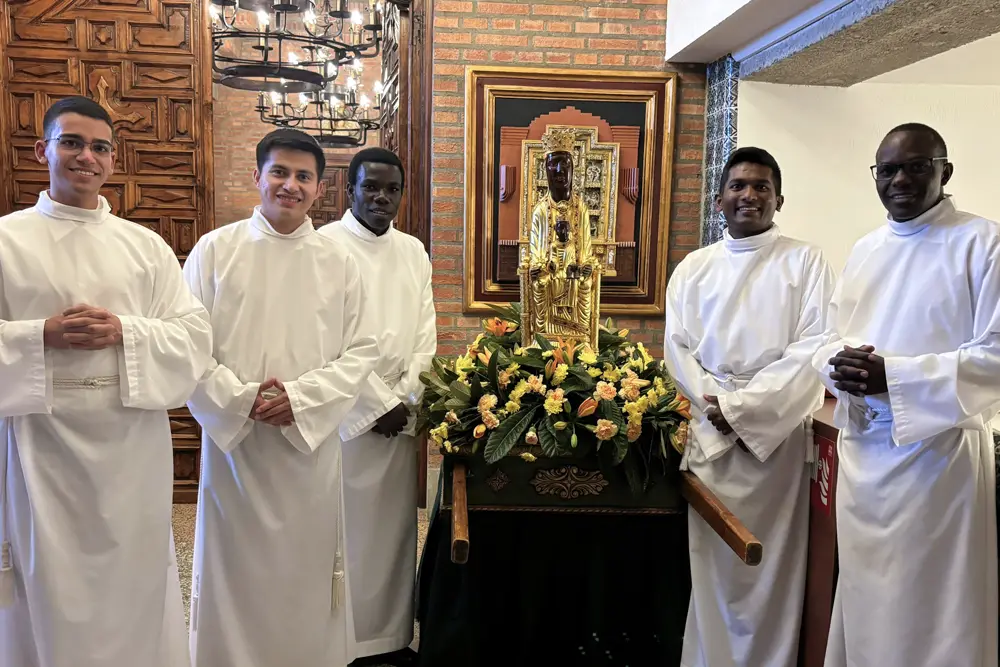
Liturgical objects and sacred vessels were gaining importance since the first centuries of Christianity. Many of them were conceived of as relics, such as the Holy Grail and the Lignun Crucis.
. The presence of sacred vessels in the Middle Ages is evident not only from the objects that have come down to us to the present day, but also from the numerous documentary sources: inventories of the churches in which the acquisitions or donations of certain liturgical objects were recorded, among which the sacred vessels stood out.
Nowadays, we call sacred vessels the utensils of liturgical worship which are in direct contact with the Eucharist. Because they are sacred, they are used only for that purpose and must be blessed by the bishop or a priest before they are consecrated with them.
In addition, they must have the necessary dignity to carry out the Holy Mass. According to the Spanish Episcopal Conference -each bishops' conference details its standards of dignity according to local traditions- it is required that they be made of noble metal or other solid, unbreakable and incorruptible materials and that they be considered noble in that place.
The paten and chalice are the most important sacred vessels since the beginning of Christianity. They contain the bread and wine that will be consecrated during the Holy Mass and that will become the Body and Blood of Christ. With the passing of time, and the needs of Eucharistic worship and of the faithful, other sacred vessels have appeared, such as the ciborium, pyx (with which communion is brought to the sick) and the monstrance, as well as other accessories.
After the celebration of the sacraments, the priest cleans and purifies the liturgical objects he has used, since all must be clean and well preserved.
Having all the elements necessary to impart the sacraments and celebrate the Holy Mass is indispensable for the ministry of a priest.
For this reason, the Social Action Board (PAS) of the CARF Foundation delivers each year sacred vessel backpacks to seminarians from all over the world who are studying in Pamplona and Rome and who are graduating and returning to their home countries. The current backpack contains everything necessary to celebrate Holy Mass with dignity in any place, without the need for a previous installation.
The Sacred Vessel Backpack of the CARF Foundation enables young priests without resources to administer the sacraments where they are most needed. At this time, it is not only the priest in front of them, but also all the benefactors who will make it possible for them to exercise their ministry with adequate material dignity.
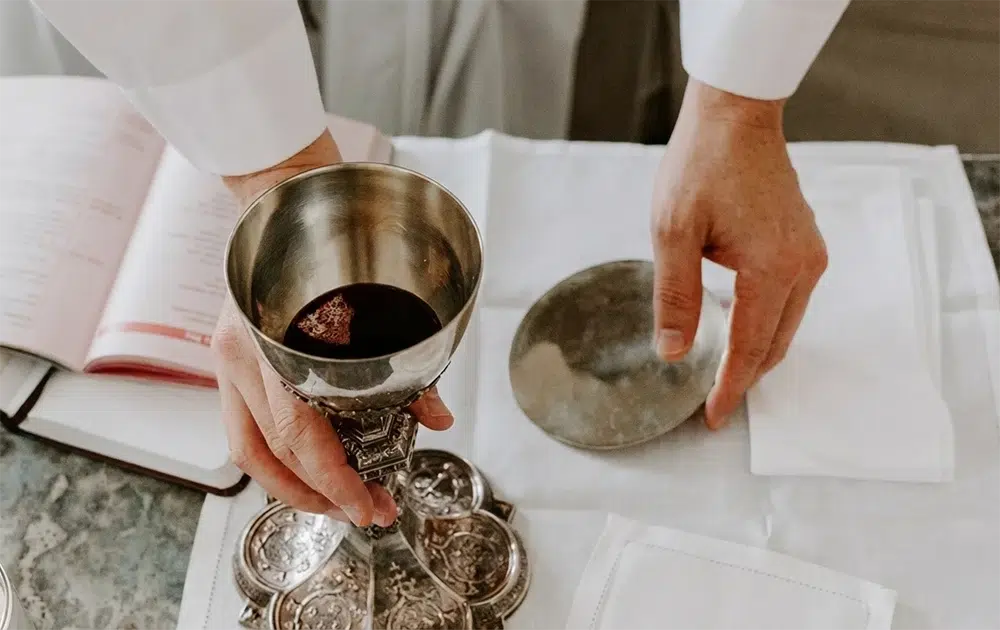
The principal sacred vessels are those which, previously consecrated, have been destined to contain the Holy Eucharist. Like the chalice, paten, ciborium, pyx, monstrance and tabernacle.
Contrary to the sacred vessels secondary, that do not have contact with the Eucharist, but are intended for divine worship, such as the cruets, acetre, hyssop, incense burner, bell, alb and the candlestickamong others.
From Latin calix which means drinking cup. The calyx is the sacred vessel par excellence. Used by Jesus and the apostles at the Last Supper, it was probably a glass of kiddush (Jewish ritual tableware for the Passover celebration), being at the time a semi-precious stone bowl.
The earliest known official decrees from synods date back to the 11th century, already expressly prohibit the use of glass, wood, horn and copper, because it is easily oxidized. Tin is tolerated and noble metals are recommended instead.
The shape of the ancient chalices resembled more a cup or amphora, often with two handles for easy handling. This type of chalice was in use until the 12th century. Since that century almost all chalices, devoid of handles, are distinguished by the width of the cup and by a greater separation between it and the foot that constitutes the stem of the chalice with the knot, at mid-height.
It comes from the Greek phatne which means plate. It refers to the shallow, slightly concave tray or saucer where the consecrated bread is placed in the Eucharist. The paten came into liturgical use at the same time as the chalice and must be gilded on the concave side. It is important that it allows easy collection of particles on the body.
In the accounts of the Last Supper, mention is made of the dish with the bread that Jesus had before him on the table (Mt 26:23; Mk 14:20). As for the material of the patens, it followed the same evolution as the chalice.
Accessories for chalice and paten
The conservation of the Eucharist after the celebration of Mass is a custom that dates back to the early days of Christianity. ciborium.
In ancient times the faithful sometimes kept the Eucharist, with exquisite care, in their own homes. St. Cyprian speaks of a little chest or ark that was kept at home for this purpose (De lapsis, 26: PL 4,501). It was also, of course, kept in the churches.
They had a space called secretarium o sacrarium, in which there was a kind of closet (conditorium) where the Eucharistic chest was kept. These conditorium were the first tabernacles. They were usually made of hard wood, ivory or noble metal; and they were called píxides -with a flat lid, fastened with hinges, or with a conical lid and in the form of a turret with a foot.
In the late Middle Ages, the possibility of receiving communion outside of Mass became popular, requiring a larger size and evolving into the present-day cup: a large cup used to distribute communion to the faithful and then to keep it to preserve the body of Christ. It is covered, when kept in the tabernacle, with a circular veil called the conopeo, the name also given to the veil that covers the tabernacle in the color of the liturgical season.
In places where Holy Communion is solemnly brought to the sick, a small ciborium of the same style is used. The small pixel used is made of the same material as that of the ciborium. It has to be gilded on the inside, the bottom should have a slight rise in the center, and it should be blessed by the shape. Benedictio tabernaculi (Rit. Rom., tit. VIII, XXIII). It is also called teak or portaviático and it is usually a round box made of noble materials.
The monstrance is an urn framed in glass in which the Blessed Sacrament is publicly exposed. It can be made of gold, silver, brass or gilded copper. The most suitable shape is that of the sun that emits its rays everywhere. The lunette (manly or lunula) is the vessel in the middle of the monstrance, made of the same material.
The lunette, as long as it contains the Blessed Sacrament, can be placed in the tabernacle within a crate. If the tabernacle has enough space to hold the monstrance, then it should be covered with a white silk veil. It is also used for processions outside the church on special dates such as the Feast of Corpus Christi.
All these vessels should be made of gold, silver or other material, but gilded on the inside, smooth and polished, and may be topped by a cross.
The wine coolers are two small pitchers where the water and wine necessary to celebrate the celebration are placed. Holy Mass. The priest mixes the wine with a little water and, for this, he has a complementary spoon. They are usually made of glass so that the priest can identify the water in the wine, and also because they are easier to clean. However, you can also find bronze, silver or pewter cruets.
Acetre
It is a cauldron in which holy water is placed and is used for the liturgical sprinklings. All the water that collects the acetre, is dispersed with the swab.
Hyssop
Utensil with which the sprinkles holy waterconsisting of a handle with a bunch of bristles or a hollow metal ball with a hole at the end to hold the water. It is used together with the acetre.
Censer and incense
The censer is a small metal brazier suspended in the air and held by chains which is used to burn incense. Incense is used to manifest worship and symbolizes the prayer that goes up to God.
Bell
It is an inverted cup-shaped utensil of small size with a clapper inside, that used to call for prayer during the consecration. The bell is used to attract attention and, in addition, to express a feeling of joy. There are single-bell or multi-bell bells.
Candlestick
It is a support where the candle is placed which is used in the liturgy as a symbol of Christ, who is the Light that guides all.
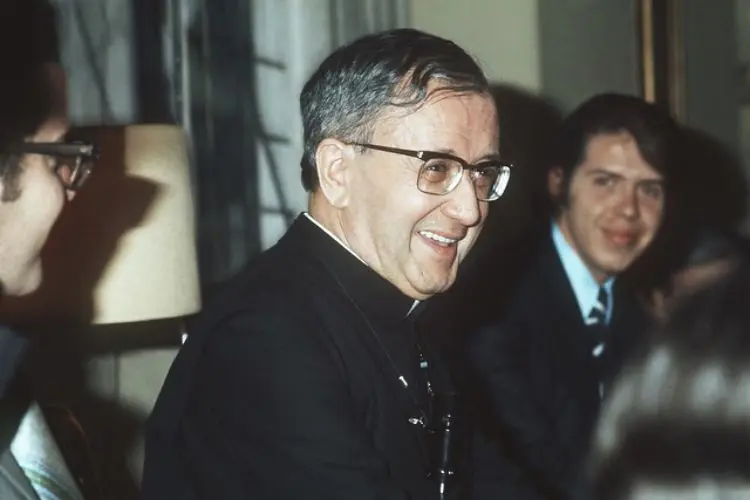
"The woman who, in the house of Simon the leper in Bethany, anoints the Master's head with rich perfume, reminds us of our duty to be splendid in the worship of God.
-All the luxury, majesty and beauty seem little to me.
-And against those who attack the richness of sacred vessels, ornaments and altarpieces, the praise of Jesus is heard:opus enim bonum operata est in me»-a good deed has he done with me». St. Josemaría
(Camino, 527).
Table of Contents
 carf@fundacioncarf.orgLandline: +34 914 029 082Mobile: +34 638 078 51145 Conde de Peñalver Street.