Adrienne studied Institutional Communication for NASA.

The Pontifical University of the Holy Cross not only trains seminarians, priests and religious. It also trains professionals who work in the field of communication not only in ecclesiastical institutions, but also in academic institutions.

This is one of the objectives of the PUSC, and especially of the School of Social and Institutional Communication: to prepare people who work in radio, television, cultural entities or governmental and scientific organizations, as is the case of Adrienne Alessandro O'Brien.

Head of Communications at NASA

After obtaining a Bachelor's degree from the School of Communication at the University of the Holy Cross (between 2007 and 2008), Adrienne Alessandro O'Brien worked in the NASA, The U.S. government's space agency, as communications manager for the Goddard Space Flight Center.

It is a NASA research laboratory that has the largest organization of scientists and engineers dedicated to expanding knowledge of the Earth, the solar system, and the universe via space-based observations within the United States and is instrumental in developing and operating unmanned scientific satellites and directing scientific research, space development and operations, and many NASA and international missions, including the Hubble Space Telescope (HST), the Explorer program, the Discovery program, and many others.

From indecision to St. Peter's Basilica

Gerardo Ferrara interviewed Adrienne to learn about her experience as a student in Rome.

Gerardo Ferrara, GF. And when did you understand more clearly that you were called to your mission as a wife, mother and communicator?

Adrienne Alessandro, AA. -After many years of indecision about my vocation, and unfortunately after a time when I turned away from God, I finally found a place where I felt at peace: St. Peter's Basilica in Rome. 

I was in the eternal city for a semester of studies. On one of the guided tours, I saw the resting place of the bones of St. Peter: a man who had walked with Christ and embraced his Body. I thought that the first Pope had understood the true meaning of vocation. He said yes to God again and again, even after he had denied him. So, I asked God (again) to end my vocational confusion. Immediately afterwards I felt a profound, literally otherworldly peace: I finally saw my vocation to marriage clearly illuminated and never had any doubts about it again.

GF. -To study something that would impact the world. After this experience in San Pedro, you returned to Washington.

AA. -Yes. I spent two years doing clerical work for political nonprofits in Washington, D.C. Endless hours making photocopies and booking co-workers' flights slowly choked the creativity in my soul. Professionally, I had always wanted to be a writer and communicator and now I was at a dead end. I wanted to do something that would impact the world. That's how I came to the Pontifical University of the Holy Cross.

GF. -Why did the University of the Holy Cross catch your attention?

AA. -Basically because I was in Rome, but the academic offer of the Faculty of Communication, the warmth and kindness of the professors, in particular Professor Arasa and Professor La Porte, made me feel immediately at home.

Academically, I loved that the Holy Cross program was so hands-on. I learned how to use a video camera, write commercial scripts, and edit audio files-I loved it all! The media training classes were my favorite because they challenged me to anticipate and explore arguments against the faith and create rational and appropriate responses. The friendships I made were irreplaceable. These are memories I will always treasure.

GF. In addition, you discovered the universality of the Church in Rome. 

AA. -Yes, and also its fragility. It was a turning point in my life when I asked myself: what could I do, on a personal level, to be a stronger and holier member of the Body of Christ and help heal this beautiful, broken Church? I still think about these questions to this day, especially in light of the sex abuse scandals around the world that have caused many others to question their faith. And I believe that the Pontifical University of the Holy Cross gave me the tools I need, personally and professionally, to help address it.

"I believe that when preached with honesty, understanding and conviction, the message of Christ remains fresh and compelling, even to young people, who are hungry for answers to life's most important questions."

Woman, Catholic and at NASA

Adrienne Alessandro O'Brien was born in 1983 in Wilmington, Delaware (USA). She is the mother of two young children and one on the way. After graduating from the School of Social and Institutional Communications at the Pontifical University of the Holy Cross (2007-2008), she worked at NASA, the U.S. government space agency, as communications manager for the Goddard Space Flight Center.

At one point in his life he asked himself: What can I do, on a personal level, to be a stronger and holier member of the Body of Christ and help heal this beautiful Church?

For her, women, with their unique (if not exclusive) ability to foster interpersonal relationships, play a key role. "But we all need support. We need strategic, engaging and outreach grassroots campaigns, supported by our bishops and leaders, to engage and catechize both the faithful and the far-flung," she says. 

GF. Did you work for NASA? Was it difficult for you as a woman and as a believer?

AA. -We were only a few coworkers, but I always felt incredibly respected and appreciated by my team. However, I was very self-conscious at first. I was working with men and women who had managed the missions to upgrade and repair the Hubble Space Telescope. They had just begun to develop technologies that would enable the refueling and repair of robotic satellites in orbit. What on earth could I offer these geniuses? I wondered

GF. -Well, communicating for ordinary people. Tell us how you developed your work.

AA. -As time went on, I gained confidence in my abilities, both as a communicator and as a woman. As brilliant as my co-workers were, they needed someone who could capture their technical idea and communicate it in a way that “ordinary” people could understand.

That was something I could do. I loved participating in strategy sessions, where I could help the team identify their target audience and formulate effective ways to reach them. I found that my person-oriented, person-centered background coupled with my feminine characteristics helped me intuit and identify some of the human issues and pitfalls the team would face, long before the technology-oriented team could recognize them.

GF. -What did you find most useful in your education at the University of the Holy Cross?

AA. -Two lessons have always stuck with me: first, earn trust and build a solid relationship with the executives on your team if you want to be a effective communicator and accurate. And second, always, always! keep your audience in mind.

During my seven years at NASA, I created and executed communications campaigns for robotic experiments that were to be launched into orbit and operate on the International Space Station; designed the team's website from scratch; conducted media training sessions for television and written interviews; conceived and managed educational video productions; gave tours of our robotic facilities to politicians and scientists; and acted as a strategic public relations advisor to my team's senior leaders.

GF. -And how did being Catholic help you?

AA. -For, throughout my career, my identity as a Catholic woman was fundamental, with the characteristics that our faith can add to any profession: kindness and consideration for the time and unique talents of others, respect, always working for the good of my team....

GF. -What I see in your human and professional history is a positive vision of what a Christian can do when he lives his faith well and truly in all aspects of his ordinary existence.

AA. -I do not see the Western and secularized world as an obstacle to evangelizing, especially to youth. I believe that when preached with honesty, understanding and conviction, the message of Christ remains fresh and compelling, even to young people: a group hungry for answers to life's most important questions.

Obstacles to evangelization

GF. -EIn your opinion, what is the greatest obstacle to evangelization?

AA. -I believe these are the crises that are growing within the Church itself. We cannot transmit what we do not have, and in many parishes and communities we have lost the true knowledge of our Catholic identity: who we are, what we believe and what it means to be Catholic in daily life.

Today's generations of Catholics can no longer explain the basic teachings, including the Eucharist. We can either blame others or we can look inward and consider whether I, personally, have raised my voice lately to witness to Christ in the public square or with my neighbor.

GF. -Today we talk about the role of women in evangelization....

AA. -Each of us, in our daily interactions with others, is called to share faith. The women, with their unique (if not exclusive) ability to foster interpersonal relationships and build community, have a critical role to play. But we all need support.

We need strategic, attractive and outreach grassroots campaigns, supported by our bishops and leaders, to engage and catechize both the faithful and those furthest away. In particular, we need to be willing to talk to young people and get to know their challenges and their hearts.

While young people may be skeptical or resistant to broad, impersonal messages, accompaniment is helpful in answering their questions and fostering an understanding of Christ's love and purpose in their lives.

"We should strive, as much as possible, to identify personal wounds and seek God's healing in our lives, either through accompaniment or therapy, especially in young people."
Adrienne estudió Comunicación Institucional para la NASA
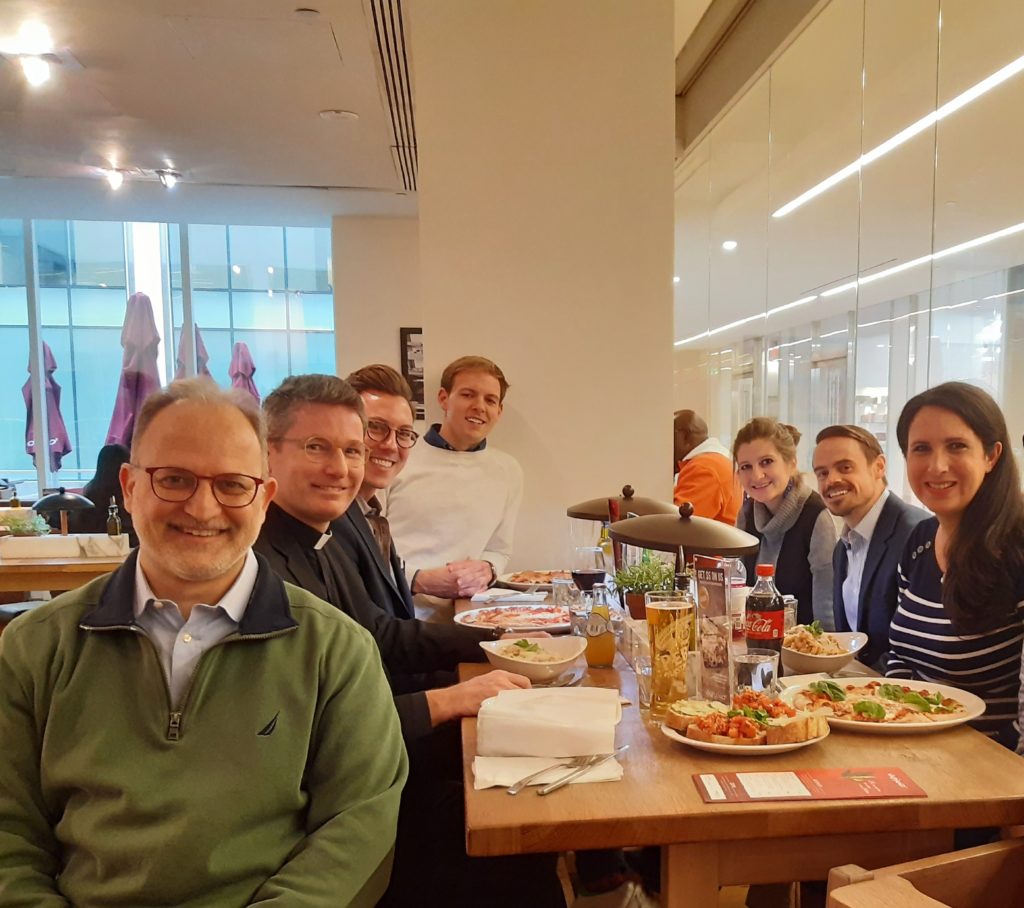
Adrienne during a lunch with teachers and friends in Rome.

GF. Everything you say presupposes a greater awareness and responsibility on the part of Catholics....

AA. -Undoubtedly! None of these efforts will do as we address, for example, the sexual abuse crisis. So far, many have felt that the church's response has been inadequate.

In the wake of new horrific stories, some dioceses in the United States have issued statements shrouded in protective, stale and evasive legal language: words that fail to capture the depths of repentance and atonement that our own Catholic faith demands. The nature and depth of these sins cry out and demand a humble and unconditional response.

How can we claim to proclaim the Word of God when our own actions and public relations efforts fall so far short of embodying what God called us to do? Abandoning the purely legalistic mindset and returning to our authentic Catholic identity in handling this crisis will allow us to regain our credibility and proclaim Christ to a world that desperately needs our message.

The challenge of Catholics in the United States

GF. The United States has been particularly affected by this plague. We are seeing an increasingly internally divided American society. Might this not be a good challenge for U.S. Catholics?

AA. -That's a really difficult question to answer, since also the U.S. Catholics are very divided on many issues, attacking each other on social networks and all in the name of... Jesus! Perhaps therein lies not only the root of the problem, but also a hint of the cure.

In my opinion one of the most destructive elements of today's society is our collective addiction to mobile devices and social media platforms, and the resulting discourtesy they foster. We are constantly entering a field of virtual indoctrination filled with secular conceptions and virtue-free responses, and many of us (myself included) often forget to put on the armor of Christ before going online.

GF. -Sometimes you have to close one, two, three, thousands of virtual doors to find a little peace.

AA. -Yes, and that is precisely why I believe that our hope lies in reclaiming our Catholic identity beginning with these small victories on a personal level.

Let us live the Gospel and remember our ultimate goal. When Christ described the final judgment, He did not mention political affiliation or verbally “destroying” someone in the nets. Rather, He said that He would ask each of us: when did you feed me, give me to drink, house me, or clothe me?

Our hearts would be much calmer if we could remember this before every encounter with a human being, even faceless strangers online. The virtues of humility, gentleness, understanding, charity: these are means that can transform our behavior and ultimately uplift society.

Personal holiness may not be an instant solution, but exercising some additional graces is the most powerful tool we Catholics have to bring about change.

Mother of three children

GF. -Besides your work, the most important thing for you is your family.

AA. -With two children under the age of three and one more on the way, my husband and I often feel like we are in survival mode!

However, personally, in every interaction with my children, I try to remember that I am more than just a mother to them, that I can be two things: either their first and foremost experience of God's love, understanding and forgiveness; or, conversely, I can establish myself as a model of how a beloved authority can judge them harshly, punish them, break their spirit and betray their trust.

Sometimes I wished I had been a mother in another era, a time when neighborhoods were safer, social contrasts weren't so stark and the porn-filled Internet didn't exist. But each decade has its own challenges and obstacles. I try to trust that God will give me the wisdom and words I need to shepherd these little ones through life to heaven.

GF. -Thank you for your testimonial. Any final message for our readers?

AA. -It has been a pleasure for me. If I could encourage one thing in general, it would be to strive, as much as possible, to identify personal wounds and seek God's healing in your life, either through accompaniment or therapy, especially in young people.

God has given us both spiritual and human tools to be at peace. Let us take every opportunity to be healthy and whole people so that we can respond appropriately to his call and share his love with others.

GF. -Thank you very much, Adrienne.

Acknowledgments to the CARF Foundation

It is very nice to continue celebrating with stories like this one the Faculty of Social and Institutional Communication of our University, a Faculty that Blessed Álvaro del Portillo insisted on having, and that would not have been possible without the contributions of all the members, friends and benefactors of the CARF Foundation.

St. Philip Neri used to say: «who does good to Rome, does good to the world». And with the stories of our students and former students we realize more and more this truth: the smallest contribution of our friends and benefactors has helped our students to bring not only a good formation around the world, but a true human and Christian wisdom, which is what the world needs.


Gerardo Ferrara
BA in History and Political Science, specializing in the Middle East.
Head of the student body at the Pontifical University of the Holy Cross in Rome.
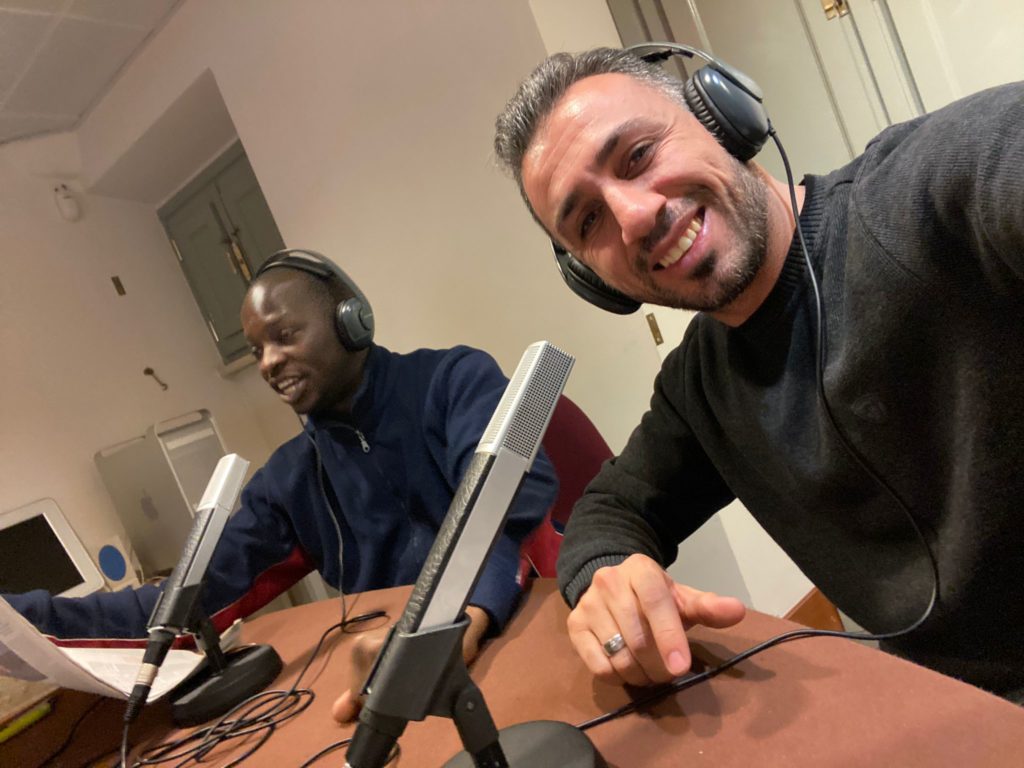
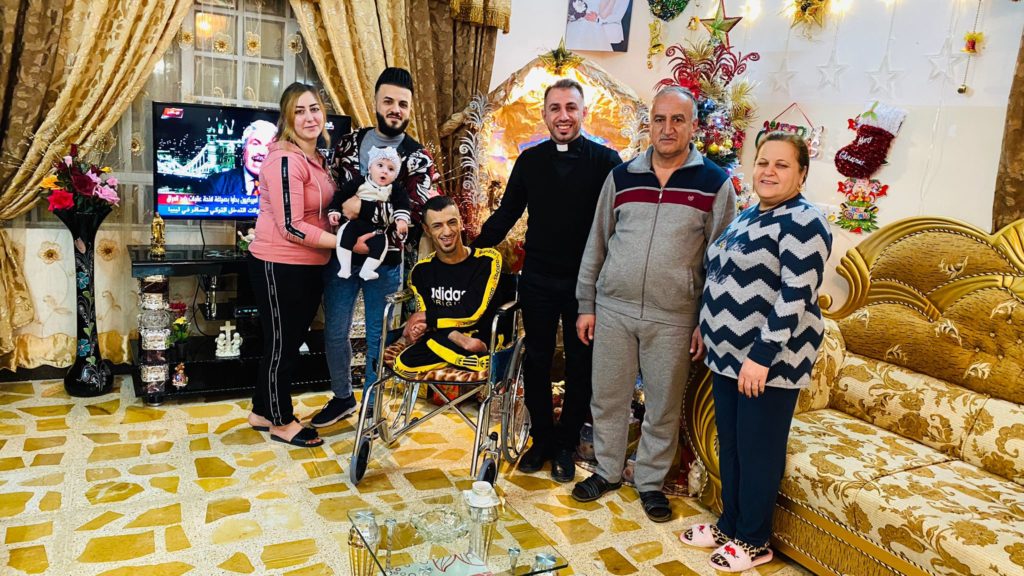
Aram Pano, Iraqi priest: a vocation of war

Gerardo Ferrara, responsible for student affairs at the PUSC, interviewed Aram Pano, a priest from Iraq, who took part in a meeting of CARF Foundation. In his speech he addressed the social, cultural and religious situation in Iraq, as well as the impact of the Holy Father's visit on the country.

Aram Pano, AP. - «The visit of the Holy Father was a great challenge to those who want to destroy the country and showed the true values of Christianity in a nation where Christians are rejected; all this, in the light of the encyclical Fratelli tutti. Iraq needs fraternity. That is why the trip changed something: socially and at the level of the people there will be changes; at the political level, however, I don't think it will change much».

Aramaic, the language of Jesus

"Thank you for inviting me to speak to our Spanish-speaking friends!Shlama o shina o taibotha dmaria saria ild kolwhich in Aramaic means "peace, tranquility and God's grace be with you all," greets Aram.

Gerardo Ferrara, GF. -Unbelievable! Unbelievable! It is shocking to hear Aramaic, the language of Jesus... And above all to know that it is the common language of many people, after two thousand years.

AP. Yes, in fact Aramaic, in the Eastern Syriac dialect, is my mother tongue and the language of all the inhabitants of the area where I was born, in northern Iraq, which is called Tel Skuf, which means Bishop's Hill. It is located about 30 km from Mosul, the ancient city of Nineveh, in the Christian heart of the country.

GF. So the whole village where you grew up is Christian.

AP. Yes, a Catholic Christian of the Chaldean rite. Life there was very simple: almost all the inhabitants are peasants and live by cultivating their fields and taking care of their livestock. People exchanged the products of the land and each one had what they needed to live. In addition, it is present the custom of offering the first fruits of the harvest, each year, to the Church, to support the priests and so that they too can take care of those most in need.

I remember that the houses were big enough for a family to live in... And for us, family is something quite extensive: children, fathers, mothers, grandparents... They all live together in these typical oriental homes, white and square, with a courtyard in the center, like a garden, and the rooms around it.

GF. -But this idyllic peace only lasted a few years....

AP. Well, in fact it never existed, because when I was born we were in the last year of the Iran-Iraq war, a war that lasted eight years and resulted in more than 1.5 million dead. My father and three of my uncles fought in the conflict and it was a very difficult time for my grandmother and mother. They hoped and prayed for their loved ones to come home. And they did, thank God, my father and his brothers came back.

GF. -And in 1991, another war broke out....

AP. We stayed in our village only until 1992, when the First Gulf War ended, between Iraq on one side and Kuwait and the international coalition on the other. We moved to a large city in southern Iraq, Basra, the third largest city in the country after the capital Baghdad and Mosul. Most of its inhabitants are Shiite Muslims and there are not many Christians there. I still remember the salty water, the heat, the palm trees... A very different landscape from what I was used to. Also, the number of oil wells and refineries everywhere... But the people were and still are very generous and welcoming.

Aram Pano, sacerdote irak
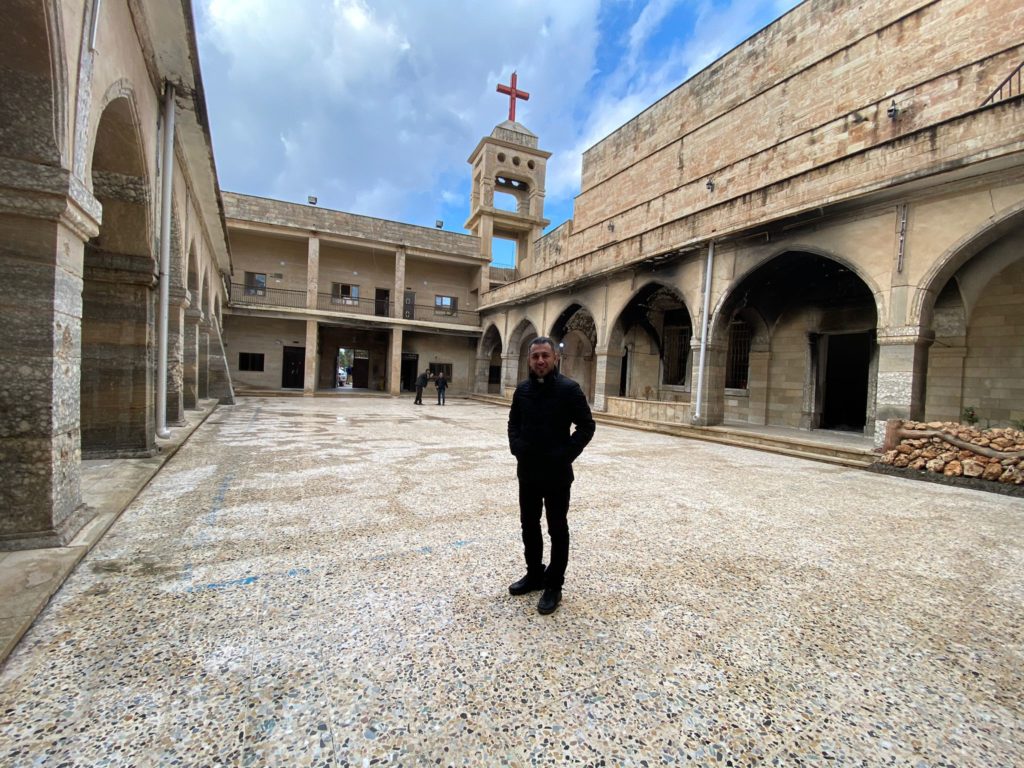
Aram, in the courtyard of the Sacred Heart of Jesus Church in Tel Kaif, a Christian city near Mosul, northern Iraq.

"In 2004, two nuns were working with the U.S. Army in Basra. One day, when they returned home, a radical Islamic group killed the sisters in front of their house. This event spread throughout Iraq and my country became the epicenter of terrorism. In 2014 ISIS came and destroyed many of our churches and our homes. There is a plan to destroy the history of Christians in my country as they did in 1948 with the Jews," he says.

The Call to Serve the Lord

The city of Basra has two parishes that are part of the Archieparchy of Basra and the South, with 800 faithful. In 1995 he received his First Holy Communion and it was then that he first felt the call to serve the Lord.

GF. -And how did it go?

AP. -The parish was like my home. I loved to go with the group of children to play with them but also for catechesis. But the idea of entering the seminary became clearer to me when I was in high school.

GF. In the third war of your life you were sixteen years old. What are your memories of the Second Gulf Conflict?

AP. led by the United States. It lasted almost 4 months and the last city to fall was Basra, where I lived. I remember seeing American planes coming in and bombing, and we were afraid, because many of the state buildings were close to our house. I remember one night I was sleeping and I woke up to the sound of a missile hitting a building about 500 meters away from us. We went out into the street, people were running and the Americans were throwing their sound bombs to strike terror into us. It was then that I could distinguish more clearly the call of the Lord.

GF. It is moving to think that, although the voice of the Lord is not in the noise of missiles and sound bombs, it is heard, in all its sweetness, in the midst of this horror.

AP. Yes, indeed. And also, if we hadn't suffered the terror of the bombings, my father wouldn't have asked the bishop for shelter: the church was very close to where we lived, but there, in the house of the Lord, we felt more secure. So, my father began to serve in the kitchen to reciprocate a little for the generosity with which we were welcomed. I, meanwhile, learned to serve at the altar with the priest. At the end of the war, our bishop chose me to go with him to a town called Misan.I was able to see the city of Basra, about 170 km northeast of Basra, and what I experienced there encouraged me to make my decision.

GF. -Do you want to tell us what happened to you?

AP. When the bishop asked me to accompany him to Misan on his pastoral mission, my family first said no, they didn't want to. But I was very determined to go and I succeeded. When we arrived, I was amazed to see the faithful entering the church on his knees and without shoes. They knelt before the altar, in front of the icon of the Virgin Mary, weeping, praying, pleading.

Later, when the MassLater, when the mass began, officiated by the bishop according to our Chaldean rite, I noticed that the faithful did not know the prayers or when to sit or stand up. This impressed me very much and I thought that they were like sheep without a shepherd. And immediately I looked at the bishop who was older and the thought crossed my mind as to who could replace him and help so many families.

GF. It is impressive to see how Jesus is moved in front of the multitude who are like sheep without a shepherd. 

AP. -Precisely! So, with this thought, I continued my studies at the Vocational Institute school and, in 2005, I entered the seminary in Baghdad, the capital of Iraq. There I studied philosophy and Theology for six years and graduated in June 2011, and on September 9, 2011 I was ordained a priest.

"In Iraq there is a plan to destroy the history of Christians in our country."

After almost 10 years as a priest, Aram Pano, sent by his bishop, studied Institutional Communication in Rome at the Pontifical University of the Holy Cross.

«The world needs each one of us to contribute to evangelization. And especially in these times, to proclaim the Gospel, We need to be aware of the digital and communication culture. I have great hope for the future: we can all work together to spread our faith through all possible channels, while preserving our identity and our originality,» he says.

One chase after another

GF. Aram reminds Christians in the West not to forget their brothers who suffer persecution in countries like his own, Iraq, where he has lived through one conflict after another. After the last war, social life in Iraq has changed a lot.

AP. "There has been a commodification of man. In the land where civilization was born, where man built the first cities, where the first legal code in history was born, everything seems to have ended in destruction: the strongest kills the weakest, corruption hovers over society and Christians have been suffering persecution for 1,400 years." persecution.

"Before 2003 Christians numbered 1.5 million and today we are 250,000. Persecution is not only something that has to do with physical survival: it extends to the social and political level, to job opportunities and even to the right to education," he says.

The visit of Pope Francis

GF. -What are the problems in Iraq today and what was the significance of the visit of the Papa?

AP. The lack of honesty and willingness to rebuild the country means that Muslims have separated, the government thinks more about being loyal to neighboring countries than about the welfare of its citizens... And all this in the eyes of the United States. There is not one problem but many complicated problems.

I believe that politics, the service to the citizen, no longer exists, because it is in the hands of others from outside Iraq. However, the fruit of God's work is not within our reach and we pray that through this journey peace, Christ's love and unity will be announced to a people who can no longer bear it.

GF. -A people, moreover, where Christianity has left deep roots, especially the Chaldean Church.

AP. -Of course! In fact, the Christianity arrived in Iraq with the apostles St. Thomas and Bartholomew and their disciples Thaddai (Addai), from Edessa, and Mari in the second century. They founded the first Church in Mesopotamia and, thanks to their missionary work, they reached as far as India y China. Our liturgy comes from the oldest Christian Eucharistic anaphora, known as the Anaphora of Addai and Mari. The Church at that time was within the Persian Empire, with its own Eastern liturgy, its own architecture and a way of praying very similar to the Jewish liturgy.

The theology of our Eastern Church is spiritual and symbolic. There are many very important fathers and martyrs, such as Mar (Holy) Ephrem, Mar Narsei, Mar Theodore, Mar Abrahim of Kashkar, Mar Elijah al-Hiri, etc.

GF. The Chaldean Catholic Church, which is in communion with Rome, was born as a result of a schism within the Church of Babylon, because of a rivalry between patriarchs, in particular, because one current wished to unite with Rome.

AP. Our tradition, however, is typically oriental and has deep roots in the country, where traces of the millenary Christian presence can be found everywhere, with sanctuaries, monasteries, churches and very ancient traditions.

I hope that my stay in Rome will allow me to work on preserving this identity and this rich and long history, also using the tools and means that modernity allows us to have today.

The Holy Cross School of Communication

This interview was conducted with other reports at the Faculty of Communication of the University of the Holy Cross.

Aram Pano during his training period in Rome.

Throughout all these years, hundreds of students from all over the world, different languages, identities, histories, problems... have passed through the Faculty.

It is a Faculty of Communication, where we learn that in this Babel that is our world, barriers and walls can be overthrown, as Pope Francis tells us, and we can truly be all brothers and sisters.

In this task, the CARF Foundation -Centro Académico Romano Fundación-, has committed itself in a very important way, providing study and maintenance grants for students The aim of the project is to help them - seminarians and diocesan priests, lay people and religious men and women - from all continents, without distinction, and to enable them to use all the most modern tools by financing the theoretical and practical activities that take place at the Pontifical University of the Holy Cross, so that they can then return to their countries and plant there the formative seeds they have received in Rome, fostering the growth of fruits of peace, high-level formation, unity and the ability to understand each other better, not only among Christians, but with people of every religion and identity.


Gerardo Ferrara
BA in History and Political Science, specializing in the Middle East.
Responsible for the student body Pontifical University of the Holy Cross in Rome.
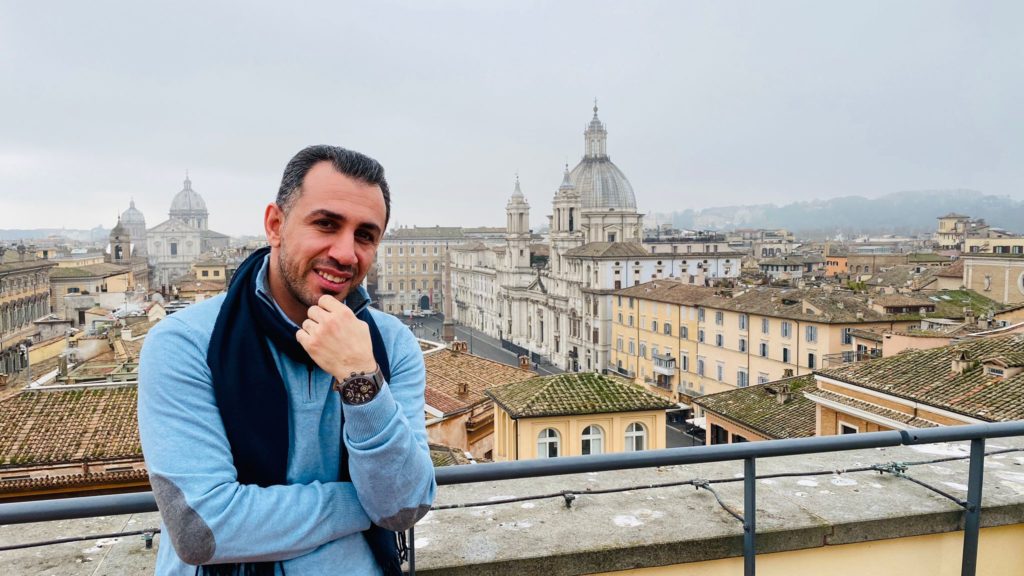

«We Christians in Pakistan have hope for a better future.»

Abid Saleem is a priest of the Oblate Missionaries of Mary Immaculate congregation studying at the Pontifical University of the Holy Cross in Rome. The Christians of Pakistan at many times discriminated against and persecuted, they have the hope “of a better future,” she recounts in her testimony.
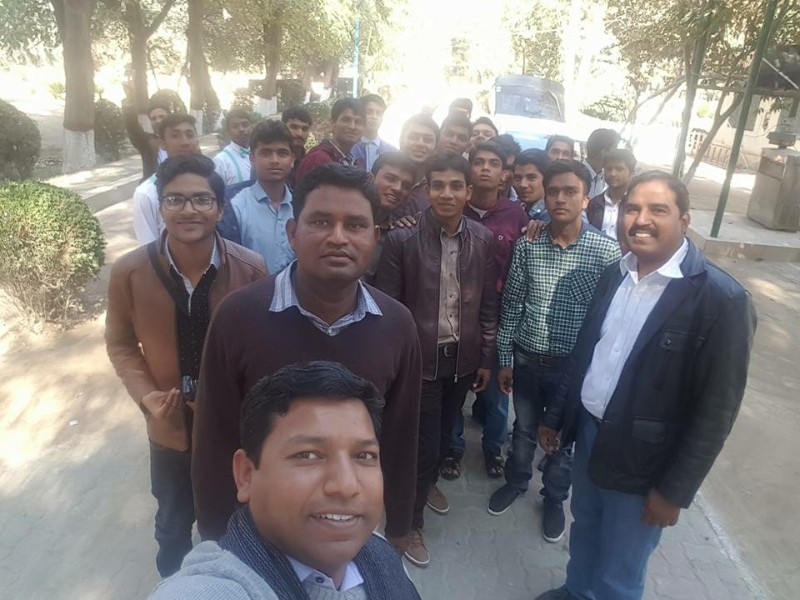
A Catholic family of eleven siblings

"I am Abid Saleem, son of Saleem Masih and Mukhtaran Bibi. I was born in Toba Tek Singh, Pakistan, on June 26, 1979, in a Catholic family of eleven siblings (eight males and three females). I am the youngest of all. My parents are already in heavenly life (may their souls rest in peace).

When you reflect on your vocation, recalls all the events that helped him discern about her. «First of all, I feel it was a desire since my childhood. I used to go to church very often and I used to be an altar boy. In school, whenever I was asked what I would like to be, my answer was only one: to be a priest.

Once he finished his compulsory education, in 1996 he was thinking of enrolling in university. It was the month of July. Then, something happened that marked his life: «I met an Oblate novice of Mary Immaculate who shared with me and explained the charism of his congregation».

When she was about to enroll in the University, she made a vocational retreat with the Missionary Oblates of Mary Immaculate.

A retreat to discover my vocation

It was to be organized a vocational program that lasted three days and Abid Saleem, without a second thought, I said yes, I wanted to participate. «Along with me, four others attended the retreat. We all enjoyed the program and loved the Oblate spirituality as well as their way “to evangelize the poor”.».

After the program, they returned home and after a few days, four of them received a letter of invitation to join the seminary. Abid Saleem and a friend entered, but after a year of discernment his friend discovered that it was not his vocation and withdrew, while Abid continued his formation, which was a very enriching time for him, with many meaningful experiences.

Oblate Mission Station

During the first year of seminary formation, among some of the activities we did, one was especially interesting. We went to Derekabad, an Oblate mission station. It is a desert area where the Oblates have built a beautiful grotto there.. The work of these brothers in the grotto was inspiring to me.

Another event that touched me was participating in a priestly ordination of a brother of the congregation, the first ordination I had ever attended. This celebration really strengthened my vocation as well.

In 1998, he was able to begin studying for a career in Philosophy and then he was sent to Sri Lanka for his pre-novitiate and novitiate, another beautiful experience of internationality.

He took his first vows in 2003. After returning to Pakistan, he completed his theological studies at the National Catholic Institute of Theology. He took his final vows on August 22, 2008 and was ordained a priest on August 22, 2008. deacon the next day.

And finally, on February 17, 2009, I was ordained a priest at Sacred Heart Cathedral, Lahore. My formation period was excellent. I thank the Lord for all those formators and teachers who formed me to be the true servant of God.

Pastoral work and service in the diocese after ordination

After its management, His bishop sent him to work in different parishes, first as an assistant and then as pastor. He has worked with youth and many other groups. He has also collaborated in the Catechetical Commission of his diocese. He started the office of the catechetical commission in the Vicariate of Quetta.

Another of the tasks I performed was to manage a small religious articles store in the same office. On the other hand, organized many programs for teachers of religion and for the people of the country. and worked as a liturgist in the Vicariate. I have been the Master of Ceremonies at the liturgy of many priestly ordinations, deaconates and candidacies.

In 2016, I passed my B.A (Bachelor of Arts) from Punjab University, Lahore. I also worked as the Rector of the Oblate Juniorate for the last three years. This was another enriching experience, though difficult, but I tried my best to accompany the students in their spiritual journey to discern about their vocation.

«In our country there is a lot of work to be done, since God's flock continues to grow, but there are few workers to tend it.

Cristianos de Pakistan

The official name of our congregation is Missionary Oblates of Mary Immaculate and its motto is “Evangelizing the poor”. It was founded by St. Eugene de Mazenod in 1816 and approved on February 17, 1826 by Pope Leo XII.

The founder of the OMI mission in Pakistan is a German priest, the Reverend Father Lucian Smith, who was then the Provincial of the Province of Colombo, Sri Lanka. It was he who sent three Oblates to Pakistan in 1971. There were many Oblate missionaries from all over the world, but basically from Sri Lanka.

Pakistan's Christians facing a Muslim majority

Pakistan is the ninth largest country in Asia. It shares a border with the Arabian Sea, China, Afghanistan, Iran and India. Mohammad Ali Jinnah is the founder of Pakistan which gained its independence on August 14, 1947.

The country covers a total area of 881,913 square km and is divided into four provinces, namely Punjab, Sindh, Balochistan and Khyber Pakhtunkhwa. The national language of the country is Urdu and English is the official language. Pakistan has a population of approximately 211,819,886 citizens. 

Muslims are in the majority with 95 % of the population. But the Christians are one of the largest religious minorities in Pakistan with 2 % of the population, approximately half are Catholic and half are Protestant.

Very poor conditions

has a long history in South Asia, although many of Pakistan's Christians are descendants of low-caste Hindus who converted under British colonial rule to escape caste discrimination.

Christians in Pakistan are, for the most part, very poorThey have also been involved in menial jobs such as cleaners, laborers and harvesters. Despite this, they have made significant contributions to the development of the country's social sector, especially in the construction of educational institutions, hospitals and health centers throughout Pakistan.

However, like other religious minorities, Christians have faced discrimination and persecution throughout history.The Christian communities are still suffering from selective violence and other abuses, including land grabbing in rural areas, kidnappings and forced conversion, and vandalism of homes and churches. Today, they continue to suffer targeted violence and other abuses, including land grabbing in rural areas, kidnappings and forced conversion, and vandalism of homes and churches.

«Despite all this, we Christians in Pakistan are hopeful for a better future,» Abid Saleem confided. We pray that Almighty God will bring peace and harmony to this country and that people will enjoy the fullness of life.

«Christians in Pakistan today continue to suffer targeted violence and other abuses.».

Oblates in Pakistan

They worked in parishes and distinguished themselves by setting up the Basic Christian Communities. Later, they also thought of starting the formation program. Now we have three main formation houses: juniorate, philosophate and scholasticate.

We work mainly in eight poor parishes in five dioceses. Christ invites us to follow him and to share his mission through word and work. Our main objective is education in schools, with young people, and especially reaching out to people who are far from God.

Training in Rome for missionary work

Now his superior is sending him to Rome for further studies in Liturgy. «My future goal is to work as a missionary».

For this great opportunity to be formed at the Pontifical University of the Holy Cross, to then return to his country and share all the good he has received, he can only thank the benefactors of the CARF Foundation: «May God bless you for all you do for the Universal Church, but also for us, the little ones, who are seeds in the hand of the Lord, in countries where the mere fact of calling oneself Christian can cause death».


Gerardo FerraraBA in History and Political Science, specializing in the Middle East.
Responsible for the student body of the Pontifical University of the Holy Cross in Rome.

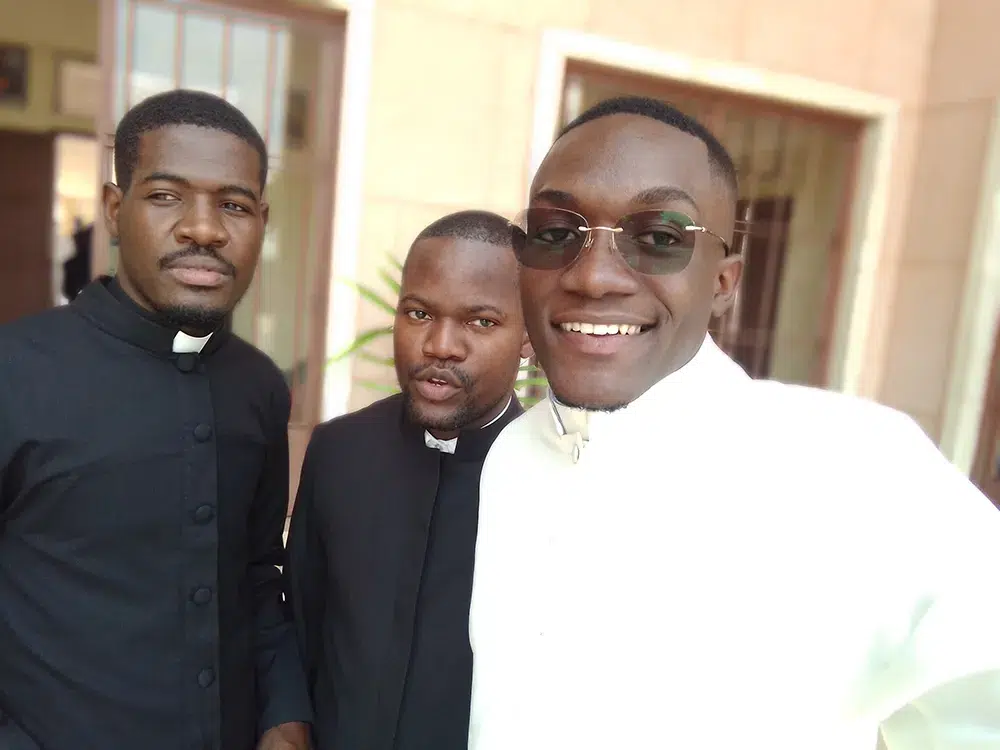
Mariano Capusu, from Angola: «when I was a child I wanted to be like the Pope».»

The story of Mariano, a young seminarian from Angola, is marked by a process of discovery and progressive discernment at the hand of his parish priest. He is now improving his formation by studying theology in order to become a priest. 

His spiritual life was well covered: his parents, from a Christian family, enrolled him in catechism classes when he was a child and he also studied in a Catholic school, although at that age he did not show much interest in the things of the Church.

In 2009, he had a meeting with Pope Benedict XVI during his visit to Angola, fortunately, Mariano personally received the blessing of the Holy Father. 

«At that time I was 8 years old. When I came home, I told my parents that I would like to be like the Pope, something typical for children. Eventually, that happened.

Preparation for First Communion

The key moment that brought him back to church life through service as an acolyte was the preparation for his First Communion.

After some time, it was time to receive the sacrament of the Eucharist. The parish priest indicated that only those who belonged to a youth group could receive it, in order to integrate them more into the Church. Mariano did not belong to any of these groups.

«I thought about becoming a scout, but the parish priest called me and told me I had to be an acolyte. There everything started all over again: the close contact with priests and bishops awakened something in me that I didn't understand, but that fascinated me. Then I remembered my childhood desire to be like the Pope, although I didn't know that the Pope was also a priest. priest and bishop. As I discovered these things, I felt more strongly that the Lord was calling me to it.».

Mariano Capusu Songomba, seminarista de Angola

The discovery of the seminar

Some years went by and he noticed that some of the acolytes of the parish, after a period of academic formation and accompaniment by the priests and vocation teams, were going to a place called «seminary». Mariano did not know what it was, but he began to wonder and to feel that maybe that was his place.

«So when I was finishing my elementary studies, I became much more active in church activities, attended groups, helped whenever necessary in the sacristy services and even became one of the formators of the acolytes.».

«Gradually a closer relationship with the parish priest developed. I often accompanied him to different communities to help with the Masses and with the purchase of materials for the sacristy, the vestments and, at those times, he would talk a lot with me explaining what the seminary was and what the priesthood consisted of and being a priest of God for others.». 

Mariano Capusu began to identify with this vocation. He spent more time and felt better at church helping than at home or in the neighborhood. In his neighborhood there were hardly any Catholics and his time was almost always reduced to the world of soccer or other activities or matters of little interest.

The discovery of his vocation coupled with a lack of priests

The decisive moment and the key to the whole process came when he realized the shortage of priests everywhere. He discovered that there were communities of the faithful who only celebrated Mass once a month, or even every two months, due to the lack of priests. He then understood that he had to serving the Church with the ministry of the priest to bring Christ to those who also needed that presence.

When he was in his last academic year, his pastor spoke to his parents to see if they were in agreement that he should enter the seminary. They were opposed. Without Mariano's knowledge, his father wanted to check if this was really his vocation and suggested that he apply for some civil formation scholarships to pursue other studies that had nothing to do with the priesthood. Mariano turned them down without hesitation, thus confirming his decision to enter the seminary. He spoke with his parish priest, took the admission tests and was accepted.

«I completed the three years of secondary education and then went on to study philosophy, which I completed in another three years. After those three additional years, at the end, my spiritual director told me: “Now begins the stage of configuration. If you feel that the Lord is calling you, go ahead; if not, it is better to stop and choose another life”. After a time of reflection and prayer, of thinking and praying, I confirmed in my heart what the Lord was asking of me and I applied to study theology.

A grant for training and study in Rome

During the first year of Theology, in the second semester of the course and in the middle of the exam period, your pastor - who had just returned from Rome after studying Social Communication at the University of Rome - was asked to take an exam at the end of the year. Pontifical University of the Holy Cross (PUSC) thanks to the support of the partners, friends and benefactors of the CARF Foundation- Emilio Sumbelelo, the bishop, asked him for the documentation.

«Many days passed. The pastor called my parents to inform them that there was a scholarship to study in Rome and that the diocese had thought of sending me. They accepted, but did not tell me anything. I had already forgotten about that visit and, besides, I thought that it was just an update for having finished the first year of theology.

He continued his pastoral work in the diocese normally and without thinking about that situation again. But some time later, the bishop called Mariano and informed him that he had to move to Rome to complete his formation at the PUSC, thanks to a grant for formation, room and board financed by the CARF Foundation.

«When I received the news, I was bewildered and in a shock I accepted, convinced that it was a gift and an undeserved design of God's providence for my life and my education. I accepted, convinced that it was a gift and undeserved design of God's providence for my life and my formation. Thus in the future I could better serve my diocese and the universal Church, and to configure myself more fully as a model priest according to the Sacred Heart of Jesus, being here in the heart of the Church of Christ».

It was even a great gift for Mariano to be the first seminarian in the diocese to receive priestly formation abroad and in Rome at a Pontifical University. In addition, he has had the opportunity to live in the international school Sedes Sapientiae.

seminarista mariano capsu seminarisa angola sacerdote teología

Deep gratitude to the CARF Foundation

Mariano expresses his deep gratitude, on behalf of his bishop, Don Emilio Sumbelelo, his diocese and himself, for the generosity of the members, benefactors and friends of the CARF Foundation.

«You can always count on our daily prayers for you, for your families and for your work and projects. All this good and support is not only for me, but for the Church which I wish to serve today and tomorrow with zeal, love, dedication and devotion, thanks to the magnificent formation I am receiving thanks to your generosity.».

«GOD BLESS YOU TODAY AND ALWAYS. MY PRAYERS IN YOUR FAVOR, ALWAYS. THANK YOU VERY MUCH».


Gerardo Ferrara, BA in History and Political Science, specializing in the Middle East.
Responsible for students at the University of the Holy Cross in Rome.


Antidius James, Tanzanian seminarian: «People in Spain who believe, really believe».»

Antidius James Kaijage is 29 years old and a diocesan seminarian. Thanks to the help of the partners, benefactors and friends of the CARF Foundation, he is in Spain training at the University of Navarra and resides at the Bidasoa Seminary.

He was born in the diocese of Bukoba, in Tanzania, in the heart of Africa. He is the fifth of eight siblings and grew up in a deeply catholic family, where faith has always been a part of daily life.

«We received a Catholic education from the beginning,» she says. Her parents and siblings live their faith naturally and consistently: Sunday Mass and, on vacations, the parish became almost a second home.

Where does Antidius James study and train?

Today Antidius is in the fourth year of Theology in the Ecclesiastical Faculties of the University of Navarre and has been living in the Bidasoa international seminar. He is far from his homeland, but not from his vocation. «God willing, he will choose me as a priest of his Church,» he says humbly.

The example of his parish priest kindled his heart

Your vocation was not born out of an extraordinary event, but from the simple and constant treatment of the sacred, and from the example of her parish priest. If I had to point to a specific moment, it would be the consecration during the Mass of his parish.

«I really liked the way the pastor I celebrated the Mass with great respect. Especially the time of the consecration, the preface... I was very attentive and it felt good,» he says.

I was just a child, but that solemnity, that silence, that silence loaded with mystery, ignited a flame. Enthusiasm then grew in the parish choir, youth activities and community life.

«When we would join together at home for prayer, that also influenced me a lot, because. the life of the priest is a community lifeBeing with the people, serving, consoling, accompanying».

The figure of a parent to discern and support their vocation

Your entry into the seminar was not easy. Her parents were hesitant at first. They told him: «Children have many desires, but when youth comes, everything changes». They feared it was a passing illusion.

seminarista tanzania iglesia formación antidius
Antidius with Bishop Methodius Kilaini, who sent him to the Bidasoa seminary for training.

But Antidius« desire was not extinguished. On the contrary, he grew up in the midst of adolescence, with its questions, its concerns, its moments of family tension and its desire to be with friends. »My parents were always teaching me, always correcting me," he recalls.

Finally, they gave him permission and their blessing. He entered the seminary supported by the faith of his family.

How is the Church in Tanzania

The Diocese of Bukoba has 150 priests and 766,970 baptized Catholics, nearly 61 % of the population of 1,255,679 people. Catholicism is the majority there, but it is not without its challenges.

«There are some Catholics who change the religion natural of their parents and enter other small religions for economic, psychological, ideological, family or personal reasons».

The Church suffers when those who have received the Baptism and the sacraments go away. That is why he insists on formation, preaching, constant education in the faith.

There is also a real material need. «My diocese needs financial help to do its spiritual, family, pastoral activities better, academic and to assist people in need, so that they are not tempted to deny their faith,» says Antidius.

«We need trained priests, with a universal vision.. Seminarians who can study abroad, learn more and better how the universal Church is, have a global mind in their daily ministries».

Data on religious freedom: latent threat

Tanzania is constitutionally a country with religious freedom.. Religion is separate from government, although there are points of connection.

However, the threat of jihadism worries them. «Tanzania faces a latent threat, although not on the same scale as our neighbors in Somalia, Kenya or Mozambique.» Especially on the islands of Pemba and Zanzibar, which is where the Muslim population is in the majority.

Faced with the problems that arise between the different denominations, this seminarian explains that education, dialogue, political cooperation, control of financing... are important.

Antidius, seminarista de Tanzania en el seminario internacional Bidasoa
Antidius, next to a painting of St. Joseph in a room in Bidasoa.

«The first thing is to put love and charity, and then everything is solved little by little.».

The humility and patience necessary for evangelization

Antidius also reflects on evangelization in secularized societies, something he is observing in Spain. For him, the starting point is clear: «missionary humility, patience (as Africans have), active listening skills and empathy».

He adds that personal witness has a great power of attraction, both in daily life and through social networks. And he points out as something essential: «to speak the truth about the faith and the teaching of Christ without fear, because that is how the apostles and the Fathers of the Church lived it».

Analyzing faith in Spain

He was coming to a country with a long Christian tradition and discovered a nation where many are «event Catholics, but not practicing Catholics. He verified it in his pastoral experience: »Faith is present in weddings, baptisms, communions, Holy Week, processions... but not in the attendance to the Holy Mass, which is the center of the mystery of our salvation,« he laments.

However, he admires the fact that many Spaniards have great devotion and respect for the Virgin Mary.

But in spite of some shadows, he confesses that he is learning a lot in our country, he is positively surprised by the coexistence in the seminary, the education, the care for customs and norms, and he highlights something hopeful: «people who believe, really believe».

What Africa can teach Spaniards

Antidius affirms that Spaniards and Africans can learn from each other for evangelization, but points out some traits of African Catholics:

Antidius with his current bishop, Bishop Jovitus Mwijage.

The priest of the 21st century

This Tanzanian seminarian speaks of the priesthood with an awareness of today's challenges. «Today's priest must integrate human, spiritual, intellectual and pastoral dimensions to respond to a secularized, technological and constantly changing society.».

For him, he must cultivate the gift of people and kindness in order to generate trust and overcome individualism. In addition, he must acquire a solid cultural and theological formation to respond to all the questions of this century.

«But, above all, he must be a man of deep and constant prayer with God, which is the source of his apostolate and his identity,» he says.

How to understand the identity of the priest

And be clear about the priestly identity and fidelity to the magisterium, spirituality centered on the altar and the Eucharistic sacrifice. As St. John Bosco says: «Priest of Jesus Christ, celebrate this Holy Mass as if it were your first, your last, your only Mass».

And it concludes with a simple and powerful image: «the priest of the 21st century is called to be a good shepherd, a father, a brother, to present and identify the presence of God and who lives in the kingdom of God».


Marta Santínjournalist specializing in religion.


Nirmala: woman, Christian, nun, communicator from India

February 26th will mark the 25th anniversary of the School of Social and Institutional Communicationfounded in 1996 within the Pontifical University of the Holy Cross.

This Faculty aims to transmitting the faith of the Church in every century with the instruments available and also to train professionals capable of operating in the field of communication in ecclesial institutions, through a very solid and diversified program, which is based on theoretical and practical study.

Social communication students

The students of Social and Institutional Communication, in addition, in fact, focus very much on the cultural environment in which the Church proposes its message, in a spirit of ongoing dialogue with the women and men of every century.

For this purpose, they must be well acquainted, on the one hand, with the contents of the faith and the identity of the Church as an institution, through subjects of a theological, philosophical and canonical nature, and on the other hand, the concrete application of the theories, practices and techniques of institutional communication to the particular identity of the institution. Catholic Church, including through advanced laboratories in the different media (radio, television, press and media based on new technologies).

25th anniversary

The Faculty of Social and Institutional Communication, thanks to its unique characteristics in the field of pontifical universities, has already trained, in 25 years, dozens of communication professionals, Today they are making their contribution in various ecclesiastical and non-ecclesiastical sectors, thanks above all to the help of many benefactors, in particular the CARF Foundation - Centro Académico Romano Foundation.

CARF, which not only provides scholarships to young people from all over the world to study at the Pontifical University of the Holy Cross, but also offers its financial support to help the university realize its goals. regular scheduled academic activities (the usual courses), to support the entire staff of professors and officials, to finance extraordinary activities (such as congresses, publications and other activities of professors) and to subsidize the necessary tools and technologies (laboratories, classrooms, didactic instruments, etc.).

To know the reality of the School of Social Communication. 

We set out on a journey to learn more about the reality of this Faculty and its mission in the world through the stories of its students, alumni and faculty. 

Sister Nirmala Santhiyagu, from India

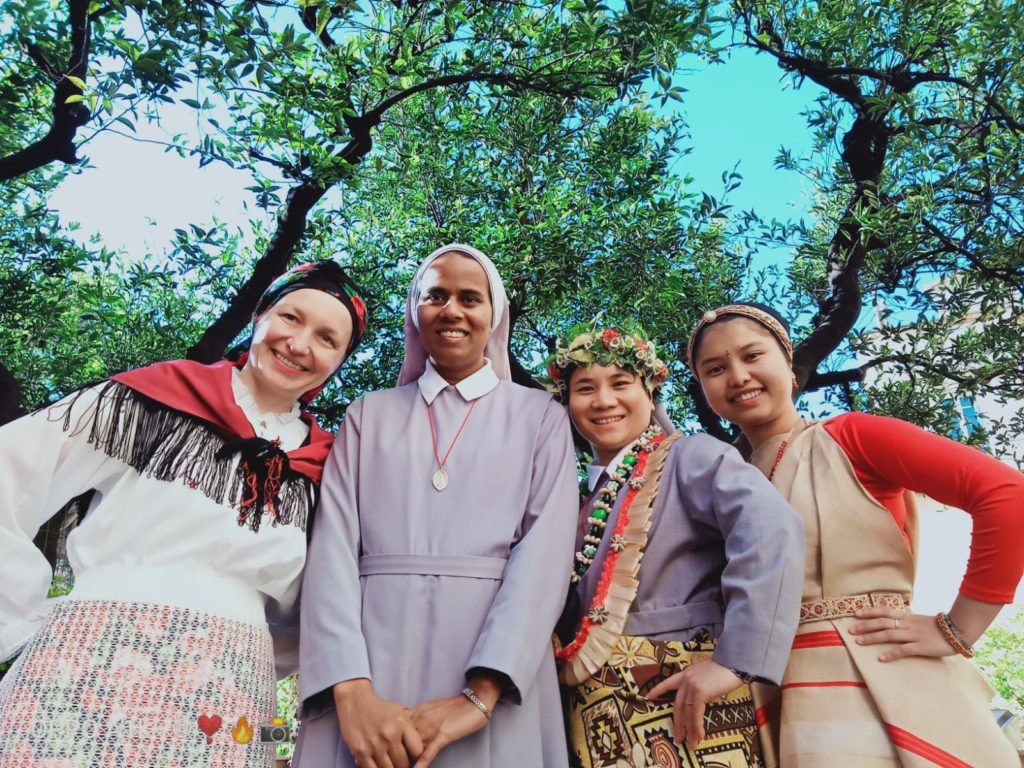
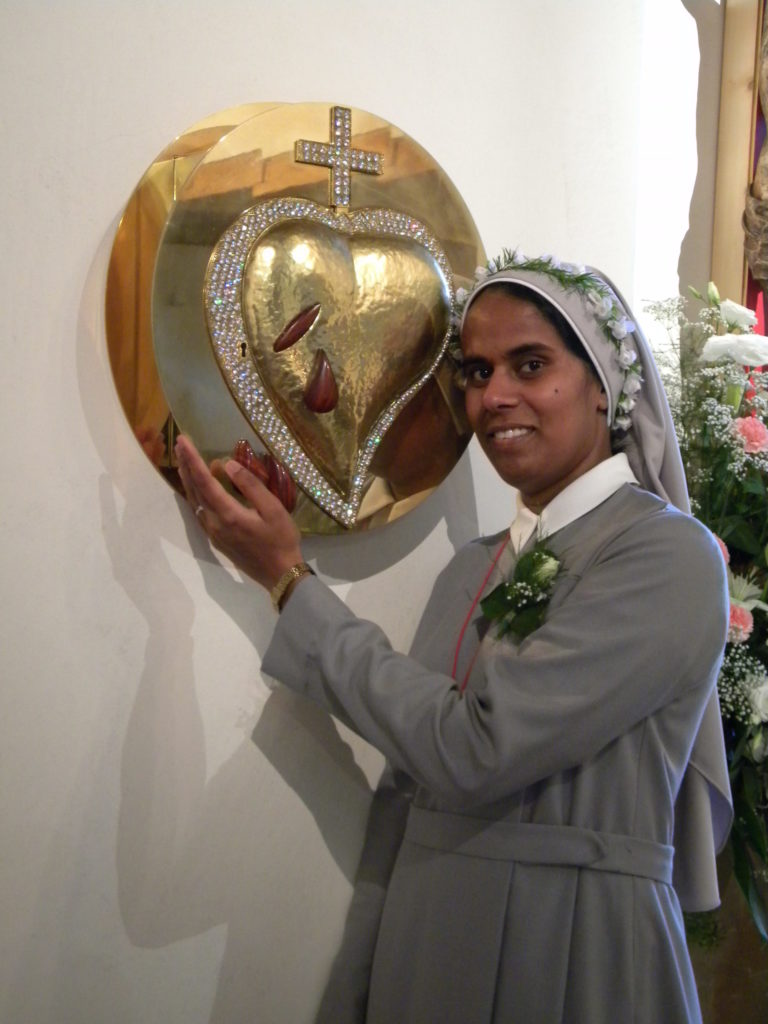
Today we find ourselves with the sister Nirmala Santhiyagu, from India, from the Congregation of the Missionary Sisters of St. Peter Claver. Nirmala is 35 years old and studies at the Pontifical University of the Holy Cross thanks to a grant from the CARF Foundation, which also helps another student from the same congregation..

Hello everyone! It is a pleasure for me, being a student in the first year of the Bachelor's Degree in Communication, to be able to approach this world through an interview so that you can get to know me and all my academic family, as I call it, of the Faculty better. This is very important, to be family here toois something I value very highly, since I was born and raised in a catholic family in Tamil Nadu, India, together with my parents and my three siblings».

Conveying training in a difficult environment

Well, it is a pleasure for me and for our readers as well. It is also very interesting that you, who come from India, as a woman, Christian and religious, study in Rome and then share your formation in an environment that is not always easy, and in a country about which the chronicles often give us dramatic stories of violence against women.

N: «Yes, in fact my congregation asked me to study Social and Institutional Communication to be able to collaborate more effectively with their communication team, working in the diocese of Indore, India. It is a very difficult time all over the world, also due to the emergence of COVID, but I think this kind of study is interesting and challenging at the same time, especially for a country like India. India, for the same reasons you mentioned».

I imagine that being born and growing up as a Christian in a country where Christians are a small minority must not have been very easy!

Well, in fact when I was little it was not as difficult as it is today. First of all, I was fortunate to have very loving parents who made sure that we children grew up in the Christian faith following their moral values. My family members played a vital role in the formation of my faith: I was always encouraged to participate in the Sunday catechism classes and in all the activities that were carried out for the formation of faith and morals in our parish.

In addition, I studied in a Catholic school run by nuns. and there I had more possibilities to value my Christian values, that is to say, to share what one has, to forgive others and above all equality: that is to say that we are all children of God and it doesn't matter the caste or creed. This is why I say that I was lucky, because I know that not all children, especially girls, have this opportunity to grow up as I did.

"I studied in a Catholic school run by nuns where I learned that we are all children of God and no matter the caste or creed."

Hermana Nirmala, religiosa de la India

The missionary activities of the Sisters of St. Peter Claver in mission countries such as India and Vietnam cooperate with diocesan pastoral activities in the Christian formation, both spiritual and moral, of children and young people, in the empowerment of women, in the education of poor children and above all to awaken missionary awareness among the faithful.

And since you were a child, did you have the opportunity to meet people of different religions?

Yes, as I grew up, either at school or in the family environment, I was able to cross paths with people of other religions, such as Hindus and Muslims, and there I learned to know the contents of their beliefs, coming to appreciate and treasure my Christian faith even more. Only in Christianity, then, did I find a God who allows you to be yourself, with all your weaknesses and abilities, and it was always exciting for me to know that I have a God who loves us, forgives us and wants his children to be happy here on earth, and then to be with him forever in heaven.

Well, it must be very enriching for a child to grow up in such an open environment.

N: Good, I must admit that children today in most parts of India do not enjoy the religious freedom that we had in our childhood days, there have been enormous changes in recent days due to the political influences of Hindu nationalism, which have not failed to affect other ethnic or religious groups.

But I remember, in my childhood days, the coexistence of different religions was very peaceful and uplifting: studying and playing together, irrespective of caste or religion; the respect we had for each other's beliefs, and so on. Even today, I cherish the wonderful experiences I had in my school days.

G: Was it in school that you felt the call to be a religious?

Well, not only there... I was actually very inspired by the activities of the nuns in my parish, as well as by my blood sister who was a nun herself. So I also wanted to be missionary. With the help of my parish priest, I joined the Congregation of the Missionary Sisters of St. Peter Claver where I am now. In 2007 I made my first religious profession. As the years went by, I rediscovered and confirmed my vocation to be the witness of God's love and in 2014 I said my “yes” to the Lord's call forever.

G: And how does that relate to communication?

N: It's all about communication, especially today! And the charism of the Sisters of St. Peter Claver is missionary animation, understood as the information and formation of the people of God about the missions. It is done by awakening in everyone cooperation in the mission, to provide the missionaries with the spiritual and material means necessary for the evangelization of peoples.

How wonderful! The whole town, the whole community involved in the mission!

The missionary activities of the Sisters of St. Peter Claver in mission countries like India and Vietnam cooperate with diocesan pastoral activities in the Christian formation, both spiritual and moral, of children and young people, in the empowerment of women, in the education of poor children and above all to awaken missionary consciousness among the faithful. And it must be said that, in the activities of empowerment of women and education of poor children, we are in constant contact with people of other religions.

A very important challenge, if we consider that Christians in India are a minority...

N: Yes, in fact the percentage of Christians in India is only 2.5%, but their presence is incredibly significant for the Indian society.Just think of St. Teresa of Calcutta! The contribution of Christianity is very remarkable, especially in the areas of reforming destructive traditions, modernizing the democratic system, social education and access to the media, medical care, social change and impact among tribals and the poor. dalits (those without caste), empowerment of women.

G: The poor get poorer and the rich get richer. A mission that involves everything...

In my opinion, the mission that awaits every Christian in this 21st century in India is not only to share the joy of the gospel, but also to promote the values of the gospel, to provide equal rights to all citizens. Although technology has improved the quality of life and work, the process of modernization has its negative social, moral and religious effects.

As people migrate from rural areas to metropolitan and industrialized areas, most people, with a low professional and educational level, end up being exploited, marginalized, victims of injustice and in extreme poverty, causing the disintegration of family ties. In this vicious circle, the poor get poorer and the rich get richer.

"The mission of every Christian in this 21st century in India is to promote Gospel values."

Nirmala, religiosa de la India

Sister Nirmala says that the percentage of Christians in India is only 2.5%, but their presence is incredibly significant for Indian society. "Just remember St. Teresa of Calcutta!" she says. Christianity's contribution is remarkable, especially in the areas of reforming destructive traditions, modernizing the democratic system, social education and access to the media.

Not to mention the contrasts between the different religious components....

We are faced with a growing fundamentalist trend, which sees modernity as the process responsible for the decline of values, claims a return to traditional values and redefines them in an ideology that supposedly replaces modernity and excludes diversity.

The current situation calls more than ever for interreligious dialogue. Because developments in the modern world have posed a challenge not only to India's social and political institutions, but also to ethical and religious beliefs and ideas. There is an urgent need for a general awareness of parity, which must be fostered among all.

G: And what is the situation of women in your country?

N: India has always been a patriarchal country.l, where women have traditionally been prevented from emancipation since ancient times. In fact, women's inferiority was codified by the Manu Code: during childhood they were the property of the father, in adolescence of the husband and, in the event of the husband's death, the property of the closest male relative. This ancient model is particularly important because it underlies old and new oppressions. Indeed, although the status of women has improved with the advent of modernity, the tradition is still deeply rooted throughout the country.

Of course, India was the first major country in the world to have a woman head of government (Indira Gandhi); and yes, there are many educated and emancipated women in the cities, and many modern marriages in which both spouses have equal rights. However, these are marginal episodes.

There is also the drama of high mortality among girls....

N: Sure. India is one of the few countries where men outnumber women, and this is partly due to the higher mortality rate of women. girls, to whom less attention is paid. Widows are allowed to remarry, but if they do, they are disapproved of and marginalized, so they mostly live in poverty. Child marriages have decreased, but still exist, especially in rural areas. In addition, there is a dramatic aspect of the female condition that has to do with dowry.

Nowadays, then, there is a real "stock exchange" of potential spouses: the higher their social status, the higher the dowry required. Often, after the marriage has already taken place, the groom's family asks for more objects or more money, and if the bride's family cannot give more, the bride is burned alive, simulating a domestic accident.

For some time now, many women have been organizing themselves into groups and committees, and hopefully one day these tragedies will come to an end, but Indian women still have a long way to go to achieve equal rights.

G: A path that goes through training and communication...

Of course! The reason for all these problems is illiteracy, lack of education, lack of access to means and instruction. Christian missionaries have worked for centuries to educate the poor and empower the marginalized. The Catholic Church has always invested in education in India and even today we have the best schools. Of course, there is much to be done, but we will not stop working in this direction.

Acknowledgments to benefactors 

And it is very good that our European and Western readers and benefactors become more aware that they are contributing, helping you to be formed, to improve the condition of the entire people of India, not only of Christians, through the work of the Church, but also of the people of India.ia.

Of course, and for this we are very gratefulWe are all Church, and I am very sure that the academic formation made possible by the contribution of our benefactors will help us to live our religious life as authentic witnesses to the Gospel and good professionals, bearing much fruit for His Kingdom. Generosity always remains in the form of a gift, the formation we receive because of the generosity of so many people will equip us in turn to be generous to others.


Gerardo FerraraBA in History and Political Science, specializing in the Middle East.
Responsible for the student body Pontifical University of the Holy Cross in Rome.