From genocide to hope: a priest in Rwanda

Pasteur Uwubashye He is a priest of the Diocese of Nyundo, Rwanda. His vocation He is dedicated to reconciliation and the training of other priests. He was born in Kigeyo, in the Rutsiro district in the west of the country, and is currently in Rome, where he is studying for his first year of a Bachelor's degree in Philosophy at the Pontifical University of the Holy Cross, thanks to a grant from the CARF Foundation.

Pasteur's story begins with a childhood marked by orphanhood and the decisive figure of his grandfather, a catechist for decades, who taught him to pray with his family and to love the Eucharist. It is also the story of a diocese deeply marked by the 1994 genocide, in which thirty priests were murdered and the Catholic community was severely wounded.

Pasteur has a clear goal: to help the Rwandan people rediscover the value of each human being, after violence that radically denied that value. That is why he insists that the training he receives is not only for himself, but also for the young people he has worked with, for the priests of his diocese and for a country that is still seeking reconciliation and peace.

«My name is Pasteur Uwubashye, and I am a priest in the Diocese of Nyundo, Rwanda. I was born on March 4, 1988, in the Kigeyo sector of Rutsiro district in the western province.

My parents, Gérard Musugusugu and Pascasie Nabonibo, died when I was still a child.
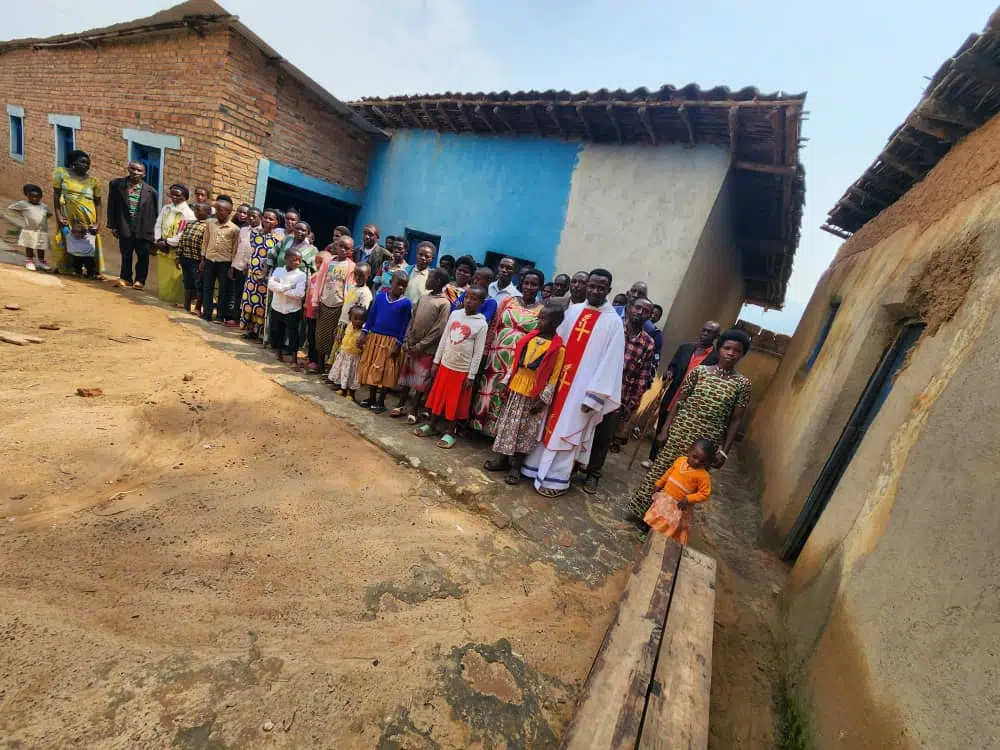
Comunidad parroquial de la diócesis de Nyundo, en Ruanda, reunida tras una celebración junto a su sacerdote.
Parishioners in Nyundo, Rwanda, with their priest after a celebration.

A grandfather who was a catechist and taught him to pray

«Since then, I was raised by my paternal grandfather, Gérard Mvunabandi, who was a catechist for forty-five years in my home parish of Biruyi. He had a profound influence on me. Christian life. I owe my faith to him.

From a very young age, he taught me to pray. Every morning and every evening, we prayed together in family, and each member had a designated day to lead the prayer. That is how I learned the morning and evening prayers, the Rosary, and also how to help others pray.

My grandfather instilled in me a love for Holy Mass. I felt great respect and affection for the priests, who visited him frequently. That close relationship awakened in me a deep love for the Church and the desire to become a priest. The day of my ordination was a great joy for him. He passed away in March 2023, at the age of 93.

Fifteen years of training: in search of his vocation as a priest

After completing primary and secondary school at the Saint Pius X minor seminary in Nyundo, Pasteur pursued higher ecclesiastical studies and was ordained a priest on July 13, 2019, by Bishop Anaclet Mwumvaneza in his home parish of Biruyi.

He was assigned to the parish of Nyange as parish treasurer, pastoral coordinator for children, and choir director. In 2021, he was appointed chaplain. diocesan for youth ministry in the Kibuye area, a mission he carried out for six years.

«I thank God for the fruits of this ministry, especially for the growth in the number of choirs and for the involvement of children and young people in the life of the Church» he explains. The diocese of Nyundo is divided into two areas: Gisenyi, with a Catholic majority, and Kibuye, where different religious denominations coexist.

In the latter, Pasteur and other priests worked to reach out to young people, bring them together, help them love the Church, encourage them to pray, participate in wholesome activities, and support one another in their faith.

During the Covid pandemic, many young people helped the most vulnerable when hunger threatened numerous families. This solidarity left a deep mark on the community and led several young people from other denominations to approach the Catholic Church.

The 1994 genocide and the choice of studies

Rwanda continues to be marked by ethnic divisions between Hutus and Tutsis, which led to the 1994 genocide against the Tutsis. This event continues to influence the social and spiritual life of the country.

For this reason, Pasteur chose to study ethics and anthropology: «the Rwandan people still need to rediscover the value of the human person and the meaning of their existence.».

In his diocese, Nyundo, the genocide had a particularly severe impact: in addition to thousands of faithful who were killed, some thirty priests died. Reconstruction was slow and difficult.

Thanks to the efforts of the bishop at that time, churches and presbyteries were restored and vocations were encouraged. Today, the diocese has some 120 priests serving 30 parishes.
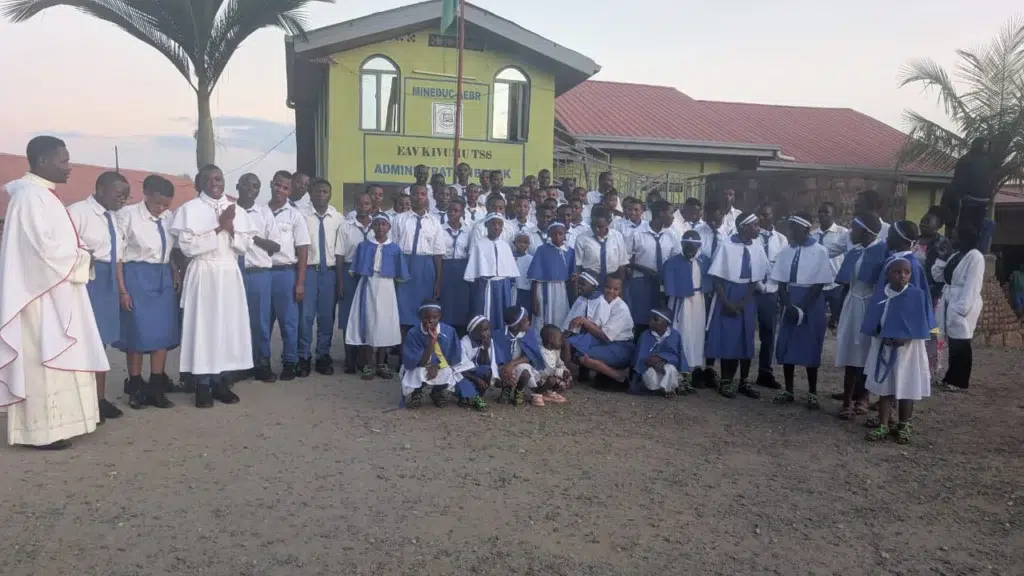
Estudiantes y religiosas en un centro educativo católico de la diócesis de Nyundo, en Ruanda, junto a sacerdotes.
Students, nuns, and priests at an educational center, where human and Christian formation is an essential part of the pastoral mission.

Lack of trainers and need for support

However, after the genocide, many priests were assigned as a priority to parishes in need, which limited the possibility of sending some to pursue higher education. This reduced the number of formators available in major seminaries and other diocesan services that require academic preparation.

Currently, the diocese has a very small number of permanent teachers. For this reason, there is a continuing education program for priests, designed to share the knowledge acquired by those who have been able to study abroad.

The bishop remains committed to priestly formation, but resources are limited. In this context, the support of institutions such as the CARF Foundation is essential.

Studying in Rome to serve better

Since September 10, 2025, Pasteur has been in Italy, at the Pontifical University of the Holy Cross. He sees this stage of his life as an opportunity that will benefit not only him, but also his diocese and his country.

He thanks his bishop for his trust, the university for its welcome, and the CARF Foundation for its assistance, which is invaluable support for a diocese that is still suffering the consequences of genocide and needs well-trained priests to better serve its people.


Gerardo FerraraBA in History and Political Science, specializing in the Middle East.
Responsible for students at the University of the Holy Cross in Rome.


Solemnity of St. Mary, Mother of God

The January 1, the Catholic Church celebrates the Solemnity of the Blessed Virgin Mary, Mother of God. It is not a pious conclusion to the Christmas season or a devotional addition to the liturgical calendar. It is a doctrinal affirmation of the first order: in Mary, the truth of who Jesus Christ is is at stake. For a Catholic in the year 2026, this feast continues to be a decisive reference point for understanding the faith, the dignity of the person, and the Christian meaning of time.

The origin of the solemnity of Saint Mary

The celebration of Mary as Mother of God has its roots in the early centuries of Christianity. It did not arise from overwhelming popular devotion, but rather from a central theological controversy: who is really Jesus of Nazareth. In the fifth century, the debate surrounding Nestorius—who refused to call Mary Theotokos (Mother of God) and preferred the title Christotokos (Mother of Christ) – forced the Church to clarify its faith.

The Council of Ephesus (431) declared that Mary is truly the Mother of God because the Son born of her is a single Person, divine, who fully assumes human nature. It is not a question of saying that Mary precedes God or is the origin of divinity, but of affirming that the subject of the birth is God made man. Separate the motherhood of Mary of Christ's divinity implies fragmenting the mystery of the Incarnation.

Since then, divine motherhood has become a cornerstone of the Christian faith. The Roman liturgy set this celebration on January 1, eight days after Christmas, following the ancient biblical tradition of the octave, to emphasize that the Child born in Bethlehem is the same Lord confessed by the Church.

The theological meaning: Mary guarantees the truth of the Incarnation

Celebrating Mary as Mother of God is, above all, a Christological confession. The Church does not focus on Mary in order to isolate her, but rather to protect the core of the faith: Jesus Christ is true God and true man. Mary is not an addition, but rather the specific place where God enters into history.

Mary's motherhood implies that God has taken on a genealogy, a body, a time. He does not become incarnate in a symbolic or apparent way. In her, God accepts dependence, growth, and care. Therefore, this solemnity has profound consequences for Christian anthropology: flesh, history, and motherhood are not secondary realities, but spaces where God acts.

From this perspective, Mary is not an idealized or distant figure. She is a real woman, situated in a specific historical context, who responds freely to God's initiative. Her faith does not eliminate darkness or uncertainty, but it does overcome them. The Gospel of the day presents her as “keeping all these things and meditating on them in her heart”: a thoughtful, not naive, faith; silent, but firm.

A celebration to start the year: a time of Christian peace

It is no coincidence that this solemnity is celebrated on the first day of the year. The Church proposes to begin the civil year from a theological perspective: time has meaning because God has entered into it. For Catholics in 2026, immersed in a fast-paced, fragmented culture marked by uncertainty, this statement is particularly relevant.

Furthermore, since 1968, January 1 has been linked to World Peace Day. Not as a slogan, but as a logical consequence: if God has assumed the human condition, all human life has an inviolable dignity. Mary, as Mother of God, also becomes a reference point for a Christian vision of peace, understood not only as the absence of war, but as a just order, reconciliation, and care for the most vulnerable.

In a global context marked by armed conflicts, cultural tensions, and crises of meaning, this solemnity reminds us that peace is not built solely with structures, but with a correct view of the human being. Mary's motherhood affirms that no one is disposable and that history is not closed to meaning.

Mary, Mother of God and Mother of Christians today

For contemporary believers, the Solemnity of Mary, Mother of God, is not an archaeological celebration. It directly challenges Christian life. Mary appears as model of mature faith, capable of integrating reason, freedom, and obedience. Her motherhood is not passive: it involves responsibility, risk, and perseverance.

St. Josemaría Escrivá insisted that turning to Mary is not a sentimental escape, but rather a school of concrete Christian life. In it, we learn to accept God's will in ordinary circumstances, to live our faith without fanfare, and to maintain hope when we do not understand everything.

At this point, the work of institutions such as the CARF Foundation takes on special relevance. Forming priests and seminarians for a Church faithful to the truth of the Incarnation involves transmitting a solid theology, rooted in tradition and capable of dialogue with today's world. The divine motherhood of Mary is not a marginal topic, but a key to an integral formation: doctrinal, spiritual, and pastoral.

A beginning that sets the tone for the entire year

The Solemnity of Mary, Mother of God, places Christians at the beginning of the year before a decisive truth: God is not an idea or an abstract force, but someone who wanted to have a mother. Everything else is ordered from there: faith, morals, social life, and hope.

Celebrating it in 2026 means reaffirming that the Christian faith still has something concrete to say about reality, time, and the person. Mary does not eclipse Christ; she reveals him in his most radical truth. And so, beginning the year under her patronage is not just another pious gesture, but a stance: trusting that history, even with its shadows, remains open to God.


December 26, Saint Stephen: the first martyr

Every December 26, the Church celebrates the feast of Saint Stephen, remembering the first maximumrpull Christian. His story, though brief, is an impressive testimony of faith, courage, and love for the Gospel. Do you know his origins and how he came to be one of the Church's most emblematic models of holiness?

Who was Saint Stephen?

Saint Esteban He was one of the first seven deacons chosen by the apostles to assist in serving the Christian community in Jerusalem. Its main mission was to care for widows and the poorest members of society, ensuring that no one was left destitute.

The Book of Acts of the Apostles tells us that Esteban was a man full of faith and the Holy Spirit (Acts 6:5). He was also known for his wisdom and for the signs and miracles he performed among the people, which attracted both admirers and detractors.

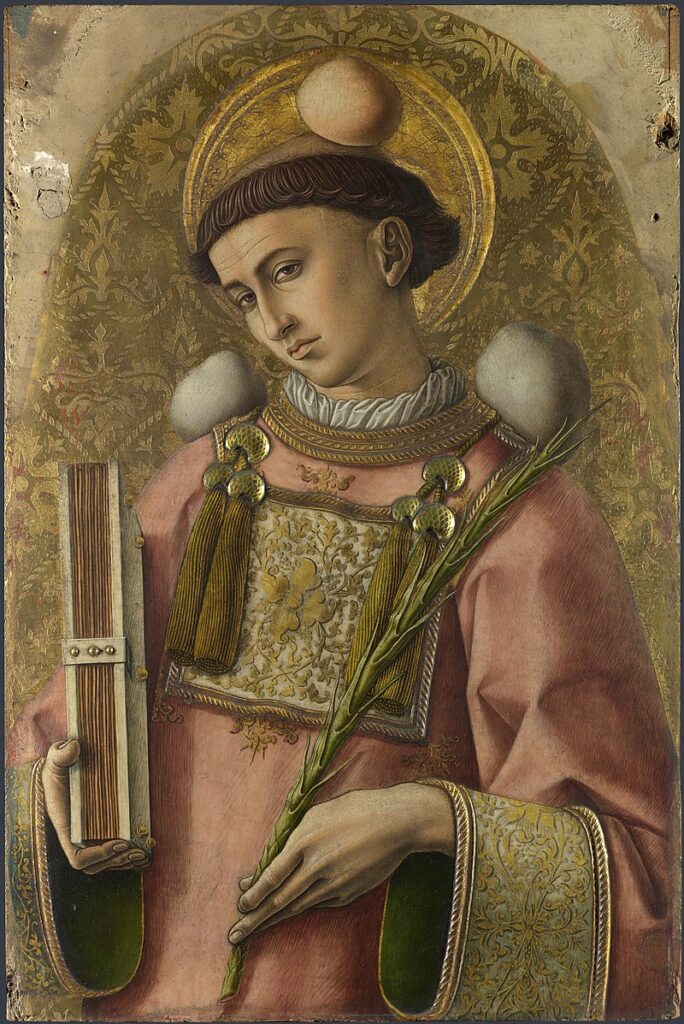
San Esteban, primer mártir de la cristiandad
Saint Stephen is depicted as a deacon, wearing a dalmatic, holding the palm of martyrdom and the stones that evoke his stoning. The work emphasizes his serenity and devotion to the Gospel.

The Martyrdom of Saint Stephen

Stephen's preaching caused controversy among some religious leaders of his time. He was falsely accused of blasphemy against Moses and against God, and brought before the Sanhedrin, the supreme council of the Jews.

During his defense, he delivered a powerful and courageous speech in which he reviewed the history of Israel and denounced the people's resistance to accepting God's will. This speech enraged his accusers, who took him outside the city and stoned him to death.

As he became the first martyr, Stephen, filled with the Holy Spirit, exclaimed: «Lord Jesus, receive my spirit.» and, with a heart full of forgiveness, he said: «Lord, do not hold this sin against them.» (Acts 7:59-60). His death is a reflection of Christ's love and mercy on the cross.

"Esteban, full of grace and power, performed great wonders and signs among the people» (Acts 6:8). The number of those who believed in the doctrine of Jesus Christ was growing. However, many—either because they did not know Christ or because they knew him poorly—did not consider Jesus to be the Savior.

«They began to argue with Stephen, but they could not withstand his wisdom and the Spirit with which he spoke. So they incited some men to say, “We have heard him speak blasphemous words against Moses and against God”» (Acts 6:9-11).

Saint Stephen He was the first martyr of Christianity. He died filled with Holy Spirit, praying for those who stoned him. «Yesterday, Christ He was wrapped in swaddling clothes by us; today, He covers Stephen with the garment of immortality. Yesterday, the narrowness of a manger held the infant Christ; today, the immensity of heaven has received Stephen triumphant. The Lord descended to lift up many; our King humbled Himself to exalt His soldiers.

Living the joy of the Gospel

We too have received the exciting mission of spreading the message of Jesus Christ with our words and above all with our lives, showing the joy of the Gospel. Perhaps St. Paul, who was present at that event, would be moved by Stephen's testimony and, once he became a Christian, would draw strength from it for his own mission.

«Goodness always tends to communicate itself. Every authentic experience of truth and beauty seeks by its very nature to spread, and anyone who experiences profound liberation becomes more sensitive to the needs of others (...). Let us rediscover and increase our fervor, the sweet and comforting joy of evangelizing, even when we must sow amid tears. And may today's world—which is searching, sometimes with anguish, sometimes with hope—be able to receive the Good News, not through evangelists sad and discouraged, impatient or anxious, but through (...) those who have received, above all in themselves, the joy of Christ» (apostolic exhortation Evangelii Gaudium by Pope Francis, 2013).

What can we learn from Saint Stephen?

Saint Stephen teaches us the importance of defending our faith with courage and humility, but also with love and forgiveness toward those who persecute us. His example invites us to trust fully in God, even in the most difficult moments.

It also reminds us of the value of service. As deacon, He dedicated his life to helping those most in need, living out the commandment to love one's neighbor in a concrete way.

The patron saint of deacons

Saint Stephen He is considered the patron saint of deacons and those who suffer. persecution for his faith. His testimony has inspired generations of Christians throughout history.

In the liturgy, his feast day on December 26 invites us to reflect on the meaning of martyrdom as total surrender to Christ.

In a world that often rejects the values of the Gospel, Saint Stephen encourages us to live our faith with authenticity and courage.

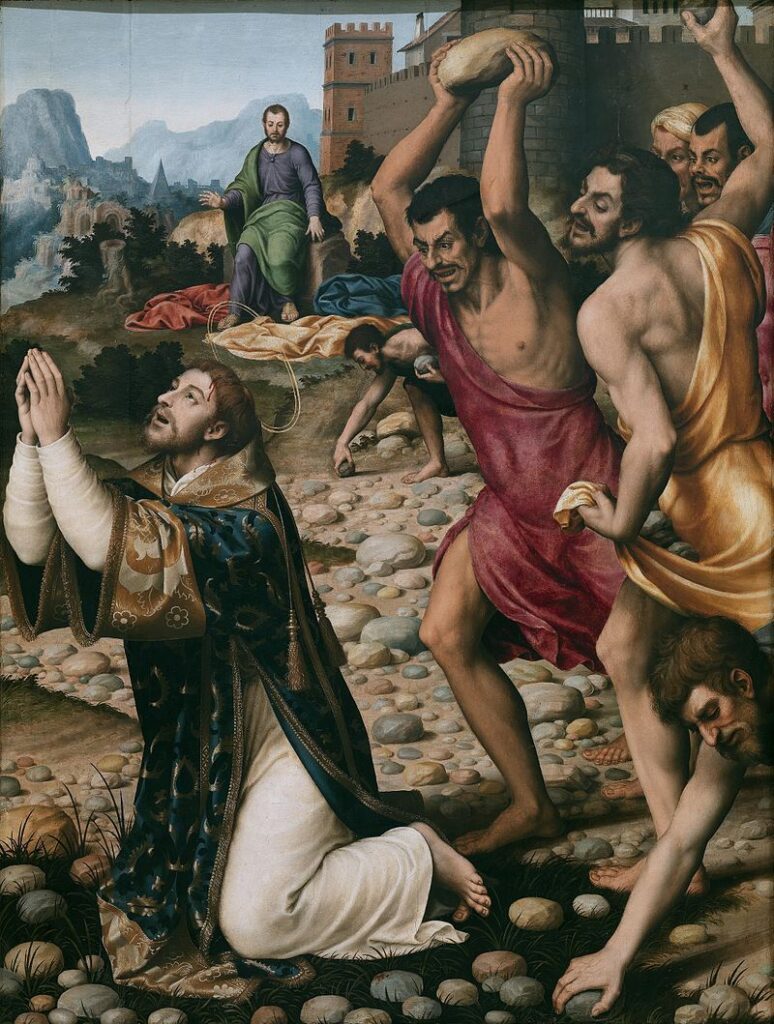
San Esteban, primer mártir de la cristiandad
Martyrdom of Saint Stephen, Juan de Juanes at the Prado Museum.

A reflection

The testimony of the first martyr, Saint Stephen, remains relevant today. How can we be witnesses to Christ in our daily lives? We may not face physical persecution, but we may encounter challenges as we try to live our faith consistently in a world that is often indifferent or critical.

The Gospel of his feast day reflects the faithfulness of Jesus' first disciple, who bore witness to him before men. Faithfulness means likeness, identification with the Master. Like Jesus, Stephen preached to his brothers of the same race, filled with the wisdom of the Holy Spirit, and performed great wonders on behalf of his people. Like Jesus, he was taken outside the city and stoned there, while he forgave his executioners and gave up his spirit to the Lord (cf. Acts of the Apostles, 6:8-10; 7:54-60).

Caring about the environment

But we can ask Jesus: how can we not worry when we feel the threat of an environment hostile to the Gospel? How can we ignore the temptation to fear Or human respect, to avoid having to resist?

Even more so when that hostility arises in one's own family environment, something that the prophet already predicted: “For the son will speak against his father, the daughter against her mother, the daughter-in-law against her mother-in-law; a man's enemies will be the members of his own household” (Micah 7:6). It is true that Jesus does not give us a technique for escaping persecution unscathed. He gives us much more: the assistance of the Holy Spirit to speak and persevere in goodness, thus giving faithful witness to God's love for all humanity, including our persecutors.

On this first day of the Octave of Christmas, there is still room for joy, since what we love most, what makes us happiest, is not our own safety, but salvation for all.

Saint Stephen invites us to remember that the strength to live and defend our faith comes from the Holy Spirit. Let us trust in Him and follow His example of love, forgiveness, and service!

In the CARF Foundation, We pray for persecuted Christians around the world and work to train seminarians and diocesan priests who, like Saint Stephen, will courageously carry the message of Christ. Let us join together in prayer for them!


December 28, Feast of the Holy Family, cradle of love

The family is defined as a school of love. This year, since Christmas does not fall on a Sunday, we celebrate the feast on the last Sunday of the year instead of the Friday before.

«The Redeemer of the world chose the family as the place for his birth and growth, thus sanctifying this fundamental institution of every society.» Pope Saint John Paul II, Angelus message, December 30, 2001.

The teachings

The family The family is an intimate communion of life and love, founded on marriage between a man and a woman, open to the gift of human life and love forever. This feast points to the Holy Family of Nazareth as the true model of life. All the families of the world should always turn to the protection of the Holy Family, in order to learn to live love and sacrifice.

The family is defined as a school of love and a domestic Church. The family is the providential place where we are formed as human beings and as Christians. Our family is where we grow in wisdom, age and grace before God and mankind.

It must be a place of dialogue between God and man, open to the Word and to listening. Seconded by the family prayer that binds us together strongly. Saint John Paul II strongly recommended praying the Holy Rosary within families, and he kept in mind the saying: «the family that prays together, stays together.».

It is for all these reasons that the Feast of the Holy Family invites us to welcome, live and proclaim the truth and beauty of the family, according to God's plan.

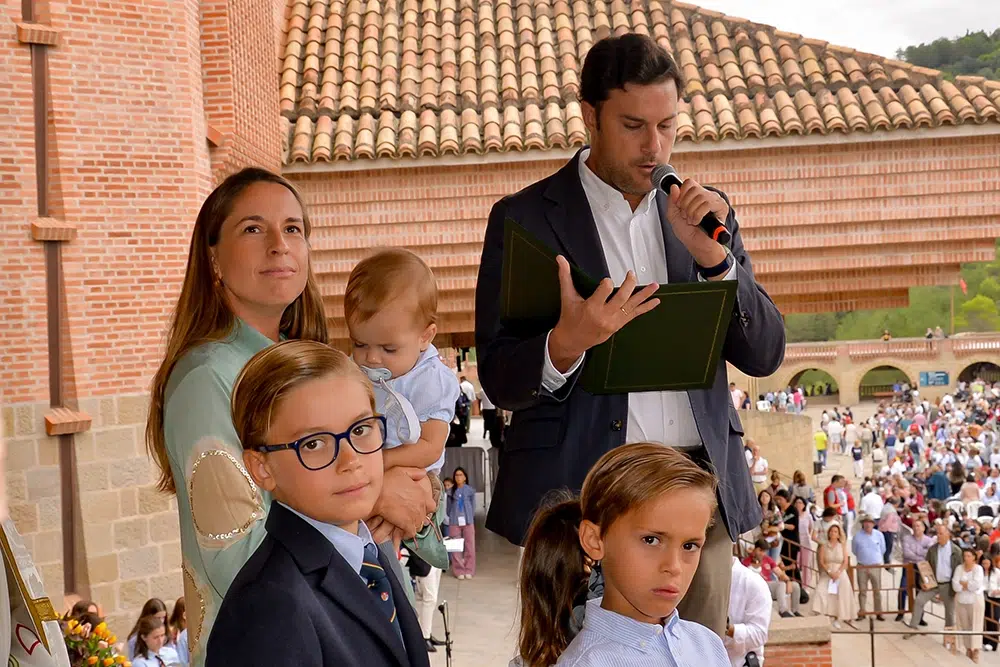
Una familia en Torreciudad rezando como la Sagrada Familia nos enseñó, unidos.
A family in Torreciudad giving thanks to the Virgin Mary.

Source of priestly vocations

The identity of Christ and his mission have taken shape in history and in the world in the bosom of the Holy Family. We can say that this is the model within which, in the vast majority of cases, the Lord's call to the sons of Christian families to their consecration and vocation to the priesthood takes place. For this reason, the role of Christian families is fundamental in the emergence of vocations.

Both the priesthood and the consecrated life are free gifts from the Lord and it is indisputable that the vast majority of vocations arise from within families that believe and practice, from environments in which the values of the Holy Family of Nazareth are lived.

To discover this vocation, the role of parents in the formation of their children is crucial. No institution can replace their work in education "especially as regards the formation of conscience. Any intrusion in this sacred sphere must be denounced because it violates the right of parents to transmit to their children an education in conformity with their values and beliefs",

Cradle of the vocation to love

In the Familiaris consortioPope John Paul II taught that "Christian marriage and the Christian family build up the Church: for in the Christian family the human person is not only brought into being and progressively introduced into the human community by means of education, but also by means of the rebirth of the human person. baptism and education in the faith in which the child is also introduced into the family of God, which is the Church".

The home that lives following the example of the Holy Family is a school of prayer. From an early age, children learn to place God spontaneously in the first place, recognizing Him and dialoguing with Him in all circumstances. TIt is also a school of lived faith, where learning does not take place in a theoretical way, but is embodied in everyday work. Likewise is a school of missionary diffusion as active promoters of consecrated vocations.

Living the gospel is not easy today, even more so in these times. However, In the Gospel we find the way to live a holy life on a personal and family level, a certainly demanding but fascinating path. We can follow the example of Jesus of Nazareth and thanks to his intercession.

In every home there are happy and sad, peaceful and difficult moments. Living the gospel does not exempt us from experiencing difficulties and tensions, from encountering moments of happy strength and moments of sad fragility. We must understand that it is the Holy Spirit who guides every human being today. But we must listen to the Spirit who speaks in us; we need a gaze of faith to grasp the reality beyond appearances.

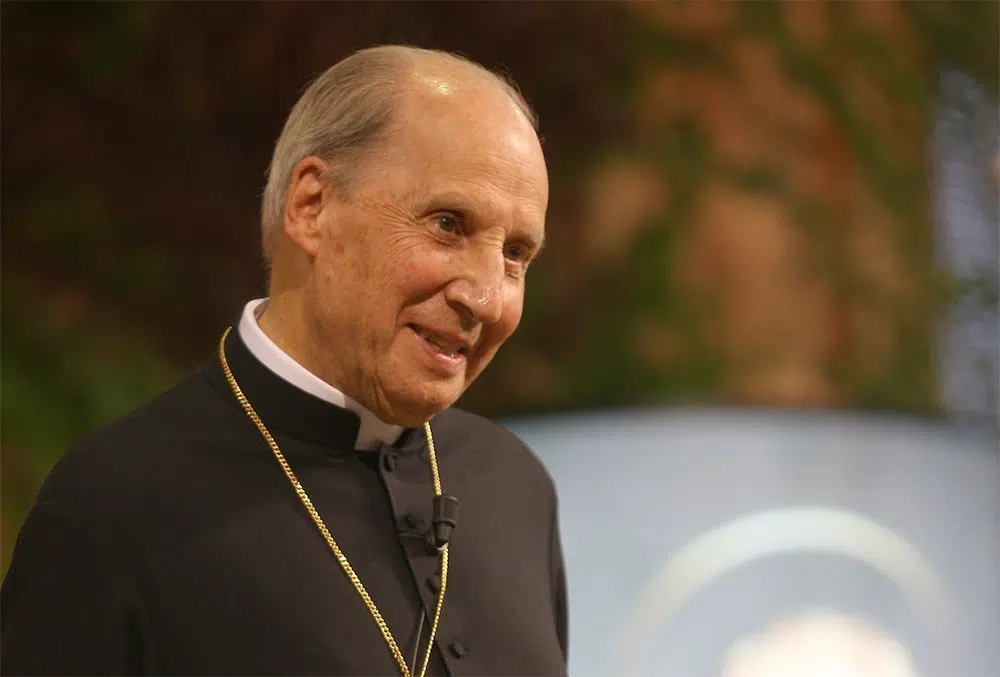
Monsignor Javier Echevarría at the shrine of Torreciudad alluded to the fact that it is the family home "where the various vocations in the Church are forged", and expressed the wish that families be "truly Christian, that they consider the call of some of their sons to the priesthood a great divine blessing".

Discernment of vocation in the Christian home

Pope Francis offers us in the apostolic exhortation Christus vivitten guidelines for reflecting on the feast, home education and facilitating the process of vocational discernment for children.

Forging in Charity


Bibliography:

- Synod of Bishops, 2001.
- Spanish Episcopal Conference 2022.
- Pope Francis Audience, 2019.
- Post-Synodal Apostolic Exhortation Christus Vivit, Pope Francis, 2019.


«It is our responsibility to the universal Church»: benefactors of the CARF Foundation

Margarita, Manuel, Alex, David, and Luis are some of the CARF Foundation's benefactors who are collaborating in the campaign. May no vocation be lost.They tell us why they collaborate with the universal Church in the comprehensive academic and spiritual formation of seminarians and diocesan priests. 

Responsibility to the universal Church

Margarita and Manuel: «We learned about CARF through Alejandro Cantero, former president of the CARF Foundation who passed away a few years ago. He spoke with genuine enthusiasm about this wonderful work, which we witnessed on our first trip to Rome for an international meeting when we visited the Pontifical University of the Holy Cross and the International Seminar Sedes Sapientiae.

On this trip we were able to realize the true sense of universality of the ChurchThe priests and seminarians we met, young people of different races and cultures but with the same enthusiasm, with the same desire, to be formed as priests and then return to their countries of origin, where they will exercise their priestly work among their people and as formators of the seminaries.

«We check the atmosphere of joy and service that permeated the seminary, not only among the young people but also with their formators, who are dedicated to caring for their formation and their life of piety.

You can imagine that their stories were very diverse, as was their call to vocation, but we understood right away that We had a responsibility to the Church. We had lamented so many times about the lack of vocations and asked God for them, and now we saw that God does call young people, all over the world, but they need to be formed and formed well, and here we all had a responsibility, so that none of them would be lost due to lack of means.

Getting to know these young people, where they study, how they live and their sense of responsibility, making the most of these formative years, and living in gratitude for it, reaffirmed our desire to do our bit. 

We can tell you that By collaborating with the CARF Foundation, we are working directly with churches around the world., priests are fundamental pillars, they are the ones who administer the sacraments and, therefore, where a priest carries out his work, the Church arrives.

The transcendental importance of priests

 For his part, Luis, comments: «I learned about the CARF Foundation through the Foundation's magazine that was sent to my home. It motivated me to financially support the Foundation., the transcendental importance of priests inside and outside the Church.

Inside, for the administration of the sacraments and for the preaching of the Gospels (both decisive for the sanctification of all its members). And outside, for the propagation of the word of the Lord (both by word and example). The holier and better prepared they are, the more effective their work will be for everyone.

I would encourage people to invest in the formation of priests because of the above and the scarcity of financial means, which unfortunately the Church has, especially at this time".

"By collaborating with CARF, we help in a direct way with the Church around the world. Priests are fundamental pillars."

'Priests are God's staff'

Alex is a benefactor of the CARF Foundation who has collaborated, among other things, in the training of seminarian Jacobo Lama from the Dominican Republic, who studies at the Pontifical University of the Holy Cross in Rome and has just completed his studies.

Alex is dedicated to training people in their search for employment, a goal that he has also transferred to his work: «Priests and seminarians are going to work for God; they are going to be 'God's staff.' Therefore, without financial resources for their training, it would be very difficult for them to perform this work to the fullest,» he says.

"When I went to Rome, I was able to get an idea of the importance of the work carried out by the CARF Foundation and the human qualities of the seminarians who train there. Diocesan seminarians, who come from a wide variety of countries and who will later return to their respective dioceses to pass on the training they have received.

Dioceses that do not have the necessary financial resources, but are instead a wonderful source of vocations, a 'raw material' that is a gift from the Church and that we must care for at all costs. I have been there five times (the foundation has awarded me the medal they give after five international meetings) and each time I return more impressed and encouraged to continue lending a hand after looking out of this window from which you can see the universality of the Church.

"Putting human resources at the service of God."

I am dedicated to helping people find work and therefore the theme "employment" motivates my day to day. My collaboration with CARF is not unrelated to this because I cannot help but see all these seminarians as "God's staff", those who are going to be on the payroll full time, with an unattractive salary but who contribute for the maximum pension, without a doubt. A job with guaranteed joy, for them and for us. And in the most diverse, distant and unimaginable places.

Entrepreneurs must consider, among other things, the return on any investment we make (ROI), and investing in the training of seminarians (which is tax deductible) is probably the best deal you can make, as you get a hundredfold return. These days, we hear a lot about essential jobs. Being a priest, exercising the priesthood, is one of the few essential jobs that cannot be done remotely.

We have a significant shortage of priests, and it is probably the most difficult position to fill, as it is not a matter of having a good grade point average to enroll in a university or receive training. online. It's about vocation and God's calling. That's why, when a vocation appears, and even more so if it lacks financial means, we must pitch in to nurture it, train it well, and help it succeed.  

We complain about the lack of priests but in CARF we have as many as we want, from all countries. They have the vocation. We have the means. It would be unforgivable to lose vocations for lack of economic resources".

"The world needs priests. It would be unforgivable if vocations were lost due to lack of economic resources."

Iglesia universal benefactores fundación CARF

David encourages collaboration with CARF for the good of the Universal Church. "Priests are very important to maintain Christian culture, traditions and faith, as well as contributing to the great social work that the Church and priests do in many underdeveloped countries," he says.

Giving time and money 

David: «I learned about the CARF Foundation thanks to Alejandro Cantero, who at that time, in 2005, was the president of the Foundation. With patience and as if he had all the time in the world for me, he explained the Foundation's origins, history, and goals.

Among the aims of the Foundation are the integral formation of diocesan priests and seminarians from all over the world, especially from the most needy countries. In the first place, scholarships are given to seminarians who apply and are sent by the Bishops of the five continents. 

Other specific purposes to which the CARF Foundation devotes its activities are the promotion and maintenance of the centers and institutions where priests and seminarians live or are trained: the Ecclesiastical Faculties of the University of Navarra and the Pontifical University of the Holy Cross. 

After the extensive and complete presentation that Alejandro Cantero made to me, he proposed me to collaborate as a member of the Board of Trustees that governs the Foundation; and in spite of the great responsibility that it meant for me, I decided to accept the position. I knew from the previous explanations that the Foundation is a non-profit entity and I assumed from the beginning that this was going to cost me time and money; but the motivation for accepting the position was the observation of the need to defend my traditions, my beliefs and my culture, given my status as a Catholic and my faith.».

Changing the world 

"I thought: from this Foundation we can change the world, and how! Later, while working at the CARF Foundation, I personally witnessed how two characteristics instilled by Baptism were fulfilled, namely: the priestly soul and the apostolate. Priestly soul, to become aware of helping your Church, that it may be Holy, Roman, and Universal.

Apostolate, according to the Gospel mandate: "Go into the whole world and proclaim the Gospel". And who better than priests to preach the Gospel. So I had only to help and contribute with my means and according to my possibilities to that priority work of the Church where you touch its heart, its spinal cord. As Catholic Theology says, the Church needs the Eucharist and the Eucharist needs the priests.

That firm decision to dedicate time and work to collaborate with CARF, sharing it with a demanding professional job and with the duties of a large family of six children in my case, is something that has done me a lot of good and that I would like to share with all those people who would like to help us as collaborators or benefactors, working on something so fascinating and for which God will reward us abundantly.

Some may dedicate a lot of time, others less, but the important thing is to carry this message in our hearts and take advantage of every opportunity to inform and enthuse others about the objective and the work we do.

An anecdote comes to my mind that I was told about a Brotherhood in Andalusia, which took an image in procession and to defray the expenses, they put underneath a jar with a cardboard that said: with these donations we cover the annual expenses. The way to collaborate is as follows: Those who have much, with much. Those who have less, with less. And those who have nothing, with nothing.

But everyone can pray and help spread the word, I might add.

In CARF even if you have nothing it does not matter, because we can all pray and ask God for the Church and to send us many and holy priests. This is how the world would change, spreading Catholicism, speaking the Truth in capital letters, with freedom and without impositions.

The good done to the universal Church 

I would encourage many people to collaborate with CARF because of the good they do for the Universal Church and also for themselves. And it is very important to maintain the Christian culture, traditions and faith; besides contributing to the great social work that the Church and priests do in many underdeveloped countries.


Sergio Rojas, priest: a Venezuelan vocation born far from God

Sergio Rojas did not grow up in a religious family, nor did he dream of becoming one. priestly vocation. He barely knew God, and his life did not revolve around faith. However, this priest from Venezuela discovered that God's call can come even when you are not looking for it.

His story is that of a priestly vocation unexpected, forged in a personal encounter with Christ and sustained, years later, by the concrete help of benefactors and friends of the CARF Foundation.

A priestly vocation that did not begin at home

The vocational story of priest Sergio Rojas does not begin in a parish or in a family especially religious. On the contrary. Although her family considered themselves Catholic, faith was not really part of their daily lives.

«I have always considered my vocation to be something very special,» he explains. And he says this with good reason: for years, God was practically a stranger to him.

The turning point came thanks to his best friend's mother. She was the one who first spoke to him about God in a personal and concrete way, and who introduced him to a community of Neocatechumenal Way. There began a journey of faith that, unbeknownst to him at the time, was planting the seeds of his priestly vocation.

When God bursts in without asking permission

Sergio had been walking in faith for barely three years when something unexpected happened. During some national Camino meetings, at the moment when vocations were being requested, he felt an inner restlessness that was difficult to explain.

«It was like a flame that burst into life,» he recalls. But along with that call came fear. He didn't feel ready. It seemed too soon. Too serious.

The question came up again some time later, in an even more direct way. A Mexican missionary nun, after meeting him, asked him a question that he couldn't get out of his head: «And you, when are you going to enter the seminary?».

From then on, the idea would not leave him alone. Until one day, before the Blessed Sacrament, he decided to stop resisting: «I challenged God. I said to Him, “If You want it, I want it.”».

That simple gesture marked the definitive beginning of his path to the priesthood.

From Venezuela to Pamplona: training to serve better

While in the seminary, his bishop made a decision that would change his life: to send him to Pamplona (Spain) to complete his training in the Bidasoa international seminar.

For this Venezuelan priest, My time in Spain was not just an academic experience. It was a deeply human and spiritual experience.

«In Bidasoa, I felt at home, despite being so far from my country,» he confesses. There he discovered something essential: «that the Church is not an abstract idea, but a universal family. People from very different cultures, languages, and realities, united by the same faith.».

That experience helped him better understand the world to which he would one day be sent as a pastor.

Much more than studies: learning to be a priest

If Sergio took anything away from his stay in Pamplona, it was not a degree, but a way of living the priesthood.

«I trained myself to give my all to pastoral work,» he explains. He learned to understand the Church from within, to understand the different human realities he would encounter and to bear witness to Jesus Christ in the midst of them.

Sergio Rojas sacerdote Venezuela vocación
Father Sergio Rojas, priest of the Diocese of Margarita, accompanied by young people from the parish.

Among the aspects that most influenced his formation were constant spiritual direction, frequent Confession, and personal contact with Jesus in the Eucharist.

But there was one testimony that left a special mark on his priestly life: that of Father Juan Antonio Gil Tamayo, his formator, who lived through his illness with a serene and luminous faith.

«He showed us that spiritual strength allows us to look beyond suffering and discover the will of God even on the cross,» he recalls.

The priest today: serving and not isolating oneself

Father Sergio Rojas does not idealize the priesthood. He is well aware of the current challenges and difficulties facing the Church.

For him, the key is clear: prayer, dedication, and humility. The priest, he says, is called to serve, not to seek comfort or recognition.

He also insists on the importance of not living in isolation. «The priest must be with the people, know their reality, share their joys and sufferings.» But all this only makes sense if it arises from a living encounter with Jesus Christ. «Without prayer, the priesthood loses its essence,» he asserts. Venezuelan priest.

Gratitude to the CARF Foundation: support that makes vocation possible

Looking back, Sergio Rojas has no doubts: without the help of benefactors and friends of the CARF Foundation, his story would have been very different.

«Without you, I would not have been able to travel, study, or train in Pamplona,» he says gratefully. This is not a platitude, but a concrete reality: his priestly vocation He also benefited from the generosity of people who invested in his education.

That's why, he says, there will always be a prayer grateful to those who make it possible for other seminarians and priests to prepare themselves to better serve the Church.