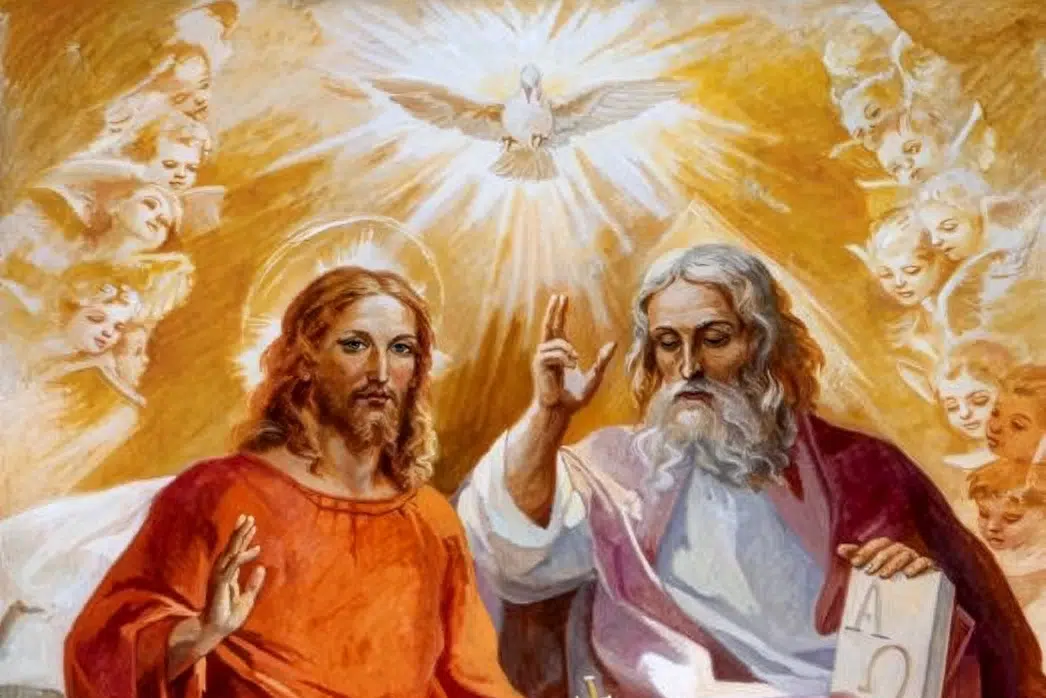
The revealed truth of the Most Holy Trinity has been from the origins at the root of the Church's living faith, principally in the act of Baptism. It finds its expression in the rule of baptismal faith, formulated in the preaching, catechesis and prayer of the Church. These formulations are already found in the apostolic writings, such as this greeting found in the Eucharistic liturgy: "The grace of the Lord Jesus Christ, the love of God and the communion of the Holy Spirit be with you all" (1 Cor 5:17).2 Co 13:13; cf. 1 Co 12,4-6; Ef 4,4-6). This reference comes literally from point 249 of the Catechism of the Catholic Church.
The liturgical celebration of the Solemnity of the Most Holy Trinity invites us to plunge into the very heart of our faith. On this day, the Church calls us to contemplate the infinite Love that unites the Father, the Son and the Son of God. Holy Spirit.
The Church dedicates the following Sunday to Pentecost to honor God in his unity and trinity. We do not celebrate an abstract concept, but rather a mystery of communion. According to the Catechism of the Catholic Church, the Trinity is the central mystery of faith and of Christian life. It is the source of all the other mysteries of the faith.
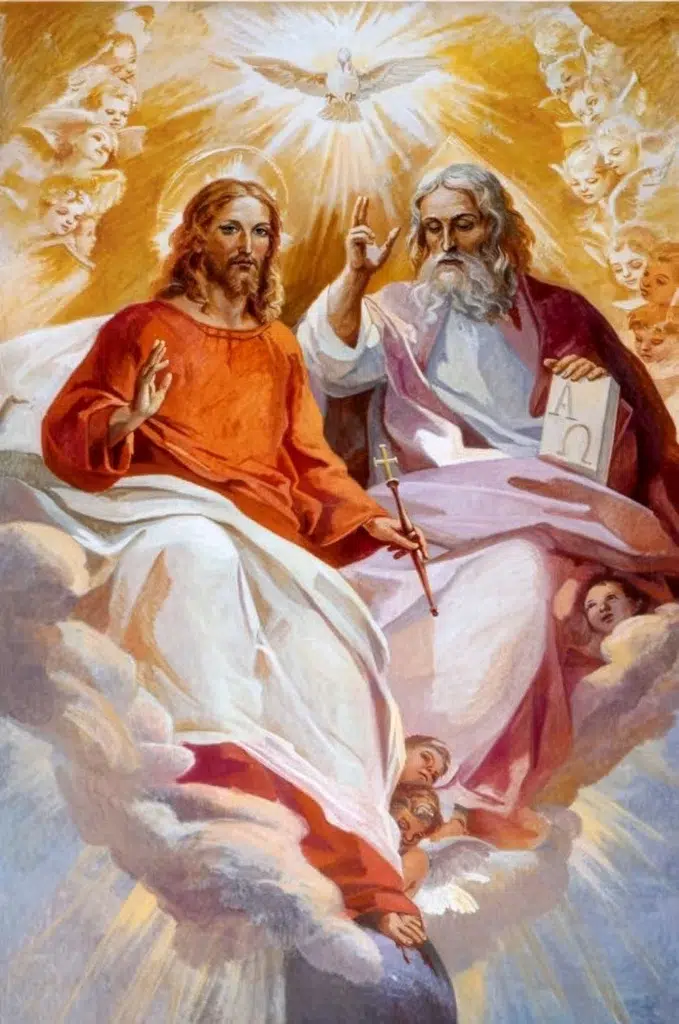
1. What is the central mystery of the faith and of the Christian life?
The central mystery of Christian faith and life is the mystery of the Holy Trinity. Christians are baptized in the name of the Father and of the Son and of the Holy Spirit.
2. Can human reason alone know the mystery of the Holy Trinity?
God has left traces of his Trinitarian being in creation and in the Old Testament, but the intimacy of his being as the Holy Trinity constitutes a mystery inaccessible to human reason alone and even to the faith of Israel, before the Incarnation of the Son of God and the sending of the Holy Spirit. This mystery has been revealed by Jesus Christ, and is the source of all other mysteries.
How does the Church express its Trinitarian faith?
The Church expresses her Trinitarian faith by confessing one God in three Persons: Father, Son and Holy Spirit. The three divine Persons are one God because each of them is identical to the fullness of the one and indivisible divine nature. The three are really distinct from each other, because of their reciprocal relationships: the Father begets the Son, the Son is begotten by the Father, the Holy Spirit proceeds from the Father and the Son.
4. How do the three divine Persons work?
Inseparable in their one substance, the divine Persons are also inseparable in their work: the Trinity has one and the same operation. But in the one divine action, each Person is present according to the way that is proper to him in the Trinity. «My God, Trinity whom I adore... pacify my soul. Make it your heaven, your beloved dwelling place and the place of your repose. May I never leave you alone in it, but may I be there entirely, fully awake in my faith, in adoration, surrendered without reserve to your creative action» (Blessed Elizabeth of the Trinity).
Free e-book texts: the Compendium of the Catechism of the Catholic Church.
1. The importance of the Trinity in the life and preaching of St. Josemaría. 2. 2. The homily Towards holiness. Unity and Trinity. The “trinity of earth” and the trinity of heaven. Trinitarian devotions.
In his preaching St. Josemaría always went to the essential, to the central mysteries of our faith and, as a consequence, his considerations, in one way or another, always have as their horizon the mystery of the Trinity: the love of God the Father who gives his Son, the love of the Son that leads him to offer his life in sacrifice, and the sanctifying action of the Spirit. His whole spiritual doctrine was deeply Trinitarian and Christological.
Importance of the Trinity in the life and preaching of St. Josemaria
As his spiritual writings attest, St. Josemaría From very early on, he had a warm relationship with each of the three divine Persons, underlining the distinction between them according to the characteristics they manifest in the history of salvation: the Father is the source and origin of everything; the Son, the Word of the Father who becomes man so that men may become children of God; and the Holy Spirit is the Sanctifier, the one who unites men with God, making them one with Christ.
One of the features that St. Josemaría emphasized in his spiritual itinerary, with great interior commotion, is the divine filiation and, consequently, the paternity of God. In a homily dated April 1964, he confided: “My life has led me to know that I am especially a child of God, and I have tasted the joy of entering into the heart of my Father” (AD, 143).
He was referring to the supernatural intuition with which he perceived the joyful reality of divine filiation and, consequently, of the paternity of God. This paternity already appears in his Apuntes íntimos (Intimate Notes), in Holy Rosary and in The Way, as the truth that serves as the foundation of his spiritual life.
The Word is present in St. Josemaría, above all, as the Word incarnate, with an endearingly human name: Jesus. He is the Wisdom and the Word of the Father, a Word full of love, for he is “the Word from whom love proceeds” (ECP, 162). With his “Heart of flesh, with a Heart like ours, which is a sure proof of love and a constant witness to the unspeakable mystery of divine charity” (ibidem). The only way to the God-Trinity is precisely the Humanity of the Lord (cf. AD, 300-303).
In the spiritual life of St. Josemaría, this great interior “discovery” took place between September 22 and October 17, 1931. In the autumn of 1932 another “discovery” took place, also of profound and lasting consequences in his interior life and in his theological thought: the importance of the work of the Holy Spirit in the soul. Pedro Rodriguez offers a text, taken from Apuntes íntimos, of great mystical elevation.
In it, St. Josemaría describes how he perceives the importance of the presence of the Holy Spirit in the soul: “Until now, I knew that the Holy Spirit dwelled in my soul, to sanctify it.... but I did not grasp that truth of his presence (...) I feel Love within me: and I want to treat him, to be his friend, his confidant..., to facilitate his work of polishing, of plucking, of kindling (...) -Purpose: to frequent, if possible without interruption, the friendship and loving and docile treatment of the Holy Spirit. Veni Sancte Spiritus” (CECH, p. 270; cf. F, 514).

When St. Josemaría speaks of God, he thinks above all of the God-Trinity. This is seen, for example, in his reading of the first chapters of Genesis: “The Trinity has fallen in love with man, raised him to the order of grace and made him in his image and likeness (Gen 1:26); he has redeemed him from sin (...) and he earnestly desires to dwell in our soul: he who loves me will observe my teaching and my Father will love him, and we will come to him and make our abode within him (Jn 14:23)” (ECP, 84).
Human freedom that springs from the freedom that exists in the Trinity. Here is a very expressive text taken from a homily entitled Freedom, gift of God: “In all the mysteries of our Catholic faith flutters this hymn to freedom. The Most Blessed Trinity brings the world and man out of nothing, in a free outpouring of love. The Word comes down from heaven and takes our flesh with this stupendous seal of freedom in submission: Behold, I come, as it is written of me in the beginning of the book, to do your will, O God (Heb 10:7)” (AD, 25).
When St. Josemaría describes God's love for man, he often recalls that this love is Trinitarian. We find a particularly eloquent passage on the Trinity in a homily delivered on Holy Thursday 1960, in which he devotes ample space to speaking of its relationship with the Eucharist: the «Trinitarian current of love for mankind is perpetuated in a sublime way in the Eucharist» (ECP, 85). Here, at the center of the Christian mystery, the manifestation of God's love for mankind also reaches its highest point: «The whole Trinity is present in the sacrifice of the Altar. By the will of the Father, with the cooperation of the Holy Spirit, the Son offers himself in redemptive oblation» (CCC, 86).
St. Josemaría is enunciating in these paragraphs truths that are very dear to him, both with regard to the celebration of the Holy Mass and to the nature of the ministerial priesthood - the liturgy, especially the Holy Mass, is the most important of the liturgies. opus Trinitatis, The Mass, I insist, is a divine action, Trinitarian, not human.
The priest who celebrates and serves the Lord's purpose, lending his body and his voice; yet he does not work on his own behalf, but in persona et in nomine Christi, in the Person of Christ and in the name of Christ» (ibidem). In celebrating, the priest enters, so to speak, into the stream of Trinitarian love precisely because, acting in the person and name of Christ, he offers the holocaust to the Father with the sanctification of the Holy Spirit (cf. ECP, 86).
The most direct way to treat the Blessed Trinity is found in the Holy Mass: «By attending Holy Mass, you will learn to treat each of the divine Persons: the Father, who begets the Son; the Son, who is begotten by the Father; the Holy Spirit, who proceeds from both. In dealing with any one of the three Persons, we deal with one God; and in dealing with all three, with the Trinity, we deal equally with one true and unique God» (ECP, 91).
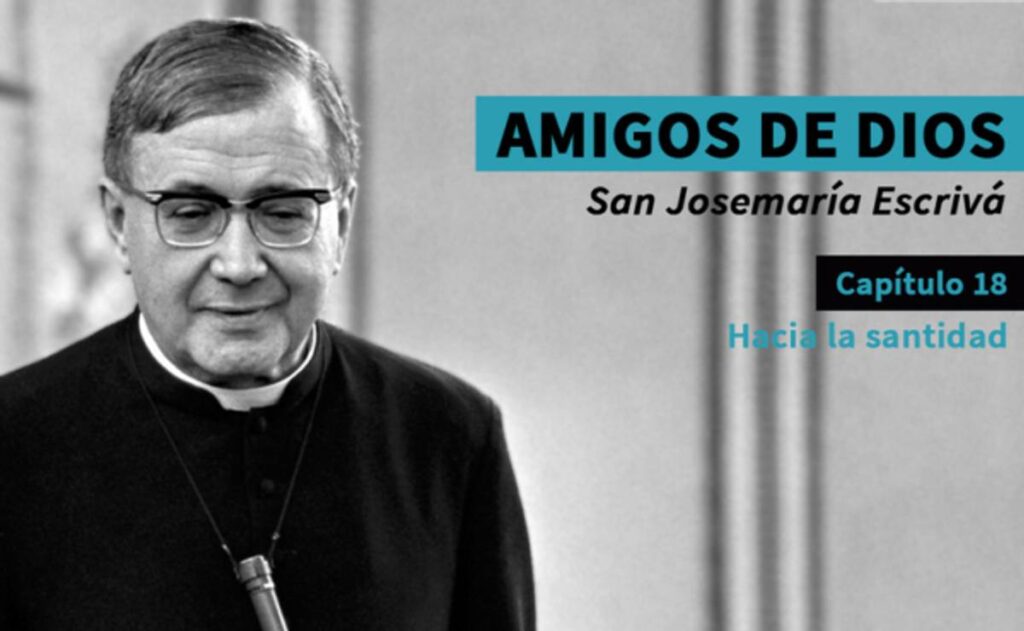
2. The Homily Toward Holiness
It is very illustrative what is said in the homily Toward Holiness about the importance in St. Josemaría's thought of the contemplation of the Most Blessed Trinity. In this homily he describes the general lines of man's journey towards God. After speaking of the universal call to holiness, of prayer, of the presence of God and of contact with our Lord Jesus Christ, he adds: «To approach God we have to take the right path, which is the Most Holy Humanity of Christ» (AD, 299). The road to the Trinity must be traveled in close union with Christ through the Bread and the Word.
Union with Christ often means an encounter with the Cross and entering into times of “passive purgation” (AD, 302). These times are to be spent in the midst of peace and joy, for if we truly love Christ, «if with divine boldness we take refuge in the opening that the lance left in his side, the promise of the Master will be fulfilled: whoever loves me will observe my teaching, and my Father will love him, and we will come to him and make our abode within him» (AD, 306). We are before the truth of the indwelling of the Trinity in the soul and its ascetic consequences.
As if the soul could have experience of this dwelling of God in it, he continues: «The heart needs, then, to distinguish and adore each of the divine Persons. In a way, it is a discovery that the soul makes in the supernatural life, like those of a creature that is opening its eyes to existence. And it entertains itself lovingly with the Father and with the Son and with the Holy Spirit; and it easily submits itself to the activity of the life-giving Paraclete, who gives himself to us without deserving it: the supernatural gifts and virtues» (AD, 306).
St. Josemaría clearly refers to the contemplation of the Blessed Trinity in the midst of the daily hustle and bustle. The expressions he uses to describe this contemplation are similar to those used by spiritual authors to speak of contemplation as the fruit of the gifts of the Holy Spirit. Here are some very graphic expressions of how he conceives this contemplation: «Words are superfluous, because the tongue is unable to express itself; the mind is stilled. One does not discourse, one looks! And the soul breaks into song again with new song, because it feels and knows that it too is lovingly gazed upon by God at all times» (AD, 307).
These words of St. Josemaría remind us of the marvelous paragraphs in which St. John of the Cross describes the union of the soul with the Holy Trinity and the indwelling of God in the soul, or rather, the indwelling of the soul in God. Of course, it is clear that St. Josemaría is speaking of contemplation and dealing with the Trinity in ordinary life.
“I am not referring to extraordinary situations. They are, they may well be, ordinary phenomena of our soul: a madness of love that, without spectacle, without extravagance, teaches us to suffer and to live, because God grants us Wisdom. What serenity, what peace then, when we are on the narrow path that leads to life! (Mt 7:14)” (AD, 307).
St. Josemaría is well aware that he is mentioning a true goal of spiritual experience, and this in ordinary life. It is a question of “ordinary phenomena” that, at the same time, are an authentic “madness of love. Here, by a logical association of ideas, some questions arise that lead us to understand the importance of union with the Most Blessed Trinity -with each of the divine Persons- in ordinary life: ”Asceticism? Mysticism? It does not worry me.
Whatever it is, ascetic or mystical, what does it matter: it is God's mercy. If you try to meditate, the Lord will not deny you his assistance (...). This is already contemplation and it is union; this must be the life of many Christians, each one going forward on his own spiritual path - there are infinitely many of them - in the midst of the cares of the world, even if they have not even realized it” (AD, 308).
St. Josemaría uses words with precision. He is speaking of contemplation and union with the Trinity, with each of the Persons; these are well known terms in spiritual theology. He also speaks of ordinary life and of many Christians “going their own spiritual way. We find ourselves, then, before a great paradox, but this paradox disappears if we keep in mind the deep conviction with which St. Josemaría relies on the universal call to holiness.
This contemplation of the Trinity will always be a “mercy” of God, a mercy that corresponds to the gift of the universal call to holiness, to the fact that we are children of God in Christ through the Holy Spirit and to the reality of the indwelling of the Trinity in the soul.
St. Josemaría emphasizes the distinction of Persons, considering the Trinity as a communion of life and love in its perfect unity, and advises us to treat each of the Persons in their distinction: “Treat the three Persons, God the Father, God the Son, God the Holy Spirit. And to arrive at the Most Blessed Trinity, go through Mary” (F, 543).
The glory that the Christian should give to God also has a Trinitarian structure. Thus it appears already in The Way: “Let no affection bind you to earth apart from the most divine desire to give glory to Christ and, through Him, with Him and in Him, to the Father and to the Holy Spirit” (C, 786). Devotion to the Trinity has an evident Christological dimension: “Our Master is Christ: the Son of God, the Second Person of the Most Blessed Trinity. By imitating Christ, we attain the marvelous possibility of participating in that stream of love, which is the mystery of the One and Triune God” (AD, 252).
In all these counsels, St. Josemaría adheres soberly to the formulations of the Symbol and the doxologies of the Liturgy, with great faith and a great ecclesial sense. Quoting St. Cyprian, he says, “we are one people confessing one faith, one Creed; one people gathered together in the unity of the Father, the Son and the Holy Spirit” (ECP, 89).
It also reflects, as a long-lived reality, his own spiritual itinerary in his dealings with the Most Blessed Trinity and with each of the divine Persons. In this sense, it is worth noting that the two planes of the consideration of the Trinitarian mystery - the Trinity ad intra and the Trinity ad extra, that is, the immanent Trinity and the economic Trinity - are very present and clearly distinguished in his teaching.
Of the first Person, St. Josemaría considers above all his paternity and his fontality: everything proceeds from the Father, he is the origin of the Trinitarian current of love, he is the one who takes the initiative in offering man the Covenant. On this question, as we have already noted in the voice God the Father, the annotations and comments of Pedro Rodriguez, in his critical-historical edition of The Way, are of great interest, especially in numbers 267 and 435.
St. Josemaría contemplates the Father's fatherhood with the eyes of our Lord, uniting his Abba to the Abba of Jesus. This is how he formulated it in a meditation preached on April 28, 1963: “When our Lord gave me those blows, around the year thirty-one, I didn't understand it.
And suddenly, in the midst of that great bitterness, those words: you are my son (Ps. 2:7), you are Christ. And I could only repeat: Abba, Pater!, Abba, Pater!, Abba!, Abba! (...) And the reason - I see it more clearly than ever - is this: to have the Cross is to identify oneself with Christ, is to be Christ, and, therefore, to be a son of God” (cf. also Illanes, 2008, pp. 471-472). Illanes rightly comments that this text and the meditation as a whole bear witness to the spiritual and theological maturity attained by St. Josemaría, who here “reveals the profound meaning from which the meaning of filiation derives and, more concretely, its development.
With regard to the Son, St. Josemaría dwells above all, as is logical, on his humanity and on the mysteries of his life, on the gesta et passa Christi. It is enough to recall what this contemplation is like in the books Holy Rosary and Way of the Cross. In the homily dedicated to the Heart of Jesus, we find a whole Trinitarian and Christological theology: “God the Father has deigned to grant us, in the Heart of his Son, infinite dilectionis thesauros (Prayer of the Mass of the Sacred Heart), inexhaustible treasures of love, mercy and affection (...).
Divine love makes the second Person of the Blessed Trinity, the Word, the Son of God the Father, take on our flesh, that is, our human condition, minus sin. And the Word, the Word of God, is Verbum spirans amorem, the Word from which Love proceeds” (ECP, 162), says St. Josemaría, following St. Augustine and St. Thomas (cf. S.Th., I q. 43, a. 5; De Trinitate, IX, 10).
Devotion to the Holy Spirit is also present with decisive force in the life and preaching of St. Josemaría. He is the one who identifies us with Christ and through him introduces us into the life of Trinitarian love: “To concretize, even in a very general way, a style of life that impels us to treat the Holy Spirit-and, with him, the Father and the Son-and to have familiarity with the Paraclete, we can look at three fundamental realities: docility, prayer life, union with the Cross” (ECP, 135).
Perhaps the best way to indicate how the mystery of the Trinity is present in St. Josemaría's writings is to say that it is present as love, according to the Johannine phrase God is Love (1 Jn 4:16) or, to use a well-known theological expression, as communio personarum: “the love of Jesus for mankind is an unfathomable aspect of the divine mystery, of the love of the Son for the Father and the Holy Spirit.
The Holy Spirit, the bond of love between the Father and the Son, finds in the Word a human Heart (...) Love, in the bosom of the Trinity, is poured out on all men through the Love of the Heart of Jesus” (ECP, 169).
4. The “trinity of earth” and the Trinity of heaven.
St. Josemaría refers to the Sagrada Familia as the “trinity of the earth”, considering that in her the Trinitarian mystery is manifested in a special way, community of life and love, and strongly emphasizes the relationship between St. Mary and the Trinity.
Even before the writing of The Way, Saint Josemaría liked to address Santa Maria recalling her relationship with each of the three Persons of the Most Holy Trinity: “How men love to be reminded of their kinship with literary, political, military and Church personalities! -Sing before the Immaculate Virgin, reminding her: Hail Mary, daughter of God the Father: Hail Mary, daughter of God the Father: Hail Mary, daughter of God the Father: Hail Mary, daughter of God the Father: Hail Mary, daughter of God the Father: Hail God, Mary, Mother of God the SonHail Mary, Bride of God the Holy Spirit.... More than you, God alone!” (C, 496).
In the critical-historical edition of The Way (CECH, pp. 649-651, nts. 15-17), Pedro Rodríguez recalls the history of this prayer of deep popular roots and offers a testimony from 1939, which documents that, already at that time, St. Josemaría advised considering the mystery of Mary in her relationship to the Blessed Trinity.
It is the same thing we find much later in Friends of God, 274: “This celebration leads us to consider some of the central mysteries of our faith: to meditate on the Incarnation of the Word, the work of the three Persons of the Most Holy Trinity. Mary, Daughter of God the Father, by the Incarnation of the Lord in her immaculate womb, is the Spouse of God the Holy Spirit and Mother of God the Son”.
St. Josemaría, who was in favor of “few but constant particular devotions” (C, 552), communicated to the members of Opus Dei in 1959 that it was advisable to begin the custom of praying or singing the Angelic Trisagion in the triduum preceding the feast of the Trinity, and of frequently praying and contemplating the Quicumque Symbol. Both customs are intended to manifest devotion to the Trinity with acts of adoration and explicit faith in the truths revealed about the central mystery of our faith. Related words: God the Father; Holy Spirit; Divine Filiation; Trinitarian Inhabitation; Jesus Christ.
Table of Contents
 carf@fundacioncarf.orgLandline: +34 914 029 082Mobile: +34 638 078 51145 Conde de Peñalver Street.