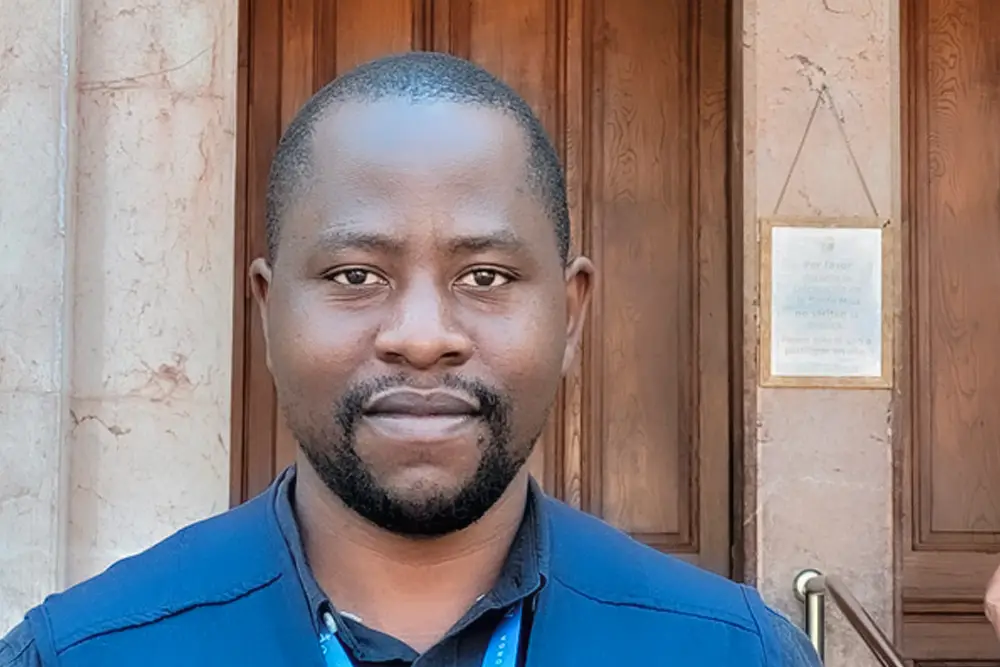
What might lead a civil engineer to leave his profession and embark on the path to the priesthood? In the case of Simon John Muhangwa, the answer did not come all at once. His calling to the priesthood grew gradually, from his childhood in a Catholic family in Tanzania through his college years and his first steps into the professional world.
Simon belongs to the Diocese of Mwanza, in Tanzania. After studying civil engineering and working for two years, he decided to answer the call he had been feeling for some time and was admitted as a seminarian in 2020. Later, his bishop sent him to Spain to continue his formation at the Bidasoa International Seminar, in Pamplona, and at the University of Navarra.
His story shows that a calling to the priesthood can develop even in the midst of a seemingly very different life, and that discernment requires time, prayer, and guidance.
A calling to the priesthood that began in the family
Simon was born on January 20, 1992, in the Magu district of the Mwanza region. He is the second of five siblings and grew up in a deeply Catholic family.
Family prayer played an important role during his childhood. From a young age, he admired priests and consecrated persons and began to wonder if God might be calling him as well.
He doesn't remember exactly when the idea of the priesthood first came to him, but he does remember that inner restlessness that grew over the years: «Little by little, a voice inside me told me that I might one day become a priest.».
His calling did not come with an immediate response. Simon continued his studies, participated actively in Catholic youth groups, and gradually took on leadership responsibilities. It was precisely during those years that some of his classmates began to tell him he had what it takes to be a priest.
Vocational Discernment: Learning to Listen
During high school, Simon was part of a group of young Catholic students and was elected as their leader. That experience allowed him to discover that he could put his abilities to work for others. But it also led him to ask himself deeper questions about his future.
He then began to seek information about the priesthood and asked priests for advice, and they helped him discern his possible vocation. Among them was Father Christian Lupindu, the chaplain at his school.
When he returned home after graduating from high school, he continued to discuss his concerns with the priests at his parish, Fathers Bartazar Kesi and Andrea Beno.
However, when he told his parents that he was considering the priesthood, they advised him to pursue a college degree first. Simon accepted that advice, but that path—far from closing the door on his vocation—helped him continue to discern his calling.
From College Student to Civil Engineer
Simon enrolled in the Mbeya University of Science and Technology, where he studied civil engineering and graduated in 2016.
During college, he continued to be active in a community of young Christians. He was also elected leader of the group and zonal president at his university. His interest in the priesthood, far from fading, continued to grow.
During that period, he also received spiritual guidance from the Father Fidelis Damana, university chaplain and missionary. Simon believes that his help was instrumental in furthering his vocational discernment.
This stage of his life was particularly significant: while he was receiving professional training to work as an engineer, he continued to wonder if God was calling him to devote his life to the priesthood.
When a Career Isn't the End of the Road
After graduating from college, Simon returned to his parish. There, he was encouraged to continue reflecting on his possible vocation.
He finally began working as civil engineer at the Tanzania Agency for Urban and Rural Roads (TARURA) in Dodoma. He worked there for two years. He had achieved what he had been preparing for over the years: a college degree and a professional position related to his studies. But his interest in the priesthood remained.
In 2020, he made the decision to take a definitive step: he was admitted as a seminarian in the Diocese of Mwanza. Subsequently, his bishop sent him to Spain to continue his formation at the Bidasoa International Seminary in Pamplona, in addition to his ecclesiastical studies at the University of Navarra.
His story is not that of someone who turned his back on education or a professional career. On the contrary: His experience as an engineer is also part of who he is as a person, which has led him to his vocational path.
Discernment requires guidance
Simon’s story reveals something essential about vocational discernment: often, a vocation isn’t discovered all at once. Some questions take time to answer, and some decisions require prayer. And there are times when it’s necessary to have someone who can help you see your own life in perspective.
In Simon's case, his parents, several priests, his college chaplain, and the Christian communities in which he was active all played an important role. Each of these people played a part in a journey that ultimately led him to the seminary. Accompanying young people in their vocational discernment is also a way to foster priestly vocations.
A Vocation Dedicated to Serving the Youth of Tanzania
During his college years, he already had experience leading Catholic youth groups and taking on leadership roles. He wants to put that experience to use in the service of the Church: «In my country, catechesis for young people is the most important and most necessary thing.».
His goal is to help young people gain a better understanding of the Catholic faith and to be able to answer the questions they have. To that end, he believes it is essential to receive a solid education.
It is not merely a matter of learning theological content. A priest needs a well-rounded education that will enable him to understand the questions of the people he will serve and to proclaim the Gospel in the specific circumstances of his time.
Faith, Technology, and Engineering
There is another particularly interesting aspect of Simon's project. His training as a civil engineer did not disappear when he began his journey toward the priesthood. He himself expresses his desire to put his professional knowledge at the service of the Church and to bring the faith closer to the modern world.
In particular, it discusses the areas of technology and the environment. This perspective is particularly significant at a time when evangelization must also engage with scientific, technological, and social changes.
A priestly vocation does not consist in turning away from the world, but rather in to serve people within the specific circumstances in which they live. Simon's professional experience can thus become another tool for his future pastoral ministry.
Training to Serve Better
For a vocation to the priesthood to develop, it requires time and proper formation. Simon was sent by his bishop to the Bidasoa International Seminary, where he was able to continue his preparation in an international setting alongside seminarians from various countries.
In his testimony, he explains that at first he faced some difficulties related to the language and adapting to Spanish culture. However, he received help learning Spanish and was able to gradually integrate into seminary life.
He also particularly appreciated the opportunity to live alongside seminarians from different countries and to study at the University of Navarra’s ecclesiastical faculties.
This international dimension allows seminarians to learn about other aspects of the Church and prepare themselves to serve in very different cultural contexts.
Support from the CARF Foundation's benefactors
The formation of seminarians and priests from dioceses with limited resources also requires the support of others. Simon personally expressed his gratitude to the benefactors, partners, and friends of the CARF Foundation for the assistance he received for his education, and he made special mention of the support provided to seminarians in Tanzania.
The support of benefactors enables seminarians and priests sent by their bishops to receive an academic, personal, and spiritual education that they will later put to use in their dioceses.
In 2026, this mission continues. In May, some thirty CARF benefactors visited the Ecclesiastical Faculties of the University of Navarra and the Bidasoa International Seminary to gain firsthand insight into the lives of the students they support. The University of Navarra notes that several hundred students from 44 countries They were trained that academic year in their ecclesiastical faculties thanks to the support of the CARF Foundation's benefactors.
Behind every number there is a story like Simon's: a person, a vocation, and a diocese that hopes to reap the benefits of that formation.
A calling that began long before seminary
Simon’s story reminds us that a calling to the priesthood can develop in very different places and circumstances. It began in a Catholic family in Tanzania. It continued through youth groups, leadership roles, college studies, and conversations with priests.
He worked as a civil engineer for a time, and that eventually led him to the seminary. It wasn't a spontaneous decision. It was a progressive discernment, accompanied by people who were willing to listen to his concerns and help him discover what God wanted from him.
Now, the desire that remains at the heart of his story is simple: to prepare himself well so that he can serve the Church and, especially, to accompany the young people of Tanzania.
Because a priestly vocation does not end when someone enters the seminary. It is the beginning of a life of formation, dedication, and service to God and others.
Simon's story ties in with a question that During his apostolic visit to Spain on June 8, 2026, Leo XIV addressed the Spanish bishops: «Who am I for?». The Pope explained that this question resonates particularly with many young people who are searching for meaning, a sense of belonging, and a reason to dedicate their lives.
In Simon’s case, that search did not end when he finished his civil engineering studies or when he began working as an engineer. On the contrary, that restlessness led him to wonder if God was calling him to devote his life in a different way.
Pope Leo XIV says: «In this task, the bishop’s ministry assumes a special responsibility. We are called to be a visible sign of communion—first and foremost, communion with Christ—lovingly safeguarding the faith we have received, in obedience to the Word of God and to the living Tradition of the Church; second, in communion with the Successor of Peter and with the universal Church, with the presbyterate and with our own diocesan community, with consecrated life, with movements, with associations, and with every authentic charism that the Spirit bestows for our common edification.”.
Your mission calls on you to safeguard unity, foster dialogue, heal divisions, and accompany the people entrusted to your care on their journey.
Communion lived in this way also possesses a missionary power. A Church that is reconciled within itself can speak more freely to brothers and sisters of other Christian denominations and other religions, to nonbelievers, to civil authorities, and to all people of good will who work for the common good.
This call to be a sign of communion in Christ—walking in unity and reaching out to the brother or sister we encounter—presents us with another challenge that touches the hearts of many today: the difficulty of making definitive commitments and making profound life decisions.
For so many young people—and not only for them—the question, “Who am I for?” resonates as a sincere search for meaning, a sense of belonging, and a calling. The human heart is not fulfilled by accumulating experiences, possibilities, or temporary certainties; it is fulfilled when it discovers a calling, when it understands that life reaches its fullness only when it is given away.
For this reason, vocational ministry cannot be reduced to a mere quest for numbers. It springs from vibrant communities, from joyful priests, from families capable of bearing witness to the beauty of fidelity, and from a Church that knows how to show, with simplicity, that following Christ does not impoverish life but rather enriches it. »Where the Gospel is lived with joy, service, and communion, the Lord’s call can once again be heard as a promise of life.”.
«Let us conclude this spiritual journey with a prayer from the holy Doctor, who reminds us that every ecclesial renewal springs from a heart conformed to Christ: «If you command me, Lord, to do what you did, give me your heart» (Sermon 57:20). Let this also be our plea: Lord, give us your heart—a heart capable of lifting its gaze toward you, of setting out on the journey, of listening, of discerning, of serving, of correcting with charity, of caring with patience, and of proclaiming with joy.
»Because the Church that receives the heart of Christ carries with her the pillar of fire that guides her, sustains her, defends her, and comforts her—the provisions needed to face any challenge. May God bless you. Thank you very much.".
Pray for a priestly vocation
Simon’s story also invites us to pray for all young people who are wondering if God might be calling them to the priesthood. Praying for them, walking alongside them, and supporting their formation are concrete ways to help their vocations come to fruition.
The CARF Foundation works to ensure that seminarians and priests from around the world can receive a proper education and then return to their dioceses to put that education to use in the service of their communities.
A calling can begin with a small spark of curiosity. Let's help it grow.
Your support can help ensure that a seminarian like Simon receives the training he needs to follow his calling and serve the Church wherever his bishop sends him.
Help to train priests for the universal Church.
 carf@fundacioncarf.orgLandline: +34 914 029 082Mobile: +34 638 078 51145 Conde de Peñalver Street.