May 1, St. Joseph the Worker: Who was the father of Jesus?

St. Joseph has several feast days on our calendar. In May, on the first day of the month, we celebrate St. Joseph the Worker, patron saint of workers. He was the one who supported and cared for Jesus and Mary with his carpentry skills. On his feast of March 19, Pope Leo XIV invited us to pay special attention to the figure of St. Joseph. To this end, he pointed out the two unique virtues that define the father of Jesus: «Joseph shows us that presence and guardianship are inseparable dimensions.» y «In it we recognize that to welcome, in addition to being present, is also to take care. To be a guardian means to be attentive to others, to respect their choices and to take care of them».

«Love St. Joseph very much, love him with all your soul, because he is the person who, with Jesus, has loved St. Mary the most and the one who has treated God the most: the one who has loved Him the most, after our Mother. He deserves your affection, and it is good for you to treat him, because he is a Master of interior life, and he can do much before the Lord and before the Mother of God», Forge, 554.

Biography of St. Joseph the Worker of Nazareth

Both St. Matthew and St. Luke speak of St. Joseph as a man descended from an illustrious lineage: that of David and Solomon, kings of Israel. The details of this ancestry are historically somewhat confusing: we do not know which of the two genealogies, which the evangelists bring, corresponds to Mary and which to St. Joseph, who was her father according to Jewish law. We do not know if his hometown was Bethlehem, where he went to register, or Nazareth, where he lived and worked.

We know, however, that he was not a rich person: he was a worker, like millions of other men throughout the world; he exercised the laborious and humble office that God had chosen for himself, by taking our flesh and wanting to live thirty years as one more among us.

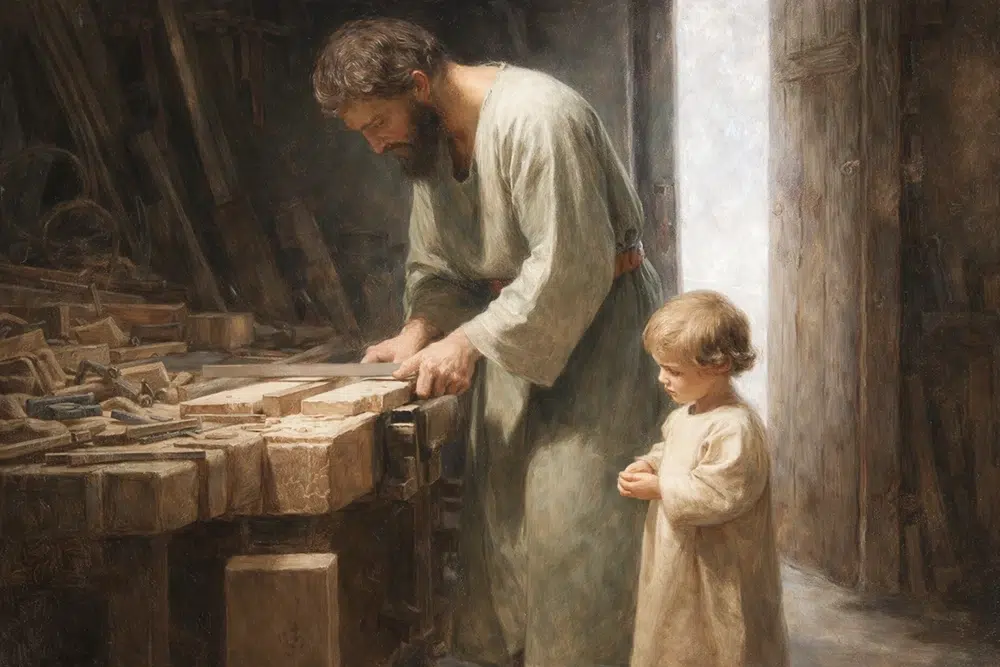
Sacred Scripture says that Joseph was a craftsman. Several Fathers add that he was a carpenter. St. Justin, speaking of Jesus' life of work, affirms that he made plows and yokes. (St. Justin, Dialogus cum Tryphone, 88, 2, 8 (PG 6, 687).Perhaps, based on these words, St. Isidore of Seville concludes that Joseph was a blacksmith. In any case, a worker who worked in the service of his fellow citizens, who had a manual skill, the fruit of years of effort and sweat.

Joseph's great human personality is evident from the Gospel narratives: at no time does he appear to us as a man who is timid or afraid of life; on the contrary, knows how to deal with problems, to get ahead in difficult situations, to assume with responsibility and initiative the tasks entrusted to him/her.
Siete domingos de san José

Who was St. Joseph the Worker in the Catholic Church?

The whole Church recognizes in St. Joseph her protector and patron. Throughout the centuries he has been spoken of, highlighting various aspects of his life, continually faithful to the mission entrusted to him by God.

In the words of St. Josemaría, St. Joseph is really Father and Lord, who protects and accompanies on his earthly journey those who venerate him, as he protected and accompanied Jesus as he grew and became man. In dealing with him, we discover that the Holy Patriarch is also a Master of interior life: because teaches us to know Jesus, to live together with Himto know that we are part of the family of God. This Saint gives us these lessons being, as he was, an ordinary man, a father of a family, a worker who earned his living with the effort of his hands.

The virtues of Joseph of Nazareth

Who is St. Joseph the Worker? He was a craftsman from Galilee, a man like so many others. In his day he had only parenting and workevery day, always with the same effort. And, at the end of the day, a poor and small house, to regain strength and start again.

But Joseph's name means, in Hebrew, God will add. God adds, to the holy life of those who fulfill his will, unsuspected dimensions: what is important, what gives value to everything, the divine. God, to the humble and holy life of Joseph, added the life of the Virgin Mary and that of Jesus, our Lord.

To live by faith, these words were fully realized in St. Joseph. Its fulfillment of God's will is spontaneous and profound..

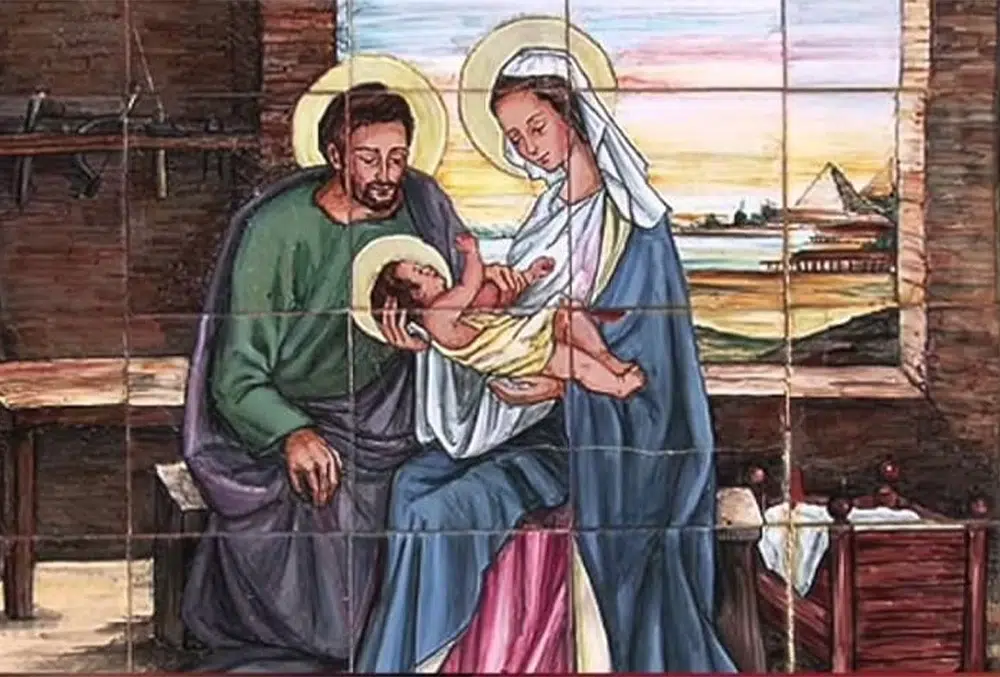
For the story of the Holy Patriarch was a simple life, but not an easy life. After anguishing moments, he knows that the Son of Mary has been conceived by the Holy Spirit. And that Child, Son of God, descendant of David according to the flesh, is born in a cave. Angels celebrate his birth and personalities from distant lands come to adore him, but the King of Judea desires his death and it becomes necessary to flee. The son of God is, in appearance, a helpless child, who will live in Egypt.

In his Gospel, St. Matthew constantly emphasizes Joseph's faithfulness, who fulfills God's commands without hesitation, even though at times the meaning of these mandates might seem obscure or their connection to the rest of the divine plans might be hidden from him.

Faith and hope

On many occasions the Fathers of the Church emphasize the firmness of St. Joseph's faith. Joseph's faith does not waver, his obedience is always strict and prompt.

In order to better understand this lesson given to us here by the Holy Patriarch, it is good to consider that their faith is active. Because the Christian faith is the opposite of conformism, or lack of inner activity and energy.

In the various circumstances of his life, the Patriarch does not give up thinking, nor does he abandon his responsibility. On the contrary, it places all its human experience at the service of faith..

Faith, love, hope: these are the axes of the Saint's life and those of every Christian life.. Joseph of Nazareth's dedication appears woven from this interweaving of faithful love, loving faith and confident hope.

This is what St. Joseph's life teaches us: simple, normal and ordinary, made up of years of work, always the same, of humanly monotonous days that follow one after the other.
Siete domingos de san José

St. Joseph the father of Jesus

«Treat Joseph and you will find Jesus.», saint Josemaría Escriva de Balaguer.

 Through the angel, God himself confides to Joseph what his plans are and how he is counting on him to carry them out. Joseph is called to be the father of Jesus; that will be his vocation, his mission.

Joseph has been, in the human aspect, Jesus' teacher; he has treated Him daily, with delicate affection, and has cared for Him with joyful abnegation.

With St. Joseph, we learn what it is to belong to God and to be fully among men, sanctifying the world. Treat Joseph and you will find Jesus. Treat Joseph and you will find Mary, who always filled the kindly workshop of Nazareth with peace.

Joseph of Nazareth took care of the Son of God and, as a man, introduced him to the hope of the people of Israel. And that is what he does with us: with his powerful intercession he brings us to Jesus. St. Josemaría, whose devotion to St. Joseph grew throughout his life, said that he is truly Father and Lord, who protects and accompanies those who venerate him on their earthly journey, just as he protected and accompanied Jesus as he grew and became man.

God continually demands more, and His ways are not our human ways. St. Joseph, like no man before or after him, learned from Jesus to be attentive to recognize the wonders of God, to have an open heart and soul.

The Feast of St. Joseph

On March 19, the Church celebrates the feast of the Holy Patriarch, patron of the Church and of the Work, a date on which we in Opus Dei renew the commitment of love that unites us to our Lord. But throughout the world we also celebrate on May 1 the feast of St. Joseph the Worker, patron of all workers.

The feast of St. Joseph brings before our eyes the beauty of a faithful life. Joseph trusted God: that is why he was able to be his trusted man on earth to take care of Mary and Jesus, and from heaven he is a good father who takes care of Christian fidelity.

The seven Sundays of St. Joseph

They are a custom of the Church to prepare for the feast of March 19. Dedicating to the Holy Patriarch the seven Sundays prior to that feast in memory of the main joys and sorrows of his life.

The meditation of the Sorrows and joys of St. Joseph helps to get to know the holy Patriarch better and to remember that he too faced joys and difficulties.

It was Pope Gregory XVI who encouraged the devotion of the seven Sundays of St. Joseph, granting him many indulgences; but Pius IX gave them perennial topicality with his desire that the saint should be called upon to alleviate the then afflictive situation of the universal Church.

One day, someone asked St. Josemaría how to get closer to Jesus: "Think of that wonderful man, chosen by God to be his father on earth; think of his sorrows and his joys. Do you do the seven Sundays? If not, I advise you to do them.

How great is the silent and hidden figure of St. Joseph," said St. John XXIII, "because of the spirit with which he fulfilled the mission entrusted to him by God. For the true dignity of man is not measured by the tinsel of showy results, but by the interior dispositions of order and good will."

Curiosities of St. Joseph the Worker

Devotion of Pope Leo XIV

«Joseph leaves behind his human securities and abandons himself completely to God, sailing “out to sea” towards a future entrusted entirely to Providence. St. Augustine describes his consent thus: "«"To the piety and charity of Joseph a son was born of the Virgin Mary, the Son of God at the same time" (Sermon 51, 30)».

Devotion of Pope Francis

"I would also like to tell you something very personal. I love St. Joseph very much. Because he is a strong and silent man. And I have a picture of St. Joseph sleeping on my desk. And while he sleeps he takes care of the Church. Yes, he can do it. We can't. And when I have a problem, a difficulty. And when I have a problem, a difficulty, I write a little piece of paper and I put it under the figure of the Saint so that he will dream it. This means to pray for that problem".

Devotion of St. Josemaría

St. Joseph is the patron of this family that is the Work. In the early years, St. Josemaría had special recourse to him so that Jesus in the Blessed Sacrament could be present in the first center of Opus Dei. Through his intercession, in March 1935 it was possible to have our Lord reserved in the oratory of the DYA Academy-Residence on Ferraz Street in Madrid.

Since then, the founder of the Work wanted the key of the tabernacles of the centers of Opus Dei to have a small medal of St. Joseph with the inscription Ite ad IosephThe reason is to remember that, in a similar way as the Joseph of the Old Testament does with his people, the holy patriarch had provided us with the most precious food: the Eucharist.

St. Joseph the Worker, the saint of silence, the protector

We do not know words expressed by him, we only know his works, his acts of faith, love and protection. He protected the Immaculate Mother of God and was the father of Jesus on earth. However, there is no mention of him in the Gospels. Rather, he was a quiet and humble servant of God who played his role to the full. Working hard to support the Holy Family.

One of the first titles they used to honor him was Nutritor DominiThe "Lord's feeder" dates back to at least the ninth century.

Celebrations in his honor

The Solemnity of St. Joseph is on March 19 and the Feast of St. Joseph the Worker (International Labor Day) is on May 1. It is also included in the Feast of the Holy Family (December 30) and is certainly part of the Christmas story.

St. Joseph has multiple patronages

He is the patron of the Universal Church, the good death, families, parents, pregnant women, travelers, immigrants, artisans, engineers and workers. He is also the patron of the Americas, Canada, China, Croatia, Mexico, Korea, Austria, Belgium, Peru, Philippines and Vietnam.

Let us ask St. Joseph the Worker to continue helping us to draw closer to Jesus in the Sacrament, who is the nourishment that nourishes the Church. This is what he did with Mary in Nazareth, and this is what he will do with her in our homes.


Palm Sunday: biblical meaning and history

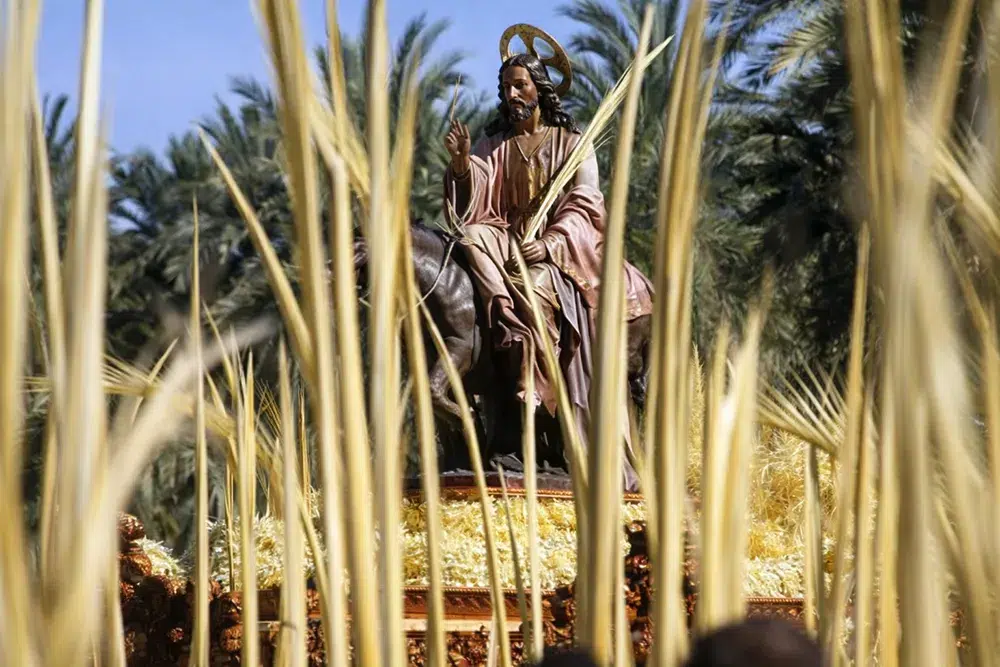
With Palm Sunday, Holy Week begins and we remember Christ's triumphal entry into Jerusalem. St. Luke writes: «As he drew near to Bethphage and Bethany, near the Mount of Olives, he sent two of his disciples, saying to them, "Go to the hamlet that is in front of you. When you enter, you will find a little donkey tied up that no one has yet ridden. Untie it and bring it here. If anyone asks you why you are untying him, tell him: the Lord needs him." They went and found everything as the Lord had told them.».

What do we celebrate on Palm Sunday?

Palm Sunday is the last Sunday before the Easter Triduum. It is also known as Passion Sunday, which marks the beginning of the Holy Week celebrations.

This is a Christian feast of peace. The branches, with their ancient symbolism, remind us now of the covenant between God and his people. Confirmed and established in Christ, because He is our peace.

In the liturgy of our Holy Catholic Church, we read today these words of profound joy: the sons of the Hebrews, bearing olive branches, went out to meet the Lord, crying out and saying: Glory in the highest.

As he passed by, St. Luke tells us, the people spread their garments on the road. And when they were near the descent of the Mount of Olives, the disciples in great numbers, overcome with joy, began to praise God with a loud voice for all the wonders they had seen: Blessed is the King who comes in the name of the Lord, peace in heaven and glory in the highest.

"By works of service, we can prepare for the Lord a greater triumph than that of his entry into Jerusalem.", St. Josemaría Escrivá.

Holy Week: origin of Palm Sunday

On this day, Christians commemorate Christ's entry into Jerusalem to consummate his Paschal Mystery. For this reason, two Gospels have long been read at Mass on this day.

As Pope Francis explains, "this celebration has a double taste, sweet and bitter, it is joyful and painful, because in it we celebrate the Lord's entry into Jerusalem, acclaimed by his disciples as king, while at the same time the Gospel account of his passion is solemnly proclaimed. So our heart feels that painful contrast and experiences in some measure what Jesus felt in his heart on that day, the day when he rejoiced with his friends and wept over Jerusalem."

It is in the Palm Sunday, As our Lord begins the decisive week for our salvation, St. Josemaría recommends that «let us leave aside superficial considerations, let us go to what is central, to what is truly important. Look: what we have to pretend is to go to heaven. Otherwise, nothing is worthwhile. To go to heaven, fidelity to the doctrine of Christ is indispensable. In order to be faithful, it is indispensable to persevere with constancy in our struggle against the obstacles that oppose our eternal happiness...."

The palm leaves, writes St. Augustine, are a symbol of homage, because they signify victory. The Lord was about to conquer, dying on the Cross. He was going to triumph, in the sign of the Cross, over the Devil, the prince of death.

He comes to save us; and we are called to choose his way: the way of service, of self-giving, of self-forgetfulness. We can follow this path by stopping during these days to look at the Crucifix, the "Chair of God".Pope Francis.

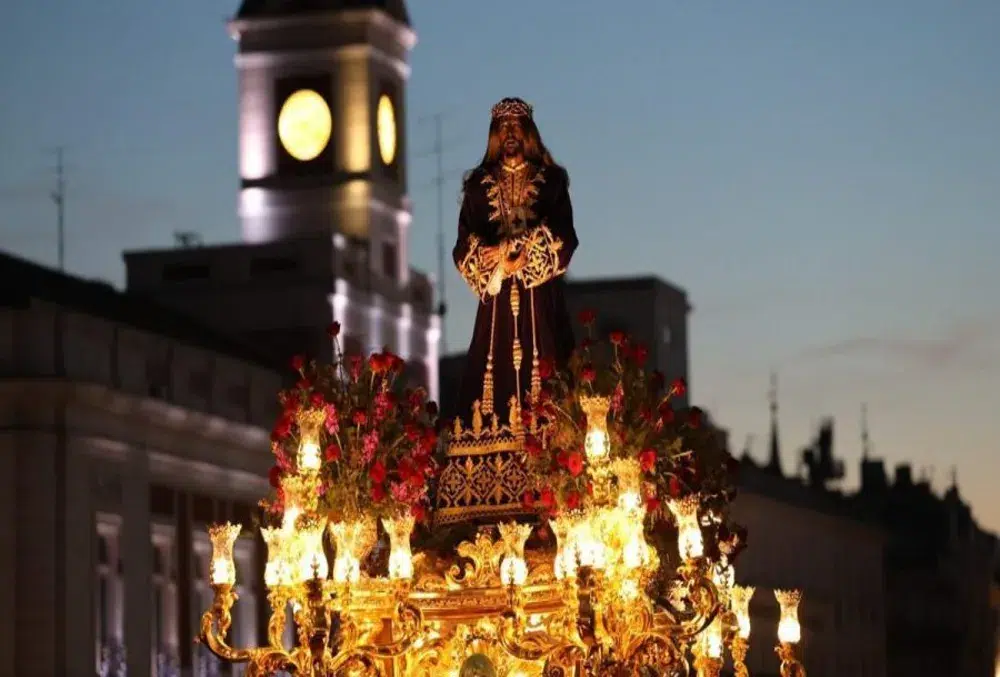
Procesiones de Semana Santa

Meaning of Palm Sunday

Bishop Javier Echevarría, makes us see the Christian meaning of this feast: "We, who are nothing, are often vain and arrogant: we seek to stand out, to attract attention; we try to be admired and praised by others. People's enthusiasm does not usually last. A few days later, those who had welcomed him with cheers will cry out for his death. And we, will we let ourselves be carried away by a passing enthusiasm? 

If in these days we notice the divine fluttering of God's grace, which passes close by, let us make room for it in our souls. Let us spread our hearts on the ground, more than palms or olive branches. Let us be humble, mortified and understanding with others. This is the homage that Jesus expects from us.". 

"Just as the Lord then entered the Holy City on the back of the donkey," says Benedict XVI, "so the Church always saw him arrive again under the humble appearance of bread and wine.

The Palm Sunday scene is repeated in a certain way in our own lives. Jesus approaches the city of our soul on the back of the ordinary: in the sobriety of the sacraments; or in the gentle hints, such as those that St. Josemaría pointed out in his homily on this feast: "live punctually the fulfillment of your duty; smile at those who need it, even if your soul is in pain; dedicate, without stint, the necessary time to prayer; come to the aid of those who seek you; practice justice, extending it with the grace of charity.

Pope Francis pointed out that nothing could stop the enthusiasm for the entry of Jesus; let nothing prevent us from finding in him the source of our joy, of authentic joy, which remains and gives peace; because only Jesus saves us from the bonds of sin, death, fear and sadness.

Palm Sunday in the Bible

The Palm Sunday liturgy puts this canticle on the lips of Christians: Lift up your lintels, O ye gates; lift up your lintels, ye ancient doors, that the King of glory may come in.

First Gospel of Palm Sunday (Luke 19:28-40)

When he had said this, he went on ahead of them, going up to Jerusalem. And when he came near Bethphage and Bethany, by the mount called the Mount of Olives, he sent two disciples, saying:

-Go to the village opposite; when you enter it you will find a donkey tied up, on which no one has yet ridden; untie it and bring it to him. And if anyone asks you why you are untying it, you shall answer him, "Because the Lord has need of it."

The envoys went and found it just as he had told them. When they untied the donkey their masters said to them:
-Why do you untie the donkey?

-Because the Lord needs it," they answered.

They took him to Jesus. And they threw their cloaks on the donkey and made Jesus ride on it. As he went on, they spread their cloaks along the road. And as he drew near, as he was going down the Mount of Olives, the whole multitude of the disciples, filled with joy, began to praise God with a loud voice for all the wonders they had seen, saying:

Blessed is the King who comes in the name of the Lord!
Peace in heaven and glory in the highest!

Some Pharisees from the crowd said to him, "Teacher, rebuke your disciples.

He answered them, "I tell you, if these keep silent, the stones will cry out.

Gospel of Palm Sunday (Mark 11:1-10)

As he drew near to Jerusalem, to Bethphage and Bethany, by the Mount of Olives, he sent two of his disciples and said to them:

-Go to the village opposite you, and as soon as you enter it you will find a donkey tied up, on which no one has yet ridden; untie it and bring it back. And if anyone says to you, "Why do you do that?" answer him, "The Lord needs him, and he will bring him back here at once."

They went away and found a donkey tied by a gate outside at a crossroads, and they untied it. Some of those who were there said to them:

-What are you doing untying the donkey?

They answered them as Jesus had said to them, and allowed them. Then they brought the donkey to Jesus, threw their cloaks on it, and he mounted on it. Many spread their cloaks on the road, others the branches they were cutting from the fields. Those who went before and those who followed behind shouted:

-Blessed is he who comes in the name of the Lord, blessed is the coming kingdom, the kingdom of our father David, Hosanna in the highest, Hosanna in the highest!

And he went into Jerusalem into the Temple; and when he had carefully observed everything, as it was toward evening, he departed for Bethany with the twelve.

"There are hundreds of animals more beautiful, more skillful and more cruel. But Christ looked to the donkey to present himself as king before the people who acclaimed him. For Jesus does not know what to do with calculating cunning, with the cruelty of cold hearts, with showy but hollow beauty. Our Lord values the joy of a young heart, the simple step, the voice without falsetto, the clear eyes, the attentive ear to his word of affection. Thus he reigns in the soul"., St. Josemaría Escrivá.

domingo de ramos semana santa

When did the Holy Week processions of Palm Sunday begin?

The tradition of celebrating Palm Sunday is hundreds of years old. For centuries, the blessing of the olive trees has been part of this feast, as well as the processions, The Holy Mass and the recounting during it of the Passion of Christ. Today they are celebrated in many countries.

The faithful participating in the Jerusalem procession, which dates back to the 4th century, They also carry palm branches, olive trees or other trees in their hands, and sing Palm Sunday songs.. The priests carry bouquets and lead the faithful.

In Spain, a cheerful Palm Sunday procession commemorates Jesus' entry into Jerusalem. Gathered together we sing hosanna and waves his palms as a gesture of praise and welcome.

The olive branches are a reminder that Lent is a time of hope and renewal of faith in God. They are attributed to be a symbol of the life and resurrection of Jesus Christ.. They also recall the Church's faith in Christ and his proclamation as King of Heaven and Earth.

At the end of the pilgrimage, it is customary to place the blessed palms next to the crosses in our homes as a reminder of Jesus' Easter victory.

These same olive trees will be prepared for the following Ash Wednesday. For this important ceremony, the remains of the palms blessed on Palm Sunday of the previous year are burned. These are sprinkled with holy water and then scented with incense.

Songs for Palm Sunday

Brief list of recommended songs for the celebration of Palm Sunday:


Bibliography:
Pope Francis, Homily, Palm Sunday 2017
Benedict XVI, Jesus of Nazareth.
St. Josemaría, Christ Is Passing By.
St. Josemaría, Forge.


Questions and answers

- What is the meaning of Palm Sunday?

The Palm Sunday is one of the most important celebrations in Christianity, as it marks the beginning of the beginning of the Holy Week. It represents the end of Lent and the beginning of the commemoration of the passion, death and resurrection of Jesus.

- What does the Palm Sunday bouquet symbolize?

It commemorates the triumphal entry of Jesus Christ into Jerusalem. It is celebrated one week before his glorious Resurrection triumphing over death and sin. Jesus entered Jerusalem riding on a donkey, and the people who had come for the Jewish Passover celebrations laid their cloaks and small branches of trees on the ground, while chanting part of Psalm 118: «Blessed is he who comes in the name of the Lord».

Lent and God's forgiveness

The Lent is the liturgical season in which the Church invites Christians to pause, look at their lives before God and return to Him with a renewed heart. For forty days a journey of conversion marked by prayer, penance and charity is proposed to us. It is not just an outward change, but a profound call to recognize our fragility and to open ourselves anew to God's mercy.

«You have compassion on all, O Lord, and hate nothing that You have done; You close Your eyes to the sins of men that they may repent and forgive them, for You are our God and Lord» (Ash Wednesday, Entrance Antiphon).

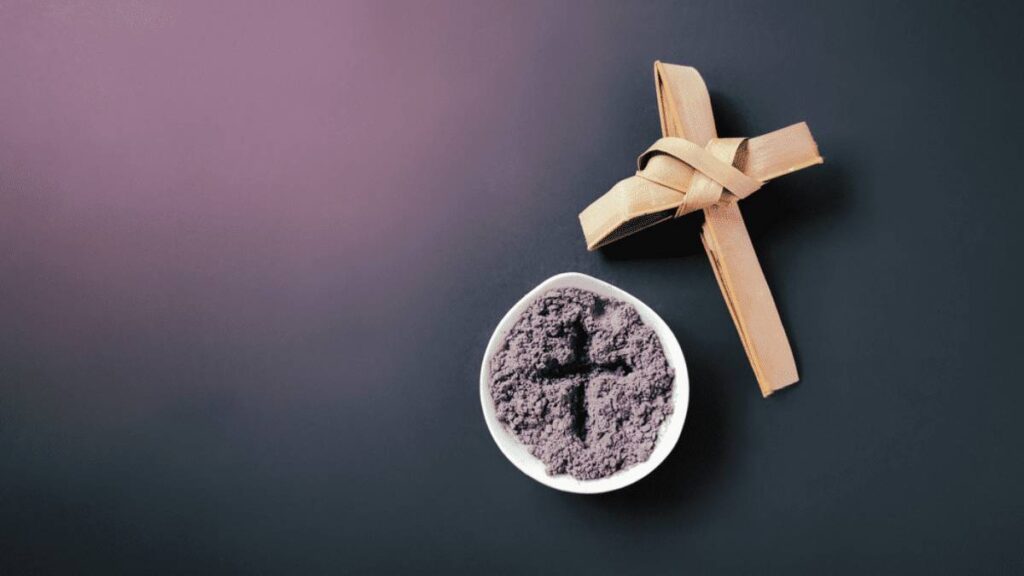
On that day, during the celebration of the Holy Mass, or in a separate ceremony, the faithful who wish to do so, approach the altar so that the priest may impose the ashes on them, while saying: «Remember that you are dust, and to dust you shall return»; or, «Convert and believe the Gospel».

These two phrases do not have a contradictory meaning. They complement each other, and if we know how to put them together, they give us the profound meaning of what the Church wants us to live in this liturgical season: a new Conversion in our Christian living.

With what disposition should we begin to live these days? Josemaría Escrivá, in It is Christ who passes, n. 57, reminds us: «We have entered the season of Lent: a time of penance, purification and conversion. It is not an easy task. Christianity is not a comfortable path. be in the Church and let the years go by. In our life, in the life of Christians, the first conversion - that unique moment, which each of us remembers, in which we clearly perceive all that the Lord asks of us - is important; but even more important, and more difficult, are the successive conversions.

And to facilitate the work of divine grace with these successive conversions, it is necessary to keep the soul young, to invoke the Lord, to know how to listen, to have discovered what is wrong, to ask for forgiveness» (...).

What is the best way to begin Lent?

We renew faith, hope, charity. This is the source of the spirit of penance, of the desire for purification. The Lent is not only an occasion to intensify our external practices of mortification: if we were to think that it is only that, we would miss its deep meaning in the Christian life, because these external acts are -I repeat- the fruit of faith, hope and love.

In order for us to live this willingness to convert, we need to prepare our spirit to listen attentively to, and then put into practice, the lights that the Lord wants to give us during these days of Lent. We can summarize this disposition in three words: sorry y ask for forgiveness.

Cuaresma perdón, tiempo para rezar a Dios

When blessing the ashes, the priest can say this prayer: «O God, who does not want the death of the sinner, but his repentance, hear with goodness our supplications and deign to bless this ash that we are going to impose on our head; and because we know that we are dust and to dust we shall return, grant us, by means of the Lenten practices, the forgiveness of sins, so that we may attain, in the image of your risen Son, the new life of your Kingdom».

Everything begins by humbly asking the Lord for forgiveness for our sins, for our lack of love for Him and for our lack of love for our neighbor. «If in bringing your offering to the altar you remember that your brother has something against you, leave your offering there before the altar; go first to be reconciled to your brother, and then return to present your offering.» (Mt. 5:23-24)

This request for forgiveness, and the thought of Christ's joy in forgiving us our sins, will move our soul to forgive wholeheartedly the offenses, injustices, mistreatments, insults, and abandonments that we may have received, and not to allow even the slightest seed of hatred, resentment, or revenge to nestle in our hearts.

Forgive as Christ forgives us. In this way we will have the humility of spirit so necessary to live our life in union with Christ, and following in his footsteps, which he pointed out to us with these words: «Learn from me, for I am meek and humble of heart». And asking the Lord for forgiveness in the sacrament of Reconciliation and Confession, as Leo XIV reminded the priests of Madrid:

«Therefore, dear children, celebrate the sacraments with dignity and faith, being aware that what is produced in them is the true strength that builds up the Church and that they are the ultimate goal to which our whole ministry is ordered. But do not forget that you are not the source, but the channel, and that you also need to drink from that water. Therefore, do not cease to confess yourselves, to return always to the mercy that you proclaim».

Lenten Messages

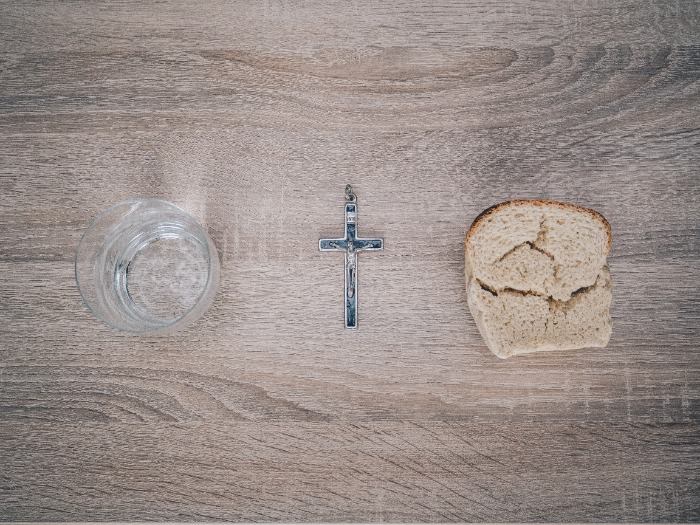
In many Lenten messages, the Popes remind us of the three classic works recommended by saints and spiritual doctors to live Lent well: «prayer, fasting, almsgiving, and almsgiving.".

«Lent is a propitious time to intensify the life of the spirit through the holy means that the Church offers us: fasting, prayer and almsgiving. At the basis of everything is the Word of God, which at this time invites us to listen to and meditate on more frequently.» (Francis, Lenten Message, 2017).

By forgiving and asking for forgiveness, our prayer will reach heaven; our fasting will lead us not to seek ourselves in our actions, and to want to give glory to God in everything we do; and our almsgiving will be to accompany the needy, to encourage sinners to repent.

Our prayer is a deep manifestation of Faith that springs from the depths of our soul. Faith that leads us to have full confidence in Christ, to unite ourselves with Him in His Life, to know Him better, and thus, we will have the joy of quenching His thirst. And it opens our hearts to love the Lord with all our strength, and with the best of ourselves.

Our fasting leads us to detach ourselves from ourselves, to seek only the glory of God in all our actions, not to think always of ourselves and not to dwell on useless worries or memories. Fasting from ourselves and our interests will elevate our heart, our soul to hunger to love Christ, to live with Him, and truly nourish ourselves on his Word, and say to him with St. Peter: «You have the words of eternal life» (Jn. 6:68). And we will renew our Hope in the Lord, who opens for us the horizon of Eternal Life.

In his Lenten Message, Leo XIV suggests us to live an abstinence that can do great good to our spirit:

«For this reason, I would like to invite you to a very concrete and often underappreciated form of abstinence, namely, that of refrain from using words that affect and hurt our neighbor. Let us begin to disarm language, renouncing hurtful words, immediate judgment, speaking ill of those who are absent and cannot defend themselves, and slander.

Let us strive, instead, to learn to measure words and cultivate kindness: in the family, among friends, in the workplace, in social networks, in political debates, in the media and in Christian communities. Then, many words of hatred will give way to words of hope and peace.».  

Our almsgiving will lead us to be generous in serving others and thus follow in the footsteps of Christ who told us «The Son of Man did not come to be served but to serve, and to give his life as a ransom for many» (Mt. 20:28). We have many people around us who, besides needing material help in some cases, need our affection, our understanding, our company. And our Charity will purify our spirit, adoring Jesus in the Blessed Sacrament of the Altar: the deepest alms of love that we offer to God. 

By living prayer, fasting and almsgiving, we are accompanying Christ in the temptations in the desert, with our Faith, with our Hope and with our Charity.

With our Faith uniting us to his response to the devil in the first temptation: «Man does not live by bread alone, but by every word that proceeds from the mouth of God» (Mt. 4:4). Faith that helps us to discover his loving heart in all the difficulties - in all the stones we may encounter on our path - and to carry with him our daily cross. He is, and will always be, our Bread.

By fasting from ourselves, and feeding on His Bread, we will revive our Hope in the Incarnation of Our Lord Jesus Christ, and we will not tempt God by asking Him to do extraordinary things to dazzle us, and force us, in some way, to follow Him, as the devil tried to do in the second temptation. We will unite our sorrows, sacrifices and sufferings in life and in our daily work, to those that He lives in His eagerness to redeem us from sin.

And we will do it without drawing attention to ourselves, in the silence of our soul, in the secret of our heart, as he reminded us: «When you help, do not pretend to be sad as the hypocrites, who disfigure their faces so that people may see that they are fasting» (Mt 6:16).

With the alms of love, Charity, we will give Him our whole heart, He alone we will adore, He alone we will serve, when we go out to meet the material and spiritual needs of the people we live with, the people in our families, our friends, and those whom the Lord wants us to meet on our journey. There are so many who are waiting for us on the roadside of our life, as that man mistreated by the bandits waited for the Good Samaritan to pass by!

Lent: sin and God's forgiveness

In accompanying Christ during these days of Lent, we are living with Him his triumph over the three lusts that will tempt us until we finish our journey on earth: the devil, the world and the flesh, and we prepare ourselves to enjoy with Him the triumph of his Resurrection, in which, in addition to these three temptations, death and sin are conquered. The light of Christ's Resurrection blinds the devil in our soul. We open the eyes of body and spirit to the horizon of Eternal Life.

The Gospel of the Fourth Sunday of Lent narrates the Lord's encounter with a man blind from birth. Jesus Christ performs the miracle of restoring his sight, and reminds us that he is the light of the world: «While I am in the world, I am the light of the world».

Filled with the light of the Lord, with his teachings, with his commandments, we will not be deceived by those words of the devil in the third temptation: «I will give you the whole world, all that you see, if you worship me». We will not sell our soul to the devil, and we will not fall into the seduction of purely material perspectives and our own triumph. that this world can offer us, and that yearn to fill our pride and our pride: our flesh, our selfishness.

We will worship the Lord alone

How can we overcome these temptations, follow the commandments and live with Christ, who purifies our heart, and thus make our life a true life “hidden with Christ in God”? Psalm 94:8 tells us: «Do not harden your hearts; listen to the voice of the Lord».

The Lord speaks to us with his life, and with his words recorded in the Gospels, and also shows us the way so that we can live hidden with him in God - «I am the Way, the Truth, the Life» -: he institutes the Eucharist, and invites us to nourish ourselves with his Body and Blood.

By receiving Christ with faith and love in the Eucharist, and by living the Holy Mass with Him, our life of Faith, Hope and Charity is deeply rooted in our soul. How and why? Because we make an act of faith in the divinity and humanity of Christ; in his words, in his Resurrection and in Eternal Life. Christ celebrates the Mass, Christ we eat, and He is Eternal Life.

When we receive Him, after offering with Him, and moved by the Holy Spirit, our life to God the Father, we live the Hope of Heaven: “Whoever eats my Flesh and drinks my Blood has eternal life”; the Church reminds us that the Eucharist is “the pledge of eternal life”.

And by living with Christ we learn to love our brothers and sisters, all men and women, as He loves them. To be able to live the Mass “with Christ, in Christ and through Christ” is already a foretaste of living with the Love that God has for us; and to receive Christ given to us in the Eucharist is to receive in our body and in our soul, the greatest Love that Christ offers us on earth: the total donation of his whole Being., for our salvation.

Following this journey, and renewing our Faith, our Hope, and our Charity, as we contemplate the Passion and Death of Christ, which we live on Good Friday, and in the sorrowful mysteries of the Holy Rosary, we will also live in the Holy Spirit and with the Blessed Virgin, the joy of the Resurrection.


Ernesto Juliá, (ernesto.julia@gmail.com) | Previously published in Religion Confidential.


Frequently Asked Questions

- What is the meaning of Lent?

Lent is 40 days before Easter, a special time to prepare ourselves for the most important feast of Christianity: the Resurrection of Jesus. This period of reflection and change began to be recognized by the Church since the 4th century, as a time to renew ourselves, practice penance and get closer to God.<br><br>In the Catechism of the Catholic Church (540) we are told that "the Church unites herself every year, during the forty days of Great Lent, to the Mystery of Jesus in the desert". Just as Jesus spent 40 days in the desert to prepare for his mission, we use these days to purify our hearts, strengthen our Christian life and live with a penitential attitude. It is a time to return to the essentials, reflect on our lives and strengthen our relationship with God.

- Why does the Church celebrate Lent?

The Church invites us to live Lent as a time of spiritual retreat, a space to pause and reflect. It is a time to strengthen our relationship with God through prayer and meditation, but also to make a personal effort, as a kind of "spiritual detoxification," in which we put aside what distances us from Him.

This effort of mortification (like fasting or almsgiving) is something that each one decides according to what he or she can give, but always with generosity. Lent is not only a sacrifice, but an opportunity to grow and prepare ourselves for the great feast of Easter: the Resurrection of Jesus. It is the time for a deep conversion, to renew our hearts and be more prepared to live Resurrection Sunday with joy and peace.

- When does Lent begin and when does it end?

Lent begins on Ash Wednesday and ends just before the Holy Thursday Mass, the Mass of the Lord's Supper. It is a time to prepare ourselves, in a more intense way, to live Easter.

- What is the point of practicing fasting and abstinence?

Fasting and abstinence are ways that the Church proposes to us to grow in the spirit of penance. But, beyond external acts, what is important is inner conversion. It is not only about what we do externally, but about changing our attitude and getting closer to God with our heart. If there is no inner change, fasting loses its meaning.<br><br>In addition to fasting from food, fasting can be lived more broadly. Sometimes, fasting means giving up good things, such as social networks, series, music or even some comforts, as a sacrifice to focus more on God.

But fasting also implies fighting against those habits or attitudes that keep us away from Him. It can be a "fast" from bad moods, from looking at ourselves too much in the mirror, or from rushing when we pray. It is about making conscious efforts to improve in those aspects of our life that do not help us to get closer to God.

Disarming peace and fidelity

Among the teachings of Pope Leo XIV in recent weeks, in the wake of the Jubilee of Hope, we focus on your Message for the 59th World Day of Peace, which marks the beginning of the year 2026, and its apostolic letter “Loyalty that generates future”on the occasion of the 60th anniversary of the Council's decrees Optatam totius Presbyterorum ordinis.

The revolution of a disarming peace

Leo XIV's message for the World Day of Peace (January 1, 2026) is entitled: «Peace be with you all: towards a ‘disarmed and disarming’ peace. It is a direct and extended echo of the first words he pronounced when he stepped out onto the balcony of St. Peter's Basilica in the Vatican (May 8, 2025).

The peace brought by the Risen Christ,« he observes in the Introduction, »is not a mere wish, but brings about a definitive change in the one who receives it and thus in the whole of reality“ (cf. Eph 2:14). The Christian mission, which involves peace with its luminous aspect with respect to the darkness and obscurity of conflicts, continues. With the proclamation of the successors of the Apostles and the impetus of so many disciples of Christ, it is ”the most silent revolution.

The peace brought by the Risen Christ,« he observes in the Introduction, »is not a mere wish, but brings about a definitive change in the one who receives it and thus in the whole of reality« (cf. Eph 2:14). The Christian mission, which involves peace with its luminous aspect with respect to the darkness and obscurity of conflicts, continues. With the proclamation of the successors of the apostles and the impulse of so many disciples of Christ, it is »the most silent revolution.

paz desarmante papa león XIV  fidelidad

Christ brings “an unarmed peace” because, in the face of conflict and violence, He brings a different path. “Sheathe your sword.”, he says to Peter (Jn 18:11; cf. Mt 26:52). 

«The peace of the Risen Jesus is unarmed,» the Pope affirms, "because his struggle was unarmed in specific historical, political and social circumstances. Christians, together, must prophetically become witnesses of this newness, remembering the tragedies in which they have so often become accomplices". 

An unarmed “struggle

Jesus proposes, instead, the way - the protocol, as Pope Francis called it - of mercy (cf. Mt 25:31-46). 

Paradoxically, today, «in the relationship between citizens and rulers, the fact that we are not sufficiently prepared for war, to react to attacks, to respond to aggressions, is considered a fault». 

But this is just the tip of the iceberg of a deeper and more widespread global problem: the widespread lThe justifying logic of fear and domination. «Indeed, the deterrent force of power, and in particular of nuclear deterrence, embodies the irrationality of a relationship between peoples based not on law, justice and trust, but on fear and the dominance of force.». 

Let ethics prevail over economic interests

It is not a question, says Leo XIV, of denying the dangers that loom over us because of the domination of others. It is a question, first, of the cost of rearmament, with the economic and financial interests it entails. Secondly, and more fundamentally, there is a major cultural problem affecting educational policies. The path of listening, encounter and dialogue, as advised by the Second Vatican Council (cf. Joy and Hope, 80).

Hence the need, on the one hand, to «denounce the enormous concentrations of private economic and financial interests that are pushing states in this direction». And, at the same time, to encourage «the awakening of consciences and critical thinking» (cfr. Fratelli tutti, 4).  

The Pope asks us to join forces «to contribute reciprocally to a disarming peace, a peace born of openness and evangelical humility». And all this, attention, not only as an ethical response, but also with attention to the Christian faith, which promotes unity. 

Promoting mutual trust

To begin with, in the Christian perspective, goodness is disarming. Perhaps that is why God became a child. God wanted to take on our fragility; whereas we, as Pope Francis pointed out, "we often tend to deny boundaries and avoid the fragile and wounded people who have the power to question the direction we have taken as individuals and as a community.(Francisco, Letter to the editor of “Corriere della Sera”, 14-III-2025). 

In his magna carta of Christian thought on peace (the encyclical Pacem in terris, 1963), St. John XXIII introduced the proposal of an «integral disarmament», based on «a renewal of the heart and of the intellect". To this end, Leo XIV now confirms, the logic of fear and war must be replaced by mutual trust between peoples and nations; without giving in to the tendency to "to transform even thoughts and words into weapons». 

Religions, says Pope Leo XIV, must help to take this step and not the other way around: substituting faith for political combat to the point of - he clairvoyantly denounces - «blessing nationalism and religiously justifying violence and armed struggle».

For this reason, and he addresses himself above all to believers, he proposes: «together with action, it is more and more necessary to cultivate prayer, spirituality, ecumenical and interreligious dialogue as ways of peace and languages of encounter between traditions and cultures."

And this has an educational translation: that every Christian community becomes a house of peace and a school of peace, "where we learn to defuse hostility through dialogue, where justice is practiced and forgiveness is preserved; today more than ever, in fact, it is necessary to show that peace is not a utopia, through attentive and generative pastoral creativity».

Clearly, adds the successor of Peter, this corresponds in a special way to politicians: «Es the disarming path of diplomacy, of mediation, of international law, sadly belied by the increasingly frequent violations of agreements reached with great effort, in a context that would require not the delegitimization, but rather the strengthening of supranational institutions».

Disarming the heart, mind and life

In continuity with his predecessors, Leo XIV denounces the desire to dominate and to advance without limits, by sowing despair and arousing distrust, even disguised behind the defense of certain values.

«To this strategy,» he proposes as the fruit of the Jubilee of Hope, "we must oppose the development of conscious civil societies, of forms of responsible association, of experiences of non-violent participation, of practices of restorative justice on a small and large scale. All this, based on both anthropological and theological reasons, within the horizon of human fraternity (cfr. Leo XIII, Rerum novarum, 35).

This, the Pope concludes, requires, above all for believers, «to rediscover themselves as pilgrims and to begin within themselves that disarmament of heart, mind and life to which God will not delay to respond - with the gift of peace - by fulfilling his promises» (cf. Is 2:4-5). 

Fruitful priestly fidelity

The apostolic letter Loyalty that generates future, The new Constitution, signed by Leo XIV on December 8, 2025, was published at the end of December.

The title already contains the proposal addressed to the priests and specified at the beginning: «To persevere in the mission apostolic offers us the possibility of questioning ourselves about the future of the ministry and of helping others to perceive the joy of the priestly vocation» (n. 1). Fruitful fidelity“ is a gift to be understood and received in the context of the Church and her mission. At the same time, the priestly ministry has an important role to play in the longed-for renewal of the Church (cf. Optatam totius, Proem). 

Hence the invitation of Leo XIV to reread the conciliar decrees Optatam totius y Presbyterorum ordinis, where it was desired to reaffirm the priestly identity and, at the same time, to open the ministry to new perspectives of doctrinal deepening. A re-reading that should be enlightened by the fact that, after the Council, «the Church has been led by the Holy Spirit to develop the Council's teaching on her nature communional according to the synodal and missionary form» (n. 4). 

Keeping God's gift alive and caring for the fraternity

In the face of painful phenomena, such as abuse or the abandonment of the ministry by some priests, the Pope stresses the need for a generous response to the gift received (cf. 2 Tim 1:6). The basis must be the “following of Christ", with the support of integral and ongoing formation. In this formation, from the seminary stage, the “affective” aspect (learning to love like Jesus), human maturity and spiritual soundness stand out.

«Communion, synodality and mission cannot be realized if in the hearts of priests the temptation of self-referentiality does not give way to the logic of listening and service» (n. 13). In this way they will be effective in their “service” to God and to the people entrusted to them.

Within the fundamental fraternity that arises in Christians as a result of Baptism, there is in priests, through the sacrament of Holy Orders, a particular fraternal bond, which is a gift and a task. Thus the Council expresses it: «Each one is united with the other members of this presbyterate by special bonds of apostolic charity, ministry and fraternity» (Presbyterorum ordinis 8). 

The Pope says that this means, first of all, on the part of everyone, «overcoming the temptation to individualism» (n. 15) and a call to fraternity, whose roots are in unity around the bishop. Institutionally, it is necessary to promote economic equality, provision for sickness and old age, mutual care, and also «possible forms of common life» that favor the cultivation of the spiritual and intellectual life, avoiding the possible dangers of loneliness (cf. Presbyterorum ordinis 8). 

Priesthood and synodality for mission

Encourages priests to participate in the synodal processes underway, referring to the Final document of the synod on synodality: «it seems essential that, in all the particular Churches, appropriate initiatives be undertaken to enable priests to familiarize themselves with the guidelines of this Document and to experience the fruitfulness of a synodal style of Church" (n. 21 of the letter).

As for priests, this should be manifested in their spirit of service and closeness, welcoming and listening. They must reject exclusive leadership, choosing instead the path of collegiality and cooperation with other ordained ministers and the entire People of God. It is necessary to avoid the identification between sacramental authority and power, which would lead to placing the priest above others (cf. Evangelii gaudium, 104). 

Regarding the mission: “The identity of priests is constituted around their ‘being for’ and is inseparable from their mission.”(n. 23 of the letter). 

The Pope warns the world's priests in the face of two temptations: activism (giving priority to what one does over what one is) and quietism (linked to laziness and defeatism). He points to pastoral charity as the unifying principle of priestly life (cf. Pastores dabo vobis, 23). In this way «every priest can find a balance in daily life and know how to discern what is beneficial and what is proper to the ministry, according to the indications of the Church» (n. 24). 

In this way, too, he will be able to find harmony between contemplation and action, and the wisdom to disappear when and how it suits him, in the midst of a culture that exalts media exposure. It will be able to promote unity with God and fraternity and the commitment of people in the service of cultural, social and political activities, as proposed in the Final Document of the Synod (cf. nn. 20, 50, 59 and 117).

With reference to the future and in view of the scarcity of vocations, Leo XIV proposes prayer and the revision of pastoral praxis, so as to renew both the care for existing vocations and the call in youth and family contexts.


Mr. Ramiro Pellitero IglesiasProfessor of Pastoral Theology at the Faculty of Theology of the University of Navarra.

Published in Church and new evangelization and in Omnes.


Lent 2026: meaning, definition and prayers

"Every year, during the forty days of Great Lent, the Church unites herself to the Mystery of Jesus in the desert." Catechism of the Catholic Church, 540.

What is Lent?

The meaning of Lent comes from Latin quadragesimaliturgical period of forty days reserved for the preparation for the Easter. Forty days in allusion to the 40 years that the people of Israel spent in the desert with Moses and the 40 days that Jesus spent in the desert before beginning his public life.

This is a preparation and conversion time to participate in the culminating moment of our liturgy, together with the entire Catholic Church.

In the Catechism, the Church proposes to follow the example of Christ in his desert retreat, in preparation for the Easter solemnities.. It is a particularly appropriate time for spiritual exercisesthe liturgies penitential, penitential pilgrimages as a sign of penitence, voluntary deprivations such as the fasting and the almsand the Christian communication of goods by means of charitable and missionary works.

This effort of conversion is the movement of the contrite heart, attracted and moved by the grace to to respond to the merciful love of God who has loved us first.

We cannot consider this Lent as just another season, a cyclical repetition of the liturgical season. This moment is unique; it is a divine help to be welcomed. Jesus passes by our side and expects from us - today, now - a great change. It is Christ who passes by, 59, St. Josemaría.

When does Lent begin?

The imposition of ashes on the foreheads of the faithful on Ash Wednesday, is the beginning of this road. It constitutes a invitation to conversion and penance. It is an invitation to go through the Lenten season as a more conscious and intense immersion in the paschal mystery of Jesus, in his death and resurrection, through participation in the Eucharist and in the life of charity.

The time of Lent ends on Holy Thursdaybefore the Mass in coena Domini (the Lord's Supper), which begins the Easter Triduum, Good Friday and Glory Saturday.

During these days we look inside ourselves and we assimilate the mystery of the Lord being tempted in the desert by Satan and his going up to Jerusalem for his Passion, Death, Resurrection and Ascension to the Heavens.

We remember that we must convert and believe in the Gospel and that we are dust, sinful men, creatures and not God.

«What better way to begin Lent? We renew faith, hope, charity. This is the source of the spirit of penance, of the desire for purification. Lent is not only an occasion to intensify our external practices of mortification: if we were to think that it is only that, we would miss its deep meaning in the Christian life, because those external acts are - I repeat- fruit of faith, hope and love». It is Christ who passes by, 57, St. Josemaría.

cuaresma miercoles de ceniza iglesia semana santa

How to live Lent?

Lent can be experienced through the sacrament of Confession, prayer and positive attitudes.

Catholics we prepare for the key events of the Easter through the pillars of the prayer, fasting and almsgiving. These guide us in our daily reflection on our own life while we strive to deepen our relationship with God and with our neighborno matter what part of the world the neighbor lives in. Lent is a time of personal and spiritual growth, a time to look outward and inward. It is a time of mercy.

Repentance and Confession

As a time of penitence, Lent is a season of is a good time for confession. It is not obligatory, nor is there any mandate from the Church to do so, but it fits very well with the words of the Gospel that repeats the priest on Ash Wednesday.

"Remember that dust you are and to dust you shall return». «Convert and believe in the Gospel». In these holy words there is a common element: the conversion. And this is only possible with repentance and a change of life.. Therefore, confession during Lent is a practical way of ask God's forgiveness for our sins and start over again.. The ideal way to begin this exercise of introspection is through an examination of conscience.

Penance

Penance, the Latin translation of the Greek word "metanoia" which in the Bible means the conversion of the sinner. Designates an entire all the interior and exterior acts aimed at the reparation of the committed sinand the resulting state of affairs for the sinner. Literally change of life, it is said of the act of the sinner who returns to God after having been far from Him, or of the unbeliever who attains faith.

Conversion

Converting is reconciliation with GodWe are to turn away from evil in order to establish friendship with the Creator. Once in grace, after confession and what it implies, we must set out to change from within everything that does not please God.

To concretize the desire for conversion, it is possible to do the following conversion workssuch as, for example: Attending the sacramentsto overcome divisions, to forgive and to grow in a fraternal spirit; practicing the Works of Mercy.

Fasting and abstinence

The Church invites its faithful to observance of the precept of fasting and abstinence of flesh, compendium of the Catechism, 432.

The fasting consists of eating only one meal a day, although it is possible to eat a little less than usual in the morning and evening. Except in case of illness. It invites to live the fast, to all the adults, until they are fifty-nine years old. Both on Ash Wednesday and Good Friday.

It is called abstinence to abstain from eating meat on Fridays of Lent. The abstinence can begin from the age of fourteen.

Care should be taken not to live fasting or abstinence as a minimum, but as a concrete way in which our Holy Mother Church helps us to grow in the true spirit of penance and joy.

Holy Father's Message for Lent

Pope Francis proposed that «in this time of conversion let us renew our faith, let us quench our thirst with the “living water” of hope and let us receive God's love with an open heart which makes us brothers and sisters in Christ» (Rome, St. John Lateran, November 11, 2020, memorial of St. Martin of Tours).

In this journey of preparation for the night of Easter, in which, Francis reminds us, we will renew the promises of our Baptism, "to be reborn as new men and women":

  1. Faith calls us to embrace the Truth and to be witnesses, before God and before our brothers and sisters.
  2. Esperanza as "living water" that allows us to continue on our journey
  3. CharityThe life lived in the footsteps of Christ, showing care and compassion for each person, is the highest expression of our faith and our hope.

The Pope also emphasizes the great difficulties we are going through as humanity, especially in this time of pandemic, "in which everything seems fragile and uncertain" and where "to speak of hope could seem like a provocation". But Where to find that hope? Precisely «in the recollection and silence of prayer".

Prayers for Lent

Prayer with an open heart is the best preparation for Easter. We can read and reflect on the Gospel, we can pray by doing the Stations of the Cross. We can turn to the Catechism of the Catholic Church and follow the liturgical celebrations with the Roman Missal. The important thing is that we encounter the unconditional love that is Christ.

«Lord Jesus, by your Cross and Resurrection you have set us free. During this Lent,
lead us by your Holy Spirit to live more faithfully in Christian freedom. Through prayer,
increase in charity and the disciplines of this sacred Season, bring us closer to You.
Purify the intentions of my heart so that all my Lenten practices may be for the good of my soul.
your praise and glory. Grant that by our words and actions,
we can be faithful messengers of the Gospel message to a world in need of the
hope of your mercy. Amen.


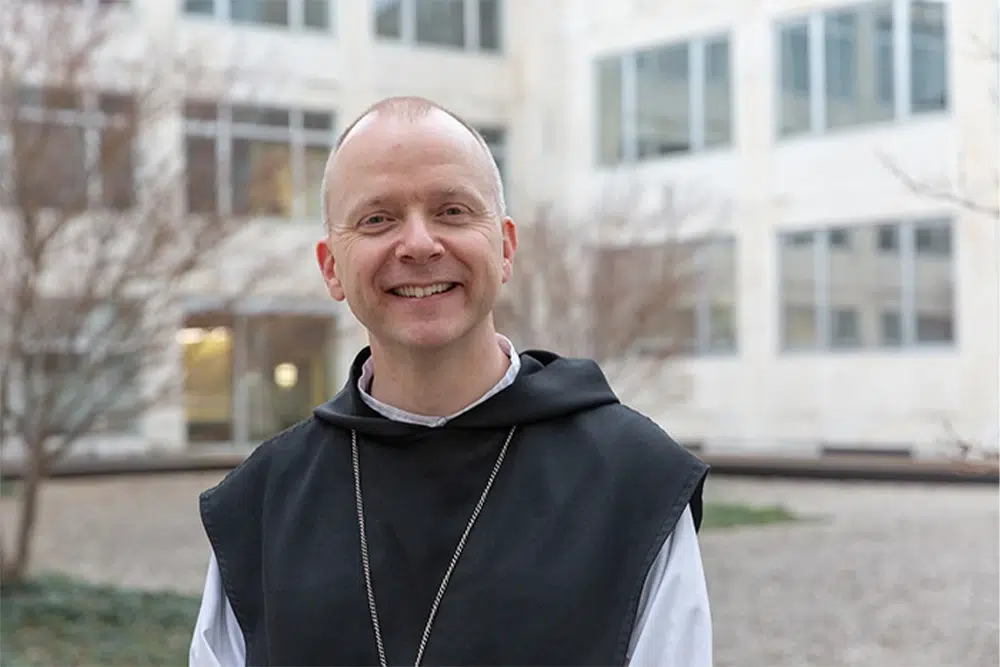
Bishop Erik Varden presents 'Healing Wounds' at Omnes Forum

Healing woundsThe fragility of life strikes us in many ways, with losses, uncertainties, visible and invisible wounds. And in the face of this personal anguish, the words of Erik Varden, Bishop of Trondheim (Norway) and Cistercian monk, emerge as the wind of hope. His message, profoundly Catholic and at the same time contemporary, has made him one of the most lucid and heard voices of Catholicism in the 21st century.

Suffering is not an enemy, but a mystery

For this reason, its presence always causes expectation and excitement, because his speech has an impact on every person who has ever felt the weight of pain, loss or uncertainty.

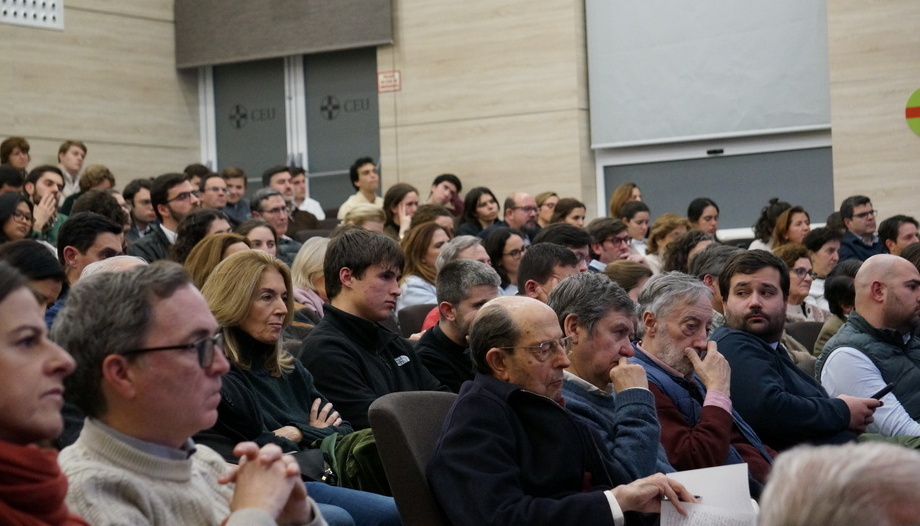
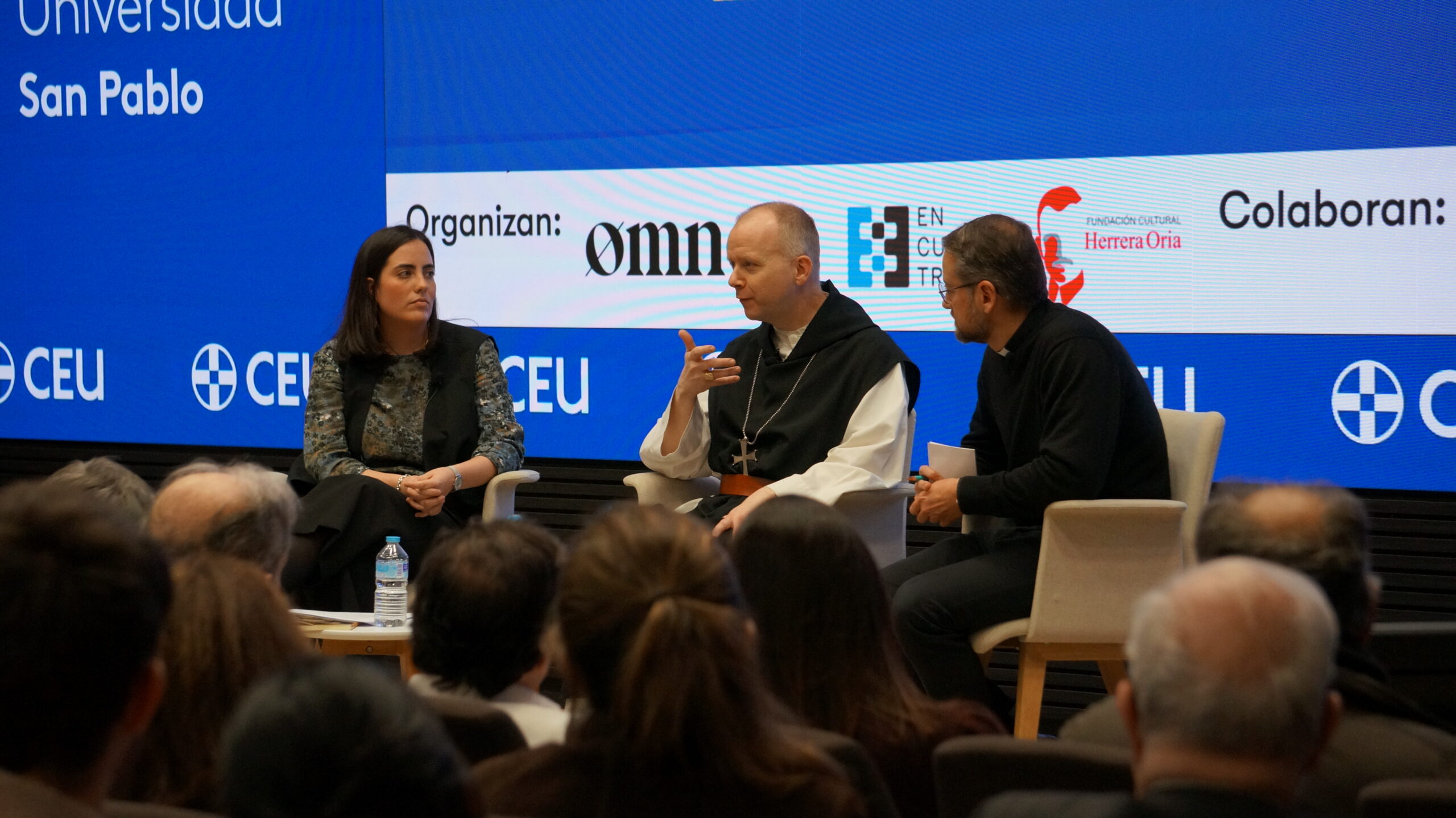
In Madrid, more than 250 people crowded the Aula Magna of the CEU San Pablo University to attend the Omnes Forum and listen to him. The bishop of Trondheim and author reflected on his latest book Healing wounds, which touches on human suffering and its Christian meaning. The Forum, organized by Omnes Magazine together with Ediciones Encuentro and the Ángel Herrera Oria Cultural Foundation, was also sponsored by the CARF Foundation.

Erik Varden (Sarpsborg, Norway, 1974) is an accessible monk, a religious man who turns the meaning of suffering upside down: «it is not an enemy, but a mystery that demands to be seen, welcomed and transformed from the heart», he pointed out.

From a Christian point of view, suffering cannot be simply explained or eliminated. Christianity does not offer theories that annul pain, but a presence capable of assuming and redeeming it. And that presence is Christ incarnate. For this reason, this monk, born into a non-practicing family of Lutheran tradition, explained that the core of the Christian mystery is in the IncarnationGod, being absolute transcendence, enters into the human condition to heal it from within. «The Incarnation takes place in view of the Redemption,» he said, insisting that the suffering is not the end of the story.

A beauty that heals

In a slow but firm voice, Varden reminds us that suffering is not a cosmic accident or a failure of the universe, but a deep mystery which, if contemplated with faith, reveals a beauty that heals.

In his lecture, he evoked a passage from Crime and punishment where a man, in the face of unjust pain, cries out in anger: «I'm not a man.«there can be no answer to this». Faced with this cry, his brother does not try to correct or explain it; he simply remains silent and looks at the cross. That, he said, is the Christian response: «not an explanation that cancels out the pain, but a silent presence in the face of suffering».

Between denial and victimization: two contemporary pitfalls

Varden pointed to two typical responses of our time to suffering. On one hand, the culture of surface and appearance, what he called the “Instagram trend” that pushes us to projecting perfect and invulnerable lives, hiding any wounds. On the other hand, the growing inclination to victimization may cause wounds to become closed and absolute identities.

The danger, he explained, is to be caught between these two dynamics: denying pain or trapping it as a static identity. And both distort the Christian perspective. 

heridas-que-sanan-erik-vardem-foro-omnes

Experiencing pain firsthand

Erik Varden is a man who has experienced firsthand the search for meaning in the face of pain. Born in a family A non-practicing Lutheran, his life took a radical turn when, as a teenager, he experienced a spiritual awakening that led him to deepen his Christian faith and, eventually, to enter the monastic life.

With studies at the University of Cambridge and the Pontifical Oriental Institute in Rome, he entered the Cistercian monastery of Mount St. Bernard in England in 2002, where he became a member of the Cistercian monastery of Mount St. Bernard in England. ordained priest and later elected abbot.

His works, which include titles such as Chastity, On Christian conversion y Healing wounds, The work combines a deep spirituality with a sensitive look at the human condition.

Healing wounds: contemplating the mystery of the cross

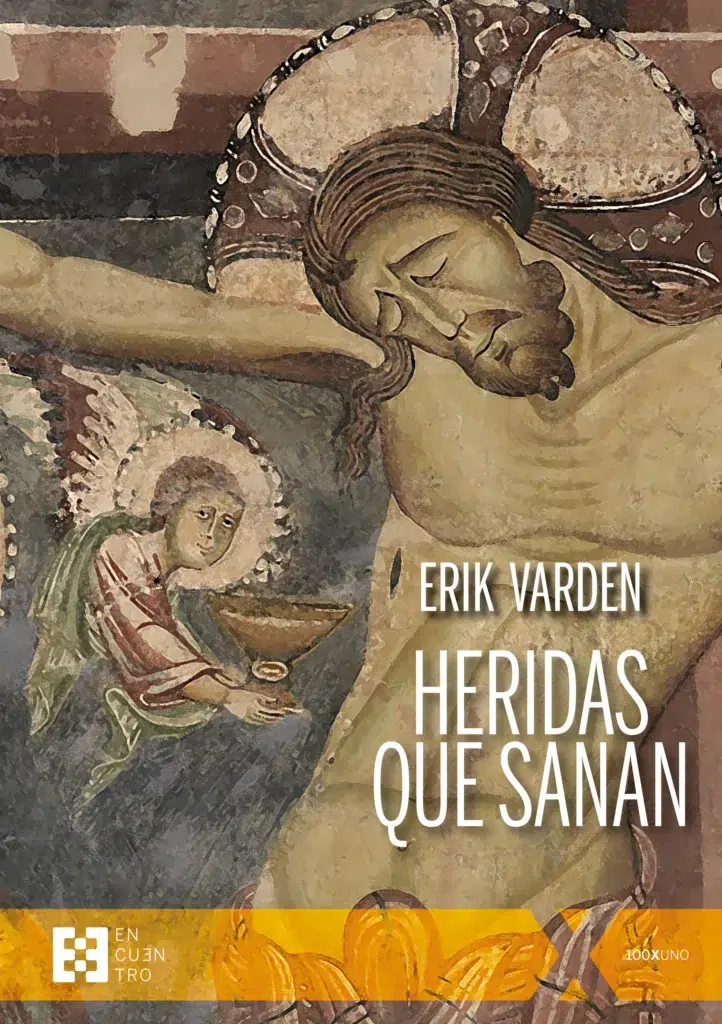
His latest book, Healing wounds stands as a profound meditation on that same experience. Drawing from an ancient Cistercian poem, Varden invites us to contemplate the wounds of Christ not as a sad or defeated symbol, but as the living source from which healing can be found.

«We all carry scars - some visible, others hidden deep in the soul - and we look for answers in therapies, philosophies or spiritual advice that often fall short of the question that tears us most: why does life hurt?»He launched as if it were a missile before the silence of the Aula Magna of the CEU.

But this contemporary monk knows how to give a comforting answer: «on the path of life, suffering is not eliminated, but transformed by to join in Christ's redemptive suffering, becoming not only a consolation but also a source of life and grace».

The cross: symbol of freedom and communion

The Norwegian bishop also reflected on the cross as a symbol that breaks with our logic of self-sufficiency. He noted that contemplate the cross -where nails pierce the flesh and mobility is nullified - seems to represent the absolute negation of freedom. But, he said, read from the perspective of faith, reveals an extreme freedom: «if it be possible, let this cup pass from me, but let your will be done.".

Even when physical freedom is restricted, a completely free inner response is still possible. The cross shows that we are not mere spectators of suffering, but can respond freely in the midst of it.

Book cover Healing wounds, by Erik Varden (Ediciones Encuentro).

Healing is not forgetting, it is transforming into love.

The bishop insisted that healing is not instantaneous nor does it automatically eliminate pain. Some physical or emotional fractures may remain, but that does not exclude them from the healing action of grace. «The Christian faith proclaims not only a God who is capable of eliminating suffering, but a God who carries it with us and transforms it into a source of healing and life.".

And here he quoted the words of Isaiah which he himself put as an epigraph in his book: “By his wounds we have been healed”to add that learning to say “Lord, this is yours.”, Even wounds that hurt can be turned into bridges of healing for oneself and others.

A valley illuminated by hope

At the conclusion of his speech at the Forum, Varden stated with serenity and depth: «we live in this world as in a valley of tears, but it is a valley illuminated by the light of Christ.".

It is not an empty phrase of consolation, but an affirmation that recognizes the reality of human pain and the Christian hope that we are not alone in our wounds. Every painful experience, when accepted and interpreted in faith, can be transformed into a path of communion with God and with others.

heridas-que-sanan-erik-vardem-foro-omnes

The Catholic turn and suffering as a horizon of life

In a interview granted to María José Atienza, Varden, editor-in-chief of Omnes Magazine, shortly after the Forum, Varden spoke of what he called a real catholic turn in our time. For him, the Christian faith «is not simply to add a layer of comfort to an already “perfect” or “self-sufficient” life, but to accept that the deepest part of human existence revolves around our wounds, which we usually prefer to hide or deny.».

Varden explained that under the prism of faith, suffering acquires a totally different dimension: «we begin to be able to see our own wounds as potentially life-giving and life-enhancing.".

This Catholic turn, according to him, is neither sentimental nor superficial, but a profound return to the Christian tradition that recognizes - but does not avoid - human wounds and places them before the mystery of Christ. It is a call not to lose oneself in the denial of pain, nor in a permanent victimization, but to situate suffering within a larger story that leads to life.


Marta Santínjournalist specializing in religion.