«The Catholic Church in Gabon needs priests trained in communication.»
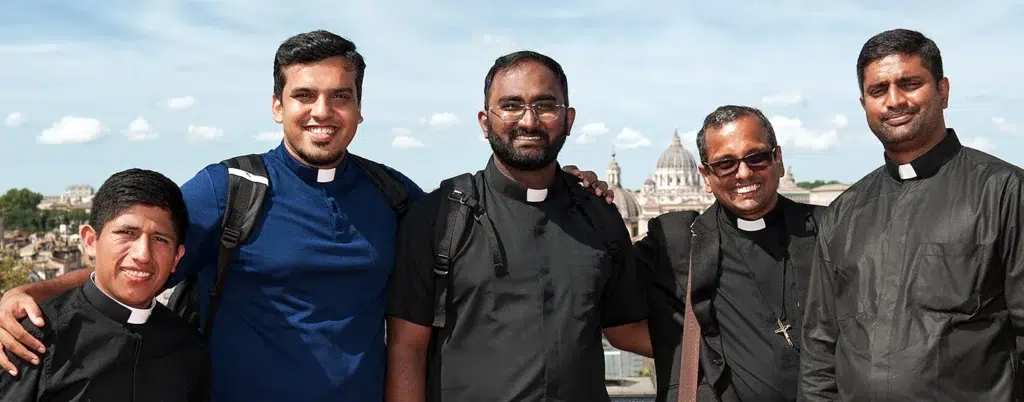
Wenceslas Herman Lengoma is a priest of the Diocese of Franceville, in Gabon (Central Africa). He is 46 years old and studied a degree in Institutional Social Communication at the Pontifical University of the Holy Cross in Rome from 2019 to 2021. This was his experience during his training.
His goal is to return to Gabon to professionally manage the media institutions of his diocese, understanding that the Gospel message today requires modern technical and narrative tools.
«We need well-trained priests for the Catholic Church».»
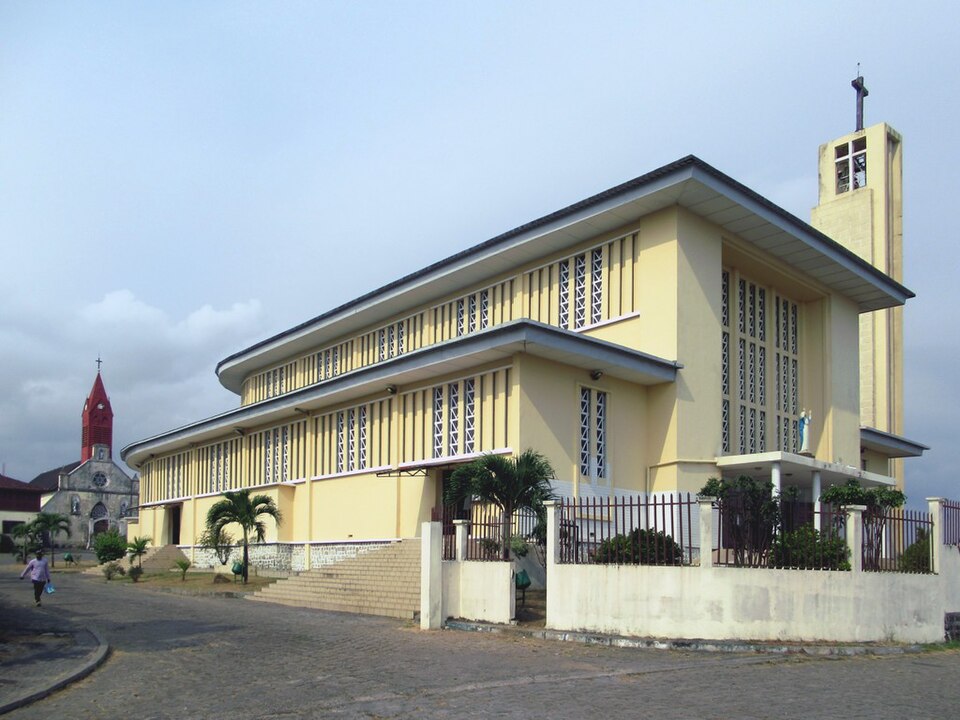
Gabon today has six dioceses and one apostolic prefecture. The country received its first missionaries in 1944, on September 29th, when the Catholic Church was established in Gabon thanks to the missionaries of the Congregation of the Sacred Heart of Mary, who later became the Congregation of the Holy Spirit or the Spiritans.
The diocese where I am incardinated, that of Franceville, groups together two large provinces: the province of Haut Ogooué and that of Ogooué Lolo. This extension poses a serious problem for pastoral work, due to the reduced number of priests who do not reach all the faithful. We need more priests in my diocese, well trained, to reach all the faithful.
This problem is causing so-called “Protestant revival churches” to be established in the area. These churches They come to us from bordering countries such as Congo Brazzaville, Cameroon, and even further afield, from countries such as Nigeria, Togo, Benin, Chad, etc.
Therefore, this is the main reason why my bishop sent me to Rome to study Institutional Social Communication, to later establish a Catholic radio station in the diocese, which would promote closeness to our faithful through religious programs such as mass, praise, reading of the word of God, etc.
Specific needs of my diocese
I began to study Social Communications at a university in Rome where I was trained in subjects such as the Social Doctrine of the Church, History of Sociology, Economics, Psychology, History of the Media, etc. All these subjects, in spite of their importance, did not meet the concrete needs of my diocese. So, I decided to change university.
"We need more well-trained priests in my diocese Franceville, (Gabon, Central Africa), to reach out to all the faithful."
Its bishop wants to promote a Catholic radio station in the diocese and to foster closeness with the faithful through religious programs.
"I embarked on an incredible adventure."
On October 8, 2018, the day of the beginning of the school year, I embarked on an incredible adventure: that of looking for where the university was that could provide me with the formation I needed to be useful and effective to the people of God in my country, and as providence is the mother of all virtues, at 10:30 - I still remember the exact day and time, I came across a large building where I could read the plaque “Pontifical University of the Holy Cross”.
My heart was filled with joy, even without knowing why. So I cheered up and, without knowing exactly where I was going, I went in and kept walking with great determination. I walked through the corridors, read material about the Faculties and the classes and in the end I arrived to meet Professor Daniel Arasa, Vice-Dean of the Faculty of Communication, and then the Dean of the Faculty of Communication.
Well-trained priests in the field of communications
I explained to them what had happened to me and the urgent need that my diocese and I had to have priests well trained in the field of communication. More than a year has passed since that moment and I can say that at Holy Cross I found a direct link with the long-awaited objectives of my diocese, and today I feel happy and I am learning a lot, for which I am very grateful to those responsible for this institution.
"At the Pontifical University of the Holy Cross, I have found a direct link to the long-awaited goals of my diocese."
Wenceslas learned a lot at the Pontifical University of the Holy Cross in Rome. Thanks to his degree in Institutional Social Communication, when he arrives in his diocese in Gabon, he will be able to promote the Catholic radio station requested by his bishop, whose work has been suspended due to lack of funds. He is grateful to the partners, benefactors and friends of the CARF Foundation for their help in completing his studies.
Thanks to the support of the CARF Foundation
What has made this great change in my academic and priestly life possible - because in this way I can dedicate myself to the needs of the people of God in my diocese - was the support of the CARF Foundation (Centro Academico Romano Foundation).
In fact, when I enrolled, the representative of this Foundation spoke to me about the possibility of being helped - and not only me, but also my diocese - to be trained in the Faculty of Communication and to put my knowledge at the service of my bishop and the faithful in Gabon, completing the radio station, whose construction work was suspended due to lack of funds.
«This experience is a providential adventure that has led me to this Pontifical University of the Holy Cross. I remain grateful to the entire administrative staff, to the professors, as well as to the benefactors of the CARF Foundation: may the Lord grant each one of you the necessary graces, and may St. Josemaría Escrivá, founder of Opus Dei, always take care of each of your families and of you!
Gerardo Ferrara BA in History and Political Science, specializing in the Middle East. Head of the student body at the Pontifical University of the Holy Cross in Rome.
Table of Contents
The Anglican Ordinariates of the Catholic Church and their contribution to education in the faith
In the founding document of the Anglican Ordinariates, created for those who desire full communion with the Catholic Church (cf. Benedict XVI, Const. Ap. Anglicanorum coetibus, 2009), it establishes its power to «to keep alive within the Catholic Church the spiritual, liturgical and pastoral traditions of the Anglican Communion.». This identity is recognized as a «precious gift» destined to nourish the faith of its members and as a spiritual richness to be shared with the entire ecclesial community (cf. section III).
A little more than a month ago, the Dicastery for the Doctrine of the Faith invited the bishops responsible for these Ordinariates to write down their experience of how they have received and integrated these elements, both cultural and religious, coming from the Anglican tradition. Their response has now been published (cf. Characteristics of the Anglican Heritage as Lived in the Ordinariates Established Under the Apostolic Constitution “Anglicanorum Coetibus”.”, 24-III-2016).
The bishops have affirmed that, despite the distances and the different places where they are settled (such as England and Scotland, Orlando, Australia and Micronesia), they are conscious of sharing an essential identity (a core share identity). «This shared identity has its origin in a common journey of following Christ that has brought them into full communion with the Catholic Church".
Therefore, they understand that, by entering the Catholic Church, they have brought with them that which already in 1970 St. Paul VI called a «precious patrimony of piety and customs» a "precious patrimony of piety and customs".» which the Church recognizes, as we have seen, as a precious gift not only for them but also to share with other Catholics.
Inculturation of the Gospel goes through England
Already in June 2024, Cardinal Victor Fernandez, from Westminster Cathedral (the main Catholic temple of England and Wales), called attention to the value of these Ordinariates in the perspective of inculturation:
«The existence of the Ordinariate [...] reflects a profound and beautiful reality about the nature of the Church and inculturation of the Gospel, as a rich English heritage. For the Church is one, and the Gospel is one, but in the process of inculturation, the Gospel is expressed in a variety of cultures. In this way, the Church takes on a new face [...] In this process, the Church not only gives, but is also enriched. For, as he taught St. John Paul II, Every culture offers positive values and forms that can enrich the way in which the Gospel is preached, understood and lived" (Apostolic Exhortation, "The Gospel is not only preached, but also understood and lived"). Ecclesia in Oceania, 2001, 16)».
The Ordinariate, said the Prefect of the Dicastery for the Doctrine of the Faith, represents a concrete expression of this reality: «In the case of the Ordinariate, the Catholic faith is inculturated among people who have lived the Gospel in the context of the Anglican Communion. By entering into full communion with the Catholic Church, the Catholic Church has been enriched. We can say, therefore, that each Ordinariate represents one of the faces of the Church, which, in this case, embraces certain elements of the rich history of the Anglican tradition: elements that are now lived out in the fullness of Catholic communion.».
As we were saying, the most recent chapter of this history is the list that the bishops of the Anglican Ordinariates have drawn up, enumerating the traits that they consider characteristic of their spiritual and pastoral heritage. They identify in seven paragraphs those traits which, as we can see, constitute interesting suggestions for the education of the faith in the Catholic Church as a whole (cf. Characteristics, document cited). These characteristics, as we shall see, have much to do with St. John Henry Newman. With his figure and with his path towards the Catholic Church.
Tradition, liturgical beauty and social dimension
Participation, tradition, beauty
1. A distinctive “ecclesial ethos”. It is an ecclesial praxis characterized «by the broad participation of both clergy and laity in the life and governance of the Church.» This culture, they explain, «is intrinsically consultative and collaborative.» It is also characterized by the ability to welcome those who wish to enter into Catholic communion «while preserving the uniqueness of their spiritual history.».
Moreover, «it is centered on a living sense of tradition that seeks to remain faithful to what has been received, while recognizing the place of organic development». As can be seen, these are principles and criteria that are also valid for faith education, insofar as they mark a style of active participation in the life and mission of the Church.
2. Evangelization through beauty. Secondly, they emphasize «the importance of beauty, not as an end in itself, but insofar as it has the power to lead us to God; therefore, it possesses an inherent evangelizing power». For this reason, «divine worship, sacred music and sacred art» are understood both as means to lead us to communion with God and as instruments of mission.
«The beauty they convey is intended to draw individuals and communities to a full participation, body and soul, in the work of the Savior, who is the ‘image of the invisible God’ (Col 1:15) and the ‘radiance of [the Father's] glory’ (Heb 1:3).» In fact, liturgy and art are expressions of the “way of beauty” that today we consider essential in the education of the faith. This education includes, in addition to the intellectual aspect, the aesthetic and spiritual experience that facilitates the encounter with the Truth and Love of God.
Liturgy and life and social dimension
3. Direct approach to the poor: «In the Ordinariates,» your bishops point out, «the beauty of worship and holiness of life are embodied in the concrete realities of the neighborhood. This is understood as a reflection of a profoundly incarnated theology, which invites us to go out of divine worship to seek Jesus among the poor and the needy (cf. Mt 25:40). As a practical example, they evoke the fact that "the crowds that gathered in the streets of Birmingham for the funeral of Saint John Henry Newman were there not only because of his scholarship, but also because he was the priest who attended to their needs».
This is so, because the Incarnation leads to promote the dignity of each person and to engage in the social dimension of evangelization. And this must be promoted in education, in all places and in all ages of people.
4. Pastoral culture. Under this heading, they understand «a pastoral culture in which divine worship and daily life are deeply interconnected». In other words, the connection between liturgy and life is promoted. In this case it is specifically «a liturgical, almost monastic rhythm, inspired by the English spiritual tradition». They consider essential to this the communal recitation of the Divine Office, understood as the prayer of the whole People of God (cf. Ps 119:164; Eph 5:19). [cf. Sacrosanctum concilium, 100).
And they affirm that this characterizes how to «form and sustain parish communities». Indeed, and this enriches faith education which is education for faith professed and celebrated, lived and translated into prayer and praise of God, along with service to all.
The domestic church and the personal care of souls
Family and education
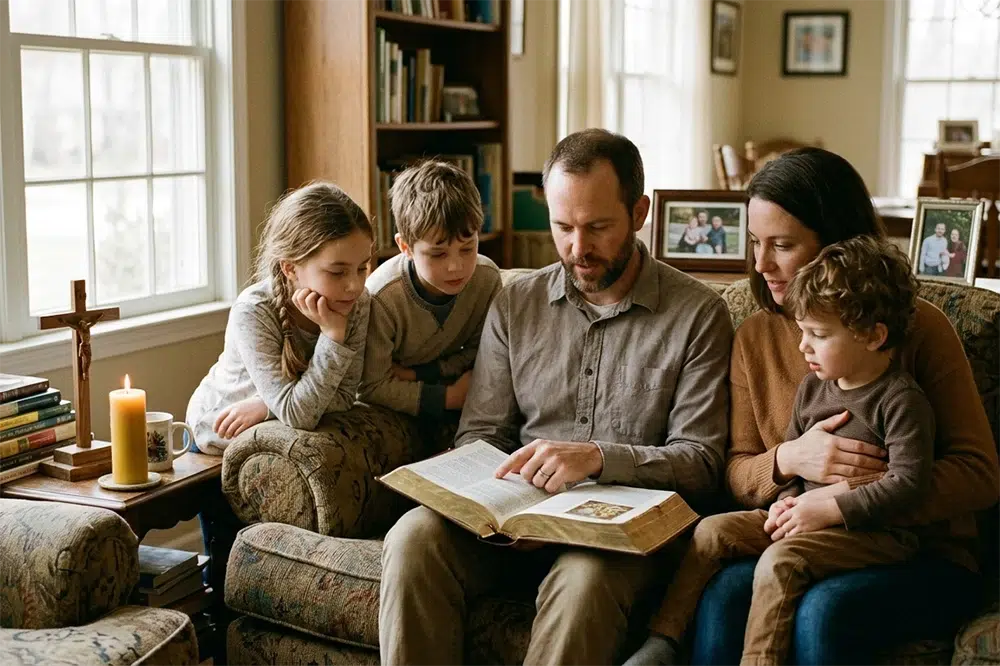
5. The family and the domestic church.Another aspect on which the bishops placed special emphasis is the importance of the family and its role as the «domestic church» (cf. Lumen gentium, 11) In fact, they pointed out that the shrine of Walsingham (dedicated to Our Lady as patroness of England) is called “the British Nazareth”. Just as Nazareth, according to St. Paul VI, is ‘the school of the Gospel’ (cf. Allocution, 5-I-1964) where we learn to observe, listen, meditate and understand the mystery of the Son of God in the bosom of the Holy Family, the Christian home is also the first place where faith is learned and lived.
At the heart of all this is «the appreciation of the sacrament of marriage and the role of parents as the primary educators of their children in the faith» (cf. Decl. Gravissimum educationis, 3). Hence, in the Ordinariates, parents are supported in this sacred responsibility of transmitting the faith to their children (cf. Dt 6:6-7; Joel 1:3) and families are accompanied in their joint growth in Christ.
In addition, «this vision leads to an organic approach to the training which focuses on the parish and the family, and which gives priority to the ongoing intellectual formation of all the members of the Body of Christ». All of this has a direct bearing on education in the faith.
Writing, preaching and personal care
6. Scripture and preaching: these bishops also pointed out that their patrimony includes «a solid tradition of preaching based on Scripture, recognizing that feeding people intellectually is an integral part of feeding their souls (cf. Mt 4:4)». Here the theme of beauty reappears: «The encounter with Christ in the splendor of the liturgy and in the proclamation of the Word are not to be understood as separate realities, but as two dimensions of the same encounter» (Sacrosanctum Concilium 7, 48-51 y Catechism of the Catholic Church 1088 y 1346).
They add that in the communities of the Ordinariate, this is lived «with a solid foundation in Tradition (especially in the Fathers of the Church) and with an appreciation of the role of reason in harmony with and at the service of faith». This relationship between Sacred Scripture and preaching in liturgical context connects with the traditional theme of the “two tables”: the Word (the Bible, The Eucharist (especially the Gospels and prayer) and the Eucharist.
7. Spiritual direction and the sacrament of Penance. Finally, they explained that they have inherited an appreciation of the importance of spiritual direction and the sacrament of Penance as elements of «the care of souls that gives priority to dedicating time to each person and accompanying them in their encounter with Christ, the Good Shepherd (cf. Jn 10:11-16; Lk 15:4-7)».
Incarnation, education and mission
In the concluding paragraphs of this document, the Dicastery for the Doctrine of the Faith notes that «if all these characteristics are considered together, one appreciates how fundamental the mystery of the Incarnation is to the patrimony preserved in the Ordinariates. The dignity of each person, the role of beauty, the richness of liturgical expression, concern for the poor and reverence for the domestic church all flow from this same source.».
This source is «ehe Son of God, Our only Savior (cf. Acts 4:12) and Mediator before the Father (cf. 1 Tim. 2:5), who, having become incarnate among us (cf. Jn. 1:14), having suffered for us (cf. 1 Pet. 2:21) and having risen from the dead, opened the way ‘so that we too might walk in newness of life’ (Rom. 6:4)».
Finally, as one could sense from reading the above, to the extent that this patrimony constitutes a way of welcoming and living the faith, «the clergy and faithful of the Ordinariates recognize that it is a living reality that looks to the future in the transmission of the faith to future generations (cf. Ps 22:30-31; 78:4-7; 102:18)». This is so, and a central aspect of this transmission of the faith is education, whether in the family, in the school (school teaching of religion) or catechesis and Christian formation in the parishes and ecclesial movements, etc.
The bishops of these Ordinariates conclude that this patrimony not only equips them with the means to welcome communities and individuals in full communion, but also «continues to shape their distinctive participation in the mission of the Church for the future,» growing organically and offering «a unique reflection of the face of the Church". Church and a distinctive contribution to the living richness of its identity as ‘one, holy, catholic and apostolic’».
Table of Contents
Mr. Ramiro Pellitero IglesiasProfessor of Pastoral Theology at the Faculty of Theology of the University of Navarra.
Published in Church and new evangelization.
Images elaborated with AI.
April 25, St. Mark the Evangelist: life and gospel
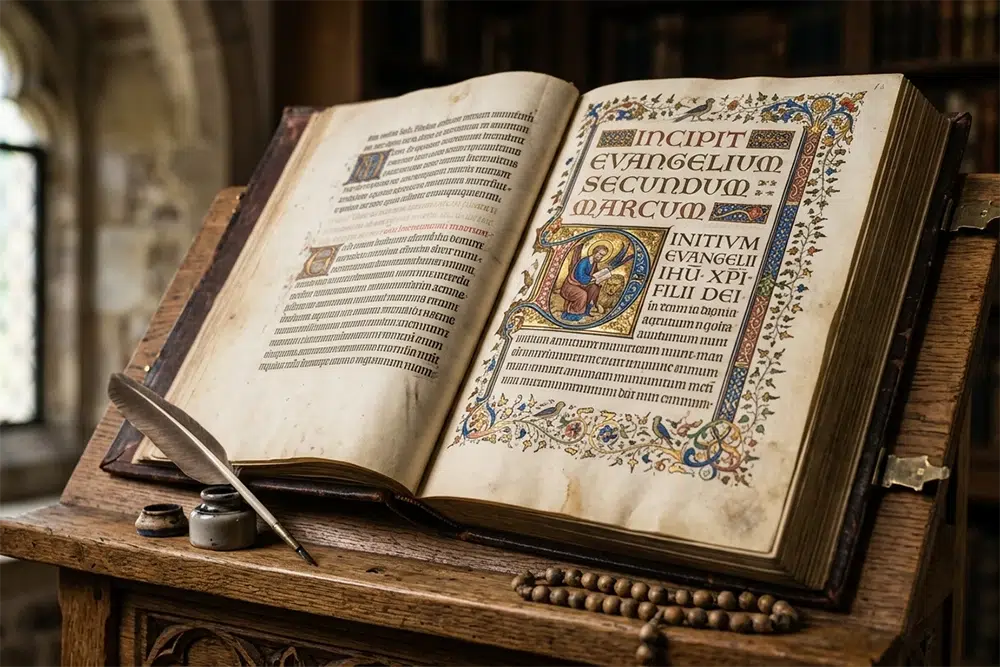
Each April 25, the Catholic Church dresses up to celebrate the feast day of St. Mark's, one of the four evangelists who, inspired by the Holy Spirit, wrote down the life, Passion, Death and Resurrection of our Lord Jesus Christ.
The figure of St. Mark is central to understanding the essence of our faith. His Gospel, considered by scholars to be the oldest of the four, is a vibrant, direct and action-packed account that invites us to discover the identity of Jesus as the Son of God.
In this article we want to approach the life of this early saint; to explore the characteristics of his sacred text in the light of the Magisterium of the Church and the teachings of St. Josemaría. We will reflect on how his figure today is driving the formation of priests worldwide.
Who was St. Mark?
To meet St. Mark's, we must immerse ourselves in the early stages of the Church history, as the Acts of the Apostles and some letters of the New Testament tell us. Also known as John Mark, he was not part of the group of the twelve Apostles, but his life was linked to the two pillars of the Church: St. Peter and St. Paul.
The ecclesial tradition places us in Jerusalem. Mark's mother, Mary, was a well-to-do woman of the first Christian community, and her house served as a meeting place for the first faithful. It is very likely that in that same house the Last Supper was celebrated and that it was the place where the disciples took refuge in fear after the crucifixion. And then they would gather there united in waiting for the coming of the Holy Spirit in Pentecost.
Paul and Barnabas's traveling companion
At the beginning of the expansion of Christianity, St. Mark's accompanied his cousin, St. Barnabas, and St. Paul on the first missionary journey to Cyprus. Although Mark decided to return to Jerusalem-an episode that caused some friction and anger on the part of St. Paul-the grace of God brought about reconciliation. And years later, we see a mature Mark again accompanying Paul during his captivity in Rome.
The "interpreter" of St. Peter
But the deepest link between St. Mark's was with the Apostle Peter. The first Pope affectionately calls him "my son Mark" in his first letter (1 Peter 5:13). The unanimous tradition of the Church, gathered together in the documents of the Holy See and in the writings of the Fathers of the Church such as Papias of Hierapolis and St. Irenaeus, confirms that Mark was Peter's interpreter. His Gospel is nothing more than the written account of the oral catechesis and the preaching of St. Peter's to the Christians of Rome.
This closeness to the original and primary source means that reading St. Mark is, in essence, listening to the living voice of St. Peter recalling the gestures, the looks and the miracles of St. Peter. Jesus of Nazareth.
What are the characteristics of the Gospel according to Mark?
The story that gives us St. Mark's is the shortest of the four Gospels (it consists of 16 chapters), but what it lacks in length, it makes up for in intensity. It is a Gospel written primarily for Christians coming from paganism, specifically from Rome. Therefore, it omits long genealogies or exhaustive explanations of Jewish laws, focusing more on action.
A vivid, direct and urgent account
One of the most frequently repeated words in the original Greek text is euthys, which means "immediately" or "at once". The Gospel moves at a rapid pace. Jesus Christ He heals, preaches, casts out demons, walks on water, and heads resolutely towards Jerusalem to consummate his sacrifice at the end of his life. the Cross.
San Marcos wants the reader to ask a fundamental question from the very first verse: "who is this man?". Through what theologians have called the messianic secret, Jesus often asks those he heals or the demons themselves not to reveal his identity. Why? Because Jesus does not want to be mistaken for a political leader or an earthly messiah. His true identity as the Son of God is only fully understood at the foot of the Cross. In fact, it is a Roman centurion (a pagan) who is the first to confess it after his death: "truly this man was the Son of God"." (Mk 15:39).
The humanity of Christ
Another poignant aspect of the work of St. Mark's is how he details the humanity of Jesus. He describes a Christ who has compassion on the multitude (Mk 6:34), who is indignant at the hardness of heart (Mk 3:5), who embraces and blesses the children (Mk 10:16), and who feels awe and anguish in the garden of Gethsemane (Mk 14:33). This approach, so human and so divine, is an inexhaustible source for the prayer personal.
St. Josemaría's teaching: living the Gospel
The sensitivity proposed by the CARF Foundation, inspired by the priestly formation and the teachings of St. Josemaría Escrivá (founder of Opus Dei), knowing and living the Word of God is vital.
St. Josemaría insistently recommended the reading and meditation of the Holy Gospel. In his work, we are invited not only to read the sacred pages as if we were reading an ancient history book, but to live them. As he often taught: «I advise you, in your prayer, to intervene in the passages of the Gospel, as one of the characters (Friends of God, point 253)».
Read the Gospel of St. Mark's In this light, our perspective changes completely. We become one of the crowd pressing against Jesus by the Lake of Gennesaret; we are the blind Bartimaeus crying out from the roadside for mercy; or those apostles who, in the midst of the storm at sea, awaken the Master with great fear and wavering faith. Through the writings of St. Josemaría we see how this familiarity with Christ's life is a support for understanding and living the holiness in the midst of the world.
St. Mark, in taking up Peter's catechesis, gave us a practical manual for meeting Jesus Christ in our daily lives, in our daily occupations, inviting us to be bearers of his message in our own families and workplaces.
April 25 celebration and tradition
The April 25, the liturgy of the Universal Church summons us to celebrate the feast of St. Mark's. It is a day of joy that, in addition to paying homage to the evangelist, The liturgical texts approved by the Holy See and promoted by the Spanish Episcopal Conference for this day emphasize the importance of the transmission of the faith. The liturgical texts approved by the Holy See and promoted by the Spanish Episcopal Conference for this day emphasize the apostolic responsibility that all the baptized share.
In the Liturgy of the Hours, the Church prays asking God that, just as he gave St. Mark the grace to preach the Gospel, we too may profit from his teachings to follow faithfully in the footsteps of Christ. It is a propitious day for renew our love by the Sacred Scriptures. As Pope Francis reminded us, carrying a small Gospel in our pocket and reading a fragment of it every day is a highly recommended spiritual practice to allow ourselves to be transformed by the gaze of Christ.
The winged lion: symbol of St. Mark
When speaking of this saint, we must mention his iconographic representation: the winged lion. This image, deeply rooted in the history of Christian art and inspired by the visions of the prophet Ezekiel and the book of Revelation, has a precious theological significance.
Christian tradition, especially since St. Jerome (4th century), assigned the lion to St. Mark, because his Gospel begins with the figure of St. John the Baptist crying out in the desert. «The voice of one crying in the wilderness: prepare the way of the Lord, make his paths straight» (Mk 1:3). The ancient exegetes associated that powerful and solitary voice in the steppe with the roar of the lion, the king of the jungle and the desert.
In medieval bestiary and patristic exegesis, it was believed that lion cubs were born dead and their father awakened them to life on the third day with his roar. This became a perfect symbol for the Gospel of Mark, which strongly underlines the majesty and victory of Christ (the Lion of Judah) over death with his glorious Resurrection.
The wings that accompany the lion represent the divine nature and heavenly inspiration of the sacred writings. They indicate that the evangelist's message is not purely human, but flies from above, connecting the earth with divinity.
This iconography adorns thousands of churches around the world, the most famous being St. Mark's Basilica in Venice, the city of which he is the undisputed patron saint and where his relics rest.
Objective of the CARF Foundation: to bring the Gospel to the whole world
The work written by St. Mark's concludes with the great missionary mandate of Jesus: «Go into the whole world and proclaim the Gospel to all creation» (Mk 16:15). This verse is not just a brilliant closing to his book; it is the continuous heartbeat of the Church and is, in a very direct way, one of the raisons d'être of the CARF Foundation (Roman Academic Center Foundation).
So that the Gospel written by St. Mark may continue to resonate strongly today, so that it may continue to touch hearts in the great de-Christianized cities and in the most remote missions and the most abandoned and poorest countries, the Church needs to holy priests, It needs well-trained, wise shepherds with the "smell of sheep". It needs men who, as Mark himself did with St. Peter, sit at the feet of the wisdom of the Church and then carry that truth in an accessible and passionate way to all corners of the planet.
At the CARF Foundation we work tirelessly to support the solid and integral formation of seminarians, diocesan priests, We are also helping religious men and women from all over the world, especially from those places where the Church suffers persecution or lacks resources. By facilitating their studies at the Pontifical University of the Holy Cross in Rome or at the Ecclesiastical Faculties of the University of Navarra in Pamplona, we are investing directly in the expansion of the Word of God.
A priest well trained in biblical theology, who understands the literary, historical and spiritual depths of the Gospel of Jesus Christ. St. Mark's, He is a priest capable of sustaining the faith of thousands of souls. Like Mark's mother, he placed his house at the disposal of the Apostles, the benefactors of the CARF Foundation contribute their resources available to the future pastors of the diocesan Church.
The validity of an eternal message
As we celebrate April 25, we not only remember a saint of the past. We celebrate that his work, inspired by the Holy Spirit, lives on. The lion of St. Mark continues to roar. He continues to awaken consciences, he continues to comfort the sick, he continues to offer hope to the hopeless.
The challenge that the feast of this evangelist leaves us is twofold. On the one hand, on a personal level, we are called to rediscover his Gospel. We invite you today to pick up your Bible and read, at least, the first chapter of San Marcos. Make a resolution to accompany Jesus, to let yourself be challenged by his authority and compassionate love.
On the other hand, at the community and ecclesial level, we are called to support the task of evangelization. No one evangelizes alone. Just as Mark needed Barnabas, Paul and Peter, so we are called upon to support them. today's priests they need you.
From the CARF Foundation, We encourage you to join our large family of partners, benefactors and friends. Each donation, The money, no matter how small, is transformed into hours of study, books and food for a seminarian or priest who will celebrate the Eucharist and read the Gospel in his parish tomorrow. Browse our website and discover how your generosity can have an eternal impact on the formation of tomorrow's pastors. And follow our social networks at @fundacioncarf to meet the faces of those you are helping to prepare to «go into the whole world and proclaim the Gospel.».
May St. Mark intercede for the Church, for the Pope, for all priests and religious, and for all of us who are part of the charism promoted by the CARF Foundation, so that the roar of faith may never be extinguished in our hearts.
Table of Contents
The royals‘ headdress charity market that promotes the formation of priests
The recent charity market of the CARF Foundation proved that elegance and social commitment are a binomial that works well. The event, which was held from March 4 to 6 and 11 to 13, in the evenings from 5 to 8:30 pm, was not only a success among benefactors, friends and members of the Foundation. The flea market is always promoted by the Social Action Board, and became a showcase of sophistication thanks to the designer's exclusive headdresses and pamelas. Maria Nieto -famous for dressing the Queen Letizia,as reported by the Servimedia agency, whose creations were the main attraction of the event.
Numerous benefactors and friends of the Foundation gathered to purchase everything from haute couture accessories to treasures. vintage, turning every purchase into a gesture of hope.
Nieves Herrero during her visit to the flea market.
Nieves Herrero at the charity flea market
The event had an exceptional sponsor: the journalist Nieves Herrero. During his visit, Herrero highlighted the relevance of the foundation's work with a phrase that sums up the spirit of the event:
«Training priests is a good for everyone.».
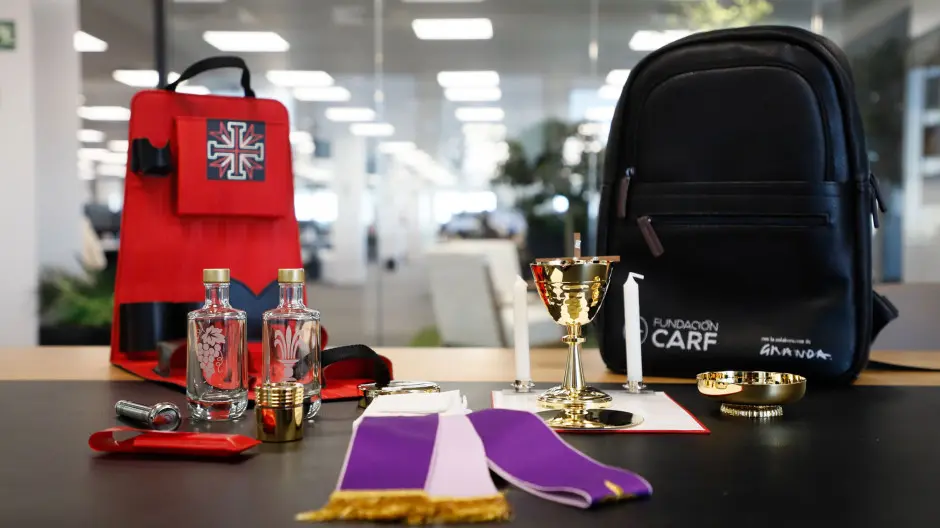
One of the most touching moments was when he discovered the backpack of sacred vessels. This kit, with a cost of 700 euros, is the most valuable graduation gift for seminarians returning to their dioceses of origin, always in countries with scarce economic resources.
The backpack is designed to enable them to celebrate Holy Mass and administer the sacraments with complete dignity, even in the most remote and under-resourced regions of the planet.
Backpack of sacred vessels from the CARF Foundation.
The backpack, a much appreciated gift
This gift, valued at 700 euros, is considered one of the most appreciated by newly ordained priests. It contains everything necessary to be able to celebrate Holy Mass and administer the sacraments with dignity, even in places where material means are scarce.
Detailed contents of the CARF Foundation's backpack of sippy cups:
Sacred vessels: chalice, paten and ciborium/bibb for the reservation and distribution of the Eucharist.
Liturgical elements: vases (made of clear glass for wine and water), altar cross and candles.
Ornament: stole (sign of Jesus and priestly authority) of various liturgical seasons.
Table linen: altar (silk) and other necessary cloths (purifier, pallia).
Additional: includes containers for the oil of the sick and holy water sprinkler.
Elite training for global impact
This mission is carried out through prestigious academic centers where those who, in the future, will take their pastoral work to the most needy corners of the world are trained.
Beyond fashion, the objective of this flea market is to raise funds for the comprehensive training (human, intellectual and spiritual) of priests and religious. The beneficiaries study in centers such as:
University of Navarra (Spain).
Pontifical University of the Holy Cross (Rome).
A day in which fashion became a vehicle for hope, and where every purchase was also a gesture of support for a cause that transcends borders.
Thanks to the generosity of the attendees, these future pastors will be able to take their work to the most needy corners of the world, with first class academic and spiritual preparation.
Liturgical objects in the backpack of sacred vessels
José Luis Solís, a priest of the Mexican diocese of Celaya, recalls when «some parish priests asked me to help them celebrate the Eucharist in remote places in their parishes. »To get close to those places, whose landscape was beautiful and where there was a great silence, it was sometimes necessary to mount on horseback or donkey or keep walking to get to the site and celebrate mass,» he continues. Once there, the priest opened his backpack, unfolded its contents and began the Eucharist, which was attended by faithful from all the surrounding villages. «I thank the foundation and pray to God for the fruits of this work,» he concludes.
Ceremonial clothing and accessories
On the other hand, the flea market also offered ceremonial and everyday clothing, as well as accessories, in an atmosphere marked by generosity and closeness. The funds raised were donated to the work of the CARF Foundation for the comprehensive training -The intellectual, human and spiritual development of diocesan priests, seminarians and religious men and women from all over the world.
Table of Contents
Marta Santínjournalist specializing in religion.
«The priest only needs to be in communion with God.»
The best way to teach is always by example, and to transmit all the good things that one has received. This is what Saúl Ruiz García does every day, priest Mexican, 38 years old and currently rector of the diocesan seminary of Tabasco, where he is responsible for the formation of future priests. And for this very important mission, he himself draws inspiration from all that he learned and experienced during his years in Pamplona in the Bidasoa international seminar and at the University of Navarra.
Saul tells in an interview with CARF Foundation that before becoming a priest he lived an intense life. He graduated with a degree in Civil Engineering and had a good job in road construction in Mexico. However, God was strongly anchored in his life and ended up giving a total turnaround to the plan he had for his future.
«I grew up in a believing family, although not a practicing one at all. I used to go with my parents to Mass on Sundays and only that. At home we were taught to pray and always motivated us to attend children's catechesis. But only up to that point,» he says.
However, he experienced something that only years later could give it the meaning it had: «Since I was a child, I was marked by seeing my father every morning while he was getting ready to leave for work, praying in his bed in front of an image of Jesus on a small altar in his bedroom.
The path to becoming a priest
That seed of faith would have a greater value than he imagined. Over the years," he points out, "he followed a path that would eventually lead him to become a priest and to seek perfect identification with Christ. It was progressive and there was apparently no one event that marked him in this call, but rather small milestones that marked his path.
«When I was 15 years old, I lived a retreat experience in the Rainbow Evangelizers Adolescent Encounter Movement. During the time that I persevered in that movement, it was during that time that the vocational concern, and it was then that I started to seriously consider the possibility of to be a priest".
«Many things happened: testimony from the parish fathers, people who suddenly told me that I was going to be a priest without my having said anything, because it was something I always kept secret. But the event that marked me the most was a priestly ordination I discovered with certainty that God was calling me to be his priest.
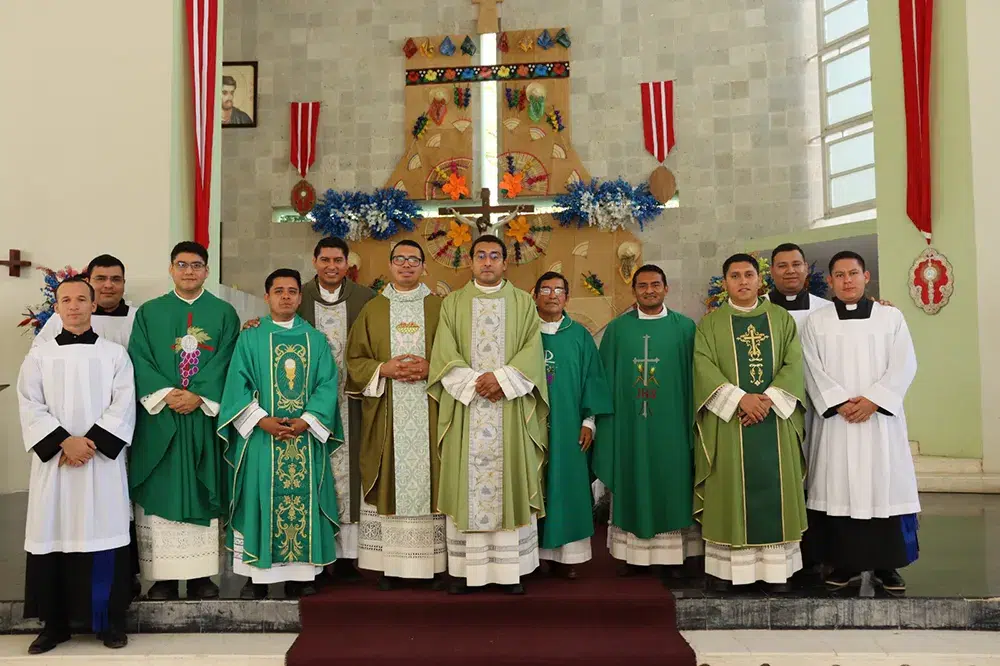
Saúl Ruiz, (center), with a group of priests and seminarians from Tabasco.
Solid foundations in faith
While still in the seminary, his bishop decided to send him to study in Pamplona thanks to the help of members, benefactors and friends of the CARF Foundation where he studied first the Theological Baccalaureate and later the Licentiate in Biblical Theology.
«My experience was very pleasant, the training I received in the Bidasoa international seminar helped me to consolidate my response to God's call to me. The The personal accompaniment of my spiritual director and my formators has been a very special tool for me. for my formation. I learned a lot from them, especially the perseverance to remain united to the Lord in prayer and work,» he confesses.
He had the same experience during his time at the University of Navarra. He admits that at the beginning it was difficult for him to adapt to the study and teaching methods, as well as the high level of training at this university. But with the passage of time and the support of the trainers, he assures that he was able to reap the many rewards of his time at this center.
«The studies carried out in Pamplona have been a very pleasant tool for my ministerial experience. On a personal level, the theological studies have helped me to lay solid foundations in my faith, because understanding the doctrine of the Church allows me to enter into dialogue with the reality in which I live and in which the world finds itself today; a reality that is constantly changing and that demands me, as a Christian, putting God first in my life to deal with such complex situations that are often presented to us disguised as good,» he explains to readers of the CARF Foundation.
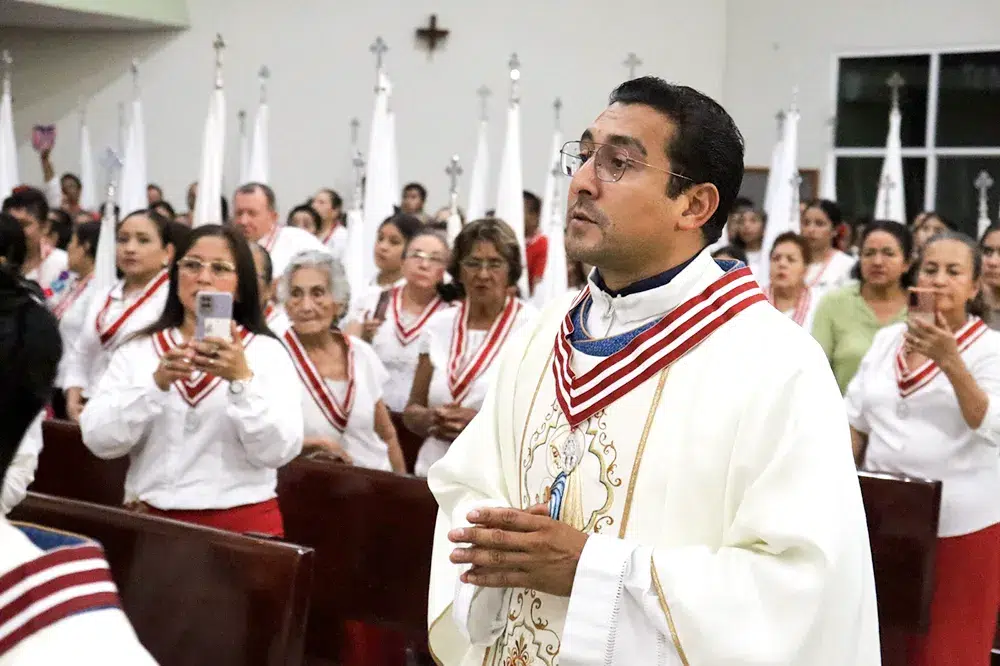
Saul enters the Church for the celebration of Holy Mass.
The example of good priests
To this experience he adds more spiritual goods, because he considers that thanks to the testimony of prayer that he found in Bidasoa and at the University of Navarra, he received important tools to «commit myself to transmit that same testimony in a world where the relationship with God can become superficial or scarce».
From those years he has a special memory that has marked his priestly ministry: the death of Don Juan Antonio Gil Tamayo, a priest «cheerful, dedicated, intelligent and with a very special charisma», whom he had as a formator in Pamplona.
«It was a difficult time for those of us who were seminarians, and for the whole seminary in general. But I am left with the pleasant experience of having known such a special human being, a priest who, despite the difficulty of his sufferings, never expressed a complaint, on the contrary, he lived his last years in generous dedication to God».
«I remember the words that a professor pronounced in the faculty shortly after the death of Don Juan Antonio: "here walked a saint". This event has deeply marked my life, first as a seminarian and now as a priest,» Saul recalls with emotion.
«Outside God, nothing: with God, everything.»
These years of ministry have allowed him to get to know the great challenges that priests face. Thus, he emphasizes that in these years he has experienced that «as a priest you need to only one thing: to be in communion with God».
He adds that the life of the sacraments and prayer is what «strengthens the priestly ministry in order to be able to give ourselves fully to the people God entrusts to us. And he warns: »anything that for the priest does not come from God, far from strengthening him, evidently weakens and loses him. Outside God, nothing; with God, everything«.
Finally, Saúl Ruiz has a very affectionate memory for the benefactors and friends of the CARF Foundation: «Never tire of collaborate in this great foundation. Rest assured that your help is bearing abundant fruit in many parts of the world. But above all, pray! Your mission does not end with each formation course, your mission is always extended in prayer for each seminarian and priest who has received your valuable help in our formation as priests. Thank you very much.
Table of Contents
A legacy of solidarity that will give the Church a future
Thinking about the future of the Church means asking the simple question: who will support all this when we are gone? To think of the Church in this way is an act of love. that you can shore up with your will or with a joint and several bequest.
During our life we received much more than we usually remember. We received a faith passed on in the family, priests who accompanied us at important moments, parishes that were open when we needed them. None of this came out of the blue. Behind it were people who cared for the future of our children. the Church, so that it would remain alive, well-structured and present in every generation.
Ana and Álvaro's generosity
In the documentary Witnesses, Álvaro and Ana tell how they learned about the CARF Foundation. through a relative who decided to include it in his will. That decision surprised them at first, but it led them to learn more about it and understand what was behind it.
They found that the CARF Foundation helps finance the integral formation of seminarians and diocesan priests from all over the world in academic institutions in Rome and Pamplona (the Pontifical University of the Holy Cross and the Ecclesiastical Faculties of the University of Navarra).
The aim is to support young people who, in many cases, come from dioceses with very few financial resources and who need solid support in order to be well trained before returning to serve their communities.
Both Ana and Álvaro understood that including the CARF Foundation in a will or legacy of solidarity was not a symbolic gesture, but a real way to ensure that this work would continue to be perpetuated over time.
Turning one life's effort into a future for others
As Alvaro says in the documentary: «It is a brilliant opportunity to prepare a home for yourself in heaven; to think that, with your patrimony and the effort of a lifetime, you can help to train so many priests».
Beyond the spiritual expression, the idea is very practical. After years of work, savings and effort, part of this heritage can continue to make an impact after we are gone. It can become integral formation for priests who will attend parishes, accompany families and be present at key moments in the lives of many people.
A decision compatible with love for the family
Include the CARF Foundation in the will. does not mean neglecting and disregarding the loved ones. In the case of Spanish law, it is allowed to allocate a part of the inheritance (that of free disposal) to a solidary cause, always respecting the legitimate part of the heirs.
It is a decision that can be taken with advice and serenity. It does not require large assets or unassuming commitments. For many benefactors it is simply the natural continuation of a life in which they have already collaborated with the Church in various ways.
Many people who have collaborated during their lifetime with donations or occasional support see in the a natural continuation of this vital commitment.
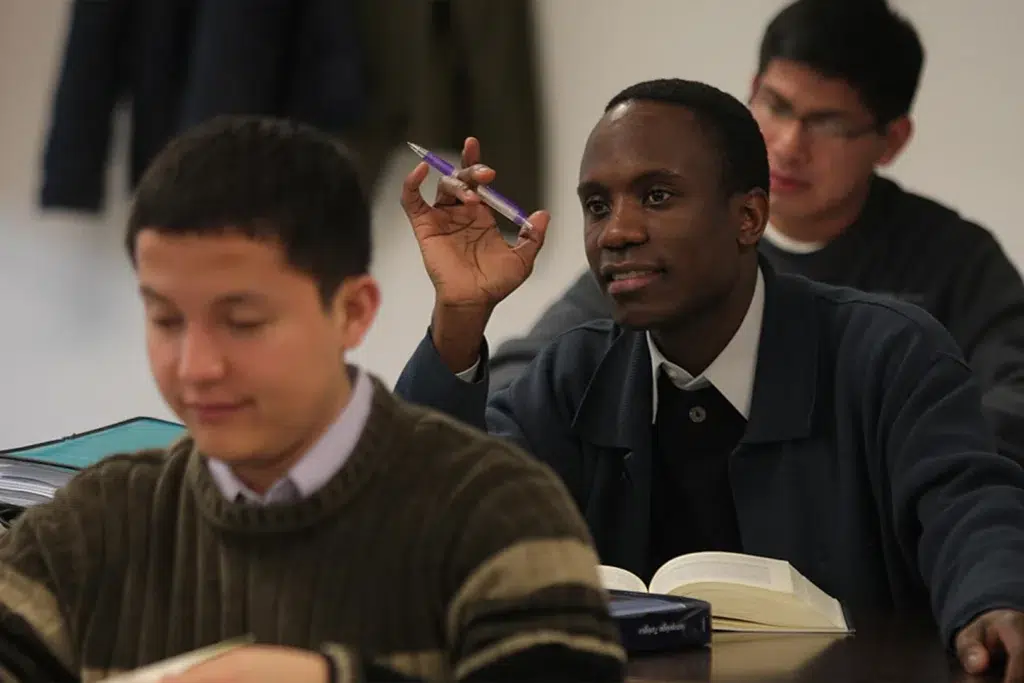
Seminarians attend a theology class at the University of Navarra's Ecclesiastical Faculties.
Your legacy of solidarity looks beyond today
Each generation has the opportunity to renew the generosity of the last. Through the CARF Foundation, your legacy becomes a direct support to seminarians and diocesan priests around the world: young people who wish to give themselves to God and serve the universal Church, but who need concrete help in order to be formed.
Just as in the past there were people who ensured the continuity of the Church's mission, patrons and major donors, today you can do the same. Convert a portion of the your life's effort to consolidate the integral formation of seminarians and diocesan priests in order to bring the Gospel to every corner of the world.
A Christian (and a non-believer, too) takes nothing to heaven, but can leave much good on earth. Your legacy can become formation, service and continuity. It can be the most valuable inheritance: the one that sustains the Church and the Church itself. allows many people to continue to encounter God through well-formed priests who strive to be saints and to help others.