«We will return on pilgrimage to Rome with friends, because it transforms the heart.»
This year, the pilgrimage to Rome with benefactors and friends had a very special motive: to participate in the Jubilee of Hope, The event was a unique opportunity to renew our faith and strengthen the bonds of friendship and spirituality that unite the entire CARF Foundation family.
During those days, the pilgrims discovered that the places full of history, The most emblematic Christian sites and be inspired by the beauty of Rome, the heart of the Church.
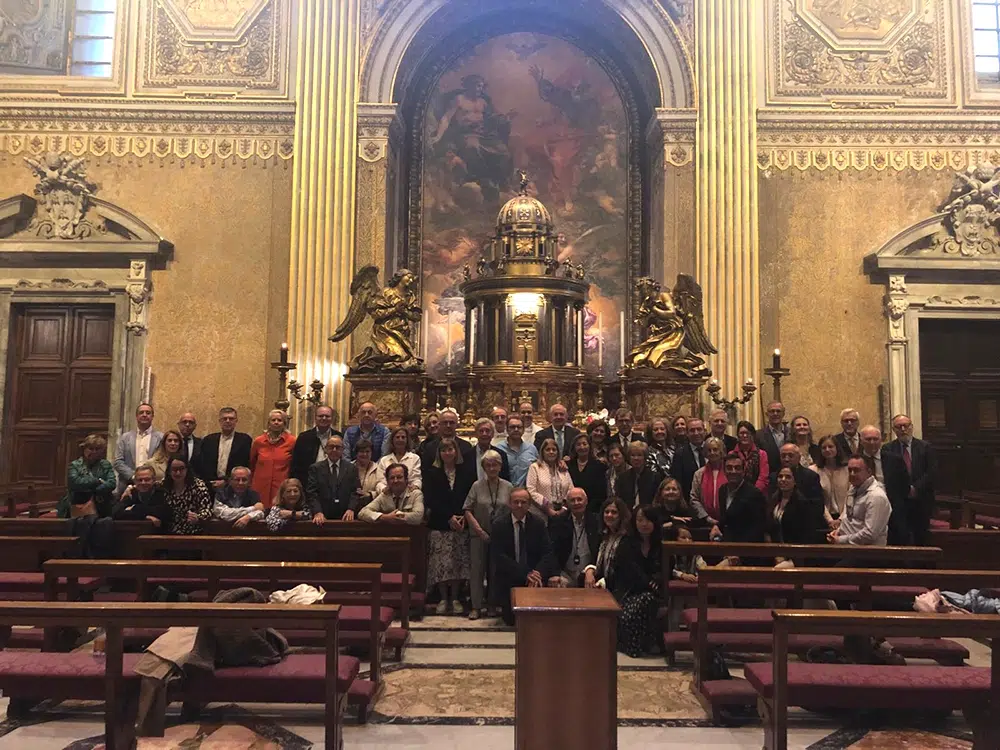
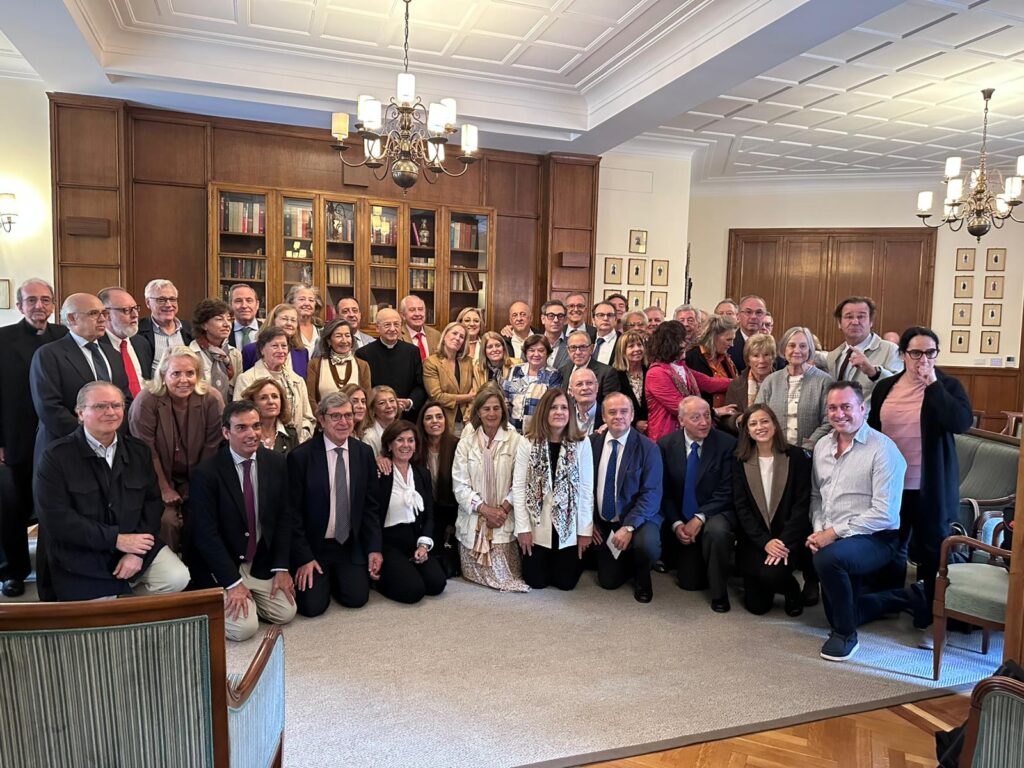
The pilgrims of the CARF Foundation, after the Mass in the Chapel of the Blessed Sacrament at St. Peter's.
Pilgrimage to Rome with the CARF Foundation
One of the most poignant moments was the Holy Mass in a Blessed Sacrament Chapel of St. Peter's Basilica, followed by the general audience with Pope Leo XIV in St. Peter's Square. In his message, the Holy Father recalled: «The Risen Christ is a safe harbor on our way».
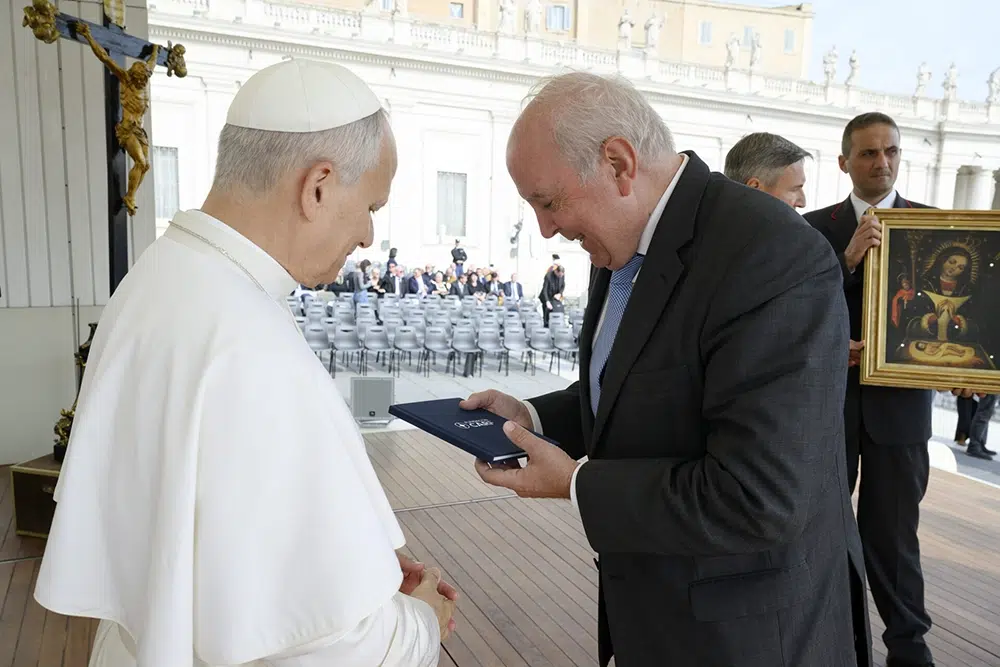
Luis Alberto Rosales, director of the CARF Foundation, presented Pope Leo XIV with a book containing the 2024 annual report.
At the conclusion of the hearing, Luis Alberto Rosales, the general director of the CARF Foundation, personally greeted Pope Leo XIV and presented him with a book on the work of the Foundation, a symbolic gesture that reflects the commitment to the universal Church and to the vocations of seminarians and diocesan priests and religious men and women.
Visit to Villa Tevere and the PUSC
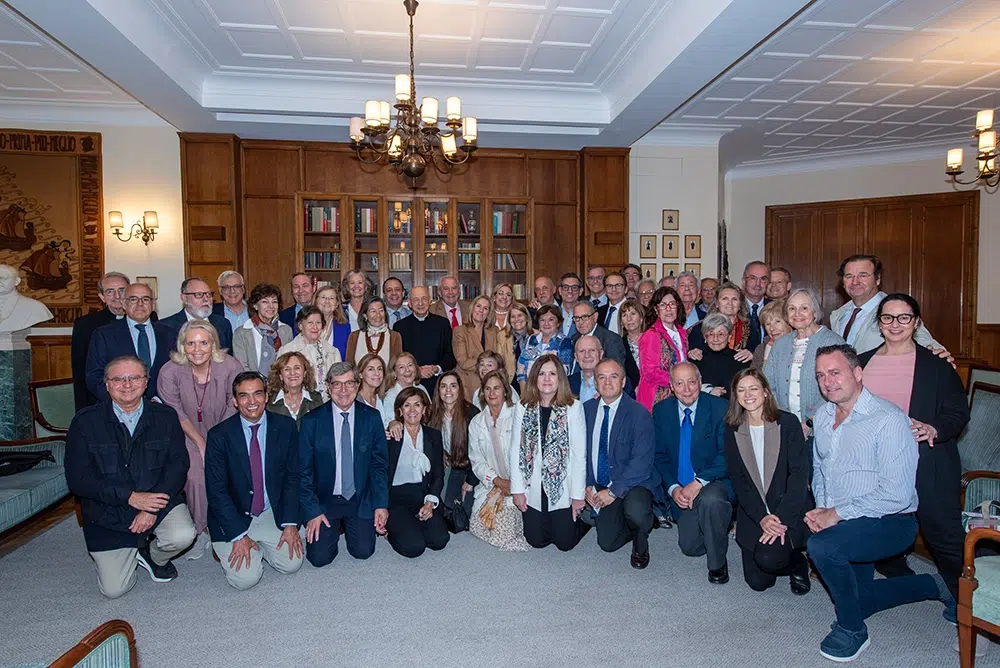
Meeting with the Prelate of Opus Dei, Father Fernando Ocáriz, at Villa Tevere.
Another moment of special significance was the visit to Villa Tevere, where the pilgrims participated in a discussion with the Prelate of Opus Dei, Msgr. Fernando Ocáriz. Their closeness, simplicity and sense of humor created an atmosphere of joy and family.
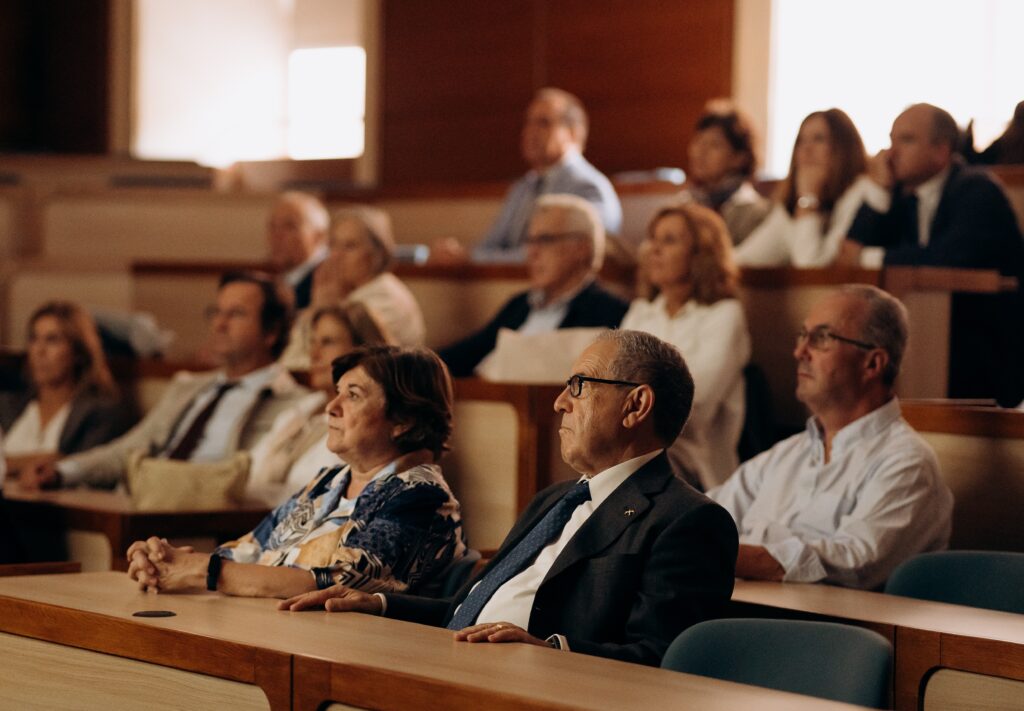
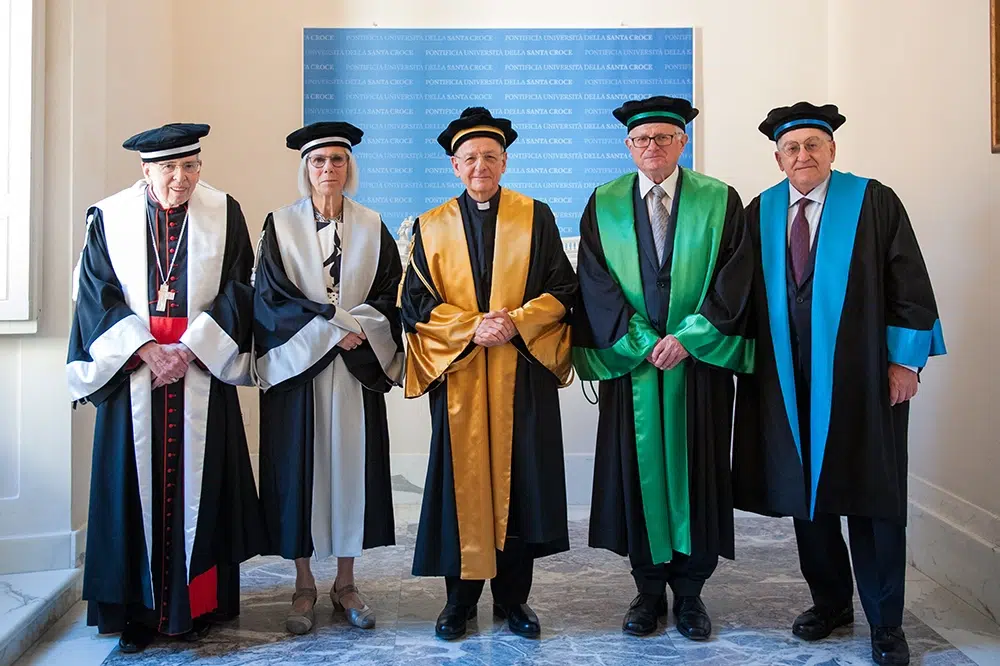
In addition, the pilgrims were welcomed at the Pontifical University of the Holy Cross by its rector, Mr. Fernando Puig, He welcomed them and shared the importance of the academic mission at the service of the Church. He also gave a lecture on Church Governance Today.
Among the attendees, Almudena Camps and Miguel Postigo were participating in this pilgrimage for the first time. «It is precious to be able to be in the Vatican close to the Pope. It helps to pray much more for him and for the Church; you feel the comfort of his presence,» they say.
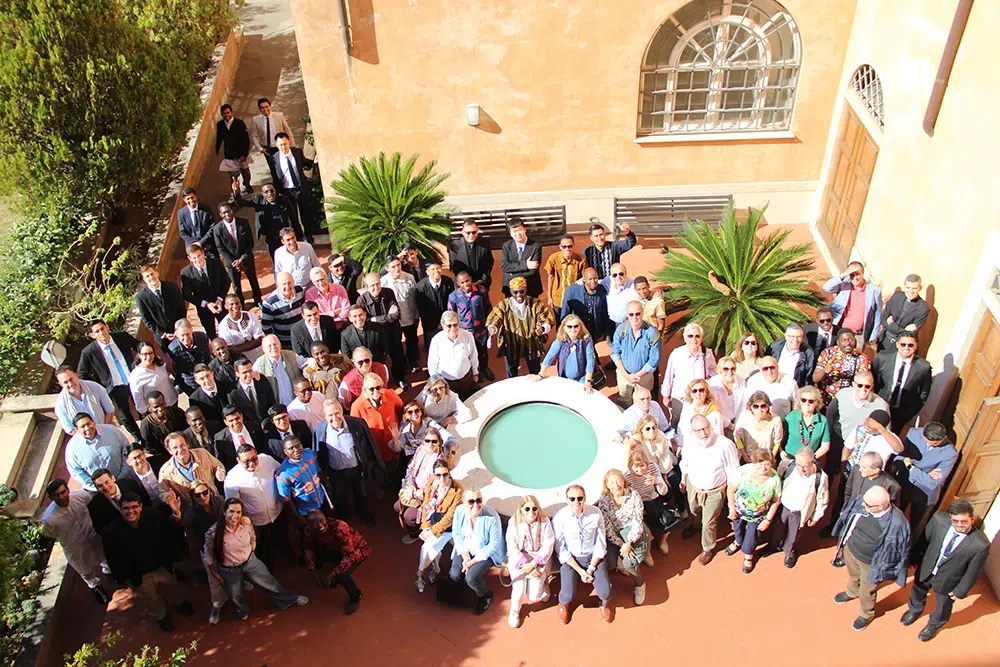
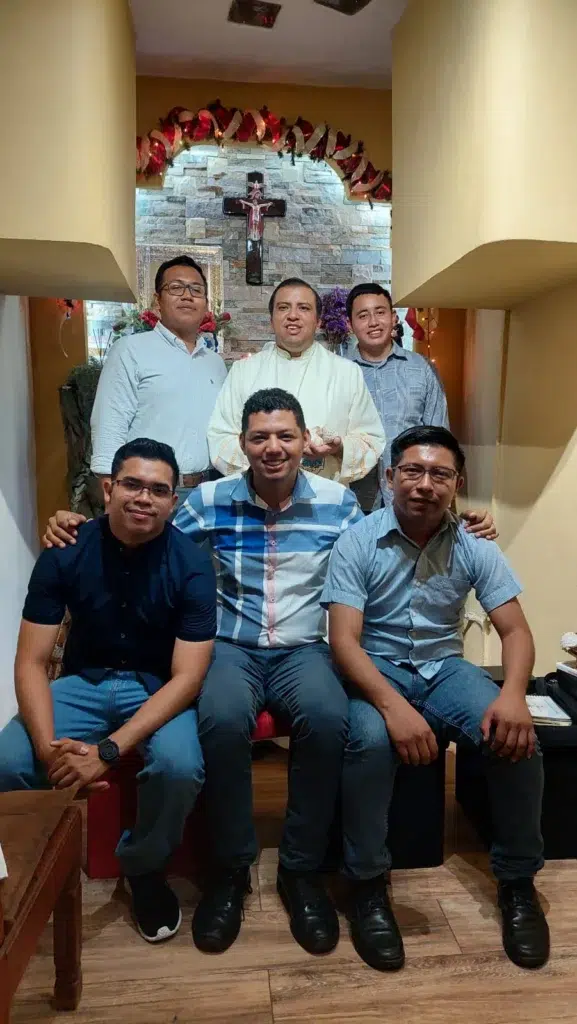
Meeting with the seminarians and formators of the international ecclesiastical college Sedes Sapientiae.
Regarding the get-together with the Prelate, they emphasize that «it was a joy to be with him; his simplicity, his clear and accessible message, his sense of humor and closeness... That morning at Villa Tevere was very worthwhile: Mass, visit and get-together.
A day of conviviality in Sedes Sapientiae
One of the most endearing moments was the meeting with seminarians, which Almudena and Miguel described as «the most sublime moment of the whole trip».
«Meeting the seminarians, with their stories and their smiles, is unique. The food style buffet allowed us to greet many of them, and the Mass, with its choir and homily, was memorable».
Both agree that it has been a transformational journey, We will come back with more friends, because it transforms the heart. In short: a ten«.
A moment of the video projection Witnesses at the Pontifical University of the Holy Cross.
Marta Santínjournalist specializing in religion.
Table of Contents
Angel David, from atheism to a life of dedication
Practical atheism is a way of life that acts as if God does not exist, without the need for philosophical debate or formal denial. It manifests itself in the absence of religious motivation, indifference to transcendent or divine issues, and the exclusion of religion from daily life.
At 20 years of age, Angel David, a Mexican seminarian, is aware of the gift he has received to study and be formed as a priest in the University of Navarra, in Pamplona. Their story is one of conversion and hope, of how God can transform a family far from the faith into a home of communion with Christ.
«Seeing my parents take up the faith again was the seed of the vocation that God put in me, and he continues to take care of it every day,» emphasizes Angel David.
From practical atheism to faith
Angel David grew up in a large family: five siblings and parents who, as he himself says, were believers, but lived a practical atheism. «We didn't contemplate God in everyday life, let alone going to Mass,» he says..
Everything changed when they decided to come back to the faith, receive the sacraments and her parents got married in the Church. «Now my parents are committed to evangelization,» he says with gratitude. That family transformation was also the fertile ground where his vocation germinated.
The moment he felt the vocation
Her first serious contact with the faith was preparing for her First Communion. What began as a tradition soon became an inner calling. «God had other plans for me.», he says with a smile. Being an altar boy allowed him to experience the liturgy up close, and in the silence of a Mass he understood that his life did not belong to him alone.
«The special moment was during a Holy Mass -he recalls. The priest had about fifty people to confess, and I thought it was impossible for him to reach all of them.. I asked myself if someday I could be the one to offer God's forgiveness... and in that instant, He planted the seed of my vocation,» he expresses serenely.
Tabasco, a land of faith facing secularism
His home diocese, Tabasco, located in southeastern Mexico, is a warm land not only because of its climate, but also because of the faith of its people. With about one and a half million inhabitants, 64 % declare themselves Catholic. It has 250 priests and 120 parishes.
However, like many other regions, it faces growing challenges. «The biggest challenge is secularism and materialism among young people,» explains Angel David. That materialism leads to a lack of commitment in the Church. In addition, the rise of diverse religions and sects has caused Catholicism to be a bit on the decline.".
Devotion to the Virgin of Guadalupe
Despite growing secularization, Tabasco is a living diocese, marked by the joy and hospitality of its people. Its rural communities preserve deeply Christian traditions, even though modernity and globalization have brought with them religious indifference.
Even so, the popular devotion, especially to the Virgin of Guadalupe, continues to be a focus of hope. The Guadalupana in Mexico is seen as a loving mother who always takes care of us and intercedes before God for us,« says the young seminarian. On December 12, the feast of our patroness, even people of other religions or atheists come to pray a rosary before her. It seems like a joke, but it's true,» he says with emotion.
A fact that surprised him from Spain
When he arrived in Spain he thought that this was also a country with great Marian devotion. He was not wrong, although, on the other hand, he was shocked by some things he did not expect. «I was very surprised to see, for example, that one day, in a Holy Mass, there were only three people,» he confesses.
However, he was struck by the fact that the few Spanish youth and adolescents who participate in Sunday Mass are very committed to their faith.
Evangelizing in today's society
When asked how to evangelize today, his answer is clear: «it is not a matter of showing a just or punishing God, but the true Merciful Father, full of love, who always forgives us and seeks us out».
His words resonate with the pastoral closeness he dreams of for the priests of the 21st century: «The priest of this time must be healthy, wise and holy.. Knowing how to live in the world, but without being of it. And he must also learn to use social networks as a bridge of evangelization, although with care so as not to isolate himself or fall into disinformation».
Ángel David Álvarez Ramírez, a young man from Tabasco who is in his third year of his bachelor's degree in Theology and who, from the heart of Navarra, is preparing to return one day to his homeland as a priest.
Marta Santínjournalist specializing in religion.
Table of Contents
Don Fernando, happy birthday!
Msgr. Fernando Ocáriz was born in Paris, France, on October 27th born in 1944, son of a Spanish family exiled in France during the Civil War (1936-1939). He is the youngest of eight siblings. On the occasion of his birthday we make a brief review of his life.
He holds a degree in Physical Sciences from the University of Barcelona (1966) and in Theology from the Pontifical Lateran University (1969). He obtained his doctorate in Theology, in 1971, at the University of Barcelona (1966). University of Navarra. That same year it was ordained priest. In his first years as a priest, he dedicated himself especially to youth and university ministry.
Consultant in various dicasteries
He has been a consultor to the Dicastery for the Doctrine of the Faith since 1986 (when it was Congregation for the Doctrine of the Faith) and to the Dicastery for Evangelization since 2022 (previously, since 2011, to the Pontifical Council for Promoting the New Evangelization). From 2003 to 2017 he was a consultor to the then Congregation for the Clergy.
In 1989 he joined the Pontifical Theological Academy. In the eighties, he was one of the professors who initiated the Pontifical University of the Holy Cross (Rome), where he was ordinary professor (now emeritus) of Fundamental Theology.
Some of his publications are: The mystery of Jesus Christ: a Christology and Soteriology textbook; Children of God in Christ. An introduction to a theology of supernatural participation.. Other volumes deal with theological and philosophical topics such as Loving with works: God and mankind; Nature, grace and glory, with a preface by Cardinal Ratzinger.
In 2013 a book interview by Rafael Serrano was published under the title. On God, the Church and the world. Among his works are two studies in philosophy: Marxism: theory and practice of a revolution; Voltaire: Treatise on tolerance.. He is also co-author of numerous monographs, and author of numerous theological and philosophical articles.
Grand Chancellor of the PUSC and UNAV
The Prelate is also, by virtue of his office, Grand Chancellor of the University of Navarra and the Pontifical University of the Holy Cross. He is the fourth, after St. Josemaría (until 1975) -founder and first Chancellor of the University-, Blessed Álvaro del Portillo (1975-1994) and Javier Echevarría (1994-2016).
Monsignor Fernando Ocáriz has dedicated many years of study and work to theology. To the point that this activity has marked his way of being. He is a friend of reason, of logic and arguments, of clarity. He has published books and articles on God, the Church and the world, with that breadth of vision that a theological gaze provides.
He shows an open spirit in the debates: I have heard him say, for example, that «heresies are wrong solutions to real problems», thus encouraging to accept the existence of the problems, to understand those who detect them and to look for acceptable alternative solutions.
In addition to being a theologian, he is a university professor. A professor since he was very young, those who have attended his classes affirm that he usually achieves the most difficult thing: to make the complex understandable. He knows how to explain and how to listen. He has the patience of a good teacher, who every year has to start from scratch with students who arrive with little knowledge and many questions.
From the Roman watchtower
Much of the theological work of Fernando Ocáriz has been developed within the Congregation for the Doctrine of the Faith, where he has been a consultor since 1986. For twenty years he worked closely with the then Cardinal Ratzinger, prefect of that Congregation, on issues of dogmatics, Christology and ecclesiology. A work that requires science and also prudence. And, as usually happens to those who work in the Vatican, the work of consultant brings a deep ecclesial sense. Rome is a vantage point from which the Church is known in breadth and depth. One of the documents he presented at the Vatican was precisely the one dedicated to the Church as communion, in 1992.
In addition to being a teacher of university and Vatican consultant, Fernando Ocáriz has worked at the headquarters of Opus Dei, always in the field of theology, formation and catechesis. First with St. Josemaría, then with Álvaro del Portillo and finally with Javier Echevarría. He was the latter's closest collaborator for twenty-two years. In this sense it can be said that he knows well the reality of Opus Dei in the last half century.
Your personal signature
In addition to these data of his profile, what is Fernando Ocáriz like? He has a serene character and an easy manner, friendly and smiling, he is not a friend of verbiage. From him you can learn something about the art of writing. He often says that in order to improve a text it is almost always best to shorten it, to prune the excess, repeated, imprecise words. Something similar has been written by the Italian writer Leonardo Sciascia.
It is not surprising to learn that the Congregation counted on his help for the publication of the Compendium of the Catechism, the Catholic Church, excellent synthesis of a much longer text. What is written in this article, he would have said it more briefly.
At his age, he still plays sports, especially tennis. He maintains the qualities of the sportsman: no matter the effort, noblesse oblige, it is not worth giving up. Theologians can also have a sporting spirit. From the University of Navarra we have conveyed to him our desire to support him in whatever way we can. In the end, almost everything in this life is a team effort.
Juan Manuel Mora García de Lomas, consultant and professor of the PUSC. Published in Nuestro Tiempo.
Table of Contents
Tithing: what is it and what is its meaning?
The purpose of the tithe was to fundraising for the material support of the Church and those most in need, today Pope Francis tells us "The enemy of generosity is consumerism".
Every Christian can contribute financially "what he has decided in his heart and not reluctantly or by force, because God loves a cheerful giver". 2 Corinthians 9:7
What is tithing
The word tithe comes from the Latin decimus and is linked to a tenth, the tenth part of something. The concept was used to refer to the 10% fee to be paid to a king, a ruler or a leader. Those who were to make the payment gave a tenth of their earnings or income to the creditor. It was a common ancient practice among the Babylonians, Persians, Greeks and Romans and among the Hebrews.
The meaning of tithing in the Bibleis the tenth part of all the fruits acquired, which must be given to God as recognition of his supreme dominion. Cf. Leviticus 27:30-33. The tithe is offered to God, but it is transferred to his ministers. Cf. Num 28:21.
The tithe and offering should be understood today, according to the Christian spirit of a heartfelt giving of love for helping the Church and the most disadvantaged in their needs.
"The generosity of the little things widens the heart, beware of consumerism".. In his homily at morning Mass at Casa Santa Marta on November 26, 2018, Pope Francis urged us to ask ourselves how we can be more generous to the poor, the current tithe is in "the little things." And he warned that the enemy of generosity is consumerism, spending more than we need to spend.
How tithing is reflected in the Bible
The Old Testament speaks of the willingness of heart to titheaccording to the phrase "let each one give as he has decided in his heart, not giving with sorrow but with joy.". The meaning of the tithe in the bible appears for the first time when Abram, gives it to the priest Melchizedek in a token of gratitude (Genesis 14:18-20; Hebrews 7:4). Over time, it was instructed for all the priests Levites and was even established as an obligation or law.
Then Jacob gives the tithe of all his possessions to the Lord. "And this stone, which I have set up for a sign, shall be God's house; and of all that thou shalt give me, I will set apart for thee the tithe." (Genesis 28:22)
Subsequently the Bible explains how each year, the Israelites set aside a tenth of what their land produced (Leviticus 27:30). If they decided to pay with money, then they had to add 20 % to its value (Leviticus 27:31). They also had to give "tenths of the cattle and herd" (Leviticus 27:32).
To calculate the tithe of their livestock, the Israelites chose every tenth animal that came out of their pen. The Law said that they could not examine whether that animal was good or bad, nor exchange it for another. Furthermore, they could not pay that tithe with money (Leviticus 27:32, 33).
But the second tithe, the one used for the annual feasts, could be paid with money. This was very practical for the Israelites who came from far away to attend the feasts (Deuteronomy 14:25, 26). Israelite families used these offerings on their special feasts. And there were specific years in which these offerings were used to helping the very poor. (Deuteronomy 14:28, 29; 26:12.)
Paying tithe was a moral obligation, the Mosaic law did not establish any punishment for those who did not comply with the law.. The Israelites had to declare before God that they had complied and then ask him to bless them for having done so (Deuteronomy 26:12-15).
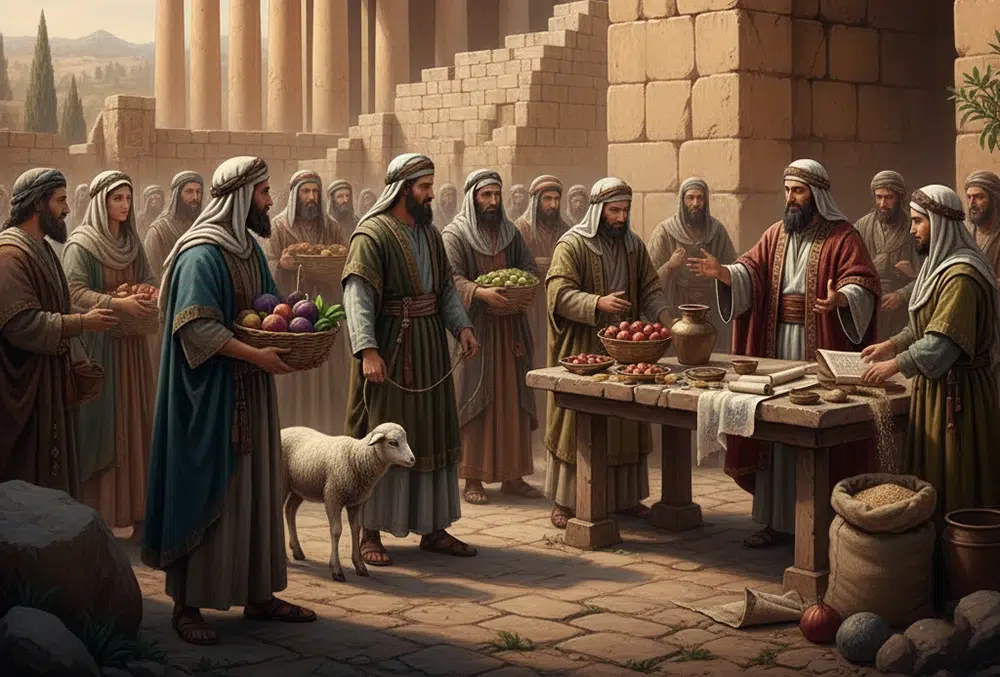
In the marketplace of ancient Judea, people came to give their tithes.
Tithing in the Bible: the New Testament
In the days of Jesustithe was still paid. But, when he died on the cross, this was no longer a requirement. Jesus does not reject it, but teaches a new reference: to give no longer the 10% but to give oneself totally as master.r, not counting the cost. Therefore, he condemned the religious leaders because they were very strict in collecting the tithe and at the same time, neglected "the most important matters of the Law: justice, mercy and faithfulness" (Matthew 23:23).
Jesus' death annulled the Mosaic Law, including "the command to collect the tithe from the people" (Hebrews 7:5, 18; Ephesians 2:13-15; Colossians 2:13, 14). In none of the four times that the tithe appears in the New Testament are we taught to be guided by that measure. It is no longer limited to the law of 10 % but refers us to the example of Jesus Christ who gave himself unreservedly. Jesus lives a radical surrender and teaches us that we should do the same. That is why he transmitted to us the concept and the importance of the Works of mercySpiritual and corporal.
The Heart of Jesus is the model of total surrender. He gave himself to death on Calvary. Jesus gives us His grace to know how to give and to give as He gave Himself.. Everything belongs to God and we are stewards of our resources according to the Holy Spirit who enlightens our conscience. San Pablo teaches and lives the same self-giving, "For you know the generosity of our Lord Jesus Christ, who, though he was rich, yet for your sakes became poor, that you might be enriched by his poverty." (II Corinthians 8,9)
The Pope Francisco Pope gives catechesis on Jubilee, tithing and condemnation of usury. At the general audience on Ash Wednesday 2016.
Importance for the financing of the Church in Spain
The Catechism of the Catholic Church mentions the tithe only once, in reference to the Christian's responsibility towards the poor, already founded in the Old Testament. The fifth commandment, "to help the Church in her needs", that the faithful are obliged to help, each according to his or her ability, to the material needs of the Church(cf. CCC can. 222).
There is much confusion among the population about the sources of financing of the Catholic Church in Spain. The Catholic Church receives from the Spanish State, 0.7% of the taxes of those who freely check the corresponding box in the personal income tax declaration. This has been the case since the modification of the tax allocation system was signed in December 2006. And it can be considered a way of contributing a tithe or offering to the Church today.
In addition to the State's contribution via personal income tax, the Church is supported by the contributions and offerings of its faithful through other means:
Personal donations and tax deductible donations to NGOs made in accordance with the Patronage Law 49/2002.
Ordinary collections.
Extraordinary collections (DomundCampaign against Hunger, World Day of Migrants and Refugees...).
Fees (matrimonial files, etc.).
Inheritances. Joint and several legacies and wills of the faithful.
Marking the Church box on the income tax return does not imply any cost for the citizen. You will not get back less or pay more. But it is a great help for thousands of people who need it. A small gesture for a great work. In the CARF Foundation's Reflection Days that we organized with different collaborators online, Silvia Meseguer explained the financing of religion in Spain.
Bibliography:
Catechism of the Catholic Church infocatolica.com Opusdei.org
Table of Contents
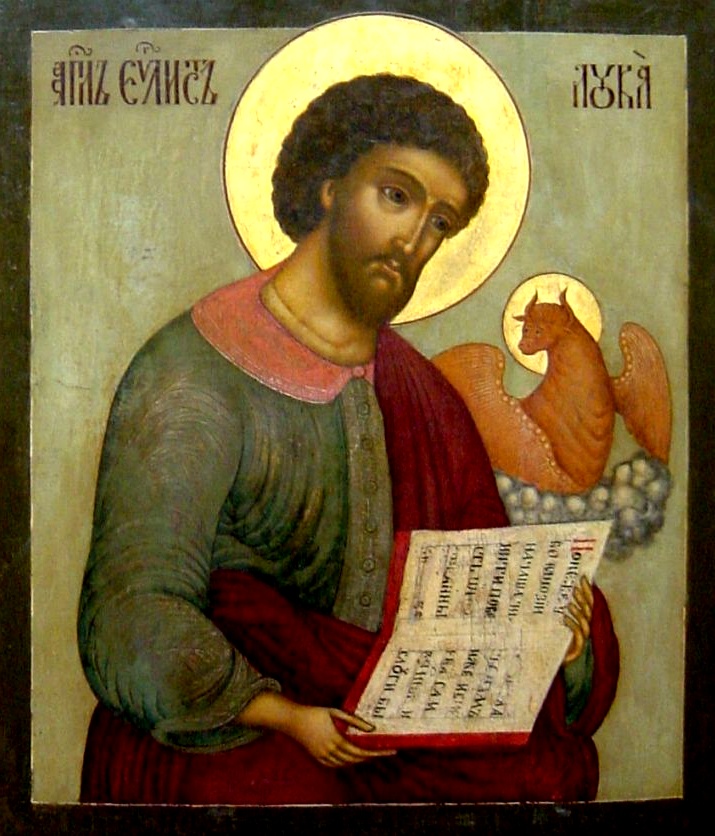
St. Luke, writer of the third Gospel
Saint Luke was born in Antioch. His origin was Gentile, probably Greek, and he dedicated himself to medicine. After converting to Christianity around the year 40, he accompanied St. Paul on his second apostolic journey and spent the last part of the apostle's life with him at the time of his captivity in Rome. He is the author of the third Gospel and the Acts of the Apostles.
There are figures who, without having known Jesus directly, managed to transmit in their account of the Lord's life a special vividness and tenderness. One such man was St. Luke'sHe was the physician loved by St. Paul and the chronicler who most detailed the infancy of Jesus among all the evangelists. He is the one who has best shown us that period of the Lord's life.
St. Luke offers details that help us consider the humanity of Jesus Christ and the normality of the life of the Holy Family: how Our Lord was wrapped in swaddling clothes and laid in a manger, the purification of Mary and the presentation of the Child in the temple, the loss of Jesus in Jerusalem... Probably any family of that time lived through similar situations. And surely it was Our Mother the Virgin Mary who told it to them firsthand.
Presenting the truth
He was not an apostle of the first hour, no; his vocation was the same as that of any Christian, but it was a call to investigate, to order and to present the Truth with the precision of a physician and the soul of an artist.
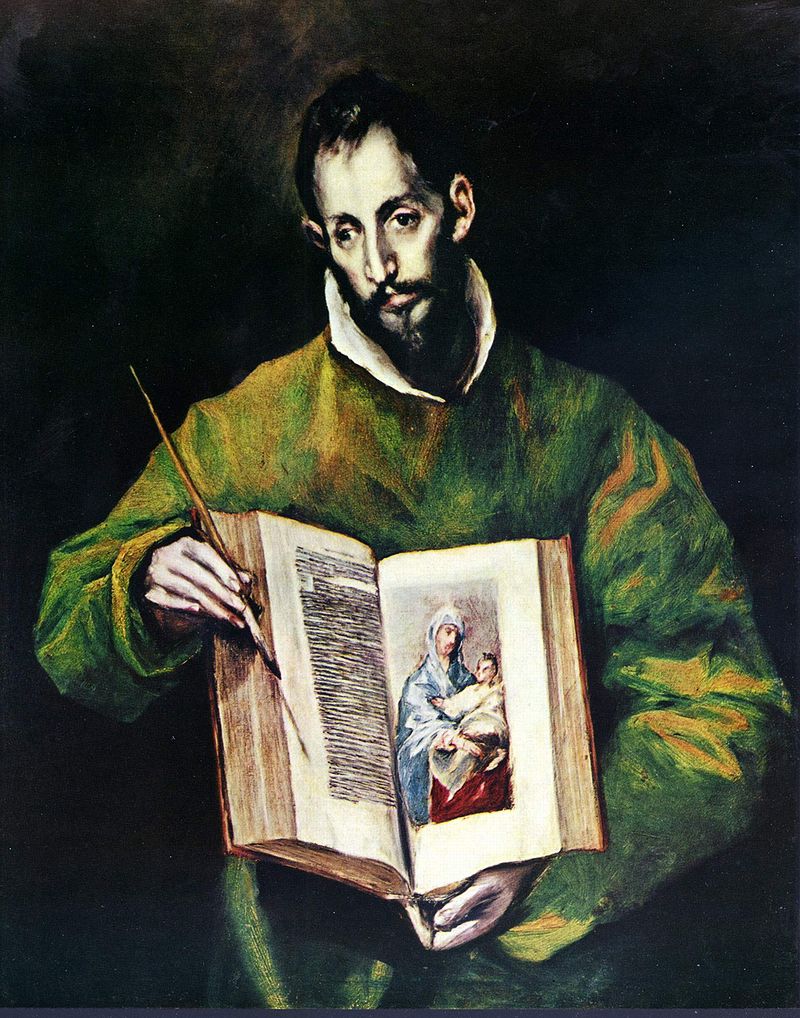
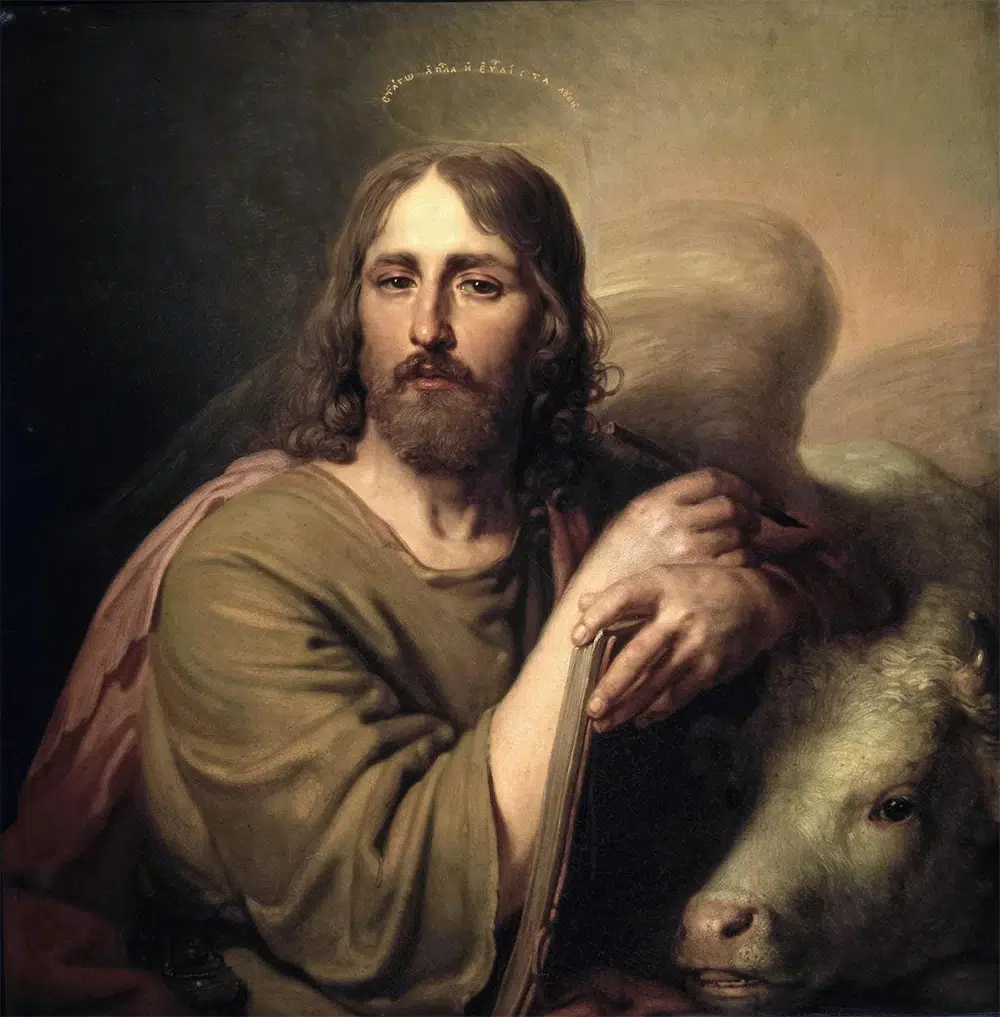
From very early times, St. Luke received the title of painter of the Virgin. Because he is the evangelist who most clearly traces the figure of Mary as a model of correspondence to God. Of her he emphasizes that she is full of grace, she conceives by the Holy Spirit, she will be blessed for all generations....
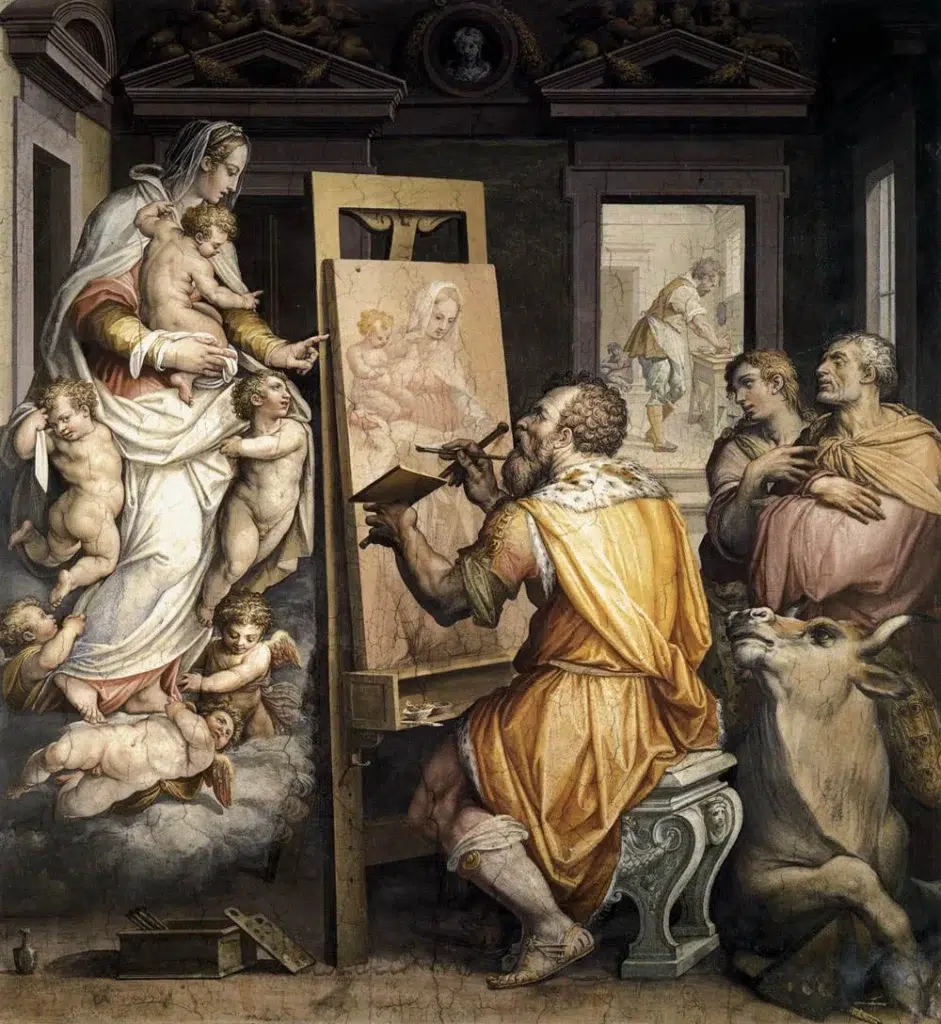
Giorgio Vasari as St. Luke painting the Virgin, 1565. The bull, symbol of the evangelist in the tetramorphos.
At the same time, it expresses that she responds with fidelity and gratitude to all these divine graces: she receives with humility the angel's announcement, she surrenders herself to the divine plans, she observes the customs of her people....
His story does not begin with a miraculous catch of fish or a direct call to the seashore. St. Luke was a learned man, instructed in the science of Hippocrates, a Gentile whose mind was trained to observe in detail and contrast. That attentive gaze allowed him to approach with precision and clarity the life and figure of the carpenter of Nazareth. His gospel is, in a sense, a detailed history of salvation from birth to death, resurrection, ascension and appearance to different groups of disciples and the apostles.
The beloved doctor
Providence weaves threads in unsuspected ways. Luke's path crossed that of Saul of Tarsus, the persecutor turned Paul, apostle to the Gentiles. In the Acts of the Apostles, the second part of his work, where Luke himself, with humility, uses the pronoun "we," he includes himself in the missionary adventure of St. Paul. He became his inseparable companion, confidant and, as Paul himself calls him in the letter to the Colossians, 'the beloved physician'"' (Col 4:14).
It is easy to imagine these two great saints conversing during long voyages across the Mediterranean or during nights in prison. Paul, the passionate apostle; Luke, the methodical observer. Perhaps from these dialogues, from this sharing of faith and mission, or perhaps at the invitation of St. Paul, the conviction was born in St. Luke to put down in writing, and in an orderly way, everything that had happened.
Eyewitnesses
He was not satisfied with what he had heard; as a good investigator, "it seemed to me also, after I had accurately reported everything from the beginning, to write it down for you in an orderly fashion, distinguished Theophilus" (Lk 1:3), interviewing the eyewitnesses, those who had seen, heard and touched the Word made flesh.
According to a very ancient tradition, who better to tell her the mysteries of Jesus' infancy than Jesus herself? Virgin Mary? Your Gospel is the most Marian one, the one that gives us the MagnificatIt is the one that allows us to look into the Immaculate Heart of Our Mother Mary.
St. Luke painting the Virginfresco by Giorgio Vasari (1565).
To God through letters
It is not known how St. Luke's died and appeared before the Judgment of God. Some sources indicate that he may have been martyred, but other traditions indicate that he died at the age of 84, after a patient, meticulous and God-inspired work.
His work: the Gospel and the Acts of the Apostles, two books, one story: the story of the love of God who became man and who continues to live and act in his Church by the power of the Holy Spirit. And with St. Luke as a faithful companion of St. Paul on his missionary journeys, he documented the beginnings of the Church.
The Gospel of Mercy
If we were to define the third Gospel with a single word, it would be mercy. Luke presents a Jesus who constantly comes to heal human frailty. It is the parable of the Good Samaritan, of the lost sheep, of the prodigal son....
It is the Gospel that shows us a God who never tires of forgiving, who runs to embrace the repentant sinner and who celebrates a feast in heaven for every conversion. As the Catechism of the Catholic Church reminds us in number 125, "the Gospels are the heart of all the Scriptures because they are the chief witness to the life and teaching of the Word made flesh, our Savior." Luke's work is an eloquent witness to this truth.
His pen, guided by the Holy Spirit, not only brought his addressee, the illustrious Theophilus, out of doubt, but has continued to bring souls closer over the course of twenty centuries, reminding us that holiness is not the absence of pain, but allowing oneself to be accompanied by the Divine Physician, Christ.
The chronicler of early Christianity
In the Acts of the Apostles, Luke focuses on the nascent Church, but the protagonist remains the same: the Holy Spirit. He narrates with detail and emotion the adventure of the first Christians, the persecutions, Paul's journeys, the miracles and, above all, the irrepressible spread of the Good News. It teaches us that the vocation Christianity begins with a personal encounter with Christ that impels one to carry out the mission: witnesses to the ends of the earth.
The work of St. Luke's is, in short, a hymn to the faithfulness of God and to the greatness of the vocation human. A physician from Antioch, a man who did not know Jesus personallybecame, by the grace of God and his diligent work, one of his most faithful portraitists, bequeathing to us a gospel which is a balm for the soul and a road map for the Church of all times.
Christians in the Acts of the Apostles
As Pope Francis shows us in a 2019 catechesis "in the Acts of the Apostles, St. Luke shows us the Church of Jerusalem as the paradigm of every Christian community. The Christians persevered in the teaching of the apostles, in communion, they remembered the Lord through the breaking of bread, that is, the Eucharist, and they dialogued with God in prayer.
The believers lived all together, conscious of the bond that unites them as brothers and sisters in Christ, feeling especially called to share with everyone spiritual and material goods, according to the needs of each one. Thus, by sharing the Word of God and also the bread, the Church becomes the leaven of a new world in which justice, solidarity and compassion flourish.
The book of Acts adds that the disciples went daily to the temple, broke bread in their homes and praised God. Indeed, the liturgy is not just another aspect of the Church, but the expression of its essence, the place where we meet the Risen One and experience his love."
Table of Contents
Marcus Vinicius, from biologist to priest
Young Marcus is in love with everything related to life, which is evident in his own evolution, where he went from working as a biologist to entering seminary and to be ordained priest.
. Living beings, all created by God, continue to fascinate him, but it is now man, God's masterpiece, who is the focus of his attention and whom he now helps to get to know his Creator.
He belongs to the clergy of the Brazilian diocese of Nova Friburgo, in Rio de Janeiro. Marcus currently has a fundamental mission as a formator in the diocesan seminary, specifically in the propaedeutic course, a key stage for young men who are discerning and evaluating their vocation to the priestly life.
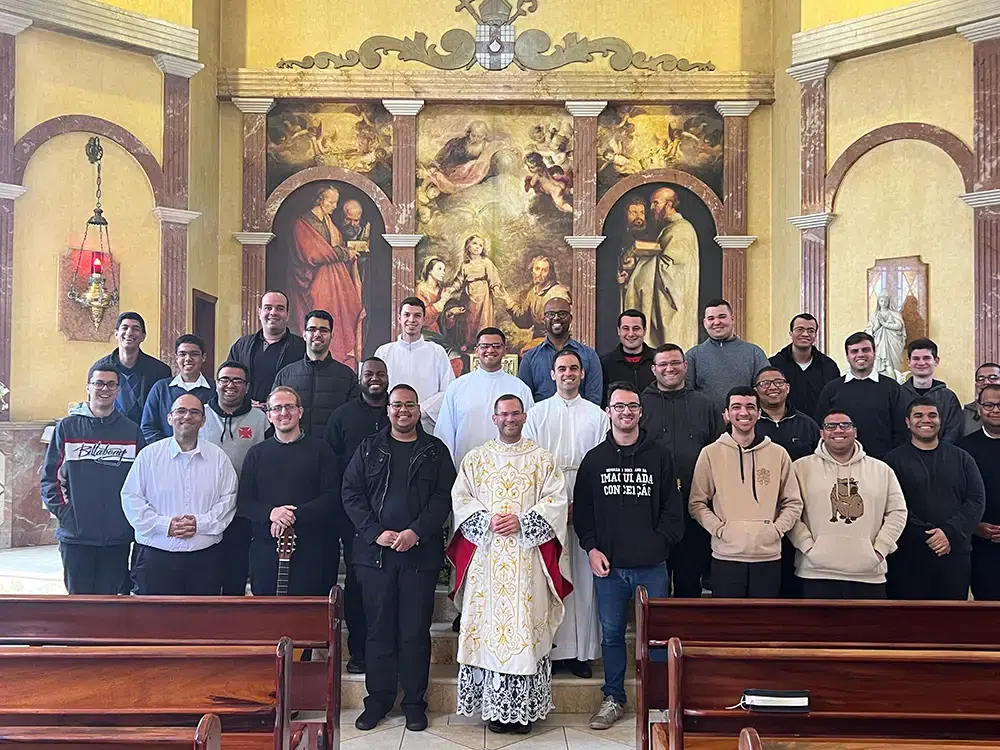
Marcus Vinicius Muros surrounded by his fellow seminar participants.
Family, the key to being ordained a priest
In this interview with CARF FoundationThe young priest, ordained in 2021, recalls that he comes from a Catholic family that actively participated in the pastoral activities of his parish. "My parents have been teachers of faith for my brother and me. Already as a child I played at celebrating Mass. I lived with many priests who went to my parents' house, but I never thought of being one of them," he says.
However, everything changed when he had the opportunity to get to know the seminary of his diocese, after the delegates of the vocation ministry visited his parish one day. Marcus admits that this was the first moment when he considered becoming a priest, although there was a big obstacle: "I was already working; I had my job and my financial independence".
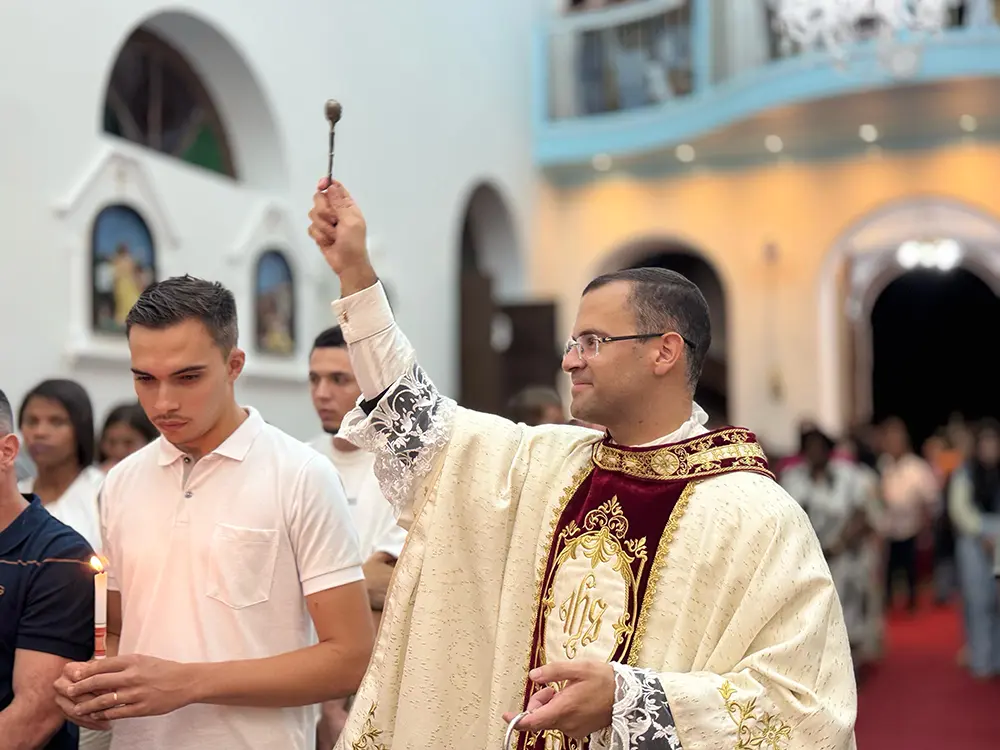
Marcus Muros imparts the blessing in the church by sprinkling holy water.
"But although I had everything," adds this priest, "none of what I had was enough for me. I was missing something important, something that would make my life meaningful and worth living. The parable of the rich young man challenged me a lot," says Marcus. And so it was that finally in 2014 that inner struggle came to an end and he entered the seminary to begin his formation.
Good training for today
Barely a year later, another moment would come that would mark his life. His bishop sent him to Spain to continue his formation and philosophical and theological studies. About this experience he says that "I will never forget the years of formation and prayer in Pamplona. They were much more than an academic preparation for the exercise of the priestly ministry, it was an experience of the universality of the Church".
He defines this time as some "unforgettable years" marked by his stay at the University of Navarra and the Bidasoa international seminarwhere he had the grace of having "a singular opportunity to obtain an excellent human, spiritual, intellectual and pastoral preparation".
If there is one thing that Marcus has taken away from these years, it is that his training in Navarra has been "a good preparation for what God is entrusting to me today".
Marcus is currently a parish administrator and seminary formator. "When I was appointed by the bishop, while I was still a deacon, as formator of the Propaedeutic, the beginning stage in the seminary, all I wanted was to to offer to those who are now preparing for the ministerial priesthood the same as I received in Pamplona," he confesses.
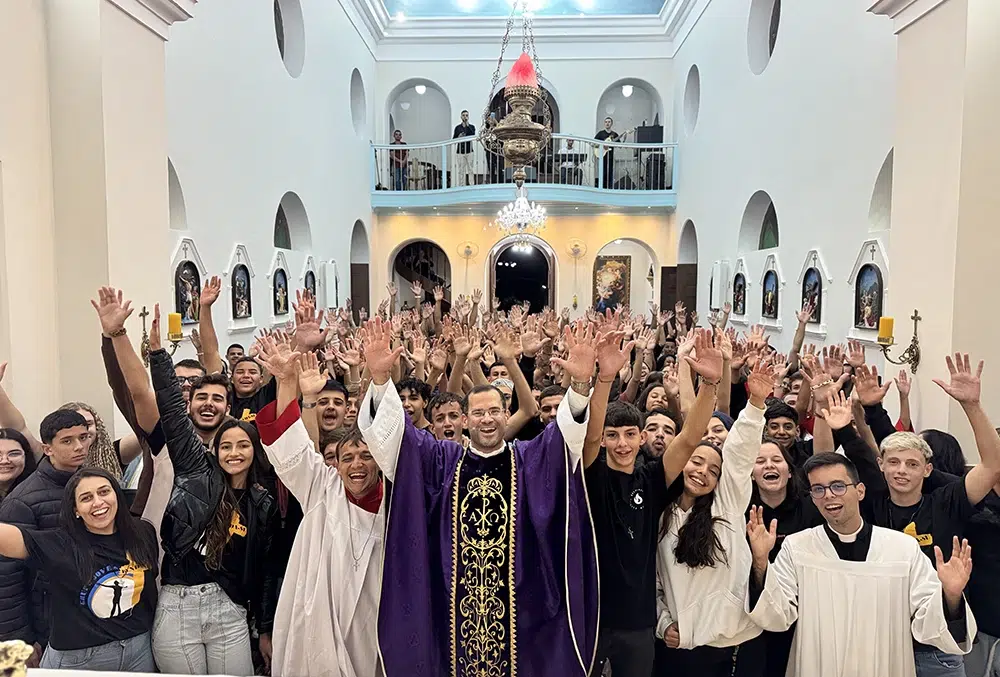
Marcus Muros celebrating with the faithful the joy of being children of God.
To be a good priest: a lot of prayer life
As he tells us, "in Bidasoa we learn that love for God and the Church impels us to give the best of ourselves. Today, between the parish and the seminary, I try to give the best of myself, to spend myself for the souls the Lord entrusts to me.
The world needs priests who give themselves to God in a world that is often hostile to the Christian faith. For this reason, Father Muros is convinced that "the priest needs a soul in love with the Lord and available to faithfully serve all people. These are not easy times, but all the difficulties help us to trust in Christ and in his power. We are in his hands as insufficient instruments, but which the Lord desires for the realization of his work".
But in addition to a soul in love, he considers it indispensable "to have a profound life of prayer. Whoever does not understand that to be a man of God requires a great deal of prayer life is not capable of sacrifice. And it is intimacy with Christ that makes us understand that we are not only celebrants, but also victims who every day offer themselves out of love for the Beloved".
Thank you for your training assistance
Finally, Marcus would like to extend a special thank you to the benefactors of the CARF Foundation. "I was always struck by their generosity in donating without expecting the benefit to go to their diocese or country, but to the universal Church.
Thank you for providing us with the means to help our dioceses and the Church. Thank you for your open hearts. May the Lord grant you and your families many blessings," he concludes.