From Uganda to Pamplona as a seminarian: a story of overcoming the odds

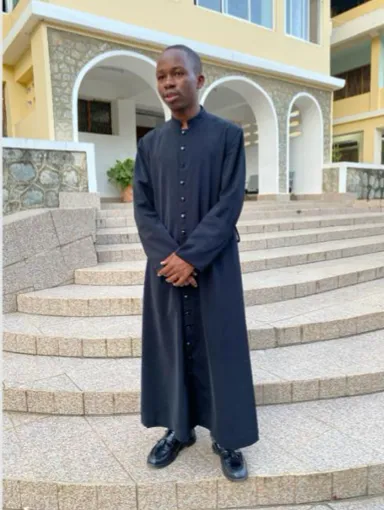
Timothy Katende, a 28-year-old Ugandan seminarian, is studying for his fifth year of the baccalaureate in Theology at the Ecclesiastical Faculties of the University of Navarre. He was orphaned as a child and was educated by his uncles and aunts: «the extended family is vital in my country». He is the first member of his diocese, Kiyinda-Mityana, to come to Spain to study theology.

As he unravels his present and future, Timothy visualizes the road he has traveled. Barely a month after his birth, he lost his mother and at the age of seven his father, which meant that he had to be separated from his brother to be raised by relatives in Maddu, a village in the diocese of Kiyinda-Mityana.

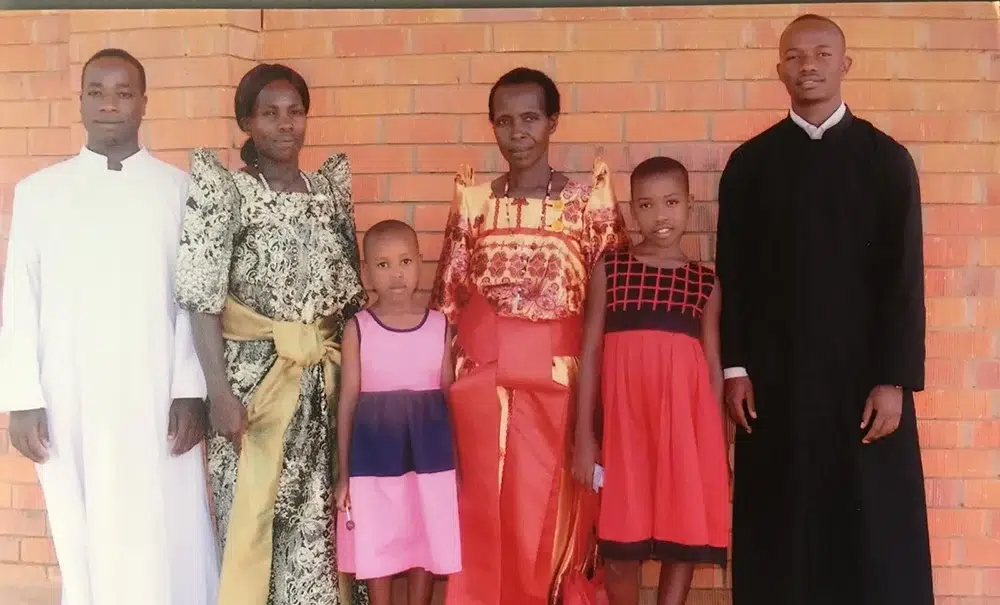
Timothy, the orphaned seminarian, grew up with his cousins.

"Growing up with my uncles and my four cousins who were around the same age as me helped me a lot. Also, in the village there was a good family atmosphere and I had many friends with whom I played soccer and went to elementary school. My aunt and uncle supported me a lot with the little they had, they gave me a lot of affection and sacrifice. I never lost contact with my brother," he says.

To Timothy, the role of the family is very important because that is where moral and social values are taught: respect for others, responsibility and care for cultural and religious practices. "The family is where one should feel most loved, respected and supported. In families, one teaches and learns one's responsibilities and obligations," he explains.

seminarista uganda familia timothy

He entered the minor seminary at the age of thirteen.

Since he was a young boy, he collaborated in the parish as an altar boy, organizing the choir and transmitting the priest's announcements to the community.

"After the national exam to finish primary school, when I was 13, the parish priest told me about the minor seminary that was looking for young boys and asked me if I would like to go: I was thrilled!" he says.

Overcoming the access was one step, but paying for the studies and the material was even more difficult. The parish priest explained the situation at the Sunday celebration and the neighbors came out to help him. This was the beginning of a journey that continued after he passed six courses and entered the major seminary (Alokolum Major Seminary) in Gulu.

«The family is where one should feel most loved, respected and supported. In families, responsibilities are taught and learned.».

By unraveling its present and its future, Timothy, visualizes the road he has traveled. Just a month after his birth, he lost his mother and at the age of seven his father, which meant that he had to be separated from his brother to be raised by relatives in Maddu, a village in the diocese of Kiyinda-Mityana (Uganda).

"Growing up with my uncles and my four cousins who were around the same age as me helped me a lot. Also, in the village there was a good family atmosphere and I had many friends with whom I played soccer and went to elementary school. My aunt and uncle supported me a lot with the little they had, they gave me a lot of affection and sacrifice. I never lost contact with my brother," he says.

Freedom and obedience to study

"When I finished I was offered a scholarship to study French philology: I liked law and languages.... but it was already clear to me that I wanted to be a priest, I wanted to follow the path that God had chosen for me. And so he continued his formation with three years of philosophy, another of pastoral work in a parish and another of theology at the Kinyamasika Seminary. He was there when he was called to come to Pamplona.

"When I was told that my bishop, Msgr. Joseph Antony Zziwa of Kiyinda-Mityana diocese wanted to talk to me, I was a little worried. But then the fears dissipated.  He asked me if I wanted to come to Pamplona to study. I told him that if there was the opportunity, I was willing. I did it freely and obediently».

First member of his diocese to come to Spain

This is how Timothy Katende began his Spanish adventure by becoming the first member of his diocese to come to Spain to study theology, as they usually travel to Italy or the United States.

The initial fears of entering an unfamiliar culture and a strange language, as well as "the concern for the bishop's trust and the responsibility to do well," were overcome by enthusiasm.

Telling my story

"Many of us find ourselves in the same situation, so we learn and help each other. This situation has made me mature," explains Timothy, who hopes to draw on his experience in the future. "
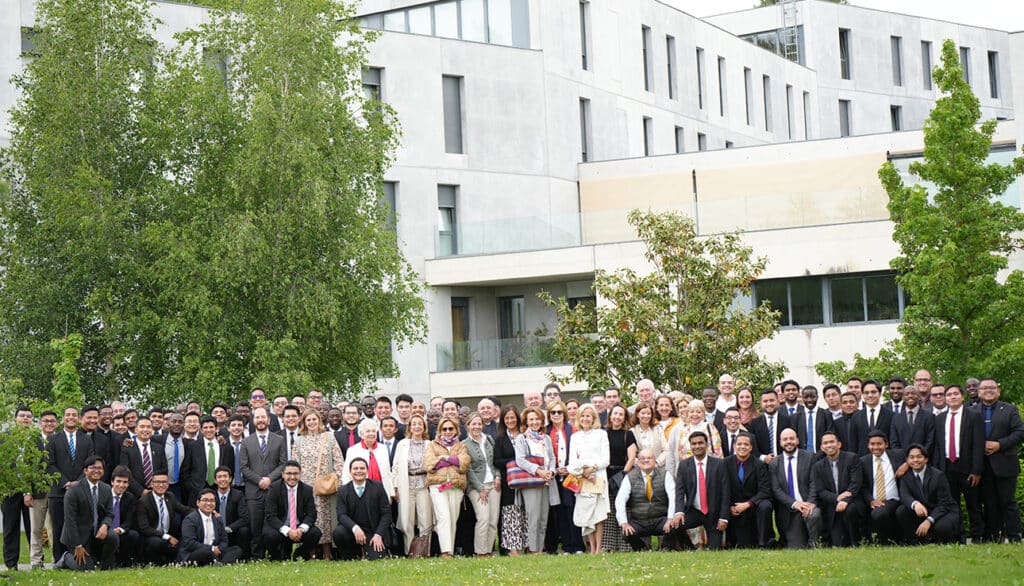
Since he arrived in July 2017 to learn Spanish, he has been living at the Bidasoa International Seminary and this year he is studying the 5th year and finishing Cycle I with the Degree in Theology at the Ecclesiastical Faculties of the University of Navarra thanks to the benefactors and friends of the CARF Foundation.

«Putting what I have learned at the service of my diocese is a way of thanking both the formators I have had and the benefactors who allowed me to be formed in Uganda initially, as now in Pamplona. I am very grateful to all those who support me in this journey».

His diocese, Kiyinda-Mityana is located in the central region of Uganda, in the ecclesiastical province of Kampala. «It is a rural diocese. Many children don't have the opportunity to go to school and sometimes those who manage to finish elementary school don't get far in their studies because of financial problems,» he says.

That is why he is clear that when he returns he wants to look for «vocations by telling my testimony and explaining that the responsibility has to be of the whole parish: there are many families willing to help others and the Church needs vocations».

Timothy explains that most schools lack necessary resources, such as access to water, chairs or blackboards in the classrooms, electricity, etc. There are even some schools without roofs.

In his diocese, 40 % of the population is Catholic., although the majority is Protestant Christian. But it is mostly Christian. However, Islam is growing more and more. Although now the population of Muslims is growing more and more.

The current uncertainty also surrounds his future ordination, but Timothy knows what he would like to do when he finishes his studies: «My dream is to return to a parish in my country and, apart from the work of a priest, I would like to support the vocations. Especially in my case, I have been able to study because of the benefactors and I have seen many who have not been able to continue because of lack of resources».


Marta Santínjournalist specializing in religion.


From genocide to hope: a priest in Rwanda

Pasteur Uwubashye He is a priest of the Diocese of Nyundo, Rwanda. His vocation He is dedicated to reconciliation and the training of other priests. He was born in Kigeyo, in the Rutsiro district in the west of the country, and is currently in Rome, where he is studying for his first year of a Bachelor's degree in Philosophy at the Pontifical University of the Holy Cross, thanks to a grant from the CARF Foundation.

Pasteur's story begins with a childhood marked by orphanhood and the decisive figure of his grandfather, a catechist for decades, who taught him to pray with his family and to love the Eucharist. It is also the story of a diocese deeply marked by the 1994 genocide, in which thirty priests were murdered and the Catholic community was severely wounded.

Pasteur has a clear goal: to help the Rwandan people rediscover the value of each human being, after violence that radically denied that value. That is why he insists that the training he receives is not only for himself, but also for the young people he has worked with, for the priests of his diocese and for a country that is still seeking reconciliation and peace.

«My name is Pasteur Uwubashye, and I am a priest in the Diocese of Nyundo, Rwanda. I was born on March 4, 1988, in the Kigeyo sector of Rutsiro district in the western province.

My parents, Gérard Musugusugu and Pascasie Nabonibo, died when I was still a child.

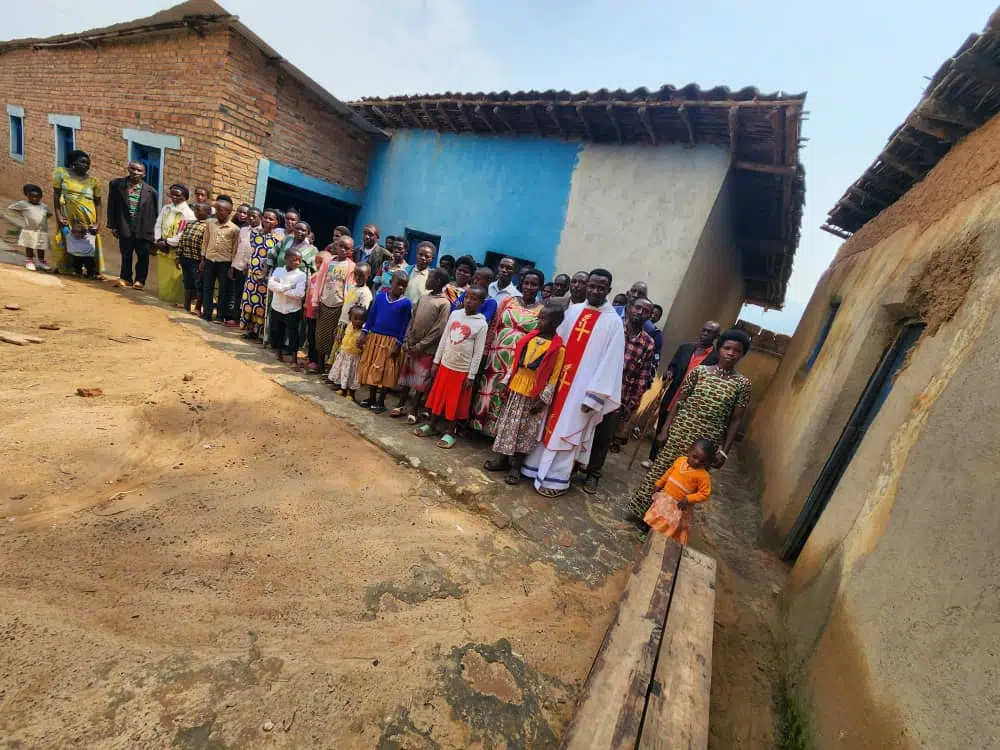
Comunidad parroquial de la diócesis de Nyundo, en Ruanda, reunida tras una celebración junto a su sacerdote.
Parishioners in Nyundo, Rwanda, with their priest after a celebration.

A grandfather who was a catechist and taught him to pray

«Since then, I was raised by my paternal grandfather, Gérard Mvunabandi, who was a catechist for forty-five years in my home parish of Biruyi. He had a profound influence on me. Christian life. I owe my faith to him.

From a very young age, he taught me to pray. Every morning and every evening, we prayed together in family, and each member had a designated day to lead the prayer. That is how I learned the morning and evening prayers, the Rosary, and also how to help others pray.

My grandfather instilled in me a love for Holy Mass. I felt great respect and affection for the priests, who visited him frequently. That close relationship awakened in me a deep love for the Church and the desire to become a priest. The day of my ordination was a great joy for him. He passed away in March 2023, at the age of 93.

Fifteen years of training: in search of his vocation as a priest

After completing primary and secondary school at the Saint Pius X minor seminary in Nyundo, Pasteur pursued higher ecclesiastical studies and was ordained a priest on July 13, 2019, by Bishop Anaclet Mwumvaneza in his home parish of Biruyi.

He was assigned to the parish of Nyange as parish treasurer, pastoral coordinator for children, and choir director. In 2021, he was appointed chaplain. diocesan for youth ministry in the Kibuye area, a mission he carried out for six years.

«I thank God for the fruits of this ministry, especially for the growth in the number of choirs and for the involvement of children and young people in the life of the Church» he explains. The diocese of Nyundo is divided into two areas: Gisenyi, with a Catholic majority, and Kibuye, where different religious denominations coexist.

In the latter, Pasteur and other priests worked to reach out to young people, bring them together, help them love the Church, encourage them to pray, participate in wholesome activities, and support one another in their faith.

During the Covid pandemic, many young people helped the most vulnerable when hunger threatened numerous families. This solidarity left a deep mark on the community and led several young people from other denominations to approach the Catholic Church.

The 1994 genocide and the choice of studies

Rwanda continues to be marked by ethnic divisions between Hutus and Tutsis, which led to the 1994 genocide against the Tutsis. This event continues to influence the social and spiritual life of the country.

For this reason, Pasteur chose to study ethics and anthropology: «the Rwandan people still need to rediscover the value of the human person and the meaning of their existence.».

In his diocese, Nyundo, the genocide had a particularly severe impact: in addition to thousands of faithful who were killed, some thirty priests died. Reconstruction was slow and difficult.

Thanks to the efforts of the bishop at that time, churches and presbyteries were restored and vocations were encouraged. Today, the diocese has some 120 priests serving 30 parishes.

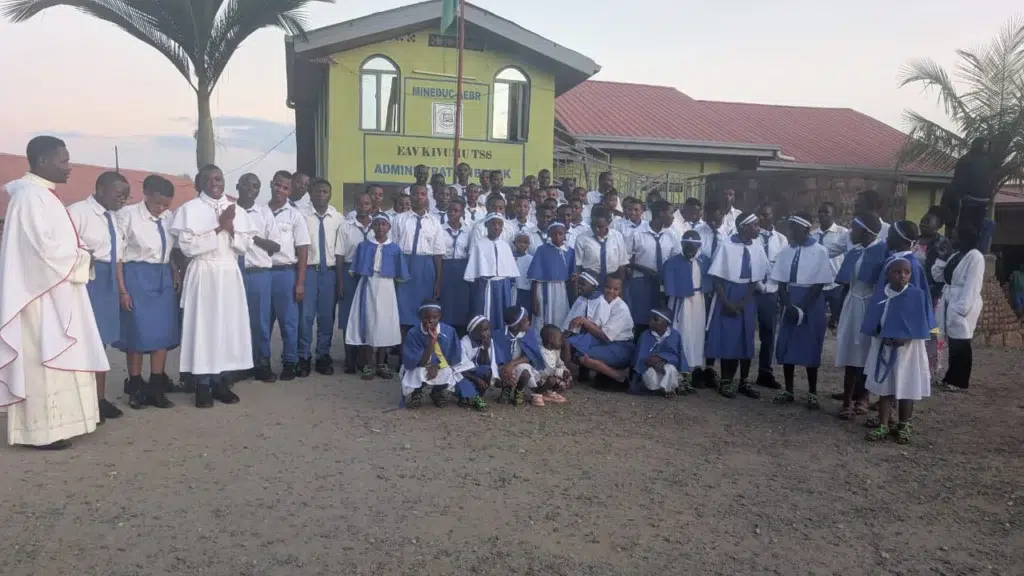
Estudiantes y religiosas en un centro educativo católico de la diócesis de Nyundo, en Ruanda, junto a sacerdotes.
Students, nuns, and priests at an educational center, where human and Christian formation is an essential part of the pastoral mission.

Lack of trainers and need for support

However, after the genocide, many priests were assigned as a priority to parishes in need, which limited the possibility of sending some to pursue higher education. This reduced the number of formators available in major seminaries and other diocesan services that require academic preparation.

Currently, the diocese has a very small number of permanent teachers. For this reason, there is a continuing education program for priests, designed to share the knowledge acquired by those who have been able to study abroad.

The bishop remains committed to priestly formation, but resources are limited. In this context, the support of institutions such as the CARF Foundation is essential.

Studying in Rome to serve better

Since September 10, 2025, Pasteur has been in Italy, at the Pontifical University of the Holy Cross. He sees this stage of his life as an opportunity that will benefit not only him, but also his diocese and his country.

He thanks his bishop for his trust, the university for its welcome, and the CARF Foundation for its assistance, which is invaluable support for a diocese that is still suffering the consequences of genocide and needs well-trained priests to better serve its people.


Gerardo FerraraBA in History and Political Science, specializing in the Middle East.
Responsible for students at the University of the Holy Cross in Rome.


«With God at the center of my life, I lost nothing; I gained everything!»

All priests in this community receive support from the CARF Foundation for their training in the Pontifical University of the Holy Cross. This training is aimed at service to God and the Church. Fabio, in particular, is enrolled in the first year of the Bachelor's Degree in Theology, after having completed the two-year philosophy program.

His story begins in a neighborhood on the outskirts of Rome, in the parish of San Raffaele. It was there that he received instruction for the sacraments of Christian initiation following Baptism (Confession, Communion, and Confirmation), and where he met the Sons of the Cross, who served in the parish.

Friendship and the discovery of a living faith in the parish

During those years, he participated in many initiatives for young people, also forming part of the group of teenagers after Confirmation. He fondly remembers his service as an animator at the summer camp and the experiences of fraternal communion at both summer and winter camps.

«Honestly, I experienced a kind of gratuitous friendship that, compared to the world of soccer—which I had played since childhood—was incomparable. Although I didn't fully realize it yet, the Lord was already calling me to become more and more involved with the priests and friends of the parish.».

The distancing from God, the illusion of false friendships, and the emptiness

«When I started secondary school, I decided to move away, eager to try all the experiences the world had to offer, influenced by the conflictive atmosphere in the neighborhood and by a poor choice of studies.».

He never had academic problems, but he found himself in a school far from home, without knowing anyone. He lived those years feeling lost, with poor academic results and disrespectful behavior typical of kids from the "outskirts," completely excluding God from his life.

Fabio realized how difficult it was to find true friends, true companions in life. «I realized, however, that the deep friendships I thought I had were actually relationships of convenience, disposable, and little by little I realized that I was alone and directionless. Even soccer, which gave me so much satisfaction and gratification, ultimately left me feeling empty.».

A providential encounter that brought me back to the parish and to true friendship

The turning point came when, at the end of his second year of high school, he met one of the priests from his parish on a bus. In a very simple way, he invited him to the oratory's summer camp, and he accepted as a way to escape boredom.

That summer camp had a profound effect on him: he realized that the true friendships he had been searching for and couldn't find in the world were there, at the oratory. From that experience, he immediately became involved with the parish and everything it had to offer.

«I realized that the reason for these deep friendships was not affinity or sympathy, but that we were all educated to put God at the center, transforming our friendship into true Communion, guided by the priests. I learned that by putting God at the center of my life, I lost nothing; on the contrary, I gained everything! I experienced the joy and truth of the Gospel.».

The seminarians: a joy that sparked questions about vocations

During that time, he also met the seminarians from the community, Casa de María, who were helping out at the summer camp. Their witness of life and fraternal friendship, even with those they were meeting for the first time, like him, made a deep impression on him. He began to wonder about them, about their joy and happiness. Something stirred within Fabio, but he still did not clearly understand what the Lord wanted from him. He simply continued on and waited for a sign.

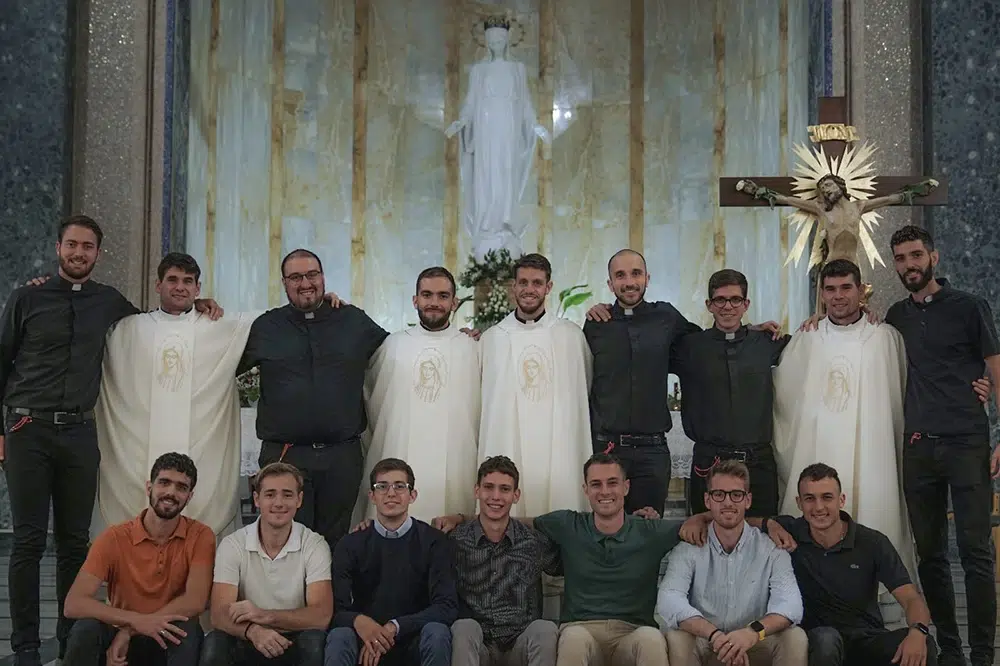
Sacerdotes al servicio de Dios y la Iglesia.

Medjugorje: from doubt and skepticism to a renewed and living faith

Another decisive moment was his pilgrimage to Medjugorje with the parish youth group. Before going, he had many doubts, even about the action of the Holy Spirit in that place; you could say he was quite skeptical. He recalls that during the trip, they had a moment of prayer, and he expressly asked the Virgin Mary to take away his many doubts and help him answer the questions that troubled him, especially about his vocation.

«When we arrived on the first day, during the introduction to the place, we heard for the first time an invitation to seriously consider what the Lord wanted from our lives. It was a first shock for me.».

Consecrating one's life to Mary: trusting in a living and present Mother

I could recount many episodes from that pilgrimage, but what affected her most was the renewed faith that the Virgin Mary gave her, especially while praying on the hill where the apparitions took place. It was there that she experienced Mary's maternal love as a living person, and decided to place her life in her hands.

«After this experience, I asked to be able to seriously approach the group of consecrated members of the Immaculate Conception in our community, beginning a journey of preparation with other young people, which culminated in my consecration and entry into the prayer group on August 11, 2023.».

The day God spoke: the clear call to priesthood during worship

Meanwhile, he had started college, studying civil engineering. Although he had not ruled out the possibility of priesthood, he had not seriously considered it. There was a resistance, a fear within him. Until one day everything changed. It was Saturday, October 22, 2022, the feast of St. John Paul II. I was coming off a summer of doubts, feeling that something big was at stake, but without the courage to ask the Lord.

«That day, during Eucharistic adoration, I clearly felt the call to the priesthood. The first thing I did was call Don Stefano, the priest who had been instrumental in my return to the parish. I told him everything, that I wanted to respond to this call and also become a Son of the Cross, like the priests in my parish.».

A path of learning, gratitude, and discovery at the University of the Holy Cross

Since that October 2022, the journey began for priestly formation, which continues today and includes studies at the Pontifical University of the Holy Cross. «I am deeply grateful, not only for the studies, but also for the exceptional people I have met: professors, students, administrative staff, and so many others. I have never experienced such a deep communion between students and the university as I have at Holy Cross.».

Give thanks for the witnesses God has placed in my path.

«He wants to conclude by thanking the Lord for the many witnesses He has placed in his life: his family, who never opposed his decision to enter the seminary; the Sons of the Cross, who have been for him a true example of priesthood, consecration, and love for the Virgin Mary; and the brothers with whom he shares this formative journey, who were an example when he was a teenager and continue to be so today. «Truly, with them and in them, I discover the action and love of the Lord.».

Finally, he would like to express his special gratitude to the donors of the CARF Foundation, thanks to whom this educational journey is possible. «I hope to be able to repay such generosity with my life, my prayers, and my service to the Church.».


Gerardo FerraraBA in History and Political Science, specializing in the Middle East.
Responsible for students at the University of the Holy Cross in Rome.


Arthur Cesar: «I felt a peace that confirmed it was God calling me.»

Arthur, a 25-year-old seminarian from Brazil, is undergoing an intense experience of comprehensive training on his path to priesthood. Thanks to the help of benefactors and friends of the CARF Foundation, he is currently in his third year of Bachelor's Degree in Theology from the University of Navarra, as an essential part of its priestly formation. He has also been living at the Bidasoa International Seminary for a year and a half. His vocational journey began in his childhood parish and matured into a total commitment to the priesthood.

A life marked by faith and service since childhood

He grew up in a deeply Catholic home: his parents and grandmother were involved in parish life and it was they who patiently encouraged him to take his first steps in the Church. Although at first he found it difficult to attend celebrations and activities, family life gradually shaped his faith.

Music became his first bridge to the community. At the age of ten, he began learning to play the guitar, and between the ages of 12 and 19, he was part of the parish choir. That hobby helped him to serving the ChurchOn weekends, he studied and helped out at the parish, like most young people in his circle.

Family influence

Arthur remembers his younger sister fondly and gives thanks for her faith. Seeing how she joyfully serves others, and feeling called to do the same, fills him with gratitude and hope.

The call to priesthood: two moments that changed everything

There are two events that, according to him, had a profound impact on his priestly vocation. The first was his Confirmation at age 17. That sacrament transformed him internally: he understood for the first time what it meant to belong to Christ and felt the need to proclaim the joy of faith. With some friends, he created a youth group and they placed themselves at the service of the parish priest.

The second moment was a youth retreat in June 2018. He entered convinced that his future would be a civilian career and a family, but on Sunday he left determined to enter the seminary: «a profound interior experience, a real encounter in which God speaks to the heart and an unmistakable peace that confirmed to me that it was He who was calling.».

After six months of parish accompaniment and a year in the vocational group of his archdiocese, he was invited to enter the São José seminary in February 2020. Since then, he has been reviewing his life: more sacraments (frequent Confession and daily Mass), spiritual direction, and a continued commitment to the formation of priests.

The retreat experience

He describes the retreat as the turning point: it was not a passing intuition, but a peaceful certainty that called him to complete ministerial dedication.

Evangelizing in diverse contexts: from Rio to Spain

The Archdiocese of São Sebastião de Rio de Janeiro is immense and diverse: some 4,700 km², more than 750 priests, and nearly 298 parishes. Evangelizing there means that those who work there must face very different realities—from rural areas to favelas or affluent neighborhoods—and a challenge: a large part of the population is not practicing Catholic.

Arthur highlights Cardinal Orani João's work as a promoter of unity and initiatives that bring the Church closer to professionals and educators. Even so, secularism particularly affects young people: «the witness of so many committed Catholics is like a streetlight that, little by little, illuminates the streets of our city more and more.».

Rformación sacerdotal seminarista sacerdote Arthur brasil
Arthur Cesar, seminarian of the Archdiocese of São Sebastião de Rio de Janeiro.

For him, evangelization in secularized contexts begins with the witness of one's life: «More than words, it is a life transformed by Christ that convinces. The world does not need watered-down versions of the Church; it needs authenticity: solid doctrine, clear morals, dignified worship, and language that everyone can understand.».

Today's priest

In your opinion, the priest of the 21st century must persevere in a righteous and virtuous life. «The people are not looking for event organizers, but for closeness, sacraments, and formation. The priest's first calling is to holiness; to be an example and companion in the search for Christ,» he affirms.

While studying in Spain, Arthur has observed an admirable popular devotion in Spain. For example, in the Holy Week processions, although sometimes devoid of spiritual roots: «I am impressed by their beauty, but it is painful when participation remains cultural and does not continue with attendance at Easter Sunday Mass.».

Coming from a vibrant and complex archdiocese, Arthur looks with hope at the mission of the Church: he asks for persevering and holy priests, willing to give their lives to bring every heart closer to Christ. His testimony—supported by his education at the University of Navarra and the help of the CARF Foundation– is an example of loyalty and service.


Marta Santínjournalist specializing in religion.


The priestly vocation of Juan Sebastian

Juan Sebastian Miranda (1997) is an Argentinean seminarian from the Diocese of San Roque. He explains with emotion that his vocation is a "vocation to the priesthood".undeserved gift".The story that God wrote through simple people who, without knowing it, were leading him to Him.

Studying the third year of the Bachelor of Theology at the Ecclesiastical Faculties of the University of Navarra and is his second year residing at the international seminary. Bidasoawhere he continues on this path that the Lord has traced for him.

The vocation of the older brother

Juan is the oldest of six siblings. He knows what it means to share and give. He grew up in a family Catholic, although for many years they were not practicing Catholics.

"For some time now, by the grace of God alone, I have seen how my family has started attending Sunday Mass again," he says with enthusiasm.

Juan was studying for a degree in Physical Education. "Between the frenetic pace of the race, he also felt the restlessness of the call to the priesthood."

Juan Sebastián (on the right of the image), in a parish of San Roque.

This seminarian recalls the specific moment that marked a before and after in his vocation. "It was the last day of novena to the Immaculate Conceptionpatroness of my parish. During those days, a preacher would give us a short reflection before Mass, and ask us to bring the Bible.

That afternoon I arrived discouraged, without any desire, and I only went because I was a youth group leader. I sat in the last pew, apart, with the Bible to one side, listening to the preaching in the background without paying too much attention to it," he tells us.

Suddenly an inner voice was telling him: "Open Lk. 5,10". Juan ignored it but repeated himself again: "Open Lk. 5,10". Again he let it pass. The third time he heard that voice urging him on, he could not help but open the New Testament and read the passage.

Luke 5,10 is a biblical verse where Jesus addresses Simon Peter after a miraculous catch of fish and tells him: "Do not be afraid; from now on you will be a fisher of men". 

Juan Sebastian relates that at that time he lived with doubts about whether the Lord was calling him to be a priest. But that day, with those words, everything became clear. That verse illuminated everything. He felt that God was confirming what He wanted from him.. "Since then, my life has been an attempt, imperfect but sincere, to answer that call and fulfill His will." will".

Juan Sebastian en el camino de su vocación como sacerdote

To be the priest the world expects

On this path to the priesthood, he is very clear about what today's world needs, and they are priests that identify deeply with Christ.

"Prayer and intimacy with God cannot be neglected. Only a heart rooted in such a relationship can respond to the needs of society and to guide her along the path of hope".stresses Juan Sebastián.

And so, this seminarian continues to walk, with his limits (like everyone), but with the certainty that God is writing his story. "Every day I ask him to help me to be faithful, so that in my weakness his strength may be manifested," he adds.

The challenges of your diocese at San Roque

Juan is training in Spain before returning to his diocese in San Roque, a very large circumscription with 24 parishes, each with large rural areas and numerous communities.

"My parish serves about 25,000 inhabitants, plus ten rural communities, and has only one priest.". In total, the diocese has more than 500,000 faithful, served by 41 diocesan, missionary and religious priests alone.

For this reason, the formation of the priest is essential, especially in the face of another challenge that is taking hold in the region: the growth of Protestantism.

"One of our great challenges is to reach places where they cannot celebrate daily Holy Mass because of the shortage of priests. In addition, it is also very important to accompany young people, who, in a society marked by the individualismThey seek to fill their existential emptiness with social networks and the constant need to be seen, without finding a deep meaning to life", expresses concern.

Juan Sebastian poses with some friends after celebrating Holy Mass.

Evangelizing in a secularized society

For Juan Sebastian, the prevailing individualism in society is a problem that needs a paradigm shift. And in this change it is vital that Christians show the world that they are not called to live in isolation, but to go out to meet the other.

"In a society that distances itself from God and accommodates the truth to its own convenience -sometimes out of ignorance-, close and communitarian witness is more necessary than ever," he says.

During his years in Spain, he has been struck by the fact that, in general, people are quite religious, especially the elderly. He has observed this appreciation for traditions, such as the processions of Easter.

seminario internacional bidasoa formación sacerdotes

The Bidasoa family

Juan is in Bidasoaan international seminar located in Pamplona. "It is a place where a worldwide family gathers, where one gets to know other brothers who share the same faith, the same madness of wanting to serve the Lord from the call to the priesthood".

"I think it would be beautiful if that the same passion for Holy Week should also be lived in the Eucharist, in Confession and in the sacraments. In my country we don't have that same cultural expression, so for me it has been something new and enriching," concludes Juan Sebastián, hoping to return to Argentina with strength and enthusiasm.


Marta Santínjournalist specializing in religion.


Questions and answers about priests

What are the four vocations of the Catholic Church?

Everyone has a unique vocation to holiness. However, they are distinguished:

Marriage: a sacred vocation in which a man and a woman commit themselves to live together in an indissoluble bond, open to life and to the education of children, seeking their mutual sanctification and that of their family.

Priesthood: call men to serve the Church as ordained ministers (bishops, priests and deacons). Priests are dedicated to the proclamation of the Gospel, the administration of the sacraments and the pastoral care of the community.

Consecrated life: a call to men and women to consecrate their lives to God through the vows of poverty, chastity and obedience, living in community. This includes nuns, monks, friars, brothers and sisters of various religious orders and congregations.

Celibate life: The vocation of persons who, without joining a religious order or marrying, dedicate themselves to serving God and the Church through their professional work, their service to others and their life of prayer, seeking holiness in their particular state of life.

What is the vocation of a priest?

According to a catechesis of Pope Francis "the sacrament of Holy Orders comprises three degrees: the episcopate, the presbyterate and the diaconate.

The one who receives this sacrament exercises the mission entrusted by Jesus to his Apostles and prolongs in time his presence and action as the one true Teacher and Shepherd. What does this mean concretely in the lives of those who are ordained? Those who are ordained are placed at the head of the community as servants, as Jesus did and taught.

The sacrament also helps them to love the Church passionately, dedicating their whole being and their love to the community, which they are not to consider as their own property, but as the Lord's.

Finally, they should strive to revive the gift received in the sacrament, granted through prayer and the laying on of hands. When the ordained ministry is not nourished by prayer, listening to the Word, daily celebration of the Eucharist and frequent reception of the sacrament of Penance, one ends up losing the authentic sense of one's own service and the joy that comes from a profound communion with the Lord".

How many years does a seminarian have to study to become a priest?

The time of formation of a seminarian to become a priest is a long and rigorous process that, in general, lasts between 6 and 8 years, depending on the seminary and the diocese. This period is not only focused on academic study, but on an integral formation that encompasses several dimensions: human, spiritual, intellectual and pastoral.

What qualities should a priest have?

It is best for a newly ordained priest to respond: "I think it is best that the priest be a normal person. I am referring to character and mentality. Besides, the mission we have asks us to be people with a supernatural outlook, with a strong life of relationship with God. And at the same time, very human, close, to relate to all kinds of people who need a more intense contact with God. I would like to be a pious priest, joyful, optimistic, generous, available to all people and all needs. It seems to me that these are aspects that people especially value in Pope Francis".

Elias, a priestly vocation for Tanzania

Elias Emmanuel Mniko is 22 years old. and a look that conveys peace and conviction. Born in the region of Mwanza, northern Tanzaniaon the shores of Lake Victoria. She grew up in a home full of harmony and faith, where her father Emmanuel and her mother Miluga lovingly raised their four children.

A vocation that the Lord put in his heart

Since high school, he began to feel a deep desire: to be a priest. He could not fully explain it, but something inside him would light up every time he saw the priests at school: dedicated, serene and close. He was fascinated by the seminarians in their white cassocks, elegant and discreet. "It was a desire that the Lord put in my heart," he says now with simplicity.

Although he did not enter the minor seminary, Elias was not discouraged. He spent a year of formation at the vocation house. St. John Paul IIin his native diocese. There, in the silence of prayer and the joy of service, he matured his vocation. He understood that, in Tanzania, being a priest is not just a life choice: it is an urgent necessity..

The community is growing and there are few presbyters

The diocese of Mwanza, to which Elias belongs, faces great challenges. Although Catholics represent about 30 % of the population - some 1.2 million people - priests are scarce and communities are growing rapidly. In many villages, Mass is celebrated only once a month, and there are faithful who walk more than 10 kilometers to attend. Priestly vocations are a blessing desired with hope and faith by all the people.

In spite of everything, the Church in Mwanza is alive. The faithful are enthusiastic, the young people are proud of their faith, and the diocese is working hard to promote educational and health projects. Many schools and hospitals are run by the Church. There, in the midst of simplicity and sometimes precariousness, hope is sown every day.

"I am living a wonderful experience."

Currently, Elias resides in the Bidasoa international seminarin Pamplona. He has completed his first year of Philosophy and his face reflects amazement and gratitude. "I am living a wonderful and fraternal experience," he says. He is excited about sharing daily life with seminarians from all continents, learning from the formators and getting to know other cultures.

Elías Mniko vestido con sotana de sacertoda en un pueblo de Tanzania durante su formación

Europe is teaching me many things," he says. Europeans are very loving. But I also believe that you Europeans can learn from us Africans about the importance of family life.

The priest's life demands sacrifices

Elijah speaks calmly, but his every word is charged with inner fire. He knows that priestly life demands sacrifices. He knows that, when he returns to Tanzania, a demanding mission awaits him: to care for many souls, to accompany scattered communities, to console the suffering and to be the living presence of Christ in the midst of his people.

Sometimes he thinks of his family, his land, the joyful songs at Mass and the ground corn that accompanies almost every meal. He also remembers his friends, his parish catechists and the bishop who encouraged him not to be afraid to say yes to God.

Life at the Bidasoa International Seminary seems to him to be a gift. There are times for prayer, study, sports, service and also parties. "Here we learn to be brothers," he explains. Although at first it was difficult for him to adapt - the cold of Navarre, the language, the food - today he feels at home. His Spanish improves day by day and, when he smiles, he does it with that African warmth.

"The young people of Tanzania have a lot of hope."

Elias is not naive. He knows the problems of the Church, both in Europe and in Africa. In his country, in addition to the shortage of priests, there are social challenges: poverty, lack of access to education in rural areas and the risk of religious syncretism. But he also knows that there is a fire that will not go out. "Young people in Tanzania have a lot of hope. They know they are the future of the Church. That's why they want to train well, serve with joy and give their lives if necessary.

Mwanza, his diocese, has seen the birth of vocations like his. The local major seminary is unable to train all the candidates, so the diocese sends some, like Elias, to formation centers outside the country. It is a brave investment, in the hope that these young men will return to bear fruit.

Return to your country to serve

Elias looks to the future without fear. "I want to go back to my country and serve my people. I want to be a good pastor, like Jesus. And, if I can, I also want to help other young people hear the voice of God". He says this with a peace that moves, because there is nothing stronger than a heart that is surrendered.

His story, like that of many African seminarians, is a song of hope for the whole Church. In a world where faith sometimes seems to be dying out, voices like his remind us that the Gospel is still alive, sowing in fertile lands like Tanzania.


Marta SantínJournalist specializing in religious information.