From Uganda to Pamplona as a seminarian: a story of overcoming the odds

Timothy Katende, a 28-year-old Ugandan seminarian, is studying for his fifth year of the baccalaureate in Theology at the Ecclesiastical Faculties of the University of Navarre. He was orphaned as a child and was educated by his uncles and aunts: «the extended family is vital in my country». He is the first member of his diocese, Kiyinda-Mityana, to come to Spain to study theology.

As he unravels his present and future, Timothy visualizes the road he has traveled. Barely a month after his birth, he lost his mother and at the age of seven his father, which meant that he had to be separated from his brother to be raised by relatives in Maddu, a village in the diocese of Kiyinda-Mityana.

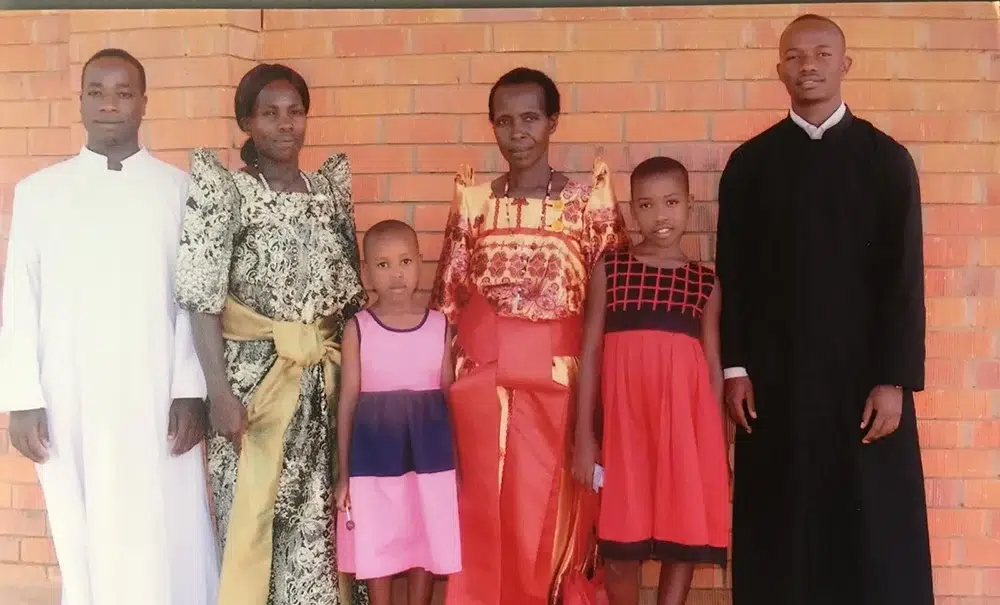
Timothy, the orphaned seminarian, grew up with his cousins.

"Growing up with my uncles and my four cousins who were around the same age as me helped me a lot. Also, in the village there was a good family atmosphere and I had many friends with whom I played soccer and went to elementary school. My aunt and uncle supported me a lot with the little they had, they gave me a lot of affection and sacrifice. I never lost contact with my brother," he says.

To Timothy, the role of the family is very important because that is where moral and social values are taught: respect for others, responsibility and care for cultural and religious practices. "The family is where one should feel most loved, respected and supported. In families, one teaches and learns one's responsibilities and obligations," he explains.

seminarista uganda familia timothy

He entered the minor seminary at the age of thirteen.

Since he was a young boy, he collaborated in the parish as an altar boy, organizing the choir and transmitting the priest's announcements to the community.

"After the national exam to finish primary school, when I was 13, the parish priest told me about the minor seminary that was looking for young boys and asked me if I would like to go: I was thrilled!" he says.

Overcoming the access was one step, but paying for the studies and the material was even more difficult. The parish priest explained the situation at the Sunday celebration and the neighbors came out to help him. This was the beginning of a journey that continued after he passed six courses and entered the major seminary (Alokolum Major Seminary) in Gulu.

«The family is where one should feel most loved, respected and supported. In families, responsibilities are taught and learned.».

By unraveling its present and its future, Timothy, visualizes the road he has traveled. Just a month after his birth, he lost his mother and at the age of seven his father, which meant that he had to be separated from his brother to be raised by relatives in Maddu, a village in the diocese of Kiyinda-Mityana (Uganda).

"Growing up with my uncles and my four cousins who were around the same age as me helped me a lot. Also, in the village there was a good family atmosphere and I had many friends with whom I played soccer and went to elementary school. My aunt and uncle supported me a lot with the little they had, they gave me a lot of affection and sacrifice. I never lost contact with my brother," he says.

Freedom and obedience to study

"When I finished I was offered a scholarship to study French philology: I liked law and languages.... but it was already clear to me that I wanted to be a priest, I wanted to follow the path that God had chosen for me. And so he continued his formation with three years of philosophy, another of pastoral work in a parish and another of theology at the Kinyamasika Seminary. He was there when he was called to come to Pamplona.

"When I was told that my bishop, Msgr. Joseph Antony Zziwa of Kiyinda-Mityana diocese wanted to talk to me, I was a little worried. But then the fears dissipated.  He asked me if I wanted to come to Pamplona to study. I told him that if there was the opportunity, I was willing. I did it freely and obediently».

First member of his diocese to come to Spain

This is how Timothy Katende began his Spanish adventure by becoming the first member of his diocese to come to Spain to study theology, as they usually travel to Italy or the United States.

The initial fears of entering an unfamiliar culture and a strange language, as well as "the concern for the bishop's trust and the responsibility to do well," were overcome by enthusiasm.

Telling my story

"Many of us find ourselves in the same situation, so we learn and help each other. This situation has made me mature," explains Timothy, who hopes to draw on his experience in the future. "
Since he arrived in July 2017 to learn Spanish, he has been living at the Bidasoa International Seminary and this year he is studying the 5th year and finishing Cycle I with the Degree in Theology at the Ecclesiastical Faculties of the University of Navarra thanks to the benefactors and friends of the CARF Foundation.

«Putting what I have learned at the service of my diocese is a way of thanking both the formators I have had and the benefactors who allowed me to be formed in Uganda initially, as now in Pamplona. I am very grateful to all those who support me in this journey».

His diocese, Kiyinda-Mityana is located in the central region of Uganda, in the ecclesiastical province of Kampala. «It is a rural diocese. Many children don't have the opportunity to go to school and sometimes those who manage to finish elementary school don't get far in their studies because of financial problems,» he says.

That is why he is clear that when he returns he wants to look for «vocations by telling my testimony and explaining that the responsibility has to be of the whole parish: there are many families willing to help others and the Church needs vocations».

Timothy explains that most schools lack necessary resources, such as access to water, chairs or blackboards in the classrooms, electricity, etc. There are even some schools without roofs.

In his diocese, 40 % of the population is Catholic., although the majority is Protestant Christian. But it is mostly Christian. However, Islam is growing more and more. Although now the population of Muslims is growing more and more.

The current uncertainty also surrounds his future ordination, but Timothy knows what he would like to do when he finishes his studies: «My dream is to return to a parish in my country and, apart from the work of a priest, I would like to support the vocations. Especially in my case, I have been able to study because of the benefactors and I have seen many who have not been able to continue because of lack of resources».


Marta Santínjournalist specializing in religion.


Why do we recommend listening to 10 minutes with Jesus every day?

The 10 Minutes with Jesus (10mcJ) have one objective: to bring the life of Christ to the listeners. To show the beauty of Jesus' life, his doctrine and virtues, and to serve as a 'loudspeaker' to touch people's hearts and bring them closer to God.

In addition, 10 minutes with Jesus has decided that donations made through its YouTube channel will contribute to the study grants funded by the CARF Foundation for diocesan priests, seminarians and religious men and women serving the Church around the world.

How do I make donations on YouTube? The Super Thanks

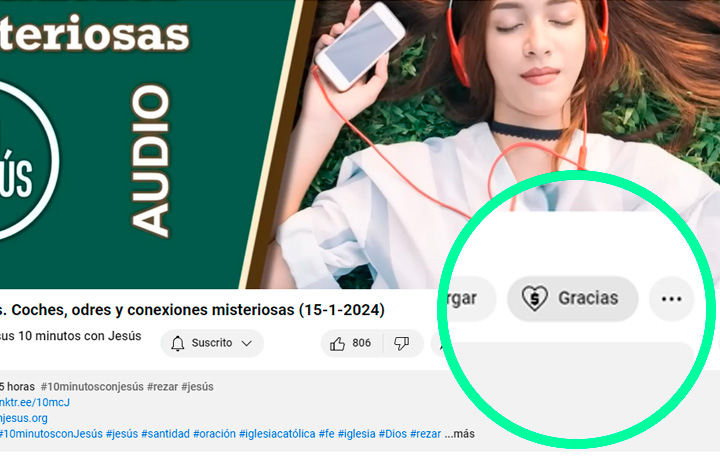
YouTube has recently activated the possibility of entering donations via a button called Super Thankswhich allows content creators to earn revenue and interact with users who want to show them greater appreciation for their content than the simple Like or I like it, which we all know.

In each 10-minute video with Jesus, a Thank You button will appear. Clicking on it opens the option to donate different amounts.

What is 10 minutes with Jesus?

This content, called 10 minutes with Jesus, are audios recorded by priests with the aim of helping to pray. The project was born in 2018, at the suggestion of Maria Feria, a mother and teacher. In view of the summer vacations, Maria suggested to the chaplain of her school to record short spiritual talks to share during those vacations with her children and young people around her.

At the mother's insistence, Father José María García de Castro, a priest incardinated in the Prelature of Opus Dei, agreed. He set up a first audio, using his own cell phone and a simple and accessible language. 

On that first occasion, Fr. José María thought of talking about everyday things and how to bring the Gospel closer to daily life. Specifically, he related the contents of a letter sent to him by a young man who had been collaborating with the nuns of Mother Teresa of Calcutta in a children's home in Nairobi, Kenya. 

In the letter, the young man told the priest, among other things, about one of the moments that marked him the most during his stay in Africa. Specifically, when a Sister of Charity asked him to take in his arms a baby who would not stop crying and invited him to give him affection.

The young man was paralyzed because the baby was so hot from the fever, but the nun's words gave him security. She began to coo to the little one, to caress him, to smile at him, to give him kisses. The child stopped whimpering and smiled. A few seconds later, he fell asleep. However, the university student noticed that the child was not breathing and called the Sister of Charity, who confirmed his death. 

"She knew that the child was dying and looking into my eyes she said to me: he has died in your arms and you have gone a few seconds ahead of the Love that God is going to give him for all eternity," the young man recounted in the letter that inspired Don José María to speak in that first audio of how each person in his day to day life can advance that Heaven, avoiding arguments at home, smiling at loved ones or being kind to others. 

Maria Feria's children connected with the message. The priest recorded a second audio and a third and then many more.

10 minutes with Jesus continued to grow

Don José María contacted other priest friends of his to join this exciting project. This is how the first WhatsApp group was created and people from all over the world began to join as listeners to this initiative. By the end of the summer of 2018, thousands of people were receiving these audios daily. The priests decided to continue recording 10 minutes until today.

Currently the 10 minutes with Jesus team is all over the world. They do not know each other, they are united by the Internet and the love for Jesus Christ.

Today, 10 minutes with Jesus has become a mass phenomenon. This is due to its ability to adapt to people's needs and lifestyles. It offers convenient access to spirituality and reflection in a busy world. It adds an immense variety of channels to cater to a very diverse audience. And it has become a valuable tool for those seeking to strengthen their spiritual life in the midst of everyday life.

"We priests speak very strangely and we don't want to fall into that; here we speak clearly and in order to be understood."

Javier Sánchez-Cervera, parish priest of San Sebastián de los Reyes.
You can listen to 10mcJ in several languages

The 10 minutes with Jesus has a YouTube channel, where you have the possibility to enjoy the content. The channel has more than 147,000 subscribers and offers you access to all the content. Here you can find the audios translated into English, Portuguese, French and German.

"In spite of all the sorrows, the world has 400,000 priests who adore the Lord and are dedicated to Him, serving all souls regardless of their creed. And what better way to help the formation of diocesan priests and seminarians, as well as religious men and women to be trained in the universities supported by the CARF Foundation?"

Javier Sánchez-Cervera, parish priest of San Sebastián de los Reyes.

Channels where you can receive or listen to the 10 Minutes with Jesus  

You can listen to 10 minutes with Jesus on a wide variety of platforms and apps. 10mcJ has a dedicated app that you can download to your Apple or Android device. In it, you can listen to the audios directly. With this tool 10 minutes with Jesus, brings to your device the content of more than 700 audios, updated daily and classified by themes, ages, priests and with links to more content related to the meditation of the day.

The APP works in the background, the audios can be listened to with the screen off or when opening other applications. In addition, it offers you different possibilities such as free access to the audio of each day and suggestions of other audios that can help you. It also allows you to search for meditations in the database. And it provides access to the Scripture quotations that accompany each meditation or any other relevant text. 

On the other hand, it has a section to take your own notes as a spiritual diary. And it allows you to download audios to your device to listen to them offline.

There are also other channels available so as not to miss the 10 minutes with Jesus. The choice of platform will depend on your personal preferences and the device you use.

"Currently the 10mcJ team is scattered around the world. We don't even know each other. We are united by the Internet and the love of Jesus Christ. Priests and lay people from the USA, Mexico, England, Spain, Colombia, Kenya, Philippines form the team that makes it possible for tens of thousands of people around the planet to spend 10 minutes a day in conversation with Jesus through WhatsApp audios, Spotify, Telegram, Instagram, YouTube, Ivoox, Apple podcast, Google Podcast in five languages." 

Javier Sánchez-Cervera, parish priest of San Sebastián de los Reyes.

Look for your moment, think that you are with Him and give the play.

It is important to note that the promoters of this initiative also offer direct contact with the priests. That is, anyone who wants to contact one of the priests of the 10 Minutes with Jesus team can do so by filling out a form on the website. 


4 questions on the origin of the Christian priesthood

Before going deeper, it is important to understand the central idea: the Christian priesthood does not arise as a structure created by the Church, but as a real participation in the unique priesthood of Christ. Everything that follows in this entry explains how this reality was expressed and consolidated from the Apostles to the first ministries.

The Christian priesthood is not born of a human institution, but of the one Priest: Christ, whose mission continues to live on in the early Church and its ministers.

How is it explained that Jesus never referred to himself as a priest?

is, above all, a mediator between God and mankind. Someone who makes God present among people, and at the same time, someone who brings before God the needs of all and intercedes for them. Jesus, who is God and true man, is the most authentic priest.

However, knowing the course that the Israelite priesthood had taken in his time, limited to the performance of ceremonies in which animals were sacrificed in the Temple, but with a heart more attentive than usual to political intrigues and the lust for personal power, it is not surprising that Jesus never presented himself as a priest.

His was not a priesthood like the one seen in the priests of the Temple of Jerusalem. Moreover, to his contemporaries it seemed evident that it was not, since according to the Law the priesthood was reserved to members of the tribe of Levi and Jesus was of the tribe of Judah.

His figure was much closer to that of the ancient prophets, who preached faithfulness to God (and in some cases like Elijah and Elisha performed miracles), or above all, to the figure of the itinerant teachers who went through cities and villages surrounded by a group of disciples whom they taught and whose instruction sessions they allowed to approach the people. In fact, the Gospels reflect that when people spoke to Jesus they addressed him as “Rabbi” or “Teacher”.

But did Jesus perform properly priestly tasks?

Of course. It is proper of the priest to bring God closer to people, and at the same time to offer sacrifices on behalf of men. Jesus' closeness to humanity in need of salvation and his intercession so that we could obtain God's mercy culminates in the sacrifice of the Cross.

Precisely there arises a new clash with the practice of the priesthood of that time. The crucifixion could not be considered by those men as a priestly offering, but quite the contrary. The essential of the sacrifice was not the suffering of the victim, nor his own death, but the performance of a rite in the established conditions, in the Temple of Jerusalem.

The death of Jesus was presented before their eyes in a very different way: as the execution of a man condemned to death, carried out outside the walls of Jerusalem, and that instead of attracting divine benevolence, it was considered - taking out of context a text from Deuteronomy (Deut 21:23) - that he was the object of a curse.

Did we start talking about priests already at the beginning of the Church?

In the moments that followed the Resurrection and Ascension of Jesus to heaven, after the coming of the Holy Spirit at Pentecost, the Apostles began to preach, and with the passage of time they began to associate collaborators to their task. But if Jesus Christ himself had never designated himself as a priest, it was logical that such a denomination would not even occur to his disciples to use it to speak of themselves in those first moments.

The functions they performed had little to do with those that the Jewish priests carried out in the Temple. That is why they used other names that more descriptively designated their functions in the first Christian communities: apóstolos which means "sent", epíscopos which means "inspector", presbýteros "elder" or diákonos "servant, helper", among others.

However, when reflecting and explaining the tasks of those "ministers" who are the Apostles or who themselves were instituting, it is perceived that these are truly priestly functions, although they have a different meaning from what had been characteristic of the Israelite priesthood.

Cuatro cuestiones sobre el sacerdocio cristiano
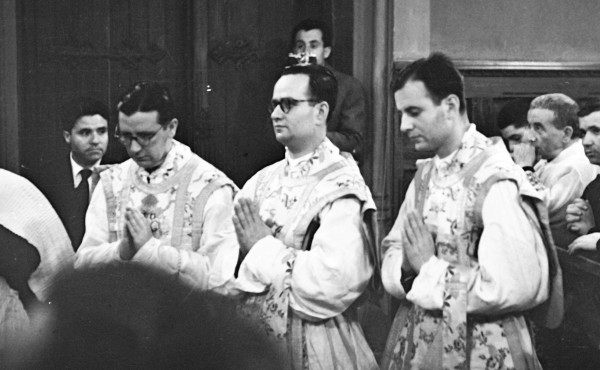
Ordination of the first priests of Opus DeiJosé María Hernández Garnica, Álvaro del Portillo and José Luis Múzquiz.

What is this new meaning of the Christian priesthood?

This "new meaning" can already be appreciated, for example, when St. Paul speaks of his own tasks in the service of the Church. In his letters, to describe his ministry he uses a vocabulary that is clearly priestly, but which does not refer to a priesthood with its own personality, but to a participation in the High Priesthood of Jesus Christ.

In this sense, St. Paul does not intend to resemble the priests of the Old Covenant, for his task does not consist in burning on the fire of the altar the corpse of an animal to remove it - "sanctifying" it in its ritual sense - from this world, but in "sanctifying" - in another sense, helping them to attain "perfection" by introducing them into God's realm - living men with the fire of the Holy Spirit, kindled in their hearts through the preaching of the Gospel.

In the same way, when writing to the Corinthians, St. Paul notes that he has forgiven sins not on their behalf, but in their name. in persona Christi (cf. 2 Cor 2:10). It is not a simple representation or a performance "in the place of" Jesus, since Christ himself is the one who acts with and through his ministers.

It can be affirmed, therefore, that in the early Church there are ministers whose ministry has a truly priestly character, who perform various tasks at the service of the Christian communities, but with a decisive common element: none of them are "priests" in their own right - and therefore do not enjoy the autonomy to perform a "priesthood" of their own accord, with their own personal stamp - but rather they are "priests" in their own right. participate in the priesthood of Christ.


Mr. Francisco Varo Pineda
Director of Research at the University of Navarra. Professor of Sacred Scripture, Faculty of Theology.


«The greatest danger is forgetting why and for whom we consecrated ourselves as priests.»

Father Miguel Romero Camarillo is a priest in love with the two countries that have marked his career: his native Mexico and Spain, the country that welcomed him so that he could complete his studies in Canon Law. In both, he has seen a faith which is falling apart, so he is dedicated to preventing this from happening by calling on believers to help revive the faith that has shaped our civilization.

He is currently parish priest of Santa María de la Asunción, in Tlancualpicán, in the Mexican state of Puebla. From there, he analyzes Catholicism in his homeland, one of the countries with the most Catholics in the world: «I think it has become a little cold; I believe that idolatry is catching up with us again. The cult of death, neo-Pentecostalism, the New Age, liturgical abuses, and even the ignorance of the clergy are gradually undermining the truths of the faith.» However, he also points out that there are many Catholics who «are committed to the Church and uphold the life of faith.» But as is so often the case, he adds, «the bad makes more noise.».

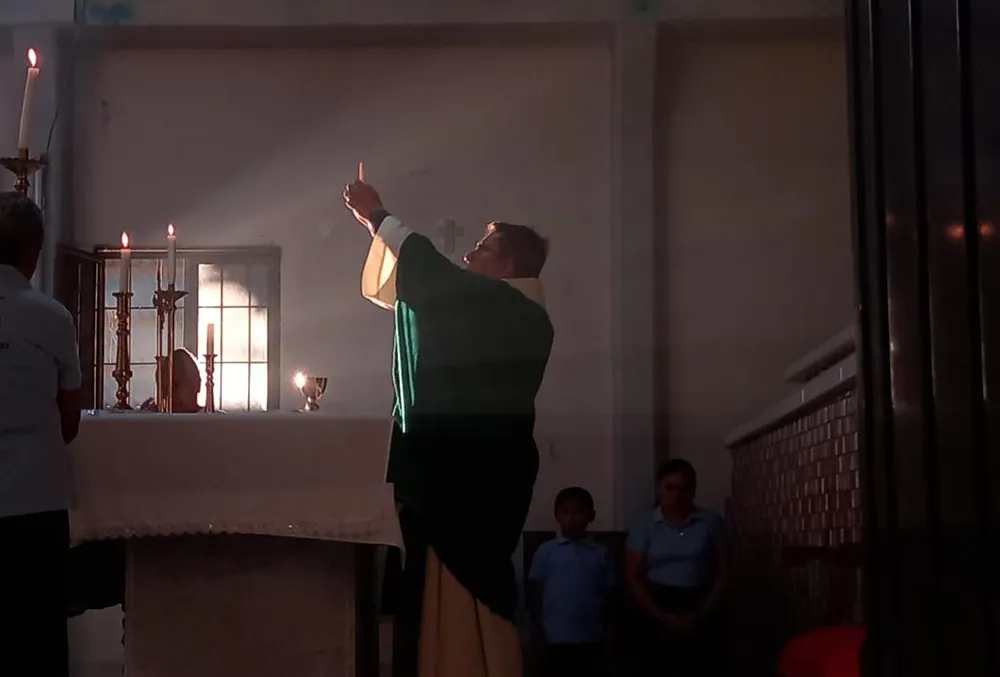
Miguel Romero celebrates Holy Mass in his parish.

Before becoming a priest, Miguel insists that he was a normal, ordinary person. He worked as an industrial chemical technician until, finally, after years of considering his vocation, he decided to take the step that God was calling him to take.

This vocation was cultivated within him from childhood, something that later proved fundamental when his family drifted away from the faith. «My paternal grandmother and my mother, in particular, played an important role. I remember things from my childhood, such as my mother reading me passages from San Francisco or we watched films about saints, or my grandmother told me about the writings of Saint Augustine,» he says.

Among those moments, he highlights something that happened to him when he was only six years old, which he remembers as if it were yesterday: «In preschool, they asked what the Holy Trinity was. And I, at six years old, answered correctly. The teacher's face was something to behold. I then had a strong desire to to be a priest".

A vocation before the Blessed Sacrament

However, shortly afterwards his family drifted away from the Church, although that seed had already been planted within him and would eventually sprout a few years later. It was at the age of 16 that Miguel decided to join a parish choir because «I felt that someone was calling me to be there.» He didn't know what he was really being called to do. It would take him five years to find out.

That desire, which I had since I was six years old to be a priest and then disappeared, reappearing with force at the age of 22. «During a Holy Hour, what had been stored away for 16 years was refreshed,» he says. Shortly afterwards, he entered the seminary, where he was ordained a priest in 2017. Just a few months later, his bishop sent him to Pamplona to study for a degree in Canon Law thanks to a grant from the CARF Foundation.

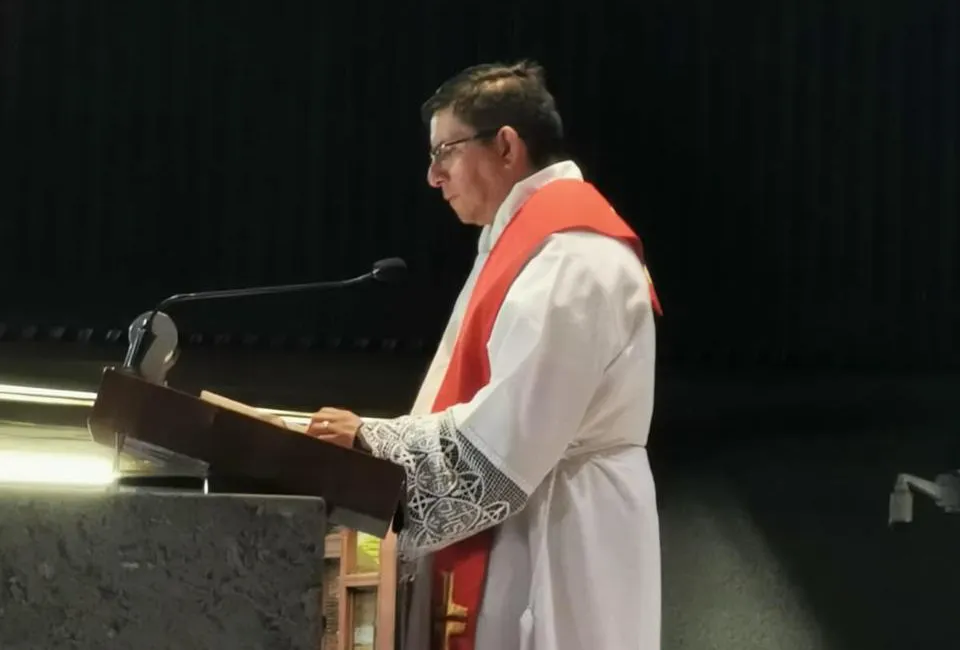
Miguel Romero during the Liturgy of the Word at Mass.

From his experience in the Bidasoa international seminar He says he has “fond memories” because, in addition to the education he received, it was a unique opportunity to do missionary work in Spain. «I helped many people and would like to do so again,» he says of his experience in Europe. In his opinion, «the world's faith is in danger and it seems that faith is disappearing, but I have not seen a place more bleak in this regard than my beloved Spain. There is a lack of love for the Cross.».

Even so, Father Miguel acknowledges that «there are many people fighting to prevent this from happening,» which is why he considers it urgent to «fight in our trenches and help our bishops to be men of faith, courage, and dedication.».

The connection between liturgy and law

With his love for liturgy and his acquired knowledge of Canonic Law, This priest wants to protect the great treasures of the Church. In his opinion, «faith is revitalized by proper liturgy, and liturgy guided by canon law is wonderful.» And that is where he believes the Church must strive to care for the liturgy with the rich rights acquired after so many centuries of Christianity.

When asked about the challenges facing priests today, Miguel Romero is clear: «The worst danger a priest can face is forgetting why and for whom he consecrated himself, or rather, to whom he entrusted his life.» He believes that «if we were aware of what we have done before God, the Church would reflect a different image.».

Finally, this Mexican clergyman thanks the CARF Foundation all the help they provide. «I appreciate their daily efforts to bring education to the most remote villages. Thank you for everything, and I hope one day to help them continue to spread the knowledge of the Church. Don't forget that this is God's work,» he concludes.


«The Pope's visit to Lebanon will bring hope»

The Father Christian Hallak, a Maronite priest from the diocese of Beirut who is studying at the Ecclesiastical Faculties of the University of Navarre Thanks to the partners, benefactors, and friends of the CARF Foundation, he is fully confident that Pope Leo XIV's visit to his country, after passing through Turkey, will fill his people with hope and optimism for the future. 

Message of hope and unity

His gaze conveys both nostalgia for returning to his homeland and the responsibility to continue on. forming to return one day to better serve his country. From Spain, he eagerly follows every news item about Pope Leo XIV's visit to Turkey and Lebanon from November 27 to December 2. «The Pope's visit will bring much hope.» he states with conviction.

In a bleak outlook for his country, the Pope's voice will be, according to him, a prophetic voice, which will remind the country of five essential things:

  1. The firmness of the hope even in the dark.
  2. The responsibility shared between Christians and Muslims to protect and sustain the homeland.
  3. The importance of applying justice and accountability to heal society.
  4. The need for the international community Do not abandon Lebanon.
  5. That Lebanon is more than a country, it is a message of coexistence, as Saint John Paul II said.

A wounded country awaiting a historic visit

In Lebanon, Pope Leo XIV's apostolic visit is seen as a historic event. For Father Christian, the arrival of the Pontiff amid regional wars, economic crisis, and a still-open social wound is a light shining through the darkness: «The Lebanese, both Christians and Muslims, see your visit as a message of hope, peace, and blessing at a time of great difficulty.».

He adds something that he considers essential: «nothing happens by chance, but by God's providence, which has allowed the situation to be as it is at this moment in Lebanon's history. 

The Catholic presence: a light that endures

Upon arrival, the Pope will be welcomed by the President Joseph Aoun, Catholic Maronite, which for Father Christian is proof of this community's historic participation in the country's political life. 

Despite the crisis, Catholics continue to be active and fruitful. In Lebanon, they coexist six Catholic communities: Maronites, Latinos, Greek Catholics, Syriac Catholics, Chaldeans, and Armenian Catholics. They all maintain schools, universities, hospitals, and social service programs that sustain the country even when everything seems to be falling apart.

«The Christian presence,» says Father Christian, "remains alive, deeply rooted, and committed to preserving its mission in society.".

But beyond politics, the people are hoping for a gesture of closeness and comfort. Pope Leo XIV's visit will not only be a formal event, but a spiritual embrace for a nation that has been on the brink of disaster for too long.

Enriching your educational mission 

Born and raised in the Maronite Church, Father Christian was ordained a priest on June 28, 2020, by Monsignor Boulous Abdel Sater. His career began at the Maronite Patriarchal Seminary in Ghazir, after completing his theological training at the Holy Spirit University of Kaslik. He then served in parishes, schools, and various pastoral settings, especially with children and young people, a field that remains his priority.

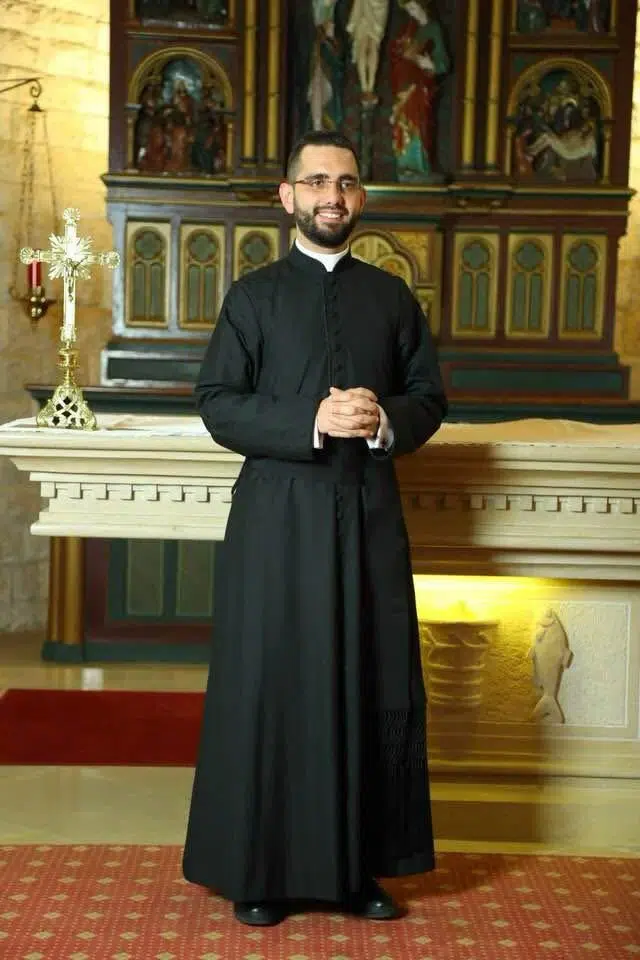
Padre don Christiana Hallak, sacerdote maronita en Libano. Fundación CARF. Visita Papa León XIV. Turquía viaje.
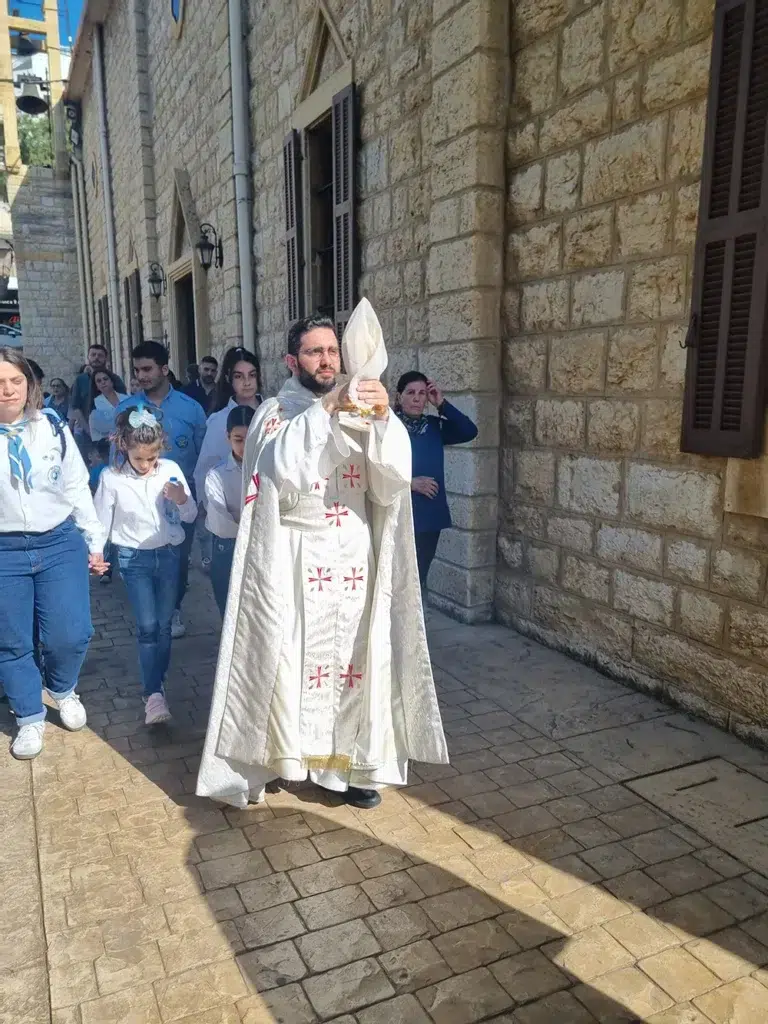
Don Christian presides over a Eucharistic procession.

He currently resides in Spain thanks to the support of the CARF Foundation, and is currently pursuing a Bachelor's degree in Fundamental Morality at the Ecclesiastical Faculties of the University of Navarra. He does so with the desire to return to Lebanon with a more solid preparation: «What I study,» he explains, "will enrich my educational and pastoral mission with young people and children.".

A Church of mountains, resilience, and faith

When he talks about his church, Father Christian does so with filial tenderness. He belongs to the Maronite Church, an Eastern Catholic Church in full communion with Rome, heir to the Syriac-Antiochian liturgy. 

His identity has been forged in the harshness of the Lebanese mountains, where his monks and faithful endured centuries of isolation, wars, and persecution. That history shaped a very distinctive spiritual temperament: ascetic, contemplative, and rooted in hope, a trait he insists on emphasizing.

«The Maronite Church," he explains, "is distinguished by its strong emphasis on Encarnacion, for his deep love for the saints, especially St. Maron and St. Charbel, and for a spirituality of steadfastness and perseverance.» Its liturgy, which combines Syriac and Arabic, is rich in symbols and aesthetics that reflect centuries of faith lived in extreme circumstances.

Don Christian recalls the figure of Saint Maron, spiritual founder of the Maronites, whose life in the mountains, sustained by prayer and austerity, became a model of resistance and fidelity. «Saint Maron endured the hardships of the climate and isolation. He remained steadfast in the faith, and that steadfastness nourishes our identity Maronite.

Padre Christiana Hallak, sacerdote maronita en Libano. Fundacaión CARF.

Monastery of Saint Maron, cradle of millions of pilgrimages

Among the most eagerly awaited stops on the trip, the Pope will visit a rural suburb of Beirut north of Jbeil, where the Monastery of Saint Maron stands in Annaya, the birthplace of millions of pilgrimages every year. 

Annaya is a landscape of green hills overlooking the coast, an environment that envelops visitors in an almost supernatural calm. Pope Leo will visit the Hermitage of Saint Charbel, a small sanctuary where the saint lived in austerity and where his incorrupt body now rests.

«Annaya,» describes Father Christian, "is a center of worldwide pilgrimage. Christians of all rites come here, but also Muslims who ask for her intercession with simple and sincere faith." In these mountains, religious diversity is not an obstacle, but a living testimony to a shared spirituality.

The miracles of Saint Charbel

Also, the Pope will descend to the The grotto where Saint Charbel is buried, the Christian monk proclaimed a saint by Paul VI, to whom more than 29,000 medically and spiritually documented miracles of healing are attributed, many of them with comparative reports before and after the healing.

«There is no saint in Lebanon whose devotion is as widespread as that of Saint Charbel Makhlouf. What is extraordinary about these events is not only their number, but also the fact that they are miracles performed on people of different religions. Many are inexplicable cures for cancer, neurological diseases, or paralysis. They are often accompanied by a profound spiritual renewal,» explains this Maronite priest. 

Father Christian insists that the real miracle is not only physical: «This is not simply a healing of the body. The greatest miracle is love and forgiveness.". With every miracle, we remember that God is with us.

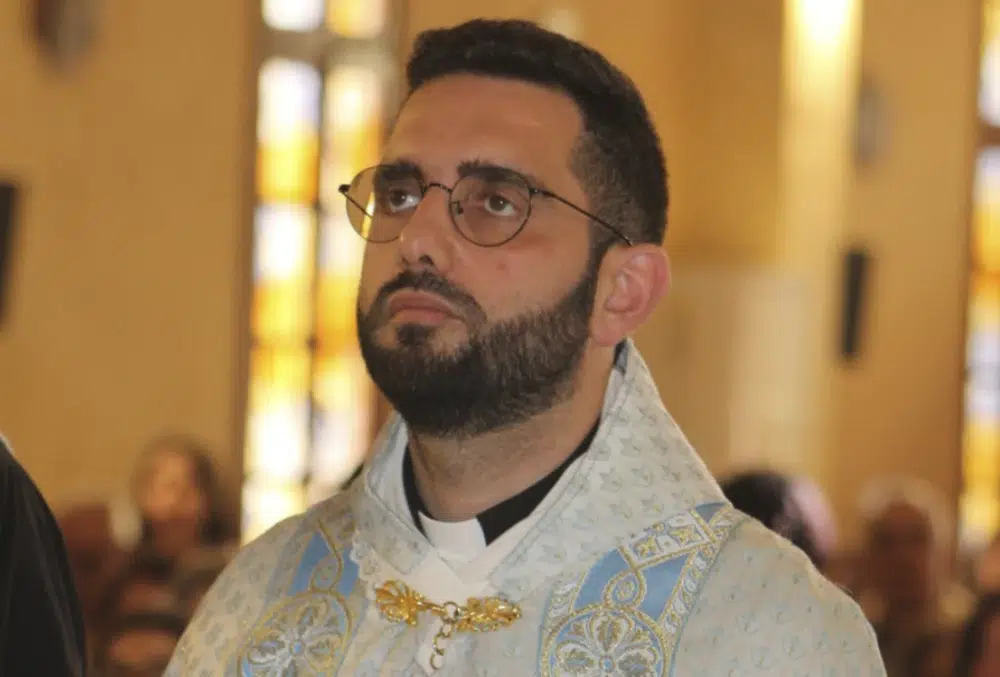
Padre don Christiana Hallak, sacerdote maronita en Libano. Fundación CARF. Visita Papa León XIV. Turquía viaje.

A wish for his people and a prayer for the Pope

At the end of the conversation, Father Christian opens his heart in a message that sums up what this visit means for him and for all Lebanese: «As a son of the Maronite Church, I trust that this visit will bring a new sense of comfort to our people. and I hope it will be a spiritual boost that reminds us that hope never disappoints. 

He appreciates the Pope's closeness at such a delicate time and offers a prayer for the protection of the saints of Lebanon: Saint Maron, Saint Charbel, Saint Rafqa, Saint Naamatallah, and so many others who have illuminated the Lebanese land, that they may continue to protect the Holy Father in his mission and accompany every step of his future visit. 

«May her intercession also protect our country, strengthen its people, and keep hope alive amid the challenges we face. With the grace of God and with the protection of our saints, we trust that a new era of peace, unity, and renewal will come to all of Lebanon. 

In Don Christian's words, it is clear that this hope is not a theoretical idea or a vague desire: it is a certainty that emerges from the faith of his people, a faith that lives on in the mountains, in the monasteries, in the streets of Beirut, and in every Lebanese person who longs for comfort.


Marta Santínjournalist specializing in religion.


Questions and answers

When is the Holy Father going to Turkey?

On Thursday, November 27, 2025, he will arrive in the capital Ankara in the morning. 

And when will it arrive in Lebanon?

He will arrive in Lebanon on November 30 and return to Rome on December 2, after a previous visit to Turkey between November 27 and 30.

What are the reasons for the trip?

The purpose of the trip will be to promote dialogue and unity among all Christians, and to foster interfaith dialogue in a complex part of the world with a rich history and marked by current tensions.

Marcus Vinicius, from biologist to priest

Young Marcus is in love with everything related to life, which is evident in his own evolution, where he went from working as a biologist to entering seminary and to be ordained priest. Living beings, all created by God, continue to fascinate him, but it is now man, God's masterpiece, who is the focus of his attention and whom he now helps to get to know his Creator.

He belongs to the clergy of the Brazilian diocese of Nova Friburgo, in Rio de Janeiro. Marcus currently has a fundamental mission as a formator in the diocesan seminary, specifically in the propaedeutic course, a key stage for young men who are discerning and evaluating their vocation to the priestly life.

Marcus Vinicius Muros ordenado sacerdote oración y formación
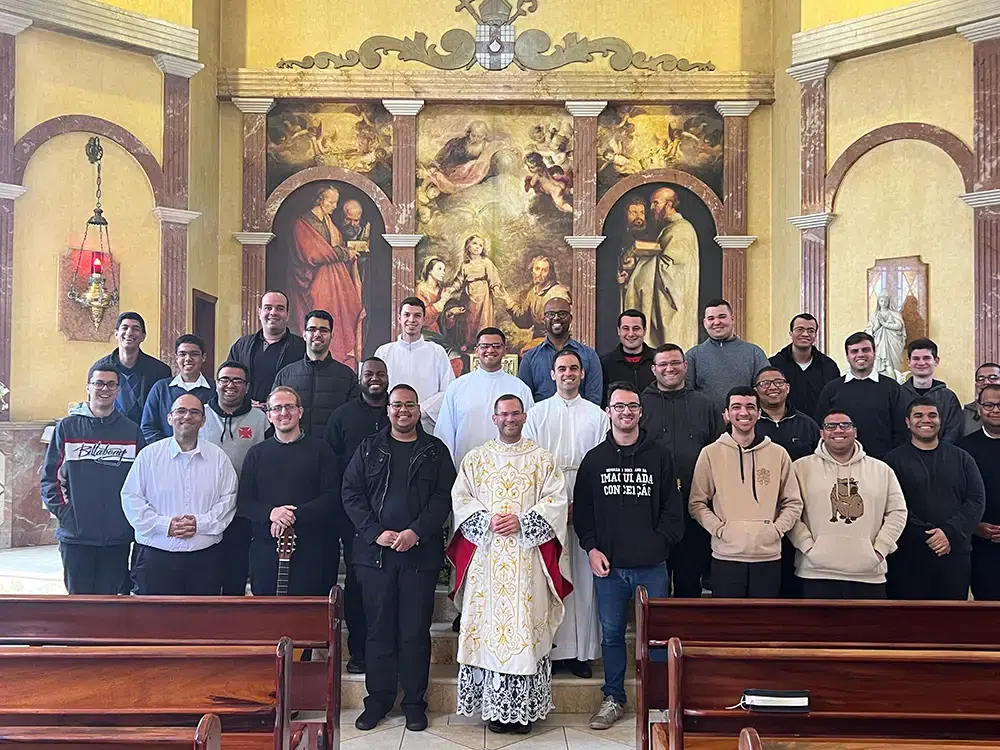
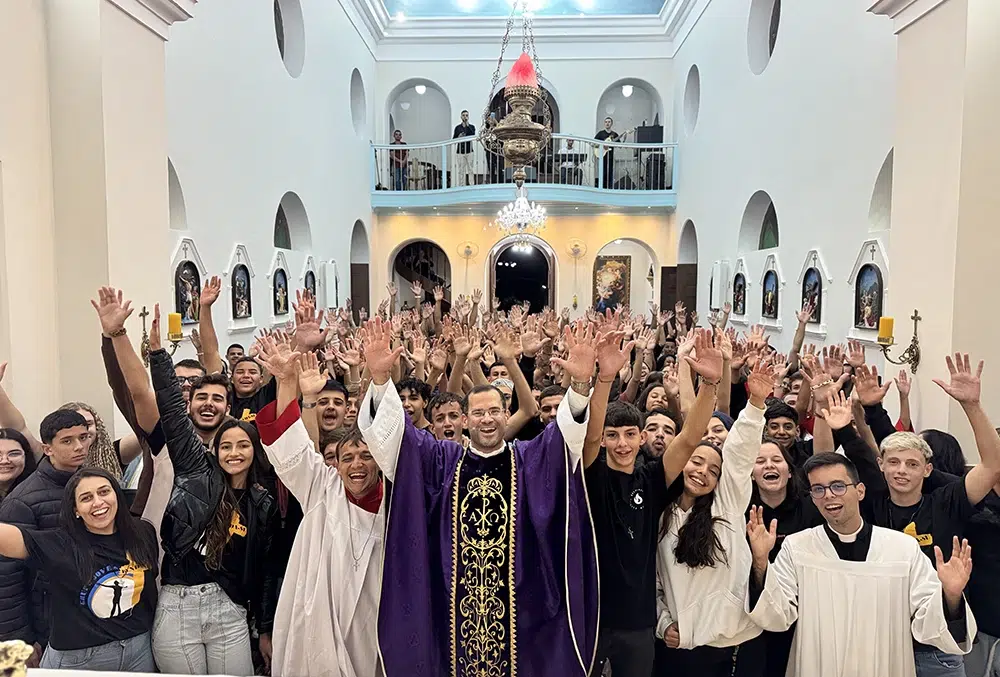
Marcus Vinicius Muros surrounded by his fellow seminar participants.

Family, the key to being ordained a priest

In this interview with CARF FoundationThe young priest, ordained in 2021, recalls that he comes from a Catholic family that actively participated in the pastoral activities of his parish. "My parents have been teachers of faith for my brother and me. Already as a child I played at celebrating Mass. I lived with many priests who went to my parents' house, but I never thought of being one of them," he says.

However, everything changed when he had the opportunity to get to know the seminary of his diocese, after the delegates of the vocation ministry visited his parish one day. Marcus admits that this was the first moment when he considered becoming a priest, although there was a big obstacle: "I was already working; I had my job and my financial independence".

Marcus Vinicius Muros ordenado sacerdote oración y formación
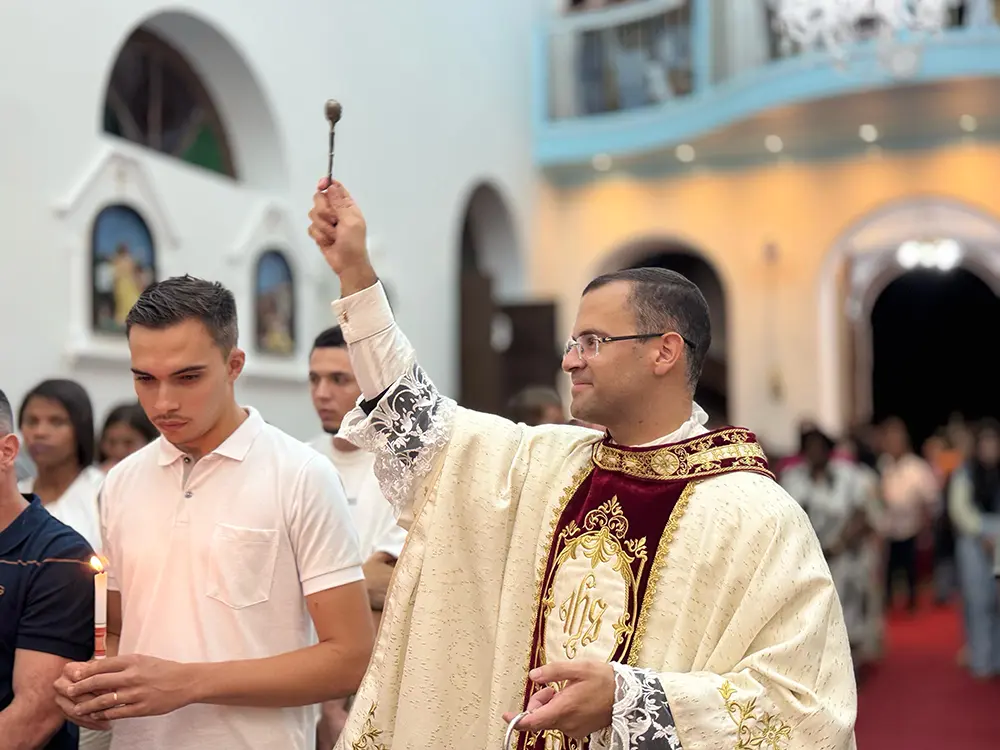
Marcus Muros imparts the blessing in the church by sprinkling holy water.

"But although I had everything," adds this priest, "none of what I had was enough for me. I was missing something important, something that would make my life meaningful and worth living. The parable of the rich young man challenged me a lot," says Marcus. And so it was that finally in 2014 that inner struggle came to an end and he entered the seminary to begin his formation.

Good training for today

Barely a year later, another moment would come that would mark his life. His bishop sent him to Spain to continue his formation and philosophical and theological studies. About this experience he says that "I will never forget the years of formation and prayer in Pamplona. They were much more than an academic preparation for the exercise of the priestly ministry, it was an experience of the universality of the Church".

He defines this time as some "unforgettable years" marked by his stay at the University of Navarra and the Bidasoa international seminarwhere he had the grace of having "a singular opportunity to obtain an excellent human, spiritual, intellectual and pastoral preparation".

If there is one thing that Marcus has taken away from these years, it is that his training in Navarra has been "a good preparation for what God is entrusting to me today".

Marcus is currently a parish administrator and seminary formator. "When I was appointed by the bishop, while I was still a deacon, as formator of the Propaedeutic, the beginning stage in the seminary, all I wanted was to to offer to those who are now preparing for the ministerial priesthood the same as I received in Pamplona," he confesses.

Marcus Muros celebrating with the faithful the joy of being children of God.

To be a good priest: a lot of prayer life

As he tells us, "in Bidasoa we learn that love for God and the Church impels us to give the best of ourselves. Today, between the parish and the seminary, I try to give the best of myself, to spend myself for the souls the Lord entrusts to me.

The world needs priests who give themselves to God in a world that is often hostile to the Christian faith. For this reason, Father Muros is convinced that "the priest needs a soul in love with the Lord and available to faithfully serve all people. These are not easy times, but all the difficulties help us to trust in Christ and in his power. We are in his hands as insufficient instruments, but which the Lord desires for the realization of his work".

But in addition to a soul in love, he considers it indispensable "to have a profound life of prayer. Whoever does not understand that to be a man of God requires a great deal of prayer life is not capable of sacrifice. And it is intimacy with Christ that makes us understand that we are not only celebrants, but also victims who every day offer themselves out of love for the Beloved".

Thank you for your training assistance

Finally, Marcus would like to extend a special thank you to the benefactors of the CARF Foundation. "I was always struck by their generosity in donating without expecting the benefit to go to their diocese or country, but to the universal Church.

Thank you for providing us with the means to help our dioceses and the Church. Thank you for your open hearts. May the Lord grant you and your families many blessings," he concludes.