What do we celebrate on All Saints' Day?

On November 1, Christians celebrate All Saints' Day. On this day the Church remembers all those deceased who, having overcome purgatory, have been totally sanctified and enjoy eternal life in the presence of God.

All Saints' Day, a Christian Solemnity

On All Saints' Day, November 1, we look to the sky. It is the day on which all the saints are honored.to those who are on the altars and to so many Christians. To those who are on the altars and to so many Christians who, after a life according to the Gospel, share in the eternal happiness of heaven. They are our intercessors and our models of Christian life.

"Holiness is the most beautiful face of the Church." writes Pope Francis in "Gaudete et exsultate", his apostolic exhortation on the call to holiness in today's world (March 2018).

The Pope reminds us that this call is addressed to each one of us. The Lord also addresses you: "Be holy, for I am holy" (Lv 11:45; cf. 1P 1,16). 

On November 1, we remember each one of those who said yes to this call. This is why All Saints' Day is not only celebrated in honor of the blessed or saints who are on the list of those canonized and for whom the Church celebrates on a special day of the year. honor all those who are not canonized, but are already living in the presence of God.. These souls are already considered saints because they are under the presence of God.
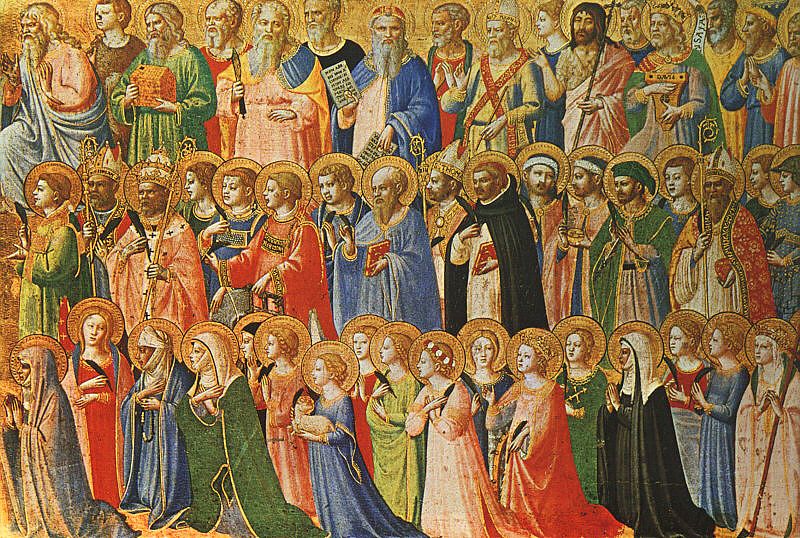
Día de todos los santos
All Saints, painted by Fra Angelico. Italian painter who knew how to combine the life of a Dominican friar with that of a painter. He was beatified by John Paul II in 1982.

History of All Saints' Day

This celebration had its origins in the IV century due to the great number of martyrs of the church. Later on May 13, 610, Pope Boniface IV dedicated the Roman Pantheon to the Christian cult. This is how they began to be celebrated on this date. Later Pope Gregory IV, in the 7th century, moved the feast to November 1st.

Several thousand saints have been officially canonized by the Catholic Church. But there is an immense number of non-canonized saints, who are already enjoying God in heaven. To these, the non-canonized saints, this feast is especially dedicated. The church seeks to recognize the work of the "unknown saints" who risked their lives for justice and freedom anonymously.
Difference between All Saints' Day and All Souls' Day

Pope Francis explained in a very clear way the difference between All Saints' Day and All Souls' Day:

"On November 1 we celebrate the Solemnity of All Saints. On November 2, the Commemoration of the Faithful Departed. These two celebrations are closely linked to each other, how joy and tears find in Jesus Christ a synthesis that is the foundation of our faith and hope.

. Indeed, on the one hand, the Church, a pilgrim in history, rejoices through the intercession of the saints and blessed who support her in the mission of proclaiming the Gospel; on the other hand, she, like Jesus, shares the weeping of those who suffer the separation from their loved ones, and like Him and thanks to Him, she makes her thanksgiving resound to the Father who has freed us from the dominion of sin and death".

"There are many wonderfully holy Christians, there are many wonderfully, delightfully holy mothers of families; there are many wonderful fathers of families. They will occupy in heaven places of wonder." St. Josemaría Escrivá.

All Saints' Day

On November 1, the Catholic Church celebrates the Solemnity of All Saints. A feast instituted in honor of each and every saint, known or unknown, for their great work in spreading God's message. Many people attend a special Mass in their honor today.

On this feast day of All Saints, the Church asks us to look to heaven, which is our future homeland. We remember all those who are already in the presence of God and who are not remembered as canonized saints. There are millions who have already reached the presence of God. Most certainly a majority of them did not arrive in a direct way, perhaps they went through purgatory, but in the end they managed to be in the presence of God.

As a commentary on the Solemnity of All Saints. "Rejoice and be glad, for your reward will be great in heaven." We were born never to die again, we were born to enjoy God's happiness! The Lord encourages us and wants us to take the path of the Beatitudes to be happy.

All Souls Day

November 2 is All Souls Day. Although it seems to be the same, it is far from it. First of all, we must keep in mind that the celebration of the dead is a cultural tradition where people remember those who have already died, and altars are dedicated where photos, flowers and the food that the person remembered liked so much in life are placed. According to historians, this tradition is mainly found in Mexico 1,800 years before Christ.

On this day the Church invites us to pray for all those who have already died but who may not have reached eternal joy. Perhaps they are in purgatory and need our prayers, so we must remember them in the Holy Mass for the dead and pray at all times for their eternal rest.

You can be a saint

All the baptized are called to follow Jesus Christ, to live and make known the Gospel. 

The purpose of Opus Dei is to contribute to the evangelizing mission of the Catholic Church by promoting a life consistent with the faith in the ordinary circumstances of life, especially through the sanctification of work, among the Christian faithful of all walks of life.


Links of interest:


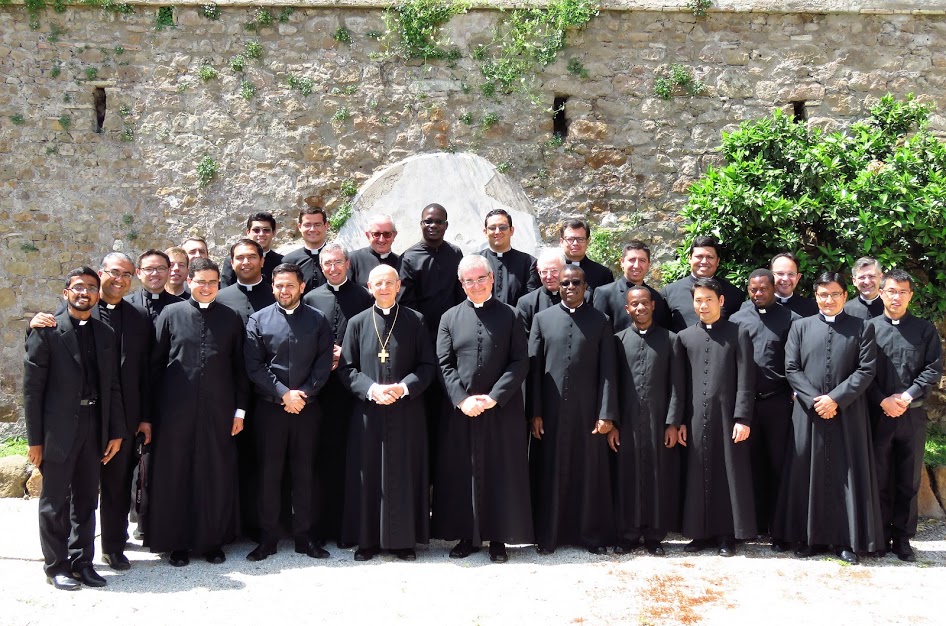
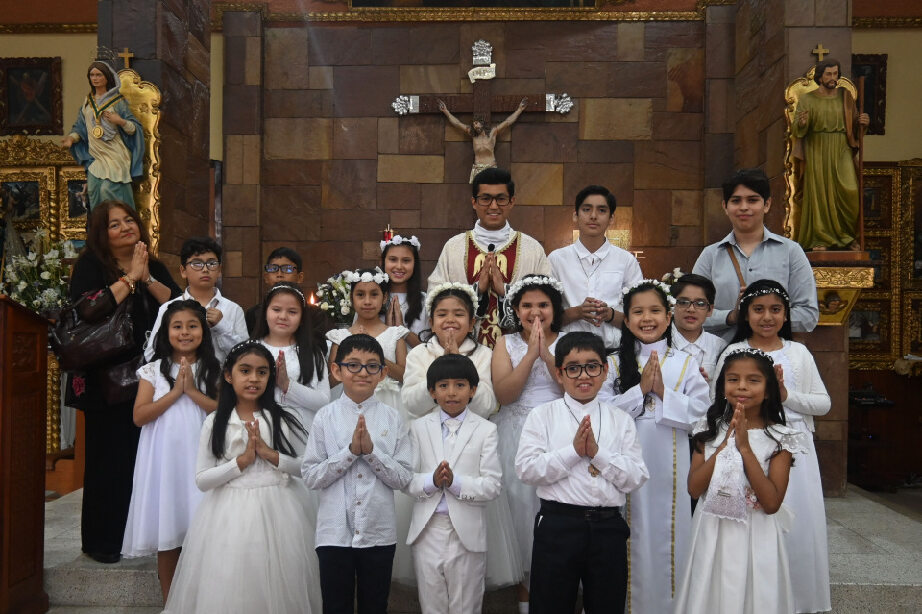
Jesús Eduardo, seminarian: "we priests of the 21st century should not be afraid of tribulations".

"In my adolescence and early youth, many people invited me to participate in a youth or worship group, and my answer was always the same: thank you very much, but no. At that time in my life, I did not see all the good that God offered me. At that time in my life I didn't see all the good that God was offering me".

The new evangelization in Mexico

Now 33 years old, he is a seminarian in the diocese of Tabasco (Mexico), studying at the University of Navarra and residing and training in the Bidasoa International Seminar (Pamplona). He is aware that a good formation is necessary to be able to evangelize in a post-modern society of the 21st century, especially in Mexico, a country with strong Catholic roots where Protestantism is also gaining ground.

"One of the main evangelization needs, not only in my diocese but in the whole country, is how to evangelize in the face of the multiple Protestant groups that are growing." 

According to his experience, it is necessary to begin with the families, catechizing and making known the beauty of the Word of God. "To achieve this, parishes must foster more of a missionary spirit in their own communities (which is something that is done) but it must be promoted much more, and thus, together with the participation of the whole community, bring God closer to those who do not yet know him or who have even moved away."

celebración por los 500 años de evangelización en México. seminarista y sacerdotes

Catholic families, the cradle of vocations

Faced with the proliferation of Protestant or anti-clerical groups, this seminarian is convinced of the power of every Catholic being a witness to the Catholic faith, and as he suggests, starting with families.

"Families are the domestic churches where the cultivation of faith begins, as well as those values, virtues, teachings and customs that will gradually mold the character and personality of each of its members."

Jesus is convinced that if the Catholic faith is lived in every family, its witness will give an answer to those anti-clerical groups that seek to attack the Church. "This is not a war between the Catholic faith and Protestant sects, but as Catholics we have a great responsibility, and illuminated by the light of faith, we must acquire the best preparation to face the new challenges of this era."

The example of his family

This seminarian, who wants to become a priest, transmits his own experience of what he learned in his family. He is the youngest of three brothers and has grown up with the support of his family, a fundamental factor in becoming the person he is today, always hand in hand with God in every project of his life.

"The good moments of my childhood are full of the union between brothers, playing, having fun, protecting each other. Something good about my childhood is that since I was little I have been a constant person in my studies, which my parents always instilled in me, something that has characterized me all my life."

A turning point: the seminar

He also recalls that adolescence was one of the best stages of his life because he began to grow and mature in his personality. "The good thing about my adolescence is that I was defining my way of being, I knew how to distinguish good from bad and above all the confidence that my parents had in me and my siblings. I thank my parents who always gave me an education based on values, creating in my brothers and me, the sense of responsibility, dedication and effort in all our activities," says this seminarian.

His parents supported him in the most important moment of his life: entering the seminary at the age of thirty, after a professional career and a stable job, always trusting in God's will, "calling me to go beyond my abilities to give back to God, in a generous way, all that He had given me throughout my life".

BIDASOA. JESUS EDUARDO FLORES seminarista

Evangelizing Mexican youth

The dream of this seminarian is to evangelize the youth of Mexico. "There is something that calls my attention and that is that the youth in Mexico, despite the changes that have occurred in recent years, is a youth that has a voice and makes itself heard, it is a youth where it is clearly seen that when there is union and all connect towards the same interest they achieve the goals they set, it is a youth where there is much hope especially in these times of modernity".

In his opinion, what is needed to bring young people closer to the Catholic faith is to give them and allow them to participate more in parishesIt is of great importance to make them feel part of the church, integrating them in the activities to generate in them attitudes of love and responsibility not only to the service they are rendering, but also to God.

"However, families are fundamental to achieve this, since it is there that love for God is fostered, as well as love for the Church," Jesus insists.

The seminarian of the 21st century

What must the seminarian and priest of the 21st century be like for Jesús Eduardo? "In my opinion he must have a great love and dedication to what God has called him to; have a sense of commitment and responsibility wherever he is; have a solidity in all his areas of formation, which will allow him to face the challenges that our Church has and will have in the future." 

In addition, he considers it necessary that the current seminarians and priests maintain a constant ongoing formation in order to be able to respond to the needs and concerns of the people of God, since we are facing future generations that are preparing themselves very well.

Losing fear and trusting in God

"A seminarian in the 21st century must not extinguish the flame of his vocation in the face of what the world has to offer, which could divert him from what he was called to do. He must always keep in mind the reason why he decided to follow God and not to be afraid of the tribulations they may experience".

Jesús Eduardo Flores concludes: "answering God's call is and will be one of the most enriching experiences that will mark the life of a seminarian, who will never forget all his efforts throughout his formation and will be reflected in his service to the Church and to all God's people as a priest". 

In closing, Jesus is very grateful to all the benefactors of the CARF Foundation who make his studies in Pamplona possible. "Thank you to the benefactors for their generosity and for their prayers, because by helping seminarians like me, they help many Christian communities around the world. I keep you in my prayers.


Marta Santín, journalist specializing in religion.

Halloween! Witches? Something much better

On All Saints' Day we rejoice and treat those who have died in God's grace and are already in heaven. On All Souls' Day we pray for those who are still in purgatory, so that, purified as soon as possible, they may enjoy heavenly glory. And on Halloween we do not celebrate anything.

Halloween, celebrations to reflect on

Both celebrations invite us to think about the mystery of death that Jesus himself wanted to take on so that we could overcome it.

It should also make us reflect on the final destiny of our lives: achieve the ultimate happiness for which you have made us (heaven)the real failure of hell, or the 'repechage' of the purgatory once properly purified. There is no room for witches or consumerist celebrations such as Halloween, imported from the United States. We celebrate life, not death.

dia-de-todos-los-santos-halloween-difuntos

The Communion of Saints

And, at the heart of this celebration, there is the faith in the communion of saints which we confess at the end of the Creed.

"Since all believers form one body, the good of one is communicated to the others.... It is therefore necessary to believe that there is a communion of goods in the Church.. But the most important member is Christsince He is the head....

Thus, the good of Christ is communicated to all the members, and this communication is made through the sacraments of the Church" (St. Thomassymb. 10) (Catechism, 947).

We are never alone, Jesus Christ and all our brothers and sisters in faith accompany and support us.

In the early Jerusalem community, the disciples persevered in the apostles' teaching, communionthe breaking of bread and the prayers (Acts 2:42).

Communion in the faith: The faith of the faithful is the faith of the Church received from the Apostles, a treasure of life that is enriched when it is shared (Catechism, 949).

The multitude of those who believed were of one heart and soul, and no one considered what he possessed as his own, but they shared all things (Acts 4:32).

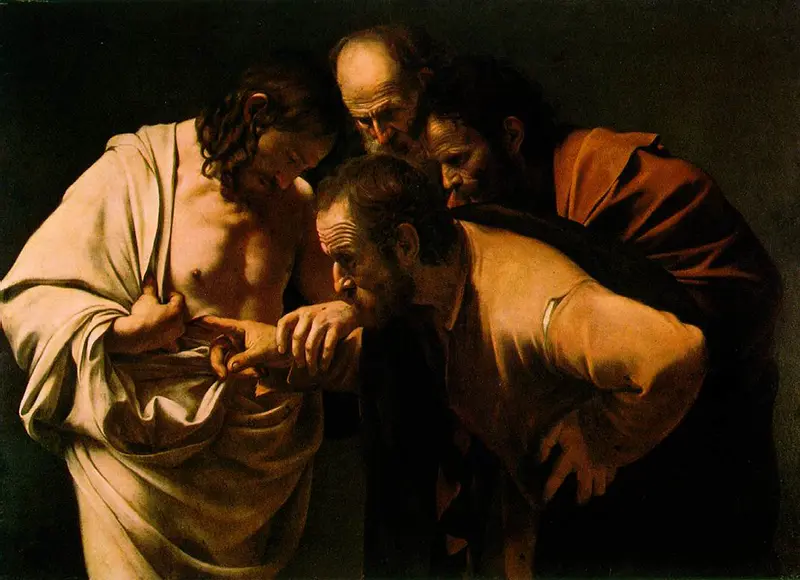
Pintura de Caravaggio que representa a Santo Tomás metiendo su dedo en la herida de Cristo, rodeado por otros apóstoles.
The Unbelief of St. Thomas" (c. 1601-1602) by Caravaggio, a masterpiece that captures the biblical moment of doubt.

Charity in the mystical body of Christ

Communion of charityIn the "communion of saints". none of us lives to himself, any more than any of us dies to himself. (Rm 14:7).

If one member suffers, all the others suffer with him. If one member is honored, all the others share in his joy. Now ye are the body of Christ, and the members thereof every man severally (1 Cor. 12:26-27).

The least of our acts done in charity has repercussions for the benefit of all, in this solidarity among all men, living or dead, which is founded on the communion of saints.

"There is a communion of life among us who believe in Christ and have been incorporated into Him through the Baptism. The relationship between Jesus and the Father is the model of this fire of love.

And the "communion of saints" is one big family. All of us are family, a family where we all try to help and support each other". Catechesis of Pope Francis.

Intercession of the saints

Let us also count on the intercession of the saints. "Because those in heaven are more intimately united with Christ, they consolidate the whole Church more firmly in holiness... they do not cease to intercede for us before the Father.

They present, through the one Mediator between God and man, Christ Jesus, the merits they have acquired on earth... Their fraternal solicitude is thus of great help to our weakness" (Vatican II, Lumen gentium 49).

Some saints, near the time of their death, were aware of the great good they could continue to do from Heaven: "Do not weep, I will be more useful to you after my death and I will help you more effectively than during my life" (St. Dominic of Guzman, dying, to his brothers, cf. Jordan of Saxony, lib 43).

"I will spend my heaven doing good on earth" (St. Teresa of the Child Jesus, verba) (cf. Catechism 956).

Let us especially invoke Mary, Mother of the Lord and mirror of all holiness. May she, the all holy one, make us faithful disciples of her son Jesus Christ, and may she take the deceased who are in purgatory to Heaven as soon as possible. Amen.

Where is there room for a celebration of death and not of life, of witches? No doubt in our lives, Halloween, or whatever you want to call it in every latitude, makes little sense. We are of saints and of praying for our deceased.


Mr. Francisco Varo Pineda
Director of Research at the University of Navarra.
Faculty of Theology. Professor of Sacred Scripture.


Don Gustavo Zamudio, parish priest in Lima, reached his adult faith thanks to his studies in Rome.

Gustavo Zamudio belongs to the new batch of young Peruvian priests who are taking on important responsibilities in their dioceses. At only 32 years of age, he is already the pastor of the Immaculate Conception parish, in the city of LimaFrom there, he works tirelessly to bring the Gospel to all corners of a society in which a rapid secularization is also taking place.

His story - as he himself tells the CARF Foundation - was very similar to that of many other children in the district of La Victoria, a populous neighborhood of Lima. But one day God touched his heart deeply and when he was only 17 years old he entered the Santo Toribio de Lima seminary. "I dedicated myself to studying, but, above all, I spent a lot of time playing soccer with my friends," he says of his childhood.

His family was Catholic and with great devotion to the Lord of Miracles.I wanted to carry him on my shoulders since I was a child, but I didn't go to church regularly. In spite of everything, he adds, "I never questioned the existence of God, although later I had to learn more about the implications of believing in Jesus Christ.

GUSTAVO ZAMUDIO, PÁRROCO EN LIMA

The group of young acolytes

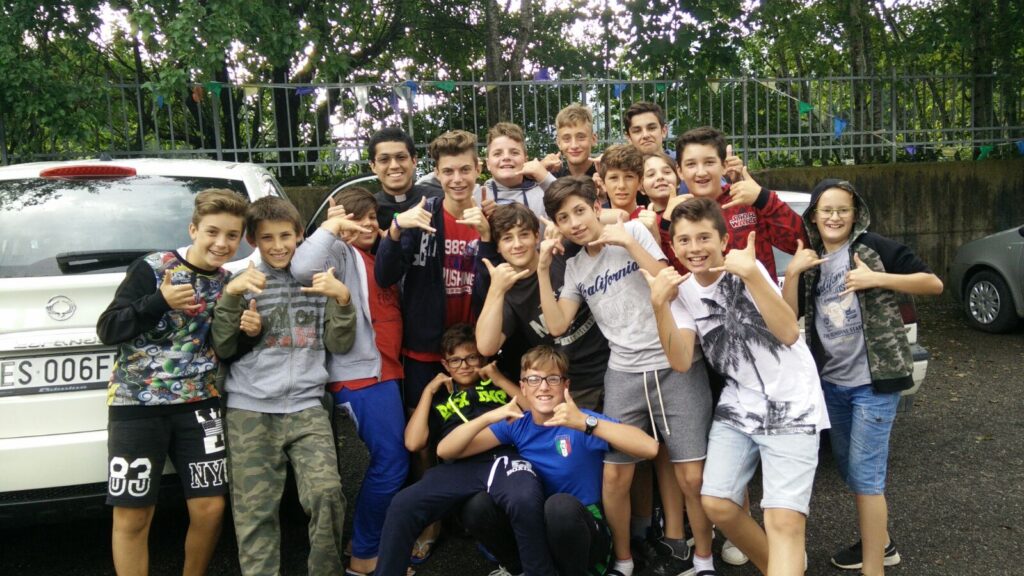
It was precisely in his adolescence, when he was only 13 years old, that he began his vocational process. "A nun of the Daughters of St. Mary of the Heart of Jesus, who was my Religion teacher in high school, he invited me to join a group of boys who met at the parish on Saturday mornings. What I remember most is that he told me there was breakfast and soccer. I didn't need to know any more...", he recalls with a laugh.

He attended that meeting for the first time and discovered that it was a group of acolytes. Although this was new to him, he decided to join the group. Gustavo Zamudio assures that it was a propitious occasion to "meet for the first time personally a diocesan priest, Father Henry, whose testimony of priestly life was very important in my discernment process".

Another factor that stands out in this process was the prayer of the parish community for vocations to the priesthood. "He felt that my calling was, in a way, an answer from God to his prayers." This context in which he began to live his faith was a fundamental help for Gustavo Zamudio, because he points out that the first thing he learned was "to take my Christian life seriously, taking care of my life of piety".

GUSTAVO ZAMUDIO, PÁRROCO EN LIMA

In this way, the now priest assures us that only in this way did he discover that "without Christ life was not life. This was quite a radical step, since, due to the social atmosphere he had breathed since he was a child, it meant a real change in the ideals of life.

Little by little, and in a natural and gradual way, he affirms that he became aware "of an inner strength that urged me to follow the path of priestly life". Gustavo spoke to his parents and told them of his desire to become a priest. Although his family had other plans for him, he did not oppose and when he finished high school he was able to enter the seminary.

The dream of Rome

Just after his ordination to the priesthood and thanks to a help The CARF Foundation's support enabled him to study for a degree in Philosophy at the Pontifical University of the Holy Cross in Rome. "Given my family's economic condition, I never imagined traveling to the eternal city. For someone like me who had only been out of Peru for a few days before, it was a truly international experience," he adds.

Although geographically he was in Italy, Fr. Gustavo Zamudio affirms that "existentially" he felt a little bit in the whole world thanks to the catholicity of the Church. He adds: "It seems to me that there is no more immersive experience of the universality of the Church, of that blessed unity in plurality - also at the intellectual level - than studying in a pontifical university and in Rome".

Another aspect that What struck him during his time in Rome was "the vitality of the Catholic intellectual world", For, according to his own experience, it was a "living and dynamic intellectual tradition, embodied in the professors, mostly priests, and in the university classrooms".

GUSTAVO ZAMUDIO, PÁRROCO EN LIMA

A help to evangelize

If there is one thing that is clear to this priest, it is that all the formation he received during his time at the Pontifical University of the Holy Cross is now of great help to him in his daily pastoral work. And about his studies of Philosophy at Rome assures: "It is helping me personally to reach an authentic adult faith that does not get carried away by the winds of fashion, of what is soon to pass".

Gustavo adds that "my philosophical studies in Rome are helping me to dialogue with the contemporary world, trying to make my own the legitimate concerns of the people of my time and seeking to offer the reasons for my hope to those who ask for them".

On a more pastoral level, the parish priest considers that this background has taught him to "know how to listen and analyze divergent ideas with respect and a critical spirit". In fact, he recognizes that both in In both the parish and the university where he teaches, young people openly ask him questions and raise objections about the faith.

"I think there is still much to be done in this first line of evangelization, with a proactive style that favors the truth to impose itself by its own force," admits this young priest.

GUSTAVO ZAMUDIO, PÁRROCO EN LIMA
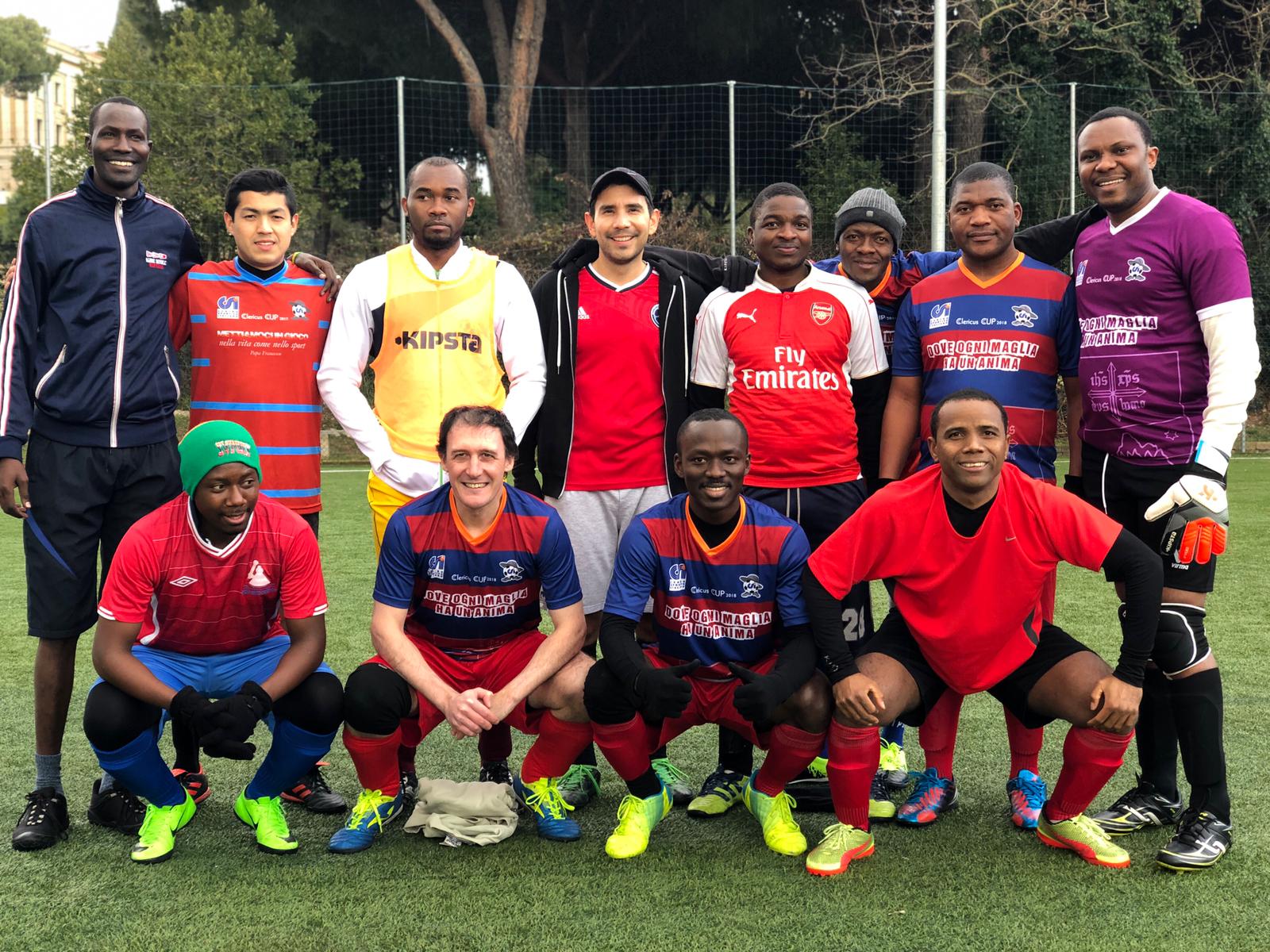
Priests' residence soccer team Altomonte.

In fact, for his teaching work at Unife, a private university in Lima, he says he has discovered during his time at Rome the witness of three saints who illuminate his ministry as a parish priest and who are fundamental to his priestly mission: St. Thomas Aquinas, St. Josemaría Escrivá and St. Philip Neri.

Gustavo Zamudio already faces many responsibilities both as a parish priest and as a teacher, but no less are the challenges he faces as a young priest. For this reason, he believes that it is fundamental "to have a solid interior life so as not to cease to be men of God".

To this he adds the need for a "coherent theological and cultural formation to make the Word of God meaningful today. And finally, the pastor also stresses the importance of "priestly fraternity and friendship in view of a healthy management of one's affectivity".

GUSTAVO ZAMUDIO, PÁRROCO EN LIMA

Finally, Father Gustavo Zamudio would like to thank the work of the CARF Foundation and all its benefactors, thanks to whom he and many other acquaintances of his in Rome were able to further their studies.

"Do not stop betting on the good formation of priests. The Church needs pastors after the heart of Christ: pastors with a wise heart capable of offering spiritual and doctrinal guidance to their brothers and sisters. I entrust them in every Eucharist so that they may always feel co-responsible for the formation of those called to the priesthood and rediscover again and again the joy of giving," he concludes.

St. Paul VI and St. Josemaría Escrivá

We cannot forget that our Faculty was erected as such in 1969, during his Pontificate. This recognition of the task begun a few years earlier with the encouragement of St. Josemaría Escrivá is part of the theological impulse that St. Paul VI wanted to give to the Church in the years following the conclusion of the Second Vatican Council.

In October 1999, I had the opportunity to prepare some words of welcome to the participants in a Study Days on "...".Modern man in search of God, according to the Magisterium of Paul VI"I would like to recall with gratitude some of the testimonies about Paul VI that, for various reasons, are connected with this Faculty of Theology. On that occasion, I wanted to recall with gratitude the memory of some testimonies about Paul VI that for various reasons are related to this Faculty of Theology and are therefore particularly dear to those of us who work here.

Today, twenty years later, I think that the canonization by Pope Francis is a good reason to remember them again.

Before becoming Paul VI: John Baptist Montini

Let us begin with a detail, merely anecdotal but significant, which refers to the first occasions on which a professor of our Faculty was personally received by Paul VI, although at the time of those meetings, 1943, Professor Orlandis, a professor at the University of Murcia and a young researcher, was not yet a professor of this Faculty, and John Baptist Montini was not yet Paul VI.

On one of the occasions on which they had arranged to meet, the previous audience went on a little longer than usual and the usher in charge of introducing the visitors to Monsignor Montini's office felt it his duty to give conversation to Fr. José Orlandis to liven up the wait.

"In the talk came up, as a confidence," recalls Prof. Orlandis, "the opinion that Montini deserved and the image that he presented before his eyes, so accustomed to contemplate him so closely. The definition, said in the popular language of an old Roman, was so funny to me," Orlandis continues, "that I could never forget it.Monsignore è proprio un santo: lavora sempre, quasi non dorme e mangia come un uccelletto!"".

This definition, somewhat singular in its form, is nonetheless an expressive testimony of the capacity for work and the affection that John Baptist Montini aroused in those who witnessed his daily work..

Years later

On the occasion of another meeting, on January 21, 1945, Professor Orlandis gave the future Pope Paul VI a copy of The Way, which St. Josemaría Escrivá had sent to him in Rome a few days earlier. Well, that book would not remain abandoned on the shelves of a library, but would also have its own history, which we have been able to learn about many years later.

Pablo VI me habló del Padre con admiración y me dijo que estaba convencido de que había sido un santo. Me confirmó que desde muchos años antes leía Camino a diario y que le hacía un gran bien a su alma

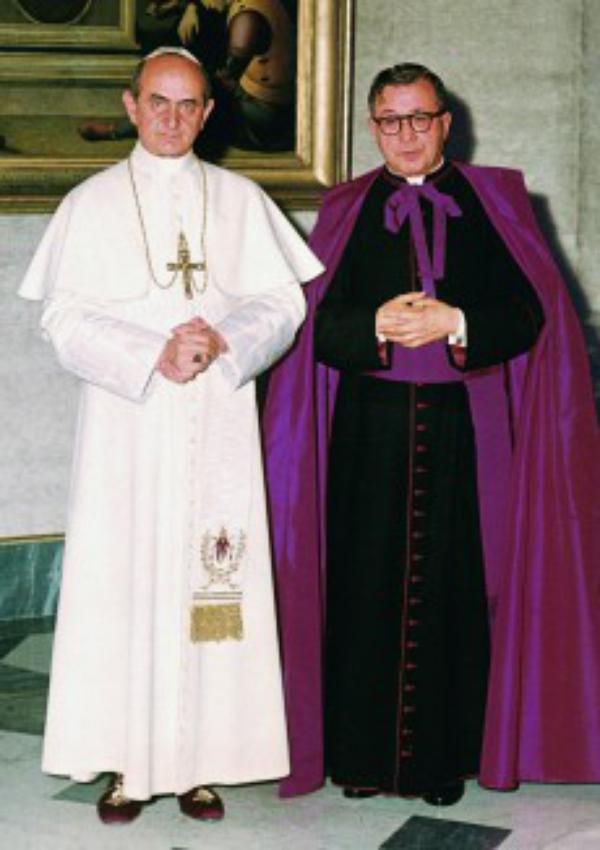
Photograph taken during St. Josemaría's audience with Paul VI on January 24, 1964.

At a hearing

Granted by Pope Paul VI to Blessed Álvaro del Portillo thirty years later, that is, in 1975, shortly after the death of St. Josemaría, he spoke to his successor as head of Opus Dei about that book, which he still kept with great care.

This is how Bishop del Portillo recalled that conversation: "Paul VI spoke to me about Father with admiration and told me that he was convinced that he had been a saint. He confirmed to me that for many years he had been reading The Way every day and that it did great good to his soul" (Álvaro del Portillo, Interview on the Founder of Opus Dei, p. 18).

Paul VI's affection for St. Josemaría was already evident from the time he had the first references to him. and of the apostolic work he was carrying outMontini paid out of his own pocket the expenses for the granting of the appointment of Domestic Prelate of His Holiness that Blessed Álvaro del Portillo had requested for St. Josemaría Escrivá (Álvaro del Portillo, Interview on the Founder of Opus Dei, p. 18).

Bishop Montini and Josemaría Escrivá had the opportunity to meet for the first time in 1946 on the occasion of the founder of Opus Dei's first trip to Rome. St. Josemaría recalled all his life, and said it repeatedly, that Bishop Montini was the first friendly hand he met on his arrival in Rome, and he always had a cordial affection for him.

January 24, 1964

When Josemaría Escrivá When he was received in audience by Paul VI, he was deeply impressed to see in the Holy Father the kind face he had met in the Vatican offices on his first trip to Rome.

I seemed to be seeing once again the kind smile, and hearing again the kind words of encouragement (they were the first I heard in the Vatican) of Bishop Montini in 1946: but now it was Peter who smiled, who spoke, who blessed" (Letter 14 Feb. 1964. The text of this letter can be found in A. de Fuenmayor - V. Gómez Iglesias - J. L. Illanes, El itinerario jurídico del Opus Dei, p. 574).

They are simple reminders of recent history that bear witness to the human category


Mr. Francisco Varo Pineda
Director of Research at the University of Navarra.
Professor of Sacred Scripture at the Faculty of Theology.

Carlo Acutis, a teenage saint: the story of the Internet's patron saint

Carlo Acutis, a very peculiar young man

The history of Carlo Acutis is extraordinary. Born on May 3, 1991 to a well-to-do family in London - because both of his Italian parents worked there - he died on October 12, 2006, very quickly from acute myeloid leukemia.

A computer genius, but also a particularly devout boy, even though his family was not - his mother said he had only gone to Mass for his communion, confirmation and marriage - Carlo not only lived a Christian life, he used the networks to create a virtual display of the miracles of the Eucharist in the world. In addition, always thanks to his computer, where he used to play video games, like all boys, elaborated a scheme of the rosary that included the mysteries of the light.

After living for a short period in London, where she had a Polish nanny, Beata, a great admirer of John Paul II He moved with his family to Milan, where he first attended a Catholic school and, shortly before his death, a high school run by the Jesuits. There he first went to a Catholic school and shortly before his death, to a high school run by the Jesuits.

From the time he received his first communion at the age of 7 - before his time because he demanded it - he never missed his daily appointment with Mass. He prayed all the time, went to confession and asked his parents to take him on pilgrimages to places of saints and places of miracles of the Eucharist, which he defined as "a highway to Heaven".

As his family also had a home in Assisi, he used to spend a lot of time in the city of St. Francis, the patron saint of Italy after whom the Argentine Pope was named. Carlo liked Assisi so much that before his death he expressed his desire to be buried there.

Carlo Acutis an adolescent of our time

"Carlo was not a Franciscan. He was simply an adolescent of our time, in love with Jesus. -and especially of the Eucharist- and most devoted to Mary, especially in the rosary practice. But in Assisi he breathed the charism of St. Francis," wrote the bishop of Assisi, Domenico Sorrentino, in a book entitled Originals, Not Photocopies, a phrase attributed to Carlo, a boy who surely swam against the current. He lived simply, got angry if his mother bought him a second pair of sneakers or brand-name clothes and used to help out at a soup kitchen in Milan.

The miracle in Brazil

His cause for beatification began in 2013. In July 2018, Pope Francis declared him venerable, a title granted by the Catholic Church to those who, by the practice of virtues exercised during their lifetime, are considered worthy of veneration by the faithful. Carlo was later credited with a miracle through his intercession, an indispensable step for his beatification. This took place in Brazil, on the seventh anniversary of his death, on October 12, 2013, in Campo Grande, capital of the State of Mato Grosso do Sul.

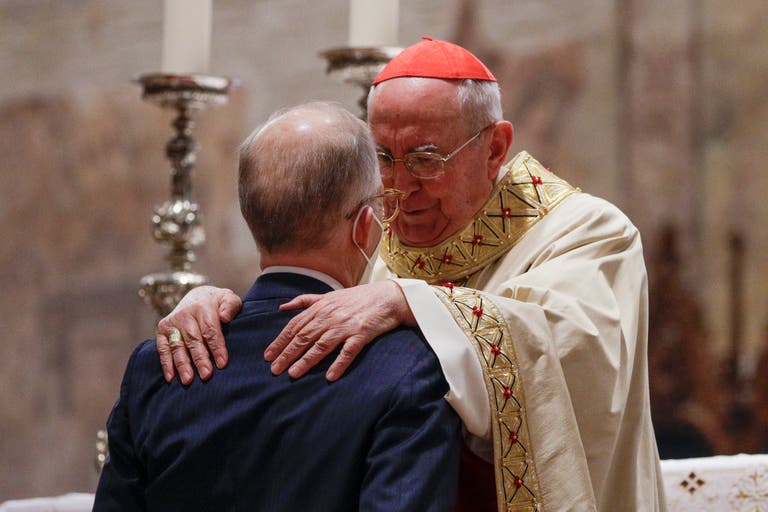
cardenal-agostino-vallini-junto-a-andrea-acutis-el-padre-de-carlo
Cardinal Agostino Vallini with Andrea Acutis, the father of Carlo Acutis, an Italian teenager who died at the age of 15 from acute myeloid leukemia, was beatified in a ceremony in Assisi.

There, a 6-year-old boy was inexplicably cured of a serious abnormality he had suffered since birth in his pancreas. "Father Marcelo Renório invited the parishioners to pray a novena and placed a piece of Carlo's T-shirt on the little patient, who the next day began to eat and whose pancreas was suddenly healthy. without the surgeons having operated on him," said his mother, Antonia Salzano, in an interview with Corrierre della Sera, in which she assured that she also received miraculous signs from her son-baby.

"Carlo predicted that I would become a mother again, even though I was about to turn 40. And in 2010, when I was already 43, I gave birth to twins, Michele and Francesca," she said, noting that when she suddenly became ill in 2006, Carlo offered his suffering to Pope Benedict XVI and the Church, as well as "to go straight to Paradise without going through purgatory. The future Blessed, in fact, also had a great sense of humor and lived his final stage with great serenity.

"Carlo embodies the sanctity of digital natives." explained in his book Bishop Sorrentino, who clarified that he was not a fan of virtual relationships and that he was also a great catechist. Faithful reflection of this, the domestic servant who worked in his family, Rajesh, thanks to him decided to convert from Hinduism to Catholicism. "It was Carlo, with his enthusiasm, with his explanations, with his films, that gave me the desire to become a Christian and to be baptized," Rajesh testified in the cause of beatification.

"Carlo knew how to speak about Jesus and the sacraments in a way that touched your heart."Bishop Sorrentino, who in his book drew a parallel between this teenager and St. Francis of Assisi, stressed that his body in 2019 was transferred from the city cemetery to the Sanctuary of the Expoliation in the church of St. Mary Major, the ancient cathedral of Assisi. It was there that the young Francis stripped himself, even to the point of nakedness, of all the goods of the world, in order to give himself entirely to God and to others.

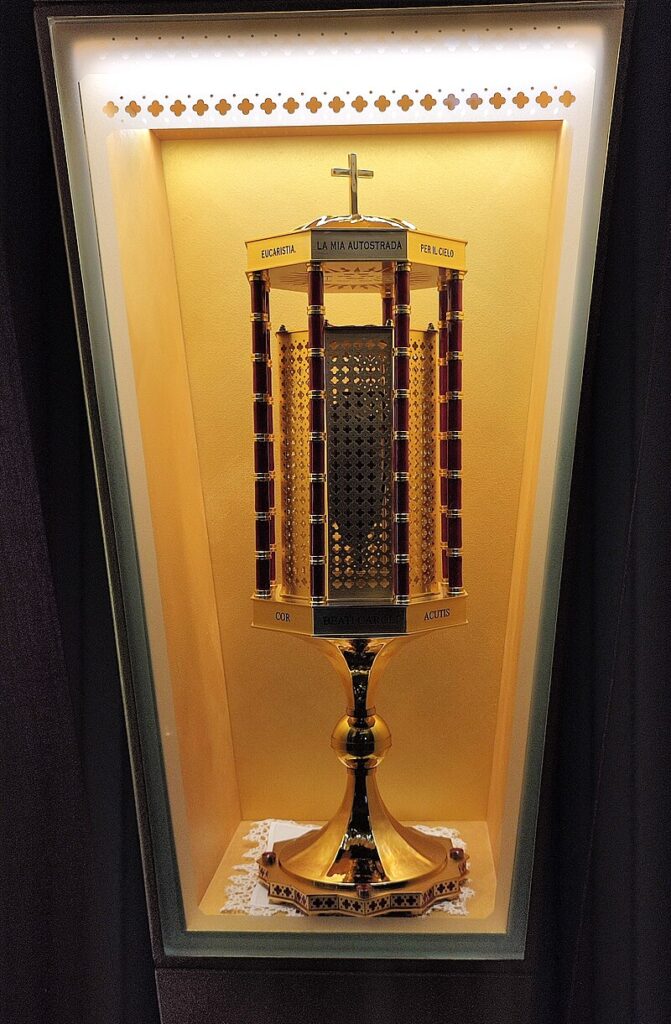
relicario corazón de carlo acutis

Carlo's body

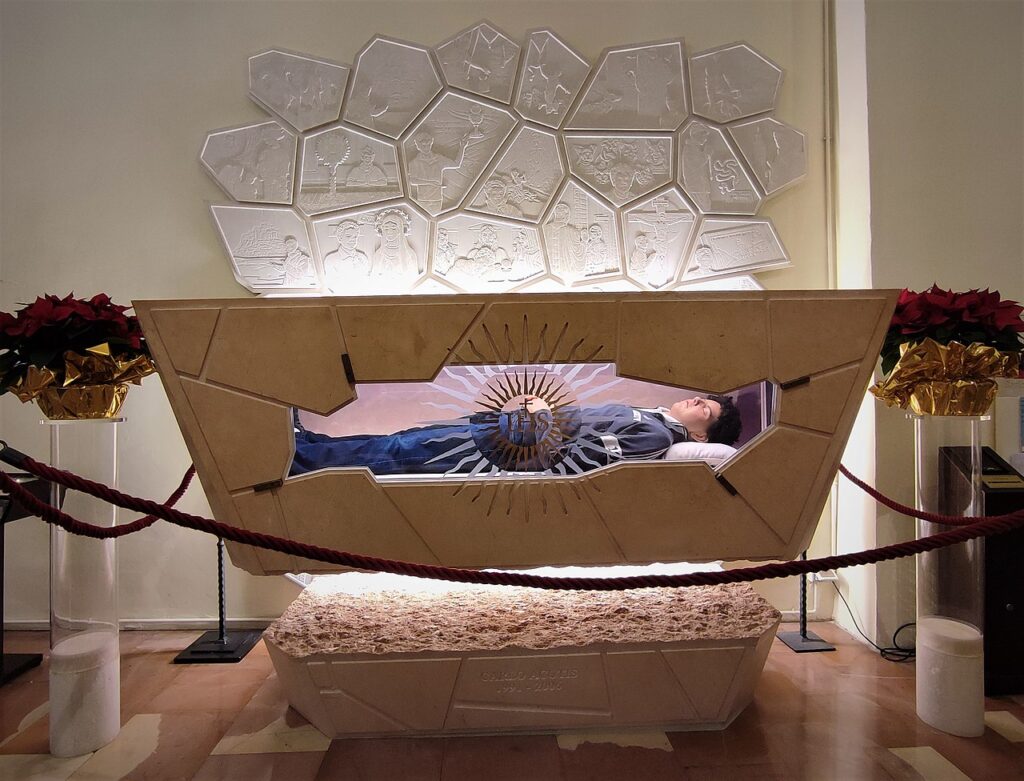
Seeing that in recent days some improper versions circulated in the media, Sorrentino a few days ago explained that it is not true that the body of the future Blessed was found incorrupt. "At the time of the exhumation from the cemetery of Assisi, which occurred on January 23, 2019, in view of the transfer to the shrine, it was found in the normal state of transformation proper to the cadaveric condition," he said.

"However, not many years after the burial, the body, still transformed, but with the various parts still in their anatomical connection, was treated with those techniques of conservation and integration that are usually practiced to expose with dignity to the veneration of the faithful the bodies of the blessed and the saints," he said.

It was an operation that was done "with art and love," said Bishop Sorrentino, who mentioned the "particularly successful reconstruction of the face through a silicone mask. The prelate also detailed that thanks to a special treatment it was possible to recover the "precious" relic of the heart, which will be used this Saturday, the day of the beatification.

In Christus vivit (Christ Lives), the apostolic exhortation he wrote to young people after the synod dedicated to them in March last year, Pope Francis made special mention of Carlo Acutis. "It is true that the digital world can put you at risk of self-absorption, isolation or empty pleasure. But don't forget that there are young people who are also creative and sometimes brilliant in these areas. This is what the venerable young Carlo Acutis used to do.", he wrote in paragraph 104.

carlo acutis tumba

"He knew very well that these mechanisms of communication, advertising and social networks can be used to turn us into numb beings, dependent on consumption and the novelties we can buy, obsessed with free time, locked in negativity. But he was able to use the new communication techniques to transmit the Gospel, to communicate values and beauty.", he continued.

Acutis passed away on October 12, 2006 (the feast day of the Virgin of Pilar in Spain and Latin America) and reached the altars with his beatification on October 10, 2020. 


Elisabetta PiquéShe is the Italy and Vatican correspondent for La Nación. She has a degree in Political Science with a specialization in International Relations.

Originally published in La Nación.