Baptizing young children is a decision that many Catholic parents take for granted, although today some families prefer to wait until their children can decide for themselves in the future. The question seems reasonable: if baptism has such a profound impact on a person’s life, shouldn’t it be a free choice made once sufficient maturity has been reached?
However, since the early centuries, the Church has upheld infant baptism as a gift from God and the beginning of the Christian life. Many parents do not view baptizing their children as a restriction on their freedom, but rather as a way to offer them grace, faith, and a sense of belonging to the Church from the very beginning.
There are many decisions that parents make without waiting to consult with their children, in matters that will affect them in a decisive way in their lives.
They provide them with food, clothing, warmth and affection before they have the use of reason, without their having freely asked for it, but this is essential to keep them alive. But they also do things, in addition to covering basic subsistence needs, that will have a decisive impact on fundamental life issues.
Let’s consider, for example, the act of speaking to them in a specific language. The acquisition of a native language stems from a decision made by parents that will shape the way their children express themselves, their deepest cultural roots, and even very specific perspectives on reality.
No reasonable parents would decide not to speak to their child at all until the child grew up, heard several languages, and decided for themselves which one they wanted to learn. Language is a very important cultural element in human development, and delaying its acquisition until adulthood would cause serious harm to the intellectual development of the young person.
But does the decision to baptize and begin faith formation bear any resemblance to speaking to children in one's own language?
A person who does not have faith and does not know what the existence of God, his goodness, his way of acting in the world and in people means, and who does not know the deepest reality of baptism will think that it has nothing to do with it, that language is indispensable and faith is not. But this does not mean that his assessment is reasonable, but rather that it is due to his cultural deficiencies, or even to his prejudices, which prevent him from reasoning on the basis of all the real data.
Therefore, in order to rationally take charge of all the factors involved in this issue it is essential to know first what it means to receive Baptism, and then to assess the situation.
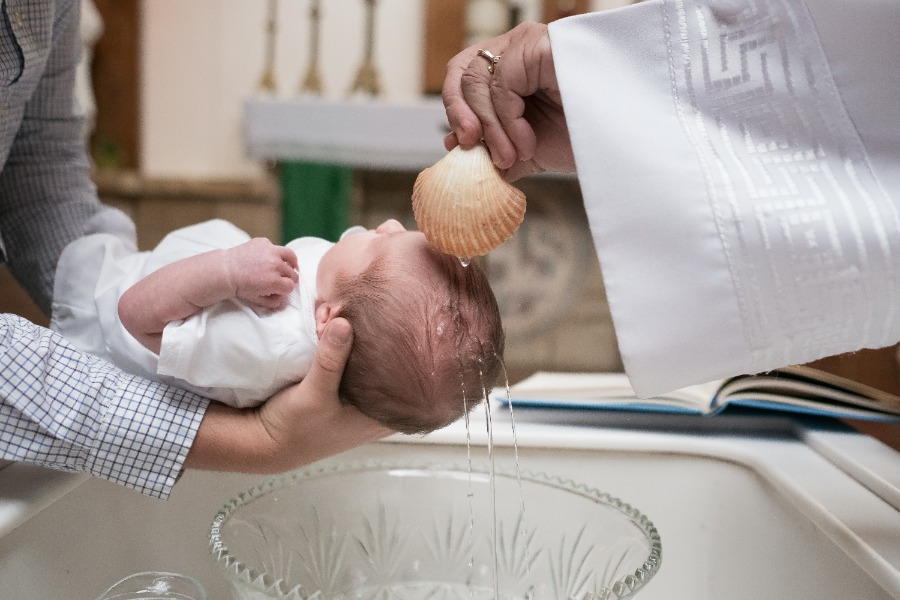
"...Holy Baptism is the foundation of the whole Christian life, the portico of life in the spirit and the door that opens access to the other sacraments..." Catechism of the Catholic Church
God has designed a love story for every human being, which is revealed little by little throughout life. To the extent that we have a close relationship with Him, that story will be revealed and take shape. And the first step for this closeness to be effective is Baptism.
The Christian faith considers the Baptism as the fundamental sacrament, since it is a prerequisite for receiving any other sacrament. It unites us to Jesus Christ, conforming us to Him in His triumph over sin and death.
In ancient times it was administered by immersion. The one to be baptized was completely immersed in water. Just as Jesus Christ died, was buried and resurrected, the new Christian was symbolically introduced into a tomb of water, to divest himself of sin and its consequences, and be reborn to a new life.
Baptism is, in fact, the sacrament that unites us to Jesus Christ, introducing us to his saving death on the Cross. frees us from the power of original sin and from all personal sinsand allows us to rise with him to a life without end. From the moment of reception, we participate in the divine life through grace, which helps us to grow in spiritual maturity.
Through Baptism, we become members of the Body of Christ, brothers and sisters of our Savior, and children of God.
We are freed from sin, plucked from eternal death, and destined from that instant to a life in the joy of the redeemed. "Through baptism, each child is admitted into a circle of friends who will never abandon him, neither in life nor in death. This circle of friends, this family of God into which the child is integrated from that moment, accompanies him continually, even in the days of sorrow, even in the dark nights of life; it will give him comfort, tranquility and light" (Benedict XVI, January 8, 2006).
"Go and make disciples of all nations, baptizing them in the name of the Father, the Son, and the Holy Spirit" (Mt 28:19)
«Baptism makes us "fideles"—'faithful,' a word that, like that other one, '"sancti —"saints"—a term used by the first followers of Jesus to refer to one another, and one that is still used today: we speak of the »faithful” of the Church. —“Think about it!” (The Forge, 622).
This practice dates back to time immemorial. When the first Christians received the faith, and were aware of the great gift of God of which they had been the object, they did not want to deprive their children of these benefits.
The Church continues to practice infant baptism for one fundamental reason: before we opt for God, he has already opted for us. He has made us and called us to be happy. Baptism is not a burden, on the contrary, it is a grace, an undeserved gift that we receive from God.
Christian parents, from the earliest centuries, applied common sense. Just as the mother did not deliberate at length about whether she should breast-feed her newborn child, but fed it when the child required it, just as they washed it when it was soiled, clothed it and wrapped it up warmly to protect it from the rigors of the cold, just as they talked to it and gave it affection.
In this way, they also provided him with the best help that any human creature needs to develop life to the full: the cleansing of the soul, the grace of God, a large supernatural family, and an openness to the language of God, so that when his sensitivity and intelligence awaken, he can contemplate the world with the light of faith, that which allows him to know reality as it is.
Christians know that they are grafted into Christ through Baptism; empowered to fight for Christ through Confirmation; called to act in the world by sharing in Christ’s kingly, prophetic, and priestly office; and made one with Christ through the Eucharist, the sacrament of unity and love. Therefore, like Christ, he must live in relation to others, looking with love upon each and every person around him, and upon all of humanity.
Faith leads us to recognize Christ as God, to see Him as our Savior, to identify with Him, and to act as He did. The Risen One, after dispelling the apostle Thomas’s doubts by showing him His wounds, exclaims: “Blessed are those who have not seen and yet have believed.”.
“Here,” remarks St. Gregory the Great, “we are spoken of in a special way, because we possess spiritually the One whom we have not seen bodily. We are spoken of, but on the condition that our actions are in accordance with our faith.” No one truly believes except the one who, in his actions, puts into practice what he believes. That is why, speaking of those who possess nothing more than words of faith, St. Paul says: they profess to know God, but deny him by their deeds.
In Christ, it is not possible to separate his nature as God-Man from his role as Redeemer. The Word became flesh and came to earth so that all people may be saved, to save all people. With our personal weaknesses and limitations, we are other Christs, the very Christ, and we too are called to serve all people.
That commandment, which will remain new throughout the centuries, must resound again and again. “Beloved,” writes Saint John, “I am not writing a new commandment to you, but an old commandment that you have had from the beginning; the old commandment is the divine word that you have heard.” And yet I tell you that the commandment of which I speak is a new commandment, which is true in itself and in you, because the darkness has passed away, and the true light is already shining. Whoever claims to be in the light but hates his brother is still in the darkness. Whoever loves his brother dwells in the light, and there is no cause for stumbling in him.
Our Lord has come to bring peace, the good news, and life to all people. Not only to the rich, nor only to the poor. Not only to the wise, nor only to the simple. To everyone. To our brothers and sisters—for we are brothers and sisters, since we are children of the same Father, God. There is, therefore, only one race: the race of God’s children. There is only one color: the color of God’s children. And there is only one language: the one that speaks to the heart and the mind, without the clamor of words, yet revealing God to us and leading us to love one another.
• The following text is from point 106 of St. Josemaría’s book *Christ Is Passing By*, in the chapter 'Christ Present in Christians.' Link: https://escriva.org/es/es-cristo-que-pasa/106/
Article published at http://dialogosparacomprender.blogspot.com/
Mr. Francisco Varo PinedaDirector of Research at the University of Navarra and Professor of Sacred Scripture in the School of Theology.
Table of Contents
 carf@fundacioncarf.orgLandline: +34 914 029 082Mobile: +34 638 078 51145 Conde de Peñalver Street.