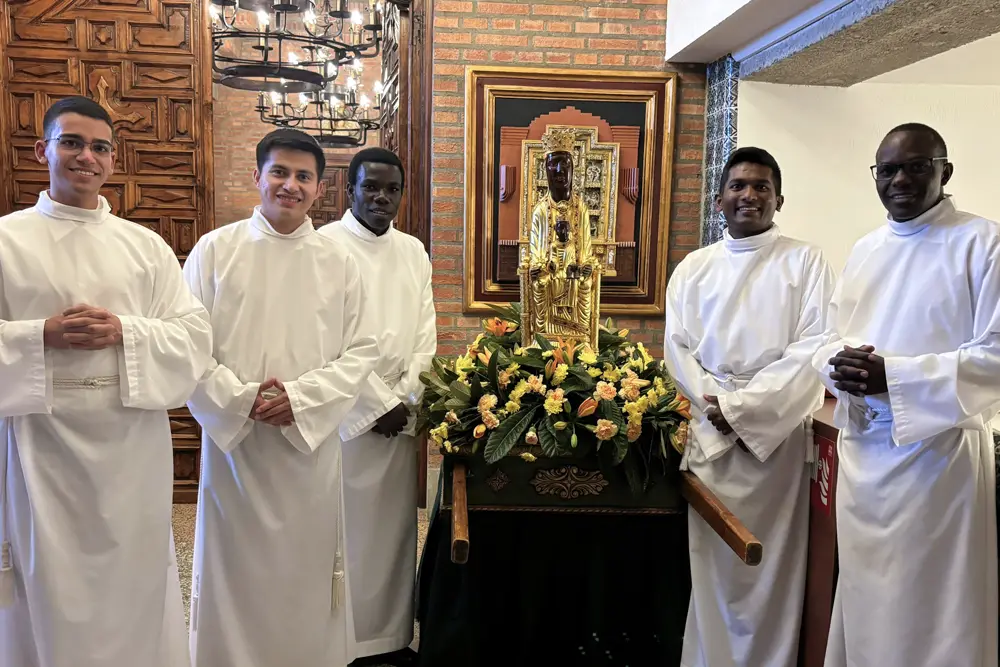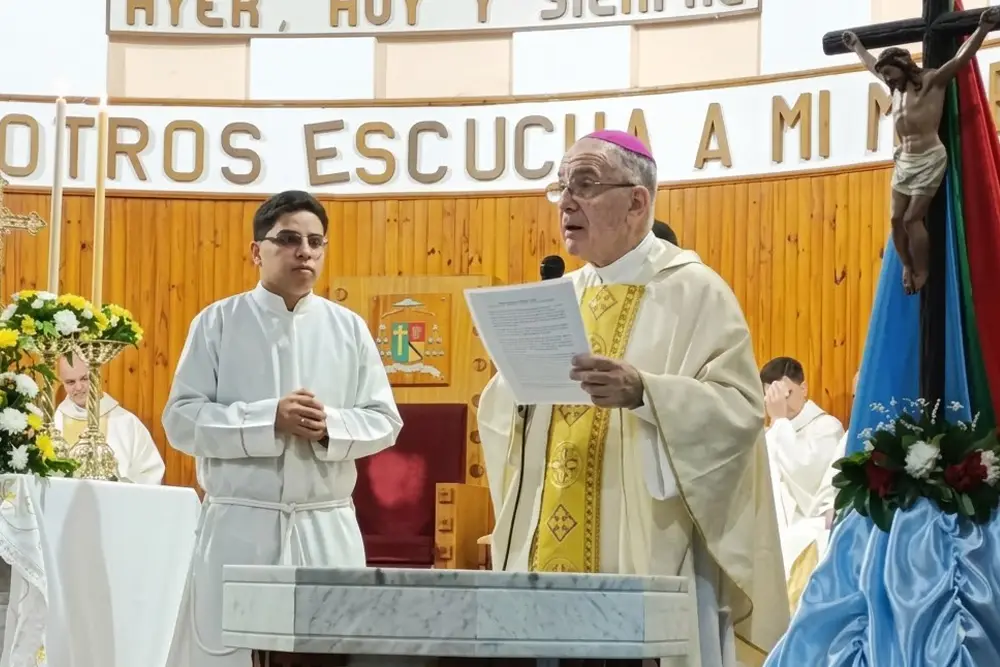
Despite the Soviet regime and years of militant atheism, faith did not disappear in Belarus.
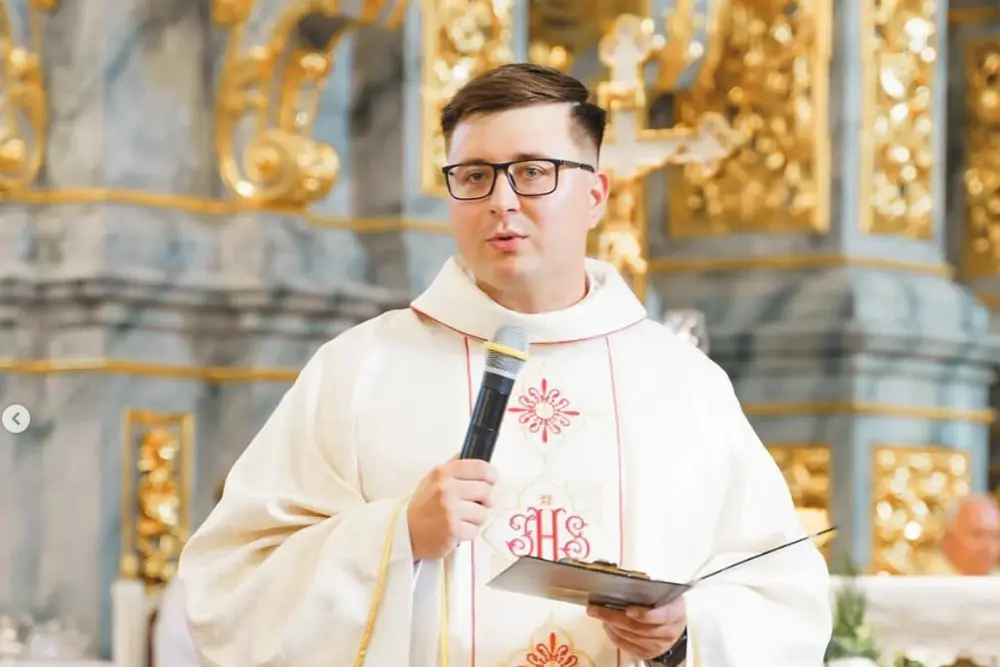
Andrei Yukhnik is a 28-year-old Belarusian priest. He was born in Lida, in western Belarus, on September 13, 1998.
She is currently in Rome, at the Pontifical University of the Holy Cross, studying her second year of a Licentiate in Canon Law thanks to a scholarship from the CARF Foundation.
Andrei nHe tells you his story:
Greetings to all the benefactors of the CARF Foundation!
My name is Andrei Yukhnik, I am Belarusian, and I am 28 years old. I grew up in a Catholic family. My parents, practicing Catholics, instilled in me the foundations of the faith from childhood, primarily through their example. Thanks to them, I learned that faith is not just a tradition, but a living relationship with God.
The parish experience from childhood as an altar boy and the example of the local priests: a source of inspiration
From childhood I attended my parish, first through catechism classes and later as an altar server. Parish life played a fundamental role in the development of my vocation. In my community, the priests served who were very close to the people and deeply dedicated to their mission. Their example gradually awakened in me the desire to consecrate my life to God and to the service of others.
The seminary years, fundamental to understanding the profound meaning of the priestly vocation
After school I entered the Major Seminary. The years of formation helped me to understand more deeply that the priesthood does not consist only of performing certain functions, but that it means, above all, belonging to Christ and serving his people.
The experience lived in the sacraments and the closeness with the people.
In 2023 I was ordained a priest and incardinated in the Diocese of Grodno. In the first years of my ministry, I have experienced how important it is for a priest to be close to people in the celebration of the sacraments, in catechesis, in accompanying young people and families, and in moments of suffering or spiritual seeking.
The Diocese of Grodno is located in western Belarus and is relatively young, having been established in 1991 by Saint John Paul II. It is one of the areas of the country with a historically significant Catholic presence, although Catholics constitute a minority in Belarus, and the majority Christian denomination is Orthodox. This does not, however, impede peaceful and respectful coexistence among the different faiths.
The persecutions during the Soviet regime and how families preserved their faith despite adversity: a great example
The history of the Catholic Church in our lands has also known very painful periods. In the 20th century, during the Soviet regime and the years of militant atheism, many churches were closed, numerous communities were left without priests, catechesis was severely restricted, and religious life faced many difficulties. Despite everything, faith did not disappear. It was primarily families who safeguarded prayers, Christian traditions, and the desire to receive the sacraments.
Following the changes of the 1990s, the Church slowly began to rebuild its own life. Even today, it continues to grow in small steps, thanks also to the support of numerous foundations, associations, and ecclesial projects. Catechesis for children, young people, and adults is organized in parishes; retreats, youth gatherings and forums, conferences, and academic symposia are held. During the summer, pilgrimages on foot to shrines are also very important, becoming opportunities for prayer, fellowship, and bearing witness to the faith.
The current challenge: to help new generations find Christ in a rapidly changing society.
Today, one of the Church's main tasks in Belarus is transmitting the faith to new generations. It is not enough to belong culturally to a Catholic family; it is necessary to help each person encounter Christ personally. Therefore, particular attention is given to young people and families in a rapidly changing society increasingly marked by secularization.
The importance of vocations and the formation of priests trained for teaching and diocesan service.
Another very important challenge concerns priestly vocations and the preparation of qualified individuals for ecclesial service. Our diocese houses the Major Seminary, which serves the Catholic Church in Belarus and needs both new vocations and priests adequately trained to teach and form seminarians.
Our new Bishop, still young, pays close attention to this aspect. He wants the Catholic Church in Belarus to be better known outside the country and for it to be recognized that, even as a minority community, it is a living and active Church. At the same time, he considers it important to prepare competent people for service in the seminary, the curia, the ecclesiastical court, and the other institutions of the diocese.
The need in the field of Canon Law in Rome and the needs of the ecclesiastical court.
This need is particularly evident in the field of canon law. Currently, our ecclesiastical tribunal suffers from a lack of adequately trained personnel, while the number of cases, especially those concerning the validity of marriage, is increasing. Therefore, I believe that my Bishop, in sending me to study Canon Law in Rome, also sees the prospect of my future service in the diocesan tribunal.
For this reason I am currently studying Canon Law at the Pontifical University of the Holy Cross. I consider this opportunity not only personal, but above all a responsibility to my diocese. Studying in Rome allows me to know the universal Church more deeply, to meet priests and students from many countries, and to experience diverse ecclesial traditions.
The canon law, In my opinion, it is not simply the study of rules and procedures. Behind every rule there are specific people and situations, and law in the Church must always be at the service of communion, justice, and ultimately, the salvation of souls.
Therefore, once I have completed my studies and returned to Belarus, I wish to make the training I have received available to my diocese, collaborating, if necessary, in the ecclesiastical tribunal, the curia, or in the formation of future priests. Whatever task I am entrusted with, I would like, above all, to remain a priest close to the people.
The recognition of God's grace through the people who have guided his path and the benefactors of the CARF Foundation
Looking back on my own history, I see how the Lord has used many people: my parents, the priests of my parish, the seminary instructors, and my bishop. That is why I consider my vocation a gift received to be given back through service.
The future of the Church in Belarus certainly presents many challenges, but I also see many reasons for hope: families who continue to pass on the faith, young people who seek God, priests and consecrated persons who carry out their mission with dedication, and communities in which the Gospel continues to be lived.
My hope is to be able to return to my diocese enriched by the formation received and to put all that I have learned at the service of the Church that has made me grow, in which I have discovered my vocation and for which I have become a priest.
That is why I thank my benefactors at the CARF Foundation who gave me this great opportunity to train in Rome and serve the universal Church.
Gerardo FerraraDegree in History and Political Science, specializing in the Middle East. Head of the student body at the Pontifical University of the Holy Cross in Rome.
 carf@fundacioncarf.orgLandline: +34 914 029 082Mobile: +34 638 078 51145 Conde de Peñalver Street.