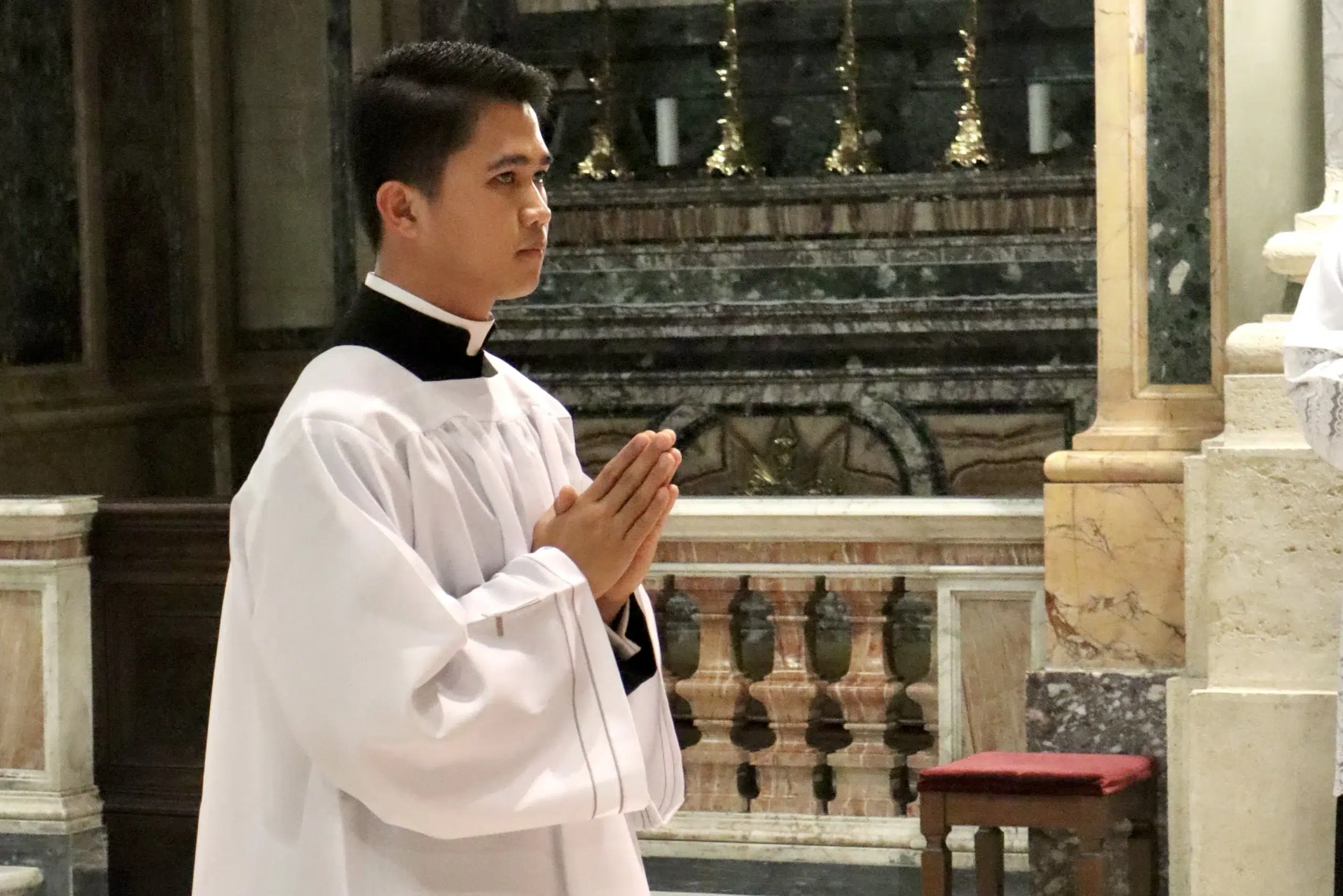
Jovan Faylogna is a young seminarian from the Philippines, He was born in Pagudpud on September 4, 1999. He comes from the diocese of Laoag, in the north of the country.
Today he studies theology in Rome at the University of Rome. Pontifical University of the Holy Cross and resides at the international church school Sedes Sapientiae, thanks to the help of members, benefactors and friends of the CARF Foundation.
His story begins in a moment of emptiness. And he wants to tell his life experience to thank the benefactors of the CARF Foundation, who give him and his diocese the opportunity to be trained in Rome.
«My name is Jovan Faylogna. When people see me today, sometimes, they assume that I must have grown up very close to the Church. But the truth is quite different. I was not the child who went to Mass every Sunday. In fact, I lived my life without thinking much about God. Holy Mass was something I attended only on feast days. I did not know it then, but I walked through life aimlessly: calm on the outside, but empty inside. I didn't know it then, but I was walking through life aimlessly: calm on the outside, but empty inside».
Everything changed unexpectedly in 2016, during her high school years. His school experienced some strange, even frightening events, and the school administration and management asked everyone to go to Mass on Sunday to pray for the school. «I went simply because we were asked. I sat with my friends without expecting anything..., but during that Mass I felt something I had never experienced before».
It wasn't dramatic or loud. «I felt a soft light inside, a quiet touch that went straight to my heart. The next Sunday, without thinking too much about it, I went back to church. And then the next. I was attending because my friends were going too, but little by little it became a habit, something that felt natural and peaceful. One day, the Youth Ministry invited me to join. I said yes almost without thinking, because something in me was drawn to it as if it were a magnet.».
And it turns out that Jovan not only came back to life. the Holy Mass, He discovered something greater: a community that welcomed him and, in that welcome, the presence of God.
«Eventually, I became an altar boy. And that changed everything. Suddenly, I was no longer going to Mass alone on Sundays: I attended every day. I even woke up at 5:30 in the morning for adoration, morning prayer and Mass. The parish community took me under their wing, even inviting me to have breakfast with them before school. I felt loved. I felt at home. It was the first time in my life that faith and God was not something I observed from the outside: it became someone I knew.».
The vocation, however, did not come as a sudden certainty. Before, as is normal, Jovan felt doubts and the fear of not being worthy.
«About a year later, seminarians from our diocese came to our school for vocation promotion. My friends were teasing me by telling me to join, but I always laughed and said no. Deep down, I didn't think I was worthy. When the entrance exam came, something in my heart whispered quietly, “Try it.” I told my pastor, “Father, I want to try,” but I didn't tell my parents, because I was afraid they would refuse.».
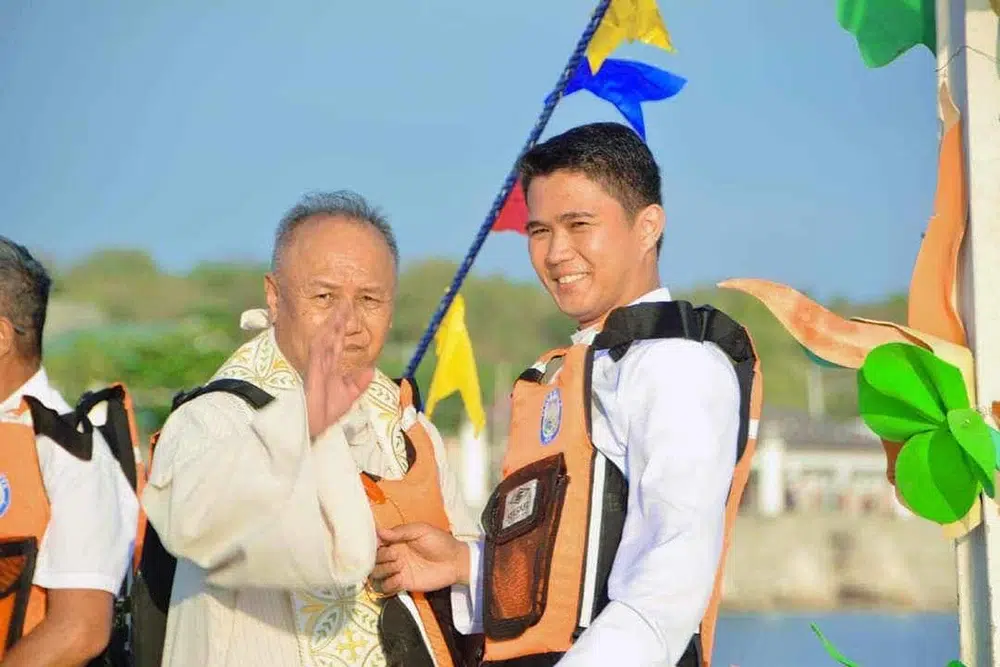
Jovan took the exam and passed. But to complete his admission, his parents had to meet with the rector. «It took me months to convince them. The truth is that at that time they were not fully supportive, not fully, not emotionally. And when the day came for the new seminarians to enter, they all arrived with their families...while I entered alone. I still remember how much that moment weighed on me.
Jovan highlights how God has a way of writing stories that surprise us. And at the most unexpected moment, the sign you need arrives.
"God writes stories with beautiful surprises. During our investiture with the sacred habit, I waited and prayed for my parents to arrive. Five minutes before Mass began, they appeared. I saw them smile, but I also saw sadness in their eyes, because that same day was my grandfather's funeral, which I could not attend.
The ceremony was beautiful, and at the end, my bishop called them and spoke to them with a kindness that softened something in their hearts. After that, they accepted my vocation. They began to visit me frequently.».
Any path is never easy. Seminary life is also costly financially, and Jovan's family was struggling in that regard. But God provides in ways we don't expect. A generous family helped him continue his formation, something he will never forget.
«Inside the seminary, I was not the best. In fact, I was on the verge of being expelled twice. I struggled, made mistakes and questioned many times if it was my place. But God acts in ways that surprise us. Just before I finished my Bachelor's Degree in Philosophy, my bishop asked me if I wanted to study Theology in Rome. I did not know how to answer. I remembered the boy I was: the one who hardly went to Mass, and now I was being asked to study in the heart of the Church».
«My first reaction was, “I can't.” But in prayer, I felt the serene assurance of Our Blessed Mother, “I am your mother. I will take care of you. Don't worry about your family: I will be with them.” And with that, I found the courage to say yes.».
He arrived in Rome with hope and enthusiasm..., but suddenly he was told that he had to return to the Philippines. Jovan did not understand why. He was plunged into a deep crisis. Although he confesses that that year served him a lot in his formation and gave him a lot of humility. Later, his bishop called him back and told him: «Go back to Rome. Finish what you started.
The bishop entrusted him with a mission: to help his diocese build communion with the separated communities and to teach the truth of Christ's Church, especially through the gift of the Eucharist.
An essential element of Jovan's story is to feel grateful, especially for the benefactors, partners and friends of the CARF Foundation. «None of this, absolutely none of this, would have been possible without God's grace and without the people He uses as His instruments. People like you.
«Your generosity, whether financial, spiritual or emotional, has given me the opportunity to continue my journey. You have no idea how much your support has touched my life. Every step I take towards the priesthood is also a step of his".
«I don't know how to pay them. I don't think I can do it at all. But I can promise you this with all my heart: you are in my prayers every day. And I bring your friendship and generosity to every Holy Mass I attend. Thank you very much, friends of the CARF Foundation, may God bless you through the intercession of Our Blessed Mother!».
Gerardo FerraraBA in History and Political Science, specializing in the Middle East.
Head of the student body at the Pontifical University of the Holy Cross in Rome.
Table of Contents
An overview of Philippine history and cultural roots
The Philippines is a unique case in Asia. With more than five centuries of Christian history after the arrival of the Spanish in 1521, Catholicism is not a superficial veneer, but the backbone of the national identity.
Faith is lived through an overflowing and massive popular piety, incarnated in universal devotions such as the Santo Niño of Cebu or the Black Nazarene. Filipino Catholicism is eminently communitarian, festive and very familiar; the transmission of the faith has always been carried out in a natural way in the homes through prayer and fidelity to the sacramental practice.
Philippines, a spiritual lung for the world
The Philippine Church today enjoys an enviable spiritual health compared to the West, especially old Europe. Its main virtue is a joyful and resilient hope. In a country that is constantly hit by natural disasters (typhoons, earthquakes, etc.), faith has always become a refuge and a driving force for reconstruction, without falling into victimhood.
In addition, the Philippines is a young and fruitful Church in vocations to the priesthood and consecrated life. While other regions suffer from a shortage of pastors, the Philippines has become an exporting land of faith.
Its laity and priests, when they emigrate for work or pastoral reasons, act as true missionaries in Europe, America and the Middle East, revitalizing aging parishes thanks to their vitality and human closeness.
Urgent problems and challenges
Despite its vitality, the Church in the Philippines faces complex realities:
The great challenge for the Philippine Church (and for the entire planet) in the coming years is to to move from a merely customary or sentimental faith to a deeply formed faith. Popular piety is a treasure, but if it is not accompanied by a solid doctrinal and intellectual formation, it runs the risk of being diluted in the face of modern relativism or the proselytism of fundamentalist sects that are gaining ground in the peripheries.
To resolve this, the local Church urgently needs highly prepared priests and formators - both humanly, spiritually and intellectually - who are capable of shepherding these scattered communities, giving theological depth to the devotion of the people and healing the social wounds from the Gospel.
 carf@fundacioncarf.orgLandline: +34 914 029 082Mobile: +34 638 078 51145 Conde de Peñalver Street.