Freddy Arigo shares his testimony on the priestly formation he received thanks to the CARF Foundation, highlighting how it has boosted his service vocation The pastoral challenges in his native land and the hope that the spiritual rebirth of young Spaniards instills in them.
«Those years profoundly marked my spiritual, academic and pastoral life, strengthening my love for Sacred Scripture and for the service to the Church", he says.
Back in his country, he talks about the danger of emotionalism among young Ecuadorians and the surprise he received when he returned to Spain last year: a resurgence of Catholicism.
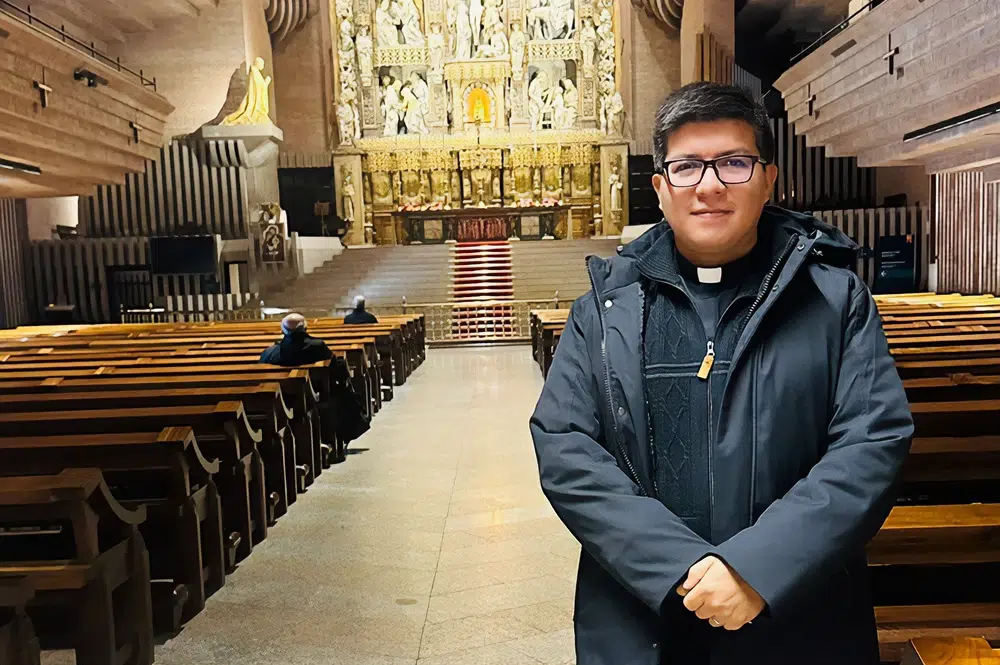
Freddy was ordained on June 25, 2016. Last year he returned to Pamplona to finish his Licentiate in Biblical Theology in the Ecclesiastical Faculties of the University of Navarre. Now, back in Ecuador, where he spends every day exercising a service vocation to others and to the Church.
He was born into a Catholic family of six siblings: «My parents, with a simple but firm faith, were able to educate all of us in Christian living. Thanks to their witness, we grew up in an environment where faith was a natural part of daily life,» he says proudly.
In the midst of this Christian family environment, at the age of 14, he met the ident missionaries in his hometown of Ibarra.
«Thanks to them I was able to discover more deeply the meaning of Christian life, the love of the heavenly Father and the richness of the community gathered around the altar.».
Two years later, he clearly experienced God's call to the priesthood. «It happened during a Eucharist celebrated in Quito by the general president of the Idente missionaries. At that moment I felt in the depths of my heart that the Lord was inviting me to give my life to him".
So, when he finished high school, at the age of 17, he decided to begin his studies at the Central University of Ecuador, while living with the missionaries in Quito. But he was not fully satisfied with his university studies: «everything that had to do with God awakened in me a greater interest, especially when I saw a priest something was stirring inside me intensely,» he recalls with joy.
During that time he began a period of intense prayer asking the Lord to enlighten him and give him the necessary courage to take the step. Finally, at the beginning of the second semester, he made the decision to leave the university and enter the diocesan seminary of Ibarra, and thus begin his priestly formation, because he understood that the Lord was calling him to become a priest, in a secular vocation in the service of the Church.
After these years of priestly formation at the University of Navarra, he has returned to his country with a complete and comprehensive training. The Diocese of Ibarra is located in the north of Ecuador. It is currently composed of 62 parishes and has a presbyterate of approximately one hundred priests. The great majority of them have been formed in the major seminary Nuestra Señora de la Esperanza.
«A decisive impulse in the pastoral life of the diocese was given by Msgr. Juan Larrea Holguín, who was Bishop of Ibarra and had been sent by St. Josemaría Escrivá to begin the pastoral work of Opus Dei in Ecuador when he was still very young. His dedication and apostolic zeal deeply marked the ecclesial life of our Church in particular,» Freddy explains.
A deep devotion to the Sacred Heart of Jesus
Ecuador is a diverse country rich in culture and resources. However, political mismanagement in recent decades has favored the expansion of drug trafficking, organized crime, extortion and kidnapping, causing an alarming increase in insecurity.
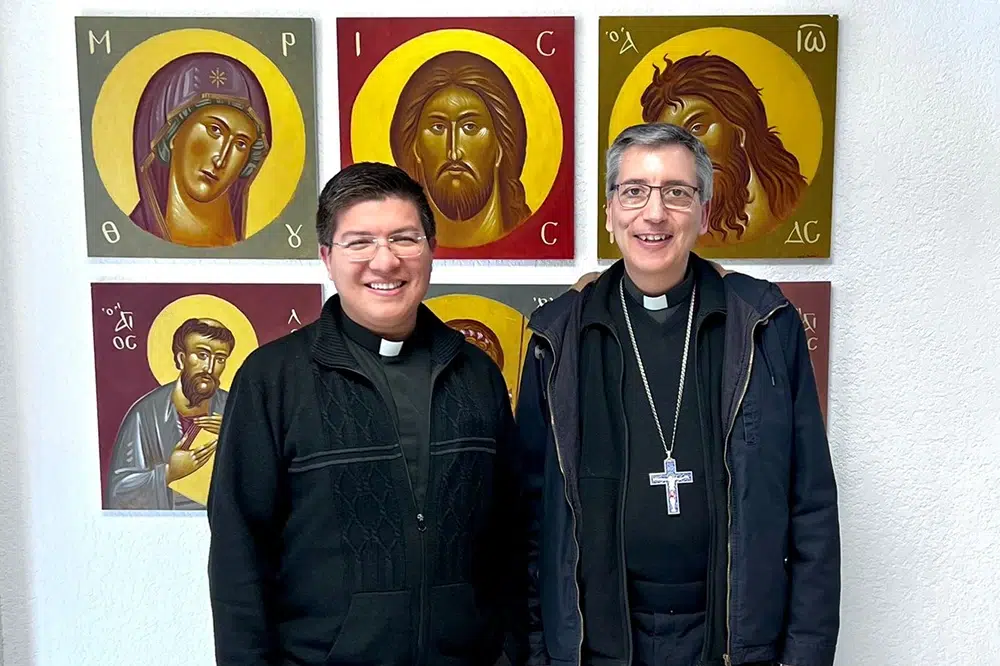
But Ecuadorians do not lose confidence, much less the priests.In spite of everything, our people keep hope alive. There is a deep devotion to the Sacred Heart of Jesus and a deep love for the Virgin Mary, expressed in many manifestations of popular religiosity. This simple faith makes many people continue to look to the Church with confidence, even in the midst of their weaknesses, recognizing her as mother and guide in difficult times«.
Decline in vocations
As in many regions of Europe, Central and South America, the number of vocations to the priesthood and consecrated life in your country has also declined.
Among the various influencing factors, he considers that one of them is the notable drop in the birth rate in the country, which naturally reduces the number of young people and, therefore, of possible vocations.
«Faced with this situation, in the diocese we are committed to work with greater unity and determination, especially in favor of the family and young people. We want them to find in the Church a true oasis: a place of encounter with Christ, a spiritual refuge and a family that knows how to welcome with hospitality, accompany with patience and propose with clarity the beauty of the Christian vocation», says Freddy with enthusiasm.
The problem of emotivism
The current problem of the Church in Ecuador does not lie mainly in the presence of the Protestant sects that have been in the country for several decades, what is observed more frequently is another phenomenon: when one of the Catholic communities breaks into a family, there may be an initial enthusiasm. However, once the emotional fervor wears off, many of those who joined end up distancing themselves not only from that community, but also from the Catholic Church.
In view of this situation, Freddy laments: «The result, in many cases, is not a firm commitment to another Christian confession, but a growing religious indifference. This leads to an individualistic religiosity, detached from sacramental life and community commitment.
Secularism is making inroads through social networks
Added to this problem is the influx of secularism, which is affecting the entire Western world and is coming in force through social networks.
«Many young people are dazzled by proposals marked by materialism, hedonism and various forms of evasion. However, over time a deep existential void appears. This void can lead to loneliness, depression and even an increase in self-destructive behavior, but it can also, thanks be to God, become an opportunity,» describes this priest who is currently responsible for university ministry in his diocese.
Thus young people, in many cases, this same emptiness leads them to search for something more authentic. And it is there where parishes, youth groups and ecclesial movements become privileged spaces for rediscovering the faith, living fraternity and experiencing the Church as a family.
The resurgence of the Church in Spain
In this line, in his last stage in Spain, he has been surprised by how secularism seems to be losing strength in certain youth environments. Many young people are waking up and becoming aware that a life centered solely on the material ends up leading to a deep existential void.
«I see with great hope the resurgence of the Church in Spain, especially through various movements and ecclesial realities such as Effetá, Hakuna, Bartimeo, Opus Dei, Communion and Liberation and the Neocatechumenal Way, among others. In them one can perceive a sincere desire for prayer, formation and community life», he says with enthusiasm.
This awakening of faith in young people is, in Freddy's opinion, a sign of how the Holy Spirit continues to guide their pastors and renew the Church. «It is as if, after a time of apparent cooling, faith is reemerging with new vitality.».
What Spain can learn from Latin American countries
At the same time, he thinks that our country can learn a lot from Latin American countries, especially Ecuador: the warmth of its people, the closeness in relationships and the profoundly lively and expressive way of celebrating faith.
And he gives a clue: «this exchange of gifts - the formative and structural solidity of Europe together with the vitality and warmth of Latin America - can greatly enrich the universal Church».
Making the face of the Good Shepherd transparent
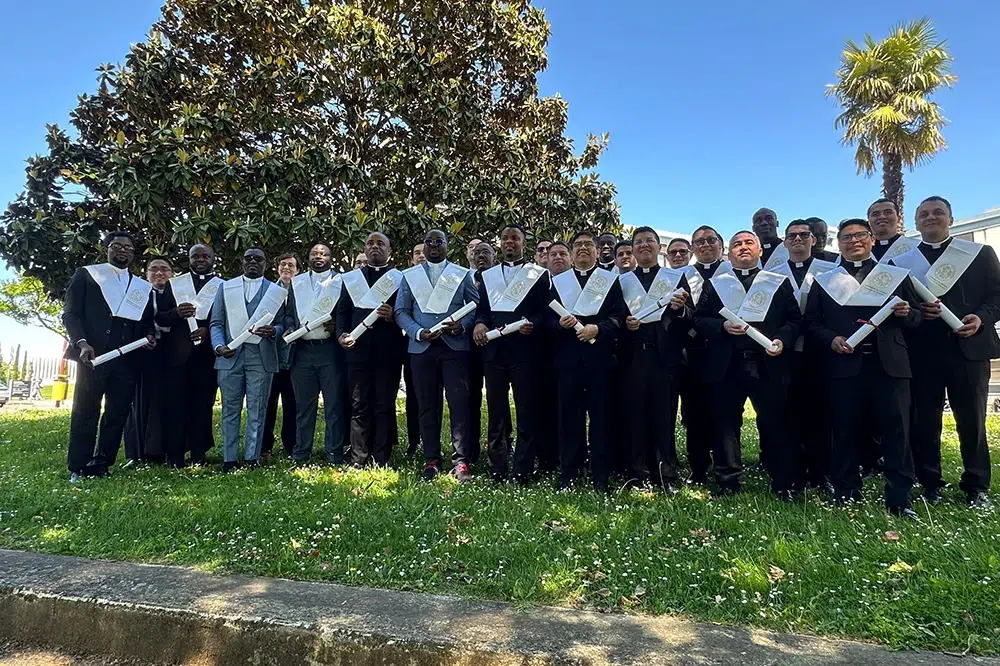
In the midst of this great task, Freddy Arigo Llerena continues to be formed to try to live the qualities that the 21st century needs of priests: called to configure themselves more and more each day with Jesus Christ, their Master and Lord. Because for him, it is not enough to perform functions: it is necessary to make the face of the Good Shepherd transparent with one's own life.
«Young people need us to be authentic witnesses of the Risen Christ: men in love with the Church and passionate for her ministry. Our way of speaking, of listening, of celebrating and even our outward appearance should reflect what we carry in our hearts: a deep friendship with Christ and a sincere dedication to his people,» he said.
To this end, every day he strives to transmit to daily life what he celebrates in the holy mysteries: «the Eucharist that we preside must be translated into concrete closeness, in human and affectionate treatment of families, in availability to those who suffer and in special attention to those who have fallen away from the faith. Only in this way will our ministry be credible: when the grace of the altar becomes living charity in the midst of the world,» he concludes.
Marta Santínjournalist specializing in religion.
 carf@fundacioncarf.orgLandline: +34 914 029 082Mobile: +34 638 078 51145 Conde de Peñalver Street.