We cannot forget that our Faculty was erected as such in 1969, during his Pontificate. Such recognition of the task initiated a few years earlier with the encouragement of St. Josemaría Escrivá de Balaguer is part of the theological impulse that St. Paul VI wanted to imprint on the Church in the years following the conclusion of the Vatican Council II.
In October 1999, I had the opportunity to prepare some words of welcome to the participants in a Study Days on "...".Modern man in search of God, according to the Magisterium of Paul VI"I would like to recall with gratitude some of the testimonies about Paul VI that, for various reasons, are connected with this Faculty of Theology. On that occasion, I wanted to recall with gratitude the memory of some testimonies about Paul VI that for various reasons are related to this Faculty of Theology and are therefore particularly dear to those of us who work here.
Today, twenty years later, I think that the canonization performed by the Pope Francis is a good reason to remember them again.
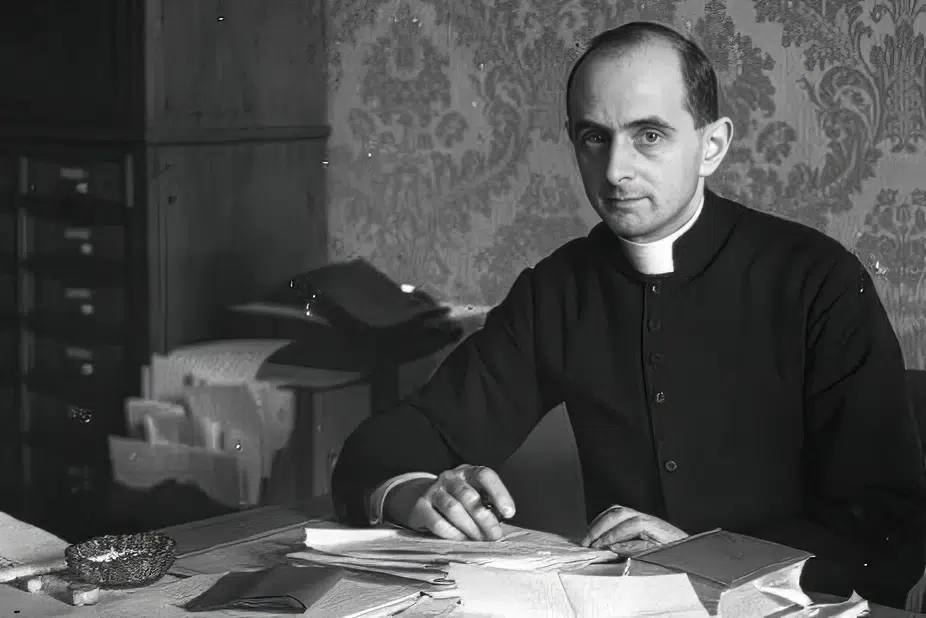
Let us begin with a detail, merely anecdotal but significant, which refers to the first occasions on which a professor of our Faculty was personally received by Paul VI, although at the time of those meetings, 1943, Professor Orlandis, a professor at the University of Murcia and a young researcher, was not yet a professor of this Faculty, and John Baptist Montini was not yet Paul VI.
On one of the occasions on which they had arranged to meet, the previous audience went on a little longer than usual and the usher in charge of introducing the visitors to Monsignor Montini's office felt it his duty to give conversation to Fr. José Orlandis to liven up the wait.
"In the talk came up, as a confidence," recalls Prof. Orlandis, "the opinion that Montini deserved and the image that he presented before his eyes, so accustomed to contemplate him so closely. The definition, said in the popular language of an old Roman, was so funny to me," Orlandis continues, "that I could never forget it.Monsignore è proprio un santo: lavora sempre, quasi non dorme e mangia come un uccelletto!"".
This definition, somewhat singular in its form, is nonetheless an expressive testimony of the capacity for work and the affection that John Baptist Montini aroused in those who witnessed his daily work..
On the occasion of another meeting, on January 21, 1945, Professor Orlandis gave the future Pope Paul VI a copy of The Way, which St. Josemaría Escrivá had sent to him in Rome a few days earlier. Well, that book would not remain abandoned on the shelves of a library, but would also have its own history, which we have been able to learn about many years later.
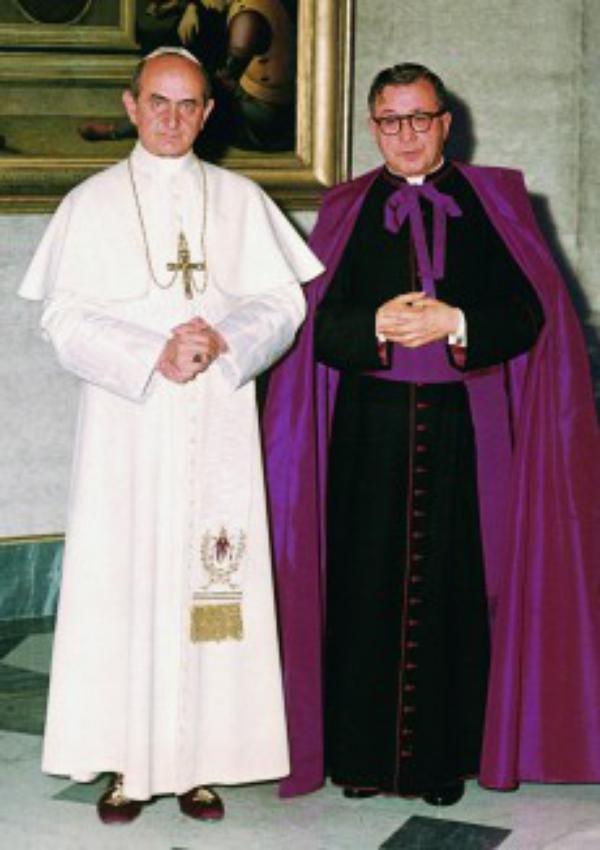
Granted by Paul VI to the Blessed Álvaro del Portillo Thirty years later, that is, in 1975, shortly after St. Josemaría's death, he spoke to his successor at the head of Opus Dei about that book, which he still carefully preserved.
This is how Bishop del Portillo recalled that conversation: "Paul VI spoke to me about Father with admiration and told me that he was convinced that he had been a saint. He confirmed to me that for many years he had been reading The Way every day and that it did great good to his soul" (Álvaro del Portillo, Interview on the Founder of Opus Dei, p. 18).
Paul VI's affection for St. Josemaría was already evident from the time he had the first references to him. and of the apostolic work he was carrying outMontini paid out of his own pocket the expenses for the granting of the appointment of Domestic Prelate of His Holiness that Blessed Álvaro del Portillo had requested for St. Josemaría Escrivá (Álvaro del Portillo, Interview on the Founder of Opus Dei, p. 18).
Monsignor Montini and Josemaría Escrivá had the opportunity to meet for the first time in 1946 on the occasion of the founder's first trip to Rome. Opus Dei. Throughout his life, St. Josemaría recalled, as he said repeatedly, that Bishop Montini was the first friendly hand he met on his arrival in Rome, and he always had a cordial affection for him.
When Josemaría Escrivá When he was received in audience by Paul VI, he was deeply impressed to see in the Holy Father the kind face he had met in the Vatican offices on his first trip to Rome.
I seemed to be seeing once again the kind smile, and hearing again the kind words of encouragement (they were the first I heard in the Vatican) of Bishop Montini in 1946: but now it was Peter who smiled, who spoke, who blessed" (Letter 14 Feb. 1964. The text of this letter can be found in A. de Fuenmayor - V. Gómez Iglesias - J. L. Illanes, El itinerario jurídico del Opus Dei, p. 574).
They are simple reminders of recent history that bear witness to the human category
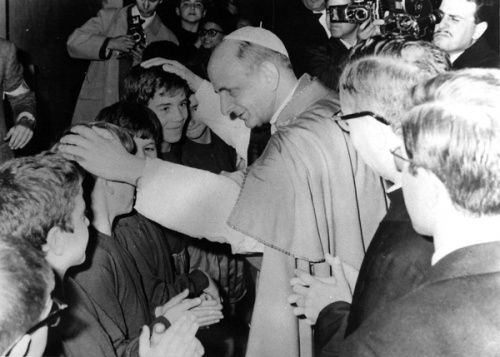
Giovanni Battista Montini -Paul VI- was born in Concesio, a town in the Italian region of Lombardy, near Brescia, on September 26, 1897. He died in Castelgandolfo on the evening of the Feast of the Transfiguration of the Lord (August 6), 1978. He was ordained priest on May 29, 1920 and bishop on December 12, 1954. On December 15, 1958, he was created a cardinal, the first in the list of the first cardinals of Pope John XXIII. Since 1954 he was Archbishop of Milan, where he remained until his election to the See of Peter on June 21, 1963.
In 1922 he joined the diplomatic corps of the Holy See. After six years in Warsaw, he was transferred to Rome and served in the Roman Curia until 1954. In 1952 he was appointed prosecutor of state by Pius XII. He also worked in youth and university ministry and in Catholic Action.
As Pope, he continued, promoted and crowned the Second Vatican Council, implemented its first reforms, promoted ecumenism and interreligious dialogue and undertook apostolic journeys to various continents. He was the author of seven encyclicals and a great apostle of dialogue and rapprochement with contemporary culture. He was beatified by Pope Francis on October 19, 2014, at the closing Mass of a Synod of Bishops, an institution promoted by Paul VI in 1965.
Lord Jesus, we thank you for the luminous witness of Pope Paul VI, whom you gave us as a servant of the Gospel and universal Pastor.
His ardent love for you, his passion for the good of your Church, his wisdom and his balance in moments of tension have guided our path in the glorious years of the Council and in those not at all easy ones that followed. His passionate dialogue with culture in search of truth, his tireless action for peace, his courageous defense of the value of life, his pilgrimage in the footsteps of the Apostle of the Gentiles, his prophetic voice in proclaiming the civilization of love are still luminous signs for the Church and for our time.
Show your benevolence towards us and, if you so desire, glorify your servant Pope Paul VI,
that his memory may shine before the whole Church as a stimulus to a rejoicing journey of faith, to an integral ecclesial communion, to a trustworthy and passionate missionary witness.
Amen.
Cardinal Montini was very worried during the conclave, because he knew what awaited him. During his fifteen years of papacy, he fearlessly faced the challenges of his time. He did so with 7 surprising gestures and feats.
Mr. Francisco Varo Pineda
Director of Research at the University of Navarra.
Professor of Sacred Scripture at the Faculty of Theology.
Table of Contents
 carf@fundacioncarf.orgLandline: +34 914 029 082Mobile: +34 638 078 51145 Conde de Peñalver Street.