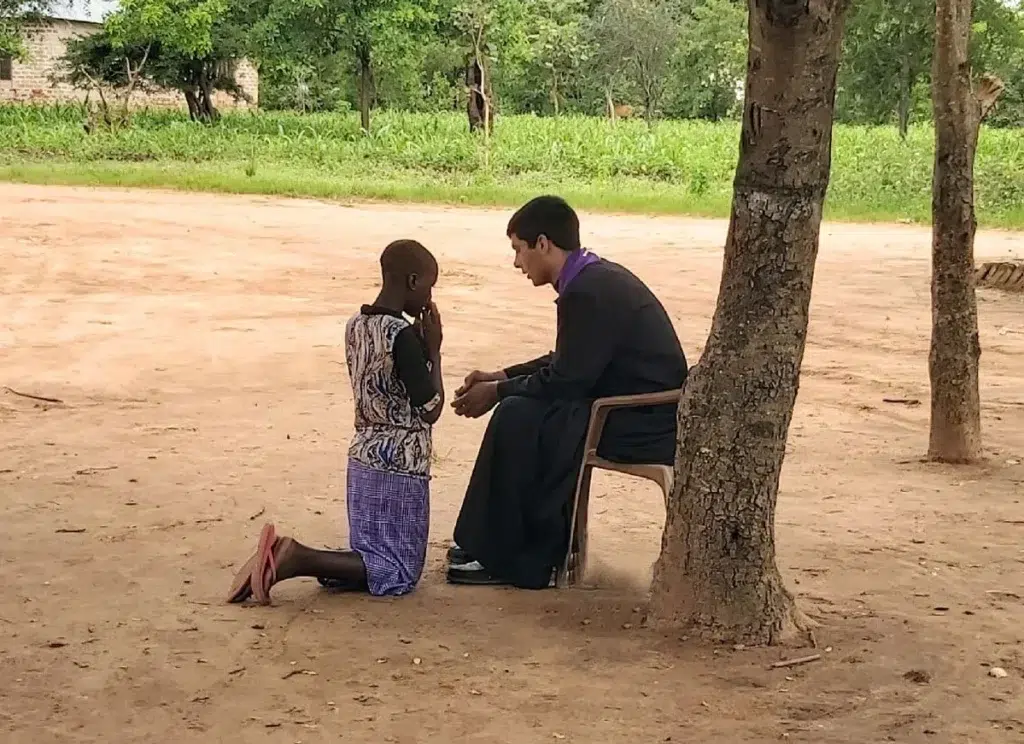
There are people who have not gone to confession for many years. Others want to do it, but do not know where to start. The website I confess has arrived to help us. Some people are afraid, ashamed or simply feel that they “no longer remember” what it was like and what they should do. And then there are those who confess frequently, but have fallen into a kind of routine where they always say the same thing, almost by rote, without stopping too long to review their life.
In the midst of this reality, a simple, direct and very current digital proposal appears: yomeconfieso.es, a website designed to help you prepare well for the sacrament of Confession. But who is behind this initiative? A priest, of course, Don Javier Sanchez-Cervera, creator also of the famous audios, ten minutes with Jesus.
The website is not intended to replace the priest, nor to turn the sacrament into something digital. Its objective is much simpler and, precisely for that reason, interesting: to accompany the person before going to confession.
And it does so with a friendly, uncomplicated language and a very intuitive dynamic.
Many Catholics remember learning to go to confession as children, before First Communion. The problem is that the years go by and, if one moves away from the practice of the sacrament, a fairly common feeling returns: “I don't know how to do it”.
The website is clearly designed to respond to this situation. From the beginning it conveys the feeling that no one is judging you. It does not use overly technical or moralizing language. It seems more like someone who accompanies you step by step to help you do something important: to look at your life with sincerity.
This approach is probably one of the great successes of the project. Because today many people do not reject Confession out of rebellion against the faith. Sometimes they simply feel blocked, insecure or disconnected. They have lost the habit. They do not remember the formulas. They don't know what to say. Or they think that their sins “are always the same” and that there is no point in going back. The web tries to break precisely that initial barrier.
The most interesting part of the experience is the interactive self-examination offered by the website. Instead of offering a long text to read, it proposes different themes related to daily life. The user marks whether he/she falls a lot, regularly, a little or not at all on each one.
And here is something important: it does not focus only on the “most scandalous” sins. The list includes a wide variety of issues: not praying; superstition or missing Mass; blasphemy, pride, disobedience, bad answers, hatred, anger, criticism, gossip, bullying, xenophobia, drugs, gluttony, pornography, impurity, sex; theft, greed, materialism, selfishness, laziness, lying, envy.
The approach is striking because it mixes traditionally recognized sins with others that are very present in today's life, especially among young people and adults: speaking ill of others, living obsessed with material things, normalizing the consumption of pornography or falling into dynamics of hatred and aggression in social networks.
That makes the exam not seem abstract or disconnected from reality. The web manages to ground sin in concrete situations of daily life. And that is important, because many times the problem is not that a person does not want to go to confession, but that he does not even identify certain attitudes as something that is hurting him spiritually or personally.
And it doesn't just ask questions: it also helps to reflect. After sorting these topics according to frequency, the site proposes to start a guided chat. Before starting, a simple message appears to prepare the user: “Let's go with the questions about the list you have ordered before.".
From there, questions related to the previously marked topics appear. The user must answer if he/she has fallen into it many times, some times, few times or never.
The system is progressive: you answer a question and the next one appears. This makes the exam much more dynamic than a traditional checklist. But, above all, it helps you to stop. Because one of the most difficult things today is precisely that: to stop and review one's life calmly.
We live surrounded by noise, screens, rushing and constant distractions. It has been a long time since many people have spent ten minutes sincerely asking themselves how they are living. The web yomeconfieso.es, without dramatization, forces us to do a little bit of this inner exercise.
Confession does not begin at the confessional
One of the most interesting messages this tool conveys is that a good confession begins before entering the church. It begins when you decide to be honest with yourself.
The examination of conscience is more than “making a list of sins”. It is to search the heart. Detecting habits. To discover wounds. To recognize attitudes that perhaps had been normalized. And here the web has a lot of pastoral value, because it helps especially people who:
It can also be of great help to those who do go to confession regularly, but have turned the sacrament into something automatic. It is relatively frequent to fall into the feeling that “I always confess the same thing”. And, in part, it is true: we all have tendencies, defects and recurrent falls. But sometimes that makes us stop looking at other areas of our life.
Perhaps one is preoccupied with certain specific sins and, in the meantime, has completely neglected prayer, charity, family treatment, pride, selfishness or the way one speaks of others. Yomeconfieso.es proposes to broaden the focus. It makes the person look again at his whole life.
Another interesting aspect is the language. Everything is presented in a very visual, simple and direct way. It does not look like a page written years ago. Nor does it use excessively complicated or moralizing expressions.
This makes it much easier to connect with young people or people far from the Church. Because many times the problem is not the Christian content, but the way of communicating it.
In this case, the experience is similar to a guided conversation. The person advances step by step, without pressure, almost as if someone were accompanying him personally.
Moreover, the structure is somewhat reminiscent of dynamics that today are part of everyday digital life: answering questions, interacting, moving through screens, receiving personalized accompaniment.... And that makes it familiar even to those who do not have much religious training.
When the questioning process is over, the website does not limit itself to displaying a list. It also offers concrete help to better prepare for the sacrament. This detail is important because many people still have practical doubts:
The web tries to respond to all of this in a natural way.
Finally, it shows a kind of guide or orientative conversation on how to begin the confession with the priest and presents the list of sins that the person has identified during the examination.
It does not replace the actual dialogue with the confessor, but it does remove some of the initial fear. And that, for many people, can make the difference between taking the step or continuing to postpone it indefinitely.
Projects like this one show that the Internet can also become a space for evangelization and accompaniment. The key is in how it is used.
In this case, technology does not distract. It does not seek to entertain or generate dependency. It does just the opposite: it helps to get inside oneself.
And that's quite countercultural. Because while much of the internet is designed to constantly grab attention, this website invites silence, reflection and sincerity.
There is something pedagogical about the format itself. Many people would perhaps never sit down to read a long examination of conscience on paper, but they are willing to interact with short questions from their cell phone or computer. And there the tool finds a very interesting access point.
In the end, the most valuable thing about the website is not the technology or the questioning system. It is to remember something essential: confession is not an uncomfortable procedure or a cold list of errors. It is an encounter with God's mercy.
Sometimes the sacrament is spoken of only as a moral obligation, but many people need to rediscover it from another perspective: as an opportunity to start anew. That is why tools like these can help so much, because they lower psychological and emotional barriers that weigh heavily today, such as, for example, the following:
The web does not force. It does not pressure. It simply accompanies. And perhaps therein lies a good part of its effectiveness.
Table of Contents
 carf@fundacioncarf.orgLandline: +34 914 029 082Mobile: +34 638 078 51145 Conde de Peñalver Street.