How much does the formation of a seminarian cost?

The cost involved in the formation of seminarians and diocesan priests should be a collective effort of all Christians. Dioceses, foundations, faithful and even the brotherhoods and confraternities collaborate ingeniously so that we sow the world with priestly vocations.

The CARF Foundation and the challenge of seminarian formation

Since its foundation in 1989, the CARF Foundation has acted as a link between thousands of benefactors willing to contribute financially with study grants and scholarships so that priests and seminarians from all over the world can receive a solid theological, human and spiritual preparation.

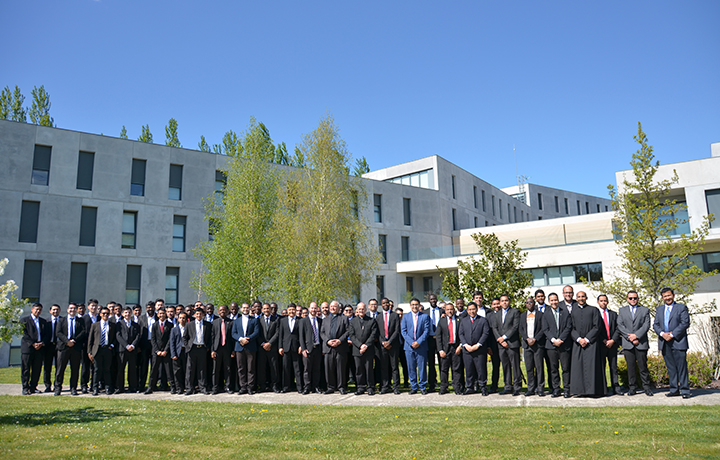
More than 800 bishops from 131 countries want some of their priests and seminarians to study at the Pontifical University of the Holy Cross in Rome or at the Faculties of Ecclesiastical Studies of the University of Navarra in Pamplona. In turn, they complete their human and spiritual formation at the Sapientiae (Rome) and Bidasoa (Pamplona) International Ecclesiastical Colleges. In order to carry out this training also apply for study grants for their candidates.

Thanks to benefactors and donors like you, the CARF Foundation meets most of the requests, but the needs are growing and we want all requests to be met.
seminaristas-formación-sacerdotes

How much does a full formation grant for a seminarian cost?

18,000 euros is the amount necessary for a candidate to live, study and train for a year at the universities of Rome or Pamplona. The neediest dioceses in the world request a full scholarship for their candidates. In all cases, the diocese covers a small part of the cost of training a seminarian in his country of origin, as a sign of its commitment to maximize the future use of the aid.

Approximately every academic year the CARF Foundation assists with direct and indirect scholarships approximately: 400 seminarians, 1,120 diocesan priests and about 80 members of religious institutions. Each full scholarship, awarded by the foundation, can be broken down as follows: €12,000, room and board. 8,000 €, tuition and academic fees, supplements for academic, human and spiritual formation. Personal expenses are always paid by the student or the diocese.

How much has the number of seminarians in the world grown?

The Central Statistical Office of the Church has been in charge of the edition of The Pontifical Yearbook 2022 and the Ecclesial Statistical Yearbook 2020 published in recent days.

They gather the data on the 2019-2020 biennium which gives us an overview of the numerical reality of the Catholic Church in the different countries and on the different continents allowing us to extract some news related to the life of the Church in today's world.

The presence of Catholics does not change at the level of the entire planet, but it does if we analyze the number of Catholics in the different continents. There is a maximum increase on the African continent and a relative increase in Asia. On the other hand, in Europe there has been a continuous decline in recent years. America and Oceania remain stable in relation to the world total.

The data analyzed on priests in all ecclesiastical districts of the Catholic world, both diocesan and religious, reveal a decline in the number of priests. At the close of 2020 there were 410,219 priests in the world, 4,117 fewer priests than the previous year. Only in Africa and Asia were there significant increases in the number of priests, which together contributed a total of + 1,782 priests to the world during the biennium under analysis.

We can observe a clear imbalance between the number of Catholics and priests in the world, which translates into a very high overall pastoral burden.
seminaristas-formación-sacerdotes

Regarding seminarians

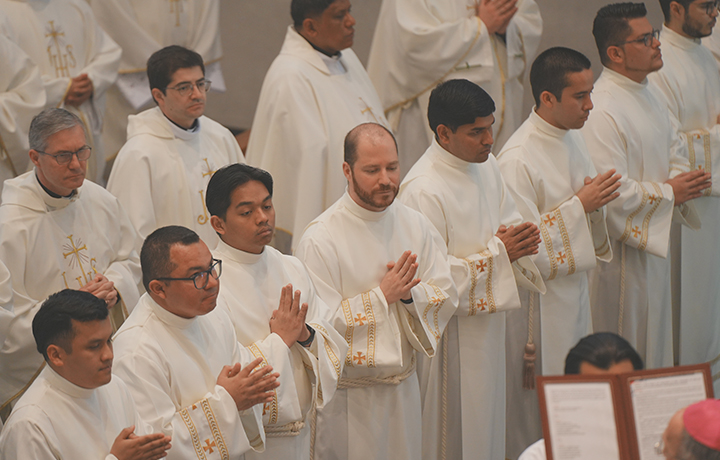
Candidates for the priesthood went from 114,058 seminarians in the world in 2019 to 111,855 in 2020. The trend in major seminarians observed in the world total, between 2019 and 2020, affects all continents, with the exception of Africa, where seminarians increased by 2.8%. From 32,721 to 33,628 seminarians.

The decreases in priestly vocations are significant especially in Europe (-4.3%,) although they can also be seen in the Americas (-4.2%) and Asia (-3.5%.)

The percentage distribution of seminarians by continent shows slight changes over the two-year period. Africa and Asia contributed 58.3% of the world total in 2019 and in 2020 their share rises to 59.3%. Oceania reveals some negative adjustment. America and Europe as a whole see their share decrease. American and European seminarians accounted for almost 41% of the total, while one year later they drop to 39.9%.

The birth of priestly vocations in Africa and Asia is a constant fact recorded in recent years. These future priests will support and strengthen the European and American Churches. This data helps us to get a real idea of the responsibility we have as Catholics to take care of each new vocation with the utmost care. Supporting the dioceses in the formation of seminarians, even more so in the most disadvantaged continents.


Bibliography:

- Annuario Pontificio 2022 and Annuarium Statisticum Ecclesiae 2020
Franklin, Brazilian seminarian: "The priest must be a friend of Christ".

Franklin Cavalcante

Franklin Cavalcante is a seminarian from the Archdiocese of San Sebastian in Rio de Janeiro. He is 31 years old and has been studying for more than a year at the Bidasoa International Seminary and at the Ecclesiastical Faculties of the University of Navarra, thanks to a scholarship from the CARF Foundation. He studied philosophy at the Pontifical University of Rio de Janeiro.

He is the only son of Joselina Severino de Lima and Vicente Cavalcante Inacio. His mother was more religious than his father and from her he learned the faith since he was a child. Seminarian Franklin tells us his vocation testimony.


I listened to God

In my youth I wanted to be a soccer player because I wanted to find the true path to happiness. After receiving my first communion, unfortunately, I moved away from the Church, rarely attending mass.

However, at the age of 18, at one of the few Masses I attended, I could hear God speaking to me.. Since then I began to take the Christian life seriously, entering a Chrism course. I received the sacrament of confirmation and began to help in the pastoral work of my parish as a catechist and preacher in the prayer group.

"Jesus Christ was what made me happy."

Little by little I discovered that Jesus Christ, the fullness of my life, was what made me truly happy. Until then, I had never thought of becoming a priest, but my pastoral work in my parish made me realize that the people needed pastors.

Therefore, I had a deep conversation with my parish priest and began my vocational journey. After two years of participating in vocational meetings, I discerned that the priesthood was my vocation and my path to happiness. To make Jesus Christ known and to make people friends of God is the mission I hope to carry out throughout my life.

The priest of the 21st century

I am convinced that the formation I am receiving will help me to become a priest of the 21st century who, in my opinion, must be first and foremost a friend of Christ who witnesses, with his life, to love for the Church and for souls.

Bidasoa, a blessing

I sincerely believe that the Bidasoa International Seminar is a blessing for our priestly formation. Here we receive very good formation to grow in friendship with Christ and, consequently, to mature in the priestly vocation. Experiencing the richness of the Universal Church, with so many brothers from different countries, is like living a "Pentecost".

Among the many positive aspects of our seminary, I would highlight the spiritual assistance. We participate in daily Mass, have time for personal prayer and frequent the sacrament of penance. We also receive a great deal of support for study, which is complemented by the three libraries that provide good study space, literature, philosophy and theology books.

I am also grateful for the patience of the professors at the University of Navarra to support and understand us in the difficulty of the language (that's why they speak slowly).

Fostering priestly vocations

In these times in which we are living, a "change of era" as Pope Francis says, in which many young people are far from God, I think that in order to foster priestly vocations it is important, above all, the prayer of the Christian people so that the Lord of the harvest will send out workers. Moreover, it is indispensable that priests give witness to the beauty of the priestly vocation through a balanced and mature life.

Secularization and evangelization

At present, secularization and the irruption of Protestantism in Brazil are affecting the Catholic religion. For this reason, the Church has the mission, today more than ever, to announce the good news of Jesus Christ. Promoting the encounter of young people with the Person of Jesus, so that they may discover in Him the sure path to happiness, is very important. In the face of secularization, we must live the faith as witnesses of the Risen One and in the face of Protestantism, we must present the truth of the faith.

Apostolic needs of Rio de Janeiro

In this line, I believe that the most important apostolic needs of Rio de Janeiro are: the personal conversion of each Christian and, from this, to promote an evangelization that presents all the richness and truth that Jesus Christ entrusted to the Catholic Church.

Thanks to benefactors

Finally, I would like to thank the CARF Foundation and to all the benefactors for their generous help, because thanks to them, I can receive an integral formation in Bidasoa and at the University of Navarra. May God bless you and the Virgin Mary protect you. I pray for you.

► You may be interested in: Simon, Tanzanian seminarian: from engineer to priest


Don Pablo Santa Maria Watson, priest from Canada

"Thanks to the Sacred Vessel Backpack I was able to celebrate Holy Mass at my grandmother's residence."

The Social Action Board of the CARF Foundation delivers each year more than 60 sets of complete Holy Vessels to deacons and priests from all over the world who study in Pamplona and Rome.

They are newly ordained priests who return to their countries to carry out their pastoral work. On many occasions, they must to celebrate Mass or impart the sacraments in remote places or parishes lacking the means to do so.

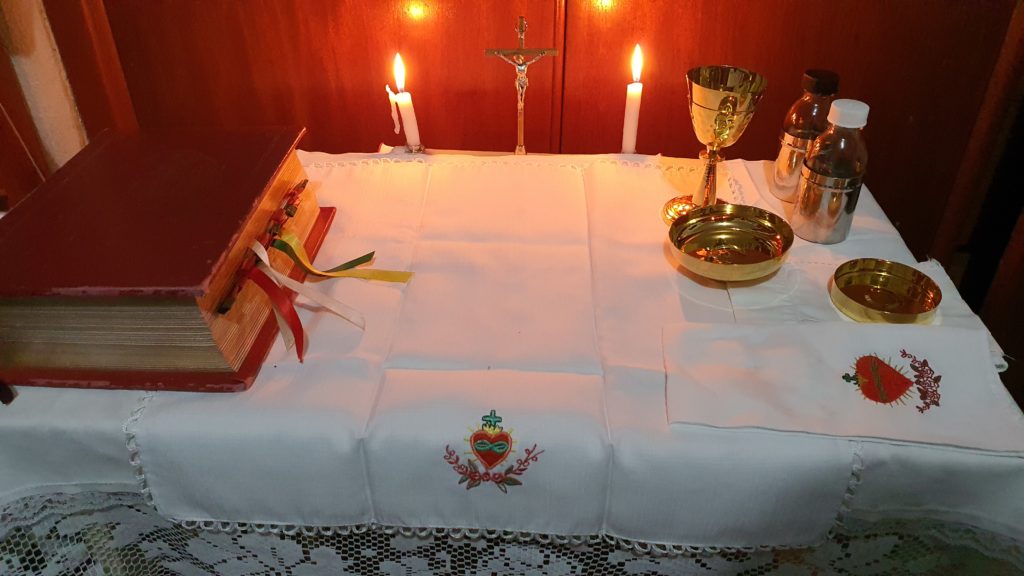
The Holy Vessel case contains everything necessary to celebrate Holy Mass with dignity in any location, without the need for prior installation.

On my grandmother's birthday

Douglas Lyra da Silva, parish priest of the Archdiocese of São Sebastião do Rio de Janeiro and former student of the Bidasoa International Seminary (Pamplona) tells us in a testimony how this set of Sacred Vessels has helped him.

"The case I received has helped me on several occasions. One of the most endearing moments was when I was I used all the sacred vessels and all the elements in their entirety at my grandmother's birthday party at her residence.

Administering the Anointing 

This gift is a great service for the care of the sick in nursing homes and hospitals. I carry the holy oil and the aspersorium to administer the Anointing.

There are no words to describe the joy that our sick little brothers feel when they receive the comfort and encouragement of the priest. The sacraments relieve them of their pain. In these moments, it is not only the priest who is in front of them, but also all the benefactors that will make it possible to exercise the ministry with dignity.

During the Covid 

It also helped me enormously when I celebrated Holy Mass in my room because I had to be confined and isolated by the COVID last January.

In addition, thanks to the set of holy vessels, I was able to celebrate Holy Mass at the "flag peak" on a day with the young people.

Estuche de Vasos Sagrados

Celebrating Holy Mass in your room thanks to the Holy Vessel Case.


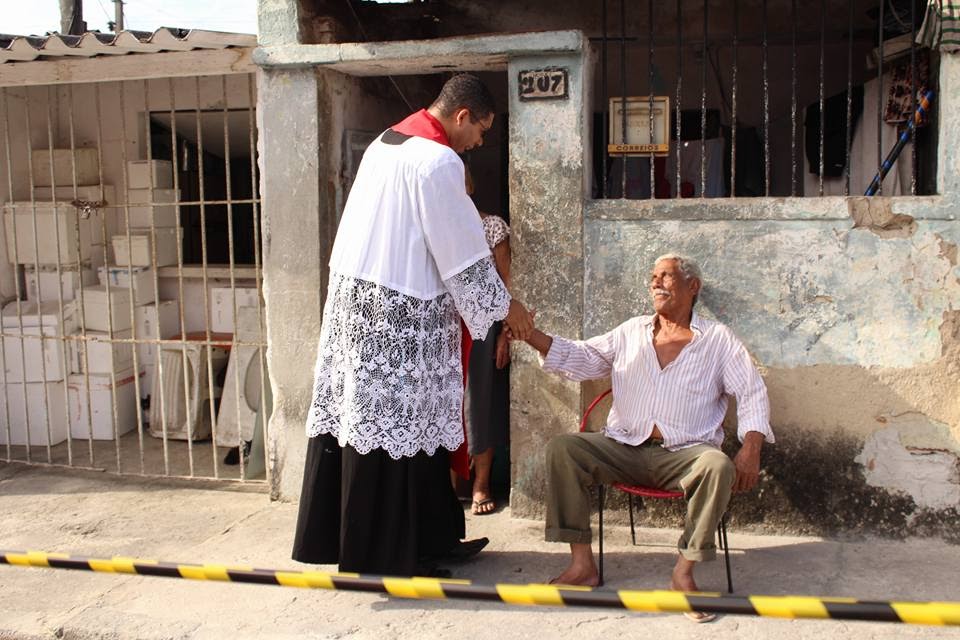
El P. Douglas saludando a personas de las periferias de Río de Janeiro.

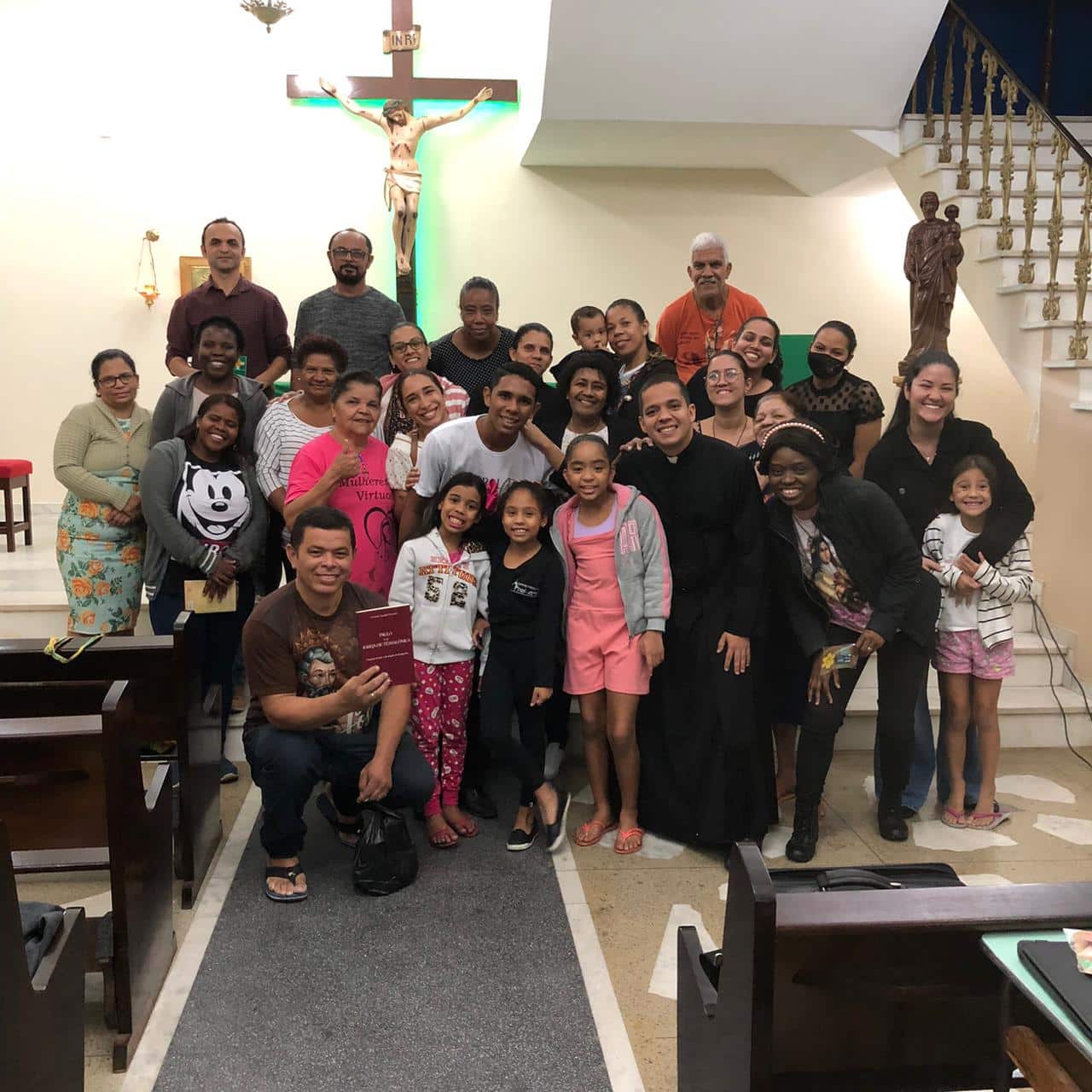
Douglas is from Rio de Janeiro and is currently the pastor of the Church of the Eucharistic Heart of Jesus in the Archdiocese of São Sebastião de Rio de Janeiro. Thanks to the Sacred Vessel Kit given to him by CARF's Social Action Board, he has been able to celebrate Mass in some places lacking the means to do so.

"There are no words to describe the joy our sick little brothers feel when they receive the comfort and encouragement of the priest. The sacraments relieve them of their pain. In these moments, it is not only the priest in front of them, but also all the benefactors who will make it possible to exercise the ministry with dignity," he says.

Memories of Bidasoa

"It has been five years since I returned to my archdiocese, in the city of Rio de Janeiro, Brazil. I studied and resided in the Bidasoa International Ecclesiastical College from 2012 to 2016. My rector was Don Miguel Ángel Marco de Carlos, the responsible formator Don Emílio Forte López and the spiritual director Don Joaquín Sedano.

One of the good memories I have of those four years was the work they requested for computer services, the construction of the web page and the live transmission of the ordinations in St. Nicholas Church, when the means were still scarce, It was an adventure.

I did everything with great pleasure and at that time it was a path of sanctification for me, of service to our brothers and gratitude towards Bidasoaa home that forms us in the Love of the Heart of Jesus.

Ordained priest at age 31 

I was ordained a priest at the age of 31, on August 13, 2016, in my home parish, St. Blaise, in the Madureira neighborhood where I grew up, in one of the suburbs of the city.

Now, I carry out pastoral work at the Eucharistic Heart of Jesus Parish.in the most peripheral area of Rio de Janeiro. I arrived here while still a deacon and after ordination, I stayed on as Parochial Vicar, until my appointment as pastor on March 5, 2018.

Four years as pastor 

Here, in addition to the Mother Church, we have six other branch parishes: St. Michael the Archangel, St. Sebastian and St. George, Our Lady of the Head and St. Luke, Our Lady of Fatima, Our Lady of Graces of the Miraculous Medal, St. Peter. Of these, 4 are still under construction.

Of these four years as pastor, two have been spent in the midst of the COVID pandemic. Many were isolated in fear in their homes. But we priests continued to work, celebrating Mass and broadcasting on social networks, even when we had to close the doors (there was no public celebration for some time).

We also went many times to the cemetery to bury the victims of the virus. And on occasion, we gave communion and anointing to the elderly who needed it. The mission did not stop, despite the risk.

Accompanying vocations 

Currently, the bishop has entrusted me with the task of accompanying vocations in the vicariate or "West" region of the city: I am the spiritual director of the apostolate of prayer in the Vicariate. In addition, I coordinate two groups of couples of the "Teams of Our Lady", and I am also a member of the presbyteral council of the archdiocese.

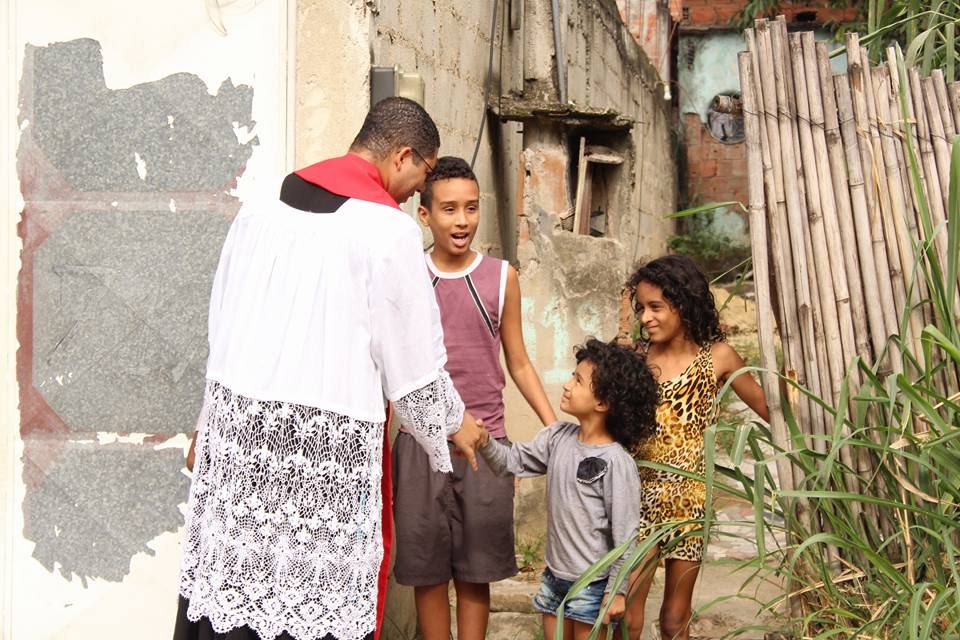
El P. Douglas saludando a niños de las periferias.

Fr. Douglas greeting children from the peripheries.

"This gift, the Holy Vessel Case, is a great service for assisting the sick in nursing homes and hospitals. I carry the holy oil and the aspersorium for administering the Anointing."

Brazil's challenges

What are the challenges of the mission in Brazil, a continental country with an incredible diversity of culture and social realities?

I believe that in the urban region where I am, the work is aimed at couples, children and young people, so that they look at faith with closeness and as a response to the existential crisis that leads to bad dependencies of all kinds, and to the loss of the meaning of life and the value of a life in community.

Non-Christian practices 

There are many distractions, mainly on the Internet, that induce them to non-Christian practices and conceptions, based on a perfidious 'freedom', on 'click for visibility' and on 'consumerism' that does not satiate the soul.

There is still the loss of catechesis and transmission of the faith within the family, because there are few Christian marriages, which drowns the future of Christianity in a gloomy perspective towards darkness.

Thank you to the benefactors of the CARF Foundation.

Finally, I would like to say good-bye by thanking the benefactors The CARF Foundation for the Sacred Vessel kit, and for its dedication to providing the conditions for a good formation for priests in dioceses around the world.

El P. Douglas con las Hijas de María. Douglas with the Daughters of Mary.


Marta Santín, Journalist specializing in religious information

Don Leandro Farías, Argentinean priest

"Christians in the Holy Land are a minority in number, not in quality."

- It is a pleasure to greet you, dear Father Marwan, especially in these days when we are again watching on TV and reading in the newspapers about the conflicts that are shaking Jerusalem and the Holy Land. Talking to someone who is committed to institutional communication and Christians in the Holy Land, helps us to understand how great is the complexity of that part of the world. And you are an example of this complexity.

Yes, I was born in Jerusalem in 1974 in an ecumenical family. My father was from the Orthodox Church and my mother is from the Latin Church. As you anticipated, I was baptized by the Melkites, because my mother's uncle was a Melkite priest. When I was born, he asked my parents to be able to baptize me himself, and he did it according to his rite. After that, my parents wanted me to go to one of the best schools we have in Jerusalem. So they enrolled me in the Anglican school. And in the end, with an Orthodox father, a Latin mother, baptized by the Melkites and educated by the Anglicans, I finally entered the convent of the Franciscans of the Holy Land.

The complexity of the Christians of the Holy Land

- Well, something very fascinating but not very easy to understand for those who do not live in the East and do not know this complexity...

And mind you, my first contact with the faith was, in fact, in the Anglican Church. At school we went to church to pray, obviously according to the Anglican rite. At the same time, my parents would send me to the oratory of the parish church, which was a Latin parish. I went once a week and as often as I could. At that time I met some young friends, not from school but from the neighborhood, who were part of the Franciscan Youth of the Old City of Jerusalem.

I joined them because I liked the way they gathered to pray and meditate on the Word of God. Little by little I got to know the Franciscan friars better and I began to feel God's call to be part of this Franciscan fraternity.

At the end of my last year of high school, I had already decided to enter the friary for a trial of Franciscan life with the friars of the Custody of the Holy Land. My parents were strongly opposed. However, after much insistence on my part, they allowed me to enter the friary.

cristianos en tierra santa

- An Israeli citizen, of Arab-Palestinian ethnicity, of Christian faith and, moreover, raised among several confessions and rites. How do you live this complex identity?

Certainly, as a Palestinian native of Jerusalem, which is in fact in Israel, a country of so many ethnicities, with a really diverse ecclesial background, it has not been and still is not at all easy... Well, notice that in Jerusalem everyone would like to have a small place.

And it has not been easy, first of all, because in Holy Land a person has to adapt to so many mentalities and so many ways of existing. And I'm not just talking about Arab Israeli citizens, but also about the many different mentalities of so many pilgrims who visit the Holy Land all the time, and often so many foreigners who live there.

On the one hand, their presence can be a challenge; on the other hand, it is also a richness. A challenge because it is necessary to have both an ecumenical spirit and an interreligious openness. The richness lies in knowing how to grasp and appreciate the best messages of all these cultures.

How many Christians are there in the Holy Land

- How many Christians are there in the Holy Land, of what confession and what are their particular needs?

Christians in the Holy Land are from many different churches. There is the Catholic Church, the Anglican Church, the Protestant Church, as well as the Orthodox Churches. However, we Christians live together in great harmony of faith, because we believe in the same God and savior Jesus Christ. Our absolute need is to affirm our existence and presence, as a united body, because we are less than 2 % of the population of the Holy Land (the State of Israel alone has almost 9.5 million inhabitants). So we are really a minority.

It is normal for there to be this need for self-affirmation and to say that we are really present. In fact, we are present from the scientific and educational point of view, from the administrative point of view, in the world of work and business, and also from the point of view of faith.

Interreligious dialogue

- And this aspect of faith and dialogue is very important, as we know that Christians play a special role in peace talks, thanks to having the best schools in the country. Statistically, they are the most successful in their studies, especially in fields such as medicine. And they are a real factor of national unity, even if they are squeezed between the two major majority denominations: Judaism and Islam.

Indeed, we are. We are one of the components that make up the society that lives in the world. Holy Landbetween Christians, Muslims, Jews, Druze and others. What happens on a socio-political level throughout society, happens to us as well. And what others may experience, we experience as well. But being in the minority means that we are steadfast. We are present, in fact, in many areas, as you rightly said. We are also influential thanks to the support of the Church.

Evangelization through the media in the Holy Land

- You are currently studying Institutional Communications at the Pontifical University of the Holy Cross. When you finish your studies, what will be your apostolic goals? We would like you to tell us about your career before coming to Rome.

I have been very involved in the apostolate and pedagogical formation. I was the director of a school for 15 years and was also a parish priest both in the city of Bethlehem and in the parish of the city of Nazareth. In addition, I worked in various educational and pastoral settings, such as in the "Casa del Fanciullo", a center for children with particular disorders, both physical and social.

Now my direction is changing, in a sense of the method of my work. However, the goal remains and will always remain to serve the word of God, to promote and proclaim his message of salvation. Evangelization is the key word of my study.

For this reason, I am currently training with a view to returning and working in the Christian Media Centre of Jerusalemwhere I will be able to evangelize through the media in my country. I would like to transmit the voice of Christians in the Holy Land nationally and internationally, because our voice makes it clear that we are the living stones of the Land of Jesus, and our life is a mission, a vocation to persevere in faith. 

Representing the true identity of the Christians of the Holy Land is a duty, and if I really want to do it, I have to know how to do it, that's why I chose to study Social and Institutional Communication at the Pontifical University of the Holy Cross in Rome.

Decisive support from the benefactors of the CARF Foundation

- And in this sense, it is also important the contribution of our benefactors, who help you and other students from all over the world to be properly trained in order to serve each one in their particular reality...

Of course! In Arabic it is said that the word 'yes' is a word blessed by the Lord, because it shows adherence to His plan, and adherence in turn shows faith. You, dear benefactors of the CARF Foundation, have given a testimony of faith by adhering to the request for help made by our Pontifical University of the Holy Cross, which is forming people who will be able, thanks to this preparation, to work better in the Lord's field, so your 'yes' is truly blessed by the Lord.

It will bring you all its blessings, because in an indirect way you have participated in spreading the word of God in the message of salvation. You are our partners in evangelization. For this, I thank you and pray for you, and the Lord will know how to reward you for your generosity.

- Thank you very much, dear Father Marwan... And as they say in the Holy Land... Shalom, Salam!


Gerardo Ferrara
BA in History and Political Science, specializing in the Middle East.
Head of the student body at the Pontifical University of the Holy Cross in Rome.