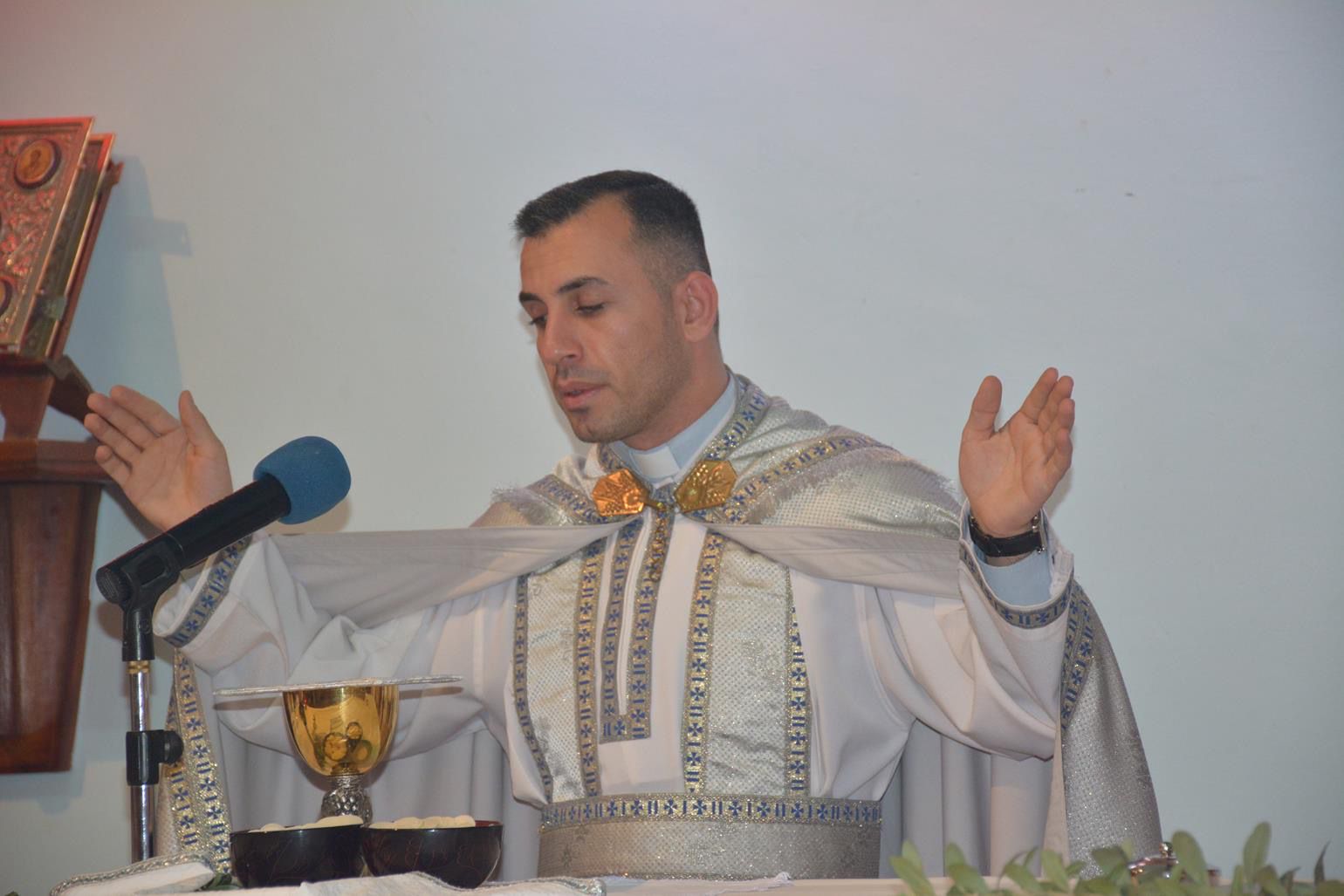
The Catholics in Haiti often experience a situation that is surprising in other parts of the world: they are communities of the faithful who spend months without being able to celebrating and living the Eucharist. Hugues Paul, from the diocese of Jacmel, has known this reality since his childhood.
That experience was decisive in his life. «In these church communities, sometimes almost a year can go by without the celebration of Holy Mass,» he explains.
It was precisely this shortcoming that awakened in him the vocation. He grew up in a small community that in Haiti is known as the chapel, a church attached to a parish where, in the absence of priests, the faithful keep the faith alive with celebrations of the Word led by lay people.
«Normally there is a pastoral agent, whom we call the chapel director, in charge of presiding over celebrations of the Word in the absence of the priests». In the midst of this reality, Fr. Hughes Paul felt God's call: «It was in this context that I felt God's call to lend a hand in his vineyard, to help his people to encounter him and to live the faith in a deeper way where the Eucharist was at the center».
Hugues Paul was ordained priest the June 26, 2021 and now has 39 years old. He comes from a large family with two brothers and five sisters, and is grateful that his parents are still alive.
He received a solid Catholic education at home, although his academic formation took place in Christian centers of other denominations: he studied elementary school in a Catholic school. protestant school and secondary school in a center of the Episcopal Church of the Anglican Communion.
His adolescence was marked by an intense participation in the life of the local Church. «I lived a very joyful and active adolescence, participating in groups and in the chapel choir, until I finally entered the seminary.».
That simple community, where faith was sustained with few resources, but with great conviction, was the place where he matured his priestly vocation.
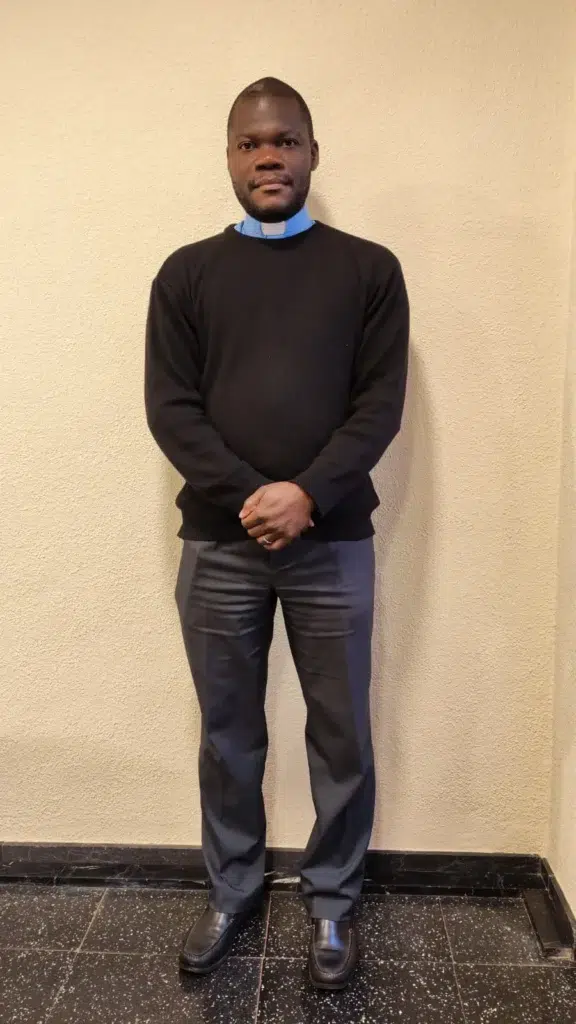
Today it continues its priestly formation in Spain. The June 30, 2024 thanks to the support of the CARF Foundation and other institutions, and is currently completing a bachelor's degree in Biblical Theology, The final phase, already in its final phase, in the Ecclesiastical Faculties of the University of Navarrein Pamplona.
From a distance, he observes the situation in his country with concern. Haiti is going through a deep crisis marked by violence and insecurity. «Life has become very difficult, especially because of the insecurity that affects almost the entire territory, especially the capital,» he explains.
However, even in the midst of that context, faith remains one of the living force. «Despite this, the people continue to believe: many people take risks to find a place to live their faith and participate in the celebrations.».
The Jacmel diocese, located in the southeast of the country, is in a relatively more stable situation than in other regions, but the consequences of the great earthquake of 2010 remain visible. «We are still awaiting the completion of the reconstruction of the cathedral and many destroyed parishes.".
The lack of sufficient resources and aid has delayed for years these works, which for many communities are essential.
The Catholics in Haiti represent between 60 and 66 % of the population. In the diocese of Jacmel there are about 80 priests for 36 parishes, and in the country as a whole - adding the ten dioceses and the religious - it is estimated that there are between 800 and 900 priests. The universal Church has been a fundamental support in these difficult years. «We have received great support from the universal Church, especially through Aid to the Church in Need.».
His experience in Spain has also made him reflect on the differences between the two ecclesial realities. What has impressed him most positively is «the beauty of the churches». However, he is concerned to see temples with few young people. «I am struck by the fact that the Church seems to be made up mainly of older people, with very little presence of young people and children in the celebrations».
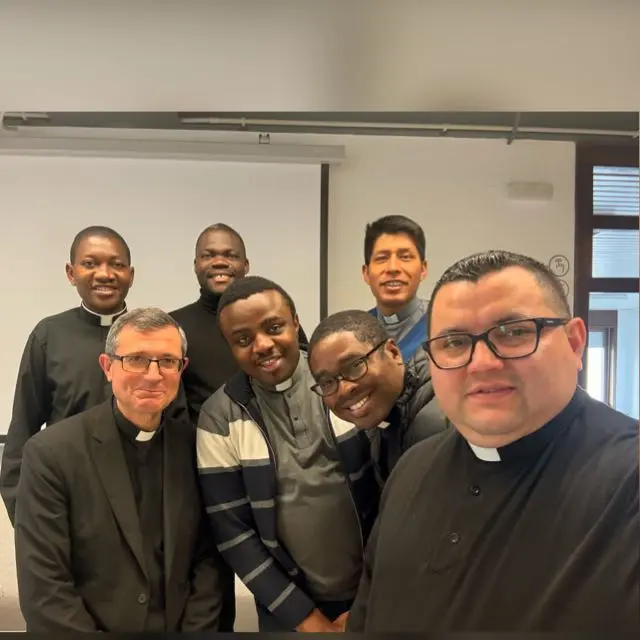
In his opinion, Spanish society is undergoing a profound process of secularization. Even so, he believes that there are also opportunities to revitalize the life of the Church. In particular, he thinks that Spanish Catholics could draw inspiration from the way the liturgy is lived in Haiti. «Spanish Catholics could learn from Haitian Catholics enthusiasm for sung celebrations, The new programs, which help to make them more lively and participative».
Looking to the future, Hugues Paul is clear about what kind of priests the Church needs in the 21st century: «to be close, empathetic and coherent with his faith; a good communicator, open to dialogue, sensitive to social problems, with a solid spiritual life and capable of accompanying without judging».
He considers this same attitude essential to approach those who today live far from the faith. «To evangelizing young people and those who are far from God, I consider it fundamental to listen to them with respect, to give testimony with one's own life, to use current language and digital media, to create welcoming spaces and to show that we are all in the same place. faith answers the real questions of today's world».
Hugues Paul's story is a reminder of a reality that often goes unnoticed: in many parts of the world Christians spend many months without Eucharist and await the arrival of a priest to celebrate Holy Mass.
Precisely from this waiting, new vocations are also born, ready to serve. All the members, friends and benefactors of the CARF Foundation pray for them, promote their good name throughout the world and find financial resources so that they can receive an integral formation in Rome and in Pamplona, as in the case of Hugues Paul.
Marta Santínjournalist specializing in religion.
Table of Contents
 carf@fundacioncarf.orgLandline: +34 914 029 082Mobile: +34 638 078 51145 Conde de Peñalver Street.