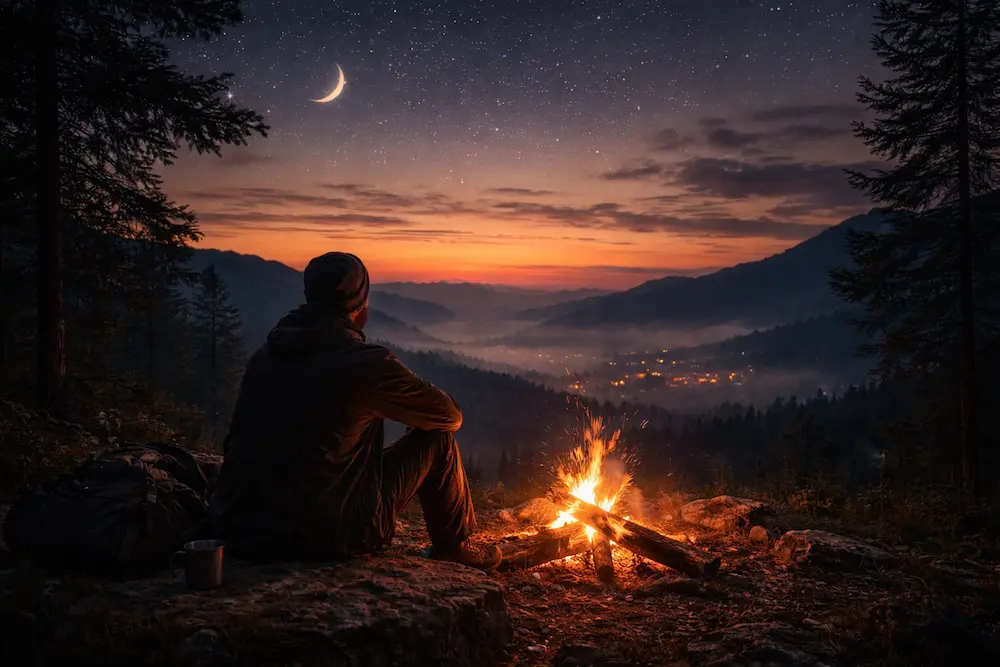
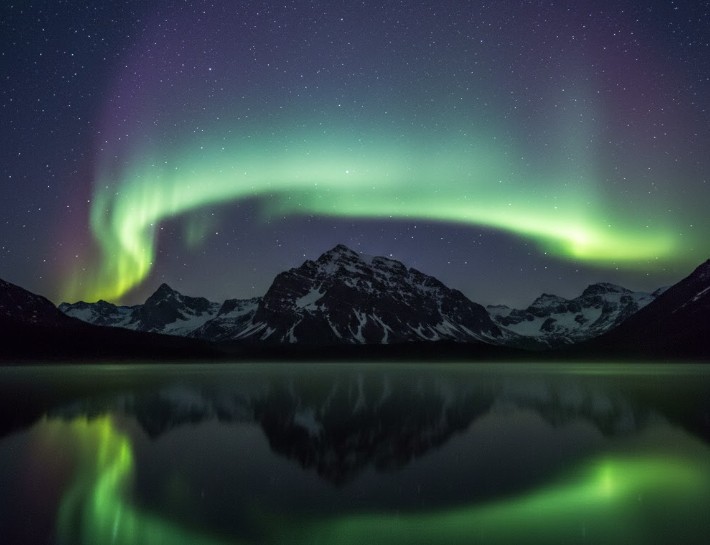
In our walk, we arrive at dusk, at night. Since I was a child, I have been pushed - encouraged, perhaps it would be better - to walk with the day already darkened; and to walk, solitary and in silence, in the midst of the darkness not interrupted by urban lighting. Impregnated in the night, one lives in another way the beating of the earth, the glow of the stars, the aroma of all creation.
And what a joy, to abandon ourselves to the night without nostalgia, to enter it, almost on tiptoe, and ask it to make us participants in its mystery! A joy that perhaps one day Rainer Maria Rilke glimpsed when he wrote these verses in his Poems to the night:
«And suddenly I understood that you walk with me and play, / oh you, grown night, and I looked at you in amazement.... / ...you, elevated night, / you were not ashamed to know me. Your breath / passed over me. Your dilated seriousness, shared / with a smile, penetrated me».
Some welcome the night as a friend, others shun it, as an enemy with whom one can never make peace.
Those who welcome it amicably dispose their spirit to scrutinize the virgin love hidden in darkness and silence. Perhaps with a certain trembling, like Rilke:
«If you felt, O night, as I behold you, how my being recoils at the impulse/ To want to throw itself confidently into your arms/ Can I grasp it so that my brow, arching again/ Will save so vast a flood of gaze?».
I know that I will not find words to sing the beauty of the night -even if I ask poets for help-; perhaps because words exhaust their service in the effort of trying to understand each other; and the night is a land of curds for the hidden human dialogue of the soul with the spirit, which opens and prepares for the ineffable communication -and not only dialogue- between man and God, his creator.
Night is God's creature, and, like all creatures, God's gift to man. Without its darkness, not even the sun would shine. Without the rest it offers us, our walk on earth would be reduced to mere madness; our whole person would lose direction, orientation, and not only the nervous system. The silence and darkness of the night open to man unlimited horizons, more distant and impenetrable than those hidden in the rough sea, and that barely emerge at the edge of the crests of the waves of the ocean sea.
And the night keeps a silence and a darkness for youth; a darkness in silence for maturity; a silence in radiant darkness for the fullness of life. The night enriches our scrutiny; it invites us to penetrate unexplored corners, and the eyes, unable to hold the gaze of the sun, open paths by looking at the stars, and come to unravel the mystery that hides the night: the mystery of man having no other horizon than the Eternal Life, Heaven.
For those who await it as an enemy, the soul of the night is exhausted in darkness and emptiness; and its image seems a foretaste of nothingness.
The night appears then, and appears, twinned with silence and darkness. Tragically twinned. As if darkness were nothing more than darkness, and silence hid the threat of emptiness and oppression. Juan Ramón Jiménez wrote: "The night is leaving, black bull/ -full flesh of mourning, of fright and mystery-, / that has roared terribly, immensely, / to the sweaty fear of all the fallen".
Faced with such an enemy, there is no other recourse but to try to annihilate it, or to flee from it. The night is annihilated by artificially filling it with noise and false light, waiting for the dawn. The candorous mumbled silence becomes anxious shouting, disguised with more or less masked smiles. And the radiant darkness of the universe in the open sky is transformed into tunnel darkness that excludes the stars from our gaze.
Night takes on a different hue when its mystery is combined with that of illness. Some patients await its arrival with anxiety, fearful with a double dread: that sleep will not come, and anguish may turn the hours until dawn into the figure of death, of death itself; or that, if sleep finally overcomes them, it may become the last earthly sleep.
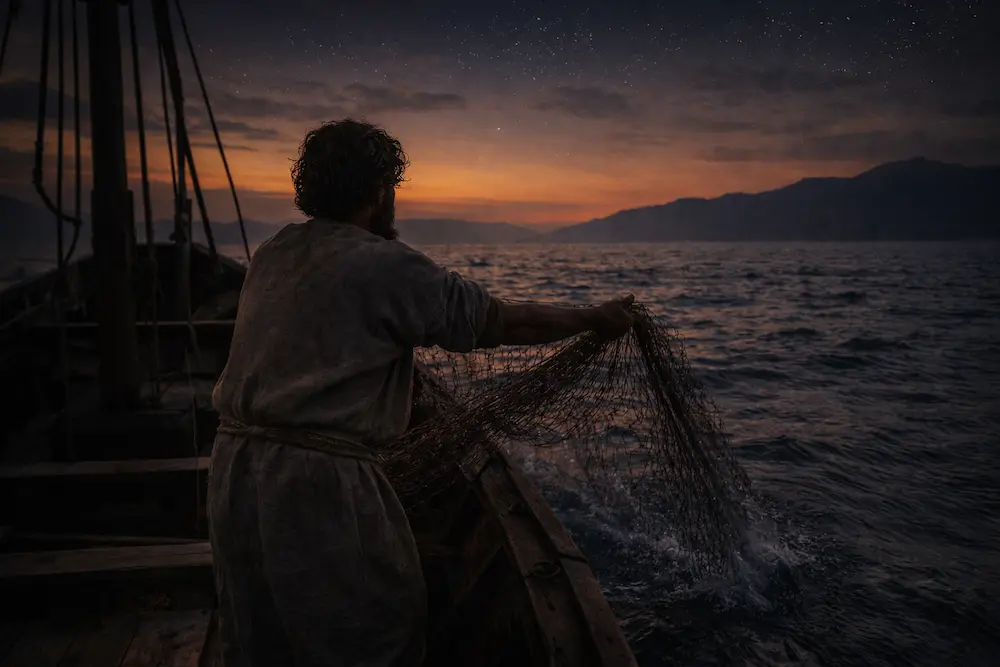
At night the man is aware, without blush or shame, of his penury, of his indigence and even of his misery. He has already discovered, without wonder, that every saint has something - or much - of wretchedness; and that every wretch is in a position to have something - or much - of saint. He has tasted the confirmation of what he had already foreseen in a certain way: that man does not retire: those who stay on land, when the time comes to make the boats to the sea, The best time to fish is always at night. The best fishing is always at night.
Perhaps he feels more helpless in the face of so many fears that assail him at the least opportune moments. Perhaps. And yet, it is worth facing the risk so that at last the night may become light, as the Psalmist prophetically announces: «and the night shall be my light in my delights /for the night, like the day, will be illuminated.»; St. John of the Cross added: «O night you guided, / O night kindlier than the dawn; / O night you joined / Beloved with beloved, / Beloved into Beloved transformed.».
In a way, Gibran also glimpsed it, who in The Prophet, he wrote:
«I can't teach you how the seas, the mountains, the forests pray. pray in the depths of your heart, / Lend your ear in the peaceful nights, and you will hear murmuring, / Our God, wings of ourselves, we wish with your Will. (...) / We can ask You for nothing; You know our destitution before it is born; / Our need is You; by giving us more of Yourself, You give us everything».
God has given us Himself to us in the Baby Jesus which we have sung with our lips, worshipped with our intelligence, received in our hearts, with the shepherds, with the magi, with Maria Has his light illuminated the darkness of our night?
Ernesto Juliá, (ernesto.julia@gmail.com) | Previously published on Religion Confidential.
Table of Contents
 carf@fundacioncarf.orgLandline: +34 914 029 082Mobile: +34 638 078 51145 Conde de Peñalver Street.