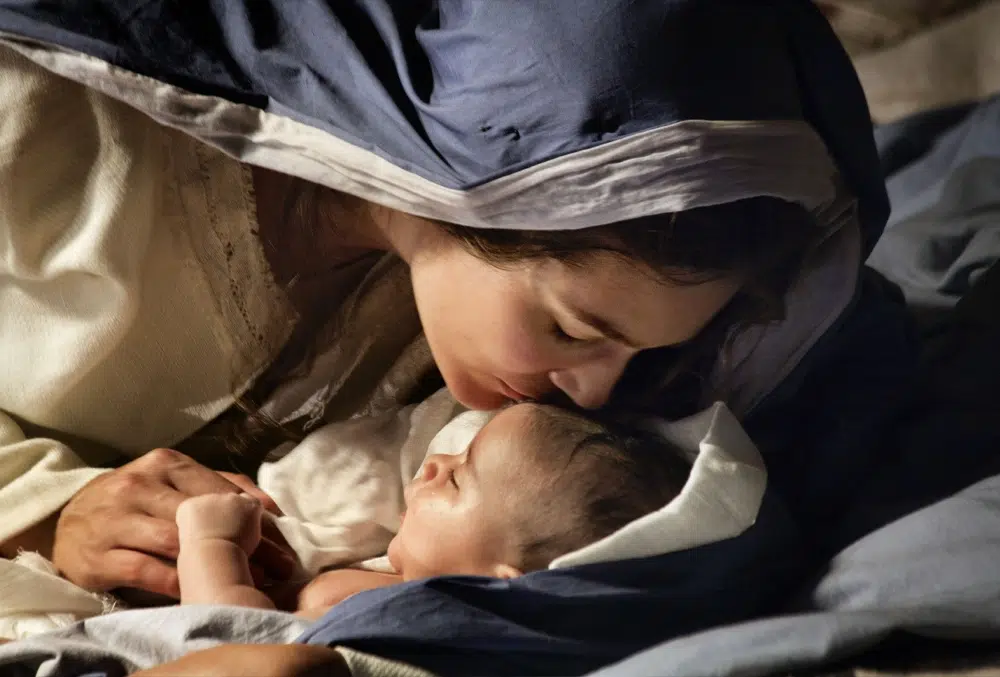
The January 1, the Catholic Church celebrates the Solemnity of the Blessed Virgin Mary, Mother of God. It is not a pious conclusion to the Christmas season or a devotional addition to the liturgical calendar. It is a doctrinal affirmation of the first order: in Mary, the truth of who Jesus Christ is is at stake. For a Catholic in the year 2026, this feast continues to be a decisive reference point for understanding the faith, the dignity of the person, and the Christian meaning of time.
The celebration of Mary as Mother of God has its roots in the early centuries of Christianity. It did not arise from overwhelming popular devotion, but rather from a central theological controversy: who is really Jesus of Nazareth. In the fifth century, the debate surrounding Nestorius—who refused to call Mary Theotokos (Mother of God) and preferred the title Christotokos (Mother of Christ) – forced the Church to clarify its faith.
The Council of Ephesus (431) declared that Mary is truly the Mother of God because the Son born of her is a single Person, divine, who fully assumes human nature. It is not a question of saying that Mary precedes God or is the origin of divinity, but of affirming that the subject of the birth is God made man. Separate the motherhood of Mary of Christ's divinity implies fragmenting the mystery of the Incarnation.
Since then, divine motherhood has become a cornerstone of the Christian faith. The Roman liturgy set this celebration on January 1, eight days after Christmas, following the ancient biblical tradition of the octave, to emphasize that the Child born in Bethlehem is the same Lord confessed by the Church.
Celebrating Mary as Mother of God is, above all, a Christological confession. The Church does not focus on Mary in order to isolate her, but rather to protect the core of the faith: Jesus Christ is true God and true man. Mary is not an addition, but rather the specific place where God enters into history.
Mary's motherhood implies that God has taken on a genealogy, a body, a time. He does not become incarnate in a symbolic or apparent way. In her, God accepts dependence, growth, and care. Therefore, this solemnity has profound consequences for Christian anthropology: flesh, history, and motherhood are not secondary realities, but spaces where God acts.
From this perspective, Mary is not an idealized or distant figure. She is a real woman, situated in a specific historical context, who responds freely to God's initiative. Her faith does not eliminate darkness or uncertainty, but it does overcome them. The Gospel of the day presents her as “keeping all these things and meditating on them in her heart”: a thoughtful, not naive, faith; silent, but firm.
It is no coincidence that this solemnity is celebrated on the first day of the year. The Church proposes to begin the civil year from a theological perspective: time has meaning because God has entered into it. For Catholics in 2026, immersed in a fast-paced, fragmented culture marked by uncertainty, this statement is particularly relevant.
Furthermore, since 1968, January 1 has been linked to World Peace Day. Not as a slogan, but as a logical consequence: if God has assumed the human condition, all human life has an inviolable dignity. Mary, as Mother of God, also becomes a reference point for a Christian vision of peace, understood not only as the absence of war, but as a just order, reconciliation, and care for the most vulnerable.
In a global context marked by armed conflicts, cultural tensions, and crises of meaning, this solemnity reminds us that peace is not built solely with structures, but with a correct view of the human being. Mary's motherhood affirms that no one is disposable and that history is not closed to meaning.
For contemporary believers, the Solemnity of Mary, Mother of God, is not an archaeological celebration. It directly challenges Christian life. Mary appears as model of mature faith, capable of integrating reason, freedom, and obedience. Her motherhood is not passive: it involves responsibility, risk, and perseverance.
St. Josemaría Escrivá insisted that turning to Mary is not a sentimental escape, but rather a school of concrete Christian life. In it, we learn to accept God's will in ordinary circumstances, to live our faith without fanfare, and to maintain hope when we do not understand everything.
At this point, the work of institutions such as the CARF Foundation takes on special relevance. Forming priests and seminarians for a Church faithful to the truth of the Incarnation involves transmitting a solid theology, rooted in tradition and capable of dialogue with today's world. The divine motherhood of Mary is not a marginal topic, but a key to an integral formation: doctrinal, spiritual, and pastoral.
The Solemnity of Mary, Mother of God, places Christians at the beginning of the year before a decisive truth: God is not an idea or an abstract force, but someone who wanted to have a mother. Everything else is ordered from there: faith, morals, social life, and hope.
Celebrating it in 2026 means reaffirming that the Christian faith still has something concrete to say about reality, time, and the person. Mary does not eclipse Christ; she reveals him in his most radical truth. And so, beginning the year under her patronage is not just another pious gesture, but a stance: trusting that history, even with its shadows, remains open to God.
Table of Contents
 carf@fundacioncarf.orgLandline: +34 914 029 082Mobile: +34 638 078 51145 Conde de Peñalver Street.