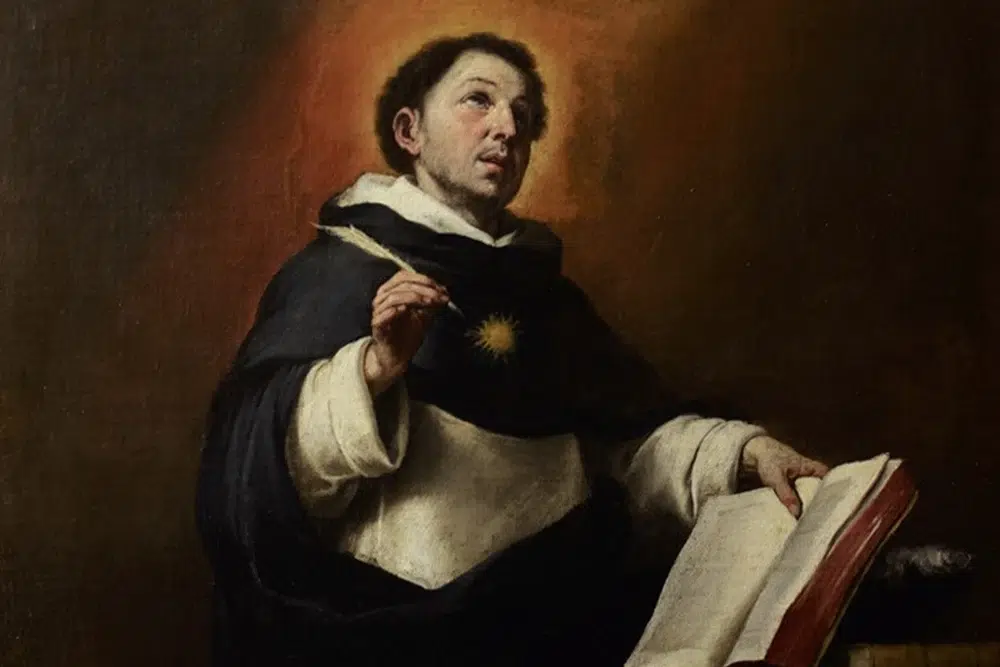
St. Thomas Aquinas (1224/1225-1274) is one of the most influential figures in the history of the Church. A Dominican priest, his life and work show that love of God and intellectual rigor call for each other. The Church has recognized in him a perennial model for theological, philosophical and spiritual formation, especially in the formation of priests.
Born in Roccasecca, in the Kingdom of Sicily, into a noble family, Thomas received his early education at the Benedictine abbey of Montecassino. He later studied at the University of Naples, where he came into contact with the texts of Aristotle and the newly founded Order of Preachers. Against his family's plans, he decided to join the Dominicans. This choice would definitively mark his life.
The biography of St. Thomas is full of episodes of fidelity, work and prayer. After entering the Order of Preachers, he was sent to study in Paris and Cologne, where he became a disciple of St. Albert the Great, one of the great scholars of the 13th century. There he was trained in philosophy and theology, with a method that integrated human reason and Christian revelation.
His family, opposed to his religious vocation, even held him back for a time to dissuade him. Thomas remained steadfast. This episode, far from being anecdotal, shows an essential trait of his character: the serenity and deep conviction with which he sought the truth and fulfilled the will of God.
Once ordained a priest, he developed an intense academic work. He taught at the University of Paris and in various Dominican studies in Italy. He was an advisor to popes and actively participated in the intellectual life of the Church of his time. However, he never understood study as an end in itself. For Thomas, study was a form of service: to serve the Church, preaching and the salvation of souls.
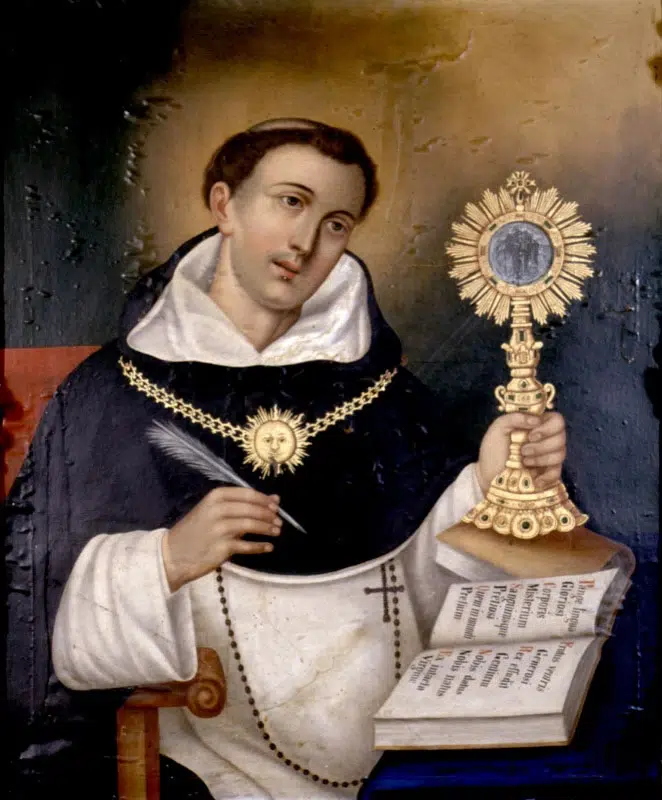
The spirituality of St. Thomas is sober and profound. A man of prayer, he celebrated the Eucharist with great recollection. In his Eucharistic hymns -still used today in the liturgy, such as the Pange lingua or the Adoro te devote- a deep faith, centered on Christ, is perceived, which complements his enormous intellectual rigor.
He died on March 7, 1274 in the abbey of Fossanova, on his way to the Council of Lyon. He was about 49 years old.
He was canonized in 1323 and proclaimed Doctor of the Church in 1567. Later, the Church would declare him Common Doctor, recommending his doctrine in a special way for theological formation.
The greatness of St. Thomas Aquinas is manifested above all in his extensive and systematic written work. Among all his writings, two stand out for their importance and their lasting impact on the life of the Church.
The Summa Theologica is his best known work. Conceived as a manual for the formation of theology students, it is structured in a pedagogical way: each question is posed with objections, a central answer and the final replies. This method seeks to teach how to think. Thomas accepts difficulties and questions, because he trusts that the truth can be known and expressed with clarity.
In the Summa addresses the great themes of the Christian faith: God, creation, the human being, the moral life, Christ and the sacraments. Everything is arranged with a clear criterion: to lead man to his ultimate end, which is God. This integral vision explains why the Church continues to recommend this work as the basis for ecclesiastical studies.
The Summa contra Gentiles, is more apologetic in character. It is designed to dialogue with those who do not share the Christian faith, showing that many fundamental truths can be reached by reason. It is a work especially relevant today, in a pluralistic cultural context, where the Church is called to dialogue with contemporary reason without renouncing revelation.
One of the central contributions of St. Thomas is the harmony between faith and reason. For him, there can be no contradiction between the two, because both proceed from God. Human reason has its own field and a real dignity; faith does not annul it, but elevates it. This principle has been explicitly assumed by the Magisterium of the Church, especially in documents on priestly formation and Catholic education.
It is also essential to contribute to the Moral Theology. His explanation of the natural law, of the virtues and of human action remains a solid reference for understanding Christian morality as a path to fulfillment, not as a simple set of norms. Morality, for St. Thomas, is a free and reasonable response to the love of God.
St. Thomas Aquinas proposes five remedies of surprising efficacy against sadness.
It is as if the famous theologian had already intuited seven centuries ago the idea, so widespread today, that chocolate is an antidepressant. It may seem a materialistic idea, but it is clear that a day full of bitterness can end well with a good beer.
That something like this is contrary to the Gospel is difficult to prove: we know that the Lord gladly participated in banquets and feasts, and both before and after the Resurrection he gladly enjoyed the beautiful things of life. Even a Psalm affirms that wine gladdens the heart of man (although it is necessary to clarify that the Bible clearly condemns drunkenness).
Often, a moment of melancholy is harder if you can't find an escape route, and it seems as if the bitterness builds up until it prevents you from carrying out the smallest task.
Crying is a language, a way of expressing and undoing the knot of a pain that can sometimes suffocate us. Jesus also wept. And Pope Francis points out that "certain realities of life can only be seen with eyes that have been cleansed by tears. I invite each of you to ask yourselves: Have I learned to cry?.
The character of Renzo's friend comes to mind, in the famous book "Los novios", who, in a large house uninhabited because of the plague, recounts the great misfortunes that have shaken his family. "These are horrible events, which I would never have thought I would have seen; things that take away the joy for life; but talking about them among friends is a relief".
It's something you have to experience to believe. When you feel sad, you tend to see everything in gray. At such times it is very effective to open your soul with a friend. Sometimes all it takes is a short message or phone call and the picture brightens up again.
This is the fulgor veritatis of which St. Augustine speaks. Contemplating the splendor of things, in nature or in a work of art, listening to music, being surprised by the beauty of a landscape... can be an effective balm against sadness.
A literary critic, a few days after the death of a dear friend, had to speak on the subject of adventure in Tolkien. He began thus: "To speak of beautiful things before interested people is for me a real consolation...".
The fifth remedy proposed by St. Thomas is perhaps the one that one would least expect from a medieval master. The theologian states that a fantastic remedy against sadness is to sleep and take a bath.
The efficacy of the advice is evident. It is profoundly Christian to understand that in order to remedy a spiritual evil, bodily relief is sometimes necessary. Since God became Man, and thus assumed a body, the material world has overcome the separation between matter and spirit.
A widespread prejudice is that the Christian vision of man is based on the opposition between soul and body, and the latter would always be seen as a burden or obstacle to the spiritual life.
In reality, Christian humanism considers that the person (soul and body) is completely "spiritualized" when it seeks union with God. To use the words of St. Paul, there is an animal body and a spiritual body, and we will not die, but we will be transformed, because it is necessary that this corruptible body be clothed with incorruptibility, that this mortal body be clothed with immortality.
For all these reasons, St. Thomas Aquinas is a figure who is particularly close to the mission of the CARF Foundation, which supports the integral, intellectual, human and spiritual formation of seminarians and diocesan priests from all over the world. His life is a reminder that the Church needs well-formed pastors, capable of thinking with rigor, teaching with clarity and living their teachings with coherence.
Table of Contents
 carf@fundacioncarf.orgLandline: +34 914 029 082Mobile: +34 638 078 51145 Conde de Peñalver Street.