Dear children:
I am pleased to be able to address this letter on the occasion of your presbyteral assembly and to do so out of a sincere desire for fraternity and unity. I thank your archbishop and, from my heart, each of you for your willingness to come together as a presbyterate, not only to discuss common issues, but also to support one another in the mission you share.
I appreciate the commitment with which you live and exercise your priesthood I know that this ministry is often carried out in the midst of fatigue, complex situations and a silent dedication to which only God is a witness. Precisely for this reason I hope that these words will reach you as a gesture of closeness and encouragement, and that this meeting will foster a climate of sincere listening, true communion and trusting openness to the action of the Holy Spirit, who never ceases to work in your life and mission.
The times in which the Church is living invite us to pause together in a serene and honest reflection. Not so much to remain in immediate diagnoses or in the management of emergencies, but to learn to read with depth the moment in which we live, recognizing, in the light of faith, the challenges and also the possibilities that the Lord opens before us. On this path it is becoming ever more necessary to educate our gaze and exercise our discernment, so that we can perceive with greater clarity what God is already at work, often silently and discreetly, in our midst and in that of our communities.
This reading of the present cannot ignore the cultural and social framework in which faith is lived and expressed today. In many environments we see advanced processes of secularization, a growing polarization in public discourse and a tendency to reduce the complexity of the human person, interpreting it from ideologies or categories that are partial and insufficient. In this context, faith runs the risk of being instrumentalized, trivialized or relegated to the realm of the irrelevant, while forms of coexistence that dispense with any transcendent reference become entrenched.
Added to this is a profound cultural change that cannot be ignored: the progressive disappearance of common references. For a long time, the Christian seed found a largely prepared soil, because the moral language, the great questions about the meaning of life and certain fundamental notions were, at least in part, shared.
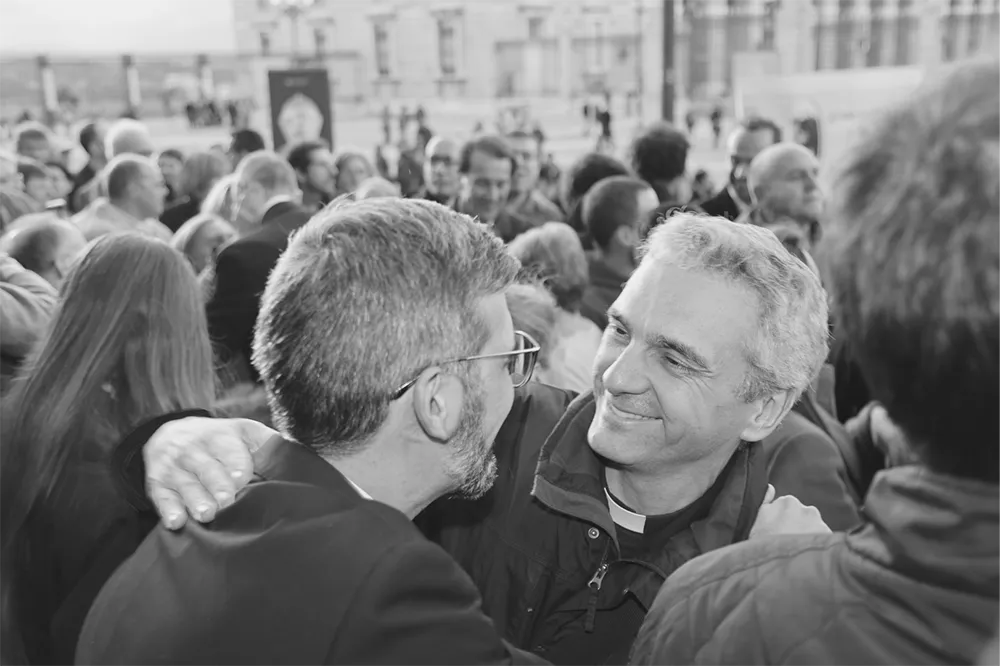
Today this common substratum has weakened considerably. Many of the conceptual presuppositions that for centuries facilitated the transmission of the Christian message are no longer evident and, in many cases, even understandable. The Gospel does not only meet with indifference, but with a different cultural horizon, where words no longer mean the same thing and where the first proclamation cannot be taken for granted.
However, this description does not exhaust what is really happening. I am convinced - and I know that many of you perceive this in the daily exercise of your ministry - that in the hearts of many people, especially the young, a new restlessness is opening up today. The absolutization of well-being has not brought the expected happiness; a freedom detached from truth has not generated the promised fullness; and material progress alone has not succeeded in fulfilling the deep desire of the human heart.
In fact, the dominant proposals, together with certain hermeneutical and philosophical readings with which people have sought to interpret man's destiny, far from offering a sufficient response, have often left a greater sense of weariness and emptiness. Precisely because of this, we note that many people are beginning to open themselves to a more honest and authentic search, a search which, accompanied with patience and respect, is leading them once again to an encounter with Christ.
This reminds us that for the priest This is not a time for withdrawal or resignation, but for faithful presence and generous availability. All this is born of the recognition that the initiative is always the Lord's, who is already at work and precedes us with his grace.
It is shaping up like this what kind of priests Madrid needs -and the entire Church at this time. Certainly not men defined by the multiplication of tasks or by the pressure of the results, but men configured to Christ, capable of sustaining their ministry from a living relationship with Him, nourished by the Eucharist and expressed in a pastoral charity marked by a sincere gift of self.
It is not a matter of inventing new models or of redefining the identity we have received, but of re-proposing, with renewed intensity, the priesthood in its most authentic core - being alter Christus-Let him be the one who shapes our lives, unifies our hearts and gives form to a ministry lived in intimacy with God, faithful dedication to the Church and concrete service to the people entrusted to our care.
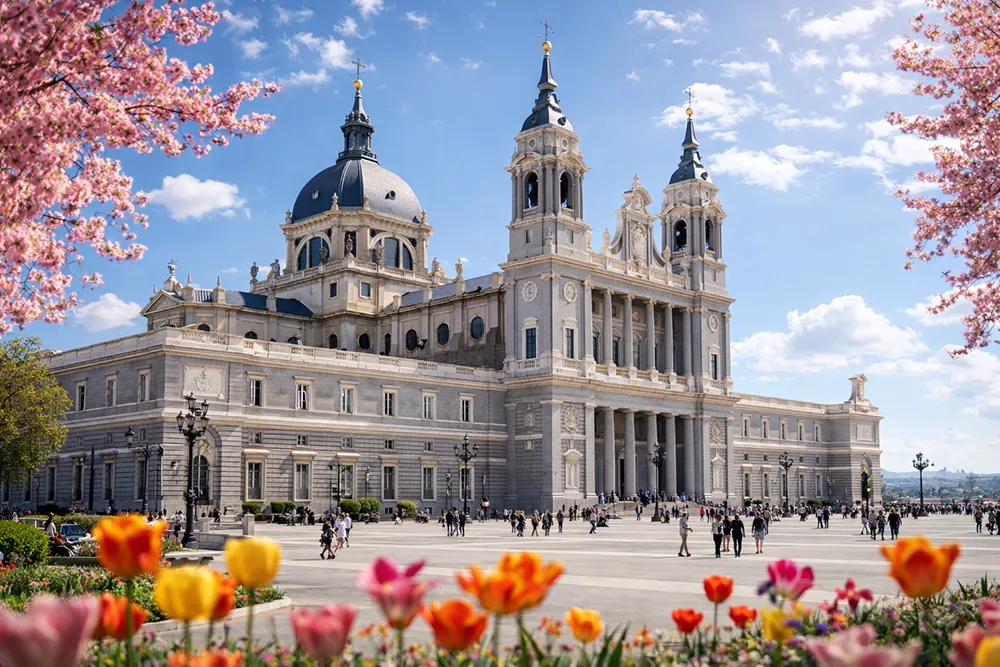
Dear children, allow me to speak to you today about the priesthood using an image you know well: your cathedral. Not to describe a building, but to learn from it. For cathedrals - like any sacred place - exist, like the priesthood, to lead to an encounter with God and reconciliation with our brothers and sisters, and their elements contain a lesson for our life and ministry.
When contemplating its façade, we already learn something essential. It is the first thing we see, and yet it does not tell us everything: it indicates, suggests, invites. So too the priest does not live to show off, but neither does he live to hide. Your life is called to be visible, coherent and recognizable, even if it is not always understood. The façade does not exist for itself: it leads to the interior. In the same way, the priest is never an end in himself. His whole life is called to refer back to God and to accompany the passage towards the Mystery, without usurping his place.
When we reach the threshold, we understand that it is not convenient to bring everything inside, because it is a sacred space. The threshold marks a step, a necessary separation. Before entering, something remains outside. The priesthood is also lived in this way: being in the world, but without being of the world (cf. Jn 17,14). Celibacy, poverty and obedience are situated at this crossroads; not as a negation of life, but as the concrete form that allows the priest to belong entirely to God without ceasing to walk among men.
The cathedral is also a common home, where everyone has a place. This is what the Church is called to be, especially for her priests: a home that welcomes, protects and does not abandon. And this is how the priestly fraternity must be lived; as the concrete experience of knowing that we are at home, responsible for one another, attentive to the life of our brothers and ready to support one another. My children, no one should feel exposed or alone in the exercise of the ministry: resist together the individualism that impoverishes the heart and weakens the mission!
As we walk through the temple, we notice that everything rests on the columns that support the whole. The Church has seen in them the image of the Apostles (cf. Ef 2,20). Nor is priestly life sustained by itself, but by the apostolic witness received and transmitted in the living Tradition of the Church and guarded by the Magisterium (cf. 1 Co 11,2; 2 Tm 1,13-14). When the priest remains anchored on this foundation, he avoids building on the sand of partial interpretations or circumstantial accents, and rests on the firm rock that precedes and surpasses him (cf. Mt 7,24-27).
Before reaching the presbytery, the cathedral shows us discrete but fundamental places: in the baptismal font the People of God is born; in the confessional it is continually regenerated. In the sacraments, grace is revealed as the most real and effective force of priestly ministry.
Therefore, dear children, celebrate the sacraments with dignity and faith, We are aware that what is produced in them is the true force that builds up the Church and that they are the ultimate goal to which all our ministry is directed. But do not forget that you are not the source, but the channel, and that you also need to drink from that water. Therefore, do not cease to confess, to return always to the mercy that you proclaim.
Next to the central space there are several chapels. Each one has its own history, its own dedication. In spite of being different in art and composition, they all share the same orientation; none of them is turned in on itself, none of them breaks the harmony of the whole. So it is also in the Church with the different charisms and spiritualities through which the Lord enriches and sustains your vocation. Each receives a particular way of expressing faith and nourishing interiority, but all remain oriented towards the same center.
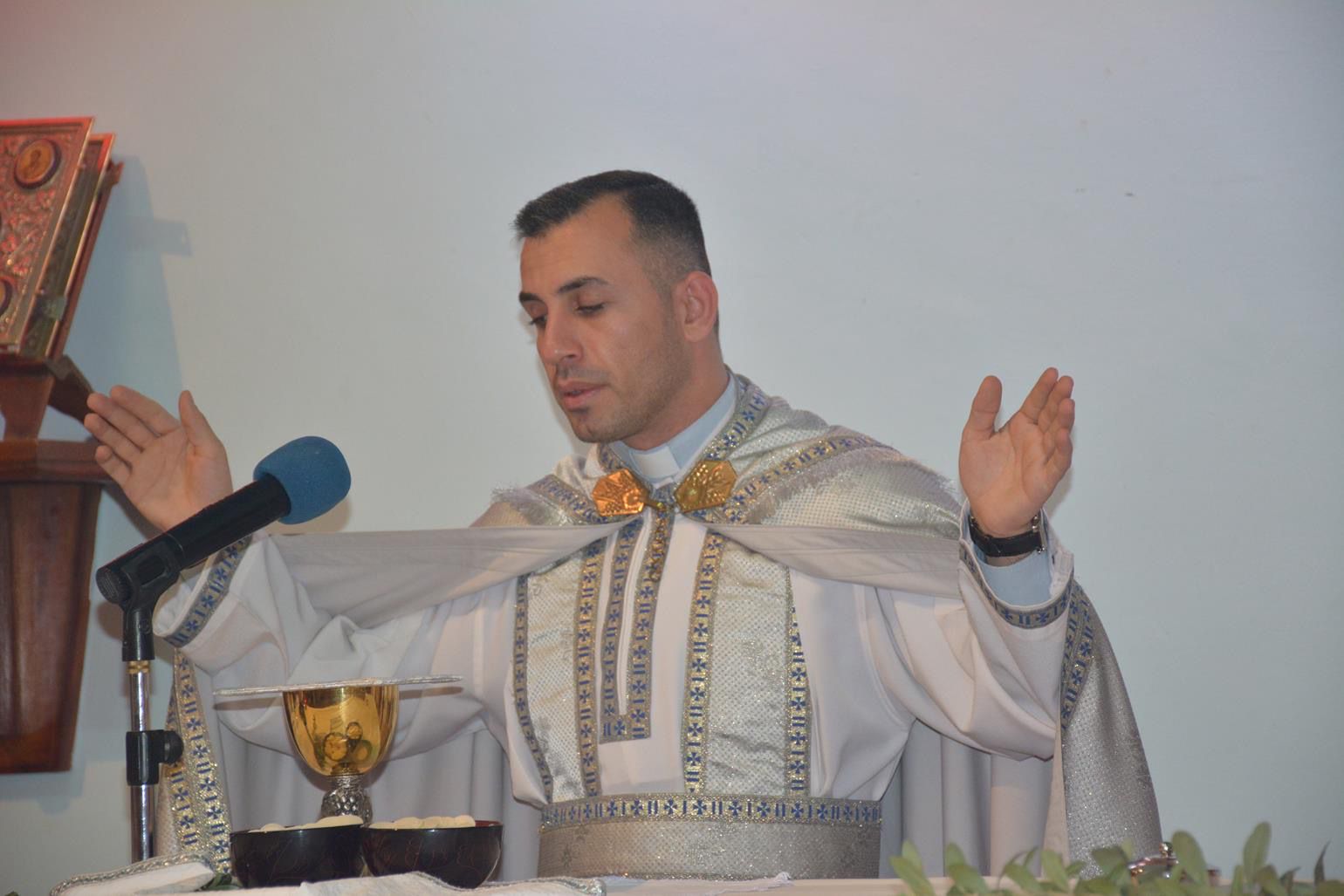
Let us look at the center of everything, my children: here is revealed what gives meaning to what you do every day and from where your ministry flows. On the altar, by your hands, the sacrifice of Christ is actualized in the highest action entrusted to human hands; in the tabernacle, the One whom you have offered remains, entrusted once again to your care. Be worshippers, men of profound prayer, and teach your people to do the same.
At the end of this journey, in order to be the priests that the Church needs today, I leave you with the same advice of your holy compatriot, St. John of Avila: «Be ye all his» (Sermon 57) Be saints! I commend you to Saint Mary of Almudena and, with a heart full of gratitude, I impart to you my Apostolic Blessing, which I extend to all those entrusted to your pastoral care.
Vatican City, January 28, 2026. Memorial of St. Thomas Aquinas, priest and doctor of the Church.
LEÓN PP. XIV
 carf@fundacioncarf.orgLandline: +34 914 029 082Mobile: +34 638 078 51145 Conde de Peñalver Street.