This is the title of a proposal that the University is carrying out in collaboration with the company Digito Identidad, known for making documentaries. The aim of the initiative is to try to discover that "more" that the Christian history of Rome contributes to the integral formation of a student from Santa Cruz.
Specifically, these are groups of films, presented by the students themselves, through which the artistic, cultural and religious riches preserved in the Eternal City are shown. The episodes, with an average duration of five minutes, will be published periodically in the YouTube channel and on the University's social networks, starting in the 2023/2024 academic year and for the following three years.
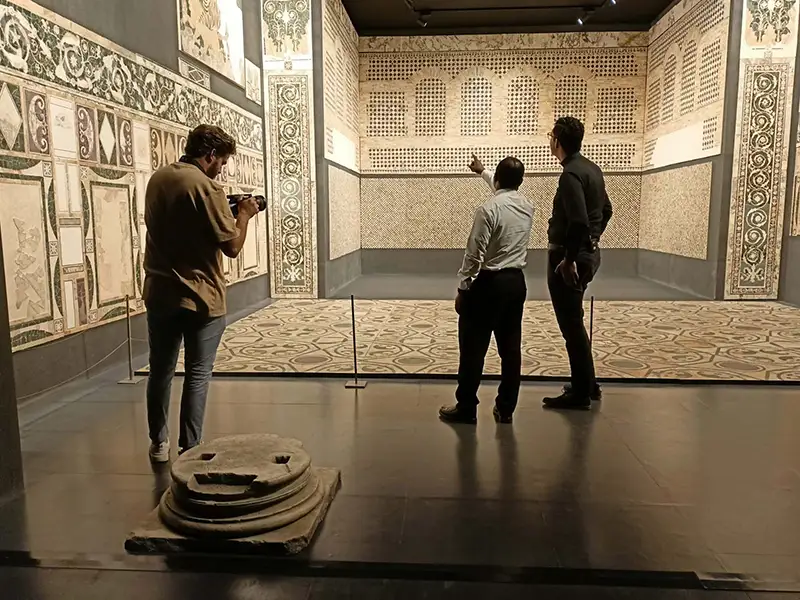
Rome is the capital of the Lazio region and of Italy. With a population of 2,857,321 inhabitants, is the most populated municipality in Italy and the third most populated city in the European Union. It has been known since ancient times as the Urbe (Urbs). It is also called The Eternal City».» (at Italian: Eternal City).
In the course of its history, which spans three millennia, it came to extend its dominions over the entire Mediterranean basin and a large part of Europe, the Middle East and North Africa. As the capital of the Roman Republic and Empire, it became the first great metropolis of mankind, the center of one of the most important ancient civilizations. It influenced society, culture, language, literature, music, art, architecture, philosophy, politics, gastronomy, religion, law and morals in the following centuries.
It is the city with the highest concentration of historic properties and architectural heritage of the world. Its historic center delimited by the perimeter marked by the Aurelian Walls, overlapping traces of three millennia, is the highest expression of the historical, artistic and cultural heritage of the Western world. In 1980, together with the extraterritorial properties of the Holy See located in the city and the Basilica of St. Paul Outside the Walls, it was included in the Unesco World Heritage List.
Rome is the geographic heart of the Catholic religion, the holy city of Catholicism and a pilgrimage destination (via rome), and also the only city in the world that has an autonomous state entity within it: the enclave of Vatican City, which is under the temporal power of the pope. For this reason it is also known as the capital of two states.
 carf@fundacioncarf.orgLandline: +34 914 029 082Mobile: +34 638 078 51145 Conde de Peñalver Street.