Josemaría Escrivá de Balaguer visited Loreto for the first time on January 3 and 4, 1948. But the reason why the founder of Opus Dei felt particularly indebted to Our Lady of Loreto was due to a very serious need that arose years later and was linked to the legal structure of the Work, for which he sought the protection of the Virgin Mary.
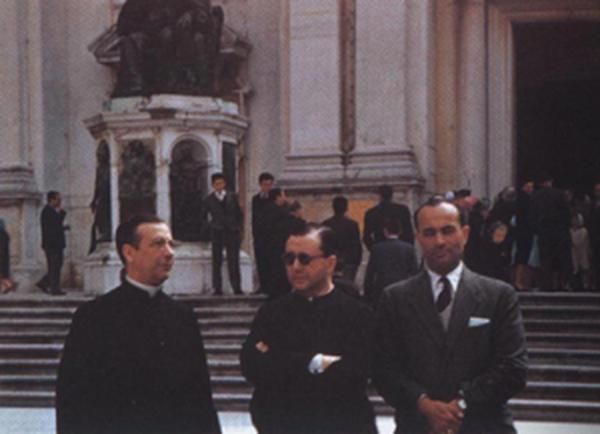
«On the afternoon of January 3, Saint Josemaría and Don Álvaro del Portillo, Salvador Moret Bondía, and Ignacio Sallent Casas. They said the prayer in the courtyard of the House of Nazareth, inside the Shrine. Upon leaving the temple, the Father asked Don Álvaro:
—What did you say to the Virgin Mary?
«Do you want me to tell you?« And, at a gesture from the Father, he replied: "Well, I repeated what I always say, but as if it were the first time. I said to him: I ask of you what the Father asks of you.".
-I think what you said is very good. –St. Josemaría later told him. Repeat it many times.».
The 1950s were years of great suffering for St. Josemaría, due to misunderstandings and conflicts. In the midst of these difficulties, he decided to go to Loreto to place himself under the protection of the Virgin Mary's mantle and caresses.
«On August 14, 1951, he decided to set out by road for Loreto," recounts writer Ana Sastre, "to be there on the 15th and consecrate Opus Dei to the Blessed Virgin. The heat was suffocating, and thirst would be felt throughout the journey. There was no highway. The road runs through valleys, climbs steeply up the Apennines, and descends in the last part until it reaches the Adriatic Sea.
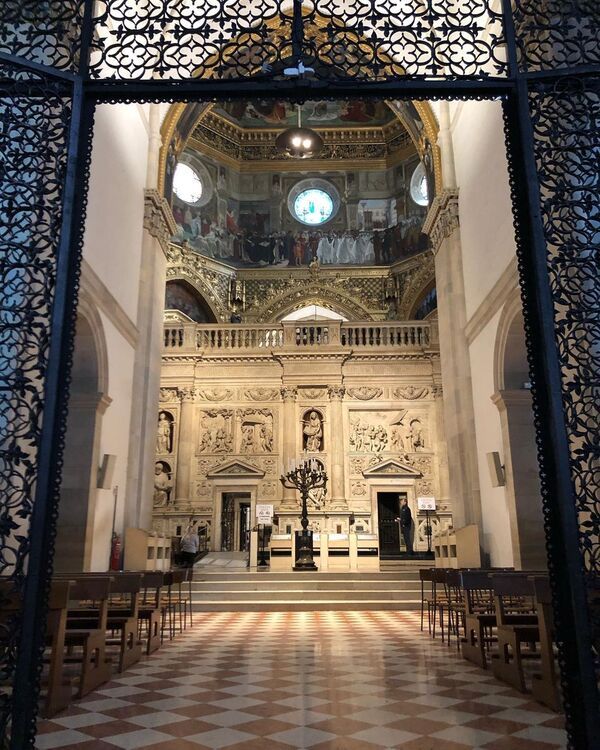
According to a centuries-old tradition, since 1294 the Holy House of Nazareth has stood on the hill of Loreto, beneath the transept of the basilica built later. It is rectangular, with walls about four and a half meters high. One wall is modern, but the others, without foundations and blackened by candle smoke, are, according to tradition, those of the House of Nazareth.
Its structure and the geological formation of the materials bear no resemblance to the characteristics of the ancient architecture of the area: it is perfectly analogous to the constructions that were built in Palestine twenty centuries ago: sandstone blocks, using lime as a binding agent.
The sanctuary stands on a hill covered with laurel trees, hence its name. They park in the central square and the priest quickly gets out of the car. For fifteen or twenty minutes, they lose sight of him among the crowds filling the basilica. Finally, he emerges, after greeting the Virgin Mary, smiling and cheerful. It is half past seven and they have to return to Ancona to spend the night.
«The next morning, before the sun rises, they return to the road. Despite the early hour, the sanctuary is packed. The Father dresses in the sacristy and advances toward the altar of the House of Nazareth to celebrate Mass. The small enclosure is crowded and the heat is stifling.
«Under the votive lamps, he wants to officiate the Liturgy with complete devotion. But he has not counted on the fervor of the crowd on this feast day: "While I was kissing the altar as prescribed by the rubrics of the Mass, three or four peasant women were kissing it at the same time. I was distracted, but I was moved.
I was also struck by the thought that in that Holy House—which tradition holds to be the place where Jesus, Mary, and Joseph lived—these words have been placed on the altar table: Here the Word became flesh. Here, in a house built by human hands, on a piece of the earth where we live, God dwelt" (Christ is Passing By, 12).
«During Mass, without any formula but with words full of faith, the Father performs the consecration of Opus Dei to the Lady. And then, speaking quietly to those beside him, he repeats it again on behalf of the whole of Opus Dei:
"We consecrate ourselves and our lives to you; everything that is ours: what we love and what we are. To you we give our bodies, our hearts, and our souls; we are yours. And so that this consecration may be truly effective and lasting, we renew today at your feet, Lady, the commitment we made to God in Opus Dei. Instill in us a great love for Church and to Papa, and make us live fully submissive to all his teachings."(RHF 20755, p. 450).
The Father has left Rome Visibly tired. But when he returns, he seems renewed. As if every obstacle had just been pulverized in God's path. A few weeks ago, he suggested to his sons and daughters that they repeat an invocation to the Mother of Jesus over and over again. Sweetest Heart of Mary, make my journey safe!,Sweetest Heart of Mary, prepare a safe path for us!»
«The paths of Opus Dei will always be preceded by the smile and love of the Virgin Mary. Once again, the Founder has moved within the coordinates of faith. He provides the human means, but trusts in the decisive intervention from above. "God is the same as always. Men of faith are needed: and the wonders we read about in the Holy Scriptures will be renewed." Writing. Behold, the hand of the Lord is not shortened –The arm of God, his power, has not been diminished! (The Way, 586).
He went to the Holy House six more times: on November 7, 1953, May 12, 1955, May 8, 1960, April 22, 1969, May 8, 1969, and finally on April 22, 1971. On December 9, 1973, the eve of the feast of Our Lady of Loreto, she said, "All the images, all the names, all the invocations that the Christian people give to Saint Maria, I think they are wonderful. But in Loreto, I am especially indebted to Our Lady.".
The history of this Marian devotion revolves around the house where the Virgin Mary was born and lived with Jesus and Saint Joseph in Nazareth, Palestine.
The miracle: According to tradition, when the Crusaders lost control of Holy Land at 1291, The house was in danger of being destroyed. To save it, a group of angels lifted it into the air and carried it across the Mediterranean.
The story of the journey tells that the house first flew to Croatia (Trsat), then crossed the Adriatic Sea to Italy (Ancona), and finally landed in December 10, 1294, in a forest of laurels (lauretum in Latin, from which the name Loreto derives).
From the perspective of various modern studies, some suggest that the Byzantine noble family Angeli (a surname meaning angels) financed and organized the transfer of the stones from the Holy House by boat to save them, giving rise to the beautiful legend of the angelic flight.
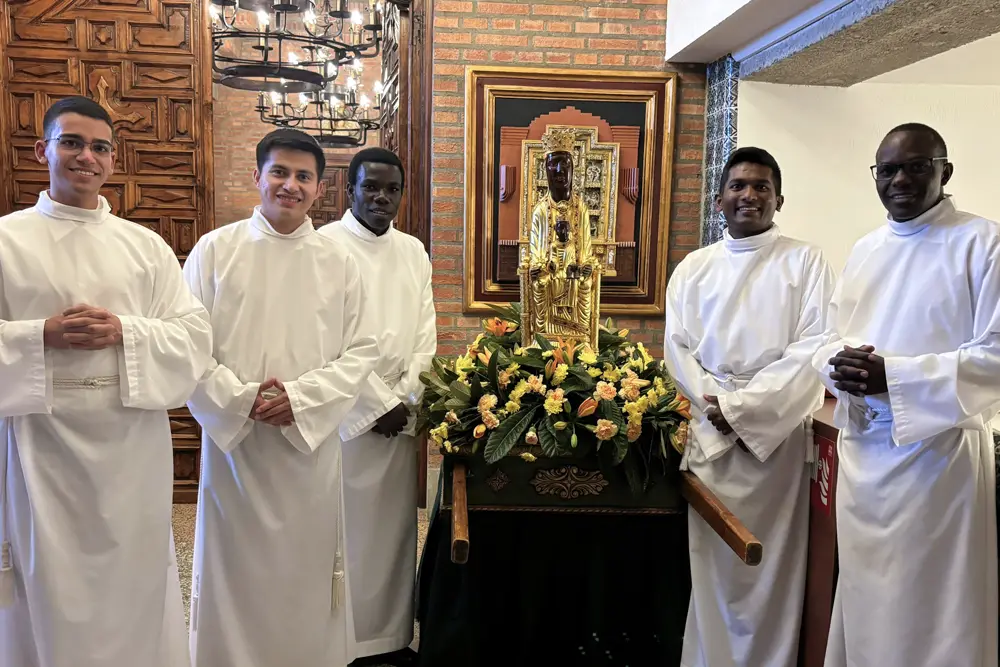
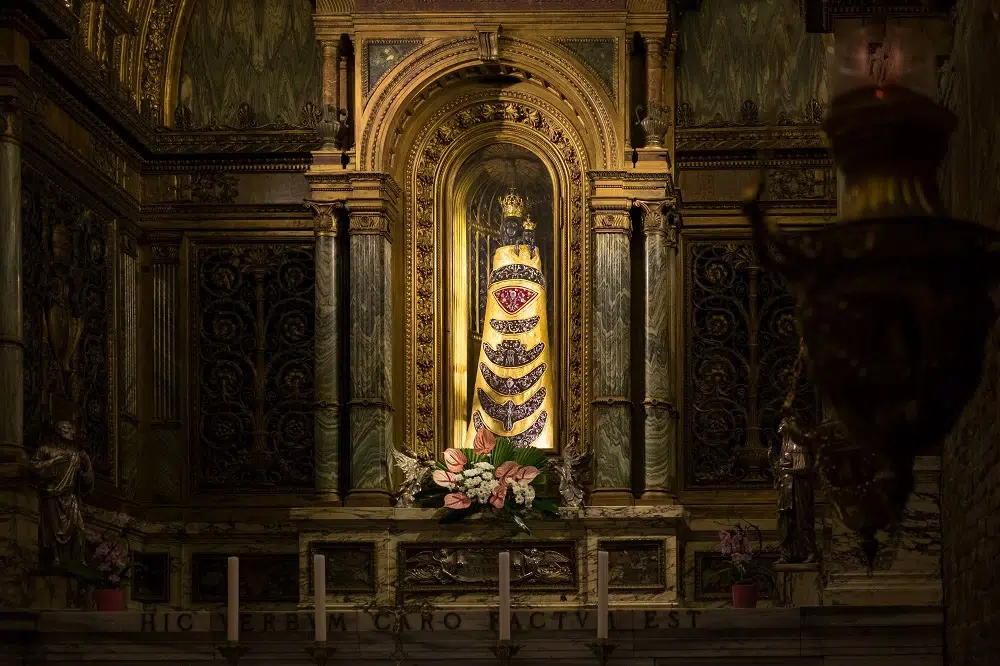
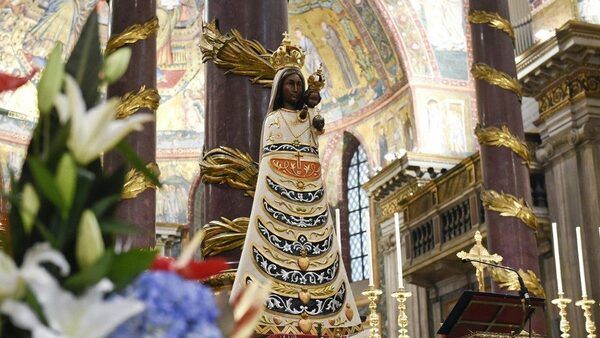
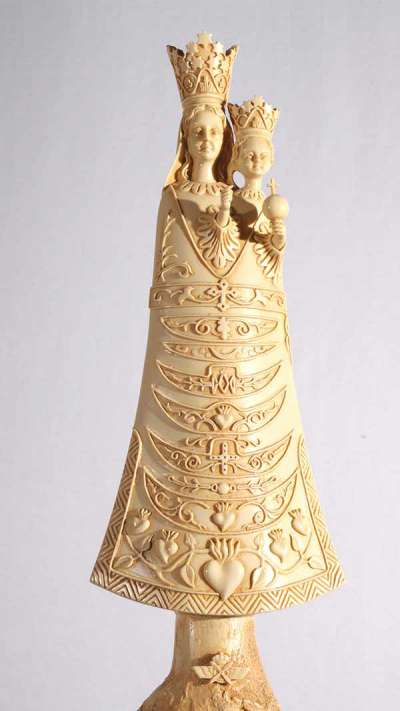
When you visit the shrine of Loreto or contemplate the images of many Marian devotions, Torreciudad, Montserrat... you notice that both the Virgin and the Child have dark skin. The most common cause of this very dark brown tone is that the wood took on this color over the years, mainly due to the smoke from candles and oil lamps inside the small Holy House.
In the case of Loreto, following a fire in 1921, a new image was carved using Lebanese cedar (a dark wood) and it was decided to retain the traditional black color that had made it so recognizable to pilgrims for centuries.
Due to the miraculous transfer of the Holy House from Palestine to Italy, the Pope Benedict XV proclaimed her the patron saint of universal aviation in 1920. In Spain, she is also the patron saint of the Air Force, the Sepla (Spanish Air Traffic Controllers' Association), and Space. Every December 10 is a big day at all Spanish air bases.
The Virgin of Loreto protects pilots and military personnel, but also air travelers and all flight personnel.
In Spain, devotion is closely linked to this stirring hymn, which is sung at military and religious ceremonies:
«Hail, Mother, Hail, Queen of Heaven, of beauty a star, of purity the radiance; source of the purest love, our hope is in her, Hail, Mother, Hail, Queen of Heaven.
If our wings break at the end of our flight, before we reach the ground, may your arms open with love. Hail, Mother, Hail, Queen of Heaven.
In addition to traditional military celebrations, there are also very popular religious and civil celebrations: December 10 itself, which is the official liturgical holiday. It is celebrated in many parishes dedicated to Our Lady of Lore (such as Barajas in Madrid or on hills near airports).
As notable popular festivals in Jávea and Santa Pola, towns in Alicante, the festivals in honor of the Mother of God of Loreto are very important. Interestingly, in Jávea they are celebrated at the end of August and beginning of September, with the traditional Bulls to the Sea.
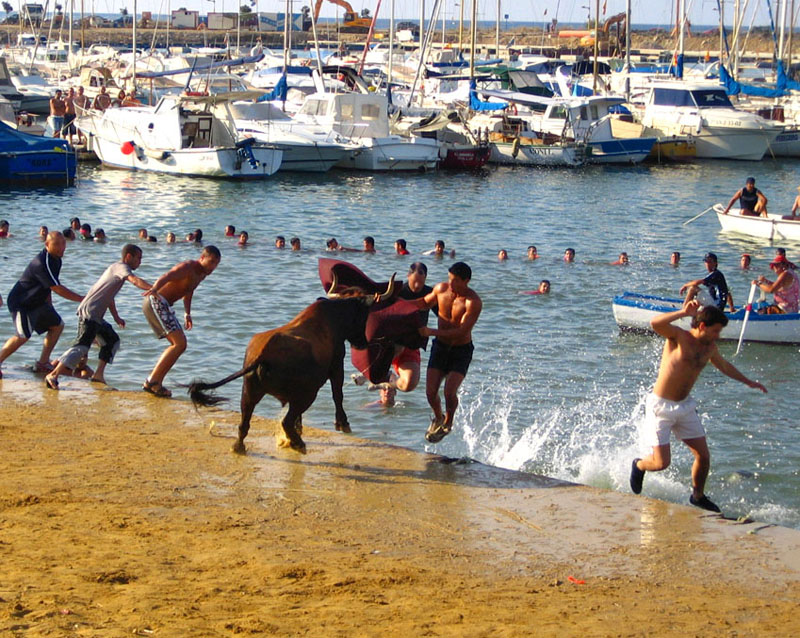
Table of Contents
 carf@fundacioncarf.orgLandline: +34 914 029 082Mobile: +34 638 078 51145 Conde de Peñalver Street.