Four steps of the sacrament of Confession

"Jesus Christ our Lord, our God, instituted the sacraments, which are like the footprints of his footsteps, so that we may tread there and reach Heaven. And one of the most beautiful and consoling sacraments is the sacrament of Confession", St. Josemaría Escrivá, Argentina, June 15, 1974.

St. Josemaría quoted and here we show you what he said about the sacrament as a marvel of God's love.

Sacrament of Confession

Christ instituted this sacrament offering us a new possibility to convert and to recover, after Baptism, the grace of God.

«The sacrament of Reconciliation is a sacrament of healing. When I go to confession, it is to heal myself, to heal my soul, to heal my heart, and to heal something I did that is not working well.», Pope Francis, General Audience, February 19, 2014.

Like all the sacraments, this is an encounter with Jesus. During Confession, we tell our sins to Jesus. priest who acts in the person of Christ and with the authority of Jesus to listen, offer guidance, provide adequate penance and pronounce the words of absolution.

"At the celebration of the In the Sacrament of Reconciliation, the priest does not represent God alone, but to the whole Community, which recognizes itself in the fragility of each of its members, which listens to their repentance, which is moved, which is reconciled with Him, which encourages and accompanies them on the path of conversion and of human and Christian maturity.

Someone may say: "I confess only to God". Yes, you can say to God: "forgive me", and tell him your sins. But our sins are also against our brothers, against the Church, and for this reason it is necessary to ask forgiveness from the Church and our brothers, in the person of the priestPope Francis, Catechesis of Wednesday, February 19, 2013.

St. Josemaría used to call Confession the sacrament of joy, because through it one recovers the joy and peace that friendship with God brings.
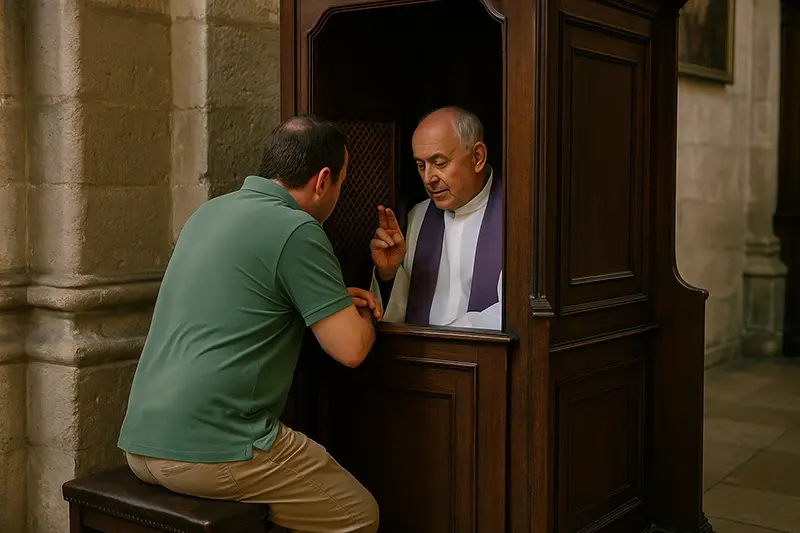
examen confesión sacramento examen sacerdote pasos
Moment of Confession, sign of God's forgiveness and mercy.

Importance of Confession

This sacrament not only restores our relationship as sons and daughters of God, but also reconciles us to each other by remaking our union with the Body of Christ, his Church.

Pope Francis explained the importance of confession with these words: "The forgiveness of our sins is not something we can give ourselves. I cannot say: I forgive myself my sins. Forgiveness is asked for, it is asked of another, and in Confession we ask Jesus for forgiveness. Forgiveness is not the fruit of our efforts, but it is a gift, a gift of the Holy Spirit".

There are several details that we can take into account to do it in a deeper and more effective way.

For example, we can help ourselves with a guide with the necessary keys for a good examination of conscience. It is the moment to be sincere with oneself and with God, knowing that He does not want our past sins to oppress us, but that He wants to free us from them so that we can live as His good children.
sacramento confesión examen
Alvaro del Portillo gives absolution to St. Josemaría.

Steps for a good Confession

The Catechism of the Church proposes four steps for a good confession. These express the path to conversion, which goes from the analysis of our actions to the action that demonstrates the change that has taken place in us.

There are four steps we take to be able to receive the great embrace of love that God, our Father, wants to give us with this sacrament: "God waits for us, like the father in the parable, with outstretched arms, even if we do not deserve it. Our debt does not matter. As in the case of the prodigal son, we need only open our hearts" (St. Josemaría, Christ Is Passing By, no. 64).

1st Examination of conscience

In the examination of conscience we try to examine our soul in prayer before God, in the light of the teachings of the Church, starting from our last confession.

We reflect on those actions, thoughts or words that may have distanced us from God, offended others or harmed us internally.

There are several details that we can take into account to do it in a deeper and more effective way. For example, we can use a guide with the necessary keys for a good examination of conscience. 

It is the moment to be sincere with oneself and with God, knowing that He does not want our past sins to oppress us, but that He wants to free us from them so that we can live as His good children.

2º Contrition and resolution not to sin again.

Contrition or repentance, is a gift from God. It is a sorrow of the soul and a rejection of our sins, which includes the resolution not to sin again.

Confession consists of telling sins to the priest. Sometimes, repentance comes with an intense feeling of pain or shame, which helps us to make amends. But this feeling is not indispensable. The important thing is to understand that we have done wrong and to have the desire to improve as Christians. Otherwise, we will put ourselves in God's hands to ask Him to work in our hearts to reject evil.

"Contrition," the Pope explains, "is the portico of repentance, it is that privileged path that leads to the heart of God, who welcomes us and offers us another chance, provided that we open ourselves to the truth of penance and allow ourselves to be transformed by his mercy.

3º Confess sins

The priest is an instrument of God. Let us put aside shame or pride, and open our souls in the certainty that it is God who listens to us.

"Confessing to a priest is a way of placing my life in the hands and heart of another, who at that moment acts in the name and on behalf of Jesus. [It is important that I go to the confessional, that I place myself in front of a priest who represents Jesus, that I kneel in front of Mother Church, who is called to distribute the Mercy of God. There is an objectivity in this gesture, in kneeling in front of the priest, which, at that moment, is the process of the grace that comes to me and heals me."Pope Francis. The name of God is mercy, 2016.

Confession consists of telling sins to the priest. It is often said that a good confession has "4 C's":

  • Clear: point out what the specific fault was, without adding excuses.
  • Concrete: say the precise act or thought, do not use generic phrases.
  • Concise: avoid unnecessary explanations or descriptions.
  • Complete: without silencing any serious sin, overcoming shame.
  • Confession is a sacrament, the celebration of which includes certain gestures and words on the part of the penitent and the priest. the most beautiful moment of the sacrament of Confession, for we receive God's forgiveness.

    4º Fulfill the penance

    Penance is a simple act that represents our reparation for the fault we have committed. It is also a good occasion to thank God for the forgiveness we have received, and to renew our resolution not to sin again.


    Bibliography


    Vinel Rosier, priest: "The Church in Haiti sustains the hope of the people".

    Vinel Rosier was born on October 10, 1989 in Cavaillon, Haitithe third in a family of four children. He received the diaconate on May 25, 2019 and was ordained a priest on August 31 of the same year in the cathedral of Les Cayes, Haiti.

    His first pastoral assignment was as vicar in the parish of Sacré-Cœur des Cayes, a task he combined with the direction of the KIRO" movementThe first of its kind, formed by young Christians, along with teaching catechism in secondary schools and giving introductory Bible classes to young people about to enter the Major Seminary.

    How did you discover your vocation to the priesthood?

    -As a child, I prepared for my First Communion in a school run by nuns. In one class, one of the nuns asked what we wanted to be when we grew up and I answered that I wanted to be a priest. That desire grew inside me, fostered by the fact that I joined a group of altar boys who helped out in Mass.

    There I was impressed by the availability of the priests and their willingness to serve. After a while, I asked the parish priest to send me to discern my vocation, and that is what I did for two years until, in 2010, I started the propaedeutic program. 

    What was the reaction of your family and friends when you told them you wanted to become a priest?

    -Although, at first, there was some anxiety and opposition among my relatives, in the end they were happy. My family thought that I would no longer be able to go to my neighborhood, that I would have other friends and another family. But in the end, their joy outweighed the prevention because it is a source of pride for the family to give a priest to the Church.

    My friends, especially my classmates, had the same feeling of discontent at first but, when they saw my determination to enter the seminary, they finally accepted my choice.

    How would you describe the Church in Haiti?

    -Haiti was a predominantly Catholic country, so much so that the great Marian devotion of the people was the origin of a miraculous intervention by the Virgin Mary. Maria when the smallpox epidemic was ravaging the population. On December 8, 1942, the president of the country allowed the ecclesiastical authorities to consecrate Haiti to Our Lady of Perpetual Help.

    But between the end of the 19th century and the beginning of the 20th century, Protestantism began to grow. With the U.S. occupation of Haiti, there was a further consolidation of the Protestant presence in Haiti and this has caused a decline of Catholicism in the country. 

    Although the presence of Catholicism is still strong in the country. It is true that our Church is totally dependent on foreign aid, but with our limited resources we try to support people where the State is absent. 

    Despite all the problems and difficulties, the Church in Haiti remains a source of hope, working for a better tomorrow.

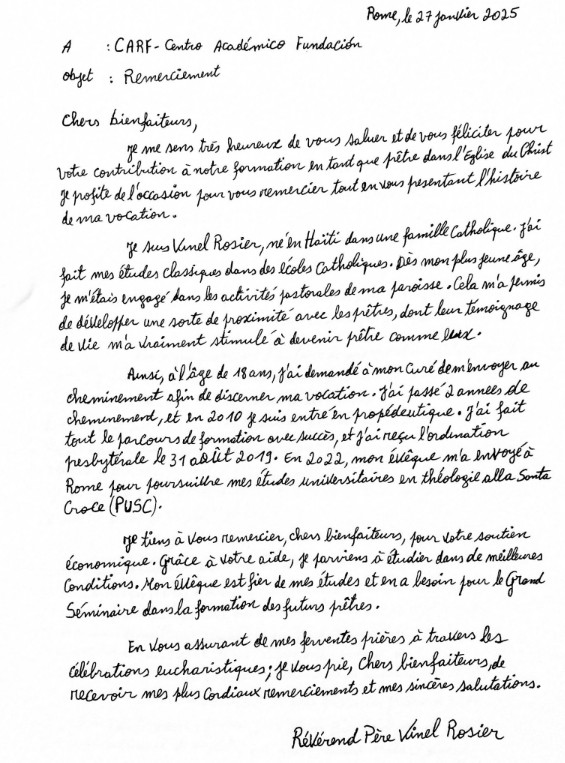
    viniel rosier sacerdote haití carta agradecimiento
    Thank-you letter from Viniel Rossier to the benefactors of the CARF Foundation.

    What are the challenges facing the Church in your country?

    -Due to political instability, the challenges facing the Church are increasingly intense. Almost every day we see indiscriminate violence by gangs operating with impunity. Every day we see acts of murder and banditry. The gangs sow terror and despair, and so the inhabitants have taken to the streets to escape, sometimes without even knowing where they are going.

    Haiti is a country under real threat, because the institutions of the State have become fragile and the leaders are incapable of stabilizing the situation. In the face of this, the Church plays its role, recalling the urgent need for a transformation of mentalities. 

    The Church in Haiti works to ensure that young people in particular, and Haitians as a whole, do not let themselves be discouraged, and sustains the hope of the people through its prophetic mission and its interventions in the field of charity.

    What do you appreciate most about your training in Rome? 

    -What I appreciate most about my education is the breadth of vision that I acquired at the university in Rome. I discovered other cultures thanks to our meetings and exchanges with university students from other countries. I was able to make friends and discover a lot of richness and beauty. 


    Original interview published in Omnes.

    St. Bartholomew, apostle: example of faith and dedication

    The Church history is full of testimonies of saints and apostles, such as St. Bartholomew, who show by their lives how to respond to God's call with total dedication and generosity.

    One of the twelve chosen by Jesus to announce the Gospel to the world. Nathanael can be a beacon of inspiration for those young men who feel the call to a priestly or religious vocation.

    Who was Saint Bartholomew?

    St. Bartholomew is one of the twelve apostles of Jesus Christ, named in the Gospels, although with few explicit mentions in the New Testament. He is traditionally identified with Nathanael, a young Israelite known for his sincerity and deep faith in Jesus. His name, Bartholomew, means son of Tolmai or son of the teacher, and Nathanael, God has given.

    Although his figure appears briefly, tradition and history attribute to him a fundamental role in the expansion of Christianity, reaching distant lands to proclaim the Lord and the Gospel.

    The call of St. Bartholomew

    St. Bartholomew's vocation began in a moment of profound sincerity and search for truth. In the Gospel of John (1:45-51)Philip, one of the first disciples of the Master, meets Nathanael and tells him: "We have found him of whom Moses wrote in the law, and also the prophets: Jesus of Nazareth, son of Joseph". Nathanael, skeptical, replies, "Can anything good come out of Nazareth?".

    But when he meets Jesus, who surprises him by saying that he had seen him under the fig tree before Philip called him, his heart opens to faith, exclaiming, "Rabbi, you are the Son of God, you are the King of Israel."

    This meeting is a precious example for all those who feel the call: a vocation is always born from a personal encounter with Christ, who knows our heart and invites us to follow him with total trust.

    A testimony of life

    After his encounter with Jesus, St. Bartholomew did not hesitate to leave behind his former life to devote himself fully to the mission of proclaiming the Gospel. According to tradition, he preached in various regions, such as the India, Armenia, Mesopotamia and Ethiopiatransmitting the word of God and often facing great difficulties and persecutions.

    His courage and fidelity are an example for those preparing for the priesthood or consecrated life. Unreserved dedication to the mission, courageous witness even in the face of suffering, and trust in God's providence are essential traits that St. Bartholomew transmits to us.

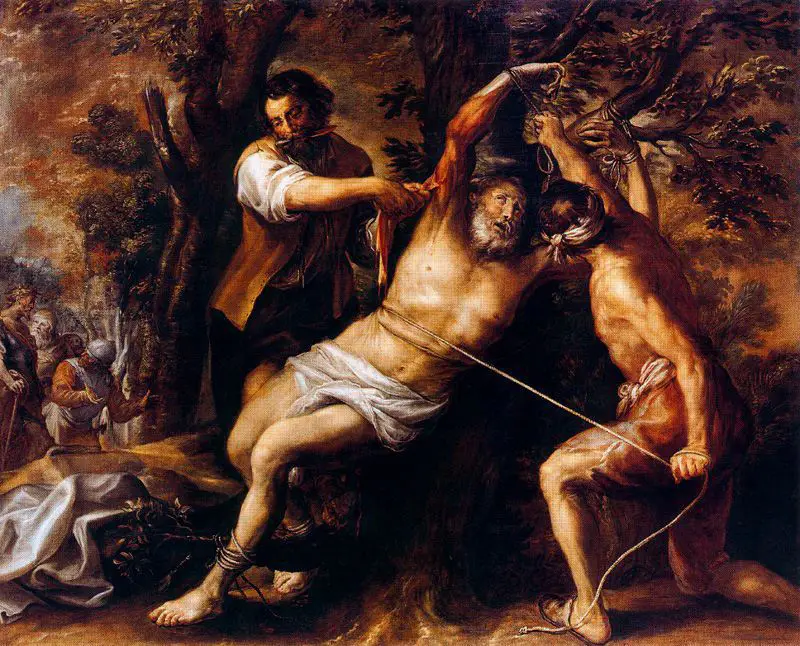
    San Bartolomé, apóstol mártir servicio iglesia
    The Martyrdom of Saint Bartholomew, José de Ribera, Museo del Prado.

    Martyrdom, the culmination of love for Christ

    Like many apostles, St. Bartholomew gave his life for love of Christ and the Church. Tradition has it that he was martyred for preaching faith in Jesus. It is said that he was flayed alive, a particularly cruel martyrdom which, however, did not make him lose heart and renounce Love.

    This extreme sacrifice reminds us that the priestly and religious vocation is a call to give one's life for the Gospel, not necessarily in a physical way, but with total and unreserved love, willing to give our time, talents and, at times, even face trials for the love of Christ and others.

    Why is St. Bartholomew an example for seminarians and priests?

    At the CARF Foundation, which promotes the formation of diocesan priestsIn St. Bartholomew we see an exemplary model of faith, dedication and courage. His life invites us to reflect on three fundamental aspects:

    The legacy of St. Bartholomew

    The mission of the CARF Foundation is support the formation of priests so that they may respond faithfully to God's call, just as St. Bartholomew did. We believe that every seminarian, like the apostle, is called to be a light in the world, the smile of God in the world and a living witness to the love of Christ.

    To support a seminarian is to accompany that vocation that springs from a personal encounter with Jesus and is expressed in a life given, often with sacrifices, for the salvation of souls. For this reason, we invite you to learn more about the Foundation's work and to join us in this beautiful mission.

    St. Bartholomew, apostle and martyr, teaches us that the true greatness of the Christian life lies in responding to the call of Christ with an open heart, full of faith and love. His example challenges all those who feel the call to the priestly or consecrated life not to fear the obstacles, but to trust fully in God's grace.

    May his life and testimony be an inspiration so that more and more young people may discover the beauty of vocation and give their lives to God and to the service to the Church.

    The Gospel of the day (Jn 1:45-51)

    At that time, Philip found Nathanael and said to him:

    - We have found him of whom Moses in the Law and the Prophets wrote: Jesus of Nazareth, the son of Joseph. Then Nathanael said to him:

    - Can anything good come out of Nazareth?

    -Come and see," Philip replied.

    Jesus saw Nathanael approaching and said of him:

    - Here is a true Israelite in whom there is no duplicity. Nathanael answered him:

    - How do you know me? Jesus answered and said to him:

    - Before Philip called you, when you were under the fig tree, I saw you.

    Nathanael replied:

    -Rabbi, you are the Son of God, you are the King of Israel.

    Jesus replied:

    -Because I told you that I saw you under the fig tree, do you think? You will see greater things. And he added:

    - Truly, truly, I say to you, you will see heaven opened and the angels of God ascending and descending upon the Son of Man.


    Bibliography:

    Saint Mary Queen: the Virgin Mary, empress of heaven and earth

    Every year, the Church celebrates with emotion the feast of St. Mary QueenIt is a date that invites us to contemplate with deep devotion the role of the Blessed Virgin Mary as Queen of heaven and earth. St. Josemaría teaches us his devotion and love for our mother. Her reign is not based on human power, but on the immense love she has for us all; on a surrender to God's will with humility and service, in perfect harmony with her yes from the first moment of the Incarnation of the Son of God.

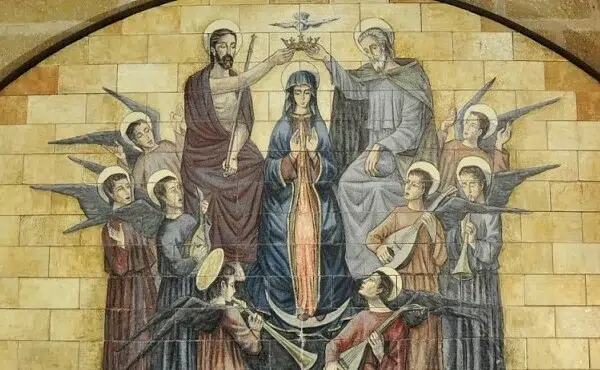
    The Pope Pius XII instituted this feast in 1954.It was later, with the liturgical reform of the Second Vatican Council, it was placed within the octave of the Assumption of the Virgin Mary, on August 22. Thus, the coronation of Mary as Queen and Mistress of all creation is celebrated just after her glorious entrance into heaven in body and soul.

    Holy Mary Queen because she is Mother

    The royalty of the Virgin Mary is intimately linked to her role as Mother of God. St. Josemaría Escrivá, a great devotee of our Mother, often meditated on this truth, teaching that Mary was the first woman of the world. exalted by God above every creatureWe have as our Mother the Mother of God, Queen of Heaven and of the World".

    On another occasion St. Josemaría wrote in a homily: "If our faith is weak, let us turn to Mary. St. John tells us that through the miracle of the wedding feast at Cana, which Christ performed at the request of his Mother, his disciples believed in him. Our Mother always intercedes before her Son so that he will attend to us and show himself to us in such a way that we can confess: You are the Son of God, Friends of God 285

    From the first moment of her conception, Mary was filled with grace. She was preserved from original sin and lived her entire existence perfectly united to the will of God. In the fullness of her self-giving, she accepted to be the Mother of the Savior, and at the foot of the Cross, she also became the Mother of God. Mother of all men and Coredemptrix with her Son.

    Therefore, her reign is not symbolic: it is a reflection of her essential role in the plan of salvation, willed by God as intercessor, protector and guide of the Christian people.

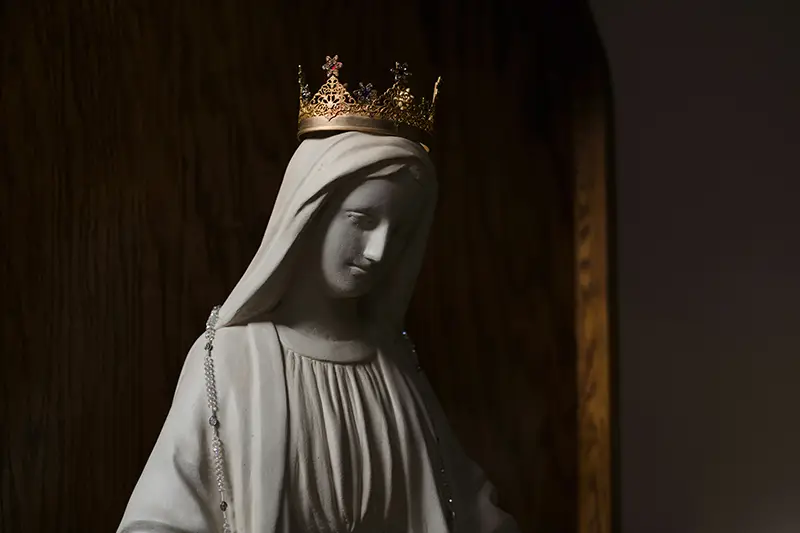
    Santa María Reina san Josemaría amor a la Virgen María

    Virgin Mary source of peace in the midst of storms

    Unlike human reigns marked by power or ambition, Mary's reign is filled with maternal tenderness and compassion. As St. Josemaría points out, she is Queen of Peaceand to turn to her is to find consolation: "Holy Mary is the Queen of Peace. Therefore, when your soul is troubled... do not cease to acclaim her.... Regina pacis, ora pro nobis!".

    Our Lady is not distant: she is close, understanding and available. Many Christians experience how, when they turn to her in the midst of difficulties-illness, family worries, vocational doubts-her presence serenades the heart and opens paths of hope.

    Queen and Mother of the Apostles

    In addition to consoling, Mary encourages. It is Regina ApostolorumQueen of Apostles. St. Josemaría insisted that the Blessed Virgin Mary encourages us to live a life of self-giving and mission:

    "Be bold. You can count on the help of Mary, Regina apostolorum. And Our Lady, without ceasing to behave as a Mother, knows how to place her children before their precise responsibilities. (...) Many conversions, many decisions of dedication to the service of God have been preceded by an encounter with Mary. Our Lady has fostered the desire to search, she has maternally activated the anxieties of the soul, she has made us aspire to a change, to a new life. And so the "do what he will tell you" became a reality of loving dedication, a Christian vocation that has since then illuminated our whole personal life.". St. Josemaría, It is Christ who passes by, 149

    This apostolic dimension of Mary's reign connects profoundly with the mission of the CARF Foundationwhich promotes the training of seminarians and diocesan priests and religious men and women at the service of the universal Church. Mary, who knew how to welcome and guide the vocation of the first apostles, continues today to accompany those who give their lives to the priesthood or consecrated life.

    How to celebrate the feast of Saint Mary Queen?

    We propose you to live this day with some simple but profound gestures:

    santa maría reina san josemaría virgen maría
    The Coronation of the Virgin Mary. Photo of the gallery of the scenes of the Rosary of the Sanctuary of Torreciudad.

    "Mary's divine Maternity is the root of all the perfections and privileges that adorn her. By this title, she was conceived immaculate and is full of grace, she is always a virgin, she ascended body and soul to heaven, she has been crowned Queen of all creation, above the angels and the saints. More than her, only God. The Blessed Virgin, because she is the Mother of God, possesses a dignity that is in a certain sense infinite, of the infinite good that is God. There is no danger of exaggerating. We can never delve deeply enough into this ineffable mystery; we can never thank Our Mother enough for this familiarity she has given us with the Most Blessed Trinity."St. Josemaría. Friends of God, 276

    Prayer proposal for August 22

    That this August 22, when honoring Saint Mary QueenLet us find in her maternal help and reigning presence the peace and the impulse to serve with generous hearts and willing hands.


    Bibliography:

    Emmanuel Enwenwen, priest: "many Nigerians are missionaries today".

    Emmanuel Enwenwen was born into a Catholic family in Nigeria. At the age of 12 he entered the minor seminary and, years later, "driven by an ardent zeal to serve God and humanity", entered the major seminary. After a decade of formation, he received priestly ordination on July 7, 2018.

    How did you discover your vocation as a priest?

    -Growing up in a Catholic family and in a Catholic community had a lot of positive influence on my faith. I grew up seeing Catholic priests as agents of hope because of the role they played in our community.

    The selflessness of these priests who dedicated their lives to the service of the needy and the sick was a great source of inspiration for me. The desire to bring the message of hope to the people in their difficult times became a burning zeal that led me to the altars.

    What was the reaction of your family and friends when you told them you wanted to become a priest?

    -Their reaction was positive. They assured me of their support and promised never to be an obstacle to my progress and mission. I have enjoyed that support until today. I owe them eternal gratitude and pray for them every day.

    How would you describe the Church in Nigeria?

    -The Catholic Church in Nigeria has remained a mother focused on the salvation of all her children. This has yielded many positive results, as seen in the attendance to Mass.

    This faith commitment is also seen in the number of vocations to both the priesthood and religious life. A few years ago, we were beneficiaries of missionaries who came to evangelize us. Today many Nigerians have become missionaries in different parts of the world.

    What are the challenges facing the Church in your country?

    -The Catholic Church in Nigeria faces numerous challenges as it strives to fulfill its spiritual and social mission. One of the main problems is insecurity. There is violence from insurgent groups, bandits and kidnappers who attack clergy, laity and even places of worship, disrupting pastoral activities and spreading fear. In fact, in some parts of the country, the Church has become an easy route to martyrdom.

    How do you see the future of the Church in Nigeria?

    -The future of the Catholic Church in Nigeria has profound significance, not only for the faithful, but for the soul of the nation itself. Thanks to a young and dynamic population, the Church has the capacity to reshape the moral landscape of the nation. Moreover, with the many young people in the seminaries and convents, there is great hope of continuity for the future.

    Emmanuel Enwenwen sacerdote Nigeria

    What do you appreciate most about your education in Rome?

    -Studying in Rome is the best thing that can happen to any Catholic priest. Aside from the rich academic possibilities, here in Rome, the Rome history and faith converge. I greatly appreciate the multicultural character of the Pontifical University of the Holy Cross, which has exposed me to the different cultures of the world. For me it is a long period of learning, unlearning and relearning.

    What is your priestly vocation like today?

    -The gift of the priesthood is for me one of the greatest blessings I have received from God. I consider myself an unworthy servant entrusted with the greatest privilege of serving God's people.

    I feel privileged to celebrate the Holy Eucharist every day and to be a bearer of the Good News of Christ, which is a message of hope. Not only am I happy to be a priest, but I feel fulfilled and grateful for the privilege of being a priest.

    How does the training received through the benefactors of the CARF Foundation help you in your pastoral work?

    -I am a student of Institutional Social Communication. Being a professional in the field of communication equips me with many tools for my pastoral work in today's changing world. Good communication contributes greatly to the success of missionary work.

    My training provides me with a critical eye to read the reality around me and communicate a message that brings hope to the people entrusted to my care. The knowledge acquired here will be passed on to other young men preparing for the priesthood in Nigeria.


    Original interview published in Omnes

    Why does the CARF Foundation support the formation of Catholic congregations?

    The CARF Foundation in its mission of service to the Church, is committed not only to facilitating access to formation for priests and future priests from all over the world, but also for members of various Catholic congregations of men and women religious.

    In the Church there are different Catholic denominations and congregations.

    Each religious congregation has its own mission and specific activities according to its charism. They dedicate their time to fields as diverse as education, health or social assistance to the most needy, or simply, through contemplation, to being the spiritual lungs of modern life. Their services are fundamental to our society and their work in these fields is highly appreciated and valued.

    The CARF Foundation, in addition to assisting in the formation of seminarians and diocesan priests from all over the world, also grants scholarships to religious men and women belonging to the various Catholic congregations so that they may have access to a solid and adequate formation for the realization of their mission as pastoral agents.

    Why is it important for Catholic congregations to have well-formed members?

    Members of Catholic congregations are important bearers and transmitters of the faith. A solid formation enables them to fully understand and live the fundamentals of the Gospel and the doctrine of the Church.

    Many of these religious orders are dedicated to education and are at the service of society. An integral formation enables them to respond to the needs of others more effectively and in keeping with their mission. Moreover, in an increasingly globalized world, it is essential that members of Catholic congregations be well trained both for institutional communication and for interreligious and ecumenical dialogue.

    The CARF Foundation supports the formation of religious congregations such as Franciscan priests.

    The Franciscan priests, who belonged to the Order of Friars Minoralso known as the Franciscan Friars, one of the most important religious congregations, share the distinctive characteristics of Franciscan spirituality founded by St. Francis of Assisi; they embrace evangelical poverty as a way of imitating Christ, living a simple life stripped of material goods and committed to living in fraternal community. The CARF Foundation, to the extent of its possibilities, supports the formation of religious congregations such as the Franciscan Friars.

    Father MarwanAfter serving as pastor at the Basilica of the Annunciation in Nazareth, he was ordained a Franciscan priest. He studied at the Pontifical University of the Holy Cross in Rome, thanks to a study grant from the CARF Foundation.

    The CARF Foundation supports the formation of priests of the Priestly Fraternity of the Missionaries of St. Charles Borromeo.

    The Missionaries of St. Charles Borromeo, also known as the Missionaries of St. Charles Borromeo, also known as the Missionaries of St. Charles Borromeo. Missionaries of Communion and LiberationLuigi Giussan, an Italian priest. The main objective of this movement is to promote a personal encounter with Jesus Christ and the profound experience of the Catholic faith in daily life.

    "I cannot fail to thank those who, with prayers and material help - such as my benefactors at the CARF Foundation - have helped me in my work.-I was able to study at this great university where I met many new friends from all over the world, and I was able to study in depth with excellent professors in so many disciplines that will help me in my mission as a priest of the Lord. Filippo Pellini is 32 years old, belongs to the Priestly Fraternity of the Missionaries of St. Charles Borromeo and has received a grant from the CARF Foundation to complete his theology studies at the University of Rome. Pontifical University of the Holy Cross in Rome. 

    congregaciones religiosas formación CARF PUSC

    The CARF Foundation supports the formation of priests of the Congregation of the Precious Blood. 

    The Missionaries of the Precious Blood, founded by St. Gaspar del Bufalo in 1815 in Italy, are dedicated to the preaching of the Gospel and the service of the redemption of the world through devotion to the Precious Blood of Jesus shed on the Cross.

    Their charism focuses on reconciliation, redemption and spiritual renewal. They seek to bring God's love and mercy to all corners of the world and to all people.

    The congregation is composed of priests and religious brothers who live in fraternal communities and profess the vows of poverty, chastity and obedience. 

    Francesco Albertini is a young seminarian from the Missionaries of the Precious Blood and the first of his congregation to study at the Pontifical University of the Holy Cross, thanks to a study grant from the CARF Foundation.