Prayer was already sustaining the early Church. That same night an angel came down to the prison, woke Peter, opened all the doors, and when he left Peter in the street, he disappeared from his presence. Herod's plans to kill Peter were frustrated; and the Church began to grow in all the territories bordering Israel.
The challenges of the new pontificate
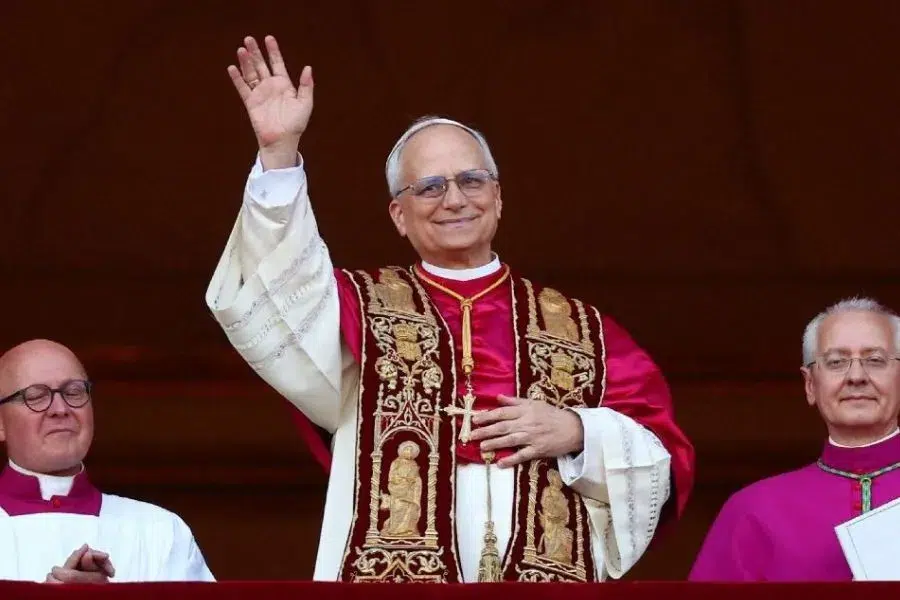
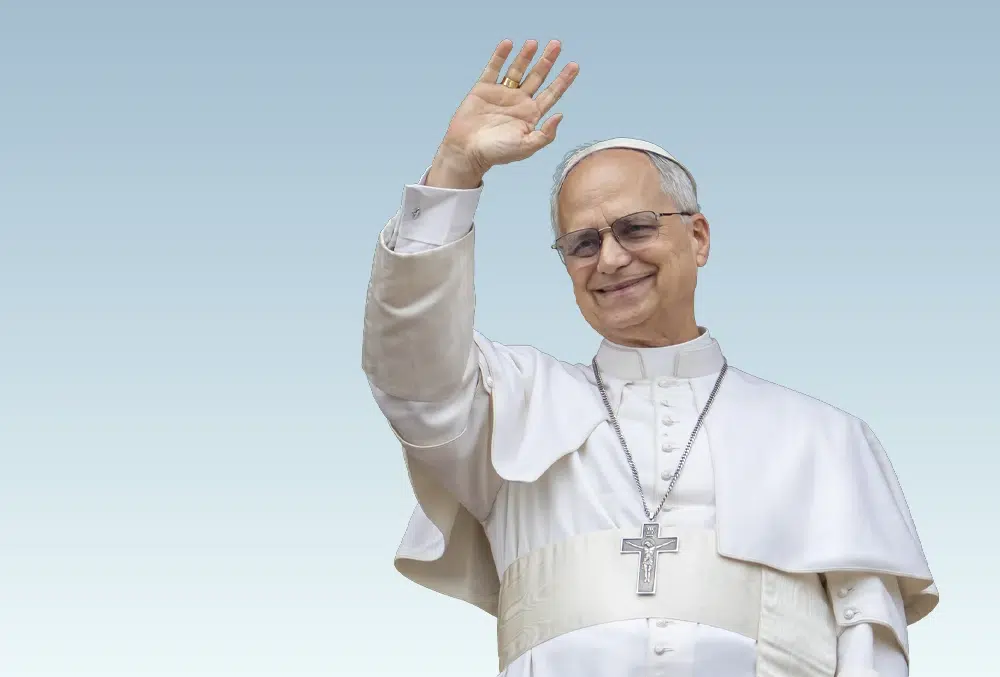
Today we do not have any Herod who wants to do away with the Pope, but there are more than one with more power and more influence than the miserable -perhaps the best adjective we can apply to him- Herod, who try to influence him not to carry out the mission for which he has been chosen by the founder of the Church who has chosen him as its visible head: the Church of Christ. The One, Holy, Catholic and Apostolic Church.
Commentaries and articles that lucubrate on whether he is conservative, progressive, etc., or what qualifier can be applied to him; and thus have an open channel to judge him in what he can do. Qualifiers that make no sense when it comes to living, or not living, the life and doctrine of Christ.
The weight of apostolic succession
From the very first day of his pontificate it seems to me that he has made it clear that the center of their entire mission, is to follow Jesus Christ, His mission in the Church is the same that Peter received: «to strengthen the Faith of all believers»; and to strengthen it by following the Magisterium of the Tradition of the two thousand years of life that the Church has been transmitting the teachings of Christ.
We are all well aware of the problems that Pope Leo XIV has to face, which are a legacy of currents of thought, behavior and practices that have become established in various areas of the Church and society, which have relied on the weakness of pastors; and in some cases, unfortunately, not only of weakness, but also of bad example.
Evangelizing in a secularized world
Finding the best measures to solve all these problems, in addition to requiring a certain amount of time to think, consult, and discover the most appropriate channels to implement the possible measures; time about which the pope Leo XIV made a comment at the Audience on May 28, regarding the parable of the Good Samaritan.
«We can imagine that, after having stayed a long time in Jerusalem, the priest and the Levite are in a hurry to return home. It is precisely the hurry, so present in our lives, that often prevents us from feeling compassion. He who thinks that his journey must have priority, is not willing to stop for another».
The Pope: a man in need of filial support
It is only five months since his election, and it is logical to realize that he needs to think, to meditate, to consult, in matters as serious and grave as those he has encountered; and ask for many lights from the Blessed Trinity, Father, Son and Holy Spirit.
In his homily at the Holy Mass at the beginning of his pontificate, and after pointing out that «We face this moment - he refers to the conclave - with the certainty that the Lord never abandons his people., He gathers it together when it is scattered and cares for it “like a shepherd for his flock” (Jer 31:10),” he adds:
«We have placed in God's hands the desire to elect the new successor of Peter, the Bishop of Rome, a pastor capable of guarding the rich patrimony of the Christian faith and, at the same time, of looking beyond it, to know how to face the questions, concerns and challenges of today. Accompanied by their prayers, we have experienced the work of the Holy Spirit, who has been able to harmonize the different musical instruments, making the strings of our heart vibrate in a single melody».
«I was elected without having any merit and, with fear and trepidation, I come to you as a brother who wants to become a servant of your faith and joy, walking with you on the path of God's love, who wants us all united in a single family.».
Prayer as communion and service
The Pope Leo XIV asks all Christians to pray for God's grace to flood their spirit when making decisions. on doctrine, on persons, to help all believers to be firm in the Faith and Morals that the holy Church has lived throughout the centuries, and to continue to discover the mysteries of love hidden in the Incarnation of the Son of God. This is their mission, the mission entrusted to Peter by Our Lord Jesus Christ.
Supporting the Pontiff
And like him, let us leave our prayers in the hands of the Mother of God, Mary Most Holy, as Pope Leo XIV did, when he prayed the Regina Coeli, at the end of the Mass at the beginning of his pontificate: «While we entrust to Mary the service of the Bishop of Rome, Pastor of the universal Church, From Peter's boat, let us contemplate her, Star of the Sea, Mother of Good Counsel, as a sign of hope. Let us implore through her intercession the gift of peace, help and consolation for those who suffer and, for all of us, the grace to be witnesses of the Risen Lord».
World Day of the Poor: Do not turn away your face from the poor
On Sunday, November 16, the Catholic Church celebrates the ninth World Day of the Poor. This event, scheduled on the penultimate Sunday of Ordinary Time, has become a basic moment for reflection and pastoral action throughout the world.
Pope Leo XIV has proposed a motto taken from from the Book of Tobit: "Do not turn away your face from the poor"." (Tb 4, 7). The following is the full message that was signed on June 13, 2025 in the Vatican on the day of thememory of St. Anthony of Padua, patron saint of the poor.
Message of Leo XIV for the IX World Day of the Poor
1. «You, Lord, are my hope» (Salt 71, 5). These words come from a heart oppressed by serious difficulties: «You have put me through many troubles» (v. 20), says the psalmist. In spite of this, his soul is open and confident, because it remains firm in faith, which recognizes God's support and proclaims it: «You are my rock and my fortress» (v. 3). From this comes the unfailing confidence that hope in him does not disappoint: «I take refuge in you, O Lord, may I never be ashamed» (v. 1).
In the midst of life's trials, hope is encouraged by the firm and encouraging certainty of God's love, poured into hearts through the Holy Spirit. That is why it does not disappoint (cf. Rm 5:5), and St. Paul can write to Timothy: «We toil and struggle because we have set our hope on the living God» (1Tm 4, 10). The living God is, in fact, the «God of hope» (Rm 15:13), which, in Christ, through his death and resurrection, has become «our hope» (1Tm 1, 1). We cannot forget that we have been saved in this hope, in which we need to remain rooted.
Do not store up treasures on earth
2. The poor can become a witness of a strong and reliable hope precisely because they profess it in a precarious condition of life, marked by deprivation, fragility and marginalization. He does not trust in the securities of power or of having; on the contrary, he suffers from them and is often a victim of them. His hope can only rest elsewhere. Recognizing that God is our first and only hope, we also perform the passage of the hopes ephemeral to the hope durable. Faced with the desire to have God as a companion on our journey, riches become relative, because we discover the true treasure that we really need.
The words with which the Lord Jesus exhorted his disciples ring out loud and clear: «Do not store up treasures on earth, where moth and rust consume them, and thieves break through walls and steal them. Lay up for yourselves treasures in heaven, where no moth or rust can consume them., and thieves who drill and steal» (Mt 6, 19-20).
Saint Augustine: may God be all your presumption
3. The most serious poverty is not knowing God. This is what the Pope Francis when in Evangelii gaudium wrote: «The worst discrimination suffered by the poor is the lack of spiritual attention. The vast majority of the poor have a special openness to the faith; they need God and we cannot fail to offer them his friendship, his blessing, his Word, the celebration of the Sacraments and the proposal of a path of growth and maturation in the faith» (n. 200).
Here we see a fundamental and totally original awareness of how to find one's treasure in God. Indeed, the apostle John insists: «He who says, “I love God,” and does not love his brother, is a liar. How can he love God, whom he does not see, who does not love his brother, whom he sees?» (1 Jn 4, 20).
It is a rule of faith and a secret of hope that all the goods of this earth, the material realities, the pleasures of the world, the economic well-being, although important, are not enough to make the heart happy. Riches often deceive and lead to dramatic situations of poverty, the most serious of which is to think that we do not need God and that we can lead our lives independently of Him. The words of St. Augustine come to mind: «...".«Let God be all your presumption: be destitute of Him, and so shall you be filled with Him. Whatever you possess without Him will cause you greater emptiness.» (Enarr. in Ps. 85, 3).
Christian hope, an anchor in Jesus
4. Christian hope, to which the Word of God refers, is certainty on the path of life, because it does not depend on human strength but on the promise of God, who is always faithful. For this reason, Christians from the beginning wanted to identify hope with the symbol of the anchor, which gives stability and security.
Christian hope is like an anchor that fixes our heart on the promise of the Lord Jesus., who has saved us by his death and resurrection and who will return again in our midst. This hope continues to point to the «new heaven» and the «new earth» as the true horizon of life (2 P 3, 13) where the existence of all creatures will find its authentic meaning, for our true homeland is in heaven (cf. Flp 3, 20).
The city of God, therefore, commits us to the cities of men. These must, from now on, begin to resemble it. Hope, sustained by the love of God poured into our hearts through the Holy Spirit (cf. Rm 5, 5 transforms the human heart into fertile soil, where charity can sprout for the life of the world. The Church's Tradition constantly reaffirms this circularity between the three theological virtues: faith, hope and charity.
Hope is born of faith, which nourishes and sustains it, on the foundation of charity, which is the mother of all virtues. And we need charity today, now. It is not a promise, but a reality to which we look with joy and responsibility: it commits us, orienting our decisions to the common good. Whoever lacks charity not only lacks faith and hope, but also deprives his neighbor of hope.
The greatest social commandment, charity
5. The biblical invitation to hope therefore entails the duty to assume consistent responsibilities in history, without delay. Charity, in fact, «represents the greatest social commandment» (Catechism of the Catholic Church, 1889). Poverty has structural causes that must be addressed and eliminated. While this is happening, we are all called to create new signs of hope that bear witness to Christian charity, as did many saints of all ages. Hospitals and schools, for example, are institutions created to express acceptance of the weakest and most marginalized.
Today they should already be part of the public policies of every country, but wars and inequalities often prevent them from doing so. More and more signs of hope today are family homes, communities for minors, centers for listening and welcoming, soup kitchens for the poor, shelters, popular schools: how many signs, often hidden, to which perhaps we do not pay attention and yet so important to shake us out of indifference and motivate us to commit ourselves to various forms of volunteer work.
The poor are not a distraction for the Church, but the most beloved brothers and sisters., Because each of them, by their very existence, and even by their words and the wisdom they possess, provokes us to touch the truth of the Gospel with our hands. For this reason, the World Day of the Poor wants to remind our communities that the poor are at the center of all pastoral action. Not only of its charitable dimension, but also of what the Church celebrates and proclaims.
God has assumed his poverty in order to enrich us through their voices, their stories, their faces. Every form of poverty, without excluding any, is a call to live the Gospel concretely and to offer effective signs of hope.
Helping the poor, a matter of justice
6. This is the invitation that comes to us from the Jubilee celebration. It is not by chance that World Day of the Poor is celebrated towards the end of this year of grace. When the Holy Door closes, we will have to guard and transmit the divine gifts that have been poured into our hands throughout a whole year of prayer, conversion and witness.
The poor are not objects of our pastoral care, but creative subjects who stimulate us to find ever new ways of living the Gospel today. Faced with the succession of new waves of impoverishment, there is a risk of becoming accustomed and resigned. Every day we meet poor or impoverished people, and sometimes it can happen that we ourselves are the ones who have less, who lose what we once thought was secure: housing, adequate food for the day, access to medical care, a good level of education and information, freedom of religion and freedom of expression.
In promoting the common good, our social responsibility is based on the creative gesture of God, who gives to all the goods of the earth; and just as these, so too, are the goods of the earth. the fruits of man's labor must be equitably accessible. Helping the poor is, in fact, a matter of justice rather than charity. As St. Augustine observes: «You give bread to the hungry, but it would be better if no one were hungry and you had no one to give to. You clothe the naked, but would that all were clothed and there were no need to clothe anyone!» (Homilies on the First Letter of St. John to the Parthians, VIII, 5).
I hope, therefore, that this Jubilee Year can give impetus to the development of policies to combat old and new forms of poverty, as well as new initiatives to support and help the poorest of the poor. Work, education, housing and health are the conditions for a security that will never be achieved with weapons. I am pleased with the initiatives already in place and with the commitment that a large number of men and women of good will are making every day at the international level.
Let us trust in Mary Most Holy, Consolation of the afflicted, and with her let us sing a song of hope making our own the words of the Te Deum: «In Te, Domine, speravi, non confundar in aeternum -In you, Lord, I have trusted, I shall not be disappointed forever».
Vatican City, June 13, 2025, memorial of St. Anthony of Padua, Patron Saint of the Poor. Leo XIV.
The connection with Dilexi Te
Pope Leo XIV's message for this World Day of the Poor is a document of theological density. He uses the figure of Tobit to remind the Church that love of God and love of neighbor are inseparable, and he situates the whole of the social action of the Church as the only coherent response to the Dilexi Te with which God has founded Creation and Redemption.
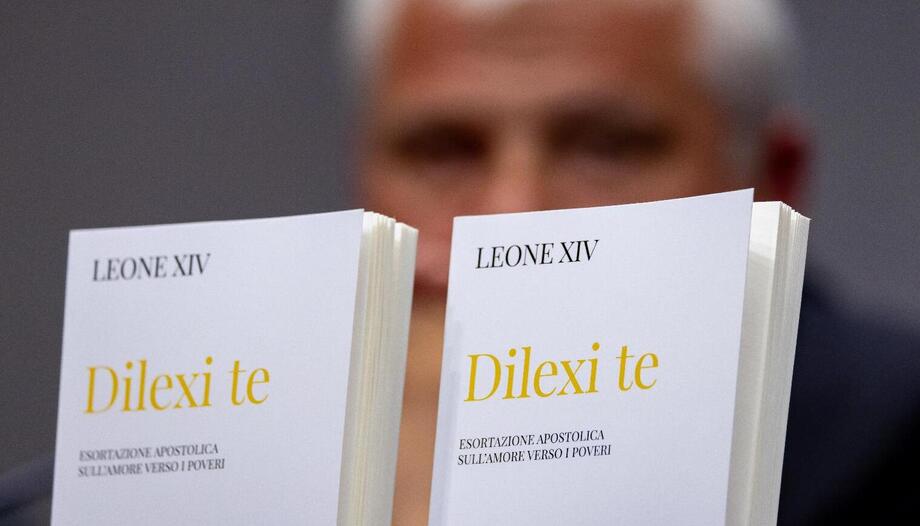
Pope Leo XIV asks parishes and dioceses not to limit the day to a collection, but to promote gestures of fraternity, such as shared lunches and listening centers. Pope Leo XIV uses this message to pastorally apply some of the principles of his first apostolic exhortation, Dilexi Te (I have loved you).
If in Dilexi Te Pope Leo XIV explained that God's foundational love is a concrete act and not an abstract idea, in this message he concludes the logical implication of that idea: «If we have been loved first (Dilexi te) for a God who has not turned his face away from us, how can we turn our face away from him in whom Christ is present?».
Pope Leo XIV is clear in affirming that «charity is not assistance». It is not a matter of «giving what we have in excess, but of sharing what we are» and of «questioning the economic structures» that perpetuate exclusion.
Table of Contents
Joseph Weiler: Europe's spiritual crisis
The Aula Magna of the headquarters of the University of Navarra in Madrid hosted the Omnes-CARF Forum on "The Spiritual Crisis of Europe". A topic that has aroused great expectation translated into the large audience that has gathered at this meeting.
The Omnes management thanked speakers and attendees for their presence and highlighted the intellectual and human level of Professor Weiler, who becomes the third Ratzinger Prize winner to attend an Omnes-CARF Foundation Forum.
The director of Omnes also thanked the sponsors, Banco Sabadell and the Religious Tourism and Pilgrimages section of Viajes el Corte Inglés for their support for this Forum, as well as the Master's Degree in Christianity and Culture of the University of Navarra.
"We see the consequences of a society full of rights but without personal responsibility."
Professor María José Roca was in charge of moderating the session and introducing Joseph Weiler. Roca pointed out the defense of "that a plurality of visions is possible in Europe in a context of respect for rights". embodied by Professor Weiler who represented Italy before the European Court of Human Rights in the Lautsi v. Italy case, which ruled in favor of freedom from the presence of crucifixes in Italian public schools.
The "European trinity
Weiler began his dissertation by stressing how "the crisis that Europe is experiencing is not only political, defensive or economic. It is a crisis, above all of values". In this area, Weiler explained the values which, in his opinion, underpin European thinking and which he called "the European trinity": "the value of democracy, the defense of human rights and the rule of law".
These three principles are the basis of European states, and are indispensable. We don't want to live in a society that doesn't respect those values, Weiler maintained, "but they have a problem, they are empty.They can go in a good direction or in a bad direction".
Weiler has explained this emptiness of principles: democracy is a technology of government; it is empty, because if there is a society where the majority were bad people, there would be a bad democracy. "Likewise, the indispensable fundamental rights give us freedoms, but what do we do with that freedom? Depending on what we do, we can do good or bad; for example, we can do a lot of bad things protected by the freedom of expression".
Finally, Weiler pointed out, the same applies to the rule of law if the laws it emanates are unjust.
The European void
Faced with this reality, Weiler has defended his postulate: the human being seeks "to give a meaning to our life that goes beyond our personal interest".
Before World War II, the professor continued, "this human desire was covered by three elements: family, Church and homeland. After the war, these elements disappeared; and this is understandable, if we take into account the connotation with, and abuse by, the fascist regimes. Europe becomes secular, churches are emptied, the notion of patriotism disappears and the family disintegrates. All this gives rise to a vacuum. This is the origin of Europe's spiritual crisis: "its values, 'the European holy trinity' are indispensable, but they do not satisfy the search for meaning in life. The values of the past: family, church and homeland no longer exist. There is thus a spiritual vacuum".
We certainly do not want to return to a fascist Europe. But, taking patriotism as an example, in the fascist version the individual belongs to the State; in the democratic-republican version, the State belongs to the individual.
The constitutional expert asked himself in the conference if a non-Christian Europe is possible. To this question, Weiler continued, we can answer according to how Christian Europe is defined. If we look at "art, architecture, music, and also political culture, it is impossible to deny the profound impact that the Christian tradition has had on the current culture of Europe".
But the Christian root is not the only one that has influenced the conception of Europe: "in the cultural roots of Europe there is also an important influence of Athens. Culturally speaking, Europe is a synthesis between Jerusalem and Athens".
Weiler pointed out that, in addition to this, it is very significant that twenty years ago, "in the great discussion on the preamble of the European Constitution, it began with a quote from Pericles (Athens) and spoke about the enlightenment reason and the idea of including a mention to the Christian roots was rejected". Although this rejection does not change the reality, it demonstrates the attitude with which the European political class approaches this issue of Europe's Christian roots.
Another possible definition of Christian Europe would be if there were "at least a critical mass of practicing Christians. If we do not have this majority, it is difficult to speak of a Christian Europe. "It is a Europe with a Christian past," the jurist stressed. "At present we find ourselves in a post-Constantinian society. Now»said Weiler, «the Church (and believers: the creative minority) must look for another way to influence society.".
The three dangers of Europe's spiritual crisis
Joseph Weiler has pointed out three key points in this spiritual crisis in Europe: the idea that faith is something relative to the private sphere, a false conception of neutrality which is, in reality, a choice for secularism, and the conception of the individual as a subject only of rights and not of duties:
1. Considering faith as something private
Weiler has exposed, with clairvoyance, how we Europeans are "children of the French Revolution and I see many Christian colleagues who have taken on this idea that religion is something private. People who say grace at the table but don't do it with their work colleagues because of this idea that it is something private".
At this point, Weiler recalled the words of the prophet Micah: "Man, you have been made to know what is good, what the Lord wants of you: only practice right, love kindness, and walk humbly with your God" (Micah 6:8) and pointed out that "it does not say walk in secret, but walk humbly. Walking humbly is not the same as walking in secret. In the post-Constantinian society, I wonder if it is a good policy to hide the faith, because there is a duty of witness".
2. The false conception of neutrality
At this point, Weiler has pointed out this other "legacy of the French Revolution". Weiler illustrated this danger by giving as an example the field of education. A point on which, "Americans and French are in the same bed. They think that the state has the obligation to be neutral, i.e. it cannot show a preference for one religion or another. And that leads them to think that the public school must be secular, secular, because if it is religious it would be a violation of neutrality.
What does this mean? That a secular family that wants a secular education for their children can send their children to public school, financed by the state, but a Catholic family that wants a Catholic education must pay because it is private. It is a false conception of neutrality, because it opts for one option: the secular one.
It can be demonstrated by the example of the Netherlands and Great Britain. These nations have understood that the social rupture of now is not between Protestants and Catholics, for example, but between religious and non-religious. States fund secular schools, Catholic schools, Protestant schools, Jewish schools, Muslim schools..., because to fund only secular schools is to show a preference for the secular option».
"God asks us to walk humbly, not to walk in secret." Joseph Weiler, Ratzinger Award 2022.
3. Rights without duties
The last part of Professor Weiler's lecture dwells on what he refers to as the "an obvious consequence of the secularization of Europe: the new faith is the conquest of rights".
Although, as he has argued, if the law puts man at the center, it is good. The problem is that nobody talks about duties and little by little, it "turns this individual into a self-centered individual. Everything begins and ends in myself, full of rights and without responsibilities".
He explained: "I don't judge a person according to his religion. I know religious people who believe in God and who are, at the same time, horrible human beings. I know atheists who are noble. But as a society something has disappeared when you have lost a powerful religious voice."
But "in non-secularized Europe," explained Weiler, "every Sunday there was a voice, everywhere, that spoke of duties and it was a legitimate and important voice. This was the voice of the Church. Now no politician in Europe could repeat Kennedy's famous speech. We will be able to see the spiritual consequences of a society that is full of rights but no duties, no personal responsibility".
Recovering a sense of responsibility
When asked what values European society should recover in order to avoid this collapse, Weiler appealed, first of all, to "personal responsibility, without which the implications are very important". Weiler defended Christian values in the creation of the European Union: "possibly more important than the market, in the creation of the European Union was peace".
Weiler defended that "on the one hand it was a very wise political and strategic decision, but not only that. The founding fathers: Jean Monet, Schumman, Adenauer, De Gasperi... convinced Catholics, made an act that showed faith in forgiveness and redemption. Without these sentiments, do you think that five years after the Second World War, French and Germans would have shaken hands, where did these sentiments and this belief in redemption and forgiveness come from if not from the Catholic Christian tradition? It is the most important success of the European Union".
Joseph Weiler, a biographical sketch
An American of Jewish origin, he was born in Johannesburg in 1951 and has lived in various places in Israel as well as in Great Britain, where he studied at the universities of Sussex and Cambridge. He then moved to the United States where he has taught at the University of Michigan, then Harvard Law School, and New York University.
Weiler is a renowned expert in European Union Law. Of Jewish faith, Joseph Weiler, married and father of five children, is a member of the American Academy of Arts and Sciences and, in our country, has received honorary doctorates from the University of Navarra and CEU San Pablo.
He represented Italy before the European Court of Human Rights in the Lautsi v. Italy case, in which his defense of the presence of crucifixes in public places is of particular interest for the clarity of his arguments, the ease of his analogies, and above all, for the level of the reasoning presented before the Court, stating, for example, that "the message of tolerance towards others must not be translated into a message of intolerance towards one's own identity".
In his argument Weiler further emphasized the importance of a real balance between individual freedoms, characteristic of traditionally Christian European nations, which "demonstrates to countries that believe that democracy would force them to shed their religious identity that this is not true."
On December 1, in the Clementine Hall of the Apostolic Palace, the Holy Father Francis will present the Ratzinger Prize 2022 to Father Michel Fédou and Professor Joseph Halevi Horowitz Weiler.
María José Atienza, Director of Omnes. She has a degree in Communication, with more than 15 years of experience in Church communication.
Table of Contents
November 9: Diocesan Church Day 2025
Diocesan Church Day is an opportunity to remember the mission of each diocese as a local community, centered on faith, solidarity and the spiritual accompaniment of all its members. Through the work of priests, seminarians and communities of the faithful, dioceses are the beating heart of the Church, a place where faith is lived in its closest and most personal dimension.
In Spain, we celebrate this day on the second Sunday of November. And this year its motto is: «You too can be a saint.» mainly promoted by the Spanish Episcopal Conference .
The diocese: local heart of the Church
The diocese is the ecclesial unit that brings together the faithful of a given region under the direction of a bishop. In it, the priests are in charge of spiritually guiding the faithful, administering the sacraments and making Christ's love present. Each diocese, although it has its own particularity, is part of the universal Church, and its mission is to build the community of believers, transmitting the message of the Gospel in a concrete and accessible way to all.
The diocese is also a place of communion, where the laity, consecrated and clergy unite to work together in evangelization and service to those most in need. This work is vital to strengthen the social and religious fabric, promoting justice, peace and fraternal love.
The importance of seminarians in the formation of the Church
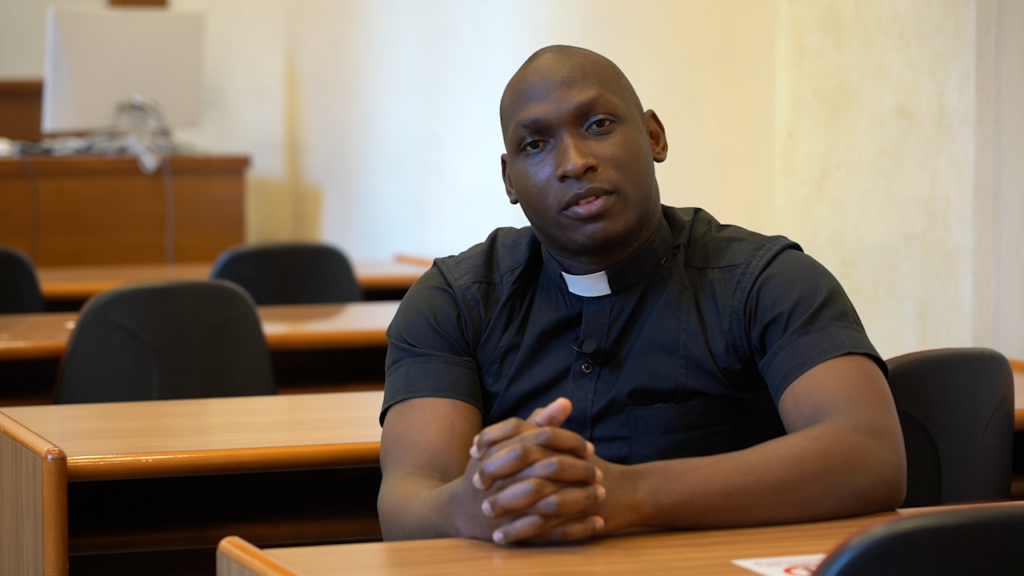
Nigerian seminarian undergoing formation in Rome.
One of the pillars of the vitality of the dioceses is the formation of new priests. Seminarians, young men preparing to embrace the priesthood, are the future of the Church. Their studies cover not only theological knowledge, but also human and spiritual formation, essential elements to bring the Word of God with authenticity and closeness to the communities.
This is also a good time to reflect on the importance of seminarians and to support them in their journey of discernment. Their vocation, guided by the Holy Spirit, is a generous response to the call to serve others, and their good instruction is essential for them to carry out the pastoral mission of the Church with dedication and love.
Being well-formed: a fundamental pillar for diocesan mission
Formation, both for priests and seminarians, is key in the process of building up the diocesan Church. This instruction is integral and encompasses academic, spiritual and pastoral aspects. In the dioceses, a constant formation is sought, which allows clerics and seminarians to face the challenges of the modern world without losing the essence of their Christian vocation.
Moreover, it is aimed not only at future priests, but also at the laity, who, through education in the faith, are trained to be authentic disciples of Christ. The study of the laity is essential so that they can live their faith in a committed way and be agents of change among their friends and family.
A call for generosity and commitment
It is important to remember that the Church is not only a global institution, but a local community lived and experienced in each diocese. Priests, seminarians, and all members of the diocesan community are called to be missionary disciples, bringing the Gospel message to every corner. Support for seminary and seminary instruction, as well as collaboration with dioceses, is essential so that this commitment continues to be a source of life for the Church and society.
Dioceses are the place where vocations are forged, faith relationships are nurtured and a community based on Gospel values is built. This November 10, let us celebrate the vocation, work and commitment of all those who make possible the mission of the Church in its closest dimension: the diocese.
Formation for seminarians and diocesan priests
The CARF Foundation plays a fundamental role in the studies of seminarians and diocesan priests around the world, supporting the vocational journey of those who feel called to serve the Church through priestly ministry. Through its work, the CARF Foundation contributes to the integral preparation of these future priests, offering them the necessary resources for their academic, spiritual and human studies, which will bear so much fruit when they return to their diocesan churches.
Thanks to the generosity of our benefactors, diocesan priests have the opportunity to receive a complete formation that prepares them to serve with dedication and love the communities they entrust to their ministry. This collective effort is vital to strengthening the mission of the Church and, by extension, the Universal Church.
His path from the Charismatic Renewal to his studies at the University of the Pontifical University of the Holy Crossz in Rome, shows how God's grace transforms life and opens horizons of mission for the Church today, giving impetus to the lay training for the new communities that emerge in it.
Fabiana was born on March 23, 1980 in Recife, in the Northeast region of Brazil, and is currently in her last year of her degree in Canon Law, thanks to the CARF Foundation, which granted her a scholarship during her studies.
A transforming encounter with Jesus
I am Brazilian, I was born in the city of Recife, in the state of Pernambuco, in the northeastern region of Brazil. I am the youngest daughter of four siblings. My family has always been Catholic: my mother, a deeply committed and practicing woman of the Catholic faith and the sacraments; my father, although not practicing, encouraged my siblings and me to participate and follow my mother. I grew up in an environment where Christian values were presented to us and witnessed by my parents as a reality of daily life.
But it was around the age of 13 when I had a personal experience with the living Jesus, through the Catholic Charismatic Renewal. From that experience, Jesus became someone close to me, who lived with me, who accompanied me in my moments of study and also in my leisure time, when I was with my friends. Jesus was with me in my daily life. He was not only a God who gave me rules (the ten commandments) to follow, but a God who wanted me to be happy and joyful in my daily life.
Experience renewed sacramental practice and prayer life
Through this experience, participation in the Holy Eucharist took on a new meaning: I began to attend daily, not just as an obligation on Sundays.
Born in me the desire to read the Bible, I began to learn more about the Catholic faith, to participate more fervently in the sacrament of Confession. I began to join a prayer group of the Catholic Charismatic Renewal, to take an interest in activities and social works, wishing that other people could also have that same personal encounter with Jesus that gave a new meaning to my life.
Everything good became even better, and what I had previously considered negative I learned to see in a different way, even discovering the meaning of difficulties.
This personal encounter with Jesus was a turning point in my life. I am very grateful to God because it happened at the beginning of my adolescence, giving me a fundamental foundation. A desire for holiness was born in me: to do everything well and to do it for God., giving meaning to the values that my parents taught me, to the attitudes that I saw in them and that now found a deeper meaning in God's love for me, for my family and for each person.
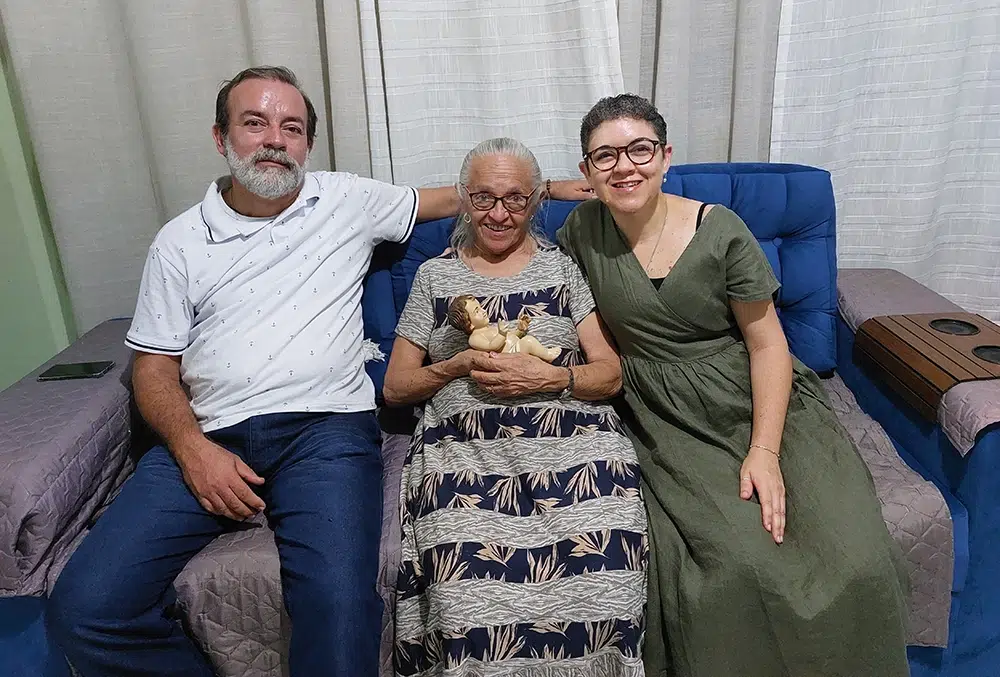
Fabiana Valdevino de Souza with her father and mother.
From Charismatic Renewal to service in the new communities
However, as the years went by, I began to feel that God was asking more of me, and that I also wanted to give more to the Lord. It was then that, for the first time, I thought of living in a new community. After a few months of prayer and discernment, I had the courage to seek out the Founder and those in charge of the community. Behold your Mother-Work of Mary to share what I was feeling and express my desire to make a community experience.
Years later I met the Community Behold your Mother-Work of Mary, a new community born in the neighborhood of Várzea, where I was living in Recife. When I came into contact with the first members of the community, I experienced mixed feelings: on the one hand, I was impressed by their courage in leaving everything - their father's house, their city - to live in community with the aim of evangelizing; on the other hand, it seemed to me an enormous challenge. My first thought was: «What about my projects, my dreams, am I going to give up everything? It is not necessary... I am already following Jesus, I am already fulfilling my part».
This is how I assumed, as a way of life, the charism of the community: to evangelize in every way, with joy, helping the local Church in its various needs, inviting everyone to take the Virgin Mary home, both in a physical and spiritual dimension. To evangelize and serve the Church like the Virgin Mary, guided by the grace of the Holy Spirit. To carry out the mission of the community I was sent to our mission house in Rome, where we developed our apostolate in a parish in the periphery.
Formation of the laity: discovering Canon Law
After a few years in Rome, a friend of the community told us about the course. Ecclesial Movements and New Communities, organized by the Pontifical University of the Holy Cross. He told us that he had already done it and that it would be very good for me and another missionary to participate as well, to help in the needs of the community. I spoke with our founder and after sharing it with the General Council, we received the proposal to do the course. That was our first contact with the PUSC.
From that course onwards we better understood the need for some members to enter the world of Canon Law, in order to help the Community in a special way and, at the same time, to prevent future errors. At the beginning we thought it was something intended for the formation of priests. However, in sharing it with the organizers of the course, we were encouraged to recognize the importance of also having the laywomen of a new community dedicate themselves to the study of Canon Law, given that this reality is still new and requires the preparation of lay people.
With some fear, but also with enthusiasm, I started my first steps in the ISSRA and then in the course of Canon Law. In time, I recognized as divine providence the opportunity to study Canon Law, especially at the PUSC, where it is always presented to us with its true purpose: the contribution to the salus animarum. Without this objective, the study would become cold and distant from the mission for which the Church exists with all its structure.
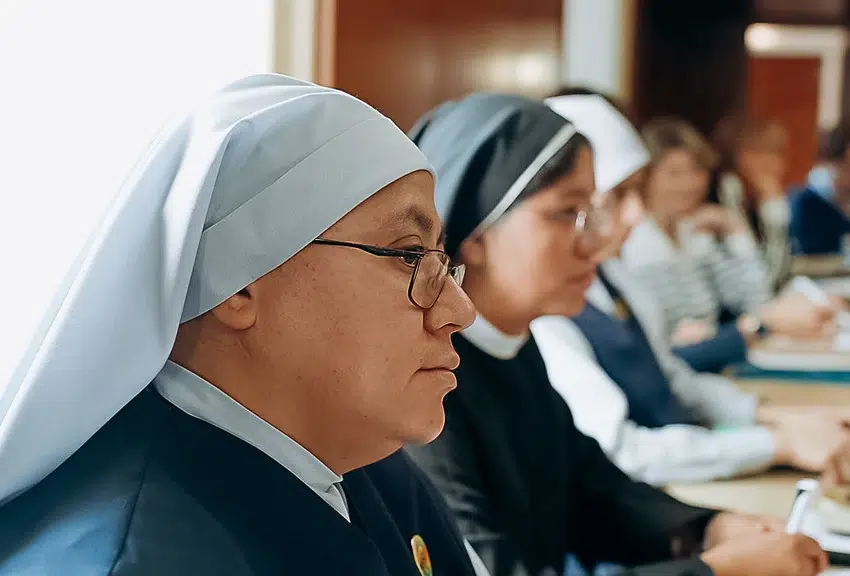
Religious, in a PUSC class.
CARF Foundation grants, a key support for training
The financing of study grants managed by the CARF Foundation, thanks to the generosity of thousands of benefactors and friends, is key to the formation of seminarians and diocesan priests, but also for religious men and women of new and consolidated movements in the Church.
«Given this opportunity to receive a solid formation, my desire with the Degree in Canon Law is to help my community, but also other communities and movements in Brazil and in the world. I wish to serve better and be faithful to the call that the Lord has given me, and for this I am enormously grateful to the benefactors of the CARF Foundation for giving me this great opportunity to receive concrete help in my formation», thanks Fabiana Valdevino de Souza.
Gerardo Ferrara, Degree in History and Political Science, specializing in the Middle East. Head of the student body at the Pontifical University of the Holy Cross in Rome.
Table of Contents
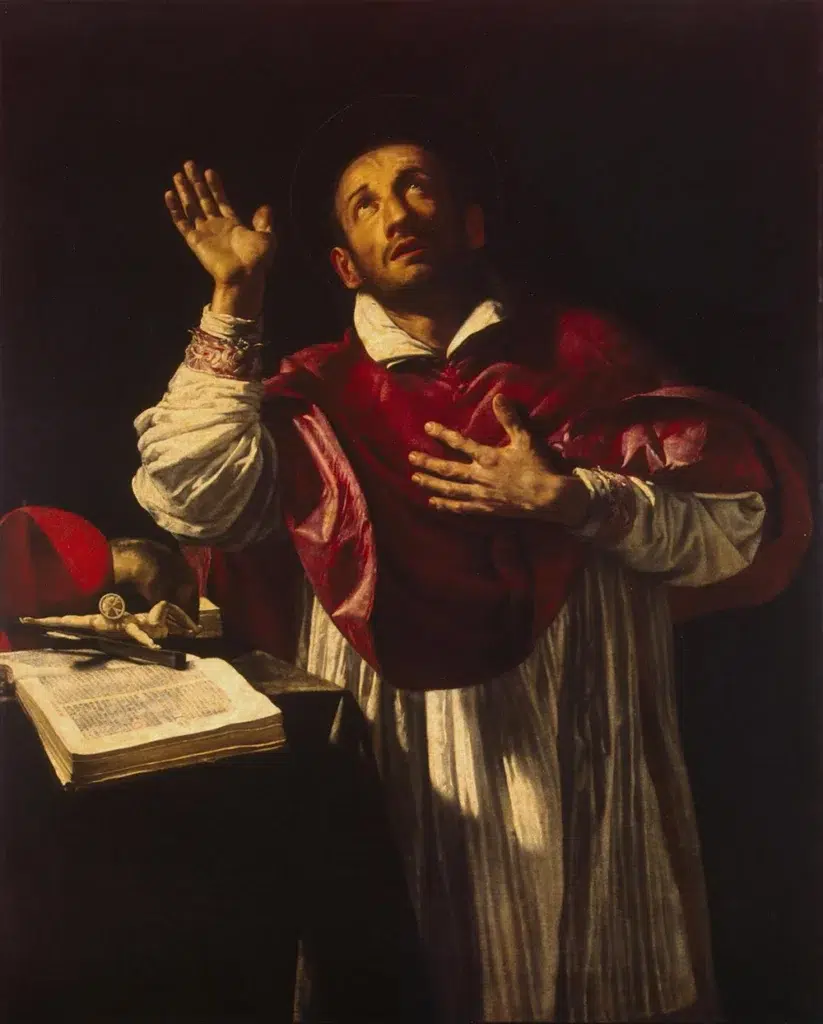
St. Charles Borromeo, patron saint of seminarians
St. Charles Borromeo was one of the most important persons of the Catholic Reformation, also known as the Counter-Reformation, in the 16th century. A man who was born into the opulence of the nobility and chose service and austerity.
His life shows how a priest, Armed with an iron will and faith, he can help transform the Church. He is remembered as a model pastor for his love of the Church. formation of seminarians and catechists.
The Borromeo family
Charles Borromeo was born on October 2, 1538 in the castle of Arona, on Lake Maggiore (Italy). His family, the Borromeo, was one of the oldest and most influential of the Lombard nobility. His father was Count Gilberto II Borromeo and his mother Margarita de Medici.
This maternal kinship would mark his destiny in a decisive way. His maternal uncle, Giovanni Angelo Medici, would become Pope Pius IV. From a young age, Charles showed remarkable piety and a serious inclination towards study, despite suffering from a slight speech impediment.
At the age of twelve, his family had already destined him for an ecclesiastical career, receiving the tonsure and the title of commendatory abbot. He studied Canonic Law and Civil Engineering at the University of Pavia.
A lay cardinal at the age of 22
The life of St. Charles Borromeo changed in 1559. After the death of Pope Paul IV, his maternal uncle was elected Pope, taking the name Pius IV. Almost immediately, the new pope called his nephew to Rome.
In 1560, at only 22 years of age and without having been ordained priest still, Charles was named cardinal deacon. It is essential to understand that, at that time, the cardinalate was often a political and administrative position. Pius IV also appointed him secretary of state of the Holy See.
It became, de facto, the most powerful man in Rome after the pope. He administered the affairs of the Papal States, managed Vatican diplomacy and oversaw countless projects. He lived like a Renaissance prince, surrounded by luxuries, although he personally maintained his piety.
The life of St. Charles Borromeo in Rome, although administratively efficient, was mundane. However, a tragic event shook his conscience: the sudden death of his older brother, Frederick, in 1562.
This loss caused him to reflect deeply on the vanity of the earthly life and the urgency of eternal salvation. Frederick was the heir of the family, and his death put pressure on Charles to leave the ecclesiastical life to ensure offspring.
Charles rejected this idea. He experienced a profound spiritual conversion. He decided that he would no longer be a lay administrator with a cardinal's title, but a true man of God. In 1563, it sought ordination and was consecrated priest, and soon after, bishop. His life changed radically: he adopted a lifestyle of extreme austerity, fasting and prayer.
The driving force behind the Council of Trent
The great work of the pontificate of Pius IV was the resumption and completion of the Council of Trent (1545-1563), which had been blocked for years. St. Charles Borromeo, In his position at the Secretariat of State, he was the diplomatic and organizational driving force that brought the Council to a successful conclusion in its final phase.
It was he who managed the tense negotiations between the European powers (Spain and France), the papal legates and the bishops. His tenacity was key to the council defining Catholic doctrine in the face of the Protestant reform and, crucially, establishing the decrees for the internal reform of the Church.
The council ended, St. Charles Borromeo did not rest. He dedicated himself body and soul to implementing his decrees. He chaired the commission that drafted the Roman Catechism (or Catechism of Trent), a fundamental tool for instructing the faithful and unifying teaching.
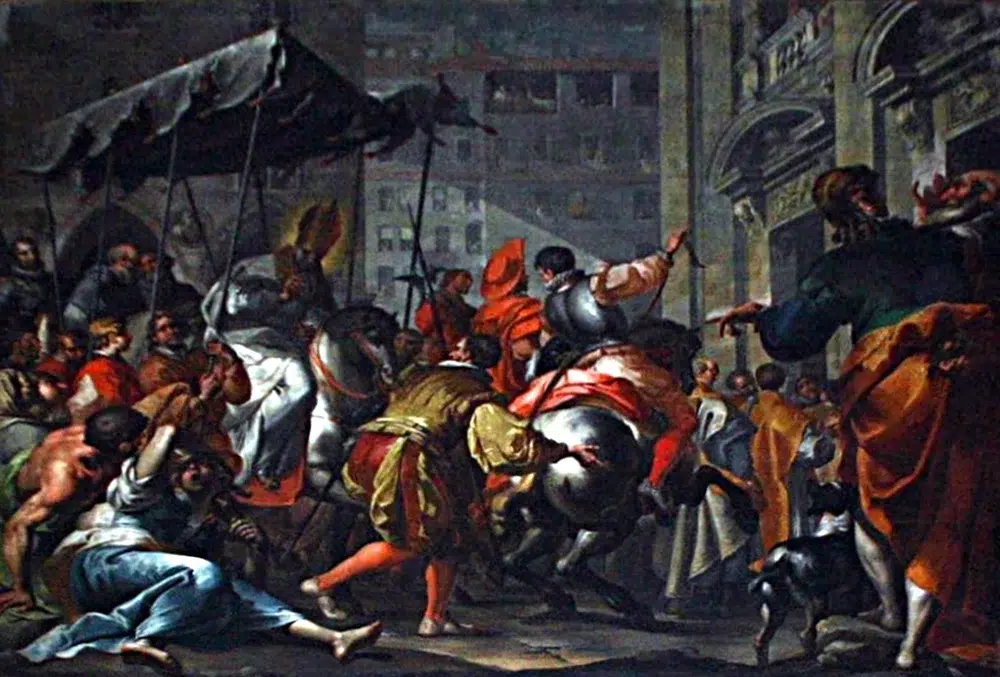
The triumphal entry of St. Charles Borromeo in Milan by Filippo Abbiati, Milan Cathedral.
St. Charles Borromeo: resident archbishop of Milan
While in Rome, St. Charles Borromeo had been appointed archbishop of Milan in 1560. However, as was the custom of the time, he governed his diocese "in absentia" through vicars. He was a "shepherd without a flock".
The very Council of Trent that he helped conclude forbade this practice and required bishops to reside in their dioceses. True to his principles, Charles begged his uncle, the pope, to allow him to leave the glory of Rome for the difficult Milan.
In 1565, Pius IV agreed. The entry of St. Charles Borromeo in Milan marked the beginning of a new era. For the first time in almost 80 years, Milan had a resident archbishop.
Milan's challenge: a diocese in ruins
The archdiocese of Milan which found Charles Borromeo was a reflection of the ills of the pre-Tridentine Church. It was one of the largest and richest dioceses in Europe, but spiritually it was in anarchy.
The clergy were deeply relaxed and poorly trained. Many priests did not keep celibacy, lived luxuriously or were simply ignorant of basic doctrine. The religious ignorance of the people was vast. The monasteries, both male and female, had lost their discipline and had become centers of social life.
The relentless reform of St. Charles Borromeo
St. Charles Borromeo applied the decrees of Trent with superhuman energy. His method was clear: to visit, regulate, form and lead by example.
He began by reforming his own archiepiscopal house. He sold the luxurious furnishings, drastically reduced his servants and adopted an almost monastic regime of life. His example as priest austere was his first reform tool.
He began pastoral visits, tirelessly touring each of the more than 800 parishes in his diocese, many in difficult-to-access mountainous areas in the Alps. He inspected the churches, examined the clergy and preached to the people.
To implement the reform, he convoked numerous diocesan synods and provincial councils, where he promulgated strict laws to correct the abuses of the clergy and laity. He was not afraid to confront the nobles and Spanish governors, who saw his authority as an intrusion.
The creation of the seminar
St. Charles Borromeo understood perfectly well that the reform of the Church was impossible without a well-trained clergy. The Council of Trent had ordered the creation of seminars for this purpose, but the idea was at a very theoretical level.
Charles was the absolute pioneer in its practical implementation. He founded the major seminary in Milan in 1564, making it the model for the entire Catholic Church. He went on to establish minor seminaries and schools (like the Helvetic, to train clergy against Calvinism).
He established strict rules for the spiritual, academic and disciplinary life of every seminarian. I wanted the future priest was a man of deep prayer, learned in theology and morally blameless. The figure of the seminarian modern, dedicated exclusively to his formation for ministry, is a direct inheritance of the vision of St. Charles Borromeo. For this reason, he is considered the patron saint of all seminarian.
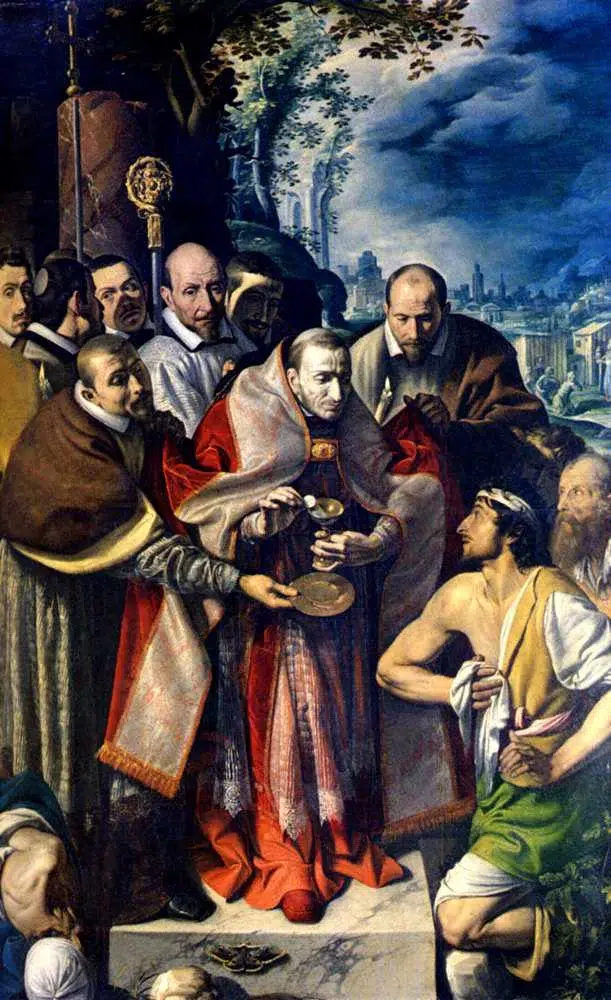
St. Charles Borromeo giving communion to plague victims, by Tanzio da Varallo, ca. 1616 (Domodossola, Italy).
A priest for his people
The defining moment of the heroism of St. Charles Borromeo was the terrible plague that devastated Milan between 1576 and 1577, known as the plague of St. Charles.
When the epidemic broke out, the civil authorities and most of the nobles fled the city to save themselves. St. Charles Borromeo he stayed. He became the moral, spiritual and, in many ways, civil leader of the disease-ridden city.
He organized field hospitals (lazarettos), gathered his faithful clergy and urged them to care for the dying. He himself went through the most infected streets, giving Communion and Extreme Unction to the plague-stricken, without fear of contagion.
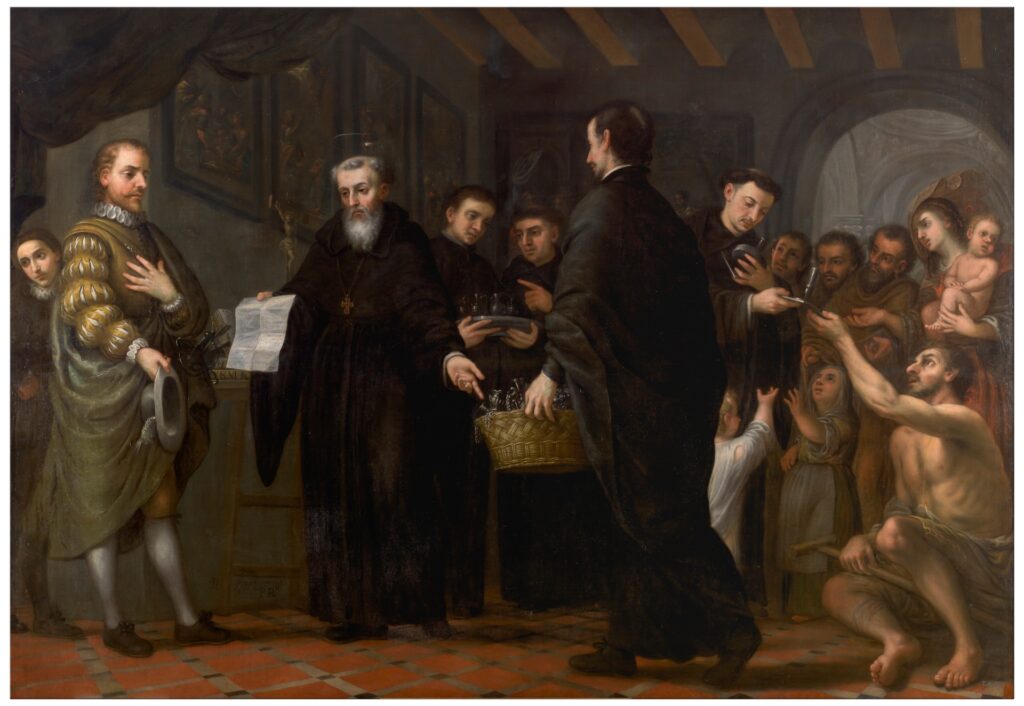
He sold his remaining possessions, including the tapestries of his palace, to buy food and medicine for the poor. So that the sick who could not leave their homes could attend Mass, he ordered the Eucharist to be celebrated in public squares. His figure, leading barefoot penitential processions through the city, became an important figure in the city's history. symbol of hope.
Opposition and attack
The reform of St. Charles Borromeo was neither easy nor popular. His rigor earned him powerful enemies. He constantly clashed with the Spanish governors of Milan, who tried to limit his jurisdiction.
But the most violent opposition came from within the Church. The Humiliati, The friars, a religious order that had become morally lax and possessed great wealth, refused to accept his reform. In 1569, a member of this order, Friar Girolamo Donato Farina, attempted to assassinate him.
While St. Charles Borromeo While he was praying on his knees in his chapel, the friar shot him in the back with an arquebus at point-blank range. Miraculously, the bullet only tore his vestments and caused a slight bruise. The people saw this as a divine sign, and Pope Pius V suppressed the order of the Humiliati shortly thereafter.
Legacy, death and canonization
The constant effort, extreme penances and tireless work exhausted the health of St. Charles Borromeo. In 1584, while performing a spiritual retreat on Mount Varallo, he contracted a fever.
He returned to Milan gravely ill and died on the night of November 3, 1584, at the age of 46. His last words were Ecce venio (Here I come).
His reputation for holiness was immediate. The people of Milan venerated him as the priest martyr to charity and reform. The process of canonization was extraordinarily rapid for the time. He was beatified in 1602 and canonized by Pope Paul V in 1610.
St. Charles Borromeo is universally recognized as the patron saint of bishops, catechists and, in a very special way, of all the bishops and catechists. seminarian and spiritual director. His influence on the definition of the priest post-Tridentine - formed, pious and dedicated to his people - is incalculable.