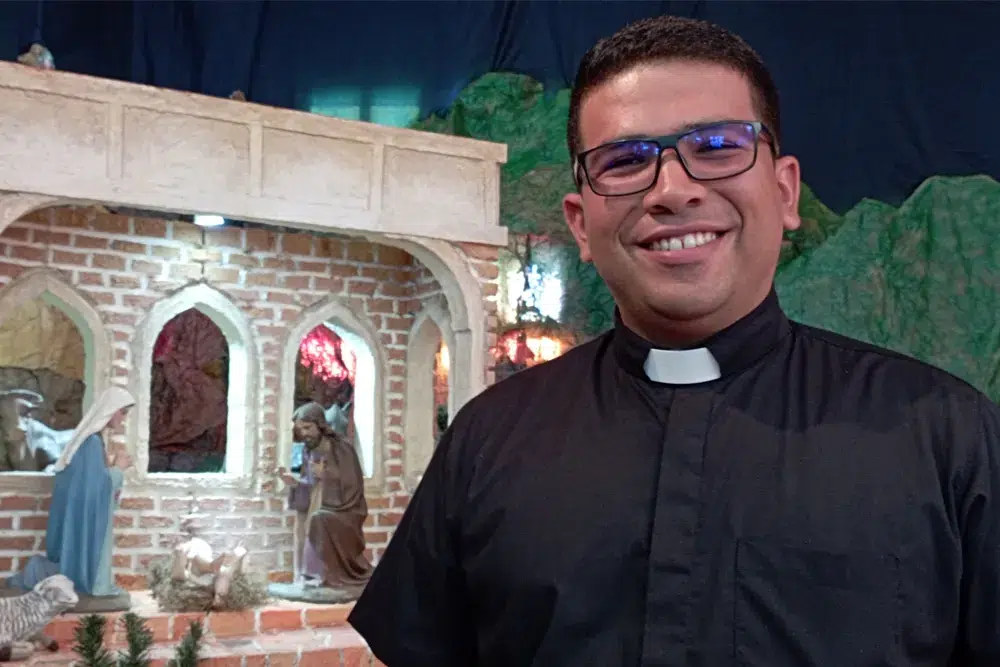
In the midst of the political, social and economic crisis that Venezuela is going through, the Church continues to be one of the few institutions with a stable presence throughout the country. This is explained by the Venezuelan priest Gustavo José Perozo Pérez, ordained in 2020 and incardinated in the Diocese of Carora, who is currently studying Canon Law at the University of Carora. Ecclesiastical Faculties of the University of Navarre.
Convinced that Church law is not a theoretical discipline, he emphasizes that its purpose is very concrete: serve to truth, justice and people.
Although he grew up in an environment of faith, his vocation did not arise in his childhood. It was later, in his youth, when, through catechesis, service as an altar boy, parish groups, the closeness of some religious and the witness of the parish priest, he began to consider his call. «All this awakened in me the search for something more,» he explains.
In 2012, at the age of 19, he left his university studies in Geography and History and entered the seminary. Eight years later he was ordained priest.
The sending of his bishop to the Ecclesiastical Faculties of the University of Navarra is not accidental. For Gustavo, Venezuela needs well-trained canonists, and you need them urgently.
«Canon Law contributes much to the mission of the Church, it is at her service. From this perspective, its contribution to the pastoral action of the Church in Venezuela is evident, and at the same time, it is at the service of the Church., the need for specialists in Canonic Law, in all branches, that can favor this service».
He also believes that at a historic moment such as the one we are living in Venezuela, In a time when the social referents of justice and the common good are violated, finding in ecclesial institutions the dimension of justice and truth is a sign of what should be and, consequently, of what should be sought.
«In this way, canon law can contribute not only to the development of a society, but also to the church but also in the current complex socio-political situation,» the Venezuelan priest points out.
This affirmation situates the Church not as an isolated actor, but as a moral and juridical reference in the midst of the country's institutional fragility.
The Venezuelan people have been suffering for years from a political, social and economic situation that affects freedoms. However, in the midst of this complexity, the Church's action is not passive, «it remains present and committed, trying to illuminate every reality with criteria and initiatives centered on the Gospel».
For Gustavo, the most visible action is the social work, especially through Caritas, The Church has been present in the area, with soup kitchens, medicine banks, nutrition programs, medical care and job training. But the Church's commitment goes much further: «In the midst of all the reality experienced and suffered, in each place and in different ways, the presence of the Church has been adapting to the needs, evangelizing and offering a response to each need that has arisen; all this, fruit of a committed listening and a shared effort», he points out.
«This service also has a profoundly social and political value because, thanks to the many agents pastoral who, through their dedication, availability, sensitivity, generosity and prayer, In a spirit of communion and charity, and from the Church's own institutions, they are the hands and feet that bring, give, lift, carry and make it possible, in short, for this service to be a sign of comfort and hope.
Therefore, he concludes with forcefulness: «the role of the Church transcends the intra-ecclesial sphere and becomes a true diaconia to the Venezuelan society».
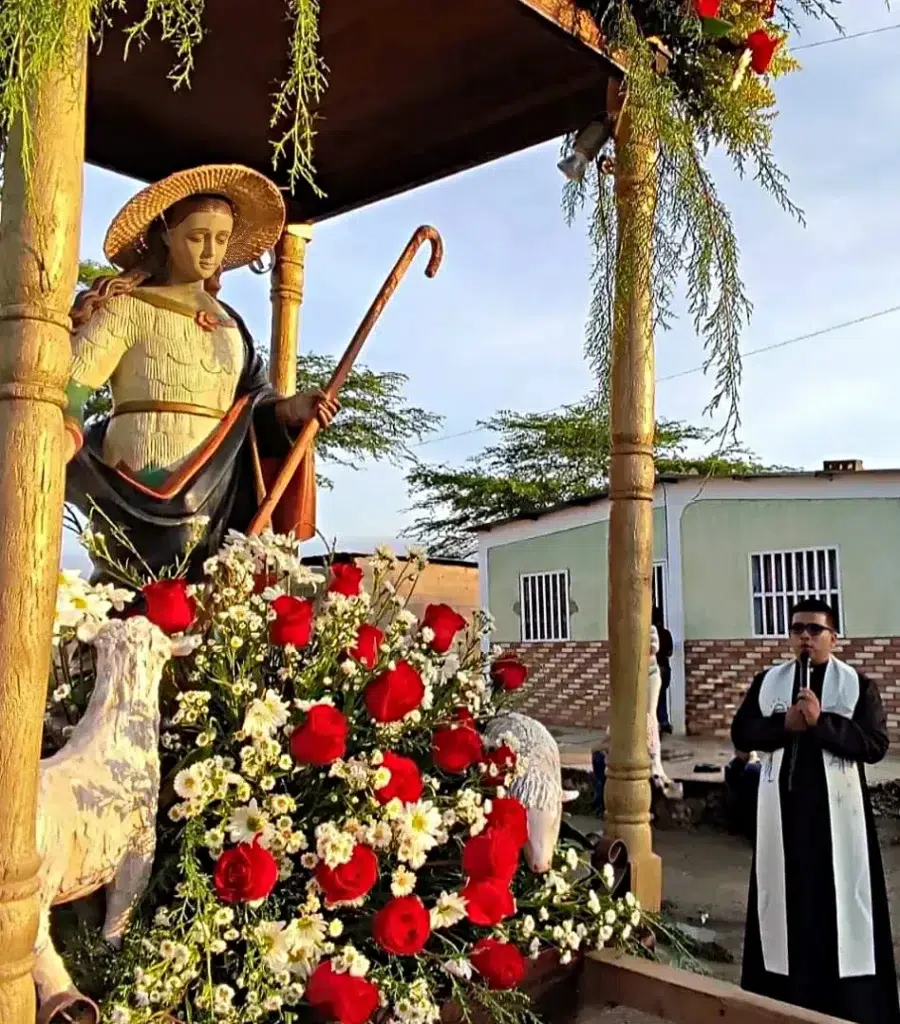
A Church that suffers with its people
The priest is clear and balanced: the Church in Venezuela is not a privileged elite. It lives and suffers the same reality as the rest of the citizens. Although it does not suffer a persecution open as in other countries, it does experience threats, limitations and consequences derived from the socio-political context.
The Church, both as an institution and in each of its faithful, is not immune to the country's suffering.
Hope in the midst of uncertainty
From his legal training, he recognizes that the dominant feeling today is uncertainty, both inside and outside the country. Even so, there is something that has not been lost: «Hope perseveres in the hearts of most Venezuelans».
«The road to the restoration of democratic institutions will be a long one," he says, "but it will be a long one. it is not impossible». This conviction sustains a people who, in spite of everything, continue to look forward.
A new burning of faith in Venezuela
Faced with the phenomenon of secularization, especially among the young people, Perozo Perez's diagnosis is both surprising and encouraging. Far from a massive abandonment of the faith, in many communities one can perceive «a new ardor, a reconfiguration of the experience of faith».», even in the midst of hardships such as migration.
«There are many young people who participate in retreats, movements and various charismatic experiences, which bring them closer to the Church and then lead them to processes of accompaniment, maturation, commitment and apostolate.».
The testimony of Gustavo José Perozo Pérez reveals that, in the midst of the crisis Venezuelan, the Church continues to be a place of hopethe Canon Law emerges as an instrument of justice and truth, and faith, far from being extinguished, is transforming and renewing itself. A silent but profoundly eloquent sign that even in the longest night, lights continue to be lit.
Table of Contents
Marta Santínjournalist specializing in religion.
 carf@fundacioncarf.orgLandline: +34 914 029 082Mobile: +34 638 078 51145 Conde de Peñalver Street.