How to help seminarians?

Types of grants that can be made to CARF Foundation

We work so that no vocation is lost and so that the seminarians, once ordained priests, can transmit in their pastoral work all the light, science and doctrine received. Thanks to our benefactors, we help in the formation of priests, spread their good name and pray for their fidelity and for vocations.

There are different ways in which the CARF Foundation can help seminarians:

Donate online to seminarians

A fast and secure way to help seminarians, support the seminary and finance their formation. From anywhere, just with your mobile device, you can make a donation by following a few simple steps. Select the amount you want to donate and whether you want to make a one-time or recurring donation. Many seminarians depend on this act of generosity to complete their studies.

Donate Sacred Vessel Backpack

With your donation of 600 euros, you can help seminarians about to be ordained with a Sacred Vessel Backpack that contains all of the liturgical objects necessary to impart the sacraments and celebrate Mass wherever he may be.

He will pray for you for the rest of his life, and you will know who he is and in which country he will carry out his pastoral work, to commend him to be holy and faithful to his vocation.

Donations in kind

Another way to help seminarians with their formation is by making donations in kind. Donations in kind are those in which, instead of contributing money, the benefactor makes a contribution of certain goods: jewelry, watches, works of art....

Most of the time, these are valuable assets that the donor already knows he or she will not enjoy, and considers that they will be more useful if they support a worthy cause. The goods will receive a professional appraisal and, once they are auctioned, the money they bring in to support seminarian vocations will be tax-deductible.

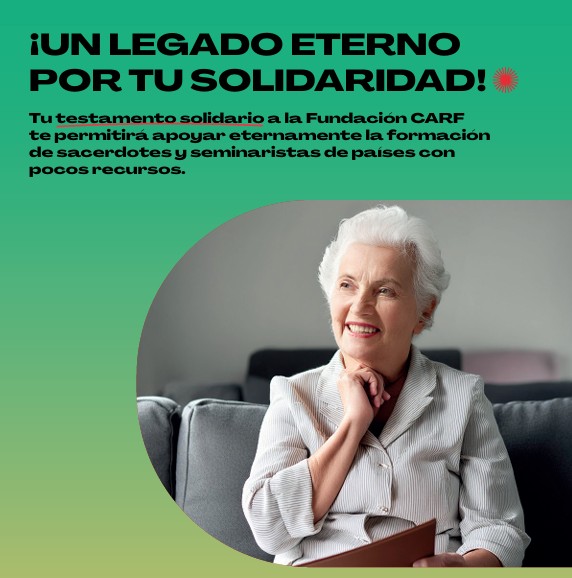
He donates legacies and wills to train seminarians.

This testamentary disposition is a procedure that favors a non-profit institution, such as the CARF Foundation. Your legacy of solidarity is a commitment to the future and a way to perpetuate your life's work in others: to continue to support seminarians and diocesan priests on five continents. To do so, all you have to do is decide, in the form of an entire will or a part of a legacy of solidarity, your desire to help seminarians through the CARF Foundation.

seminarista donar Seminario internacional Bidasoa

International seminars with which the CARF Foundation collaborates

Under the inspiration and encouragement of St. John Paul II, Blessed Alvaro del Portillo initiated in 1989 the activity of the CARF Foundation to help seminarians and diocesan priests. Currently more than 800 bishops from the five continents annually request places and study grants for their seminarians and priests at the Pontifical University of the Holy Cross in Rome and at the Faculties of Ecclesiastical Studies of the University of Navarre.

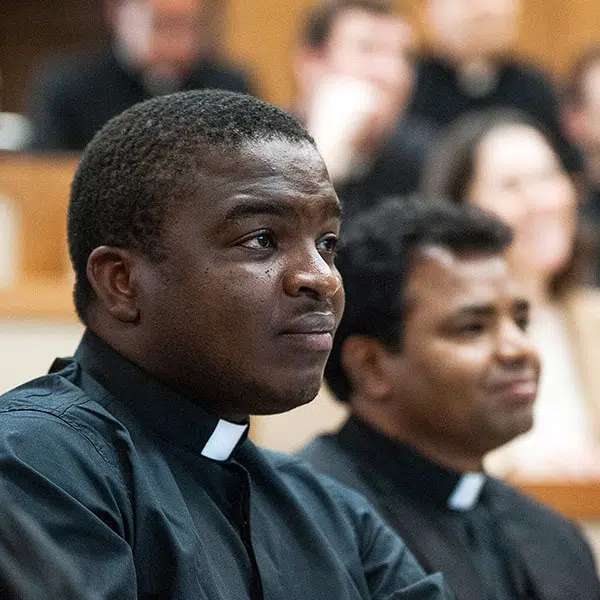
The CARF Foundation collaborates with two international seminaries, two priests' colleges and three major colleges, so that they can receive seminarians from all over the world who come to Europe to prepare for their formation.

We should be grateful to God for priests. Let us not cease to pray for them or to collaborate in their ministry. Let us ask the Lord to continue to give us many good priests, for work is abundant and vocations are scarce. Let us begin to help seminarians and support seminaries so that there will be no shortage of priests who, in the name of Christ, care for the people of God.

The example of St. Joseph, guardianship and service

 
The ministry of the pope is at the service of Christian life. The Christian life is at the service of everyone and of the created world. And every person also finds there, The meaning of his life is in care and service: to guard God's gifts, something that can only be done with love, as St. Joseph did.

St. Joseph's mission and ours

San José's mission (cf. Mt 1:24) He began by referring to the feast day of Benedict XVI: "We are close to him with our prayers, full of affection and gratitude". St. Joseph was custodianCustodian of whom? Of Mary and Jesus; but it is a custody that is then extended to the Church.As Blessed John Paul II has pointed out: 'Just as he lovingly cared for Mary and devoted himself with joyful commitment to the education of Jesus Christ, and his paternity also guards and protects her mystical body, the Church, of which the Holy Virgin is the figure and model'. (Apostolic Exhortation Redemptoris Custos, 1).

Pope Francis continued by asking himself: "How does Joseph live his vocation as guardian of Mary, of Jesus, of the Church? With constant attention to God, open to his signs, available to his plan, and not so much to his own.(...) He knows how to listen to God, he allows himself to be guided by his will, and precisely for this reason he is even more sensitive to the people entrusted to his care, he knows how to read events realistically, he is attentive to his surroundings and knows how to make the most sensible decisions. (...) He responds to God's call, with availability, with readiness".

Here you can see how St. Joseph of Nazareth puts into practice a true discernment of the will of GodThe second Vatican Council speaks of the "signs of the times". That is to say, the signs of the workings of the Holy Spirit that are perceived when they are looked upon with faith and realistically assess the situation in question and make the decision to act accordingly, both from a personal and Church point of view, Gaudium et spes, 4, 11 and 44.

At the same time, the pope notes that, in St. Joseph "we also see the center of the Christian vocation: Christ.". And so he invites us: "Let us keep Christ in our lives, to keep others, to safeguard creation.

All this is a school for Christians, especially for educators and formators.

Homily of the Holy Father Francis, St. Peter's Square, Tuesday, March 19, 2013 Solemnity of St. Joseph.

Custodianship, everyone's job, starting with oneself

But guarding, Pope Francis warned, is everyone's vocation: we must all guard the beauty of created realities; here, the evocation of St. Francis of Assisi, caring for the people around us, "especially children, the elderly, those who are more fragile and who often remain on the periphery of our hearts".

We must all take care of our relatives, our spouses, our parents and children, our friendships. "Be custodians of God's gifts," he advises us; for indeed, everything is a gift. If we fail in this, he says, destruction advances and the heart dries up.

If stewardship is everyone's responsibility, and this is understood and practiced by people of good will, it is the responsibility of all. particularly of "those who hold positions of responsibility in the economic, political or social sphere". We must take care of nature created by God, the environment. But we must start with ourselvesIn order to "guard", we must also take care of ourselves. Let us remember that hatred, envy and arrogance make life dirty.

To guard means then to watch over our feelings, our heart, because that is where good and bad intentions come from: those that build and those that destroy. We must not be afraid of kindness, indeed, not even of tenderness."It is not a virtue of the weak but of the strong, like St. Joseph.

Indeed. Hence the importance of examining one's conscience together with a good formation. And if a sentimentalism that is not integrated with reflection and Christian formation can produce havoc, so can a rationalistic or voluntaristic education that does not integrate feelings and their appropriate and necessary manifestations. Dietrich von Hildebrand, in his work "The Heart: An Analysis of Human and Divine Affectivity", puts it like this (Madrid 2009).

When Pope Francis delivered the homily of the Inaugural Mass In his pontificate, he invited everyone to be custodians of Creation as St. Joseph was custodian of the Holy Family.

The meaning of the pope's ministry

The pope then explained what the power of the Petrine ministry consists of:

"Let us never forget that true power is service, This is the title of one of his books, and that even the Pope, in order to exercise power, must enter more and more into that service which has its luminous culmination in the cross. Such is the power of love. We also learn it from St. Joseph.

And this is how the ministry of the pope should be exercised: "He must set his eyes on the humble, concrete, rich in faith, service of St. Joseph and, like him, to open his arms to guard the whole People of God and to welcome with affection and tenderness all of humanity, especially the poorest, the weakest, the smallest.that which Matthew describes in the final judgment on charity: to the hungry, to the thirsty, to the stranger, to the naked, to the sick, to those in prison (cf. Mt 25:31-46).. And he concluded with another lesson: "Only he who serves with love knows how to guard.".

Carrying the warmth of hope

In the last part, he appeals to hope, on which Abraham relied (cf. Rom 4:18).. "Also today, before so many clusters of gray sky, we must see the light of hope and give hope ourselves.. To guard creation, every man and every woman, with a gaze of tenderness and love, is to open a glimmer of light in the midst of so many clouds; it is to bring the warmth of hope."

For us Christians, "like Abraham, like St. Joseph, the hope that we carry has the horizon of Godwhich has been opened to us in Christ, is founded on the rock which is God".

This is his way of explaining that title of the pope that comes at least from St. Gregory the Great: "Servant of the servants of God".


Mr. Ramiro Pellitero Iglesias
Professor of Pastoral Theology at the Faculty of Theology of the University of Navarra.

Published in Church and new evangelization.

Lent: what is Lent and what does it mean, definition and prayers?

"The Church unites herself every year, during the forty days of Great Lent, to the Mystery of Jesus in the desert." Catechism of the Catholic Church, 540.

What is Lent?

The meaning of Lent comes from Latin quadragesima, a liturgical period of forty days reserved for the preparation of Easter. Forty days in allusion to the 40 years that the people of Israel spent in the desert with Moses and the 40 days that Jesus spent in the desert before beginning his public life.

This is a preparation and conversion time to participate in the culminating moment of our liturgy, together with the whole Catholic Church, which on Wednesday we began with enthusiasm.

In the Catechism, the Church proposes to follow the example of Christ in his desert retreat, in preparation for the Easter solemnities.. It is a particularly appropriate time for spiritual exercisesthe liturgies penitential, penitential pilgrimages as a sign of penitence, voluntary deprivations such as the fasting and the almsand the Christian communication of goods by means of charitable and missionary works.

This effort of conversion is the movement of the contrite heart, attracted and moved by the grace to to respond to the merciful love of God who has loved us first.

Donate now to help form diocesan and religious priests to serve the Church around the world.

"We cannot consider this Lent as just another season, a cyclical repetition of the liturgical season. This moment is unique; it is a divine help to be welcomed. Jesus passes by our side and expects from us - today, now - a great change". It is Christ Who Passes By, No. 59.

When does Lent begin?

The imposition of ashes on the foreheads of the faithful on Ash Wednesday, is the beginning of this road. It constitutes a invitation to conversion and penance. It is an invitation to go through the Lenten season as a more conscious and intense immersion in the paschal mystery of Jesus, in his death and resurrection, through participation in the Eucharist and in the life of charity.

The time of Lent ends on Holy Thursdaybefore Mass in Coena Domini (the Lord's Supper), which begins the Easter Triduum, Good Friday and Glory Saturday.

During these days we look inside ourselves and we assimilate the mystery of the Lord being tempted in the desert by Satan and his going up to Jerusalem for his Passion, Death, Resurrection and Ascension to the Heavens.

We remember that we must convert and believe in the Gospel and that we are dust, sinful men, creatures and not God.

Donate now to help form diocesan and religious priests to serve the Church around the world.

"What better way to begin Lent? We renew faith, hope, charity. This is the source of the spirit of penance, of the desire for purification. Lent is not only an occasion to intensify our external practices of mortification: if we were to think that it is only that, we would miss its deep meaning in the Christian life, because these external acts are - I repeat - the fruit of faith, hope and love". Christ Is Passing By, No. 57.

How to live Lent?

Lent can be experienced through the sacrament of Confession, prayer and positive attitudes.

Catholics we prepare for the key events of the Holy Week through the pillars of the prayer, fasting and almsgiving. These guide us in our daily reflection on our own life while we strive to deepen our relationship with God and with our neighborno matter what part of the world the neighbor lives in. Lent is a time of personal and spiritual growth, a time to look outward and inward. It is a time of mercy.

Repentance and confession

As a time of penitence, Lent is a season of it is a good time to go to confession. It is not obligatory, nor is there any mandate from the Church to do so, but it fits very well with the words of the Gospel that the priest repeats on Ash Wednesday: "Remember that dust you are and to dust you shall return" o "Convert and believe in the Gospel".

In these holy words there is a common element: the conversion. And this is only possible with repentance and a change of life.. Therefore, confession during Lent is a practical way of ask God's forgiveness for our sins and start over again.. The ideal way to begin this exercise of introspection is through an examination of conscience.

Penance

Penance, the Latin translation of the Greek word "metanoia" which in the Bible means the conversion of the sinner. Designates an entire all the interior and exterior acts aimed at the reparation of the committed sinand the resulting state of affairs for the sinner. Literally change of life, it is said of the act of the sinner who returns to God after having been far from Him, or of the unbeliever who attains faith.

Conversion

Converting is reconciliation with GodWe are to turn away from evil in order to establish friendship with the Creator. Once in grace, after confession and what it implies, we must set out to change from within everything that does not please God.

To concretize the desire for conversion, it is possible to do the following conversion workssuch as, for example: Attending the sacramentsto overcome divisions, to forgive and to grow in a fraternal spirit; practicing the Works of Mercy.

Fasting and abstinence

The Church invites its faithful to observance of the precept of fasting and abstinence of flesh, compendium of Catechism 432.

The fasting consists of eating only one meal a day, although it is possible to eat a little less than usual in the morning and evening. Except in case of illness. It invites to live the fast, to all the adults, until they are fifty-nine years old. Both on Ash Wednesday and Good Friday.

It is called abstinence to abstain from eating meat on Fridays of Lent. The abstinence can begin from the age of fourteen.

Care should be taken not to live fasting or abstinence as a minimum, but as a concrete way in which our Holy Mother Church helps us to grow in the true spirit of penance and joy.

Donate now to help form diocesan and religious priests to serve the Church around the world.

Calendario de propósitos para vivir la Cuaresma día a día

Proposed calendar of resolutions to live Lent.

Holy Father's Message for Lent 2024

Through the wilderness God leads us to freedom

"Dear brothers and sisters:

When our God reveals Himself, He communicates freedom: "I am the Lord, your God, who brought you out of Egypt, out of a place of slavery" (Ex 20,2). Thus opens the Decalogue given to Moses on Mount Sinai. The people know well what exodus God is talking about; the experience of slavery is still imprinted on their flesh. They receive the ten words of the covenant in the desert as the way to freedom. We call them "commandments", underlining the power of the love with which God educates his people. The call to freedom is, in fact, a vigorous call. It is not exhausted in a single event, because it matures along the way. Just as Israel in the desert still carries Egypt within her - indeed, she often misses the past and murmurs against heaven and Moses - so too today the people of God carry within them oppressive bonds that they must decide to abandon. We become aware of this when we lack hope and wander through life as in a desolate wasteland, without a promised land towards which we can walk together. Lent is the time of grace in which the desert once again becomes - as the prophet Hosea announces - the place of first love (cf. Os 2,16-17). God educates his people to abandon their slavery and experience the passage from death to life. As a bridegroom he draws us back to himself and whispers words of love to our hearts.

The exodus from slavery to freedom is not an abstract path. In order for our Lent to be concrete, the first step is to want to see the reality. When at the burning bush the Lord drew Moses and spoke to him, he immediately revealed himself as a God who sees and above all hears: "I have seen the oppression of my people, who are in Egypt, and I have heard the cries of pain, caused by their taskmasters. Yes, I am well acquainted with their sufferings. That is why I have come down to deliver them from the power of the Egyptians and to bring them up out of that land to a land that is fertile and spacious, to a land flowing with milk and honey" (Ex 3,7-8). Today too, the cry of so many oppressed brothers and sisters reaches heaven. Let us ask ourselves: does it also reach us, does it shake us, does it move us? Many factors distance us from one another, denying the fraternity that unites us from the beginning.

On my trip to Lampedusa, faced with the globalization of indifference, I asked two questions, which are becoming more and more topical: "Where are you?" (Gn 3,9) and "Where is your brother?" (Gn 4,9). The Lenten journey will be concrete if, listening to them again, we confess that we are still under the dominion of Pharaoh. It is a dominion that leaves us exhausted and makes us insensitive. It is a model of growth that divides us and robs us of the future; that has polluted the earth, the air and the water, but also souls. For although our liberation has already begun with baptism, there remains in us an inexplicable longing for slavery. It is like an attraction to the security of what we have already seen, to the detriment of freedom.

God is moved

I would like to point out a detail of no small importance in the story of the Exodus: it is God who sees, who is moved and who liberates, not Israel who asks for it. Pharaoh, in fact, destroys even dreams, steals the sky, makes a world in which dignity is trampled underfoot and authentic bonds are denied, seem unchangeable. In other words, it succeeds in keeping everything subject to it. Let us ask ourselves: do I desire a new world, and am I willing to break my commitments to the old one? The witness of many brother bishops and of a great number of those who work for peace and justice convinces me more and more that what needs to be denounced is a deficit of hope. It is an impediment to dreaming, a mute cry that reaches to heaven and touches the heart of God. It resembles that longing for slavery that paralyzes Israel in the desert, preventing it from moving forward. The exodus can be interrupted. Otherwise it would not be explained that a humanity that has reached the threshold of universal fraternity and levels of scientific, technical, cultural and legal development, capable of guaranteeing the dignity of all, walks in the darkness of inequalities and conflicts.

God never tires of us. Let us embrace Lent as the powerful time in which his Word addresses us once again: "I am the Lord your God, who brought you out of Egypt, out of a place of slavery" (Ex 20,2). It is a time of conversion, a time of freedom. Jesus himself, as we remember every year on the first Sunday of Lent, was led by the Spirit into the desert to be tested in his freedom. For forty days he will be before us and with us: he is the Son incarnate. Unlike Pharaoh, God does not want subjects, but sons. The desert is the space in which our freedom can mature into a personal decision not to fall back into slavery. In Lent, we find new criteria of judgment and a community with which to embark on a path we have never traveled before.

You are my beloved Son

This implies a struggleThe book of Exodus and the temptations of Jesus in the desert tell us clearly. To the voice of God, who says: "You are my beloved Son" (Mc 1:11) and "you shall have no other gods before me" (Ex 20:3), the lies of the enemy are in fact opposed. More fearsome than Pharaoh are the idols; we could consider them as his voice in us. Feeling omnipotent, recognized by all, taking advantage over others: every human being feels within himself the seduction of this lie. It is a well-worn path. Therefore, we can become attached to money, to certain projects, ideas, objectives, to our position, to a tradition and even to some people. Those things instead of driving us, will paralyze us. Instead of uniting us, they will pit us against each other. There is, however, a new humanity, that of the small and humble who have not succumbed to the charm of lies. While idols render mute, blind, deaf and immobile those who serve them (cf. Salt 115:8), the poor in spirit are immediately open and well disposed; they are a silent force for good that heals and sustains the world.

It's time to act, and in Lent to act is also to stop. Stop at prayerto welcome the Word of God, and to stop like the Samaritan, before the wounded brother. Love of God and love of neighbor is one love. To have no other gods is to stop before the presence of God, in the flesh of one's neighbor. This is why prayer, almsgiving and fasting are not three independent exercises, but a single movement of opening, of emptying: away with the idols that weigh us down, away with the attachments that imprison us. Then the atrophied and isolated heart will awaken. Therefore, slow down and stop. The contemplative dimension of life, which Lent will help us rediscover, will mobilize new energies. Before the presence of God we become sisters and brothers, we perceive others with new intensity; instead of threats and enemies we find companions and fellow travelers. This is God's dream, the promised land toward which we march when we leave slavery.

The synodal form of the Church, which in recent years we have been rediscovering and cultivating, suggests that Lent should also be a time of community decisionsI invite all Christian communities to do this: to offer their faithful moments to reflect on their lifestyles, to take time to verify their presence in the neighborhood and their contribution to improving it. I invite all Christian communities to do this: to offer their faithful moments to reflect on lifestyles; to take time to verify their presence in the neighborhood and their contribution to improving it. Woe to us if Christian penance were like that which saddened Jesus. He also says to us: "Do not look sad, as do the hypocrites, who disfigure their faces so that it will be seen that they are fasting" (Mt 6,16). Rather, let joy be seen in the faces, let the fragrance of freedom be felt, let that love be released that makes all things new, beginning with the smallest and closest. This can happen in every Christian community.

Sparkle of a new hope

To the extent that this Lent is one of conversion, then, lost humanity will feel a thrill of creativity; the sparkle of a new hope. I would like to say to you, as I did to the young people I met in Lisbon last summer: "Seek and risk, seek and risk. In this historical moment the challenges are enormous, the groans are painful - we are living a third world war in bits and pieces - but we embrace the risk of thinking that we are not in agony, but in labor; not at the end, but at the beginning of a great spectacle. And it takes courage to think this" (Speech to university students3 August 2023). It is the courage of conversion, of coming out of slavery. Faith and charity take this little hope by the hand. They teach her to walk and, at the same time, it is she who drags them forward. I bless you all and your Lenten journey". Pope Francis, 2024.

Donate now to help form diocesan and religious priests to serve the Church around the world.

Prayers for Lent

Prayer with an open heart is the best preparation for Easter. We can read and reflect on the Gospel, we can pray the Via Crusis. We can turn to the Catechism of the Catholic Church and follow the liturgical celebrations with the Roman Missal. The important thing is that we encounter the unconditional love that is Christ.

Lord Jesus, with your Cross and

Resurrection you have made us

free. During this Lent,

lead us by your Holy Spirit to

living more faithfully in freedom

Christian. Through prayer,

increase in charity and the

disciplines of this Time

sacred, bring us closer to You.

Purify my intentions

heart so that all my

Lenten practices are for

your praise and glory. Grant that

by our words and actions,

we can be faithful messengers

of the Gospel message to a

world in need of the

hope of your mercy. Amen.

Donate now to help form diocesan and religious priests to serve the Church around the world.

St. Joseph: Who Was The Carpenter Father Of Jesus Of Nazareth

"Love St. Joseph very much, love him with all your soul, because he is the person who, with Jesus, has loved St. Mary the most and the one who has treated God the most: the one who has loved Him the most, after our Mother. He deserves your affection, and it is good for you to treat him, because he is a Master of interior life, and he can do much before the Lord and before the Mother of God.

His feast day is March 19 and Pope Francis has invited us to pay special attention to the figure of St. Joseph. For this, he pointed out the two unique virtues that define the father of Jesus:Joseph is the man who knows how to accompany in silence". and it is "the man of dreams".

Biography of St. Joseph of Nazareth

Both St. Matthew and St. Luke speak of St. Joseph as a man descended from an illustrious lineage: that of David and Solomon, kings of Israel. The details of this ancestry are historically somewhat confusing: we do not know which of the two genealogies that the evangelists bring corresponds to Mary and which to St. Joseph, who was her father according to Jewish law. We know that his hometown was Bethlehem, where he went to register, but he lived and worked in Nazareth.

We know, however, that he was not a rich person: he was a worker, like millions of other men throughout the world; he exercised the laborious and humble office that God had chosen for himself, by taking our flesh and wanting to live thirty years as one more among us.

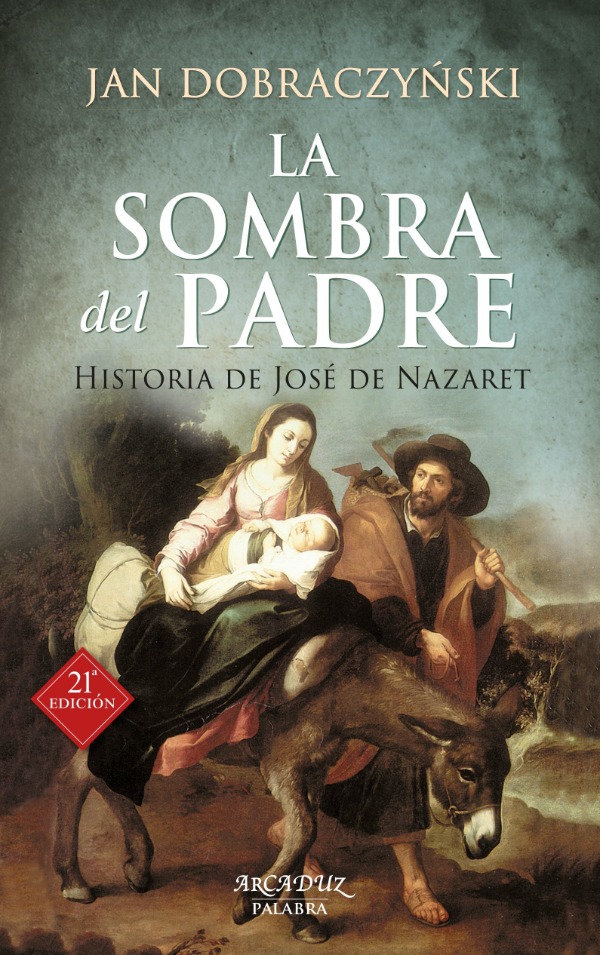
The Holy Scripture says that Joseph was a craftsman. Several Fathers add that he was a carpenter. St. Justin, speaking of Jesus' life of work, affirms that he made ploughs and yokes. (St. Justin, Dialogus cum Tryphone, 88, 2, 8 (PG 6, 687).Perhaps, based on these words, St. Isidore of Seville concludes that Joseph was a blacksmith. In any case, a worker who worked in the service of his fellow citizens, who had a manual skill, the fruit of years of effort and sweat.

san josé
Joseph's great human personality is evident from the Gospel narratives: at no time does he appear to us as a man who is timid or afraid of life; on the contrary, knows how to deal with problems, to get ahead in difficult situations, to assume with responsibility and initiative the tasks entrusted to him/her.

Who was St. Joseph of Nazareth in the Catholic Church?

The whole Church recognizes in St. Joseph her protector and patron. Throughout the centuries he has been spoken of, highlighting various aspects of his life, continually faithful to the mission entrusted to him by God.

  • In the 17th century, Pope Gregory XV instituted for the first time a liturgical feast in his name.
  • In the 16th century, St. Teresa of Avila spread her devotion, which, until then, had remained in the background.
  • During 1870, Pope Pius IX named St. Joseph universal patron of the Church.
  • Thereafter, Leo XIII dedicated an encyclical to the saintly patriarch
  • On the 100th anniversary of this document, St. John Paul II wrote the apostolic exhortation Redemptoris custos.
  • Pope Francis also published a letter on St. Joseph in 2020, under the title. Patris cordea father's heart.

In the words of St. JosemaríaSt. Joseph is really "Father and Lord, who protects and accompanies on his earthly journey those who venerate him, as he protected and accompanied Jesus as he grew and became man. In dealing with him, we discover that the Holy Patriarch is also a Master of interior life: because teaches us to know Jesus, to live together with Himto know that we are part of the family of God. This Saint gives us these lessons being, as he was, an ordinary man, a father of a family, a worker who earned his living with the effort of his hands".

oración a san josé padre de jesus de nazaret

Prayer mentioned in Patris corde (With a Father's Heart) and in the decree granting the gift of special indulgences on the occasion of the Year of St. Joseph.

The virtues of Joseph of Nazareth

Joseph the worker was a craftsman from Galilee, a man like so many others. In his day he had only parenting and workevery day, always with the same effort. And, at the end of the day, a poor and small house, to regain strength and start again.

But Joseph's name means, in Hebrew, God will add. God adds, to the holy life of those who fulfill his will, unsuspected dimensions: what is important, what gives value to everything, the divine. God, to the humble and holy life of Joseph, added the life of the Virgin Mary and that of Jesus, our Lord.

To live by faith, these words were fully realized in St. Joseph. Its fulfillment of God's will is spontaneous and profound..

For the story of the Holy Patriarch was a simple life, but not an easy life. After anguishing moments, he knows that the Son of Mary has been conceived by the Holy Spirit. And that Child, Son of God, descendant of David according to the flesh, is born in a cave. Angels celebrate his birth and personalities from distant lands come to adore him, but the King of Judea desires his death and it becomes necessary to flee. The son of God is, in appearance, a helpless child, who will live in Egypt.

In his gospel, St. Matthew constantly emphasizes Joseph's faithfulness, who fulfills God's commands without hesitation, even though at times the meaning of these mandates might seem obscure or their connection to the rest of the divine plans might be hidden from him.

Faith, love and hope

On many occasions the Fathers of the Church emphasize the firmness of St. Joseph's faith. Joseph's faith does not waver, his obedience is always strict and prompt.

In order to better understand this lesson given to us here by the Holy Patriarch, it is good to consider that their faith is active. Because the Christian faith is the opposite of conformism, or lack of inner activity and energy.

In the various circumstances of his life, the Patriarch does not give up thinking, nor does he abandon his responsibility. On the contrary, it places all its human experience at the service of faith.. Faith, love, hope: these are the axes of the life of the saint and of every Christian life. Joseph of Nazareth's dedication is woven from this interweaving of faithful love, loving faith and confident hope.

This is what St. Joseph's life teaches us: simple, normal and ordinary, made up of years of work, always the same, of humanly monotonous days that follow one after the other.

St. Joseph the father of Jesus

"Treat Joseph and you will find Jesus." St. Josemaría Escrivá de Balaguer. Through the angel, God himself confides to Joseph what his plans are and how he is counting on him to carry them out. Joseph is called to be the father of Jesus; that will be his vocation, his mission.

Joseph has been, in the human aspect, Jesus' teacher; he has treated Him daily, with delicate affection, and has cared for Him with joyful abnegation. With St. Joseph, we learn what it is to belong to God and to be fully among men, sanctifying the world. Treat Joseph and you will find Jesus. Treat Joseph and you will find Mary, who always filled the kindly workshop of Nazareth with peace.

Joseph of Nazareth took care of the Son of God and, as a man, introduced him to the hope of the people of Israel. And that is what he does with us: with his powerful intercession he brings us to JesusSt. Josemaría, whose devotion to St. Joseph grew throughout his life, said that he is truly Father and Lord, who protects and accompanies those who venerate him on their earthly journey, just as he protected and accompanied Jesus as he grew and became man.

God continually demands more, and His ways are not our human ways. St. Joseph, like no man before or after him, learned from Jesus to be attentive to recognize the wonders of God, to have an open heart and soul.

The Feast of St. Joseph

On March 19, the Church celebrates the feast of the holy Patriarch, patron of the Church and of the Work, a date on which the members of Opus Dei renew the commitment of love and fidelity that unites them to the Lord.

The feast of St. Joseph brings before our eyes the beauty of a faithful life. Joseph trusted God: that is why he was able to be his trusted man on earth to take care of Mary and Jesus, and from heaven he is a good father who takes care of Christian fidelity.

The seven Sundays of St. Joseph

They are a custom of the Church to prepare for the feast of March 19. Dedicating to the holy Patriarch the seven Sundays prior to that feast in remembrance of the principal joys and sorrows of his life.

The meditation of the "Dolores y Gozos de san José". helps us to get to know St. Joseph better, and to remember that he too faced joys and difficulties.

It was Pope Gregory XVI who encouraged the devotion of the seven Sundays of St. Joseph, granting him many indulgences; but Pius IX gave them perennial topicality with his desire that the saint should be called upon to alleviate the then afflictive situation of the universal Church.

One day, someone asked St. Josemaría how to get closer to Jesus: "Think of that wonderful man, chosen by God to be his father on earth; think of his sorrows and his joys. Do you do the seven Sundays? If not, I advise you to do them."

How great is the silent and hidden figure of St. Joseph," said St. John XXIII, "because of the spirit with which he fulfilled the mission entrusted to him by God. For the true dignity of man is not measured by the tinsel of showy results, but by the interior dispositions of order and good will."

Curiosities of St. Joseph

Devotion of Pope Francis

"I would also like to tell you something very personal. I love St. Joseph very much. Because he is a strong and silent man. And I have a picture of St. Joseph sleeping on my desk. And while he is sleeping he takes care of the Church. Yes, you can. We can't. And when I have a problem, a difficulty. And when I have a problem, a difficulty, I write a little piece of paper and put it under the figure of the saint so that he will dream it. This means that I pray for that problem.

St. Josemaría's devotion

St. Joseph is the patron of this family that is the Work. In the early years, St. Josemaría had special recourse to him so that Jesus in the Blessed Sacrament could be present in one of the first centers of Opus Dei. Through his intercession, in March 1935, it was possible to have our Lord reserved in the oratory of the Academia-Residencia DYA, on Ferraz Street, in Madrid. Since then, the founder of the Work wanted the key to all the tabernacles of the centers of Opus Dei to have a small medal of St. Joseph with the inscription Ite ad IosephThe reason is to remember that, in a similar way as the Joseph of the Old Testament does with his people, the holy patriarch had provided us with the most precious food: the Eucharist.

The saint of silence, St. Joseph

We do not know words expressed by him, we only know his works, his acts of faith, love and protection. He protected the Immaculate Mother of God and was the father of Jesus on earth. However, there is no mention of him in the Gospels. Rather, he was a silent and humble servant of God who played his role to the full.

Guardian of the Lord and celebrations in his honor

One of the first titles they used to honor him was nutritor Domini, dates back to at least the 9th century.

The Solemnity of St. Joseph is on March 19, and the Feast of St. Joseph the Worker (International Day of St. Joseph the Worker) is on March 19. work) is May 1st. It is also included in the Feast of the Holy Family (December 30) and is certainly part of the Christmas story.

St. Joseph and his multiple patronages

He is the patron of the Universal Church, the good death, families, parents, pregnant women, travelers, immigrants, artisans, engineers and workers. He is also the patron of the Americas, Canada, China, Croatia, Mexico, Korea, Austria, Belgium, Peru, the Philippines and Vietnam. Let us ask St. Joseph to continue to help us draw closer to Jesus in the Blessed Sacrament, who is the nourishment on which the Church is nourished. He did so with Mary in Nazareth, and he will do the same with her in our homes.

Bibliography:

  • Opusdei.org
  • Romereports.com
  • Hearts.org

Jacques Philippe: keys to hope in times of crisis

At an event on November 24 at the Omnes Forum of the Universidad de Villanueva de Madrid, Jacques Philippea prominent French Catholic author, shared profound reflections on spirituality in the contemporary world. More than two hundred people were immersed in the fundamental question: Do we need God? The meeting was sponsored by the CARF Foundation and Banco Sabadell.

Jacques Philippe's books

In addition to his inspirational talks, Jacques Philippe is acclaimed for his literary work on the spiritual life. With influential titles such as Inner freedom, Time for God y The spiritual paternity of the priestPhilippe offers practical and profound insights into faith and the interior life, guiding countless people toward a more intimate relationship with God.

The importance of maintaining the connection with God

Jacques Philippe's reflections on the absence of God are poignant. "To turn away from God is also to turn away from the source of truth" he explains, offering a clear perspective on how this absence affects us greatly. This is why he invites us to reflect on the importance of maintaining a living connection with God, even in moments of apparent darkness. 

Emphasizing the need to constantly seek God's presence and trust in His love and mercy to find hope in our lives.

Addressing Spiritual Challenges in the Contemporary World

In a society marked by secularization and the emergence of new spiritualities, Jacques Philippe recognizes the phenomenon of individualism and loneliness that characterizes the contemporary world. He observes how each individual tends to construct his or her own beliefs and to move away from the idea of a shared faith that unites the community as a single family. 

This is why Philippe advocates an openness to religious community and the shared search for God as a source of spiritual fulfillment and human connection.

jacques-philippe
Meditation delivered by Jacques Philippe in Madrid.

The vital importance of God's presence at Jacques Philippe

Jacques Philippe defends the need for God and his mercy in a world increasingly marked by individualism and atheism. He points out the lie of atheism, and uses the parable of the prodigal son to illustrate how, once God is rejected, the possibility of finding mercy and forgiveness is eliminated. Philippe describes how the absence of God leaves man alone with the weight of his mistakes, without the possibility of receiving the forgiveness that only God can grant. 

In this context, he highlights the importance of returning to God and finding the grace and mercy that only He can offer, stressing the importance of returning to the Gospel and rediscovering divine fatherhood as an antidote to human pride and loss of meaning.

Spiritual parenthood in modern society

Philippe addresses the complex exercise of human freedom in the absence of the presence and love of God as Father. Pointing out that, without this divine guidance, we can fall into two extremes: total irresponsibility, where everything is permitted and responsibility for actions is not assumed; or excess of responsibility, carrying the weight of life and decisions in a solitary and distressing way. Highlighting the tendency in today's society towards these extremes, where immense freedom coexists with the lack of spiritual guidance and objective truth. 

It underscores the importance of God's role as Father, not to restrict freedom, but to help us discern and exercise our freedom in a way that benefits us and our neighbor. God offers us a light in the midst of the uncertainty and loneliness that characterize the contemporary world.

A transformative perspective for everyday life

Next, Jacques Philippe encourages us to reflect on the importance of Kingdom hope as a transformative perspective on daily life. It highlights how living without the certainty of eternal life can make existence feel cramped and heavy, with the feeling that every missed opportunity is irretrievable. 

Philippe emphasizes that the hope of the Kingdom offers an infinite horizon of possibilities and freedom, even in the midst of life's responsibilities and challenges. He uses the example of the good thief at Jesus' crucifixion to illustrate how even the most unsuccessful life can be transformed into achievement with the hope of the Kingdom and God's mercy. For at any moment God can bring salvation and renewal to those who trust in his mercy.

The Importance of Forgiveness in a Godless World

Jacques Philippe presents us with how living in a world without God and without mercy can lead to generalized anguish and harshness in human relationships. It highlights how a lack of faith hinders forgiveness, since the wrong received is perceived as irremediable.

He discusses how faith in God's mercy is fundamental to making forgiveness possible, as it provides the hope of healing and salvation for both the wrong that has been done and the wrong that has been suffered. And he warns us about the risk of hardening ourselves against others when we remove God from the equation, which can lead to anger and lack of inner peace. 

A successful life is not defined by material possessions, but by glorifying God's mercy and love, which is always possible with faith in His transforming power.

Self-acceptance in the light of Faith

One of the most significant challenges in today's world is the difficulty in accepting ourselves. Philippe stresses that God's loving gaze upon us is fundamental to our self-acceptance. By embracing our fragility and accepting His love, we find a freedom to love ourselves and others.

Jacques Philippe reminds us that, in the midst of the internal struggles of the modern world, the presence of God and His merciful love are our greatest comfort and hope. As we welcome God into our hearts, we find the confidence and joy that come from His eternal love.

With these words, Jacques Philippe gives us a light of hope in times of uncertainty, reminding us that, even in the darkest moments, God is present and His love and infinite mercy never abandons us.

Women in the Church, experiences and perspectives by Franca Ovadje and Janeth Chávez

At the intersection of faith, social engagement and women's empowerment, a vital dialogue emerges about the role of women in the Church. In this context, we invited to the Omnes-CARF Foundation Forum on Women in the Church two outstanding women, Nigerian economist Franca Ovadje and Janeth Chavez, women who shine as inspiring examples of leadership and action.

Franca, originally from Nigeria and recipient of the Harambee Award in 2022, stands out as founder of the Danne Institute Research. On the other hand, Janeth, director of Magnífica Groupsdedicates her energy to educating and strengthening women's identity through faith and study.

Franca Ovadje and her innovative projects to empower women in society

Franca Ovadje, has done remarkable work in the area of women in the Church, highlighting the importance of women's engagement and influence in contemporary society. At the Women in the Church: Work, Engagement and Influence seminar, Franca shared her inspiring story and commitment to women's empowerment in Nigeria. Her work continues to positively impact communities both locally and globally.

From her own personal experience, Franca highlights the influence that the faith and education she received in a Catholic home had on her life. Raised in an environment where the social doctrine of the Church was palpable through the example of her parents, Franca learned from a young age the value of service and solidarity with others. This solid formation laid the foundation for her future work in the promotion of social justice and the empowerment of women.

Ovadje projects transform and empower women in Nigeria

One of Franca's flagship projects is the Project Tech Poweran initiative aimed at encouraging girls' interest and participation in the field of technology and engineering. By recognizing the gender gap in the technology field in Nigeria, Franca aims to challenge gender stereotypes and provide opportunities for young girls to acquire relevant skills for the future. Through this project, Ovadje not only seeks to bridge the digital gender gap, but also to cultivate leadership and ethical values in the participants.

Another significant program is Always a Brideswhich addresses the challenges facing married women in contemporary Nigerian society. Franca recognizes the importance of strengthening family bonds and promoting healthy marital relationships. This program offers practical guidance and emotional support to create happy and stable marriages and homes.

In addition, Franca is committed to the education and empowerment of women through the Literacy for Young Women. Aware of the importance of education in personal and social development, this initiative seeks to provide basic reading and writing skills, as well as to promote social awareness and leadership among the participants.

In each of her projects, Franca Ovadje demonstrates an unwavering commitment to Christian values and the social doctrine of the Church. Her holistic approach to women's empowerment encompasses educational, professional and personal aspects, with the ultimate goal of promoting the dignity and well-being of all women. Through her work, she not only challenges social and economic injustices, but also inspires other women to find their voice and power for change in Nigerian communities and beyond.

Janeth Chavez and Magnifica's commitment to the integral formation of women

Janeth Chávez, director of Magnífica Groupsan inspirational voice in promoting the role of women in the Church, provides a educational platform which seeks to strengthen women's identity and dignity through study and prayer.

In her speech, Janeth emphasized the importance of faith formation as a fundamental tool for spiritual growth and understanding of Christian identity. Through Magnífica, she offers the opportunity to study the documents of the magisterium and the writings of the saints to women from all over the world and provides a solid foundation for the development of their interior life and their relationship with God.

Janeth calls on women to join together in study and prayer groups; she emphasizes the importance of accompaniment and communion in the journey of faith. She stresses the need to create spaces where women can share, learn and grow together, and recalls the transformative power of encounter and authentic listening.

Through teaching the truth about the dignity and nature of women, Chavez seeks to empower women to embrace their identity as beloved daughters of God. Inspired by the teachings of the popes and saints, she promotes a deeper understanding of the unique qualities of womanhood, and invites women to live authentically their vocation in the world.

Janeth encourages women to cultivate an active prayer life because it is only through a personal relationship with God that they can fully discover their vocation and dignity as women. She stresses the importance of going out of oneself and serving others with authenticity and generosity, following the example of Jesus as a model of love and service.

In summary, Janeth Chavez and Magnifica offer a valuable resource for women seeking to grow in their faith, discover their true identity and live fully their vocation as daughters of God in the Church and in the world. Their focus on education, accompaniment and faith formation reflects a sincere commitment to the empowerment and spiritual well-being of women in contemporary society.

Franca Ovadje and Janeth Chávez offer a profound and reflective view on the role of women in the Church. and in contemporary society. Through their experiences, innovative projects and unwavering commitment, they remind us of the importance of promoting the dignity, empowerment and integral formation of women in all areas of life. Their inspiring example invites us to continue working to build a Church where every woman can flourish fully in her identity and vocation.