In the context of a rural Peru, a priestly vocation takes on its own nuances. Great distances, scarcity of resources and a strong cultural identity of the Andean peoples mean that the ministry of the priest must be lived from the discomfort and without urban schemes. In this environment, the priest is an expected and necessary presence, often the only stable reference of the Church in extensive and difficult to travel territories.
In this framework, vocation is understood as a personal call and as a response to a concrete need of the people. Being a priest in the Andes implies accepting a life marked by constant displacement, direct contact with poverty and a very close relationship with the faithful, who know their pastor by his word, his availability and his daily closeness.
Christiam's testimony is inserted precisely in this reality. His personal history is linked to the territory to which he was sent and to the communities he serves, where faith is lived with depth and simplicity, even in the midst of great need.
The father Christiam Anthony Burgos Effio was born in Lima on August 26, 1992 and is a member of the Diocese of Sicuani, in the Andean region of the southern part of the country. He is the eldest of four siblings and grew up in a Christian family where faith was lived naturally.
The family faith was expressed in religious practices and also as a concrete way of understanding life, sacrifice and service. In this environment, the figure of the priest was respected and valued as someone close to the people, which helped the vocation to germinate without initial rejection, although with many questions.
During the years of discernment, Father Christiam learned to listen patiently to what God was asking of him, without making hasty decisions. The vocation matured in silence, prayer and contact with the concrete reality of the local Church, until it became a firm choice.
This gradual process was the key to later facing the renunciations inherent to the priestly journey and to assuming formation as a necessary time of interior and pastoral preparation.
His call to the priestly vocation came at the age of 16, during a Eucharist in which the Gospel of St. Matthew was proclaimed: "you are the salt of the earth (...) and the light of the world" (Mt 5:13-16). That Word was not a momentary impact, but the beginning of a constant restlessness that led him to seriously consider the priesthood as a way of life.
«I truly believe that the Lord used his word to put in me the restlessness of vocation, the desire to be able to serve him fully through his people, in the priestly ministry».
From childhood, the faith learned at home and Marian devotion -especially the recitation of the Holy Rosary- accompanied his process. As time went by, he understood that God had been preparing his vocation in a silent and patient way.
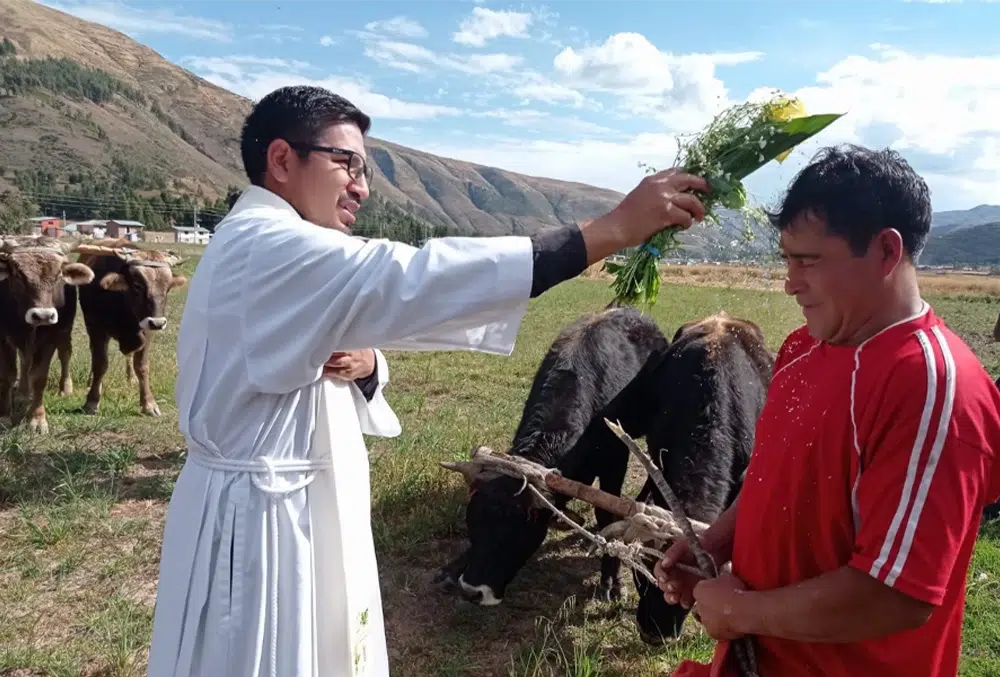
Priestly formation not only involved acquiring theological and human knowledge, but also learning to live in community, to obey and to serve without being the protagonist. These years were decisive in shaping a style of priesthood simple and close, especially suitable for the Andean reality.
In a context where many communities see the priest only a few times a year, interior preparation takes on special importance. Spiritual strength, constancy and the ability to adapt to difficult situations become indispensable tools for ministry.
This formative stage allowed Father Christiam to realistically assume the mission that awaited him, without idealizing it, but also without fear.
The decision to enter the seminary came when he had already begun his university studies and had defined personal projects. Betting on the priesthood meant leaving behind legitimate plans and assuming the uncertainty of a demanding path.
The most difficult test was the family one. For his parents, the decision initially meant the feeling of losing a son. That pain was transformed over the years into a process of shared faith, lived in parallel with the priestly formation of Christiam. Today, this initial renunciation is a reason for gratitude and profound joy.
The time spent in the seminary was the key to maturing humanly and spiritually, and to purifying one's vocation until it became a free and conscious response to God's call.
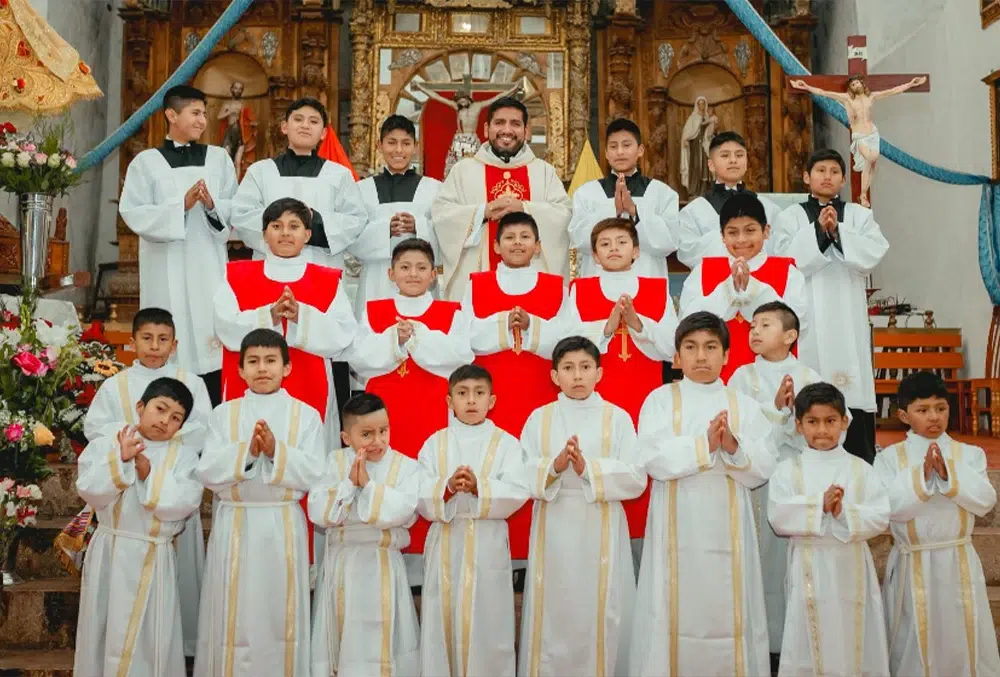
His ordination to the priesthood, celebrated on the eve of the feast of the Good Shepherd, marked the beginning of a definitive dedication. From that moment on, Father Christiam's ministry was tied to an extreme pastoral reality.
Its diocese covers more than 16,700 km² and has a very limited number of priests to serve dozens of parishes separated by great distances. In this context, the priest accompanies spiritually and often has to assume educational and social tasks.
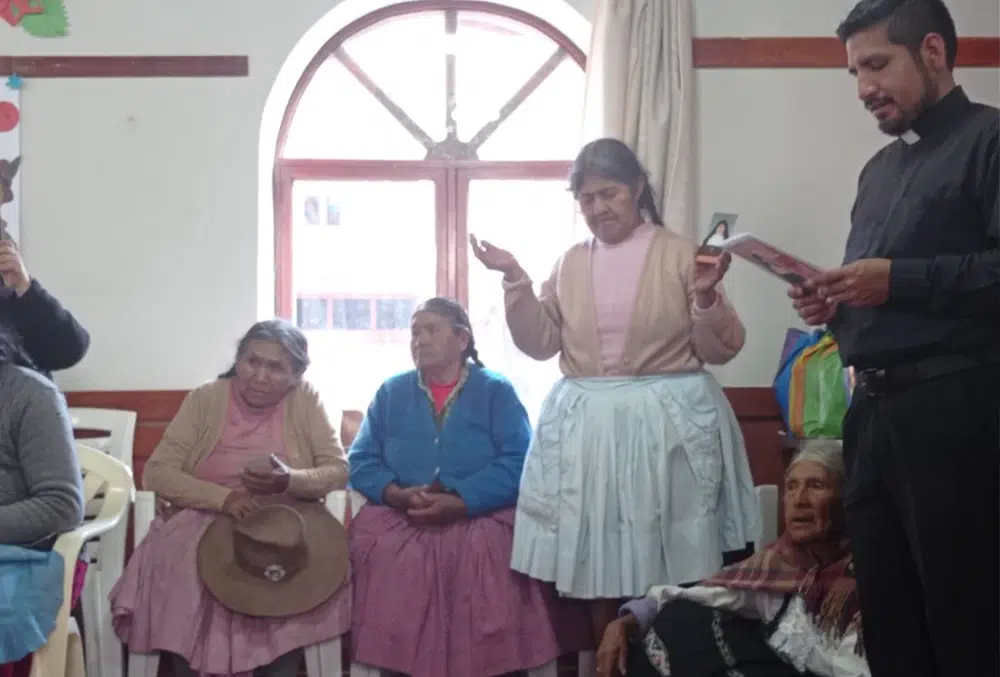
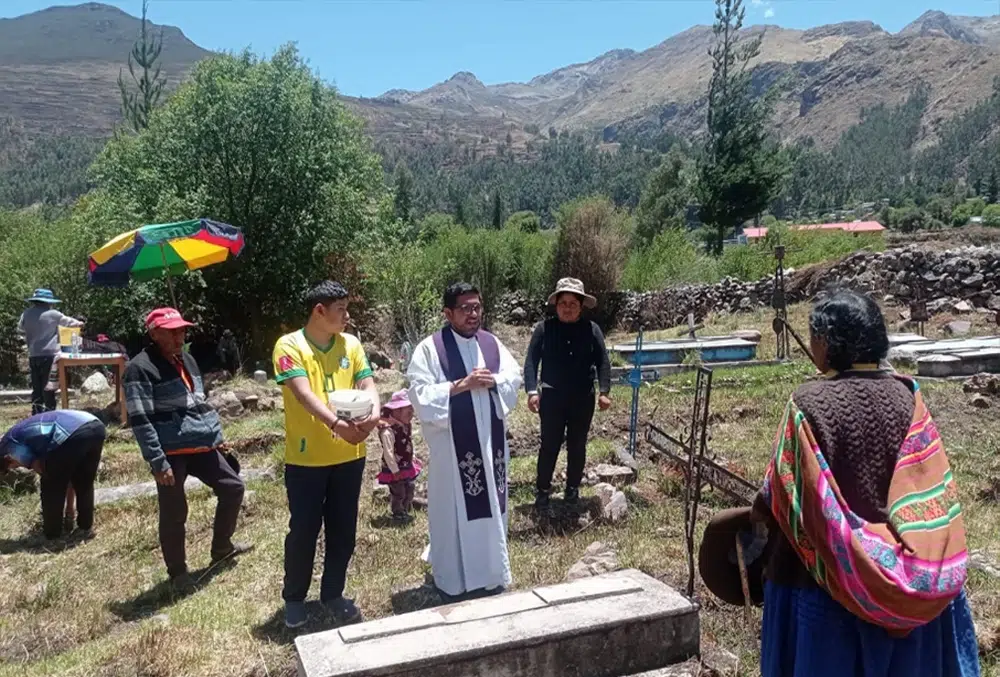
In addition to the parish, Father Christiam serves thirteen rural communities. Some, such as Paropata and Tucsa, are located at almost 4,900 meters above sea level and are only accessible on foot or by horse or mule. These are villages with serious material and sanitary deficiencies, but with a living faith that is expressed in deeply rooted customs.
In these communities, evangelizing also means sharing the work of the field, listening, teaching and sustaining hope. There, the priest discovers that, as he evangelizes, he is also evangelized by the simple faith of the people.
Christiam is currently studying canon law at the University of University Pontifical of the Holy Cross, in Rome, thanks to the support of partners, benefactors and friends of the CARF Foundation. He lives this stage not as a personal merit, but as an opportunity to be better formed and to serve with greater dedication to the Church of Peru when he returns.
His priestly vocation continues to have a clear horizon: to return to the Andes and continue caring for the people God has entrusted to him.
Gerardo FerraraBA in History and Political Science, specializing in the Middle East.
Responsible for students at the University of the Holy Cross in Rome.
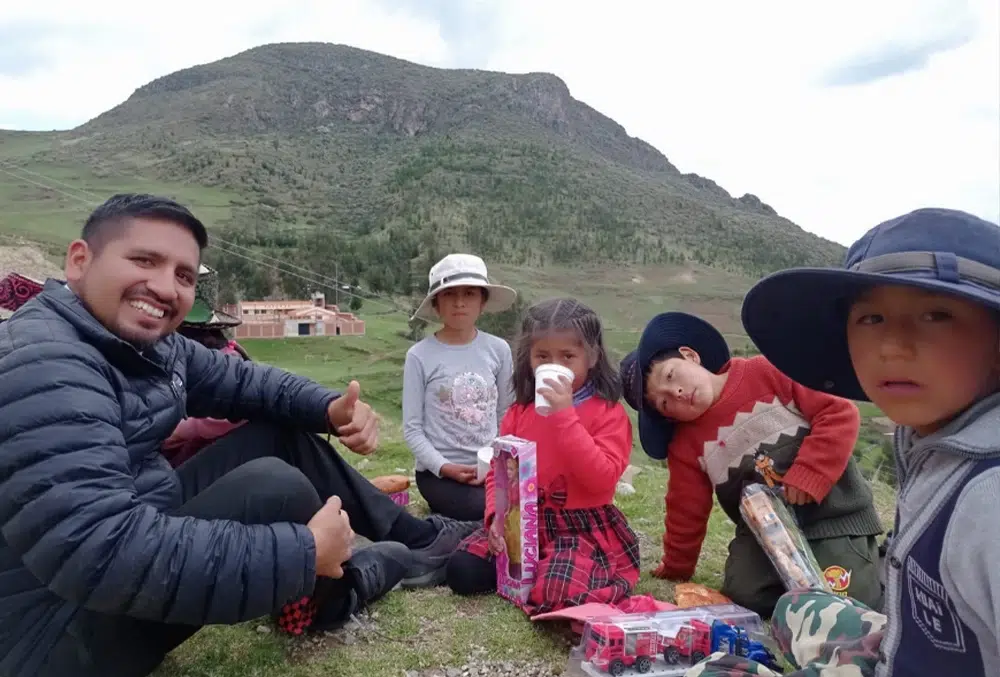
Table of Contents
 carf@fundacioncarf.orgLandline: +34 914 029 082Mobile: +34 638 078 51145 Conde de Peñalver Street.