Nativity of the Virgin Mary: September 8th

Each September 8the Church celebrates the Nativity of the Virgin MaryThe feast that commemorates the birth of the Mother of God. The celebration is closely linked to the solemnity of the Immaculate Conception (December 8), for nine months later the Church contemplates the gift of his birth.

Mary's birth is seen as the beginning of the fulfillment of the divine promises: she is the woman chosen to be the Mother of the Savior.

Many centuries had passed since God, on the threshold of Paradise, promised our first parents the coming of the Messiah. Hundreds of years in which the hope of the people of Israel, depositary of the divine promise, was centered on a maiden, of the lineage of David, that shall conceive and bear a Son, and shall call His name Immanuel, which means God with us. (Is 7, 14). Generation after generation, the pious Israelites awaited the birth of the Mother of the Messiah, the one who is to give birth, as Micah explained against the backdrop of Isaiah's prophecy (cf. My 5, 2).
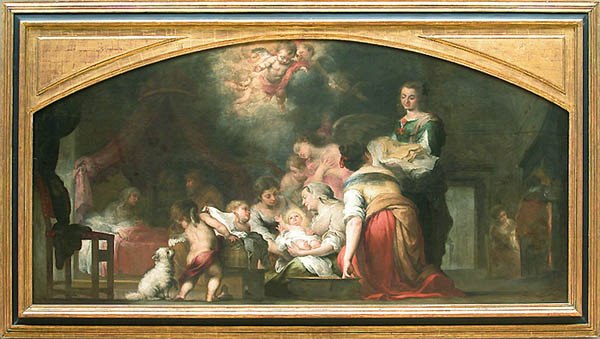
The birth of the Virgin by Bartolomé Esteban Murillo. Louvre Museum, Paris.

The birth of Mary, announcement of Salvation

Several Popes have described this feast as the dawn announcing the arrival of the Sun of righteousness: Jesus Christ.. At words of St. John Paul IIThe birth of the Virgin Mary is a luminous sign that prepares for the Incarnation of the Son of God.

The liturgy calls her "the root of our joy" because in Mary the plan of salvation begins to become visible. The prophet Micah, quoted on this feast, announces that the Savior will be born in Bethlehem and that he himself will be peace. Mary, daughter of Israel and mother of the Messiah, is the bridge between the promise and its fulfillment.

Mary, sign of peace and hope

Pope Francis recalled that this feast also speaks of peace. In the readings of the day, the word peace resounds three times, because the arrival of Mary prepares the heart of humanity to receive Christ, the Prince of Peace.

To celebrate the birth of the Virgin Mary is to recognize her as star of hope. She enlightens the Church and every Christian, inviting us to live open to God, as she did, and to let Christ transform our lives.

Mary model of holiness

The Nativity of the Virgin Mary is not only a historical memory, but a feast that encourages us to look at life with faith: Mary is a model of holiness and spiritual beauty.the perfect creature that God prepared for his Son.

Its birth marks the beginning of salvationShe is the link between the promises of the Old Testament and their fulfillment in Christ. For the faithful, her feast is an occasion to renew their trust in God and to ask for the grace to live with the same docility and faith that Our Lady had.

When the fullness of time had come, God sent forth his Son, born of a woman, born under the Law, to redeem those who were under the Law, so that we might receive the adoption of sons. (Gal 4, 4-5). God is careful to choose his Daughter, Spouse and Mother. And the holy Virgin, the very high Lady, God's most beloved creature, conceived without original sin, came to our earth. She was born in the midst of a profound silence. They say that in autumn, when the fields sleep. None of his contemporaries realized what was happening. Only the angels in heaven made merry.
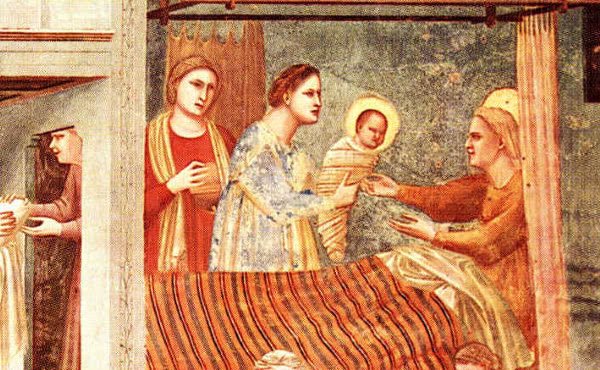
Of the two genealogies of Christ that appear in the Gospels, the one recorded by St. Luke is most probably that of Mary. We know that she was of noble lineage, a descendant of David, as the prophet had pointed out when speaking of the Messiah.a shoot shall come forth from the stock of Jesse, and from its roots shall blossom a scion (Is 11, 1)-and as St. Paul confirms when he writes to the Romans about Jesus Christ, born of the seed of David after the flesh (Rm 1, 3).

An apocryphal writing from the second century, known as the Protoevangelium of Santiago, has transmitted to us the names of her parents - Joachim and Anna - which the Church inscribed in the liturgical calendar. Various traditions place the place of Mary's birth in Galilee or, more probably, in the holy city of Jerusalem, where the ruins of a 5th century Byzantine basilica have been found, built over the so-called "holy city of Jerusalem". Santa Ana housevery close to the Probationary pool. No wonder the liturgy puts on Mary's lips some phrases from the Old Testament: I have settled in Zion. In the beloved city he has given me rest, and in Jerusalem is my dominion. (Sir 24, 15).

Gospel reading of the day

✠ A reading from the Holy Gospel according to St. Matthew1:1-16. 18-23

Book of the origin of Jesus Christ, son of David, son of Abraham.

Abraham begat Isaac, Isaac begat Jacob, Jacob begat Judah and his brothers. Judah begat, of Tamar, Pharez and Zarah, Pharez begat Eshron, Eshron begat Aran, Aran begat Amminadab, Amminadab begat Nahshon, Nahshon begat Salmon, Salmon begat, of Rachab begat Boaz, Boaz begat, of Ruth, Obed, Obed begat Jesse, Jesse begat David the king.

David by Uriah's wife begat Solomon, Solomon begat Rehoboam, Rehoboam begat Abijah, Abijah begat Asaph, Asaph begat Jehoshaphat, Jehoshaphat begat Jehoran, And Joran begat Uzziah, and Uzziah begat Johanan, and Johanan begat Ahaz, and Ahaz begat Hezekiah, and Hezekiah begat Manasseh, and Manasseh begat Amos, and Amos begat Josiah; Josiah begat Jechoniah and his brothers, at the time of the Babylonian exile.

After the Babylonian exile, Jechoniah begat Shealtiel, Shealtiel begat Zerubbabel, Zerubbabel begat Abiud, Abiud begat Eliakim, Eliakim begat Azor, Azor begat Zadok, Zadok begat Zadok, Zadok begat Aquinas, Aquinas begat Eliud, Eliud begat Eleazar, Eleazar begat Mattan, Mattan begat Jacob; And Jacob begat Joseph, the husband of Mary, of whom was born Jesus, who is called Christ.

The generation of Jesus Christ was like this: Mary, his mother, was betrothed to Joseph and, before they lived together, it turned out that she was expecting a son by the work of the Holy Spirit.

Joseph, her husband, being just and not wanting to defame her, decided to divorce her privately. But, no sooner had he taken this resolution, than an angel of the Lord appeared to him in a dream and said:
"Joseph, son of David, do not be afraid to take Mary your wife, for the child in her is from the Holy Spirit. She will bear a son, and you are to name him Jesus, for he will save his people from their sins."

All this happened to fulfill what the Lord had spoken through the prophet:
"Behold: the virgin shall conceive and bear a son, and they shall call his name Immanuel, which means "God-with-us"."

Bibliography

Opusdei.org. Life of Mary.
Catechesis of the Pope: Jesus Christ, Our Hope

General Audience with Pope Leo XIV in St. Peter's Square, September 3, 2025.

Dear brothers and sisters:

At the heart of the passion story, at the brightest and at the same time darkest moment of the life of Jesus ChristJohn's Gospel gives us two words that contain an immense mystery: "I thirst" (19:28), and immediately afterwards: "All things are accomplished" (19:30). These last words, but loaded with a whole life, reveal the meaning of the entire existence of the Son of God. On the cross, Jesus does not appear as a victorious hero, but as a beggar of love. He does not proclaim, he does not condemn, he does not defend himself. He humbly asks for what he cannot give himself in any way.

Jesus Christ crucified, full expression of Love

The thirst of the Crucified is not only the physiological need of a broken body. It is also, and above all, the expression of a profound desire: that of love, of relationship, of communion. It is the silent cry of a God who, having wanted to share everything of our human condition, also allows himself to be pierced by this thirst. A God who is not ashamed to beg for a sip, because in this gesture he tells us that love, to be true, must also learn to ask and not only to give.

"I thirst," Jesus says, and in this way he manifests his humanity and ours as well. None of us can be enough for ourselves. No one can save himself. Life is "fulfilled" not when we are strong, but when we learn to receive. And precisely at that moment, after having received from the hands of others a sponge soaked in vinegar, Jesus proclaims: "All is fulfilled". Love has made itself needy, and precisely because of this it has carried out its work.

Jesús

This is the Christian paradox: God saves not by doing, but by allowing himself to be done. Not by overcoming evil with force, but by accepting to the end the weakness of love. On the cross, Jesus teaches us that the human being is not fulfilled in power, but in trusting openness to others, even when they are hostile and enemies. Salvation does not lie in autonomy, but in humbly recognizing one's own need and knowing how to express it freely.

The fulfillment of our humanity in God's design is not an act of force, but a gesture of trust. Jesus does not save with a coup d'effect, but by asking for something that alone cannot be given. And here opens a door to true hope: if even the Son of God has chosen not to be sufficient for himself, then his thirst - for love, for meaning, for justice - is not a sign of failure, but of truth.

Letting ourselves be loved by Jesus Christ

This truth, apparently so simple, is difficult to accept. We live in an age that rewards self-sufficiency, efficiency and performance. However, the Gospel shows us that the measure of our humanity is not what we can conquer, but our capacity to let ourselves be loved and, when necessary, to help.

Jesus saves us by showing us that asking is not unworthy, but liberating. It is the way out of the concealment of sin, to return to the space of communion. From the beginning, sin has generated shame. But forgiveness, the true forgiveness, is born when we can look our need in the face and no longer fear being rejected.

The thirst of Jesus on the cross is then also our thirst. It is the cry of wounded humanity that continues to seek living water. And this thirst does not distance us from God, but unites us to him. If we have the courage to recognize it, we can discover that our fragility is also a bridge to heaven. Precisely in asking - not in possessing - a path of freedom opens up, because we stop pretending to be enough for ourselves.

In fraternity, in the simple life, in the art of asking without shame and offering without calculation, is hidden a joy that the world does not know. A joy that brings us back to the original truth of our being: we are creatures made to give and receive love.

Dear brothers and sisters, in the thirst for Christ we can recognize all our thirst. And learn that there is nothing more human, nothing more divine, than to know how to say: I need. Let us not be afraid to ask, especially when it seems to us that we do not deserve it. Let us not be ashamed to reach out. It is precisely there, in that humble gesture, where salvation is hidden.

A moment of the catechesis on Jesus Christ during Pope Leo XIV's general audience in St. Peter's Square (@Vatican Media).

Pope Leo's final appeal

Dramatic news is coming from Sudan, particularly from Darfur. In El Fasher, many civilians are trapped in the city, victims of shortages and violence. In Tarasin, a devastating landslide has caused numerous deaths, leaving behind pain and despair. And, as if that were not enough, the spread of cholera threatens hundreds of thousands of already exhausted people. I am closer than ever to the Sudanese people, particularly families, children and displaced persons.

I pray for all the victims. I sincerely appeal to those responsible and to the international community to ensure humanitarian corridors and to launch a coordinated response to stop this humanitarian catastrophe. It is time to initiate a serious, sincere and inclusive dialogue between the parties to end the conflict and restore hope, dignity and peace to the people of Sudan.

St. Mother Teresa of Calcutta: September 5th

Each September 5the Church celebrates the memory of Mother Teresa of Calcutta. His life, marked by humility and total dedication to those most in need, continues to be a model of holiness and service.

Bishop Javier Echevarría pointed out how Mother Teresa knew how to look at life from the perspective of Christian love: a love that gives of itself, that reaches out to the most needy and that transforms every act into an opportunity to live with God. The then prelate of Opus Dei, stressed that she "saw the world as a common home" and that her life invited to "learn to live for others".

Institution of liturgical memory

The Dicastery for Divine Worship and the Discipline of the SacramentsThe Pontifical Council for the Laity, under the prefecture of Cardinal Arthur Roche, issued a decree on December 24, 2024, officially instituting the liturgical memorial of Mother Teresa on General Roman Calendar.

This decree allows his memory to be celebrated on September 5 in all the dioceses of the world. The intention is that the faithful remember his example of humility and service, and that liturgical celebrations include prayers and readings that reinforce the centrality of love of neighbor in Christian life.

The institution of the liturgical memorial also facilitates the Church's ability to disseminate the liturgical texts Mother Teresa's own, which include readings from Isaiah 58 (Break your bread with the hungry) and Matthew 25 (As you did it to one of the least of these my brethren, you did it to me), reinforcing the spiritual dimension of her testimony.

The spiritual legacy of Mother Teresa of Calcutta

In an article published in opusdei.orgJavier Echevarría, then prelate, recalled that St. Teresa always bent down to "welcome the abandoned or heal wounds of body and soul. These words reflect well what she was: a woman who knew how to discover Christ in the face of the poorest.

In his reflection on Mother Teresa, he emphasized how she incarnated charity on a day-to-day basis. He did not limit himself to grandiose gestures, but found Christ in every person in need: the sick, the poor, the abandoned. His life demonstrates that holiness is built through concrete acts of love, consistency and dedication.

His life challenges all Christians, because it is not only a matter of admiring his generosity, but of make delivery a way of life in the ordinary. As he taught St. Josemaríaholiness is in the little things, at work, in the family and also in selfless service to those around us.

For this reason, the memory of Mother Teresa becomes an opportunity to review our Christian commitment: do we look at those who suffer with eyes of faith, do we know how to discover in each person the dignity of a child of God, do we put love in the concrete details of life?

Why September 5?

In the Church, the memory of a saint is celebrated on the day of his deathThe moment when she enters fully into the glory of heaven. In Mother Teresa's case, this corresponds to the moment when she enters fully into heaven. September 5, 1997He died in Calcutta on that date.

Since that day, many began to remember her example and to pray through her intercession. His canonization in 2016 by Pope Francis reinforced the importance of this date. Thus, the annual celebration not only honors his life, but also invites the faithful to reflect on holiness and concrete service to others.

In various dioceses and parishes, this date has become an occasion for the realization of charitable activities and liturgical celebrationsrecalling that Mother Teresa's life was a testimony of love for the poorest and most marginalized.

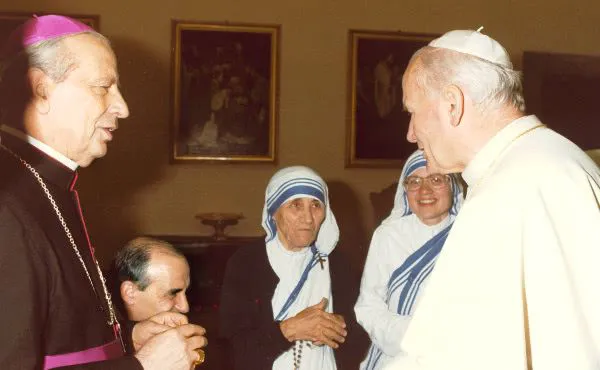
St. John Paul II, with St. Teresa of Calcutta and Blessed Alvaro del Portillo, June 1, 1985.

Mother Teresa illuminates the service

Cardinal Arthur Roche, prefect of the Dicastery for Divine Worship, affirmed that Mother Teresa is "a exceptional witness of hope"in times of pain and marginalization. His life is a concrete response to the call of the Gospel to serve the least and forgotten.

From a Christian perspective, its liturgical feast is not only a historical remembrance, but an invitation to to follow his example in the present. Every Christian can incarnate this same spirit in his environment: caring for the sick, accompanying the lonely, the dying, the orphaned... dedicating time to those in need.

Thus, Mother Teresa becomes a guide for living charity with consistency, reminding us that the path to holiness is not measured by words, but by concrete gestures of love.

Liturgical texts and celebrations

The liturgical decree includes specific texts for the Mass and the Liturgy of the Hours, adaptable by the episcopal conferences in different languages. Among them are prayers, readings and antiphons that emphasize the mercy of God and the importance of active charity.

This ensures that the faithful can participate in a uniform celebration throughout the world, and that the feast of Mother Teresa is not limited to a historical remembrance, but is lived in a spiritual and communal way.

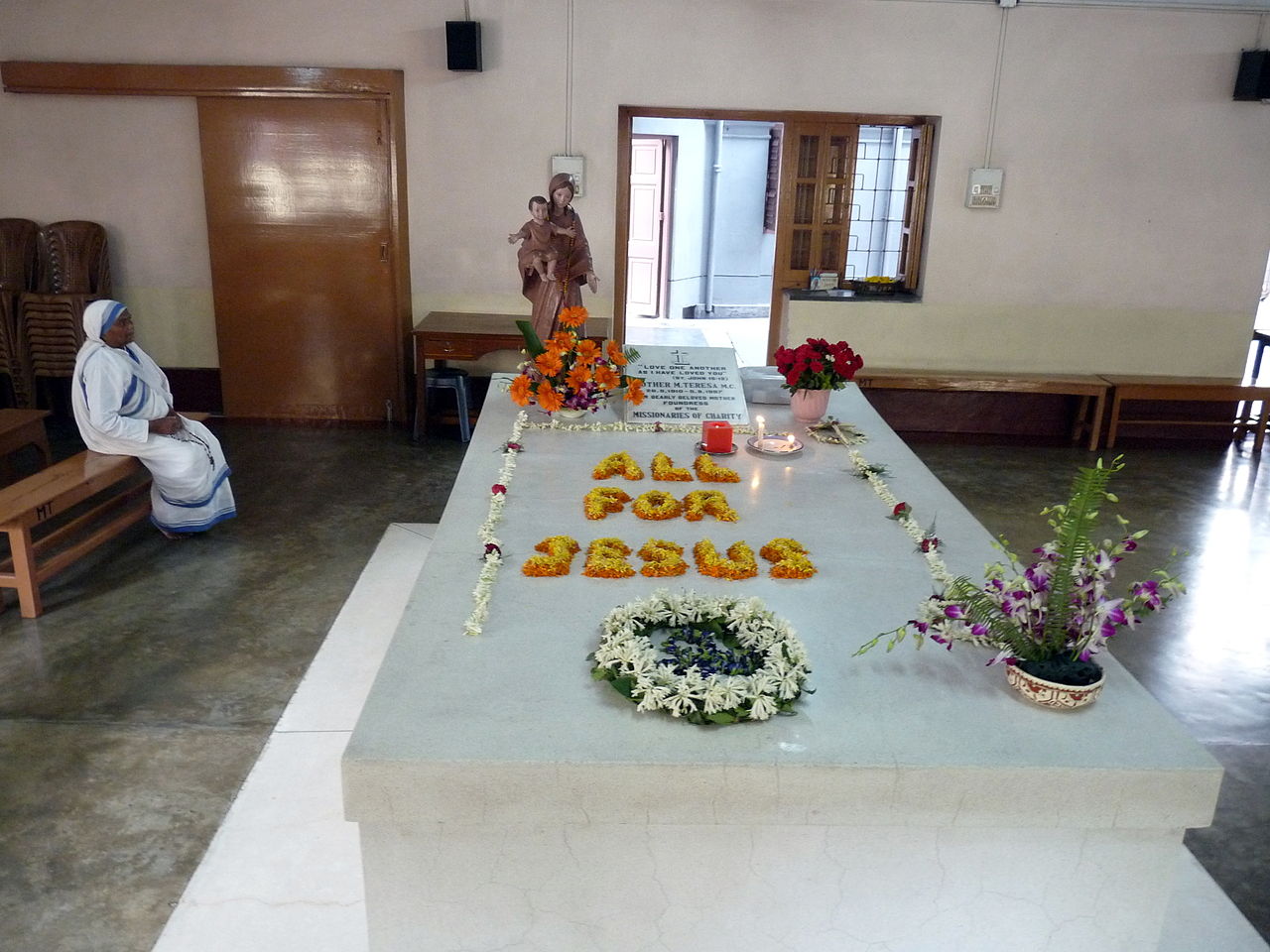
Mother Teresa's tomb in Calcutta (India).

Key facts about St. Teresa of Calcutta

His life and work show how Christian charity can transform concrete realities and leave a legacy that continues to inspire millions of people around the world.

The feast of Mother Teresa invites us to look at the world with her eyes: eyes of compassion, of faith, of limitless dedication. As the prelate of Opus Dei, Javier Echevarría, stressed, it is a matter of learning to living for others.

Two days before his departure to the Father's House, the Pope John Paul IIa personal friend of the nun, dedicated the Sunday Angelus prayer in St. Peter's Square to Mother Teresa of whom he said: "The beloved nun, universally recognized as the Mother of the Poor, leaves us an eloquent example for all, believers and non-believers. She leaves us the testimony of God's love. Her works speak for themselves and demonstrate to the people of our time the high meaning of life.".

How can you make your daily life a service to others? On September 5, but throughout your life, celebrate Mother Teresa's feast day with gestures of service: prayer, acts of charity or a reflection on how to put love and compassion into your daily life. Help us spread her legacy of holiness and dedication.


Sources consulted

Fundación Unicaja, one more year, with integral education

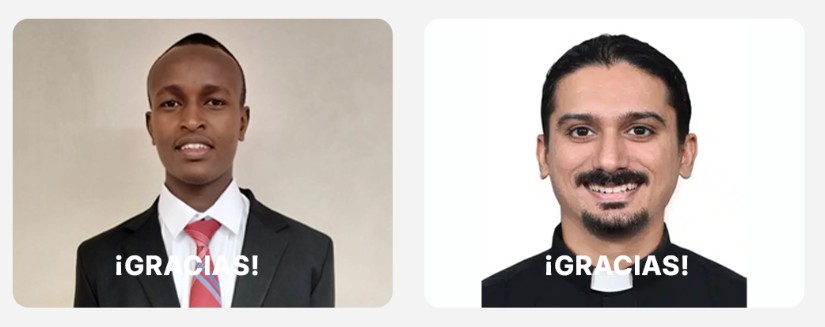
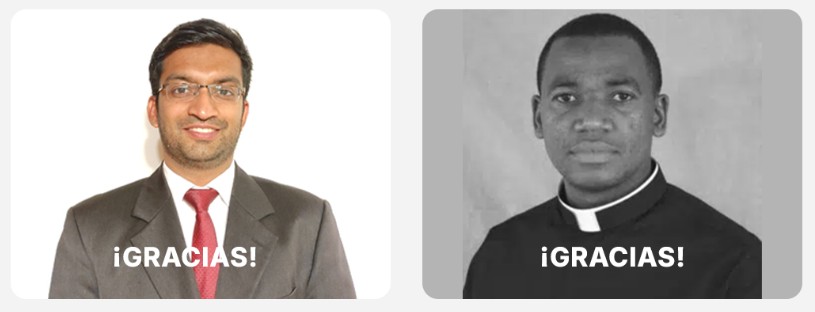
We are very grateful to the Unicaja Foundation because, for yet another academic year, it will help the integral formation of seminarians and diocesan priests from poor countries who come to Europe to receive an education of excellence. 

fundacion unicaja colaboración formación1

Students always return to their home countries once they have completed their studies. training The company's activities were carried out in an integral manner, in this case at the Pontifical University of the Holy Cross in Rome.

Mission of the CARF Foundation

The mission of the CARF Foundation is framed in elements:

The CARF Foundation -Centro Académico Romano Fundación-. was born on February 14, 1989, at the suggestion of St. John Paul II to Blessed Alvaro del Portillo. It has been in existence for more than 35 years.

Its objective is to help the academic, human and spiritual formation of seminarians and diocesan priests and religious men and women without financial resources to serve the church throughout the world.

Today, thanks to the support of its donors and friends, almost 25,000 in its history, and in the hundreds of them from Andalusiathe Foundation has helped about 30,000 students in 130 countries lacking material and economic resources. The Unicaja Foundation itself has been committed to this project for two years.

So that they can study and train in Italy (Pontifical University of the Holy Cross) and in Spain (Faculties of Ecclesiastical Studies of the University of Navarra).

The CARF Foundation upholds the values defined in the Universal Declaration of Human Rights of the United Nations of 1948. And it makes special mention of the freedom, equality and religious freedom. Promoting international coexistence, freedom of opinion and expression and, above all, the right to education.

Return what was received

The commitment of institutions such as the Unicaja Foundation makes it possible for people without resources to train in Europe and return to their countries to train others; they give back what they have received. An endless chain of favors.

fundacion unicaja colaboración formación2

Thank you from the bottom of my heart! 

????
????

St. Gregory the Great: a Pope who changed history

St. Gregory the Great was a reformer of the liturgy, promoter of Gregorian chant, defender of the poor and promoter of evangelization, his pontificate marked a before and after in history. His life reminds us that true greatness lies in serving God and others with generous love.

Throughout its history, the Catholic Church has had extraordinary figures who, in moments of crisis and darkness, have known how to guide the Christian people with wisdom, humility and fortitude. One of these providential men was St. Gregory the Great (540-604), Pope between 590 and 604, considered one of the four great Fathers of the Latin Church. His pontificate left an indelible mark on the liturgy, the evangelizing mission and the organization of the Church.

St. Gregory is remembered as "the pope who ruled with a monk's heart".because, in spite of assuming the weight of the headquarters of Rome in a turbulent time, he always maintained the spirit of service and humility that he had cultivated in his monastic life.

His figure continues to be a current example for pastors and faithful, because he knew how to combine firmness of government with a deep interior life, personal austerity with great generosity towards the poor, and tradition with openness to the needs of his time.

In this blog story we will delve into his life, his historical context, his main works and why the Church venerates him as a saint and Doctor of the Church.

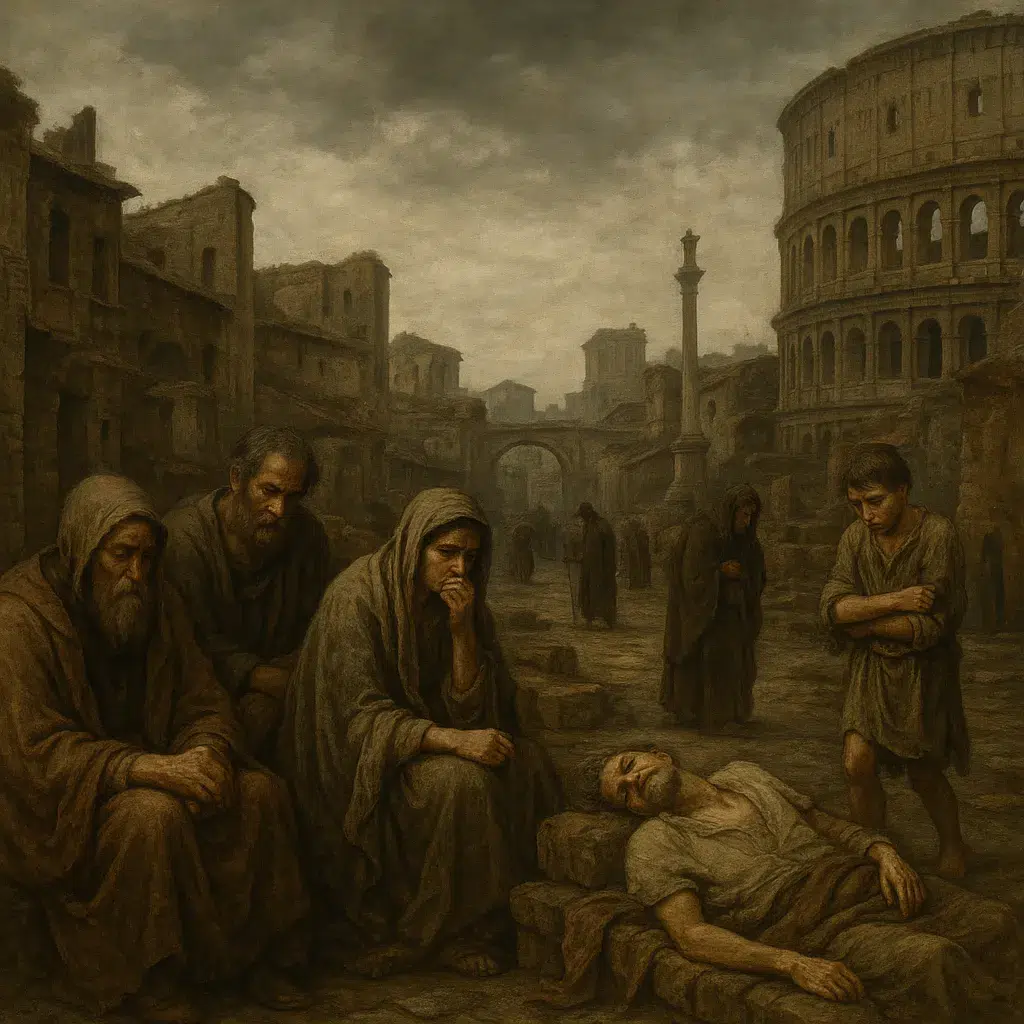
Roma, la ciudad que vio nacer a san Gregorio Magno, estaba muy lejos de su antiguo esplendor imperial.

Historical context: a Rome in ruins

St. Gregory was born in Rome around 540, into an aristocratic family of ancient senatorial tradition. The city where he was born was far from its former imperial splendor: after the fall of the Western Roman Empire (476), Rome had been reduced to a decadent place, stricken by wars, epidemics and poverty.

The western world was fragmented and under pressure from peoples, such as the Lombards, who had invaded Italy and constantly threatened the city of Rome. The political authority was weak and the only stable reference point for the people was the Church and the Pope.

This context of crisis was decisive in understanding the figure of Gregory: a man who, without seeking it, had to assume the burden of guiding not only the spiritual life, but also the material survival of an entire people.

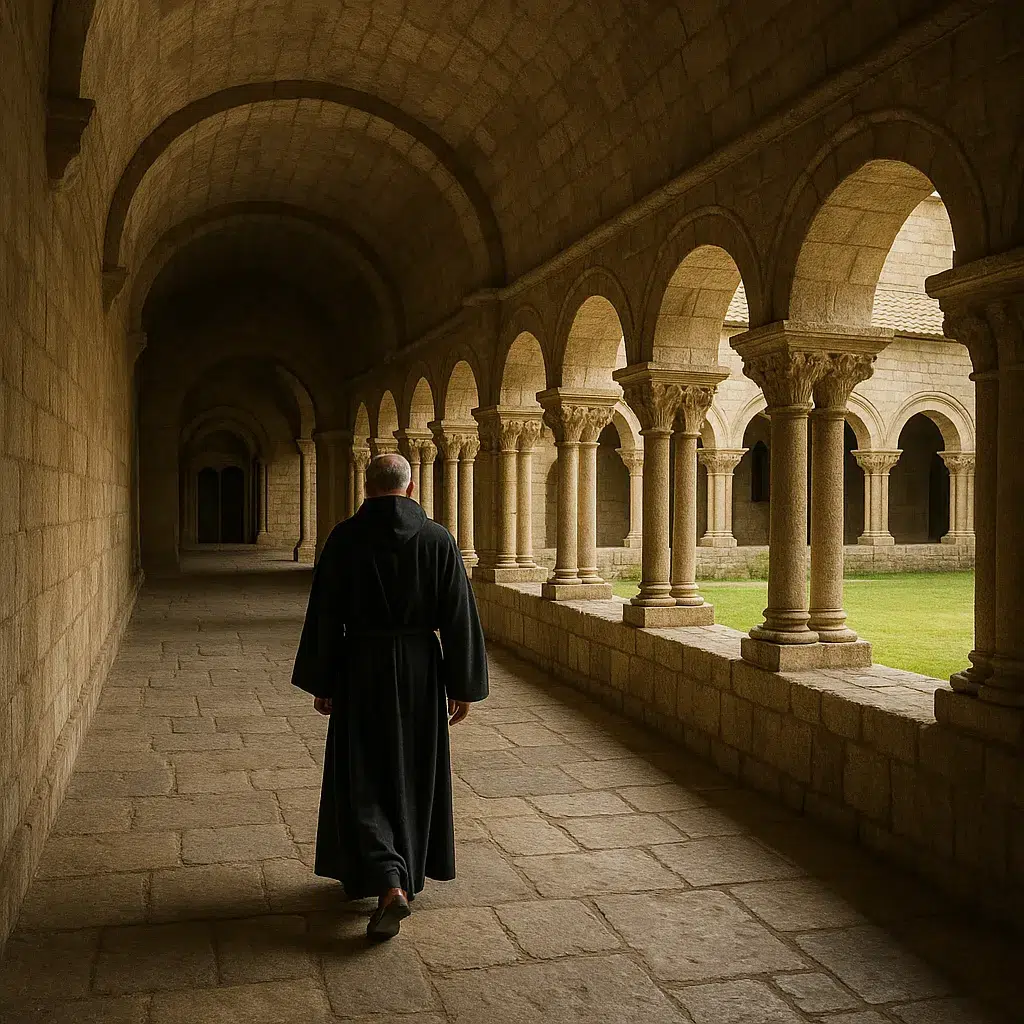
Claustro monástico con arquerías, columnas y un monje caminando de espaldas
A monk walks along a stone cloister, whose arcades open onto a courtyard.

From prefect of Rome to Benedictine monk

Gregorio received a refined education befitting his social rank. He was trained in Law, Literature and Administration, which allowed him to occupy positions of great responsibility. Around the year 572 he became prefect of RomeThe city's highest civil authority.

However, after the death of his father, Gregory decided to make a radical change in his life. He sold much of his possessions to help the poor and transformed his house on Mount Celio into a Benedictine monastery. He himself retired there as a monk, leading a life of prayer, study and austerity.

His monastic vocation was always the center of his identity, and although obedience later led him to leave this contemplative life, Gregory never ceased to consider himself a simple "servant of the servants of God," a title he introduced and which is still used today by the Popes as a sign of humility.

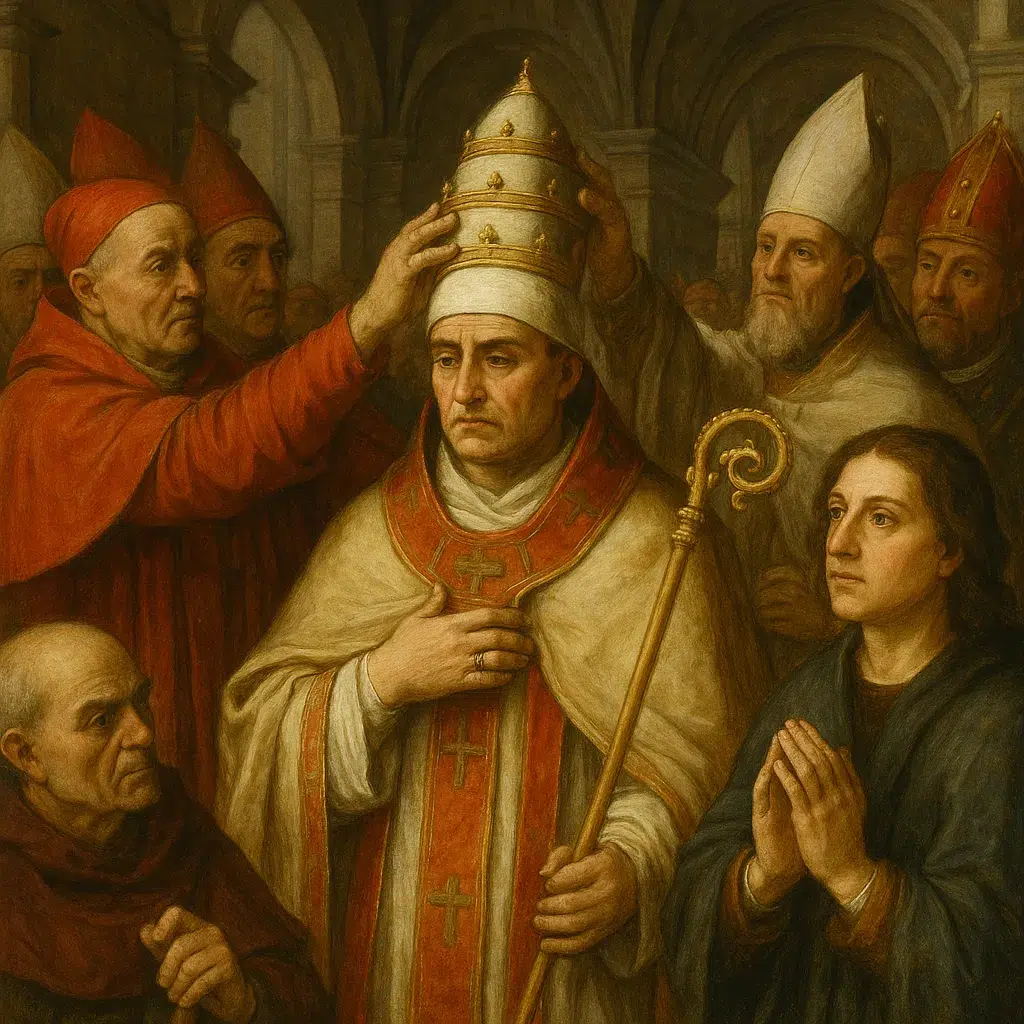
Arte renacentista: ceremonia de investidura papal con vestimentas eclesiásticas y tiara
A new pontiff receives the papal tiara from clerics and cardinals, marking the moment of his investiture.

The Pope who did not want to be Pope

In the year 590, after the death of Pope Pelagius II, Gregory was elected as successor of St. Peter. The choice was not easy: Gregory tried to resist, even asking the emperor not to confirm his appointment, as he felt he was not prepared for the enormous burden. However, the Roman people acclaimed him and he finally accepted the Petrine ministry.

His pontificate began in the midst of a terrible plague that was ravaging Rome. Tradition has it that he organized penitential processions and processions of supplication to the Virgin, in which, on arriving at Hadrian's mausoleum, he had a vision of the archangel Michael sheathing his sword, a sign that the plague was coming to an end. From then on, that place was called Castel Sant'Angelo.

A pastor and reformer Pope

St. Gregory ruled the Church for 14 years, until his death in 604. His work can be summarized as:

1. Liturgical Reform and Gregorian chant

One of the best known legacies of Gregory the Great is the consolidation of the Roman liturgy. He gave unity to the rites, promoted clarity in the prayers and set norms for the celebration of Mass and chant in the liturgy.

Although he did not invent Gregorian chant, he did promote and organize it, so that the musical tradition of the Western Church was linked to his name. Gregorian chant became a universal expression of prayer and beauty that is still alive today in monasteries and temples around the world.

2. The evangelizing mission

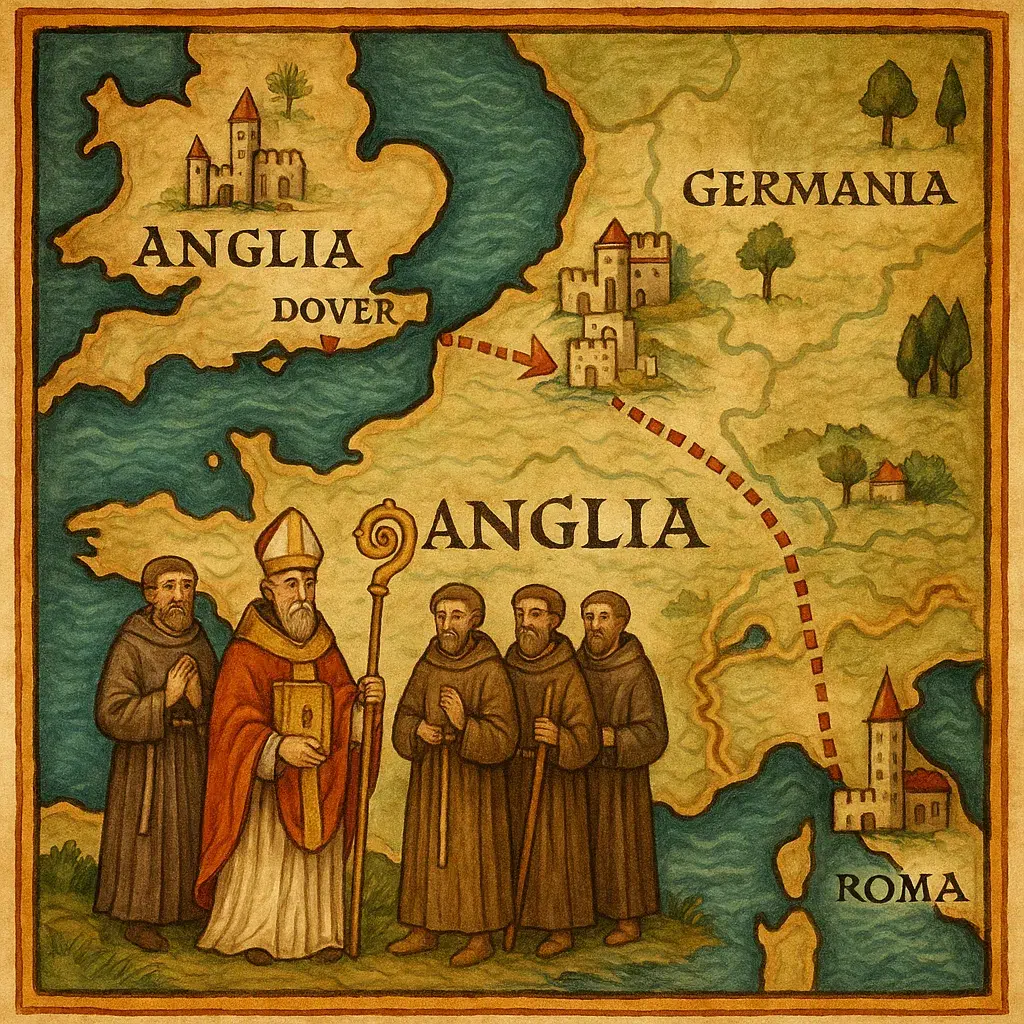
Gregory understood that the Gospel had to reach all peoples. He sent missionaries from Rome, the most famous case being that of saint Augustine of Canterburywho brought the Christian faith to the Anglo-Saxon peoples in England. Thanks to this initiative, the English Church became in a few centuries a focus of evangelization for the whole of Europe.

With this missionary impulse, Gregory reinforced the universality of the Church and laid the foundations for the Christianization of medieval Europe.

3. Charity as the axis of his pontificate

If anything characterized Gregory, it was his closeness to the poorest. The Roman Church, under his government, became the main institution of assistance to the needy. He organized a system of distribution of food and aid, administering with great rigor the ecclesiastical goods to put them at the service of the people.

His example of personal austerity was clear: while he ruled firmly, he lived simply, aware that his mission was to serve.

4. Writings and spiritual doctrine

St. Gregory was a prolific and clear writer. His works were widely disseminated and marked the spirituality of the Middle Ages. Among them are:

The Pastoral Rule: a manual for bishops and pastors on how to exercise their ministry with humility and zeal. It was so influential that Charlemagne had it distributed to all the bishops of his empire.

Dialogues: where he narrates the lives of Italian saints, especially St. Benedict of Nursia, whose spirituality he deeply admired.

Homilies on Ezekiel and on the Gospels: with clear and practical teachings for the Christian life.

His theology, more pastoral than speculative, stood out for its ability to unite doctrine with life, wisdom with closeness.

5. Government and diplomacy

Gregory was not only a spiritual leader, he also had to serve as an administrator and diplomat in a devastated Italy. He negotiated directly with the Lombards, reaching peace agreements that saved lives and protected the city of Rome.

He also strengthened the organization of the Church, sending letters and directives to bishops all over the world. We have preserved more than 800 of his letters, which allow us to see his enormous activity and pastoral care.

Holiness and legacy

St. Gregory died on March 12, 604, exhausted by illness and incessant work. He was buried in St. Peter's Basilica, where his tomb is still venerated.

The people proclaimed him a saint almost immediately. His reputation for holiness was due to his austere life, his love for the poor, his fidelity to prayer and his zeal for the Church. In 1295, Pope Boniface VIII declared him a saint. Doctor of the Churchrecognizing the depth of his spiritual teaching.

Today he is remembered as St. Gregory the GreatThe title he shares with only a few Popes in history, such as St. Leo the Great.

gregorio magno papa
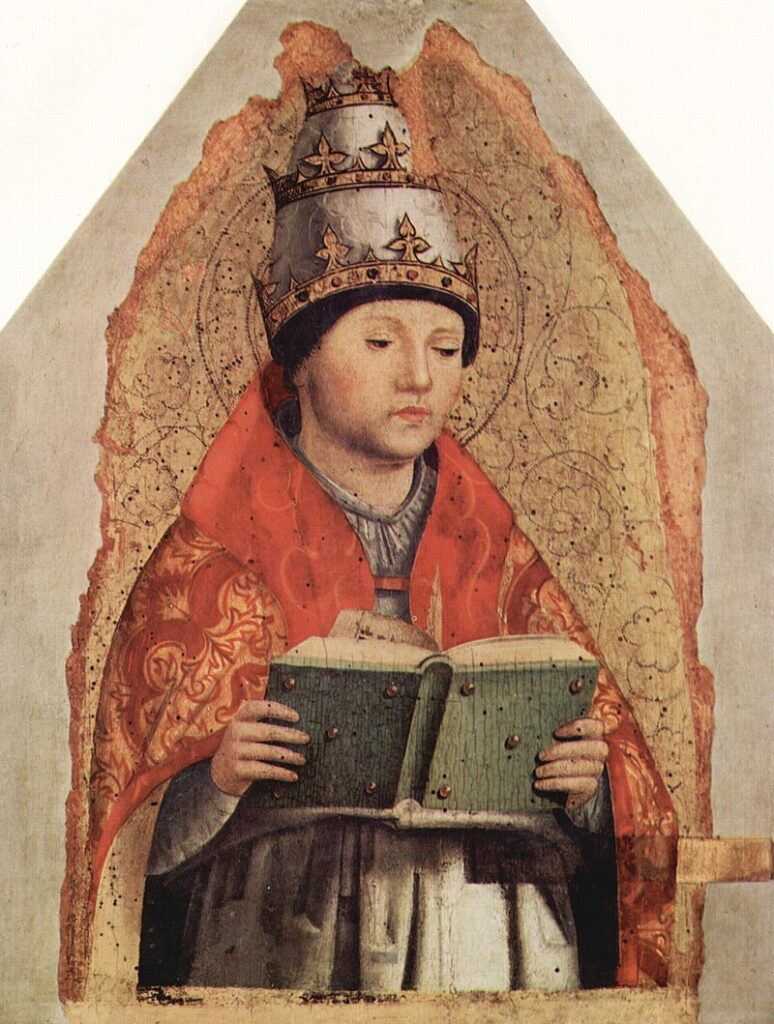
St. Gregory the Great, painting by Antonello da Messina.

Why is St. Gregory the Great still relevant today?

Although more than 1,400 years have passed since his death, the figure of St. Gregory is still very relevant for the Church and for the world:

Exceptional in times of crisis

St. Gregory the Great was an exceptional Pope who knew how to lead the Church in times of crisis, not from power, but from humility and service. His life demonstrates that holiness does not consist in doing extraordinary things, but in living with fidelity and dedication the responsibilities that God places in our hands on a daily basis.

The Church venerates him as a saint and doctor because he united the prayer of the monk, the wisdom of the teacher and the fortitude of the pastor. His example continues to inspire Christians today to be light in the midst of darkness, humble servants of others and faithful messengers of the Gospel.

As he wrote in his Pastoral Rule: "He who has been placed as pastor must be, above all, an example of life, so that his very conduct may be a point of reference for others."

St. Gregory the Great teaches us that true greatness is in the magna caritasin the great and generous love that gives itself without measure.


Four steps of the sacrament of Confession

"Jesus Christ our Lord, our God, instituted the sacraments, which are like the footprints of his footsteps, so that we may tread there and reach Heaven. And one of the most beautiful and consoling sacraments is the sacrament of Confession", St. Josemaría Escrivá, Argentina, June 15, 1974.

St. Josemaría quoted and here we show you what he said about the sacrament as a marvel of God's love.

Sacrament of Confession

Christ instituted this sacrament offering us a new possibility to convert and to recover, after Baptism, the grace of God.

«The sacrament of Reconciliation is a sacrament of healing. When I go to confession, it is to heal myself, to heal my soul, to heal my heart, and to heal something I did that is not working well.», Pope Francis, General Audience, February 19, 2014.

Like all the sacraments, this is an encounter with Jesus. During Confession, we tell our sins to Jesus. priest who acts in the person of Christ and with the authority of Jesus to listen, offer guidance, provide adequate penance and pronounce the words of absolution.

"At the celebration of the In the Sacrament of Reconciliation, the priest does not represent God alone, but to the whole Community, which recognizes itself in the fragility of each of its members, which listens to their repentance, which is moved, which is reconciled with Him, which encourages and accompanies them on the path of conversion and of human and Christian maturity.

Someone may say: "I confess only to God". Yes, you can say to God: "forgive me", and tell him your sins. But our sins are also against our brothers, against the Church, and for this reason it is necessary to ask forgiveness from the Church and our brothers, in the person of the priestPope Francis, Catechesis of Wednesday, February 19, 2013.

St. Josemaría used to call Confession the sacrament of joy, because through it one recovers the joy and peace that friendship with God brings.

examen confesión sacramento examen sacerdote pasos
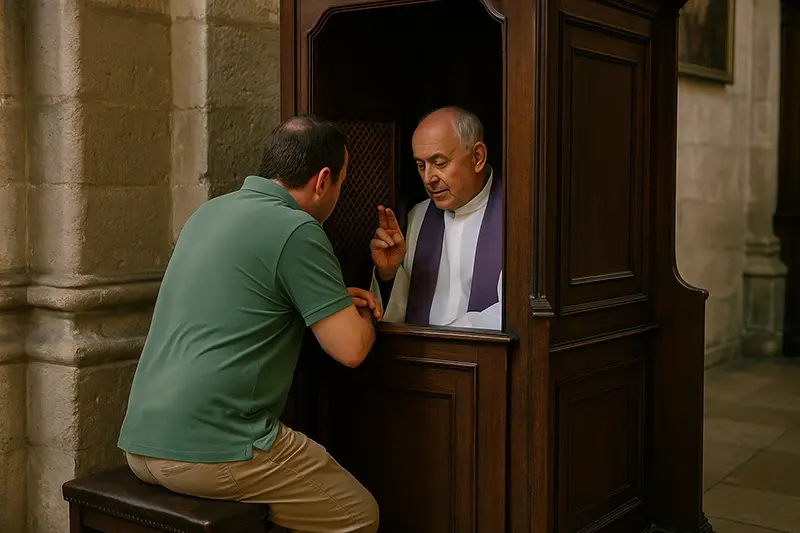
Moment of Confession, sign of God's forgiveness and mercy.

Importance of Confession

This sacrament not only restores our relationship as sons and daughters of God, but also reconciles us to each other by remaking our union with the Body of Christ, his Church.

Pope Francis explained the importance of confession with these words: "The forgiveness of our sins is not something we can give ourselves. I cannot say: I forgive myself my sins. Forgiveness is asked for, it is asked of another, and in Confession we ask Jesus for forgiveness. Forgiveness is not the fruit of our efforts, but it is a gift, a gift of the Holy Spirit".

There are several details that we can take into account to do it in a deeper and more effective way.

For example, we can help ourselves with a guide with the necessary keys for a good examination of conscience. It is the moment to be sincere with oneself and with God, knowing that He does not want our past sins to oppress us, but that He wants to free us from them so that we can live as His good children.

sacramento confesión examen
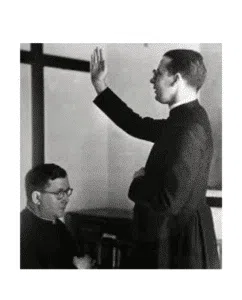
Alvaro del Portillo gives absolution to St. Josemaría.

Steps for a good Confession

The Catechism of the Church proposes four steps for a good confession. These express the path to conversion, which goes from the analysis of our actions to the action that demonstrates the change that has taken place in us.

There are four steps we take to be able to receive the great embrace of love that God, our Father, wants to give us with this sacrament: "God waits for us, like the father in the parable, with outstretched arms, even if we do not deserve it. Our debt does not matter. As in the case of the prodigal son, we need only open our hearts" (St. Josemaría, Christ Is Passing By, no. 64).

1st Examination of conscience

In the examination of conscience we try to examine our soul in prayer before God, in the light of the teachings of the Church, starting from our last confession.

We reflect on those actions, thoughts or words that may have distanced us from God, offended others or harmed us internally.

There are several details that we can take into account to do it in a deeper and more effective way. For example, we can use a guide with the necessary keys for a good examination of conscience. 

It is the moment to be sincere with oneself and with God, knowing that He does not want our past sins to oppress us, but that He wants to free us from them so that we can live as His good children.

2º Contrition and resolution not to sin again.

Contrition or repentance, is a gift from God. It is a sorrow of the soul and a rejection of our sins, which includes the resolution not to sin again.

Confession consists of telling sins to the priest. Sometimes, repentance comes with an intense feeling of pain or shame, which helps us to make amends. But this feeling is not indispensable. The important thing is to understand that we have done wrong and to have the desire to improve as Christians. Otherwise, we will put ourselves in God's hands to ask Him to work in our hearts to reject evil.

"Contrition," the Pope explains, "is the portico of repentance, it is that privileged path that leads to the heart of God, who welcomes us and offers us another chance, provided that we open ourselves to the truth of penance and allow ourselves to be transformed by his mercy.

3º Confess sins

The priest is an instrument of God. Let us put aside shame or pride, and open our souls in the certainty that it is God who listens to us.

"Confessing to a priest is a way of placing my life in the hands and heart of another, who at that moment acts in the name and on behalf of Jesus. [It is important that I go to the confessional, that I place myself in front of a priest who represents Jesus, that I kneel in front of Mother Church, who is called to distribute the Mercy of God. There is an objectivity in this gesture, in kneeling in front of the priest, which, at that moment, is the process of the grace that comes to me and heals me."Pope Francis. The name of God is mercy, 2016.

Confession consists of telling sins to the priest. It is often said that a good confession has "4 C's":

  • Clear: point out what the specific fault was, without adding excuses.
  • Concrete: say the precise act or thought, do not use generic phrases.
  • Concise: avoid unnecessary explanations or descriptions.
  • Complete: without silencing any serious sin, overcoming shame.
  • Confession is a sacrament, the celebration of which includes certain gestures and words on the part of the penitent and the priest. the most beautiful moment of the sacrament of Confession, for we receive God's forgiveness.

    4º Fulfill the penance

    Penance is a simple act that represents our reparation for the fault we have committed. It is also a good occasion to thank God for the forgiveness we have received, and to renew our resolution not to sin again.


    Bibliography