Kenyan seminarian seeks help to build a parish in his county

A parish project for Home Bay

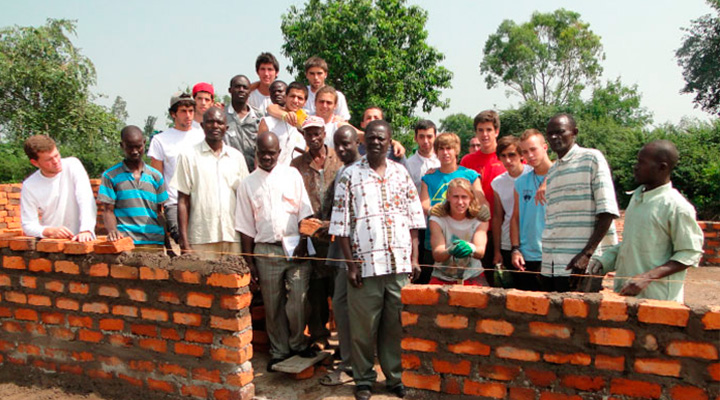
Cecil Agutu is a Kenyan seminarian studying theology at the University of Navarra thanks to a scholarship from the CARF Foundation. Cecil also heads a parish project in his hometown, Kagan, which is located in the rural county of Homa Bay in Kenya. Uganda Martyrs Achego Catholic ChurchThe objective of this parish is multiple, because it will not only serve the faithful of the county, but will also contribute to improve the health, education and employment of its inhabitants.

This parish will bring together the 21 chapels that depend on it and that will serve 3,080 Catholics and a larger community of 30,553 inhabitants. "This is a noble project that will do a tremendous amount of good for many families," Cecil tells the CARF Foundation.

"We are building the new parish from scratch. So far we have managed to put in the basic liturgical vessels needed to celebrate Mass and other celebrations and also, to build the parish house, so that the pastor has already been able to live in the parish to serve the faithful. What we propose to do now is to build the church and Mary's wayside shrine, parish offices and related facilities," he explains.

In what ways will it improve community services?

The construction of the parish will also entail the construction of the creation of a hospital. The clinic and the two dispensaries that exist in the area are too few for the more than 30,000 inhabitants because the facilities are limited for simple ailments and first aid. In addition, there is no doctor to treat them. Many times people have to travel more than 29 kilometers to receive medical attention.

The parish will also have a water well. The lack of drinking water is the greatest need in the region, as there is no river or public water supply. This well will serve 1,055 people of the surrounding area and, in times of drought, to another 1,272 people who live more than one kilometer away.

In addition, will increase the level of education thanks to improvements to the Achego Primary and Secondary schools, which are sponsored by the Catholic Church and have the largest number of children in the area. Also to be built a second school in the village of God Ndiru, which for the time being lacks teachers and classrooms.

Finally, the construction of the church will entail the construction of the critical infrastructures such as a proper road and electricity, which will open the area to business and employment for young people. In this video, Cecil explains his parish's project, "Raising the Sail".
diácono de filipinas

"The parish project we want to build will bring together the 21 chapels that depend on it and serve 3,080 Catholics and a wider community of 30,553 inhabitants. It is a noble project that will do a lot of good for many families," Cecil told the CARF Foundation.

A bit of history

Ninety-three years ago, the first Catholic missionaries arrived in Kagan (Kenya, Africa) and since then there have been many conversions. During this time, Catholics have promoted almost half of the existing schools in the rural town: fifteen primary schools and six secondary schools. The other half have been created by the government.

They have also built three wells in this time, two in villages and one for the only existing government health center in Kagan, which is as many as the government has built in the same time.

Only since September 2018, the church in Kagan has been erected as a parish, named Uganda Martyrs Achego Catholic Parish. This means that, at last, the village has the permanent presence of at least one resident priest and continuous mass service, in addition to serving families living in scattered areas of the sub-county.

First missionaries

Priest Philip Scheffer and Priest Hotsman, the first missionaries, crossed Lake Victoria from Ojola Catholic Station in Kisumu to establish St. Theresa Asumbi Parish in 1912. The place was full of wild animals and wizards who kept snakes in small pots called Asumbi. Later, the area was renamed Asumbi.

The missionaries built a thatched church in 1915 that non-believers burned in 1917. To the astonishment of the people, the fire did not burn the tabernacle, which prompted the missionaries to build another church of straw. D. Hotsman traveled to Europe in 1919 with samples of Asumbi's red earth to test whether it could be used to make bricks.

Manufacture of thousands of bricks

With the help of local believers, the missionaries made thousands of bricks between 1922 and 1923. St. Theresa Asumbi Church was completed in 1928 and served people from distant areas. Later, the Franciscan Sisters of St. Joseph established the Asumbi Convent and the Asumbi Teachers' School. A girls' primary and secondary school was also built in the area.

"In 1974, a chapel attached to St. Theresa Asumbi parish was established in my village of Kagan at a place known as Achego. It consisted of a platform covered with iron sheets. Achego was the place where my ancestors first settled when they migrated to this area. The nearby church grounds, elementary school and secondary school were donated by my family," says Cecil.

Third generation Catholic

Cecil is a third generation Catholic. His grandparents converted to Catholicism. "My grandfather, Valentine Agutu, was a polygamist and before converting, he had practiced the religion of African animism. Together with my grandmother, Susana Odero Agutu, they converted to the Catholic Church thanks to the work of the Catholic missionaries of the Society of St. Joseph in our rural district," he recounts.

He is the second of six siblings, three sisters and three brothers. His father died a year and a half ago and, as the first boy in the family, it is now his turn to help his mother, Joyce Agutu.

"The closest parish to our home, St. Theresa Asumbi Parish, was 7 kilometers away and my father recounted that, as a child, he would walk there for confession on Saturdays and to attend Holy Mass on Sundays. My mother was an Anglican and converted to the Catholic Church after marrying my father."

Projects in rural areas

Cecil studied a degree in Mathematics, Economics and Sociology at Egerton University in Kenya. He later studied a Masters in Public and Development Management at the University of the Witwatersrand, Johannesburg (South Africa) and a Masters in Philosophy at Strathmore University in Kenya.

"I worked a lot in the field of development with non-governmental organizations, especially in projects in rural areas and in less privileged neighborhoods in urban areas, for 17 years, before coming to Pamplona to study theology. I am an aggregate of the Prelature of Opus Dei and I am studying the second year of the Licentiate in Dogmatic Theology at the Ecclesiastical University of Navarra. I live in the Colegio Mayor Aralar," he explains.

At the end of the academic year he will be informed of his ordination to the priesthood.
diácono de filipinas

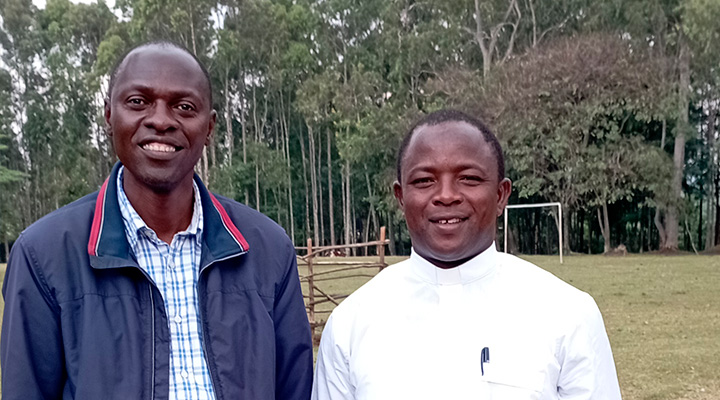
Gabriel Atieno, Judicial Vicar of the Catholic Diocese of Homa Bay and Rector of St. Joseph Rakwaro Minor Seminary. He is an alumnus of the Pontifical University of the Holy Cross, where he studied for his licentiate and doctorate in Canon Law.

Main evangelization challenges in Kenya

Catholics in Kenya usually have to travel long distances, usually on foot, to go to confession and attend Holy Mass, due to the scarcity of churches and the few priests to attend them.

In addition, due to the low human, spiritual and economic formation of the population, cultural practices such as polygamy persist, which are detrimental to the dignity of individuals and hinder the spread and practice of the Catholic faith, and the spread of sects and other heterodox communities is frequent.
Parish project data for grants.

  • Construction of the Church in Kagan, Homa Bay County, Kenya (Uganda Martyrs Achego Catholic Church).
  • Total budget for Church, Shrine of Mary, parish house, priest's offices and general facilities: 1,318,170.71 €.
  • Applicant foundation: Orem Foundation
  • Parish project partners: the Orem Foundation which is working with:
    The faithful and the pastor of the Uganda Martyrs Achego Catholic Parish.
    The Catholic Diocese of Homa Bay (http://www.cdohb.or.ke).
  • Questworks Limited ) for the design and construction of the project.
  • Presented by: Cecil Cerrilius Otieno Agutu, general manager.
    E-mail: cecil@oremfoundation.com.
    Phone: +34 665 96 22 38.
    Address: P.O. Box 2101, 40100 Kisumu, KENYA.
Marta Santín,
Journalist specializing in religious information.
How to show Jesus Christ in a country of non-believers

Anh Dao comes from a Catholic peasant family, being the fourth of five siblings. From an early age he participated in parish service as an altar boy. "My mother's testimony was an example for me to give myself to the service of the Church and others and to be able to respond to the Lord," he says.

His passion, law

In 2012, it entered the Vietnam Trade Union University and studied law for four years. "I was passionate about the idea of being able to dedicate myself professionally to the practice of law. At the same time that I was studying for my degree, I had a vocational accompaniment that allowed me to continue discerning about my vocation. Finally, I felt the call to the priesthood and decided to answer it by entering the seminary. That's how I became a seminarian in Vietnam.

However, he did not totally give up his ideal of practicing law thanks to the study of canon law: "the dream I had years ago is now becoming a reality within the Church through my vocation," he says.

A Vietnamese seminarian in Bidasoa

His bishop sent him to study at the Faculty of Ecclesiastical Studies at the University of Navarra and to reside in the Bidasoa International Seminar, where he has spent five years studying theology. "It is a seminary that has helped me to have a personal growth in a family environment with charity and fraternity. We always say that Bidasoa is the best seminary in the world, and the truth is that it is for us. We are very lucky to be part of this family, in addition to the excellent formation we are given. I am very grateful for this opportunity because I understand that this work is made possible by the collaboration of many people. Thanks to my time in Bidasoa, I am clear about the responsibility of my priestly formation".

The Bidasoa Choir

Anh, our seminarian from Vietnam, has been director of the Bidasoa Choir, a choir that produces in the faithful a special awe during the Eucharist. It lifts you up to heaven. "The Bidasoa choir is very well organized.. We receive singing and organ lessons with professors, preparing ourselves every day so that our service is more pleasing to God. In addition, in the seminary we take great care of the liturgy and music because it is an important part to be able to live the celebration better," he says. For this young man, when one puts all one's heart into singing for the glory of God, something different is produced than when one only uses technique to sing a song well.

Music to give glory to God

"Music is an instrument to give glory to God. And with this intention I believe that sacred music can bring us closer to Him". For this reason, he explains that in the choir it is clear that it is not enough to sing well, although musical technique is important: "we must be aware that our singing is by and for God, that we have to put our heart to join Him and that each musical note is a way to praise Him and it is our duty as a choir to help the assembly to also participate in this praise".

seminarista de vietnam

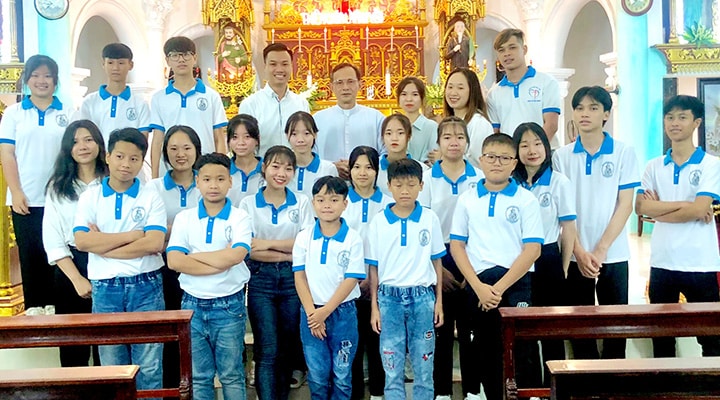
Anh Dao Quoc with young people from his parish to whom he tries to transmit the love of music.

Challenges of a Vietnamese seminarian

Back in his diocese, he is aware of the apostolic needs of his city and his country. Hanoi, the capital of Vietnam, has a population of 8,623,680 inhabitants, of whom only 3.7 % are Catholics. There are approximately 170 priests distributed in 151 parishes.

"This year, our archdiocesan family is entering the Year of Mission and will hold a diocesan synod to reflect on apostolic needs. We will hold symposiums to discuss, share and gather the opinions of all believers, thus givinǵ suitable pastoral orientations to help keep the life of faith renewed and increase communion."

For him, living in a time of social changes and challenges, all Catholics in general are called to live our faith in a more mature way so that we can commit ourselves to a new, more active and effective service to the mission of evangelization.

A Buddhist or non-believing population

According to statistics, Buddhism represents 14% of the population and Catholicism about 7%, while the majority of the inhabitants are non-believers. "It is a fact that the number of Catholics is very low compared to the total population, so the question we should be asking ourselves is, how to make Jesus Christ known in a population of non-believers? St. Paul VI tells us: "Contemporary man listens more willingly to those who bear witness than to those who teach," we recently said to a group of lay people, "or if they listen to those who teach, it is because they bear witness". "EVANGELII NUNTIANDI" n.41.

Witnesses of God

"Each Christian should be a witness to God in his or her own life, and, as St. Josemaría Escrivá taught, each one should sanctify himself or herself in daily life and in his or her work give witness to God's action in his or her life, because people see Christ in us. This is the best way to bring Christ and the Catholic Church closer to those who do not yet know them.

Marta Santín
Journalist specializing in religious information.
Mr. Evarist Guzuye, Chancellor in Tanzania

[et_pb_section fb_built="1" admin_label="section" _builder_version="4.16" da_disable_devices="off|off|off" global_colors_info="{}" da_is_popup="off" da_exit_intent="off" da_has_close="on" da_alt_close="off" da_dark_close="off" da_not_modal="on" da_is_singular="off" da_with_loader="off" da_has_shadow="on"][et_pb_row admin_label="row" _builder_version="4.16" background_size="initial" background_position="top_left" background_repeat="repeat" global_colors_info="{}"][et_pb_column type="4_4" _builder_version="4.16" custom_padding="||||" global_colors_info="{}" custom_padding__hover="||||"][/et_pb_column][/et_pb_row][/et_pb_section]

Paul, a life under the protection of St. Francis of Assisi

Paul Francis has a great devotion to St. Francis of Assisi and lives under his protection and shelter. He tells us about his vocation.

"The story of my vocation has a lot to do with my name. A life that is a miracle and a life under the protection of St. Francis of Assisi. I was born in Villa Elisa, a town in the La Plata district, in the province of Buenos Aires, Argentina. Although it has grown a lot now, when I was a child there were very few houses, it was much smaller. My parents and my whole family is a family of faith. I am the third of six siblings. My mother, Cristina, from whom we all get our faith, my father, Luis, three brothers and three sisters, all very dedicated to the apostolate.

Villa Elisa had a strong Franciscan presence, In fact, the present parish is a former Franciscan convent, which has the St. Francis of Assisi school in front of it, all of which is now run by our congregation".

My life was a miracle

"All the people of Villa Elisa were very devoted to the saint of Assisi. When my mother was pregnant with me, she had a very dangerous pancreatitis and the doctors assured her that she would lose the baby she was expecting. Lhe community prayed especially to St. Francis, and the operation was performed on December 8, the feast of the Immaculate Conception. Thank God, the operation went beyond all expectations and the child, who was me, was completely healthy.

The doctor himself could not explain this event and told my mother that it was a miracle. We also counted on the prayers of my mother's cousin, a priest in Rosario, who from the time the operation began until the day of my birth, celebrated Holy Mass every day praying for me.

I always had the conviction that the Mother of God had preserved me from that moment for her Son and, instead of dying, to live to serve God. Therefore, I am convinced that this miracle was the beginning of my vocation".

A very early vocation

"I must say that the whole family owes it to my mother to have received the faith. She herself converted my father, when we were married, and she knew how to guide all her children well. I started at the age of three at St. Francis School, and from then on I remember that I always wanted to be a priest. priest. Even, which I laugh about now, I remember playing at celebrating Mass in my room... I used a table as an altar, and an old bedside table as a tabernacle.

Thank God, there have always been vocations in my family. At this moment, an uncle of mine, my mother's brother, a priest, was taking a course in this same university. Also a cousin of my mother's, of whom I spoke before, is a priest in Rosario, Argentina.

Although in adolescence this desire to become a priest faded somewhat, now I see that the Lord has always been calling me in the backgroundfrom those first desires of my childhood.

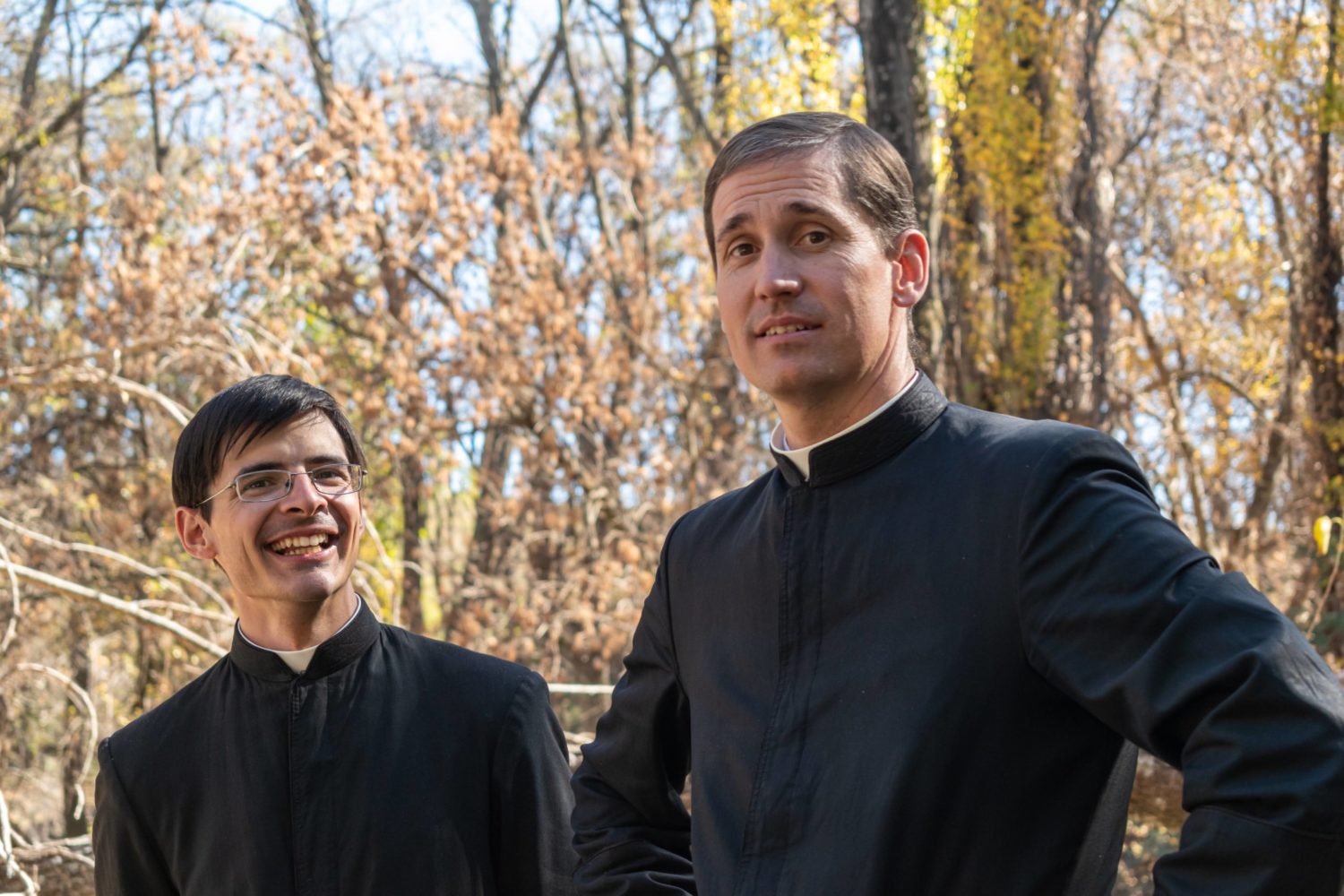
Pablo Francisco Gutiérrez con otro hermano de Miles Christi.

Pablo Francisco Gutiérrez is pictured here with another brother from the Miles Christi congregation. He relates that the story of his vocation has a lot to do with his name. "My life began because of a miracle and has always been under the protection of St. Francis of Assisi."

Towards religious life: the Miles Christi Congregation

"Knowing Miles Christi It was very easy. My house is only a block away from the parish, and since I was a child I have always attended the group called the Southern Cross Hawks, which belongs to Miles Christi. My mother always told us "you have to go to a Catholic group... whichever one you want. But you don't stay here, you have to be formed. Now my brothers and I are very grateful to him for this demand.

I spent my entire childhood and youth at Halcones. I started when I was eight years old, and finished at 17, along with school. There, the leaders and priests strove to instill in us healthy Christian joy, with a solid life of piety and strong bonds of good friendships. Thanks to this group, I came closer to the congregation, I began to lead a more serious life of piety, with spiritual direction and spiritual exercises that we did annually. And it was there that I received the call of God".

The Spiritual Exercises of St. Ignatius

"In 2013, when I was 15 years old, I made some spiritual exercises, a spiritual retreat of silence, inspired by the method of St. Ignatius. There I saw clearly that God was already calling me as a child, but now, with much greater intensity.

I remember all the questions I asked then... especially why me, what will happen to the people with whom I do apostolate, my friends, etc.? And God Himself took care of answering for me. Deep down I was afraid of what would happen, and I saw that an act of faith and trust in God was necessary. It was an act of faith and trust in God. jumping into the void, giving God a blank check, full of confidence that if I gave myself totally, He would not let Himself be outdone in generosity, and He would take care of everything I was worried about. And, of course, common sense took care of the rest: if I really want my house, my family, friends, etc. so much, it is safer for Him to take care of it".

Volunteering and prayer

"I still had a year left before I could actually enter religious life, so I decided to use that whole year to dedicate myself to the apostolate. I remember that I began to work more in the apostolate at Miles Christi, especially with my friends in the Falcon group.

In addition, with a friend belonging to Halcones, we formed a group with our classmates, about ten people, with whom we went every Thursday to the children's hospital in La Plata, to the Oncology section, to do apostolate with the children with cancer. Then, every Friday, we had a half hour of adoration of the Blessed Sacrament, and then we shared a snack with each other.

"I always had the conviction that the Mother of God had preserved me from that moment for her Son, and, instead of dying, to live to serve God."

Religious formation

"When I finished High School, I was able to enter religious life in Miles Christi, on February 22, 2015. There I did Humanities and Philosophy, in the formation house of Luján, a few kilometers from the shrine of the Virgin of Luján.

Then I made my novitiate there, and culminated with the vows and the taking of the habit, on February 11, 2021, Our Lady of Lourdes, along with the brothers Agustín and Mariano de Miles Christi, who are studying with me at the Pontifical University of the Holy Cross, they too thanks to the support of the CARF Foundation. I had the grace to be part of the congregation and to be accompanied by excellent priests who have supported me all this time, among them Father Gustavo and Father Carlos".

An unforgettable year

"After my vows, I was sent to do my apostolic practices in the province of San Luis, also in Argentina. That year and a half will be unforgettable for me. The Lord filled me with graces, but above all he matured my vocation very much. There I was able to practice the apostolate to which I would dedicate my life for the Lord, and for which I am now studying theology.

San Luis is a poor province, but the people are very close, with a strikingly strong yet simple faith. I was able to work a lot with the Halcones group, which had been founded there two years earlier, in which many young people and children participate.

I also dedicated myself to the young university students, giving talks, organizing camps, etc. A very important point was the organization of missions in the province itself: we would go with the young people to different places, sometimes towns, sometimes chapels in the sierras, where we would walk for a long time on dirt roads in the middle of the sierras to reach some unknown house, where people lived, to pray with them and try to bring them closer to God".

In addition, with young people and adolescents from the groups, we were able to form a polyphonic singing choir and even organized two concerts. Everything always seeking to bring souls to God. But one of the things for which I am most grateful to God is that, after a year there, my former formator, and also a true brother to me, was assigned to my own community, so we shared a few months of hard apostolic work there.

Pablo Francisco Gutiérrez con los jóvenes.

Pablo Francisco Gutiérrez with young people and other Miles Christi brothers.

In Rome!

"The departure to go to Rome to continue my formation was painful, but the Lord wants to complete his work, and I still had to study theology to be ordained. It hurt us all, but, as my formator said in one of the farewells, "if he could do so much good as a brother... much more he will do it as a priest". I remember that I had up to thirteen farewells.

Finally, for all this I thank God, and for giving me this great grace of being able to study theology in the center of our faith, Rome. And I desire with all my heart to be able to respond to this great grace that the Lord gives me with generosity, giving myself fully to the study of the science of God.here at the University of Santa Croce.

For this reason I would also like to thank especially all those who make it possible for me to complete my priestly formation, especially all the brothers and sisters of the CARF Foundation-Roman Academic Center Foundation, and assure you of their presence in my prayers, for providing this very concrete help for our beloved Church in the formation of new priests. And thanks also to the protection of St. Francis of Assisi".

Gerardo Ferrara
BA in History and Political Science, specializing in the Middle East.
Head of the student body of the Pontifical University of the Holy Cross in Rome.

Nieves, benefactress: «It is important to invest in the formation of priests».»

"The idea of contributing financially to the formation of a priest came to me after my father's death. Perpetuating his legacy by using part of what I received in inheritance for something good for others seemed to me to be an excellent option. And I am sure that my father, from heaven, will also like this. As a tribute to him, it is called the "José Soria Scholarship".

Investing in the formation of priests in these times is, if possible, more important than ever. The world needs God. It needs to know of God's infinite love for every man. Men need good advice that will lead them to Him.

Wise and holy priests 

They need to be forgiven by Him when they take wrong steps in life. And for this, good priests, those who are wise and holy, are indispensable. To be able to do my bit by supporting with a scholarship the formation of a priest who lacked the financial means to do so, was what encouraged me to make the donation.

I got to know the work of the CARF Foundation through my friendship with people from the Opus Dei and, although I do not belong to this personal Prelature of the Church, I know firsthand the very good theological and spiritual formation they provide.

formacion-excelente-fundacion-carf-sacerdotes

"The world needs God. That is why investing in the formation of priests in these times is, if anything, more important than ever."

Deogratias Method Nyamwihula belongs to the diocese of Mwanza in Tanzania. He arrived in Rome in 2015 and has played for Sedes Sapientiae, a seminarian soccer team among the most formidable in the Clericus Cup. The Clericus Cup is the World Cup for priests and seminarians. "I have always played soccer in my country. Without shoes, on very hard ground. I had so many friends thanks to soccer. A match is like calling a friend for lunch," he says. 

"I have considered him a son from the very first moment." 

When I contacted CARF, they told me about Deogratias from Tanzania, who studied at the Pontifical University of the Holy Cross in Rome. I thought it would be an excellent opportunity to contribute to his formation, because the great spiritual work that I have no doubt he will do, would remain in a continent as needy as Africa. Although it took me some time to get to know him personally, I have considered him as my son from the very first moment and I pray every day that he will be a good priest.

I would like to encourage all readers who have the financial means to make donations (personally or through your company) to train people with priestly vocation from countries with scarce economic resources. The good that a good priest does is like the stone dropped into the lake whose ripple spreads and reaches far and wide. God does not allow himself to be outdone in generosity, so there is no doubt that we come out ahead. 

"God does not allow himself to be outdone in generosity so, no doubt, we come out ahead." 

Deogratias Method Nyamwihula was born on July 4, 1990 and belongs to the diocese of Mwanza in Tanzania. He studied at the Pontifical University of the Holy Cross in Rome in order to be able to serve pastorally in his diocese and help in the evangelization of Tanzania. He is the third of six brothers.

The call of God's love 

Deogratias Method Nyamwihula belongs to the diocese of Mwanza in Tanzania. He is trained at the Pontifical University of the Holy Cross in Rome in order to be able to serve pastorally in his diocese and help in the evangelization of Tanzania.

Deogratias grew up in a very Christian family. His first name "predestined him to the priesthood," he says. Another of his brothers is named Melchior. 

“As I grew up, it became a love story and I had this priestly vocation. When I was 17, I felt the call of God's love to the priesthood and I began to prepare myself to understand what God wanted for my life,” he explains.

About soccer, another of his great passions, he says: “The goal is not to win, but to create friendships. And if we are all here, it is by faith. That is the victory: to win in Christian virtues".


Buy baby clothes and support the formation of priests

Buy clothes and help priests

Carmen, Rosana, Maite, Marta, María José, Amparo, Pupe, Elena, Lola and Isabel are the group of volunteers coordinating the Board of Trustees of Social Action (PAS) of the CARF Foundation. The entity aims to complement CARF's activity of serving the Church and priests. The money they raise, from the many activities they carry out, helps to carry out various initiatives. One of the most successful activities is called Teje que teje: "The team of volunteers weaves baby clothes that we sell through our weekly flea market and the large biannual flea markets that we organize at PAS. We also do commissioned work for individuals and companies - let us know what you need," explains Maite, the coordinator.

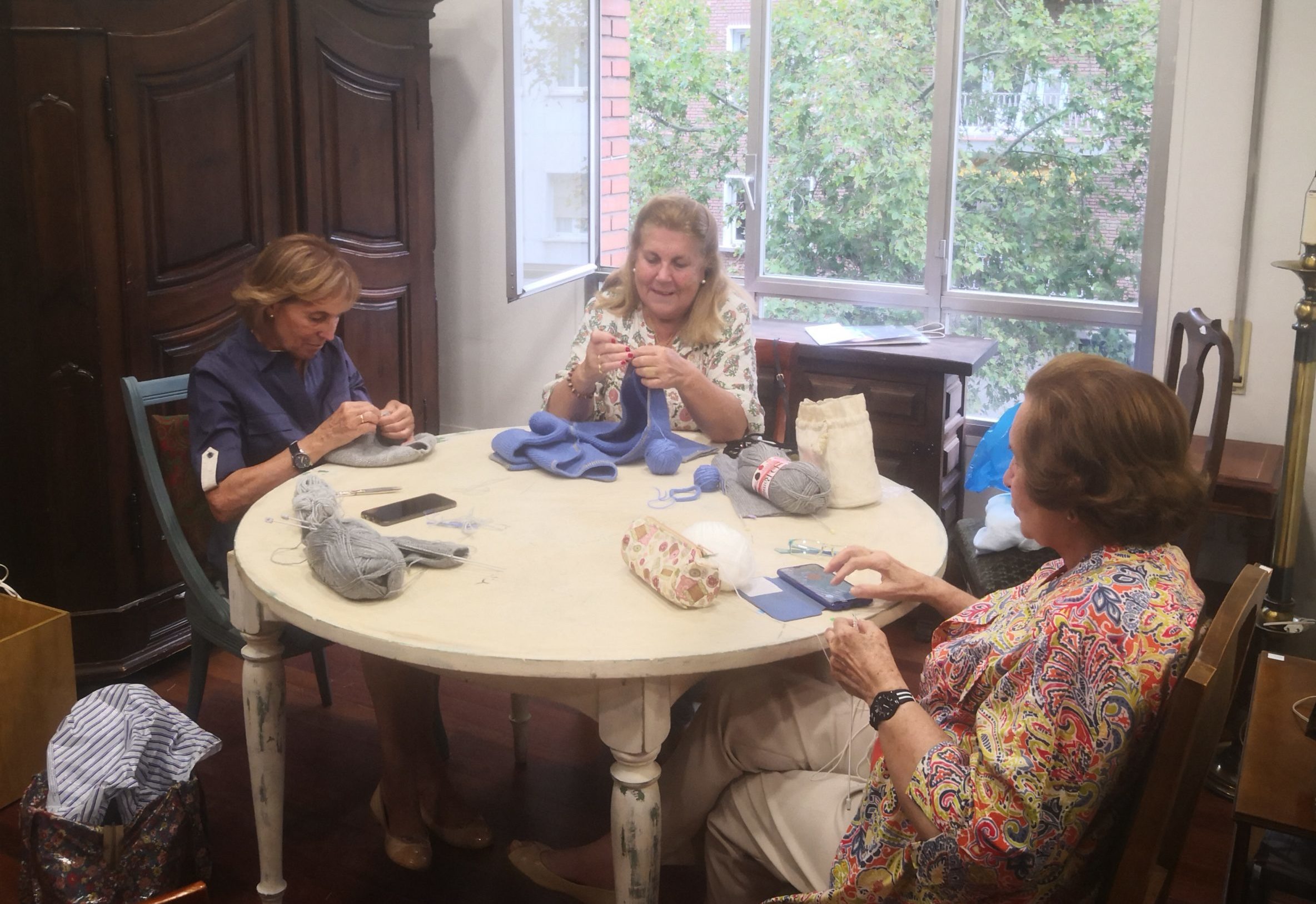
Three of the volunteers who knit every Thursday are María Teresa, Lourdes and Rosa. They knit clothes for babies and children. Booties, hoods, sweaters, diaper covers, frocks, rattles, blankets, Austrian jackets... everything for babies. "Now, many grandmothers order their grandchildren's trousseau from us, and the money raised goes to the needs of priests and seminarians," they explain.

Little experience but a lot of illusion

These three volunteers have been knitting baby and children's clothing for four years. All three are retired: one is a nurse, one a teacher and one a writer by hobby. This activity brings together approximately 10 ladies every Thursday. "What is most successful is the set of newborn sweaters, with their booties and hoods," they explain.

To take part in this activity, you don't need to be a knitting expert, you just need to be enthusiastic and have a minimum of experience. "Between Maite and Maritere, who is the one who started this activity, they have taught us a lot about how to finish off the clothes. We are delighted to contribute to this activity and to be able to to help the seminarians and priests of the CARF Foundation".they say.

Rosa, Lourdes y María Teresa, voluntarias del PAS.

In the picture we see Rosa, Lourdes and Maria Teresa, three volunteers of the CARF Foundation who meet every Thursday to knit baby clothes to help the formation of priests and seminarians. The money raised goes to the scholarships granted by the Foundation, or to other needs of the priests in their home dioceses. "We, delighted to contribute with this activity to help CARF seminarians and priests," they say.

Sacred Vessel Cases

The money they raise from the many activities they carry out helps to carry out various initiatives. For example, the endowment of vestments and liturgical objects to newly ordained priests through the Sacred Vessel Case (backpack). Every year at the Bidasoa International Seminar in Pamplona, a very special meeting is organized between volunteers and benefactors and friends of the CARF Foundation. in which this backpack is given to each seminarian who returns to his diocese to be ordained a priest.

This family day always ends with a long-awaited moment: the PAS managers backpacks delivered to the 25 seminarians The students are returning to their countries of origin, where they will be ordained after an intense period of formation in the Ecclesiastical Faculties of the University of Navarra.

Very grateful

PAS activities also help to advance the development of the medical-health needs of priests and seminarians displaced from their countries of origin, as well as care and assistance to elderly priests who are unaccompanied.

In addition, they contribute to financing material support for various tasks in parishes in needy countries.

"Now, many grandmothers order their grandchildren's trousseau, baby clothes, and all money raised goes to the needs of priests and seminarians of the CARF Foundation."

Restoration of furniture, flea market, albs for priests...

Some of the activities they perform are the following:

  • Furniture restoration: "We collect donations of furniture and antiques that we restore and then sell," says Carmen the coordinator.
  • Sewing and singing: "Our volunteer team sews and embroiders the albs and liturgical linens. They are then delivered, along with the Holy Vessel Cases, to each seminarian who completes his formation and returns to his diocese to be ordained a priest. We need many hands and a lot of enthusiasm", Elena and Guadalupe point out.
  • Solidarity MarketOur volunteers sell all the donations (clothes, household goods, decorative objects, etc.) that come to us to raise funds to finance the formation of priests and seminarians of the CARF Foundation," explain María José and Marta.

They also organize snacks with solidarity gatherings with a priest or seminarian. If you want to be a PAS volunteer, find out more at this link, through this email, patronatodeaccionsocial@gmail.comor call Rosana, 659 057 320 or Carmen, 659 378 901.

Marta Santín,  Journalist specializing in religious information