What is Baptism and what is its symbolism?

The sacrament of baptism signifies and accomplishes death to sin and entrance into the life of the Blessed Trinity through configuration to the paschal mystery of Christ. In the Latin Church, the minister pours water three times over the head of the candidate and pronounces: “I baptize you in the name of the Father, and of the Son and of the Holy Spirit”.

Thanks to Baptism, we are purified of original sin and become part of the Church and the mystical body of Christ. Once we have received the sacrament of Baptism, we have access to the other sacraments and begin to embark on the path of the Spirit. Purified by God's unconditional forgiveness, we become, to all intents and purposes, his children.

«It frees us from sin and makes us children of God. (...) We renew and confirm our own Baptism, the sacrament that makes us Christians, freeing us from sin and transforming us into children of God, by the power of his Spirit of life. (...) It introduces us all into the Church, which is the people of God, made up of men and women of every nation and culture, regenerated by his Spirit.», Pope Leo XIV, on the Feast of the Baptism of the Lord 2026.

What is Baptism?

Holy Baptism is the foundation of the whole Christian life, the portico of life in the spirit and the door that opens access to the other sacraments. Through baptism we are freed from sin and regenerated as children of God, we become members of Christ and are incorporated into the Church and made sharers in her mission. Catechism of the Catholic Church, no. 1213
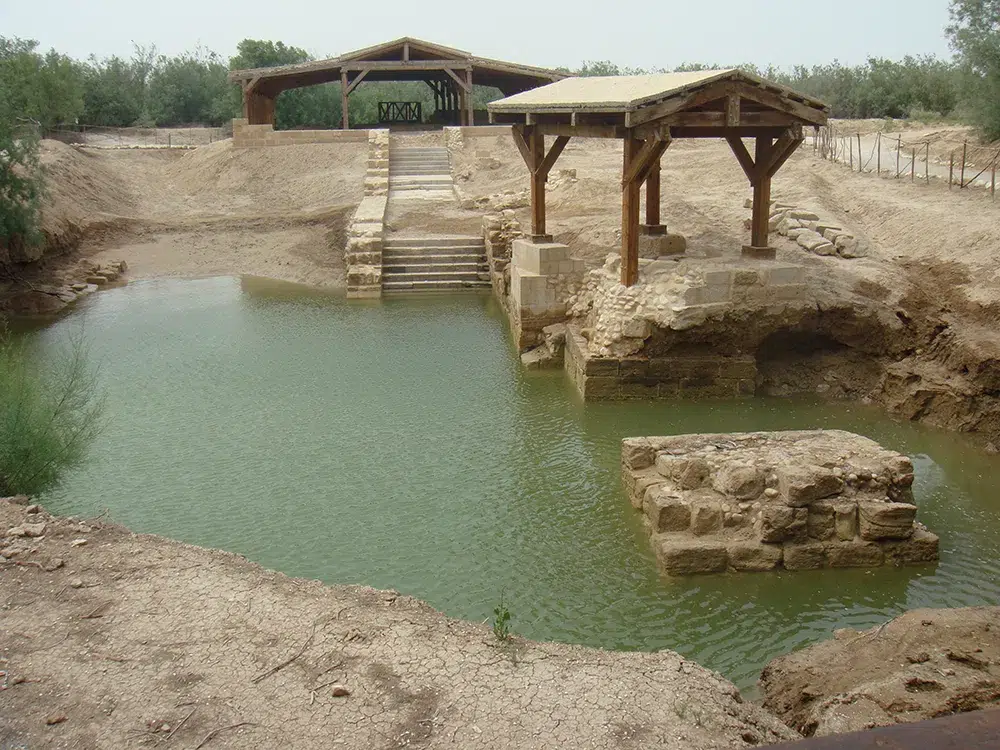
Río Jordan Betania  Bautismo Cristo
Al-Maghtas, The site where John supposedly baptized Jesus Christ east of the Jordan River.

Brief history of the sacrament

The word baptism comes from the Greek βάπτισμα, baptisma, “immersion". That's exactly what it is, an immersion in purifying water.

The symbology of the water and its saving powerin the Old Testament, it was considered to be instrument of God's will. It happened in the Flood, and in the passage of the Red Sea by Moses and the chosen people to flee Egypt. Also in the baptism of St. John the Baptist, which is the closest thing to the sacrament of Baptism as we know it today.

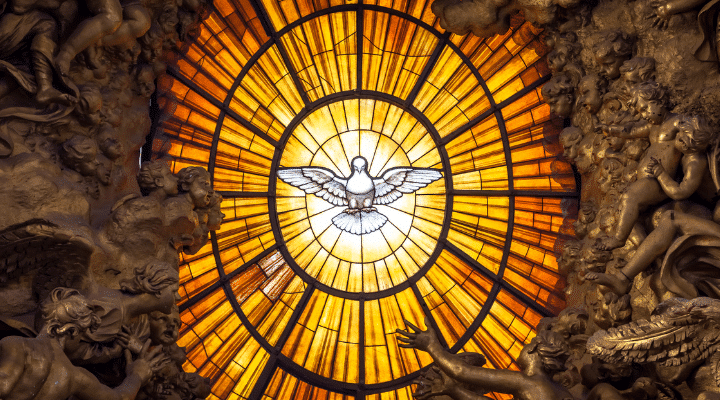
Jesus came to John to receive Baptism; he truly accepts his own destiny. Coming up out of the water, Jesus sees the heavens open and the Holy Spirit appear in the form of a dove, while from heaven a voice is heard: «You are my beloved Son, my beloved.

The Holy Spirit descends upon him, investing him in his role, transforming him into the Lamb of God. It is the beginning of a new life and the premonition of death, which will lead to the Resurrection. The destiny of a man and of all mankind is achieved on the banks of the Jordan.

From the day of Pentecost, baptism of fire of the Holy Spirit or descent of the Holy Spirit on the Apostles, fifty days after the Resurrection of Jesus, begins the mission of the Apostles and the beginning of the Christian Church.

From this moment on Peter and the other disciples begin to preach the need to repent of their sins and receive Baptism in order to obtain forgiveness and the gift of the Holy Spirit.

"We Christians live in the world and are not exempt from darkness and gloom. However, the grace of Christ received in Baptism brings us out of the night and into the light of day. The most beautiful exhortation we can make to one another is to remind ourselves of our baptism, because through it we have been born for God, being new creatures." Pope Francis, General Audience August 2017.

Why was Jesus baptized?

Jesus begins his public life after being baptized by John the Baptist in the Jordan and, after his Resurrection, he confers this mission to his Apostles: «Go therefore and make disciples of all nations, baptizing them in the name of the Father and of the Son and of the Holy Spirit, and teaching them to observe all that I have commanded you».

Our Lord willingly submitted to the baptism of St. John where the Spirit descended upon Him, and the Father manifested Jesus as His beloved Son.

With his Death and Resurrection, Christ opened to all men the fountains of grace. Therefore, the baptism of the Church erases original sin and makes us children of God. Catechism of the Catholic Church, nn. 1223, 1224, 1225.

Since when have you been baptized in the Church?

Since the day of Pentecost the Church has celebrated and administered holy baptism. In fact, St. Peter declared to the crowd moved by his preaching: "Repent [...] and let every one of you be baptized in the name of Jesus Christ for the remission of your sins, and you will receive the gift of the Holy Spirit" (Acts 2:38). The Apostles and their co-workers offer baptism to whoever believes in Jesus: Jews, God-fearing men, pagans.

Baptism is always linked to faith: "Have faith in the Lord Jesus and you will be saved, you and your household," St. Paul declared to his jailer in Philippi. The account in the Acts of the Apostles continues: "the jailer immediately received baptism, he and all his household".

According to the Apostle Paul, through Baptism the believer participates in the death of Christ; he is buried and rises with Him: «Or do you not know that as many of us as were baptized into Christ Jesus were baptized into his death? We were buried with him through baptism into death, so that, just as Christ was raised from the dead through the glory of the Father, we too might live a new life» (Rom 6:3-4).

The baptized have "clothed themselves with Christ". Through the Holy Spirit, baptism is a bath that purifies, sanctifies and justifies. Catechism of the Catholic Church, n. 1226, 1227.

Symbology of Baptism

Baptism, like all the Sacraments, implies the use of sacred elements in order to impart it. Because they are sacred, they are used only for that purpose and must be blessed by the bishop or a priest. There are also symbolic gestures and non-verbal signs that together give light to this precious and indispensable sacrament in the life of a Christian.

There are many symbols of baptism so that we humans are able to imagine what is happening in the soul of the baptized person, which we cannot see with our eyes:

bautismo

Holy water

Water is the central symbol of the sacrament of Baptism.represents the love of God. It is poured on the forehead of the baptized as a source of inexhaustible love. It has the function of purifying, washing the body and soul of sin. Water is also an element universally recognized as a symbol of life.

At the moment the priest pours water three times over the head of the baptized, the faithful are united with Christ both in his death and in his resurrection and glorification.

As Pope Leo explained, «My dear brothers and sisters, God does not look at the world from afar, at the margins of our lives, our afflictions and our hopes. He comes among us with the wisdom of his Word made flesh, making us part of an amazing plan of love for all humanity.

That is why John the Baptist, filled with astonishment, asked Jesus: «And do you come to me» (v. 14). Yes, in his holiness, the Lord is baptized like all sinners, to reveal the infinite mercy of God. The only-begotten Son, in whom we are brothers and sisters, comes indeed to serve and not to dominate, to save and not to condemn. He is the redeeming Christ; he takes upon himself what is ours, including sin, and gives us what is his, that is, the grace of a new and eternal life.» (St. Peter's Square. Sunday, January 11, 2026, Angelus).

Jesus was baptized in the waters of the Jordan at the beginning of his public ministry (cf. Mt. 3:13-17), not out of necessity, but out of redemptive solidarity. On that occasion, water is definitively indicated as the material element of the sacramental sign. «Unless one is born of water and the Spirit, he cannot enter the Kingdom of God» (Jn 3:5).

Light of the paschal candle

In the Old Testament, the Light, was a symbol of faith, With the advent of Jesus, this symbolism has been enriched with new fundamental meanings in the life of the Christian. The light in baptism is a symbol that represents the guide on the path of encounter with Christ which in turn is light in our lives and in the world. It also symbolizes the resurrection of Christ.

Pope Francis said in a general audience: «This light is a treasure that we must preserve and transmit to others. The Christian is called to be a "Christophore," a bearer of Jesus to the world. Through concrete signs, we manifest the presence and love of Jesus to others, especially to those who are going through difficult situations. If we are faithful to our Baptism, we will spread the light of God's hope and transmit reasons for life to future generations».

Chrism, holy oil or oil of the catechumens

Holy oil is a perfumed and consecrated oil used in the sacrament of Baptism. The anointing with chrism oil symbolizes the full diffusion of grace.. The priest uses the oil to trace a cross on the chest and another between the shoulder blades of the baptized person. He can also use it to anoint the head, stamping it with a seal that consecrates it to its new role.

All this symbolizes strength in the fight against temptations, a kind of shield against sin. The purpose of this symbol of baptism is to consecrate the entrance of the Christian into the great family of the church by symbolizing the gift of the Holy Spirit.

It is also used in the sacrament of confirmation, priestly ordination and anointing of the faithful. patients. The Holy Oil is blessed once a year by the bishop during the Chrism Mass on Holy Thursday.

"Moreover, the heavens are opened, the Spirit descends in the form of a dove, and the voice of God the Father confirms the divine filiation of Christ: events that reveal in the Head of the future Church what will later be sacramentally realized in her members." (Jn 3:5)

The white garment

The white garment symbolizes that the baptized person has "put on Christ" (Galatians 3:27): he has risen with Christ.

The purity of the soul without stain, symbolized by the white garment, after the sacrament of Baptism, the profound change and inner renewal that the sacrament has brought to those who have received it. White is a symbol of a new life, the new dignity that covers the baptized. In ancient times, those who were to be baptized wore a new white robe before joining the other faithful in the Church.

«In baptism, our Father God has taken possession of our lives, has incorporated us into Christ's and has sent us the Holy Spirit. The Lord, Holy Scripture tells us, has saved us by making us reborn through baptism, renewing us by the Holy Spirit, whom He has poured out upon us abundantly through Jesus Christ our Savior, so that, justified by grace, we may become heirs of eternal life according to the hope that we have.». Item 128. It is Christ who passes, in the chapter The Great Unknown, Saint Josemaría Escrivá.

The four gifts of the sacrament of Baptism:


Four steps of the sacrament of Confession

"Jesus Christ our Lord, our God, instituted the sacraments, which are like the footprints of his footsteps, so that we may tread there and reach Heaven. And one of the most beautiful and consoling sacraments is the sacrament of Confession", St. Josemaría Escrivá, Argentina, June 15, 1974.

St. Josemaría quoted and here we show you what he said about the sacrament as a marvel of God's love.

Sacrament of Confession

Christ instituted this sacrament offering us a new possibility to convert and to recover, after Baptism, the grace of God.

«The sacrament of Reconciliation is a sacrament of healing. When I go to confession, it is to heal myself, to heal my soul, to heal my heart, and to heal something I did that is not working well.», Pope Francis, General Audience, February 19, 2014.

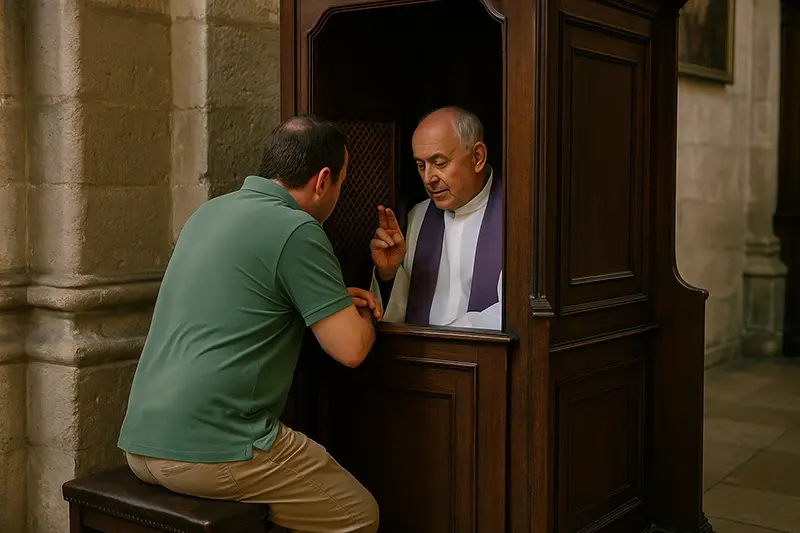
Like all the sacraments, this is an encounter with Jesus. During Confession, we tell our sins to Jesus. priest who acts in the person of Christ and with the authority of Jesus to listen, offer guidance, provide adequate penance and pronounce the words of absolution.

"At the celebration of the In the Sacrament of Reconciliation, the priest does not represent God alone, but to the whole Community, which recognizes itself in the fragility of each of its members, which listens to their repentance, which is moved, which is reconciled with Him, which encourages and accompanies them on the path of conversion and of human and Christian maturity.

Someone may say: "I confess only to God". Yes, you can say to God: "forgive me", and tell him your sins. But our sins are also against our brothers, against the Church, and for this reason it is necessary to ask forgiveness from the Church and our brothers, in the person of the priestPope Francis, Catechesis of Wednesday, February 19, 2013.

St. Josemaría used to call Confession the sacrament of joy, because through it one recovers the joy and peace that friendship with God brings.

examen confesión sacramento examen sacerdote pasos
Moment of Confession, sign of God's forgiveness and mercy.

Importance of Confession

This sacrament not only restores our relationship as sons and daughters of God, but also reconciles us to each other by remaking our union with the Body of Christ, his Church.

Pope Francis explained the importance of confession with these words: "The forgiveness of our sins is not something we can give ourselves. I cannot say: I forgive myself my sins. Forgiveness is asked for, it is asked of another, and in Confession we ask Jesus for forgiveness. Forgiveness is not the fruit of our efforts, but it is a gift, a gift of the Holy Spirit".

There are several details that we can take into account to do it in a deeper and more effective way.

For example, we can help ourselves with a guide with the necessary keys for a good examination of conscience. It is the moment to be sincere with oneself and with God, knowing that He does not want our past sins to oppress us, but that He wants to free us from them so that we can live as His good children.

sacramento confesión examen
Alvaro del Portillo gives absolution to St. Josemaría.

Steps for a good Confession

The Catechism of the Church proposes four steps for a good confession. These express the path to conversion, which goes from the analysis of our actions to the action that demonstrates the change that has taken place in us.

There are four steps we take to be able to receive the great embrace of love that God, our Father, wants to give us with this sacrament: "God waits for us, like the father in the parable, with outstretched arms, even if we do not deserve it. Our debt does not matter. As in the case of the prodigal son, we need only open our hearts" (St. Josemaría, Christ Is Passing By, no. 64).

1st Examination of conscience

In the examination of conscience we try to examine our soul in prayer before God, in the light of the teachings of the Church, starting from our last confession.

We reflect on those actions, thoughts or words that may have distanced us from God, offended others or harmed us internally.

There are several details that we can take into account to do it in a deeper and more effective way. For example, we can use a guide with the necessary keys for a good examination of conscience. 

It is the moment to be sincere with oneself and with God, knowing that He does not want our past sins to oppress us, but that He wants to free us from them so that we can live as His good children.

2º Contrition and resolution not to sin again.

Contrition or repentance, is a gift from God. It is a sorrow of the soul and a rejection of our sins, which includes the resolution not to sin again.

Confession consists of telling sins to the priest. Sometimes, repentance comes with an intense feeling of pain or shame, which helps us to make amends. But this feeling is not indispensable. The important thing is to understand that we have done wrong and to have the desire to improve as Christians. Otherwise, we will put ourselves in God's hands to ask Him to work in our hearts to reject evil.

"Contrition," the Pope explains, "is the portico of repentance, it is that privileged path that leads to the heart of God, who welcomes us and offers us another chance, provided that we open ourselves to the truth of penance and allow ourselves to be transformed by his mercy.

3º Confess sins

The priest is an instrument of God. Let us put aside shame or pride, and open our souls in the certainty that it is God who listens to us.

"Confessing to a priest is a way of placing my life in the hands and heart of another, who at that moment acts in the name and on behalf of Jesus. [It is important that I go to the confessional, that I place myself in front of a priest who represents Jesus, that I kneel in front of Mother Church, who is called to distribute the Mercy of God. There is an objectivity in this gesture, in kneeling in front of the priest, which, at that moment, is the process of the grace that comes to me and heals me."Pope Francis. The name of God is mercy, 2016.

Confession consists of telling sins to the priest. It is often said that a good confession has "4 C's":

  • Clear: point out what the specific fault was, without adding excuses.
  • Concrete: say the precise act or thought, do not use generic phrases.
  • Concise: avoid unnecessary explanations or descriptions.
  • Complete: without silencing any serious sin, overcoming shame.
  • Confession is a sacrament, the celebration of which includes certain gestures and words on the part of the penitent and the priest. the most beautiful moment of the sacrament of Confession, for we receive God's forgiveness.

    4º Fulfill the penance

    Penance is a simple act that represents our reparation for the fault we have committed. It is also a good occasion to thank God for the forgiveness we have received, and to renew our resolution not to sin again.


    Bibliography


    What is the sacrament of Confirmation?

    Confirmation unites the Church more intimately and enriches it with a special strength of the Holy Spirit, and thus those who receive it are obliged to spread and defend the faith through word and deed, as true witnesses of Christ.Catechism of the Catholic Church, 1285.

    Why do we receive Confirmation?

    The Sacrament of Confirmation, together with the sacrament of the Baptism and the sacrament of the Eucharist make up the whole of the the sacraments of Christian initiation. These are sacraments whose reception is necessary for the fullness of the grace we receive and are intended for all Christians, not just a select few.

    It is conferred when the candidate has reached the use of reason, there is no obligatory age, but its character of initiation must be taken into account. To receive Confirmation, prior instruction, a true intention and the state of grace are required.

    The term indicates that this sacrament ratifies the baptismal graceIt strengthens our relationship with the Church and gives us a special strength from the Holy Spirit to defend the faith and confess the name of Christ.

    sacramento-confirmación-espiritu-santo-fundacion-carf

    The power of the Holy Spirit

    Confirmation, like Baptism, imprints on the Christian's soul a spiritual sign or indelible character; this is why this sacrament can only be received once in a lifetime. Catechism of the Catholic Church, 1302-1305.

    Like every sacrament, Confirmation is the work of God, who is concerned that our life be shaped in the image of his Son, to make us capable of loving like him, infusing us with the Holy Spirit.

    This Spirit acts with his power in us, in the whole person throughout life. When we welcome him into our hearts, Christ himself becomes present and takes shape in our lives.

    What are the effects?

    The effect of the sacrament of Confirmation is the special outpouring of the Holy Spirit, as it was once granted to the Apostles on the day of Pentecost. Pope Francis tells us that it is the Spirit who moves us to come out of our selfishness and to be a gift to others.

    For this reason, Confirmation confers growth and depth to baptismal grace

    Who can receive it?

    "Confirmation is received only once, but its spiritual strength is sustained over time and encourages spiritual growth with others." Pope Francis.

    Every baptized person, not yet confirmed, can and should receive the sacrament of Confirmation. The sacraments of Baptism, Confirmation and Eucharist form a unity, therefore, the faithful have the obligation to receive this sacrament in a timely manner, for Without Confirmation and the Eucharist, the sacrament of Baptism is certainly valid and efficacious, but Christian initiation remains incomplete.

    In other cultures this sacrament is administered immediately after Baptism and is followed by participation in the Eucharist, a tradition that emphasizes the unity of the three sacraments of Christian initiation.

    In the Latin Church this sacrament is administered when "the age of reason" has been reached. However, in danger of death, children must be confirmed even if they have not yet reached the age of reason.

    There is a preparation for the sacrament that helps to feel part of the Church of Jesus Christ. Each parish is responsible for the preparation of the confirmands.

    To receive Confirmation it is necessary to be in a state of grace. It is advisable to go to confession and make a good examination of conscience before the sacrament. In this way, to be purified in attention to the gift of the Holy Spirit.

    It is necessary to prepare oneself with a more intense prayer to the Holy Spirit in order to receive his strength and graces with docility and availability. For Confirmation, as for Baptism, it is advisable that the candidates seek the spiritual help of a sponsor.

    Sacrament Liturgy

    "It is necessary to receive the Holy Spirit in recollection and prayer." Pope Francis.

    The rite has several liturgical gestures that express the depth of this sacrament of Christian initiation. Before receiving the anointing that confirms and reinforces the grace of baptism, the candidates are called to renew the baptismal promises and make profession of faith.

    After a prayerful silence, the Bishop extends his hands over the confirmands and invokes the outpouring of the Spirit upon them. The Spirit enriches the members of the Church with his gifts, thus building unity in diversity.

    Ensenanzas-papa-leon-XIV-confirmación-sacramento

    Consecration of Holy Chrism

    It is an important moment that precedes the celebration, but in a certain way is part of it, is the consecration of the holy chrism.

    It is the bishop who, on Ash Wednesday, during the Chrism Mass, consecrates the holy chrism for his entire diocese. The holy chrism is composed of olive oil and balsam and the anointing of the confirmandi with it is a sign of his consecration.

    With the renewal of the promises of Baptism and the profession of faith by the confirmands, the liturgy of the sacrament begins. The Bishop extends his hands over all the confirmands, a gesture which, since the time of the Apostles, is the sign of the gift of the Spirit. The bishop thus invokes the outpouring of the Spirit:

    "Almighty God, Father of our Lord Jesus Christ, who didst regenerate, by water and the Holy Ghost, these thy servants, and didst deliver them from sin: hear our prayer and send upon them the Holy Spirit the Paraclete; fill them with the spirit of wisdom and understanding, with the spirit of counsel and might, with the spirit of knowledge and godliness; and fill them with the spirit of thy holy fear. Through Jesus Christ our Lord."Ritual, 25.

    Anointing with oil

    Through the anointing with oil on the forehead, the confirmand receives "the mark", the seal of the Holy Spirit.. The anointing of the holy chrism after a sacrament is the sign of a consecration. A visible sign of the invisible gift we are receiving.

    Those who are anointed participate more fully in the mission of Jesus Christ and in the fullness of the Holy Spirit that he possesses, so that their whole life may give off Christ. the anointing of the perfumed oil or chrism, which indicates how the Spirit enters into the deepest part of us, beautifying us with so many charisms.

    Thus, the sacrament is conferred with the anointing of the holy chrism on the forehead and pronouncing these words: "Receive by this sign the gift of the Holy Spirit". An indelible character that configures us more fully to Jesus and gives us the grace to spread the good odor of Christ throughout the world.

    "Receive by this sign the gift of the Holy Spirit."Paul VI, Apostolic Const. Divinae consortium naturae.

    Kiss of peace

    It concludes the rite of the sacrament. It signifies and manifests ecclesial communion with the bishop and with all the faithful. This incorporation into the ecclesial community is manifested in the sign of peace with which the rite concludes. The Bishop says to each confirmand: "Peace be with you".

    These words remind us of Jesus' greeting to his disciples on Easter night and express the union with the Pastor of that particular church and with all the faithful. Moment that we remember during the

    "Apostle is the Christian who feels grafted into Christ, identified with Christ, by Baptism; enabled to fight for Christ, by Confirmation; called to serve God by his action in the world, by the common priesthood of the faithful, which confers a certain participation in the priesthood of Christ, which - being essentially distinct from that which constitutes the ministerial priesthood - enables one to take part in the worship of the Church, and to help men on their way to God, by the witness of word and example, by prayer and atonement. St. Josemaría Escrivá, Christ Is Passing By, 120.

    Meaning of the sacrament in the Bible

    Thus, it possesses an intrinsic unity with Baptism, although it is not necessarily expressed in the same rite.  With it, the candidate's baptismal patrimony is completed with the supernatural gifts characteristic of Christian maturity.

    In the Old Testament, the prophets announced that the Spirit of the Lord would rest upon the expected Messiah "The Spirit of the Lord Yahweh is upon me, because Yahweh has anointed me. To preach good news to the poor he has sent me." Isaiah 61 1-2

    Then God says to all the people, "I will infuse my spirit in you and cause you to conduct yourselves according to my precepts." Ezekiel 36:27.

    The Baptism of Jesus was the sign that he was the one who was to come, the Messiah, the Son of God. Having been conceived by the work of the Holy Spirit, his whole life and his whole mission are realized in total communion with the Holy Spirit that the Father gives him "without measure".

    At several points in the New Testament, Jesus promised this union with the Spirit. He did so first on the day of Easter and then on the day of Pentecost.

    Filled with the Holy Spirit, the Apostles begin to proclaim the wonders of God and Peter declares that this outpouring of the Spirit is the sign of the messianic times. The Acts of the Apostles recounts that those who believed in the apostolic preaching and were baptized received in turn the gift of the Holy Spirit through the laying on of hands and prayer.

    It is this imposition of hands that has been rightly considered by Catholic tradition as the primitive origin of the sacrament of Confirmation, which perpetuates in the Church the grace of Pentecost.

    "Don't just speak to the Paraclete, hear Him!"St. Josemaría Escrivá.


    Bibliography:

    5 keys to a good examination of conscience for Confession

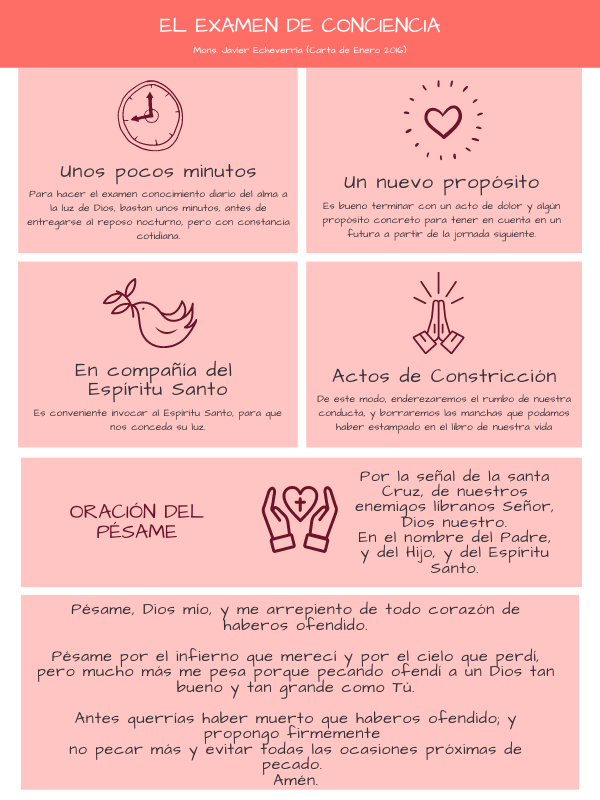
    To seek a remedy for our faults is a task of love. That is why we must take advantage of a very necessary and indispensable means, which is the examination of conscience. Bishop Javier Echevarría.

    What is the examination of conscience for?

    The purpose of the examination is not to be anguished with the faults but to recognize them with sincerity and trust in God to then go to the sacrament of confession, knowing that we will be forgiven. The whole process moves in the infinite mercy of God manifested in Jesus Christ.

    We see our faults in relation to:

    • Ten commandments.
    • Seven deadly sins.
    • Character defects.
    • Gifts that God has given us to serve Him.
    • The responsibilities of our vocation.

    Examination of conscience is a bridge to confession

    At times, it is our own life that seems to go astray as a result of wrong decisions or simply our personal weaknesses. We Christians are fortunate in that we have the possibility of starting over. That possibility exists thanks to the goodness of being able to turn to the sacrament of Forgiveness, to reach the certainty that God forgives us and encourages us to start again.

    How to make a good examination of conscience

    In the first place, the examination is made before God, listening to his voice in the conscience of each one of us.

    Cómo se puede hacer un examen de conciencia confesión
    Recommendations of Bishop Javier Echevarría in 2016.

    Take a few minutes for a daily soul-searching session.

    After that, it only takes a few minutes of daily reflection to look with the soul at the light of God. As St. Josemaría explained, it only takes a few minutes before giving oneself to nightly rest, but with daily constancy.

    Ask for the Holy Spirit's help

    But there are punctual moments, for example, the examination of conscience for confession, where it will be convenient to proceed more carefully. And in all cases, it is convenient to invoke the Holy Spirit, so that he may grant us his light.

    Ending with an act of pain and a purpose for improvement.

    Finally, it is not just a matter of enumerating sins but of discovering the wrong attitude of the heart and with sorrow for our sins, making a firm resolution not to commit them again. It is important to end with an act of sorrow and a concrete resolution for the following day. There are always areas in which we are weaker and require special attention, but if we understand that Christ is the measure, we will see that in everything we have much to grow.

    The examination of conscience proposed by Pope Francis

    Moreover, during Lent 2015, Pope Francis presented the faithful in St. Peter's Square with a special booklet entitled. "Custodian of the heart". It contains important resources for the journey towards Holy Week. It can be downloaded from the link above.

    Among these resources is an examination of conscience of 30 questions posed by the Pope to make a good confession, as well as a brief explanation on why to go to the sacrament of Reconciliation.

    Questions for a good examination of conscience

    We offer a series of questions directed by St. Josemaría Escrivá, which can help in the examination of conscience prior to confession. This version is intended for adults.

    Thou shalt love God above all things....

    • Do I believe all that God has revealed and that the Catholic Church teaches us? Have I doubted or denied the truths of the Catholic faith?
    • Do I reluctantly do the things that refer to God? Do I remember the Lord throughout the day? Do I pray at any time during the day?
    • Have I received the Lord in Holy Communion while having some grave sin on my conscience? Have I kept silent in confession out of shame about some mortal sin?
    • Have I blasphemed, have I sworn unnecessarily or untruthfully, have I practiced superstition or spiritism?
    • Have I missed Mass on Sundays or feast days? Have I observed the days of fasting and abstinence?

    ... and your neighbor as yourself.

    • Do I show respect and affection to my family members, am I attentive and help in the care of my parents or relatives if they need it, am I kind to strangers and do I lack that kindness in family life, am I patient, do I have patience, do I show respect and affection to my family members, am I kind to strangers and do I lack that kindness in family life, am I patient?
    • Do I allow my work to take up time and energies that belong to my family or friends? If I am married, have I strengthened my spouse's authority, avoiding reprimanding, contradicting or arguing with him/her in front of the children?
    • Do I respect human life? Have I cooperated or encouraged anyone to abort, destroy embryos, euthanize or any other means that threatens the life of human beings?
    • Do I wish others well, or do I harbor hatred and make critical judgments? Have I been verbally or physically violent in family, work or other settings? Have I set a bad example to those around me? Do I correct them angrily or unfairly?
    • Have I tried to take care of my health? Have I drunk alcohol to excess? Have I taken drugs? Have I risked my life unjustifiably (by driving, entertainment, etc.)?
    • Have I watched pornographic videos or websites? Do I incite others to do evil?
    • Do I live in chastity? Have I committed impure acts with myself or with others? Have I indulged in impure thoughts, desires or sensations? Do I live with someone as if we were married without being married?
    • If I am married, have I cared for marital fidelity? Do I try to love my spouse above anyone else? Do I put my marriage and my children first? Am I open to new lives?
    • Have I taken money or things that are not mine, and if so, have I made restitution or reparations?
    • Do I try to fulfill my professional duties, am I honest, have I cheated others: overcharging, purposely offering a defective service?
    • Have I spent money for my personal comfort or luxury, forgetting my responsibilities to others and to the Church? Have I neglected the poor or the needy? Am I fulfilling my duties as a citizen?
    • Have I told lies? have I repaired any damage that may have followed? have I, without just cause, discovered serious faults in others? have I spoken or thought ill of others? have I slandered? have I slandered?

    Bibliography:

    What is plenary indulgence and how to obtain it?

    Plenary indulgence is an extraordinary gift of the Catholic Church, which allows for the complete remission of the temporal punishment that remains after sins have been forgiven in the sacrament of confession.

    Since 1983 the Code of Canon Law (can. 992) and the Catechism of the Catholic Church (n. 1471), define indulgence as follows:

    "An indulgence is the remission before God of the temporal punishment for sins, already forgiven, as to guilt, which a faithful willing and fulfilling certain conditions obtains through the mediation of the Church, which, as the administrator of redemption, distributes and applies with authority the treasure of the satisfactions of Christ and the saints."

    St. Josemaría also emphasized the spiritual depth of indulgences when he stated: "indulgences are a manifestation of God's infinite mercy" (The Way, 310).

    Difference between plenary and partial indulgence

    Plenary and partial indulgence are expressions of God's infinite mercy. Although they differ in scope, both encourage us to seek holiness through faith, prayer and works of charity.

    The plenary indulgence is an extraordinary gift, since it completely removes the temporary grief that remains after the sorry of sins in the sacrament of confession. It is an act of love that allows us to present ourselves before God purified free of any stain that keeps us away from His presence.

    On the other hand, the partial leniency remits only a part of this sorrow, but it is no less significant. It is an important step that motivates us to continue advancing in our spiritual journey, offering our prayers, sacrifices and good works as concrete signs of repentance and faith.

    Pope Francis, explained it clearly during his General Audience, March 9, 2016 that. "the plenary indulgence is a gift that helps us to grow closer to God and to live a holier life.". This is why we must remember that plenary indulgences are an invitation to walk towards holiness with hope and trust in divine mercy.

    Every time we have recourse to indulgences, we renew our commitment to conversion, we confirm that God's love is always ready to welcome us and to give us a new opportunity. What greater consolation can we have than to know that, through these practices, we draw closer to the Father's loving heart?

    Requirements to obtain a plenary indulgence

    Pope Benedict XVI, in his Message for Lent 2008, affirmed: "The indulgence cannot be understood as a kind of 'discount' on the punishment due for sin, but as an aid to a more radical conversion". Indulgence is a sincere opportunity to commit ourselves to the path to holiness and to renew our relationship with God.

    1. Sacramental confession: this sacrament allows us to be in a state of grace and to be reconciled with God. In the act of confessionWe find the loving embrace of the Father who is always ready to forgive us.
    2. Eucharistic communion: receive the Eucharist with devotion. As we approach the altar, we find the strength to live in holiness.
    3. Prayer for the Pope's intentions: praying an Our Father and a Hail Mary unites us to the universal Church. This simple act invites us to think beyond our own needs and to pray for the common good.
    4. Total detachment from sin: This step does not demand perfection, but a sincere desire to reject sin, even venial sin. It is a call to examine our heart and to live according to God's will.
    5. Carry out the indulgenced work: for example, pray the Rosary in community, to read Sacred Scripture for at least half an hour or to adore the Blessed Sacrament or carry out works of mercyboth spiritual and corporal.

    Meeting these requirements is a reminder that God's grace is always available to those who seek it in humility and sincerity.

    When can a plenary indulgence be obtained?

    There are particularly significant moments for obtaining plenary indulgences:

    In addition to these specific dates, the Pope may designate other special occasions to obtain indulgences. Each of these opportunities brings us closer to the merciful heart of God and invites us to live our faith.

    Plenary indulgence and medal of St. Benedict

    At specific moments, the Church grants the possibility of gaining plenary indulgences related to the use of the St. Benedict medalThe usual conditions are met: confession, communion, prayer for the Pope's intentions, detachment from sin and the performance of an indulgenced work.

    Among the most notable occasions for gaining a plenary indulgence linked to the medal of St. Benedict are:

    Reverso y anverso de una medalla de San Benito.
    Reverse and obverse of a medal of St. Benedict.

    By knowing the meaning and beauty of the gift of plenary indulgence, we come closer to the infinite mercy of God. In this journey of faith, the work of the CARF Foundation is fundamental, as with your support it trains priests and seminarians for the Catholic Church, who will be the ones to guide and accompany us in our relationship with God. Supporting the CARF Foundation means that more Christians can come closer to God's redeeming grace throughout the world.

    What do we celebrate on All Saints' Day?

    On November 1, Christians celebrate All Saints' Day. On this day the Church remembers all those deceased who, having overcome purgatory, have been totally sanctified and enjoy eternal life in the presence of God.

    All Saints' Day, a Christian Solemnity

    On All Saints' Day, November 1, we look to the sky. It is the day on which all the saints are honored.to those who are on the altars and to so many Christians. To those who are on the altars and to so many Christians who, after a life according to the Gospel, share in the eternal happiness of heaven. They are our intercessors and our models of Christian life.

    "Holiness is the most beautiful face of the Church." writes Pope Francis in "Gaudete et exsultate", his apostolic exhortation on the call to holiness in today's world (March 2018).

    The Pope reminds us that this call is addressed to each one of us. The Lord also addresses you: "Be holy, for I am holy" (Lv 11:45; cf. 1P 1,16). 

    On November 1, we remember each one of those who said yes to this call. This is why All Saints' Day is not only celebrated in honor of the blessed or saints who are on the list of those canonized and for whom the Church celebrates on a special day of the year. honor all those who are not canonized, but are already living in the presence of God.. These souls are already considered saints because they are under the presence of God.

    Día de todos los santos
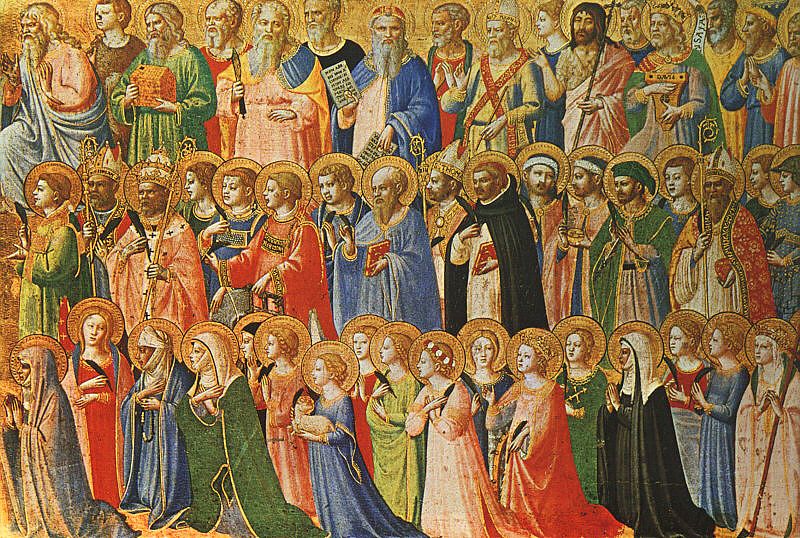
    All Saints, painted by Fra Angelico. Italian painter who knew how to combine the life of a Dominican friar with that of a painter. He was beatified by John Paul II in 1982.

    History of All Saints' Day

    This celebration had its origins in the IV century due to the great number of martyrs of the church. Later on May 13, 610, Pope Boniface IV dedicated the Roman Pantheon to the Christian cult. This is how they began to be celebrated on this date. Later Pope Gregory IV, in the 7th century, moved the feast to November 1st.

    Several thousand saints have been officially canonized by the Catholic Church. But there is an immense number of non-canonized saints, who are already enjoying God in heaven. To these, the non-canonized saints, this feast is especially dedicated. The church seeks to recognize the work of the "unknown saints" who risked their lives for justice and freedom anonymously.

    Difference between All Saints' Day and All Souls' Day

    Pope Francis explained in a very clear way the difference between All Saints' Day and All Souls' Day:

    "On November 1 we celebrate the Solemnity of All Saints. On November 2, the Commemoration of the Faithful Departed. These two celebrations are closely linked to each other, how joy and tears find in Jesus Christ a synthesis that is the foundation of our faith and hope.

    . Indeed, on the one hand, the Church, a pilgrim in history, rejoices through the intercession of the saints and blessed who support her in the mission of proclaiming the Gospel; on the other hand, she, like Jesus, shares the weeping of those who suffer the separation from their loved ones, and like Him and thanks to Him, she makes her thanksgiving resound to the Father who has freed us from the dominion of sin and death".

    "There are many wonderfully holy Christians, there are many wonderfully, delightfully holy mothers of families; there are many wonderful fathers of families. They will occupy in heaven places of wonder." St. Josemaría Escrivá.

    All Saints' Day

    On November 1, the Catholic Church celebrates the Solemnity of All Saints. A feast instituted in honor of each and every saint, known or unknown, for their great work in spreading God's message. Many people attend a special Mass in their honor today.

    On this feast day of All Saints, the Church asks us to look to heaven, which is our future homeland. We remember all those who are already in the presence of God and who are not remembered as canonized saints. There are millions who have already reached the presence of God. Most certainly a majority of them did not arrive in a direct way, perhaps they went through purgatory, but in the end they managed to be in the presence of God.

    As a commentary on the Solemnity of All Saints. "Rejoice and be glad, for your reward will be great in heaven." We were born never to die again, we were born to enjoy God's happiness! The Lord encourages us and wants us to take the path of the Beatitudes to be happy.

    All Souls Day

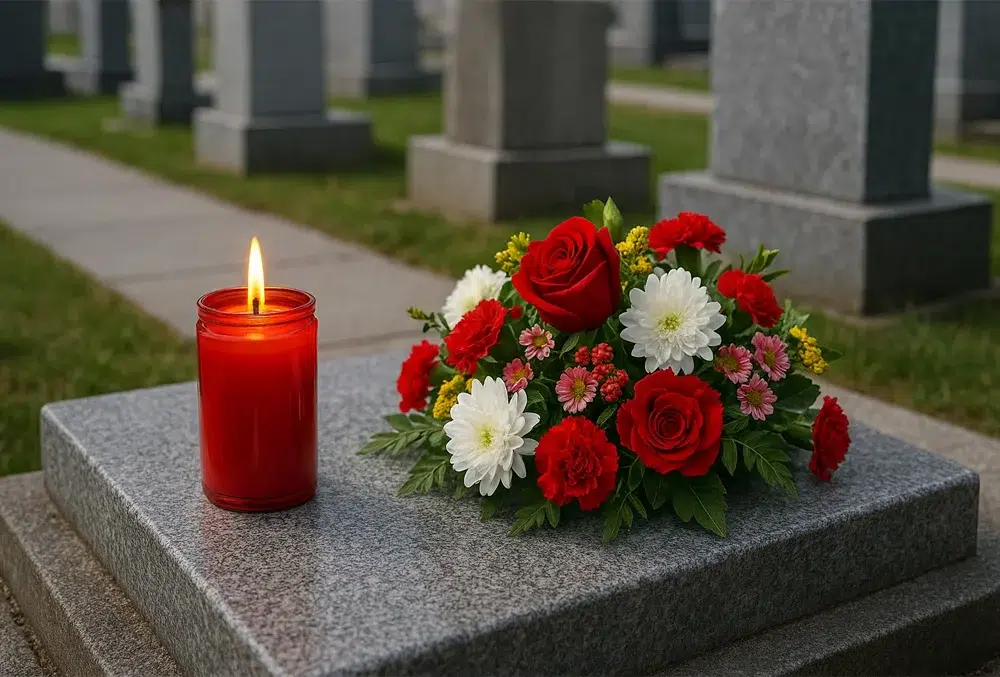
    November 2 is All Souls Day. Although it seems to be the same, it is far from it. First of all, we must keep in mind that the celebration of the dead is a cultural tradition where people remember those who have already died, and altars are dedicated where photos, flowers and the food that the person remembered liked so much in life are placed. According to historians, this tradition is mainly found in Mexico 1,800 years before Christ.

    On this day the Church invites us to pray for all those who have already died but who may not have reached eternal joy. Perhaps they are in purgatory and need our prayers, so we must remember them in the Holy Mass for the dead and pray at all times for their eternal rest.

    You can be a saint

    All the baptized are called to follow Jesus Christ, to live and make known the Gospel. 

    The purpose of Opus Dei is to contribute to the evangelizing mission of the Catholic Church by promoting a life consistent with the faith in the ordinary circumstances of life, especially through the sanctification of work, among the Christian faithful of all walks of life.


    Links of interest: