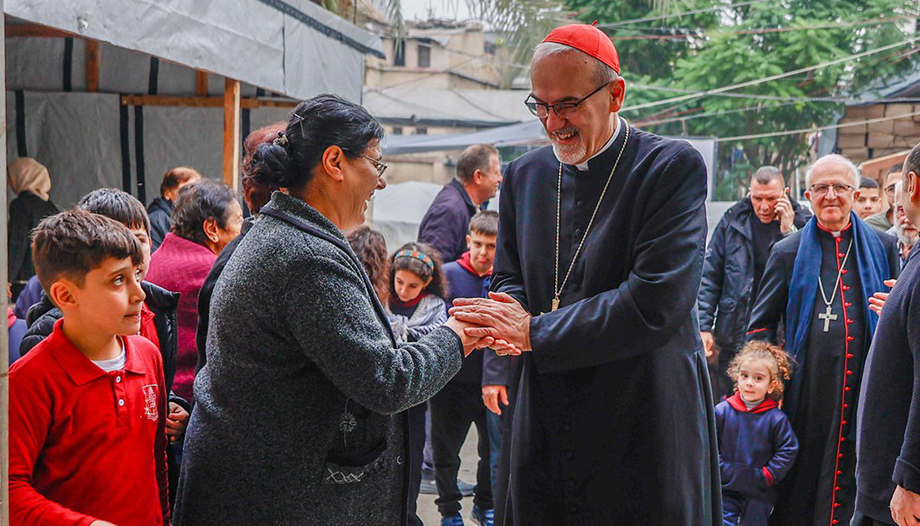
Haitian priest: «in the past, in some communities, they used to go months without the Eucharist».»
The Catholics in Haiti often experience a situation that is surprising in other parts of the world: they are communities of the faithful who spend months without being able to celebrating and living the Eucharist. Hugues Paul, from the diocese of Jacmel, has known this reality since his childhood. However, today in Haiti there are so many priests who can go to other countries on mission.
That experience was decisive in his life. «In these church communities, sometimes almost a year can go by without the celebration of Holy Mass,» he explains.
It was precisely this shortcoming that awakened in him the vocation. He grew up in a small community that in Haiti is known as the chapel, a church attached to a parish where, in the absence of priests, the faithful keep the faith alive with celebrations of the Word led by lay people.
God called him to help as a priest in his vineyard.
«Normally there is a pastoral agent, whom we call the chapel director, in charge of presiding over celebrations of the Word in the absence of the priests». In the midst of this reality, Fr. Hughes Paul felt God's call: «It was in this context that I felt God's call to lend a hand in his vineyard, to help his people to encounter him and to live the faith in a deeper way where the Eucharist was at the center».
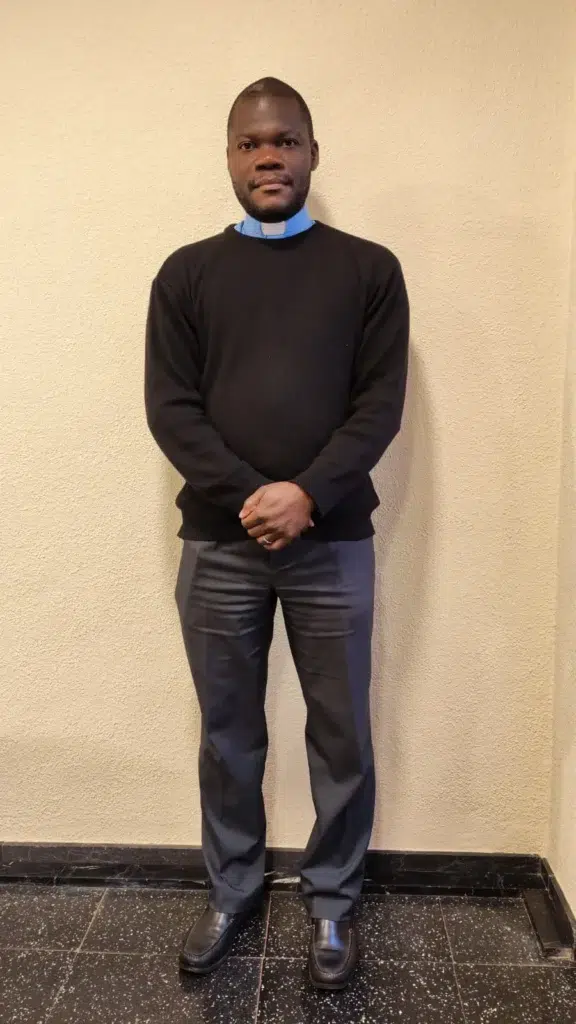
Hugues Paul was ordained priest the June 26, 2021 and now has 39 years old. He comes from a large family with two brothers and five sisters, and is grateful that his parents are still alive.
He received a solid Catholic education at home, although his academic formation took place in Christian centers of other denominations: he studied elementary school in a Catholic school. protestant school and secondary school in a center of the Episcopal Church of the Anglican Communion.
His adolescence was marked by an intense participation in the life of the local Church. «I lived a very joyful and active adolescence, participating in groups and in the chapel choir, until I finally entered the seminary.».
That simple community, where faith was sustained with few resources, but with great conviction, was the place where he matured his priestly vocation.
From a distance, he observes the situation in his country with concern. Haiti is going through a deep crisis marked by violence and insecurity. «Life has become very difficult, especially because of the insecurity that affects almost the entire territory, especially the capital,» he explains.
However, even in the midst of that context, faith remains one of the living force. «Despite this, the people continue to believe: many people take risks to find a place to live their faith and participate in the celebrations.».
The consequences of the great earthquake
The Jacmel diocese, located in the southeast of the country, is in a relatively more stable situation than in other regions, but the consequences of the great earthquake of 2010 remain visible. «We are still awaiting the completion of the reconstruction of the cathedral and many destroyed parishes.".
The lack of sufficient resources and aid has delayed for years these works, which for many communities are essential.
Catholics in Haiti, more than 60 % of the population
The Catholics in Haiti represent between 60 and 66 % of the population. In the diocese of Jacmel there are about 80 priests for 36 parishes, and in the country as a whole - adding the ten dioceses and the religious - it is estimated that there are between 800 and 900 priests. The universal Church has been a fundamental support in these difficult years. «We have received great support from the universal Church, especially through Aid to the Church in Need.».
Spain: the beauty of churches and their secularization
His experience in Spain has also made him reflect on the differences between the two ecclesial realities. What has impressed him most positively is «the beauty of the churches». However, he is concerned to see temples with few young people. «I am struck by the fact that the Church seems to be made up mainly of older people, with very little presence of young people and children in the celebrations».
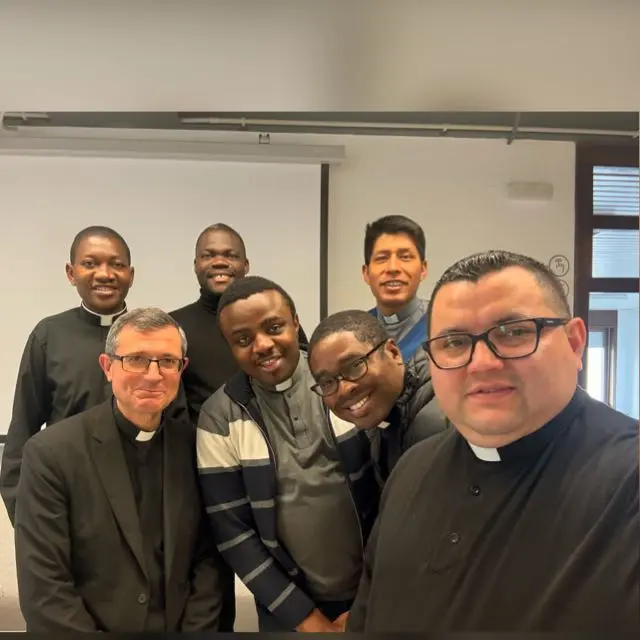
Hugues Paul, together with a group of priests in Bidasoa.
In his opinion, Spanish society is undergoing a profound process of secularization. Even so, he believes that there are also opportunities to revitalize the life of the Church. In particular, he thinks that Spanish Catholics could draw inspiration from the way the liturgy is lived in Haiti. «Spanish Catholics could learn from Haitian Catholics enthusiasm for sung celebrations, The new programs, which help to make them more lively and participative».
Close and consistent with the faith
Looking to the future, Hugues Paul is clear about what kind of priests the Church needs in the 21st century: «to be close, empathetic and coherent with his faith; a good communicator, open to dialogue, sensitive to social problems, with a solid spiritual life and capable of accompanying without judging».
He considers this same attitude essential to approach those who today live far from the faith. «To evangelizing young people and those who are far from God, I consider it fundamental to listen to them with respect, to give testimony with one's own life, to use current language and digital media, to create welcoming spaces and to show that we are all in the same place. faith answers the real questions of today's world».
Hugues Paul's story is a reminder of a reality that often goes unnoticed: in many parts of the world Christians spend many months without Eucharist and await the arrival of a priest to celebrate Holy Mass.
Precisely from this waiting, new vocations are also born, ready to serve. All the members, friends and benefactors of the CARF Foundation pray for them, promote their good name throughout the world and find financial resources so that they can receive an integral formation in Rome and in Pamplona, as in the case of Hugues Paul.
Marta Santínjournalist specializing in religion.
Table of Contents
Lent and God's forgiveness
The Lent is the liturgical season in which the Church invites Christians to pause, look at their lives before God and return to Him with a renewed heart. For forty days a journey of conversion marked by prayer, penance and charity is proposed to us. It is not just an outward change, but a profound call to recognize our fragility and to open ourselves anew to God's mercy.
«You have compassion on all, O Lord, and hate nothing that You have done; You close Your eyes to the sins of men that they may repent and forgive them, for You are our God and Lord» (Ash Wednesday, Entrance Antiphon).
On that day, during the celebration of the Holy Mass, or in a separate ceremony, the faithful who wish to do so, approach the altar so that the priest may impose the ashes on them, while saying: «Remember that you are dust, and to dust you shall return»; or, «Convert and believe the Gospel».
These two phrases do not have a contradictory meaning. They complement each other, and if we know how to put them together, they give us the profound meaning of what the Church wants us to live in this liturgical season: a new Conversion in our Christian living.
With what disposition should we begin to live these days? Josemaría Escrivá, in It is Christ who passes, n. 57, reminds us: «We have entered the season of Lent: a time of penance, purification and conversion. It is not an easy task. Christianity is not a comfortable path. be in the Church and let the years go by. In our life, in the life of Christians, the first conversion - that unique moment, which each of us remembers, in which we clearly perceive all that the Lord asks of us - is important; but even more important, and more difficult, are the successive conversions.
And to facilitate the work of divine grace with these successive conversions, it is necessary to keep the soul young, to invoke the Lord, to know how to listen, to have discovered what is wrong, to ask for forgiveness» (...).
What is the best way to begin Lent?
We renew faith, hope, charity. This is the source of the spirit of penance, of the desire for purification. The Lent is not only an occasion to intensify our external practices of mortification: if we were to think that it is only that, we would miss its deep meaning in the Christian life, because these external acts are -I repeat- the fruit of faith, hope and love.
In order for us to live this willingness to convert, we need to prepare our spirit to listen attentively to, and then put into practice, the lights that the Lord wants to give us during these days of Lent. We can summarize this disposition in three words: sorry y ask for forgiveness.
When blessing the ashes, the priest can say this prayer: «O God, who does not want the death of the sinner, but his repentance, hear with goodness our supplications and deign to bless this ash that we are going to impose on our head; and because we know that we are dust and to dust we shall return, grant us, by means of the Lenten practices, the forgiveness of sins, so that we may attain, in the image of your risen Son, the new life of your Kingdom».
Everything begins by humbly asking the Lord for forgiveness for our sins, for our lack of love for Him and for our lack of love for our neighbor. «If in bringing your offering to the altar you remember that your brother has something against you, leave your offering there before the altar; go first to be reconciled to your brother, and then return to present your offering.» (Mt. 5:23-24)
This request for forgiveness, and the thought of Christ's joy in forgiving us our sins, will move our soul to forgive wholeheartedly the offenses, injustices, mistreatments, insults, and abandonments that we may have received, and not to allow even the slightest seed of hatred, resentment, or revenge to nestle in our hearts.
Forgive as Christ forgives us. In this way we will have the humility of spirit so necessary to live our life in union with Christ, and following in his footsteps, which he pointed out to us with these words: «Learn from me, for I am meek and humble of heart». And asking the Lord for forgiveness in the sacrament of Reconciliation and Confession, as Leo XIV reminded the priests of Madrid:
«Therefore, dear children, celebrate the sacraments with dignity and faith, being aware that what is produced in them is the true strength that builds up the Church and that they are the ultimate goal to which our whole ministry is ordered. But do not forget that you are not the source, but the channel, and that you also need to drink from that water. Therefore, do not cease to confess yourselves, to return always to the mercy that you proclaim».
Lenten Messages
In many Lenten messages, the Popes remind us of the three classic works recommended by saints and spiritual doctors to live Lent well: «prayer, fasting, almsgiving, and almsgiving.".
«Lent is a propitious time to intensify the life of the spirit through the holy means that the Church offers us: fasting, prayer and almsgiving. At the basis of everything is the Word of God, which at this time invites us to listen to and meditate on more frequently.» (Francis, Lenten Message, 2017).
By forgiving and asking for forgiveness, our prayer will reach heaven; our fasting will lead us not to seek ourselves in our actions, and to want to give glory to God in everything we do; and our almsgiving will be to accompany the needy, to encourage sinners to repent.
Our prayer is a deep manifestation of Faith that springs from the depths of our soul. Faith that leads us to have full confidence in Christ, to unite ourselves with Him in His Life, to know Him better, and thus, we will have the joy of quenching His thirst. And it opens our hearts to love the Lord with all our strength, and with the best of ourselves.
Our fasting leads us to detach ourselves from ourselves, to seek only the glory of God in all our actions, not to think always of ourselves and not to dwell on useless worries or memories. Fasting from ourselves and our interests will elevate our heart, our soul to hunger to love Christ, to live with Him, and truly nourish ourselves on his Word, and say to him with St. Peter: «You have the words of eternal life» (Jn. 6:68). And we will renew our Hope in the Lord, who opens for us the horizon of Eternal Life.
In his Lenten Message, Leo XIV suggests us to live an abstinence that can do great good to our spirit:
«For this reason, I would like to invite you to a very concrete and often underappreciated form of abstinence, namely, that of refrain from using words that affect and hurt our neighbor. Let us begin to disarm language, renouncing hurtful words, immediate judgment, speaking ill of those who are absent and cannot defend themselves, and slander.
Let us strive, instead, to learn to measure words and cultivate kindness: in the family, among friends, in the workplace, in social networks, in political debates, in the media and in Christian communities. Then, many words of hatred will give way to words of hope and peace.».
Our almsgiving will lead us to be generous in serving others and thus follow in the footsteps of Christ who told us «The Son of Man did not come to be served but to serve, and to give his life as a ransom for many» (Mt. 20:28). We have many people around us who, besides needing material help in some cases, need our affection, our understanding, our company. And our Charity will purify our spirit, adoring Jesus in the Blessed Sacrament of the Altar: the deepest alms of love that we offer to God.
By living prayer, fasting and almsgiving, we are accompanying Christ in the temptations in the desert, with our Faith, with our Hope and with our Charity.
With our Faith uniting us to his response to the devil in the first temptation: «Man does not live by bread alone, but by every word that proceeds from the mouth of God» (Mt. 4:4). Faith that helps us to discover his loving heart in all the difficulties - in all the stones we may encounter on our path - and to carry with him our daily cross. He is, and will always be, our Bread.
By fasting from ourselves, and feeding on His Bread, we will revive our Hope in the Incarnation of Our Lord Jesus Christ, and we will not tempt God by asking Him to do extraordinary things to dazzle us, and force us, in some way, to follow Him, as the devil tried to do in the second temptation. We will unite our sorrows, sacrifices and sufferings in life and in our daily work, to those that He lives in His eagerness to redeem us from sin.
And we will do it without drawing attention to ourselves, in the silence of our soul, in the secret of our heart, as he reminded us: «When you help, do not pretend to be sad as the hypocrites, who disfigure their faces so that people may see that they are fasting» (Mt 6:16).
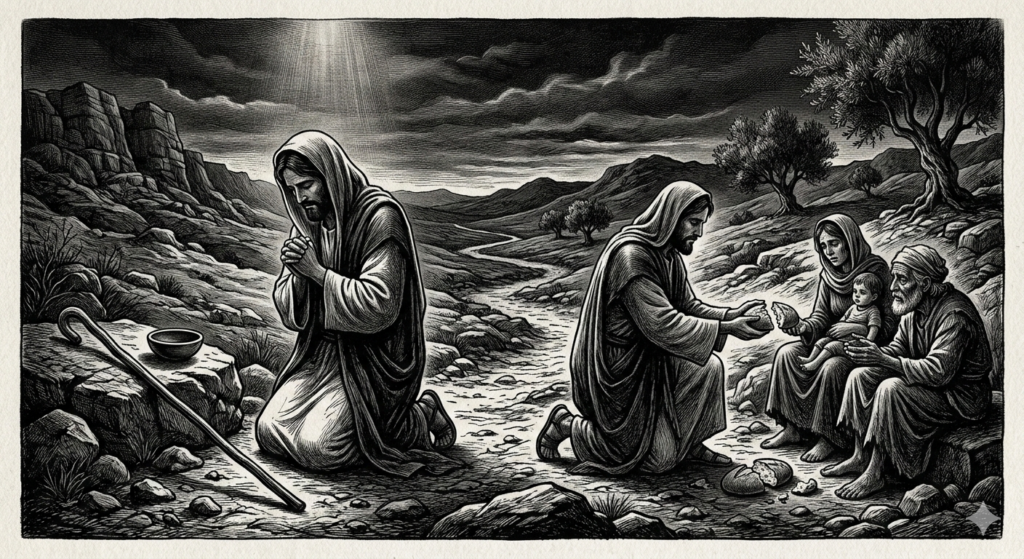
With the alms of love, Charity, we will give Him our whole heart, He alone we will adore, He alone we will serve, when we go out to meet the material and spiritual needs of the people we live with, the people in our families, our friends, and those whom the Lord wants us to meet on our journey. There are so many who are waiting for us on the roadside of our life, as that man mistreated by the bandits waited for the Good Samaritan to pass by!
Lent: sin and God's forgiveness
In accompanying Christ during these days of Lent, we are living with Him his triumph over the three lusts that will tempt us until we finish our journey on earth: the devil, the world and the flesh, and we prepare ourselves to enjoy with Him the triumph of his Resurrection, in which, in addition to these three temptations, death and sin are conquered. The light of Christ's Resurrection blinds the devil in our soul. We open the eyes of body and spirit to the horizon of Eternal Life.
The Gospel of the Fourth Sunday of Lent narrates the Lord's encounter with a man blind from birth. Jesus Christ performs the miracle of restoring his sight, and reminds us that he is the light of the world: «While I am in the world, I am the light of the world».
Filled with the light of the Lord, with his teachings, with his commandments, we will not be deceived by those words of the devil in the third temptation: «I will give you the whole world, all that you see, if you worship me». We will not sell our soul to the devil, and we will not fall into the seduction of purely material perspectives and our own triumph. that this world can offer us, and that yearn to fill our pride and our pride: our flesh, our selfishness.
We will worship the Lord alone
How can we overcome these temptations, follow the commandments and live with Christ, who purifies our heart, and thus make our life a true life “hidden with Christ in God”? Psalm 94:8 tells us: «Do not harden your hearts; listen to the voice of the Lord».
The Lord speaks to us with his life, and with his words recorded in the Gospels, and also shows us the way so that we can live hidden with him in God - «I am the Way, the Truth, the Life» -: he institutes the Eucharist, and invites us to nourish ourselves with his Body and Blood.
By receiving Christ with faith and love in the Eucharist, and by living the Holy Mass with Him, our life of Faith, Hope and Charity is deeply rooted in our soul. How and why? Because we make an act of faith in the divinity and humanity of Christ; in his words, in his Resurrection and in Eternal Life. Christ celebrates the Mass, Christ we eat, and He is Eternal Life.
When we receive Him, after offering with Him, and moved by the Holy Spirit, our life to God the Father, we live the Hope of Heaven: “Whoever eats my Flesh and drinks my Blood has eternal life”; the Church reminds us that the Eucharist is “the pledge of eternal life”.
And by living with Christ we learn to love our brothers and sisters, all men and women, as He loves them. To be able to live the Mass “with Christ, in Christ and through Christ” is already a foretaste of living with the Love that God has for us; and to receive Christ given to us in the Eucharist is to receive in our body and in our soul, the greatest Love that Christ offers us on earth: the total donation of his whole Being., for our salvation.
Following this journey, and renewing our Faith, our Hope, and our Charity, as we contemplate the Passion and Death of Christ, which we live on Good Friday, and in the sorrowful mysteries of the Holy Rosary, we will also live in the Holy Spirit and with the Blessed Virgin, the joy of the Resurrection.
Table of Contents
Ernesto Juliá, (ernesto.julia@gmail.com) | Previously published in Religion Confidential.
The Church proposes to all Christians to follow the example of Christ in his retreat to the desert, we prepare ourselves, in this time of Lent for the celebration of the Easter solemnities, with the purification of the heart, and a penitential attitude.
Pope Leo XIV has sent his first Lenten message to the whole Church. In 2026 he asks us to focus this powerful season on listening and helping with faith and humility.
As Christians, when we consciously and actively live all parts of a Mass, we relive Christ's sacrifice on the cross. Pope Francis pointed out that through the Mass we Christians receive God's love and mercy, and we open ourselves to a new life thanks to the Resurrection.
Frequently Asked Questions
- What is the meaning of Lent?
Lent is 40 days before Easter, a special time to prepare ourselves for the most important feast of Christianity: the Resurrection of Jesus. This period of reflection and change began to be recognized by the Church since the 4th century, as a time to renew ourselves, practice penance and get closer to God.<br><br>In the Catechism of the Catholic Church (540) we are told that "the Church unites herself every year, during the forty days of Great Lent, to the Mystery of Jesus in the desert". Just as Jesus spent 40 days in the desert to prepare for his mission, we use these days to purify our hearts, strengthen our Christian life and live with a penitential attitude. It is a time to return to the essentials, reflect on our lives and strengthen our relationship with God.
- Why does the Church celebrate Lent?
The Church invites us to live Lent as a time of spiritual retreat, a space to pause and reflect. It is a time to strengthen our relationship with God through prayer and meditation, but also to make a personal effort, as a kind of "spiritual detoxification," in which we put aside what distances us from Him.
This effort of mortification (like fasting or almsgiving) is something that each one decides according to what he or she can give, but always with generosity. Lent is not only a sacrifice, but an opportunity to grow and prepare ourselves for the great feast of Easter: the Resurrection of Jesus. It is the time for a deep conversion, to renew our hearts and be more prepared to live Resurrection Sunday with joy and peace.
- When does Lent begin and when does it end?
Lent begins on Ash Wednesday and ends just before the Holy Thursday Mass, the Mass of the Lord's Supper. It is a time to prepare ourselves, in a more intense way, to live Easter.
- What is the point of practicing fasting and abstinence?
Fasting and abstinence are ways that the Church proposes to us to grow in the spirit of penance. But, beyond external acts, what is important is inner conversion. It is not only about what we do externally, but about changing our attitude and getting closer to God with our heart. If there is no inner change, fasting loses its meaning.<br><br>In addition to fasting from food, fasting can be lived more broadly. Sometimes, fasting means giving up good things, such as social networks, series, music or even some comforts, as a sacrifice to focus more on God.
But fasting also implies fighting against those habits or attitudes that keep us away from Him. It can be a "fast" from bad moods, from looking at ourselves too much in the mirror, or from rushing when we pray. It is about making conscious efforts to improve in those aspects of our life that do not help us to get closer to God.
«We Christians in Pakistan have hope for a better future.»
Abid Saleem is a priest of the Oblate Missionaries of Mary Immaculate congregation studying at the Pontifical University of the Holy Cross in Rome. The Christians of Pakistan at many times discriminated against and persecuted, they have the hope “of a better future,” she recounts in her testimony.
A Catholic family of eleven siblings
"I am Abid Saleem, son of Saleem Masih and Mukhtaran Bibi. I was born in Toba Tek Singh, Pakistan, on June 26, 1979, in a Catholic family of eleven siblings (eight males and three females). I am the youngest of all. My parents are already in heavenly life (may their souls rest in peace).
When you reflect on your vocation, recalls all the events that helped him discern about her. «First of all, I feel it was a desire since my childhood. I used to go to church very often and I used to be an altar boy. In school, whenever I was asked what I would like to be, my answer was only one: to be a priest.
Once he finished his compulsory education, in 1996 he was thinking of enrolling in university. It was the month of July. Then, something happened that marked his life: «I met an Oblate novice of Mary Immaculate who shared with me and explained the charism of his congregation».
When she was about to enroll in the University, she made a vocational retreat with the Missionary Oblates of Mary Immaculate.
A retreat to discover my vocation
It was to be organized a vocational program that lasted three days and Abid Saleem, without a second thought, I said yes, I wanted to participate. «Along with me, four others attended the retreat. We all enjoyed the program and loved the Oblate spirituality as well as their way “to evangelize the poor”.».
After the program, they returned home and after a few days, four of them received a letter of invitation to join the seminary. Abid Saleem and a friend entered, but after a year of discernment his friend discovered that it was not his vocation and withdrew, while Abid continued his formation, which was a very enriching time for him, with many meaningful experiences.
Oblate Mission Station
During the first year of seminary formation, among some of the activities we did, one was especially interesting. We went to Derekabad, an Oblate mission station. It is a desert area where the Oblates have built a beautiful grotto there.. The work of these brothers in the grotto was inspiring to me.
Another event that touched me was participating in a priestly ordination of a brother of the congregation, the first ordination I had ever attended. This celebration really strengthened my vocation as well.
In 1998, he was able to begin studying for a career in Philosophy and then he was sent to Sri Lanka for his pre-novitiate and novitiate, another beautiful experience of internationality.
He took his first vows in 2003. After returning to Pakistan, he completed his theological studies at the National Catholic Institute of Theology. He took his final vows on August 22, 2008 and was ordained a priest on August 22, 2008. deacon the next day.
And finally, on February 17, 2009, I was ordained a priest at Sacred Heart Cathedral, Lahore. My formation period was excellent. I thank the Lord for all those formators and teachers who formed me to be the true servant of God.
Pastoral work and service in the diocese after ordination
After its management, His bishop sent him to work in different parishes, first as an assistant and then as pastor. He has worked with youth and many other groups. He has also collaborated in the Catechetical Commission of his diocese. He started the office of the catechetical commission in the Vicariate of Quetta.
Another of the tasks I performed was to manage a small religious articles store in the same office. On the other hand, organized many programs for teachers of religion and for the people of the country. and worked as a liturgist in the Vicariate. I have been the Master of Ceremonies at the liturgy of many priestly ordinations, deaconates and candidacies.
In 2016, I passed my B.A (Bachelor of Arts) from Punjab University, Lahore. I also worked as the Rector of the Oblate Juniorate for the last three years. This was another enriching experience, though difficult, but I tried my best to accompany the students in their spiritual journey to discern about their vocation.
«In our country there is a lot of work to be done, since God's flock continues to grow, but there are few workers to tend it.
The official name of our congregation is Missionary Oblates of Mary Immaculate and its motto is “Evangelizing the poor”. It was founded by St. Eugene de Mazenod in 1816 and approved on February 17, 1826 by Pope Leo XII.
The founder of the OMI mission in Pakistan is a German priest, the Reverend Father Lucian Smith, who was then the Provincial of the Province of Colombo, Sri Lanka. It was he who sent three Oblates to Pakistan in 1971. There were many Oblate missionaries from all over the world, but basically from Sri Lanka.
Pakistan's Christians facing a Muslim majority
Pakistan is the ninth largest country in Asia. It shares a border with the Arabian Sea, China, Afghanistan, Iran and India. Mohammad Ali Jinnah is the founder of Pakistan which gained its independence on August 14, 1947.
The country covers a total area of 881,913 square km and is divided into four provinces, namely Punjab, Sindh, Balochistan and Khyber Pakhtunkhwa. The national language of the country is Urdu and English is the official language. Pakistan has a population of approximately 211,819,886 citizens.
Muslims are in the majority with 95 % of the population. But the Christians are one of the largest religious minorities in Pakistan with 2 % of the population, approximately half are Catholic and half are Protestant.
Very poor conditions
has a long history in South Asia, although many of Pakistan's Christians are descendants of low-caste Hindus who converted under British colonial rule to escape caste discrimination.
Christians in Pakistan are, for the most part, very poorThey have also been involved in menial jobs such as cleaners, laborers and harvesters. Despite this, they have made significant contributions to the development of the country's social sector, especially in the construction of educational institutions, hospitals and health centers throughout Pakistan.
However, like other religious minorities, Christians have faced discrimination and persecution throughout history.The Christian communities are still suffering from selective violence and other abuses, including land grabbing in rural areas, kidnappings and forced conversion, and vandalism of homes and churches. Today, they continue to suffer targeted violence and other abuses, including land grabbing in rural areas, kidnappings and forced conversion, and vandalism of homes and churches.
«Despite all this, we Christians in Pakistan are hopeful for a better future,» Abid Saleem confided. We pray that Almighty God will bring peace and harmony to this country and that people will enjoy the fullness of life.
«Christians in Pakistan today continue to suffer targeted violence and other abuses.».
Oblates in Pakistan
They worked in parishes and distinguished themselves by setting up the Basic Christian Communities. Later, they also thought of starting the formation program. Now we have three main formation houses: juniorate, philosophate and scholasticate.
We work mainly in eight poor parishes in five dioceses. Christ invites us to follow him and to share his mission through word and work. Our main objective is education in schools, with young people, and especially reaching out to people who are far from God.
Training in Rome for missionary work
Now his superior is sending him to Rome for further studies in Liturgy. «My future goal is to work as a missionary».
For this great opportunity to be formed at the Pontifical University of the Holy Cross, to then return to his country and share all the good he has received, he can only thank the benefactors of the CARF Foundation: «May God bless you for all you do for the Universal Church, but also for us, the little ones, who are seeds in the hand of the Lord, in countries where the mere fact of calling oneself Christian can cause death».
Gerardo FerraraBA in History and Political Science, specializing in the Middle East. Responsible for the student body of the Pontifical University of the Holy Cross in Rome.
Table of Contents
What are the key parts of a joint and several will?
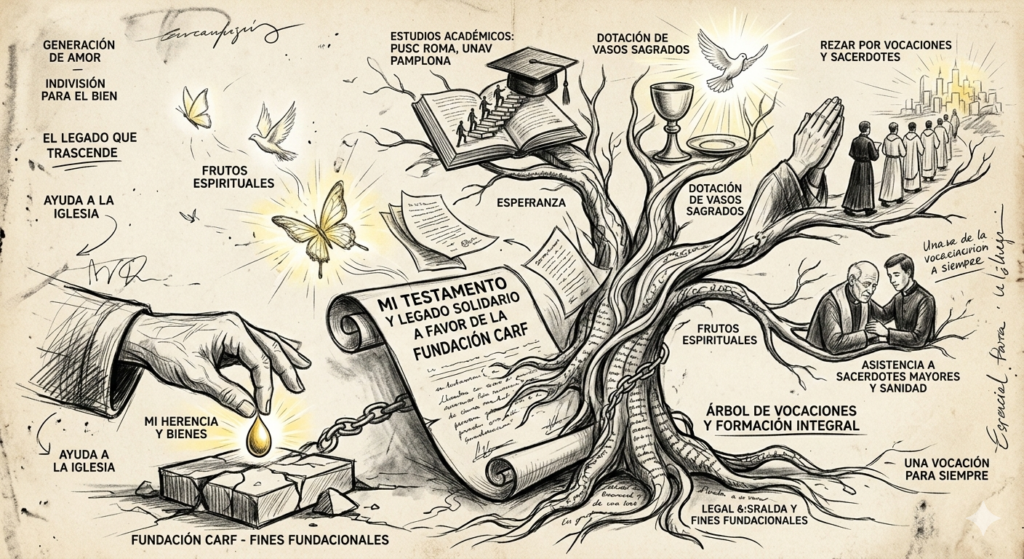
When we think of writing a will, the first thing that comes to mind is usually the family, the assets, the security of leaving everything in order. But a solidarity will is much more than a legal document: it is also an opportunity to leave a mark beyond our lifetime, to give continuity to our values and to sow the seeds of the future.
At the CARF Foundation, we believe that the solidarity will is a bridge between the life we have lived and the impact we want to leave. Each person who includes a bequest to the CARF Foundation in his or her will contributes to something transcendental: the integral formation of seminarians and diocesan priests around the world who tomorrow will lead parishes, celebrate the Eucharist and bring hope to those who need it most.
However, in order to make this decision with serenity, it is essential to understand how a will works in Spain and which are the parts that compose it. A good knowledge of these legal figures will allow you to choose the best formula for your loved ones and, if you wish, to also support a cause that transcends in time, such as the CARF Foundation.
Key figures when making a solidarity will
Testator: who gives form to his legacy
The testator is the person who grants the will., The will of the deceased, that is, the person who expresses his or her will as to how his or her property, rights and obligations should be distributed after his or her death. According to the Spanish Civil Code (arts. 662 et seq.), If a will is not executed, only those who have full legal capacity and act freely may grant a will.
The law always protects the forced heirs through the so-called legitimate, but leaves a third of free disposition that the testator can allocate to whomever he wishes, including institutions with transcendent and solidary purposes such as the CARF Foundation. It is in this space where a will or solidarity legacy makes full sense.
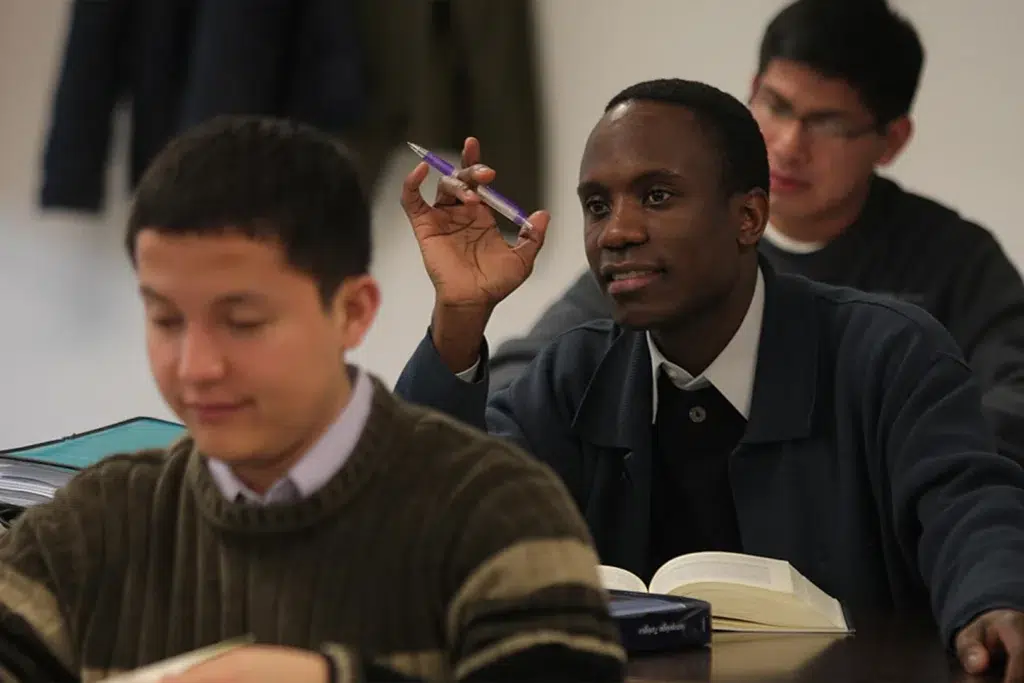
A group of seminarians from Bidasoa at the University of Navarra.
Universal heir: who takes your place in law
The universal heir is the person - or institution - who receives the entirety of your inheritance, with its assets, rights and also obligations. Spanish law defines an heir as one who succeeds “by universal title” (arts. 657 and 661 of the Civil Code). This means that the heir legally takes your place: he or she receives your estate, but is also liable for any debts that may exist.
An heir may be a sole heir or shared among several heirs (co-heirs). If you do not specify anything, your forced heirs (descendants, ascendants or spouses, as the case may be) will inherit by law. But if you decide to leave your will on record, you can grant an open will before a notary and establish who will occupy that central place.
Coheirs: when you share the inheritance
If you wish to distribute your inheritance among several people or institutions, then we are talking about co-heirs. Each of them receives a part of the whole estate, in the proportion you have decided. They all share both the rights and obligations derived from the inheritance, and a partition will be necessary to allocate the assets in a concrete way.
This is where the figure of the accountant-partidor, who can be designated in the will to avoid conflicts and expedite the distribution. In this way, even if there are several co-heirs with different interests, a professional or trusted person will be able to order the division in an equitable manner and in accordance with your will.
Legatees: a specific asset for a specific person
The figure of the legatee is different from that of the heir. While the heir receives the entire estate (or a proportional part of it), the legatee receives the entire estate (or a proportional part of it). The legatee receives a specific asset, a specific right or a specific amount of money. The law defines it as the one who succeeds “in a private capacity” (art. 881 of the Civil Code).
A fundamental characteristic is that the legatee is not liable for the debts of the estate; He receives only what has been left to him. However, the heir or the executor must hand over the bequeathed property to him, unless the testator has provided otherwise.
This figure is especially interesting when you want to support a charitable cause without affecting the rest of the family estate. It is, in fact, the most common way to include the CARF Foundation in a will.
Executor and accountant-partidor: those who watch over your will
The will also allows you to name trusted persons to ensure that your provisions are carried out. The executor is the person in charge of executing your will, either in general or for specific aspects. (arts. 892-911 of the Civil Code). You can appoint one or more, and establish the time during which they will exercise their office.
For its part, the accountant-partidor is in charge of distributing the inheritance among the heirs and legatees in accordance with what you have disposed. His role is key when there are several co-heirs and different assets to be divided. Even if you have not appointed one, the law allows a notary or a lawyer of the Administration of Justice to appoint an accountant-partidor dative to avoid blockages (art. 1057 of the Civil Code).
Thanks to these figures, your will not only expresses your will, but also ensures that it is effectively executed, avoiding arguments and ensuring family peace.
Seminarians attend Theology classes in the Ecclesiastical Faculties of the University of Navarra.
The value of a legacy of solidarity
Beyond the legal figures, the essential thing about a will is that it reflect who you are and what mark you want to leave when you are gone. By including the CARF Foundation as a legatee, you transform a juridical act into a permanent and transcendent act of commitment, faith and hope in the future of the Church throughout the planet.
How your bequest to the CARF Foundation takes shape
The totality of your bequest will go entirely to the integral formation of seminarians and diocesan priests and religious men and women from all over the world so that when they return to their countries they can continue to form others and do much good in their dioceses.
As the CARF Foundation is a non-profit foundation, bequests are exempt from Inheritance and Gift Tax. This means that every euro, property or object donated is converted into aid for study, maintenance, integral formation and the support of vocations that will accompany millions of people.
Your generosity translates into more lively parishes, greater formative richness for each of the faithful, sacraments that can be administered where they are most needed, and communities that find in priests the living presence of Christ.
It is, in short, a way for your life to continue to bear fruit when you are no longer with us. turn your generosity into a legacy of solidarity that strengthens the future of the Church.
St. Peter's Basilica celebrates its 400th anniversary
Located in the heart of Vatican City, and built by Bramante, Michelangelo and Bernini, St. Peter's Basilica is the center of Christianity and one of the greatest works of the Renaissance. The Holy See has recently presented several events to commemorate the 400th anniversary of its dedication.
St. Peter's Basilica is a work of art and faith that no one doubts. Its construction, which spanned more than a century (1506-1626), represents the transition and culmination of the Renaissance and Baroque styles.
In 1626, the great basilica erected over the tomb of the Apostle Peter was officially consecrated. Four centuries later, in 2026, St. Peter's Basilica celebrates its 400th birthday as one of the most influential buildings in the history of Western architecture.
From Bramante to Bernini: the legacy of modern architecture
The present basilica replaced the ancient 4th century Constantinian church. The project officially began in 1506 on the initiative of Pope Julius II, who commissioned the design to Donato Bramante.
Throughout more than a century of construction, the building passed through the hands of decisive architects: Michelangelo, which redefined the dome and gave the ensemble its definitive monumentality; Carlo Maderno, responsible for the current façade and the longitudinal extension that turned the church into a Latin cross; and Gian Lorenzo Bernini, He is the author of the imposing bronze baldachin under the dome and of the design of the elliptical square that embraces the pilgrims.
A history that can be viewed online
The consecration took place on November 18, 1626.. Since then, St. Peter's has been the scene of papal coronations, great public celebrations, historic funerals and key moments in contemporary history.
On this anniversary, rediscover the history of San Pedro through digital resources now available:
The basilica is a compendium of European art between the sixteenth and seventeenth centuries. The dome of Michelangelo -136 meters high- became a model for countless later churches. Bernini's baldachin introduced a baroque language that dialogues with the colossal scale of the building. The side chapels house sculptures, mosaics and funerary monuments that trace five centuries of history.
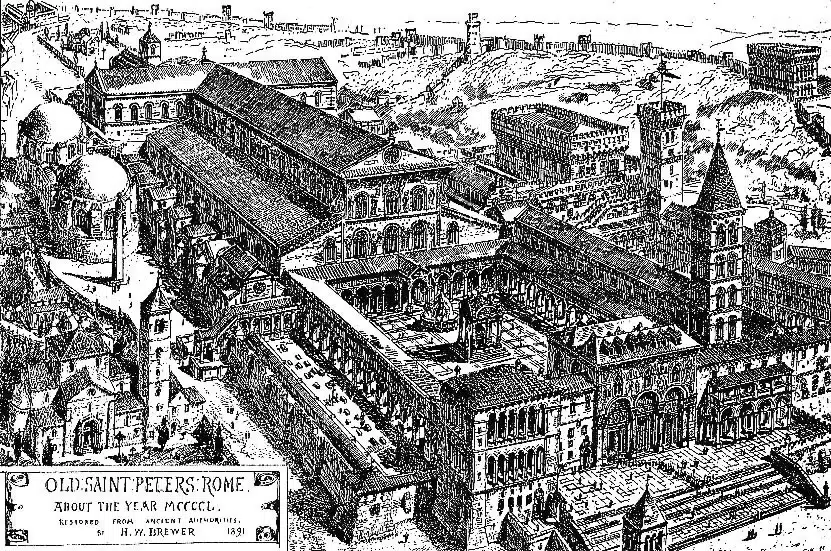
Drawing made by H. W. Brewer in 1891 of the state of the basilica between 1483-1506.
On the occasion of the anniversary, the program presented in February 2026 includes an exhibition dedicated to the design and construction phases of the temple, from Bramante's first sketches to its completion in the 17th century. The aim is to show the creative process behind a work that, more than a building, was an ongoing architectural experiment for more than a hundred years.
In addition, on February 20, a new Stations of the Cross by Swiss artist Manuel Dürr was added, integrating contemporary creation into a historic space, something that has happened periodically over the centuries.
What is the project Beyond the visible
The basilica welcomed more than 30 million pilgrims in 2025, a record number due to the Jubilee of Hope. The anniversary was the occasion to reinforce the management of flows through a booking system integrated into the official website.
In addition, a mobile app will offer simultaneous translation of liturgies, chants and readings in 60 languages, facilitating a more immersive and orderly experience. New areas of the complex will also be opened, such as the Gregorian and Clementine domes, and the terrace that runs along the three apses.
One of the most eye-catching projects of the 400th anniversary is Beyond the visible, a comprehensive digital model of the monumental complex. This is a technological and preservation project promoted by the Fabbrica di San Pietro and ENI, in collaboration with Microsoft.
During 18 months of work and more than 4,500 hours of data collection, the 80,000 square meters of the basilica have been digitally scanned.
400 years later
Few buildings can claim to have shaped for four centuries the visual identity of a city and, at the same time, the history of Western art. St. Peter's Basilica is not only the symbolic center of the Vatican; it is a synthesis of faith, architecture, sculpture, engineering and urban planning.
St. Peter's turns 400 years old not as a relic, but as a living building: a space where history, art and technology continue to dialogue under the same dome that Michelangelo imagined more than five centuries ago.
What is the Chair of St. Peter?
Every February 22nd, the Catholic Church celebrates the feast of the Virgin Mary. Chair of St. Peter, The Pope's role as successor of St. Peter and his mission to guide the faithful in faith and unity, as preached by Leo XIV since the beginning of his pontificate, is highlighted on this special occasion.
This day that challenges us to look with more love to the Pope who exercises his humble leadership in times that some call difficult; it urges us to walk fortes in fide.
The celebration of the Chair of St. Peter becomes an opportunity to unite in prayer and strengthen our faith. The Chair symbolizes the teaching and guidance that the Pope offers to the Church and all the faithful.
The Cathedra Sancti Petri Apostoli is considered by tradition to be the episcopal chair of St. Peter. It is an ancient wooden throne - symbol of the primacy and magisterium of the Pope - adorned with ivory plaques depicting the works of Hercules, and with friezes, also in ivory, from the Carolingian period (IX century).
To dignify it even more, the architect Gian Lorenzo Bernini He realized a grandiose gilded bronze monument that was completed in 1666, after ten years of difficult and costly work, especially for the fusion of the statues and the bronze elements, which weighed 74 tons. On the throne containing the relic, two angels hold the papal insignia: the keys and the tiara. The whole reaches a height of 14.74 meters.
Where is the tomb of St. Peter
The original tomb of the apostle St. Peter is located in the exactly under the main altar of St. Peter's Basilica.. It cannot be seen with the naked eye, but is located in a deep subway level, which can be visited in a very restricted way, known as the Vatican Necropolis, It is below the level of the Vatican grottoes (the place where most of the popes are buried).
Under the present high altar, archaeologists, during the 60s of the last century, found a small edicule (shrine) dating from the second century, which was built in front of a wall painted red. On it there was a graffiti in ancient Greek that said Petros eni (Pedro is here).
In a secret niche, inside that red wall, bones belonging to a robust man of about 60 to 70 years of age were found. The bones had a lot of soil stuck to them and were wrapped in a purple cloth embroidered with gold thread (a sign of great respect). After years of forensic studies, in 1968, Pope St. Paul VI officially announced that these remains could be convincingly considered to be the authentic remains of St. Peter the Apostle.
Access to the Scavi Vatican is very restricted (only about 250 visitors per day) to protect the microclimate and conditions of the ruins. Reservations must be requested months in advance by sending a form or email to Ufficio Scavi (Excavations Office of the San Pedro Factory).
As more operative details, the tour lasts approximately 90 minutes. It is an enclosed space, somewhat hot and humid, not suitable for people with claustrophobia. Children under 15 years of age are not allowed to enter and photography is not allowed.
The Vatican Grottoes
Just below the floor of the present St. Peter's Basilica are the Vatican Grottoes. To get your bearings, physically, they occupy an intermediate level between the present cathedral and the old ruins of the necropolis.
They are under the main floor of today's St. Peter's Basilica (where visitors walk today).
However, they are above the ancient Vatican Necropolis (the deepest archaeological level where the original tomb of St. Peter mentioned above is located).
To summarize, the floor of the Vatican Grottoes is the original floor of the basilica that Emperor Constantine ordered to be built in the 4th century.
The extensive crypt of the Vatican grottoes serves as the papal cemetery. There are the tombs and chapels of more than 90 popes (including Blessed John Paul I, Pius XII, St. Paul VI, among others), as well as some kings, queens and nobles who stood out for their support of the Catholic Church (such as Queen Christina of Sweden). The tomb of St. John Paul II was initially there until it was moved after his beatification to make it easier for the files to visit and pray. It is currently located to the left of Michelangelo's Pieta.
Table of Contents
Disarming peace and fidelity
Among the teachings of Pope Leo XIV in recent weeks, in the wake of the Jubilee of Hope, we focus on your Message for the 59th World Day of Peace, which marks the beginning of the year 2026, and its apostolic letter “Loyalty that generates future”on the occasion of the 60th anniversary of the Council's decrees Optatam totius y Presbyterorum ordinis.
The revolution of a disarming peace
Leo XIV's message for the World Day of Peace (January 1, 2026) is entitled: «Peace be with you all: towards a ‘disarmed and disarming’ peace. It is a direct and extended echo of the first words he pronounced when he stepped out onto the balcony of St. Peter's Basilica in the Vatican (May 8, 2025).
The peace brought by the Risen Christ,« he observes in the Introduction, »is not a mere wish, but brings about a definitive change in the one who receives it and thus in the whole of reality“ (cf. Eph 2:14). The Christian mission, which involves peace with its luminous aspect with respect to the darkness and obscurity of conflicts, continues. With the proclamation of the successors of the Apostles and the impetus of so many disciples of Christ, it is ”the most silent revolution.
The peace brought by the Risen Christ,« he observes in the Introduction, »is not a mere wish, but brings about a definitive change in the one who receives it and thus in the whole of reality« (cf. Eph 2:14). The Christian mission, which involves peace with its luminous aspect with respect to the darkness and obscurity of conflicts, continues. With the proclamation of the successors of the apostles and the impulse of so many disciples of Christ, it is »the most silent revolution.
Christ brings “an unarmed peace” because, in the face of conflict and violence, He brings a different path. “Sheathe your sword.”, he says to Peter (Jn 18:11; cf. Mt 26:52).
«The peace of the Risen Jesus is unarmed,» the Pope affirms, "because his struggle was unarmed in specific historical, political and social circumstances. Christians, together, must prophetically become witnesses of this newness, remembering the tragedies in which they have so often become accomplices".
An unarmed “struggle
Jesus proposes, instead, the way - the protocol, as Pope Francis called it - of mercy (cf. Mt 25:31-46).
Paradoxically, today, «in the relationship between citizens and rulers, the fact that we are not sufficiently prepared for war, to react to attacks, to respond to aggressions, is considered a fault».
But this is just the tip of the iceberg of a deeper and more widespread global problem: the widespread lThe justifying logic of fear and domination. «Indeed, the deterrent force of power, and in particular of nuclear deterrence, embodies the irrationality of a relationship between peoples based not on law, justice and trust, but on fear and the dominance of force.».
Let ethics prevail over economic interests
It is not a question, says Leo XIV, of denying the dangers that loom over us because of the domination of others. It is a question, first, of the cost of rearmament, with the economic and financial interests it entails. Secondly, and more fundamentally, there is a major cultural problem affecting educational policies. The path of listening, encounter and dialogue, as advised by the Second Vatican Council (cf. Joy and Hope, 80).
Hence the need, on the one hand, to «denounce the enormous concentrations of private economic and financial interests that are pushing states in this direction». And, at the same time, to encourage «the awakening of consciences and critical thinking» (cfr. Fratelli tutti, 4).
The Pope asks us to join forces «to contribute reciprocally to a disarming peace, a peace born of openness and evangelical humility». And all this, attention, not only as an ethical response, but also with attention to the Christian faith, which promotes unity.
Promoting mutual trust
To begin with, in the Christian perspective, goodness is disarming. Perhaps that is why God became a child. God wanted to take on our fragility; whereas we, as Pope Francis pointed out, "we often tend to deny boundaries and avoid the fragile and wounded people who have the power to question the direction we have taken as individuals and as a community." (Francisco, Letter to the editor of “Corriere della Sera”, 14-III-2025).
In his magna carta of Christian thought on peace (the encyclical Pacem in terris, 1963), St. John XXIII introduced the proposal of an «integral disarmament», based on «a renewal of the heart and of the intellect". To this end, Leo XIV now confirms, the logic of fear and war must be replaced by mutual trust between peoples and nations; without giving in to the tendency to "to transform even thoughts and words into weapons».
Religions, says Pope Leo XIV, must help to take this step and not the other way around: substituting faith for political combat to the point of - he clairvoyantly denounces - «blessing nationalism and religiously justifying violence and armed struggle».
For this reason, and he addresses himself above all to believers, he proposes: «together with action, it is more and more necessary to cultivate prayer, spirituality, ecumenical and interreligious dialogue as ways of peace and languages of encounter between traditions and cultures.".
And this has an educational translation: that every Christian community becomes a house of peace and a school of peace, "where we learn to defuse hostility through dialogue, where justice is practiced and forgiveness is preserved; today more than ever, in fact, it is necessary to show that peace is not a utopia, through attentive and generative pastoral creativity».
Clearly, adds the successor of Peter, this corresponds in a special way to politicians: «Es the disarming path of diplomacy, of mediation, of international law, sadly belied by the increasingly frequent violations of agreements reached with great effort, in a context that would require not the delegitimization, but rather the strengthening of supranational institutions».
Disarming the heart, mind and life
In continuity with his predecessors, Leo XIV denounces the desire to dominate and to advance without limits, by sowing despair and arousing distrust, even disguised behind the defense of certain values.
«To this strategy,» he proposes as the fruit of the Jubilee of Hope, "we must oppose the development of conscious civil societies, of forms of responsible association, of experiences of non-violent participation, of practices of restorative justice on a small and large scale. All this, based on both anthropological and theological reasons, within the horizon of human fraternity (cfr. Leo XIII, Rerum novarum, 35).
This, the Pope concludes, requires, above all for believers, «to rediscover themselves as pilgrims and to begin within themselves that disarmament of heart, mind and life to which God will not delay to respond - with the gift of peace - by fulfilling his promises» (cf. Is 2:4-5).
Fruitful priestly fidelity
The apostolic letter Loyalty that generates future, The new Constitution, signed by Leo XIV on December 8, 2025, was published at the end of December.
The title already contains the proposal addressed to the priests and specified at the beginning: «To persevere in the mission apostolic offers us the possibility of questioning ourselves about the future of the ministry and of helping others to perceive the joy of the priestly vocation» (n. 1). Fruitful fidelity“ is a gift to be understood and received in the context of the Church and her mission. At the same time, the priestly ministry has an important role to play in the longed-for renewal of the Church (cf. Optatam totius, Proem).
Hence the invitation of Leo XIV to reread the conciliar decrees Optatam totius y Presbyterorum ordinis, where it was desired to reaffirm the priestly identity and, at the same time, to open the ministry to new perspectives of doctrinal deepening. A re-reading that should be enlightened by the fact that, after the Council, «the Church has been led by the Holy Spirit to develop the Council's teaching on her nature communional according to the synodal and missionary form» (n. 4).
Keeping God's gift alive and caring for the fraternity
In the face of painful phenomena, such as abuse or the abandonment of the ministry by some priests, the Pope stresses the need for a generous response to the gift received (cf. 2 Tim 1:6). The basis must be the “following of Christ", with the support of integral and ongoing formation. In this formation, from the seminary stage, the “affective” aspect (learning to love like Jesus), human maturity and spiritual soundness stand out.
«Communion, synodality and mission cannot be realized if in the hearts of priests the temptation of self-referentiality does not give way to the logic of listening and service» (n. 13). In this way they will be effective in their “service” to God and to the people entrusted to them.
Within the fundamental fraternity that arises in Christians as a result of Baptism, there is in priests, through the sacrament of Holy Orders, a particular fraternal bond, which is a gift and a task. Thus the Council expresses it: «Each one is united with the other members of this presbyterate by special bonds of apostolic charity, ministry and fraternity» (Presbyterorum ordinis 8).
The Pope says that this means, first of all, on the part of everyone, «overcoming the temptation to individualism» (n. 15) and a call to fraternity, whose roots are in unity around the bishop. Institutionally, it is necessary to promote economic equality, provision for sickness and old age, mutual care, and also «possible forms of common life» that favor the cultivation of the spiritual and intellectual life, avoiding the possible dangers of loneliness (cf. Presbyterorum ordinis 8).
Priesthood and synodality for mission
Encourages priests to participate in the synodal processes underway, referring to the Final document of the synod on synodality: «it seems essential that, in all the particular Churches, appropriate initiatives be undertaken to enable priests to familiarize themselves with the guidelines of this Document and to experience the fruitfulness of a synodal style of Church" (n. 21 of the letter).
As for priests, this should be manifested in their spirit of service and closeness, welcoming and listening. They must reject exclusive leadership, choosing instead the path of collegiality and cooperation with other ordained ministers and the entire People of God. It is necessary to avoid the identification between sacramental authority and power, which would lead to placing the priest above others (cf. Evangelii gaudium, 104).
Regarding the mission: “The identity of priests is constituted around their ‘being for’ and is inseparable from their mission.”(n. 23 of the letter).
The Pope warns the world's priests in the face of two temptations: activism (giving priority to what one does over what one is) and quietism (linked to laziness and defeatism). He points to pastoral charity as the unifying principle of priestly life (cf. Pastores dabo vobis, 23). In this way «every priest can find a balance in daily life and know how to discern what is beneficial and what is proper to the ministry, according to the indications of the Church» (n. 24).
In this way, too, he will be able to find harmony between contemplation and action, and the wisdom to disappear when and how it suits him, in the midst of a culture that exalts media exposure. It will be able to promote unity with God and fraternity and the commitment of people in the service of cultural, social and political activities, as proposed in the Final Document of the Synod (cf. nn. 20, 50, 59 and 117).
With reference to the future and in view of the scarcity of vocations, Leo XIV proposes prayer and the revision of pastoral praxis, so as to renew both the care for existing vocations and the call in youth and family contexts.
Mr. Ramiro Pellitero IglesiasProfessor of Pastoral Theology at the Faculty of Theology of the University of Navarra.
Published in Church and new evangelization and in Omnes.