26J saint Josemaría: the saint of ordinary life

St. Josemaría was born on January 9, 1902 in Barbastro (Huesca), into a deeply Christian family. He was the second of six children. His father, José, was a merchant; his mother, Dolores, was a pious woman who passed on to her children a living and simple faith. When Josemaría was thirteen years old, the family moved to Logroño due to the bankruptcy of the family business. This change of city would mark a key moment in his spiritual life.

One winter day, during a snowfall, he saw in the street the footprints in the snow left by a barefoot Carmelite. This made a deep impression on him: he perceived that God wanted something from him. Years later, he would remember that moment as the beginning of an interior intuition, of a diffuse call, a spiritual restlessness that grew.

Although he did not know exactly what the Lord was asking of him, he decided to become a priest as a way of being more available to fulfill the divine will. He entered the seminary of Saragossa, where he began his ecclesiastical studies, which he later combined with law studies. He was ordained a priest on March 28, 1925.

After a brief period as curate in a rural parish in Perdiguera, he moved to Madrid to continue his academic formation. There he worked as a chaplain and ministered to the sick, students and people in need.

It was in this urban environment, in contact with people from all walks of life, that his life took a definitive turn. On October 2, 1928, during a spiritual retreat, he received with inner clarity the mission that God entrusted to him: to found Opus Dei. He understood that he had to open a path within the Church to help discover that all men and women, regardless of their status, profession or social condition, are called to seek holiness in their ordinary lives through each other's work.

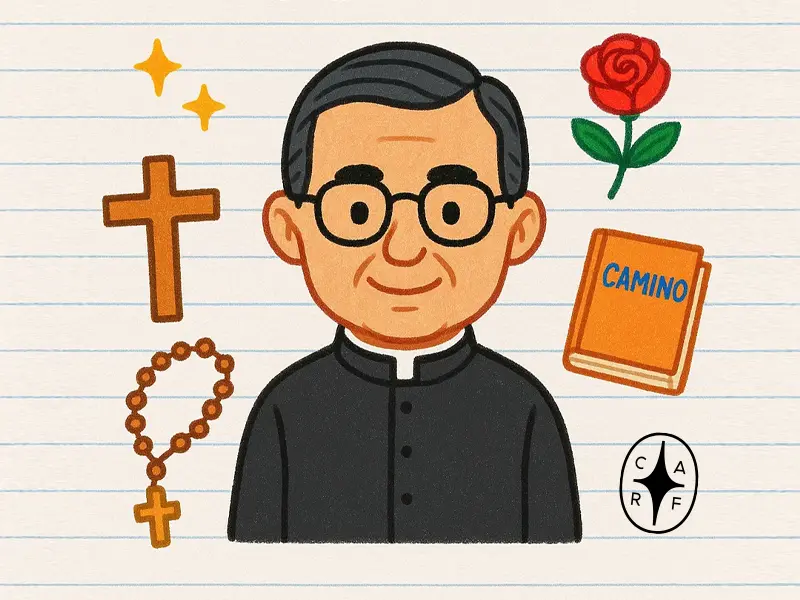
Dibujo animado de San Josemaría Escrivá con símbolos asociados: una cruz, un rosario, una rosa roja y el libro "Camino".
Representation of St. Josemaría Escrivá and some key elements of his life and message.

Who was St. Josemaría and why is it celebrated on June 26?

The initial inspiration showed him that any honest task - from an operating room to an office, a kitchen, a factory, the countryside or a classroom - could be a place of encounter with God. It was not a matter of doing extraordinary things, but of doing the ordinary with love, with perfection, with a Christian sense. Work, lived with this attitude, became a means of personal sanctification and service to others. This vision broke the mold at a time when holiness was associated almost exclusively with religious or priestly life. Josemaría insisted time and again to everyone that God does not call only some, but all.

In the early years, Opus Dei began in a very humble way: just a handful of young people in Madrid who listened to that priest speak to them about a Christian life that was coherent, joyful, demanding and committed to the world. In 1930, he also understood that this call was for women, and in 1943 he founded the Priestly Society of the Holy Cross, as part of the structure of Opus Dei. Opus Deito also integrate diocesan priests.

Expansion was slow at first, marked by the social and political difficulties of the Spain of the time. During the Civil War, the founder had to go into hiding because he was a priest. At the end of the conflict, he resumed his work with renewed impetus.

But in 1946 he moved to Rome, from where he promoted the international development of the Work. In 1950, the Holy See granted definitive approval to Opus Dei, recognizing the validity of this new path within the Church. The expansion was progressive: they reached countries in Europe, America, Asia and Africa.

From the beginning of his ordination, St. Josemaría developed an intense pastoral and formative activity. He preached retreats, wrote books on spirituality - among them the best known, Caminopublished for the first time in 1939 - and accompanied many people spiritually.

In all her writings and meetings she insisted on the value of the little things, on the importance of doing them well and with God's love. "God waits for us in the little things," he used to say. His spirituality was neither complicated nor inaccessible, but deeply incarnated in daily life with a marked confidence in being a child of God: divine filiation fills the whole life of the person.

He died in Rome on June 26, 1975, unexpectedly, having just arrived at his residence at the headquarters of Opus Dei, Villa Tevere, after seeing and spending time with his daughters at the Roman College of Santa Maria.

This is how Blessed Alvaro del Portillo relates it in an interview about the Founder. "At eleven fifty-seven we entered the garage of Villa Tevere. A member of the Work was waiting for us at the door. Father quickly got out of the car, with a cheerful face; he moved with agility, so much so, that he turned to personally close the door. He thanked his son who had helped him and entered the house.

He greeted the Lord in the oratory of the Holy Trinity and, as he used to do, he made a slow, devout genuflection, accompanied by an act of love. Then we went upstairs to my office, the room where he usually worked, and a few seconds after passing the door, he called out: Javi!

Javier Echevarría had stayed behind to close the elevator door, and our Founder repeated more forcefully: "Javi! and then, in a weaker voice: "I am not feeling well. Immediately Father collapsed on the floor. We used all possible means, spiritual and medical. As soon as I realized the gravity of the situation, I gave him absolution and the Anointing of the Sick, as he ardently desired: he was still breathing. He had begged us many times to not deprive him of this treasure.

Possibly, after greeting the picture of the Virgin Mary of Guadalupe with an ejaculatory prayer, as he always used to do when entering any room of the house, with that last small act of love he collapsed. That same day the fame of his sanctity began to spread among the faithful.

In 1992 he was beatified by St. John Paul II, and in 2002 he was canonized, The Pope himself said during his homily: "With supernatural intuition, St. Josemaría untiringly preached the universal call to holiness and apostolate. Christ calls everyone to Christian perfection: workers and peasants, intellectuals and artists, people of all professions, social conditions and cultures".

A path of holiness in the midst of the world

Today, St. Josemaría's message continues to inspire thousands of people around the world. Opus Dei is present in 68 countries and offers spiritual and human formation to Christians from all walks of life. His legacy is not limited to the creation of an institution, but lies, above all, in having opened a new way to live the Gospel in the heart of the world.

Celebrating St. Josemaría's feast day on June 26 is to remember God's call to live fully in the midst of the ordinary. It is an invitation to everyone - laity, priests, married people, singles - to seek holiness in daily life, at work, in the family, at rest, in professional duties and in human relationships. He himself said: "There where your aspirations, your work, your loves are, there is the place of your daily encounter with Christ".

In short, St. Josemaría was an instrument in God's hands to remind us of something profoundly evangelical: that there are no second- or first-division Christians, that all of us-you and I-are called to the fullness of love, without the need to change our life, but only by changing the heart with which we live it.

Praying through the intercession of St. Josemaría

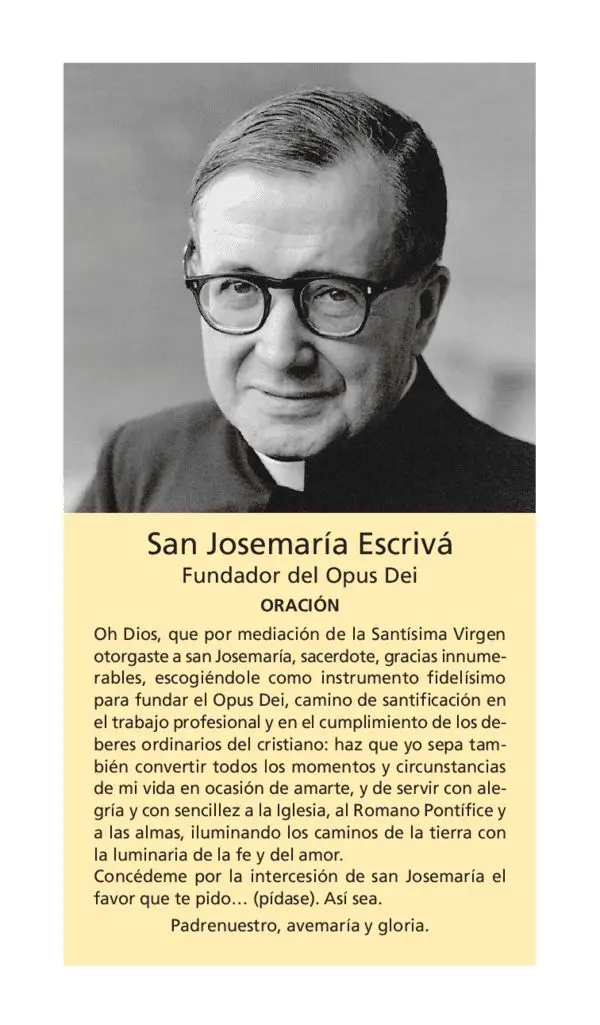
Christians have always turned to the intercession of the saints to bring their prayer into the presence of God. You can download the prayer in more than 30 languages.

Estampa de san Josemaría Escrivá con una oración por su intercesión.

Bibliography:

Solemnity of Corpus Christi

Once a year, the Catholic Church stops its ordinary liturgical calendar to put the spotlight on something extraordinary: the Real Presence of Jesus Christ in the Eucharist. That is Corpus Christi -the Body of Christ-, a solemnity that is not only contemplated, but transforms the life of those who unite themselves to Him and adore Him.

We are invited to manifest our faith and devotion to this sacrament, which is a sacrament of piety, a sign of unity, a bond of charity, a paschal banquet in which Christ is eaten, the soul is filled with grace and we are given a pledge of the glory to come.

Multitud de fieles participa en una procesión de Corpus Christi por las calles de una ciudad europea, acompañando al Santísimo Sacramento bajo palio.
The people walk united around the Eucharist during the feast of Corpus Christi.

What do we celebrate on this solemnity?

The Corpus Christi commemorates the deepest and most central mystery of the Catholic faith: that Jesus is truly present -with his Body, Blood, Soul and Divinity- in the Holy Eucharist. It is not a symbol, it is not a metaphor, it is not a pious memory. It is Himselfalive and delivered out of love.

This feast was instituted in the XIII century, thanks to the impulse of St. Julienne of Cornillon and the Eucharistic miracle of Bolsenawhich moved Pope Urban IV. And since then, every second Thursday after PentecostCatholics around the world give public witness to their faith with solemn Masses, processions and adorations.

Because in the Eucharist God gives himself completely to us. There is nothing more intimate, more transforming and more real than communion with Christ. Corpus Christi reminds us that:

A party that engages

Corpus Christi is not just a beautiful date on the calendar. It is a call to live eucharistically. To let Jesus, who breaks for us, teach us to break for others. To be bread broken for the world, especially for those who do not know Christ or who suffer in silence.

Celebrating the feast of Corpus Christi is worship Jesus with all your heartWe thank him for staying with us in every tabernacle of the world, and for allowing ourselves to be transformed by his presence. Because whoever receives communion with faith, no longer lives for himself, but for the One who gives himself daily at the altar. "He who eats my flesh and drinks my blood has eternal life (Jn 6:51-58).. I am the living bread which came down from heaven. If anyone eats this bread he will live forever; and the bread that I will give is my flesh for the life of the world.

The Jews began to argue among themselves: -How can this man give us his flesh to eat?

Jesus said to them, "Truly, truly, I say to you, unless you eat the flesh of the Son of Man and drink his blood, you have no life in you. He who eats my flesh and drinks my blood has eternal life, and I will raise him up on the last day. For my flesh is true food and my blood is true drink.

He who eats my flesh and drinks my blood abides in me and I in him. As the Father who sent me lives and I live because of the Father, so he who eats me will live because of me. This is the bread that came down from heaven, not as the fathers ate and died: whoever eats this bread will live forever.

Bread of Life Speech

On the feast of Corpus Christi we celebrate Christ's revelation of the mystery of the Eucharist. His words are of such strong realism that they exclude any interpretation in a figurative sense. The listeners understand the proper and direct meaning of Jesus' words (v. 52), but they do not believe that such a statement can be true.

If it had been understood in a figurative or symbolic sense, it would not have caused them such great surprise, nor would the discussion have taken place. From this is also born the faith of the Church that through the conversion of the bread and wine into his Body and Blood, Christ is made present in this sacrament..

Pintura histórica de una solemne procesión de Corpus Christi con presencia de autoridades civiles, eclesiásticas y militares en una ciudad española.
Corpus Christi procession with all its traditional solemnity, according to the vision of the painter Sáinz de la Maza (1944).

"The Council of Trent summarizes the Catholic faith when it states: "Because Christ, our Redeemer, said that what he offered in the form of bread was truly his Body, this conviction has always been maintained in the Church, which the Holy Council declares anew: 'by the consecration of the bread and wine there is effected the change of the whole substance of the bread into the substance of the Body of Christ our Lord and of the whole substance of the wine into the substance of his blood; the Catholic Church has justly and appropriately called this change transubstantiation' (DS 1642)."

In this discourse Jesus compares three times (cf. vv. 31-32.49.58) the true Bread of Life, his own Body, with the manna, with which God had fed the Hebrews daily for forty years in the desert. Thus, invites us to nourish our souls frequently with the food of his Body.

"From the comparison of the Bread of Angels with bread and with manna the disciples could easily deduce that, just as the body is nourished with bread daily, and the Hebrews were daily refreshed with manna in the desert, in the same way the Christian soul could daily eat and feast with the Bread of Heaven. Moreover, almost all the Holy Fathers of the Church teach that the daily bread, which is commanded to be asked for in Sunday prayer, is not so much to be understood of the material bread, food for the body, as of the daily reception of the Eucharistic Bread" St. Pius X, Sacra Tridentina Synodus, December 20, 1905.

On the Sunday after Holy Trinity Sunday, thehe Church celebrates Corpus Christi, the Solemnity of the Most Holy Body and Blood of Christ.. That is its full title, although we usually refer to it using its former Latin name, Corpus Christi. It is interesting to know that its earliest title was Festum Eucharistiae.


Eucharistic Resources for the Feast of the Eucharist Corpus Christi 

Author: don Francisco Varo PinedaDirector of Research at the University of Navarra and Professor of Sacred Scripture in the School of Theology.

Jesus Christ, High and Eternal Priest: self-giving love

Each year, the Thursday after Pentecostthe Church celebrates a singular liturgical feast: the feast of Jesus Christ, High and Eternal Priest. It is not just another liturgical remembrance, but a profound invitation to contemplate the very heart of the Christian mystery: Christ who offers himself to the Father for the salvation of the worldand which associates the priests of the Church with this sacrifice.

What is celebrated on this holiday?

This feast is centered on Christ in his priestly dimensioni.e., as mediator between God and mankind (cf. 1 Tim 2:5). He does not celebrate a particular moment of his life (such as Christmas or Easter), but rather his eternal priestly beingaccording to the order of Melchizedek (cf. Heb 5:6).

Jesus was not a priest like those of the Jewish temple. He is the perfect priest because it offered not animal sacrifices, but their own body and blood in obedience and love to the Father. As the Letter to the Hebrews says: "Christ came as High Priest of the good things to come... not by the blood of goats and calves, but by his own blood he entered once for all into the sanctuary and obtained eternal redemption" (Heb 9:11-12).

This feast was established in the liturgical calendar by some bishops -especially in Spain and Latin America- in the 20th century, and was approved by the Congregation for Divine Worship in 1987. Since then, it has been adopted by many dioceses around the world.

Escena de la película "La Pasión de Cristo" mostrando a Jesús en la Última Cena, sosteniendo el pan mientras instituye la Eucaristía, con sus discípulos observando en silencio.

The only sacrifice and the only priest

The Church teaches that Christ is at the same time priest, victim and altar. He is not only the one who offers, but also the one who the one who deliversChrist, the eternal priest, by the oblation of his body, accomplished once for all, brought to completion the work of human redemption" (Preface proper to the Mass of this feast).

At the Last Supper, he sacramentally anticipated the sacrifice he would consummate on the cross. Since then, each Mass is a real and sacramental actualization of this unique sacrifice.. It is not repeated, but is made present, by the power of the Holy Spirit.

Therefore, when priests celebrate the Eucharist, act "in persona Christi Capitis". (in the person of Christ the Head), not as mere delegates or representatives. It is Christ himself who acts through them.

Feast of Christ and his priests

This festival is also a privileged occasion to praying for priests. They have been configured with Christ the Priest to continue his mission. In the words of St. John Paul II: "The ministerial priesthood shares in the unique priesthood of Christ and has the task of making present in every age the sacrifice of redemption" (Letter to Priests, Holy Thursday 1986).

Today more than ever, priests need our closeness, our affection and our prayers. Their mission is beautiful, but also demanding. They are instruments of Christ's love, but they are not exempt from difficulties, fatigue and temptations.

This festival, therefore, is also a call to renew our love and support for our pastors. It is also a day for calling for new priestly vocations. The Church needs men who, in love with Christ, are ready to spend their lives in the service of the Gospel.

Contemplating Christ the Priest in order to follow him closely

To contemplate Christ as High and Eternal Priest is to contemplate his Heart, his surrender, his obedience to the Father and his compassion for mankind. He became a priest in order to intercede for us without ceasingAs Hebrews says: "He is able to save those who draw near to God through him, since he always lives to make intercession for them" (Heb 7:25).

In a world marked by self-sufficiency, haste, and superficiality, looking to Christ the Priest is a call to live a spirituality of dedication, intercession and silent service. Christ does not impose himself: he offers himself. He does not demand: he gives himself. He does not exhibit Himself: He gives Himself to the extreme.

For the lay faithful, this feast is also a reminder that all the baptized share in Christ's priesthood. St. Peter says it clearly: "You are a chosen race, a royal priesthood, a holy nation, a people for God's own possession" (1 Pet 2:9).

This common priesthood of the faithful is lived in daily offering, in prayer, in charity, in the witness of life. Every Christian is called to offer his life as a spiritual sacrifice pleasing to God (cf. Rom 12:1).

Pintura renacentista de Cristo sosteniendo una gran hostia consagrada en su mano izquierda y un cáliz dorado en su mano derecha, con fondo dorado y halo radiante, representando su papel como Sumo y Eterno Sacerdote.

A party to look at the altar... and at the sky

The Feast of Jesus Christ, High and Eternal Priest, invites us to look at the altar with renewed faithand to recognize that Christ himself is at work there. It reminds us that salvation does not come from our works, but from Christ's sacrifice.. And that this sacrifice is eternal, always living, always effective.

It is a profoundly Eucharistic, profoundly priestly and profoundly ecclesial feast. It is an opportunity to thank Christ for his self-giving, to pray for those who have been called to represent him sacramentally, and to offer ourselves with him to the Father for the good of the world.

Saint Josemaría's words about priests

1. What is the identity of the priest? That of Christ. All Christians can and should be not only priests, but also priests. alter Christus but ipse Christus, other Christs, Christ himself! But in the priest this is given immediately, in a sacramental way. (Loving the Church, 38).

2. We priests are asked to have the humility to learn to be unfashionable, to be truly servants of the servants of God (...), so that ordinary Christians, the laity, may make Christ present in all areas of society. (Conversations, 59).

A priest who lives the Holy Mass in this way - adoring, atoning, impetrating, giving thanks, identifying himself with Christ - and who teaches others to make the Sacrifice of the Altar the center and root of the Christian's life, will truly demonstrate the incomparable greatness of his vocation, that character with which he is sealed, which he will not lose for all eternity (Loving the Church, 49). (Loving the Church, 49).

4. I have always conceived my work as a priest and pastor of souls as a task aimed at placing each one before the full demands of his life, helping him to discover what God, in concrete terms, is asking of him, without placing any limitation on that holy independence and that blessed individual responsibility which are characteristic of a Christian conscience. (It is Christ that passes, 99).

5. The value of piety in the Holy Liturgy!

I was not at all surprised by what someone told me a few days ago about an exemplary priest who died recently: what a saint he was!

-Did you treat him a lot," I asked.

-No," he replied, "but I saw him celebrate Mass once. (Forge, 645).

6. I do not want -as I am aware- to fail to remind you again that the Priest is "another Christ". -And that the Holy Spirit has said: "nolite tangere Christos meos". -do not want to touch "my Christs". (Road, 67).

7. The professional work, so to speak, of priests is a divine and public ministry, which demands the whole activity to such an extent that, in general, if a priest has time left over for other work that is not properly priestly, he can be sure that he is not fulfilling the duties of his ministry. (Friends of God, 265).

8. Christ, who ascended the Cross with his arms wide open, with the gesture of an Eternal Priest, wants to count on us, who are nothing, to bring to "all" men the fruits of his Redemption. (Forge, 4).

9. Neither to the right nor to the left, nor to the center. I, as a priest, try to be with Christ, who on the Cross opened both arms and not only one of them: I freely take from each group that which convinces me and makes me have a welcoming heart and arms for all humanity. (Conversations, 44).

10. That priest friend worked thinking of God, holding on to his paternal hand, and helping others to assimilate these mother ideas. That is why he used to say to himself: when you die, everything will be all right, because He will continue to take care of everything.(Furrow, 884).

11. That priest friend of ours convinced me. He spoke to me about his apostolic work, and assured me that there are no unimportant occupations. Beneath this field of roses," he said, "is hidden the silent effort of so many souls who, with their work and prayer, with their prayer and work, have obtained from Heaven a torrent of rains of grace that makes everything fruitful. (Furrow, 530).

12. Live the Holy Mass!

-It will help you to consider the thought of a priest in love: "Is it possible, my God, to participate in Holy Mass and not be a saint?

-And he continued: "I will stay every day, fulfilling an ancient purpose, in the Sore of my Lord's Side!

-Cheer up! (Forge, 934).

To be a Christian - and in a particular way to be a priest, remembering also that all the baptized participate in the royal priesthood - is to be continually at the Cross (Forge, 882). (Forge, 882).

14. Let us not become accustomed to the miracles that take place before us: to this marvelous wonder that the Lord descends every day into the hands of the priest. Jesus wants us to be awake, so that we may be convinced of the greatness of his power, and so that we may hear his promise anew: venite post me, et faciam vos fieri piscatores hominumIf you follow me, I will make you fishers of men; you will be effective, and you will draw souls to God. We must trust, therefore, in these words of the Lord: get into the boat, take up the oars, hoist the sails, and launch out into the sea of the world that Christ gives us as our inheritance. (It is Christ who passes by, 159).

If it is true that we drag personal miseries, it is also true that the Lord counts on our mistakes. It does not escape his merciful gaze that we men are creatures with limitations, with weaknesses, with imperfections, inclined to sin. But he commands us to struggle, to recognize our defects; not to be cowed, but to repent and to foster the desire to be better. (It is Christ who passes by, 159).

15. Priest, my brother, always speak of God, for if you are his, there will be no monotony in your conversations. (Forge, 965).

16. The guardianship of the heart. -Thus prayed that priest: "Jesus, may my poor heart be a sealed garden; may my poor heart be a paradise, where You live; may the Angel of my Guardian guard it, with a sword of fire, with which He purifies all the affections before they enter me; Jesus, with the divine seal of your Cross, seal my poor heart". (Forge, 412).

17. When he gave Holy Communion, that priest felt like shouting: "Here I give you Happiness! (Forge, 267)

18. In order not to scandalize, in order not to produce even the shadow of suspicion that the children of God are lazy or useless, in order not to be a cause of disedification..., you must strive to offer with your conduct the just measure, the good disposition of a responsible man.... (Friends of God, 70).

Sources:

Priestly celibacy: history, meaning and challenges

Priestly celibacy has been, since the first centuries of Christianity, a reality deeply linked to the ordained ministry in the Latin Catholic Church. Although it is not a dogma of faith, celibacy has been assumed as a gift that strongly expresses the spiritual meaning of priesthood. But where does this practice come from, why is it maintained today, what challenges does it face?

A little history: biblical roots and ecclesial tradition

The practice of celibacy did not begin with the Church, but was assumed by her from very early on. Jesus himself lived celibate, and in his teaching appears the option for celibacy "for the sake of the Kingdom of heaven" (cf. Mt 19:12). St. Paul also refers to this ideal in his first letter to the Corinthians: "He who is unmarried is concerned about the things of the Lord, how to please the Lord" (1 Cor 7:32).

In the first centuries of Christianity, both married and celibate clerics lived together in ecclesial life. However, as early as the fourth century, the Councils of Elvira (c. 305) and Carthage (390) recommended perpetual continence for married clerics, that is, living as brothers once they had received holy orders. Over time, the discipline of obligatory celibacy was consolidated in the West, especially since the Second Lateran Council (1139), which established that only celibate men could be ordained.

In the Eastern Catholic Church, on the other hand, the possibility of ordaining married men has been maintained, although bishops are elected exclusively from among celibates.

The spiritual meaning of priestly celibacy

Celibacy is not simply a renunciation, but a positive choice for a greater love. As he wrote St. John Paul IICelibacy for the sake of the Kingdom is not an escape from marriage, but a particular form of participation in the mystery of Christ and of his spousal love for the Church" (John Paul II, Pastores dabo vobis, n. 29).

The priest, configured to Christ, Head and Spouse of the Church, is called to love with an undivided heart, giving himself totally to God and to the service of the people. Celibacy permits this radical self-giving, free from family ties, to be available to all.

Moreover, celibacy is an eschatological sign: it anticipates the future state of the redeemed in the Kingdom of heaven, where "they neither marry nor are given in marriage" (cf. Mt 22:30).

Jóvenes seminaristas y sacerdotes católicos asisten a clase en un aula universitaria, vestidos con la sotana negra o camisa clerical con alzacuellos. Están atentos, tomando notas o usando portátiles, como parte de su formación intelectual y espiritual para vivir plenamente su vocación y el compromiso del celibato sacerdotal.

Current challenges

In the contemporary world, celibacy is often misunderstood. In a hyper-sexualized culture focused on self-fulfillment, celibacy can seem like a burden or an unwarranted deprivation. In addition, the lack of positive testimonies and the scandals of some members of the clergy have caused some people to question its viability and desirability.

Even within the Church there are voices that propose its revision, especially in contexts where vocations are scarce. However, recent Popes have strongly reaffirmed its value. Benedict XVI affirmed: "Priestly celibacy, lived with maturity, joy and dedication, is a blessing for the Church and for society itself" (Light of the world, 2010).

And Pope Francis, although he opened a dialogue about the viri probati (married men of proven faith in remote areas), stressed that celibacy is "a gift" that should not be suppressed.

Un sacerdote sostiene unas hojas mientras parece explicar un asunto en un aula.

A call to love and freedom

Beyond the debate, priestly celibacy remains a prophetic sign, a witness that it is possible to live a full life, totally dedicated to God and to others. It is not an imposition, but a free choice that responds to a concrete vocation, accompanied by grace, formation and community.

In the CARF Foundation, we support seminarians and diocesan priests in their vocational journey, aware that celibacy is not lived in solitude, but with the help of God, of other brother priests and lay people, and of the whole Church that accompanies them. We pray for them and support them so that they may be faithful witnesses of Christ's love.

Sources and references


CARF Foundation.

Deacon: how is he different from a priest?

What is a deacon, what functions does he perform and how does he differ from a priest. We are going to explain it to you, and also answer some frequently asked questions: can they marry, do they celebrate Mass, are there different types? Read on to find out.

What is a deacon?

The word deacon comes from Greek diakonoswhich means "served" or "minister". In the Catholic Church, the diaconate is the first degree of the sacrament of Holy Orders, followed by the presbyterate (priests) and the episcopate (bishops). It is therefore an ordained minister, called to serve the people of God in the proclamation of the Word, the celebration of certain sacraments and charity.

The diaconate is not a modern invention. Already in the New Testament, specifically in the Acts of the Apostles (Acts 6:1-6), it is narrated how the Apostles chose seven men of good reputation, full of the Holy Spirit and wisdom, to be in charge of assisting widows and other tasks of service. Among them was St. Stephen, the first martyr of the Church.

Sacerdote junto a un diácono y seminaristas de Bidasoa celebrando la Exposición al Santísimo

What functions does it perform?

Deacons are called primarily to service. Their threefold mission can be summarized in three areas: Word, Liturgy and Charity.

Service of the Word
They may proclaim the Gospel at Mass, preach the homily (if authorized by the presiding priest) and teach Christian doctrine. Many collaborate in catechetical formation, evangelization and accompaniment of Christian communities.

Service of the Liturgy
Although a deacon cannot consecrate the Eucharist, he can:

Charity Service
They are especially responsible for animating charity in their communities. They visit the sick, help the poor, accompany the marginalized, promote social works and collaborate with Caritas or other institutions. This charitable dimension is deeply linked to their apostolic roots.

Diacono vestido con el alba blanca con las manos en posición de rezar

What is the difference between the two?

Although both the deacon and the priest have received the sacrament of Holy Orders, their functions, liturgical capacities and place in the ecclesial hierarchy are different.

AppearanceDeaconPriest
Degree of orderFirst degree of the sacred orderSecond degree of the sacred order
Celebration of the MassMay not consecrate or preside at the Eucharist.Can celebrate Mass and consecrate the Eucharist
Confession and AnointingCannot administer these sacramentsCan administer Confession and Anointing of the Sick
PreachingCan proclaim the Gospel and preach Can preach on a regular basis
Life statusMay be married, if permanent; celibate, if transitoryAlways celibate in the Latin rite
Subsequent ordinationCan be ordered if transientHe has already received the priesthood, no higher ordination except episcopate.

Can they get married?

This is one of the most frequently asked questions. The answer depends on the type:

Permanent deacon: is one who has been ordained with the intention of remaining in that ministry, without aspiring to the priesthood. In this case:

Transitory Deacon: is a seminarian who has received the diaconate as a preliminary step to the priesthood. In this case:

In summary: a married deacon cannot be a priest (at least in the Latin rite), and a celibate seminarian cannot marry after being ordained deacon.

Sacerdote celebrando la Eucaristía
Celebrating Holy Mass in Tanzania.

Can they celebrate Holy Mass?

No. Although they participate in the Mass and have a visible liturgical role-for example, they proclaim the Gospel, elevate the chalice, give peace and communion, are unable to celebrate the Eucharist on their ownsince do not have the power to consecrate bread and wine. That power is reserved to priests and bishops.

Therefore, does not "celebrate Mass". in the strict sense. He can preside at liturgical celebrations without Eucharist, such as liturgies of the Word, funeral services, baptisms and marriages.

Why are they important in the Church?

They remind the entire Christian community that the fundamental vocation of the Church is service. They embody the example of Christ who "came not to be served but to serve and to give his life as a ransom for many" (Mt 20:28).

Especially in contexts where there is a shortage of priests, the presence of well-formed deacons is a great pastoral support. Moreover, their closeness to the concrete realities of the people - family, work, society - allows them to be effective bridges between the Church and the world.

Dos seminaristas vestidos con el alba de diácono preparados para asisitir en una celebración litúrgica

Your training and the role of the CARF Foundation

Both permanent and transitory need solid training in theology, spirituality and pastoral care. In the case of future priests, the transitional diaconate is a key stage that marks the end of their seminary preparation.

The CARF Foundation collaborates with their training at centers such as the Pontifical University of the Holy Cross in Rome and the Ecclesiastical Faculties of the University of Navarre in Pamplona, among other institutions. Thanks to the benefactors, many seminarians from all over the world are able to prepare themselves adequately to exercise their ministry with fidelity, joy and dedication.

The diaconate is a precious ministry that enriches the life of the Church. They are not "half-priests," but ordained ministers with their own identity and mission: to serve the Word, the Liturgy and Charity. Some are on the way to the priesthood; others, like the permanent priests, are a living sign of Christ's service in the midst of the world.

From the CARF Foundation, we thank everyone for their generous dedication and encourage our benefactors to continue supporting the formation of vocations at all levels. Because a Church with well-formed servants is a Church that is more alive, holier and closer.

Bibliography

St. Joseph: a father's heart in Provence

Mount Bessillon belongs to the municipality of Cotignac, in Provence. This is where the June 7, 1660 the only apparition of St. Joseph that is recognized by the Church. It does not resemble other apparitions in which detailed messages are transmitted to a visionary. In fact, there is no message to convey.

The apparition of St. Joseph

The patriarch, alone has come to the aid of a thirsty young shepherd boyon a day very close to summer.

St. Joseph appears as a man of considerable stature who points out a huge rock to the shepherd and says: "I am Joseph, lift it up and you will drink". Gaspard gives him a look of disbelief, as he finds himself unable to lift it. But St. Joseph reiterates his order and the shepherd lifts it without too much effort.

He discovers a spring of fresh water below and drinks greedily, but when he looks up, he realizes he is alone. San JoseJesus' father, has barely broken the silence attributed to him in the Gospels.. Gaspard is the one who does not keep quiet and spreads the news around, so that sick people from all over come to the spring to be cured and relieved. Soon a provisional oratory was built on the site, and in 1663 the present chapel was inaugurated.

Current sanctuary of St. Joseph

El actual Santuario de san José fue consagrado en 1663. En la fiesta de san José, desde 1661 en adelante acudían verdaderas muchedumbres al santuario del santo.

The present shrine of St. Joseph was consecrated in 1663. On the feast of St. Joseph, from 1661 onwards, large crowds flocked to the saint's shrine.

Since then, the chapel has withstood all the ravages of time, including those of the French Revolution, even if it had to be abandoned for some years. The chapel was somewhat forgotten during the 19th century and a large part of the 20th century, even if it was abandoned for a few years. every March 19, a pilgrimage would gather the people of the surrounding area to.

Finally, in 1975, the Benedictines of the Medea monastery in Algeria settled there, and the architect Fernand Pouillon built a new monastery next to the remains of the 17th century buildings. The work harmonizes the ancient and the modern.

The influence of Jacques-Bénigne Bossuet

Around the same time that this singular apparition of St. Joseph took place, France was consecrated to the holy patriarch by Louis XIV, at the request of his mother, Anne of Austria. Those were the times when the French Court stopped to listen to the sacred oratory of Jacques-Bénigne Bossuet, one of the most influential personalities of the Church at that time.

We have sometimes been given a view of Bossuet more akin to that of a treatise writer constructing a political theory of the French monarchy, and his deep spirituality and his great knowledge of Sacred Scripture and the Church Fathers have been forgotten..

Bossuet's word, like that of other palace preachers, was a seed thrown to interlocutors who seemed to have their hearts too much turned towards the demands of power and external prestige. But it is not up to the preacher to reap the fruits; it is God who gathers the harvest in his own time.

san jose corazón de padre
Prominent French clergyman, preacher and intellectual. Jacques-Bénigne Lignel Bossuet (Dijon, September 27, 1627 - Paris, April 12, 1704).

Bossuet made to Anne of Austria two panegyrics on St. Joseph, both on March 19, 1659 and 1661. In the first, St. Joseph is presented as the custodian of Mary and Jesus, and at the same time the fact that he knew how to keep all his life the secret that God had entrusted to him is highlighted. In the second, Bossuet starts from the biblical quotation that the Lord has sought a man after his own heart. (1 Sam 13:13). He refers to David, Joseph's ancestor, and the preacher praises the simplicity, detachment and humility of the patriarch. He affirms that his faith surpasses that of Abraham, model of perfect faith, because he had to guard a God who was born and grew in weakness. José resembles the moldable clay to which the potter gives the definitive contours. 

The paternity of St. Joseph

When these words were pronounced, Joseph was present in a village in Provence. He did not appear with power and majesty, he did not want to express that he had been too forgotten in 17 centuries of Church history.

On the contrary, St. Joseph's event was marked by discretion and service. He has cared for a young shepherd, as he cared for years for Jesus and Mary.. He has been a father once again. He reminds us that the paternity is always linked to service. This is the fatherhood that instills confidence, that which bases authority on guardianship and service, and not that of the father "lord of lives and property" of the past, which has contributed so much to the current discrediting of the father figure.

However, when the father is questioned or denied, fraternity becomes impossible. This is what happens in today's society, where the seed of individualism has grown. St. Joseph reminds us that the world needs fathers so that we all become brothers.

Antonio R. Rubio Plo, Degree in History and Law. Writer and international analyst @blogculturayfe / @arubioplo