The Asunción The Assumption is a reality that also touches us, because it indicates to us in a luminous way our destiny, that of humanity and of history. In Mary we contemplate the reality of glory to which each one of us and the whole Church are called.
"The feast of the Assumption is a day of joy. God has won. Love has won. Life has won."
The Assumption: "Heaven has a heart".
It has become clear that love is stronger than death, that God has true strength, and his strength is goodness and love. Mary was raised to heaven body and soul: In God there is also a place for the body. Heaven is no longer for us a very distant and unknown sphere. In heaven we have a mother.
And the Mother of God, the Mother of the Son of God, is our mother. He said so himself. He made her our mother when he said to the disciple and to all of us: "Behold your mother".
The sky is open and has a heart. In the Gospel we have to listen to the Magnificat, this great poetry that came from the lips, or rather, from the heart of Mary.inspired by the Holy Spirit. In this marvelous hymn the whole soul, the whole personality of Mary is reflected. We can say that this song is a portrait, a true icon of Mary, in which we can see her as she is. I would like to highlight only two points of this great song.
Assumption of the Virgin Mary by Martín Cabezalero, 1665.
Magnificat, the song of thanksgiving
It begins with the word Magnificat: my soul "magnifies" the Lord, i.e., proclaims that the Lord is great.Mary wants God to be great in the world, to be great in her life, to be present in all of us. She is not afraid. She knows that if God is great, we too are great. She does not oppress our life, but raises it up and makes it great: it is precisely then that it becomes great with the splendor of God.
The fact that our first parents thought otherwise was at the core of original sin. They feared that, if God was too big, he would take something away from their life. They thought they had to push God aside in order to have room for themselves. This has also been the great temptation of modern times, of the last three or four centuries.
This is precisely what the experience of our time has confirmed. Man is great only if God is great. With Mary we must begin to understand that this is so. We should not distance ourselves from God, but make God present, make God great in our life; then we too will be divine: we will have all the splendor of divine dignity. Let us apply this to our life. It is important that God be great among us, in public life and in private life.
Let us magnify God in public life and in private life. That means making room for God every day in our life, starting from the morning with prayer and then giving time to God, giving Sunday to God.
A second reflection. This poetry of Mary, the Magnificat, is totally original; however, at the same time, it is "woven" with "threads" of the Old Testament, with the word of God. Mary, so to speak, "made herself at home" in the word of God, lived by the word of God and understood it.
Indeed, she spoke the words of God, and her thoughts were the thoughts of God. She was illuminated by divine light and also received the inner light of wisdom. She radiated love and goodness. Mary lived by the word of God; she was imbued with the word of God. By being immersed in the word of God, by having such familiarity with the word of God, she was immersed in the word of God.
He who thinks with God, thinks well; and he who speaks with God, speaks well; he has valid criteria of judgment for all things in the world, he becomes wise, prudent and, at the same time, good; he also becomes strong and courageous, with the strength of God, who resists evil and promotes good in the world.
More and more it has been thought and said: "This God does not leave us freedom, he limits the space of our life with all his commandments. Therefore, God must disappear; we want to be autonomous, independent. Without this God, we will be gods, and we will do as we please". Benedict XVI, Homily of August 10, 2012.
The Virgin Mary, Queen of Heaven and Earth
Thus Mary speaks to us, she speaks to us, she invites us to know the word of God, to love the word of God, to live with the word of God, to think with the word of God. And we can do this in many different ways: by reading Sacred Scripture, above all by taking part in Catholic MassIn the course of the year, the Holy Church opens to us the whole book of Sacred Scripture. She opens it to our life and makes it present in our life.
But I am also thinking of the Compendium of the Catechism of the Catholic Church, in which the word of God is applied to our life, interprets the reality of our life, helps us to enter the great "temple" of the word of God, to learn to love it and to be imbued, like Mary, with this word. Thus life becomes luminous and we have the criterion to judge, we receive goodness and strength at the same time.
The Virgin Mary, through the Assumption, was raised body and soul to the glory of heaven, and with God is queen of heaven and earth. Is it so far away from us? On the contrary. Precisely by being with God and in God, he is very close to each one of us. When she was on earth, she could only be close to a few people. By being in God, who is close to us, even more, who is within all of us, Mary participates in this closeness of God.
Being in God and with God, Mary is close to each one of us, she knows our hearts, she can hear our prayers, she can help us with her motherly goodness. She has been given to us as a "mother" - so the Lord said - to whom we can turn at every moment. She always listens to us, she is always close to us; and, being the Mother of the Son, she participates in the power of the Son, in his goodness.
We can always place our whole life in the hands of this Mother, who is always close to each one of us. On this feast day, let us thank the Lord for the gift of this Mother and ask Mary to help us find the right path every day. Amen.
Gospel (Lk 1:39-56) on the Feast of the Assumption of the Blessed Virgin Mary
"In those days Mary arose and went with haste into the hill country, into a city of Judah; and she entered into the house of Zacharias and greeted Elizabeth. And when Elizabeth heard the greeting of Mary, the babe leaped in her womb, and Elizabeth was filled with the Holy Ghost; and she cried aloud, and said:
-Blessed art thou among women, and blessed is the fruit of thy womb: from whence is it so good for me that the mother of my Lord should come to visit me? For as soon as your greeting came to my ears, the child leaped for joy in my womb; and blessed are you who have believed, for the things spoken to you by the Lord will be fulfilled.
Maria exclaimed:
-My soul proclaims the greatness of the Lord,and my spirit rejoices in God my Savior:
because he has set his eyes on the humility of his handmaid;Therefore, from now on all women will call me blessed.generations.
For the Almighty has done great things in me,whose name is Santo;his mercy is poured out from generation to generationon those who fear him.
He manifested the power of his arm,scattered the proud in heart.
He overthrew the powerful from their throneand exalted the humble.
He filled the hungry with good thingsand the rich he sent away empty.
He protected Israel his servant,remembering his mercy,as promised to our parents,Abraham and his descendants forever.
Mary stayed with her for about three months, and returned home."
Excerpts from a homily delivered by Benedict XVI on August 15, 2005 at Castelgandolfo (Italy).
Edith Stein: a life given out of love
The history of saint Teresa Benedicta of the Crosswhose name was Edith Steinis a luminous testimony of how the sincere search for truth leads, in the end, to an encounter with Christ. Her life, marked by intelligence, dedication and martyrdom, continues today to challenge many women who feel the call to consecrate themselves to God, body and soul.
From the CARF Foundation, which also supports the formation of religious, we remember her example as a model of fidelity, spiritual depth and unconditional love.
Digital artwork of a young Edith Stein reading the autobiography of St. Teresa of Jesus.
A youth marked by the search for
Edith Stein was born on October 12, 1891 in Wroclaw, a city that then belonged to the German Empire. She was the youngest of eleven children in a practicing Jewish family. Her mother, a woman of firm faith and strong character, was for her an example of strength and responsibility. However, during her adolescence, Edith stopped praying and declared herself an atheist. She was a young woman of brilliant intelligence, dissatisfied with easy answers and determined to find the truth for herself.
She moved to Göttingen to study philosophy, where she became a disciple and collaborator of the famous philosopher Edmund Husserl, founder of phenomenology. Her philosophical research was not a mere academic activity: she sought to understand the deep structure of the human being, his dignity, his freedom and his relationship with the world. Edith was also interested in suffering, compassion and the inner experience of people.
Intellectual honesty led her to open herself to the witness of the Christian faith. The example of believing friends, her contact with Thomistic thought and, above all, reading the lives of the saints, began to move her heart. In particular, she was deeply struck by the serenity with which a Christian friend of hers faced the death of her husband, which led her to ask herself where this firm hope came from.
The turning point came in the summer of 1921, during a stay with friends. He randomly picked up a book from the shelf: it was the autobiography of Saint Teresa of Jesus. She read it in one sitting during the night, and when she finished she said: "This is the truth". That encounter with the Spanish Carmelite saint was for Edith an interior revelation. In it she discovered not only the truth of Christianity, but also a spiritual path that filled her thirst for meaning and fulfillment.
Digital portrait of Edith Stein during her time as a teacher.
Encountering Christ
Shortly after that decisive reading, Edith Stein asked to be baptized. She received the sacrament on January 1, 1922, at the age of 30, in the church of the Dominicans in Speyer. Since then, she lived a deep, serene and coherent faith. He radically changed his way of life: he began to attend Mass every day, to pray with intensity and to place his knowledge at the service of the truth revealed in Christ. A new Edith was born inside her: a free woman, grateful and in love with God.
During the following years, she combined her spiritual life with her intellectual vocation. She worked as a teacher in a Catholic school, translated works of St. Thomas Aquinas into German and wrote philosophical essays with a Christian outlook. Everything that she had previously sought only with reason, she now understood from faith. For her, philosophy and theology were complementary paths to the full truth.
In her intimate relationship with Christ, she began to feel that it was not enough to live "for Him" from the outside: she felt that the Lord was asking her for a total surrender, a consecrated life. Years before, she had expressed the desire to become a Carmelite, but her family and professional commitments had held her back. However, with the arrival of the Nazi regime and the growing persecution of the Jews, she understood that her place was with Christ crucified, interceding for all.
In October 1933, she entered the Carmelite monastery in Cologne. There she took the name of Teresa Benedicta of the Cross. It was a radical step, but a deeply desired one. She had found her definitive place: silence, prayer and sacrifice were now the center of her life. What the world could not offer her, she found in God's love. He had fully responded to his vocation.
Vocation to Carmel
For years, Edith felt growing within her the desire to give her life completely to God. Although she initially continued her activity as a teacher, writer and lecturer, she finally took the step she had matured in prayer: in 1933 she entered the Carmelite monastery in Cologne, where she took the name of Teresa Benedicta of the Cross.
There he lived in silence, prayer and penance, intensifying his union with Christ and offering his life for the salvation of souls. He was aware of the danger he was in for being of Jewish origin in the midst of Nazi persecution, but he did not retreat. He knew that his place was at the foot of the cross.
A life offered
In her Carmelite cell, Teresa Benedicta wrote some of her most profound works. In them, she spoke of the cross as a school of love, as a place where the soul is united to Christ in his redemptive self-giving. "To accept the cross," she wrote, "means to find Christ in it.
His vocation was not an escape from the world, but a radical immersion in the mystery of human suffering, based on love. In Carmel, he prayed for his people, for the Church, for the whole world. His consecration was not isolation, but intercession.
In 1942, she was arrested together with her sister Rosa, also a convert. On August 9, both were murdered in Auschwitz. She had fulfilled her desire: to offer her life, as an oblation of love, for Christ and for humanity.
An example for female vocations
The life of St. Teresa Benedicta of the Cross is a source of inspiration for many women today who feel called to religious life. She teaches that vocation is nothing other than a response of love to a Love that calls first. And that it is worth leaving everything when the treasure is Christ.
Edith Stein was not a saint of easy life or instant answers. She searched, doubted, suffered, was formed, worked, thought... and in the midst of all that, she heard a voice that told her: "Come and follow me". And he left everything for Him.
Their testimony encourages many young women who, from different corners of the world, ask themselves if God is calling them to consecrate themselves, to serve Him in a community, to live in prayer, to give themselves completely. These are women who today form part of religious congregations and whom the CARF Foundation helps to form so that they can respond with generosity and preparation to this divine call.
A saint for our times
Canonized in 1998 by St. John Paul IIand proclaimed co-patroness of Europe the following year, St. Teresa Benedicta of the Cross is a profoundly contemporary saint. A woman who did not renounce reason, but placed it at the service of faith. A martyr who did not hate, but forgave. A nun who did not hide, but offered herself.
Her life is a hymn to truth, love and dedication. And she continues to remind us, even today, that God continues to call. That there are brave women who leave everything for Him. And that it is worth supporting them.
From the CARF Foundation: thanks to those who say "yes".
At the CARF Foundation we support with joy and hope women's vocations like St. Teresa Benedicta's. We know that their dedication changes the world, even if they do it in silence. We know that their dedication changes the world, even if they do it in silence. That their prayer sustains the Church. That their consecration is fruitful.
Therefore, we want many more women to follow the path that Edith Stein walked. May they listen to that voice that calls. May they respond. And may they find, like her, fullness in the total gift of themselves.
Feast of the Transfiguration of the Lord
The August 6the Church solemnly celebrates the Transfiguration of the Lordone of the many illuminating moments of the Gospels. Jesus goes up, accompanied by his disciples Peter, James and John, to a "high mountain", and there his face becomes resplendent "like the sun", and his garments, "white as the light". At that moment, Moses and Elijah, representatives of the Law and the Prophets, are presented to them, in dialogue with Christ, reviewing how the Salvation of the whole human race will be. The scene culminates with a voice from a cloud: "This is my Son, the Beloved; listen to him" (Matthew 17:5).
This scene is key because it configures the moment when heaven and earth meet in a tangible way. The evangelists Matthew, Mark and Luke, the synoptic gospels, relate the episode, each with their own nuances, but all reveal the importance of this Christian mystery.
Historical origin of the holiday
The Transfiguration was initially celebrated by the consecration of a basilica at the Mount TaborThe traditional place of the event. Since the ninth century it began to be celebrated in the West and, between the eleventh and twelfth centuries, the feast was established in Rome. Finally in 1457the pope Calixto III elevated it to a solemnity in the Roman calendar to commemorate the victory in the battle of Belgrade (1456), a victory considered a sign of divine intervention.
In the oriental tradition, the Transfiguration is part of the twelve great solemnitiesIt is considered a theological pillar, together with Christmas, Easter and the Exaltation of the Cross, because it expounds the divinization of man by divine grace.
Basilica of the Transfiguration of Mr.. Liorca, CC BY-SA 4.0via Wikimedia Commons.
Mount Tabor: the encounter between heaven and earth
Mount Tabor, located in Lower Galilee about 17 km. west of the Sea of Galilee, rises to an altitude of about 575 meters and dominates the surrounding landscape. It is also known as Yabel at-Tur o Mount of the Transfiguration, traditionally considered the high mountain to which Jesus and the apostles climbed.
At its summit stands a Franciscan basilicaThe building, designed by the architect Antonio Barluzzi, was inaugurated in 1924 on the ruins of Byzantine and earlier structures from the time of the Crusades.
Its interior contains a multitude of mosaics and a gilded apse, where the glorified Christ occupies the center, flanked by Moses and Elijah, and a dove symbolizes the Spirit. This iconography seeks to translate with beauty the passage of the Gospels.
Some keys to the scene
1. Confirmation of Christ's Divinity
The moment of the Transfiguration reaffirms that Jesus is truly the Son of the living God. According to the Catechism, it expresses the divine glory, confirms Peter's confession, and anticipates the glory that would come after the Passion and Resurrection.
2. Continuity with the Law and the Prophets
The presence of Moses and Elijah is not accidental: they represent the Old Testament and its mission in the History of Salvation. But Jesus has come to fulfill it perfectly and must be heard.
3. Revelation of the Trinity
The cloud-visions the presence of the Father and the Holy Spirit-and the voice that defines Jesus as Son, manifest the reality of the Trinity and is exposed before the eyes of the disciples.
4. Prelude to the Paschal Mystery
The Transfiguration prepares the disciples for the Cross. It tries to make them understand the scandal of the Cross and to strengthen them for the coming Passion and Resurrection. Moreover, the forty-day period between August 6 and the Exaltation of the Cross is likened to a second Lent.
5. Anticipation of the Resurrection
Origins of Alexandria and medieval theologians affirmed that the glory of the glorified body after the Resurrection is anticipated here. The very light that envelops them on the mountain foreshadows the light of the new creation.
The Transfiguration (1516-1520), Raphael Sanzio's last masterpiece.
The call to contemplate
St. Josemaría Escrivá emphasizes that we are called to be contemplatives in the middle of the worldWhere interior silence allows us to listen to the voice of Jesus: "Our Lord, here we are ready to listen to whatever you want to tell us... May your conversation, falling into our soul, inflame our will so that it fervently throws itself into obeying you".
One of his works, Friends of Godencourages the reader to turn each daily task into a loving dialogue with the Lord, transforming routine into service and contemplation. In this way we seek God's presence in the ordinary.
Characterized by its solemnity, the liturgy of the day of the Transfiguration is clothed with whitesymbol of the glorious light of Christ. We leave you the Gospel of the day to meditate on it.
Gospel of St. Matthew, Mt 17:1-9
"Six days later, Jesus took with him Peter, James and John. his brother, and led them up a high mountain by themselves. And he was transfigured before them, so that his face became radiant like the sun, and his garments white as the light. And there appeared to them Moses and Elijah talking with him. Peter, taking the word, said to Jesus:
-Lord, how good it is here; if you wish, I will make three tents here: one for you, one for Moses, and one for Elijah. He was still speaking, when a cloud of light overshadowed them, and a voice from the cloud said:
-This is my Son, the Beloved, in whom I am well pleased: listen to him.
When the disciples heard this, they fell on their faces in fear. Then Jesus came and touched them and said to them:
-Get up and don't be afraid.
When they raised their eyes, they saw no one. Only Jesus. As they were coming down the mountain, Jesus commanded them:
-Do not tell anyone about the vision until the Son of Man has risen from the dead".
Meditate, contemplate, pray in silence (if you can before a Tabernacle where Our Lord is present); relive the scene and decide with Jesus some purpose and commitment to improve this day.
"And he was transfigured before them, so that his face became radiant like the sun, and his garments white as the light (Mt 17:2). Jesus, to see you, to speak to you! To remain thus, contemplating you, absorbed in the immensity of your beauty and never, never cease in this contemplation! Oh, Christ, who could see you! Who could see you, to be wounded with love for you!
And a voice out of the cloud said, "This is my Son, the Beloved, with whom I am well pleased; listen to him" (Mt 17:5). Our Lord, here we are ready to listen to what you want to tell us. Speak to us; we are attentive to your voice. May your conversation, falling into our soul, inflame our will so that it may throw itself fervently into obeying you.
"Vultum tuum, Domine, requiram" (Ps. 26:8), I will seek, Lord, your face. It excites me to close my eyes, and to think that the time will come, when God wills, when I will be able to see him, not as in a mirror, and under dark images... but face to face (I Cor. 13:12). Yes, my heart thirsts for God, for the living God: when shall I come and see the face of God (Ps. 41:3)?".
Climbing Mount Tabor should not be a flight from the world in which we live; in your daily life raise your heart to meet Christ, Jesus "light of the world", sustained and strengthened to embrace his cross and, in it, discover the promise of future glory.
Is the feast of the Transfiguration of the Lord a holy day of obligation?
No, it is not obligatory to attend Mass on the day of the Transfiguration of the Lord.. Although it is an important feast in the Catholic Church, it is not a day of obligation, which means that it is not obligatory to attend Mass as on Sundays and other holy days of obligation.
The CARF Foundation invites all those who wish to attend Mass on this day to pray and ask for vocations. prieststhat there may be many of them, and that they may be very holy vocations.
St. John Mary Vianney (1786-1859), known throughout the world as theCure of Ars, is one of the most impressive and luminous figures of the Catholic priesthood. His life was a total dedication to God and to the faithful, a vocation lived with humility, sacrifice and ardent love for souls.
He was proclaimed patron of parish priests and of all priests of the world, not because of his intellectual gifts or great human feats, but because of the depth of his holiness, his pastoral fervor and his heroic fidelity to his ministry.
At the CARF Foundation, which promotes the formation of future diocesan priests around the world, his figure is a source of continuous inspiration. What makes this simple village priest a universal example? We tell you about it below.
Born in times of persecution
John Mary Vianney was born on May 8, 1786 in Dardilly, a small village in the south of France, into a deeply Christian peasant family. His childhood was marked by the French Revolution.This was a period when religious practice was persecuted and many priests celebrated Mass clandestinely.
From a very young age, Juan María showed a special love for the EucharistHe was a great admirer of priests who, at the risk of their lives, continued to exercise their ministry. He attended Mass in hidden places, accompanied by his mother, and deeply admired the priests who, at the risk of their lives, continued to exercise their ministry. That priestly courage sowed in him a seed that would germinate in the form of a vocation.
A road full of difficulties
At the age of 20, Juan María clearly felt the call to the priesthood, but his path was not an easy one. His poor previous formation and his difficulties with Latin made many consider his entrance into the seminary unfeasible. However, with the help of Abbé M. Balley, parish priest of Écully, he managed to prepare himself and was ordained a priest in 1815, at the age of 29, through sheer perseverance and faith.
He was never brilliant in academics, but he was brilliant in virtue, obedience and pastoral zeal. At his final examination, a superior said of him: "He doesn't know much, but he is pious; we leave him in God's hands. This man 'without great lights' would later become a beacon of conversion for thousands of people.
View of the town of Ars, with the Basilica where the body of St. John Mary Vianney is venerated. By Paul C. Maurice - [1], CC BY-SA 3.0 (Wikipedia).
Ars: a small town for a big mission
In 1818 he was sent as parish priest to Ars, a tiny, forgotten village in the south of France. It had only 230 inhabitants, most of them far from religious practice. Many priests considered these destinations as a punishment. Juan María, however, saw it as a mission field.
He began his pastoral work with a life of penance and prayer. He fasted frequently, spent long hours before the Blessed Sacrament and dedicated all his time to the faithful. His humility, closeness and dedication gradually won the hearts of the people of Ars.
His simple but profound preaching, his love for the poor and his zeal for the salvation of souls caused the town to begin to transform. What seemed like a forgotten corner of France became a spiritual center to which thousands of people flocked.
The confessional: throne of mercy
If there is one thing that characterizes the holy Curé of Ars, it is his tireless ministry at the confessional. He spent between 12 and 18 hours a day hearing confessions, especially in the last years of his life. Pilgrims from all over France and other countries came to Ars, seeking reconciliation with God.
It is estimated that, during peak years, more than 80,000 people per year were coming to Ars. The reason was simple: John Mary Vianney had a special gift for reading hearts, counseling with tenderness and showing God's mercy. He was an instrument of the Holy Spirit to heal souls.
Confession was not for him a mere sacramental practice, but the place where God's love was poured out on his children. His life in the confessional was his daily martyrdom, and also his source of joy.
Poverty, mortification and charity
St. John Mary Vianney lived with extreme austerity. He slept little, fed himself with the bare necessities and deprived himself of every comfort. He offered everything for the conversion of sinners. His room was so simple that many were surprised when they visited it.
But his real wealth was charity. He founded the ProvidenceShe was the head of an orphanage for girls without resources, and she devoted herself to caring for the most needy. Her love was concrete, full of small and constant gestures.
Despite his growing fame, he never became conceited. In fact, he asked several times to be transferred to another parish farther away, because he considered himself unworthy of his mission. His superiors always denied him this wish, aware of the immense good he was doing in Ars.
Temptations of the devil and spiritual attacks
Like all great saints, St. John Mary Vianney was subject to temptations and furious attacks by the devil. For years he suffered preternatural phenomena in his house: noises, screams, furniture that moved by itself, fires... The devil tried to frighten him and keep him from his mission. Far from being frightened, he offered everything for the conversion of sinners.
He used to say humorously: "The devil and I are almost friends, because we see each other every day". His spiritual strength was the fruit of a life deeply united to God.
A holy death and a living legacy
On August 4, 1859, after 41 years as pastor of Ars, St. John Mary Vianney died. serenely, surrounded by the affection of his people. He was 73 years old. He went to beatified in 1905 and canonized in 1925 by Pope Pius XI, who proclaimed him patron of parish priests. In 2009, on the occasion of the 150th anniversary of his death, Pope Benedict XVI declared him the patron saint of all priests throughout the world..
His incorrupt body can be venerated today in the shrine of Ars, which continues to receive pilgrims from all over the world. His figure remains a light for the Church and especially for priests.
The model for seminarians and priests
In a world that sometimes loses sight of what is essential, the figure of the holy Curé of Ars reminds priests of their true identity: to be men of God for othersinstruments of his mercy, shepherds with the smell of sheep, as Pope Francis said.
In the CARF Foundation, which supports the formation of seminarians and priests on the five continents, the life of St. John Mary Vianney serves as a model and stimulus, as does that of St. Josemaría, who drew much inspiration from him, even naming him Patron of Opus Dei.
Many young people today - like him in his time - find it difficult to be formed, lack resources or live their vocation in adverse environments. Our task is to help them, like the Curé of Ars, to become holy priests.
The Curé of Ars and the founder of Opus Dei
The feast of St. John Mary Vianney is celebrated on August 4. And, as we mentioned above, the feast of St. John Mary Vianney is celebrated on August 4, St. Josemaría always turned with faith to the intercession of the Curé of Ars, patron of the secular clergy.
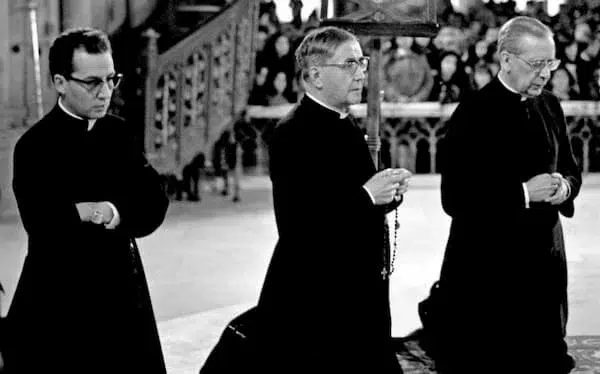
His first trip to the city of Ars (France), to visit the places where St. John Mary Vianney carried out his pastoral work and to pray before his remains, was in 1953. After that, he returned on numerous occasions. Always accompanied by Don Alvaro del Portillo, he returned in 1955, 1956, 1958, 1959 and 1960. St. Josemaría always had faith in his intercession and emphasized his priestly traits.
St. Josemaría, referring to the dedication of priests to the sacrament of PenanceHe said to them: "Sit in the confessional every day, or at least two or three times a week, waiting there for the souls as the fisherman waits for the fish.
At first, perhaps no one will come. Take with you the breviary, a book of spiritual reading or something to meditate on. In the first few days you will be able to; then a little old lady will come and you will teach her that it is not enough for her to be good, she must bring her little grandchildren with her.
After four or five days, two little girls will come, and then a boy, and then a man, a little on the sly.... At the end of two months they will not let you live, nor will you be able to pray anything in the confessional, because your anointed hands will be, like those of Christ - confused with them, because you are Christ - saying: I absolve you".
The power of a yes
St. John Mary Vianney was neither a great theologian nor an ecclesial reformer. He was, quite simply, a priest faithful to his vocationa man in love with Christ and souls. His life teaches us that holiness is not reserved for the wise or the strong, but for those who trust in God and give themselves without reserve.
His witness is still relevant and necessary. In every seminarian who is trained with the help of the CARF Foundation there is a possibility that a new Curé of Ars will emerge. Because what the world needs is not only good professionals, but also a new Cure of Ars. holy priests.
???? Did you know that...?
The Holy Curé of Ars went to confession every day.
He was tempted for years to leave his parish, but never gave in.
When asked about his secret, he would reply, "I get up and go to church."
He said: "The priesthood is the love of the Heart of Jesus".
???? Supports the formation of future saintly priests
Would you like more priests like St. John Mary Vianney to bring the Gospel and the faith to all the dioceses of the world?
With your donation, you help form seminarians and diocesan priests at the University of Navarra and the Pontifical University of the Holy Cross.
???? Find out how to collaborate with the CARF Foundation: !donate now!
Family prayer: how to learn to pray
Best of all, these times of intimacy bring us closer to each other and to God. "Let us pray that each of us may find consolation in a personal relationship with Jesus, and from his heart, learn to have compassion for the world," Pope Leo XIV prays in English in his first contribution to 'The Pope videoa monthly reflection published by the Global Network of Prayer of the Pope. Summer is always a good time to pray as a family; to pray together.
Importance of prayer in the family
Having the opportunity to grow up in a home where prayer is part of everyday life is a beautiful blessing. Its importance lies in the example of parents to children. Learning to pray in all seasons of life together with the family strengthens the union and family ties.
Family prayer springs from listening to Jesus, from reading and being familiar with the Word of God. "Faith reaches its greatest fruitfulness when it is lived in interaction with others, and in the first place with our spouse and our children, who, in fact, form our first community of life, our domestic Church." (Cic, 1655).
Living the faith in a concrete way in the home implies that there are moments of family prayer, moments of living the sacraments together, especially at Sunday Mass, which can become an authentic ritual to be enjoyed together.
It is not necessary to pray long prayers or make ostentatious acts. To pray as a family, prayers in church, made with devotion and constancy, can be enough, adding the family intentions. Simple gestures of piety, such as blessing the table, praying before going to bed or when traveling, reaffirm the Lord's presence in the home.
The union of family prayer
Praying as a family is the very foundation that holds the family together. because the family that prays together stays together. This spiritual principle, which involves prayer within the family, is a very important factor of change that helps to overcome difficult times. A family that focuses on taking time for prayer has a foundation that may be shaken at times, but will withstand whatever comes against it.Families who have their eyes constantly and sincerely fixed on the Lord, with devotion and humility, experience his great providence.
Jesus Christ taught us that "when two or three are gathered together in my name, there am I in the midst of them". (Matthew 17,19). Praising God, thanking Him and asking Him for His gifts is an essential part of a person's life. Christian family.
God wants a unity derived from Him. That is why Paul admonishes the church to be one. (1 Corinthians 1:10) And that is also why Jesus teaches that husband and wife are one flesh. (Matthew 19:5) These commandments of God call for total surrender. The family is a community of faith, hope and charity. That is why we can call it the domestic Church. The Christian family is a communion of persons, reflecting the communion that exists in God between the Father, the Son and the Son, and the Holy Spirit.
Families praying together they establish trust among themselves, learn to pray in community and come to an agreement through Jesus. This custom helps to bring unity to domestic life.
The family is a small church and our ministry begins at home. To care for it is to care for each member of the family, to show them God's way, to guide them to grow in the Lord, and to prepare them for adult life. Prayer is an important element in this process. A family that prays united with the heart for each other will pray with the heart for the world.
When God dwells in a family, happiness abounds in all its members.
Family recollection helps everyone
Education in the faith and the catechesis of children place the family in the sphere of the Church as a true subject of evangelization and apostolate. This year Pope Francis wants to strengthen the family, especially for this reason he named 2021 as the Year of the Family. And in CARF we have reflected on the challenges of the family in the 21st century in the Virtual Reflection Meetings.
Families, and more specifically parents, are free to choose for their children a particular model of religious and moral education, according to their own convictions. But even when they entrust these tasks to ecclesiastical institutions or to schools run by religious personnel, it is necessary that their educational presence remain constant and active.
For his general audience on 26/08/2015 Pope Francis chose to speak about family prayer. He explained that it is in the family that we learn to pray and to ask for the gift of the Holy Spirit. He said that the Gospel meditated on in the family is like good bread that nourishes the heart and asked parents to teach children to make the sign of the Cross.
How to pray as a family
An important part of how family prayer begins with shared reading and meditation of the Word of GodThe Word of God, a very good opportunity to create a family communion around Christ. Living the Word of God entails putting it into practice for the good of spouses and children, through the personal practice of virtues, tolerance and forgiveness. Faith, source of love, gives us the full reason to love our family by respecting it and being generous towards it.
The Bible tells us about these families of the early Christians, the domestic Church, St. Paul says(1 Cor 16:19)to which the light of the Gospel gave new impetus and new life. Pope Francis calls it a "home of mission".a home that fulfills the Lord's commission (Mt 28:19) spreading the Gospel of the family around him.
Example in the sentence
As far as children are concerned, the best way for parents to pass on the faith to their children is to live it themselves. There is no better catechesis for a child than the image of his or her parents united in prayer; such an image is more edifying, profound and lasting than words. Children need to see their parents praying at home. It is vital that family prayer be with devotion, that it not be limited to words, but that it be transformed into deeds and testimonies of faith, so that the children learn to make gestures, to repeat some simple formulas, some songs, to be in silence speaking to God.
The child learns to place our Lord in the line of the first and most fundamental affections, says St. Josemaría; he learns to treat God as Father and our Lady as Mother; he learns to pray, following the example of his parents. When one understands this, one sees the great apostolic task that parents can carry out, and how they are obliged to be sincerely pious, to be able to transmit, rather than teach, this piety to their children, which begins with family prayer.
St. Josemaría also emphasizes the uniqueness of each family and promotes using one's own creative methods to pray as a family and give thanks to God. In this way, family members become accustomed to praying at all times, and will have tools for their spiritual and emotional health.
In the family, faith must not remain an empty word or a posture, but must become a source of transformation that leads to desiring and doing good to others.
How to pray as a family with 2-7 year olds
For the young child, family prayer is often the occasion for tender intimacy with his parents. Seeing them leave their busy lives to prepare to meet God shows you the importance of this relationship. To initiate a moment of prayer with your child, Invite him to sit quietly and look at you, without speaking, while you light a candle in front of an image. This gesture associated with silence will give a certain solemnity to this moment. It will naturally lead the child to interiority. Afterwards, the child can begin to review his day, confide a problem or give thanks for the joys received.
How to pray as a family with 8-13 year olds
Catechesis completes the spiritual experience in the family, but this age group has a particular tenderness in this very familiar moment. The child is receptive and willing, we are also talking about an age of grace from a spiritual point of view. The rite is of great importance, praying an Our Father with him is a way of teaching him that beyond the family group there are many other people who pray. But encourage him also in his completely personal relationship with God. Reading the gospel will teach you that you can entrust your joys, sorrows and even your anger to God.
How to pray as a family for 14-16 year olds
With teenagers, praying as a family becomes more difficult. Their faith is more intimate and they do not like to manifest it.The influence of their friends often prevails over that of the family. The time has come to take care of their choices rather than impose our own.
Let us have the humility to accept that our children may not join in, or that they may do so in a way that is different from our way of praying. They will be able to pray or sing in chapel with their age group, participate in a meeting of young Christians, etc. Whether they tend toward mysticism or reject everything outright, they will have known the joy of prayer, and will be able to return to it at any time in their lives. P. "We are responsible for what we sow, not what grows!"Jean-Noël Bezançon.
A corner at home for prayer
Finding a place in your home for recollection helps to turn your home into a "domestic church". Above all, to face these difficult times that we are living in the world today. It is convenient to find a place in our home to establish a climate of family prayer. This corner facilitates recollection and calls for prayer. It is a powerful tool for family prayer, although it is not exclusively reserved for collective prayer because each individual can find there the calm and silence necessary to get closer to God during the day.
The permanence of this place in the house reminds everyone, throughout the day, of the role of prayer in our life, its vital importance. The family prayer corner can have a light permanently lit in front of the crucifix or image of Our Lady to remind us of God's reassuring presence.
We can also decorate it with fresh flowers and add written family petitions. Especially when we have small children these activities can make them feel part of this corner and family prayer time.
In spite of the complicated time in the family (...) Prayer allows us to find peace for the necessary things. Pope Francis, 2015.
Examples of family prayers
Pope Francis composed this prayer on the occasion of the Feast of the Holy Family. This year 2021, the pope also invites us to pray a novena as a family.
Jesus, Mary and Joseph in you we contemplate the splendor of true love, to you, with confidence, we turn. Holy Family of Nazareth, also make our families place of communion and cenacle of prayer, authentic schools of the Gospel and small domestic churches. Holy Family of Nazareth, that there will never again be episodes in families of violence, closed-mindedness and division;
that whoever has been injured or scandalized be soon comforted and healed. Holy Family of Nazareth, that the forthcoming Synod of Bishops to raise everyone's awareness of the sacred and inviolable character of the family, of its beauty in God's plan. Jesus, Mary and Joseph, hear, receive our plea.
Praying the Holy Rosary as a family
Parents can help their children discover the beauty of this simple prayer, perhaps by teaching them to pray first one mystery, then two, and by explaining the meaning of this beautiful prayer addressed to the Mother of God and Mother of the Church.
"Would that the beautiful custom of praying the Rosary as a family would be revived!"
The Church has been willing to grant innumerable graces and indulgences when praying the Holy Rosary in the family. Let us take the necessary means to encourage this prayer so pleasing to the Lord and to his Blessed Mother, and which is considered "a great public and universal prayer for the ordinary and extraordinary needs of the holy Church, of the nations and of the whole world". It is a good support on which the family unit relies and the best help to face its needs.
The St. James the Apostle is the eldest son of Zebedee and Mary Salome. Brother of John, the Evangelist. They lived in the city of Bethsaida, by the Sea of Galilee, where they had a small fishing business.
The name Santiago comes from the words Sant Iacob, from the Hebrew Jacob. During battles the Spaniards used to shout out Saint Jacob, help us and by saying it fast and repetitively it sounded like Santiago.
After witnessing the miraculous catch of fish, hearing Jesus say to them, "From now on you will be fishers of men," James left his nets, his father and his fishing company and set out to follow Jesus Christ.
James the Greater was one of the twelve disciples. Together with Peter and John, they accompanied Jesus in very important moments of his life. Such as the Transfiguration of the Lord, which we remember in the fourth of the Luminous MysteriesThe miraculous catch of fish and Jesus' prayer in the Garden of Gethsemane, among others.
The Acts of the Apostles relate that James was the first apostle martyred, beheaded by order of Herod Agrippa around the year 43 in Jerusalem.
Santiago came to Spain to proclaim the Gospel. The Cathedral of Santiago de Compostela is its main sanctuary, where the relics of the apostle are kept. Thousands of people make pilgrimages there every year, eager to walk the Camino de Compostela. Santiago apostle is represented dressed as a pilgrim or as a soldier mounted on a white horse in fighting attitude.
In 1982, when St. John Paul II visited this Spanish Cathedral, he called on Europe to revive "those authentic values" proclaimed by St. James.
The apostle St. James is also known for having paved the way for the Virgin Mary to be recognized as the "Pillar" of the Church.
Pope Francis, in February 2014, reflecting on armed conflicts, noted that James gives us simple advice: "Draw near to God and He will draw near to you."
The importance of St. James the Apostle in Spain
Although since the ninth century the kings of the reconquest recognized St. James the Apostle as their patron saint, it was not until the seventeenth century when the patronage of Spain was granted to the saint.
Pope Urban VIII, in 1630 declared, under the reign of Philip IV, that St. James the Apostle was officially recognized as the sole patron saint of Spain (which since 1627 he shared with St. Teresa of Jesus).
This decision was made in conjunction with the recognition by the Church that his remains were buried in Compostela and also establishing that the feast of St. James the Apostle would be celebrated every July 25.
Since 1646, by Philip IV, the Vow of St. James was institutionalized, which consisted of an offering by the kings, princes and the archbishop of Compostela to the Virgin of Santiago de Compostela. Santiago Cathedral every July 25th. This offering still takes place today, albeit in a symbolic way, at one of the parts of the Mass of the celebration on the Apostle's Day.
"The Camino de Santiago awakens one of the deepest desires of man's heart, the yearning to purify oneself, to improve; in short, the desire for God." St. Josemaria Escriva Image by Almudena Cuesta
When is St. James' Day?
It is the 25th of July when the festivity of the apostle Santiago and the day of Galicia is celebrated. This is a Christian celebration that takes place in many Spanish towns and places around the world.
However, since the end of the Dictatorship in Spain, the Apostle's Day is not a holiday throughout the country, but only in the autonomous communities that so decide each year when setting their holiday calendar, with the exception of Galicia, which celebrates its big day, so it is a holiday every year.
What do we celebrate and why on Santiago Apostle's Day?
On this day we celebrate the death of the saint, his death by martyrdom, an end that together with his character as a disciple very close to Jesus Christ gives him his name of apostle and saint. There are data and references that point to the year 44 as the date of the martyrdom of Santiago, although the choice of July 25 does not seem to be based on any historical data.
In any case, the celebration of St. James' Day is a very ancient celebration, a feast established in Rome around the tenth or eleventh century when we have news of its celebration in the Roman basilica of St. Peter.
In addition, on the day of St. James plenary indulgences can be obtained, that is, the possibility of obtaining forgiveness of sins for the pilgrims or faithful. In order to gain the Jubilee, and obtain the plenary indulgence, three conditions must be fulfilled:
Visit the tomb of St. James the Apostle in the cathedral.
Saying a prayer.
Receiving the sacrament of Confession fifteen days before or fifteen days after visiting the tomb and receiving communion.
Where is Santiago Apostle's Day celebrated?
Today, in the XXI century, the feast of St. James Day is celebrated more than ever in Galicia in the city of Santiago de Compostela. It represents the religious and forgiveness aspects that unite and congregate pilgrims from all corners of the world in the different areas of the city.
During the 25th, the celebration of La Holy Mass solemn ceremony in the cathedral, in which the king or a delegate of the Royal Household makes the traditional offering to the apostle Santiago.
Within the current celebration are the magnificent fireworks that take place in the Plaza del Obradoiro during the night of the 24th, which in recent years has been accompanied by projections and audiovisual shows on the facades of the cathedral and other historic buildings in the square.
"...from James we can learn many things: the readiness to welcome the Lord's call even when he asks us to leave the boat of our human securities, the enthusiasm in following him along the paths he points out to us beyond our illusory presumption, the readiness to bear witness to him with courage, if necessary even to the supreme sacrifice of life. (...) Following Jesus like James, we know, even in the midst of difficulties, that we are on the right path." Benedict XVI, General Audience June 2006
How the Camino de Santiago came about
The apostle Santiago is one of the most important saints of Christianity. After the discovery of his tomb around the year 813, where his remains rest, many Christians from the north of the country began to pilgrimage to what is now Santiago de Compostela to show his devotion.
This custom became a tradition, expanding the phenomenon of the Camino de Santiago throughout Europe, so that the city became one of the most important centers of pilgrimage in Christianity, along with Rome and Jerusalem.
In addition, pilgrims to Compostela could obtain general forgiveness for all their sins, a forgiveness that could be extended to the whole year when the feast fell on a Sunday, that is, when it was a Compostelan Holy Year.
Prayer to ask for the intercession of the apostle on St. James' Day
Almighty and merciful God, that you chose twelve apostles to evangelize the whole world. Among them, three were favored in a special way by Your Son Jesus Christ, who deigned to include the Apostle Santiago in this select number.
Through her intercession may we be worthy to obtain the glory of Heaven, where You live and reign forever and ever. Amen.
St. James the Apostle and Our Lady of Pilar
This saint is closely related to Zaragoza since it is known that Santiago Apostle "arrived with his new disciples through Galicia and Castile, to Aragon, where the city of Zaragoza is located, on the banks of the Ebro.
On the night of January 2, 40, Santiago was with his disciples by the Ebro River when "he heard the voices of angels singing Ave Maria, Gratia Plena and saw the Virgin Mother of Christ appearing, standing on a marble pillar".
The Blessed Virgin, who was still living in mortal flesh, asked the Apostle that a church be built for her there, with the altar around the pillar where she was standing, and promised that "this place will remain until the end of time so that the virtue of God may work portents and wonders through my intercession with those who in their needs implore my patronage".
The Virgin disappeared and the jade pillar remained there. The apostle Santiago and the eight witnesses of the prodigy immediately began to build a church on that site. The Basilica of the Virgin of Pilar in Zaragoza.
In honor of the apostle, one of the towers of the Pilar, the high gate of the Plaza, bears the name of Santiago. In addition, Zaragoza is also one of the stops on the Camino de Santiago and has a church named after the apostle: the Church of Santiago el Mayor, where Holy Mass is celebrated on St. James' Day.