December 28, Feast of the Holy Family, cradle of love
The family is defined as a school of love. This year, since Christmas does not fall on a Sunday, we celebrate the feast on the last Sunday of the year instead of the Friday before.
«The Redeemer of the world chose the family as the place for his birth and growth, thus sanctifying this fundamental institution of every society.» Pope Saint John Paul II, Angelus message, December 30, 2001.
The teachings
The family The family is an intimate communion of life and love, founded on marriage between a man and a woman, open to the gift of human life and love forever. This feast points to the Holy Family of Nazareth as the true model of life. All the families of the world should always turn to the protection of the Holy Family, in order to learn to live love and sacrifice.
The family is defined as a school of love and a domestic Church. The family is the providential place where we are formed as human beings and as Christians. Our family is where we grow in wisdom, age and grace before God and mankind.
It must be a place of dialogue between God and man, open to the Word and to listening. Seconded by the family prayer that binds us together strongly. Saint John Paul II strongly recommended praying the Holy Rosary within families, and he kept in mind the saying: «the family that prays together, stays together.».
It is for all these reasons that the Feast of the Holy Family invites us to welcome, live and proclaim the truth and beauty of the family, according to God's plan.
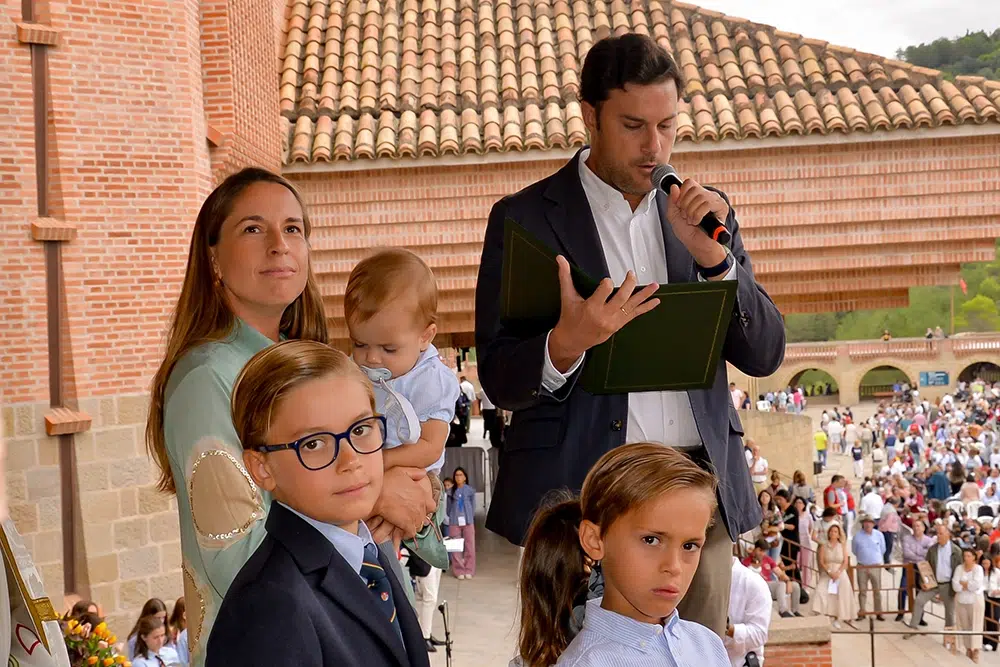
A family in Torreciudad giving thanks to the Virgin Mary.
Source of priestly vocations
The identity of Christ and his mission have taken shape in history and in the world in the bosom of the Holy Family. We can say that this is the model within which, in the vast majority of cases, the Lord's call to the sons of Christian families to their consecration and vocation to the priesthood takes place. For this reason, the role of Christian families is fundamental in the emergence of vocations.
Both the priesthood and the consecrated life are free gifts from the Lord and it is indisputable that the vast majority of vocations arise from within families that believe and practice, from environments in which the values of the Holy Family of Nazareth are lived.
To discover this vocation, the role of parents in the formation of their children is crucial. No institution can replace their work in education "especially as regards the formation of conscience. Any intrusion in this sacred sphere must be denounced because it violates the right of parents to transmit to their children an education in conformity with their values and beliefs",
Cradle of the vocation to love
In the Familiaris consortioPope John Paul II taught that "Christian marriage and the Christian family build up the Church: for in the Christian family the human person is not only brought into being and progressively introduced into the human community by means of education, but also by means of the rebirth of the human person. baptism and education in the faith in which the child is also introduced into the family of God, which is the Church".
The home that lives following the example of the Holy Family is a school of prayer. From an early age, children learn to place God spontaneously in the first place, recognizing Him and dialoguing with Him in all circumstances. TIt is also a school of lived faith, where learning does not take place in a theoretical way, but is embodied in everyday work. Likewise is a school of missionary diffusion as active promoters of consecrated vocations.
Living the gospel is not easy today, even more so in these times. However, In the Gospel we find the way to live a holy life on a personal and family level, a certainly demanding but fascinating path. We can follow the example of Jesus of Nazareth and thanks to his intercession.
In every home there are happy and sad, peaceful and difficult moments. Living the gospel does not exempt us from experiencing difficulties and tensions, from encountering moments of happy strength and moments of sad fragility. We must understand that it is the Holy Spirit who guides every human being today. But we must listen to the Spirit who speaks in us; we need a gaze of faith to grasp the reality beyond appearances.
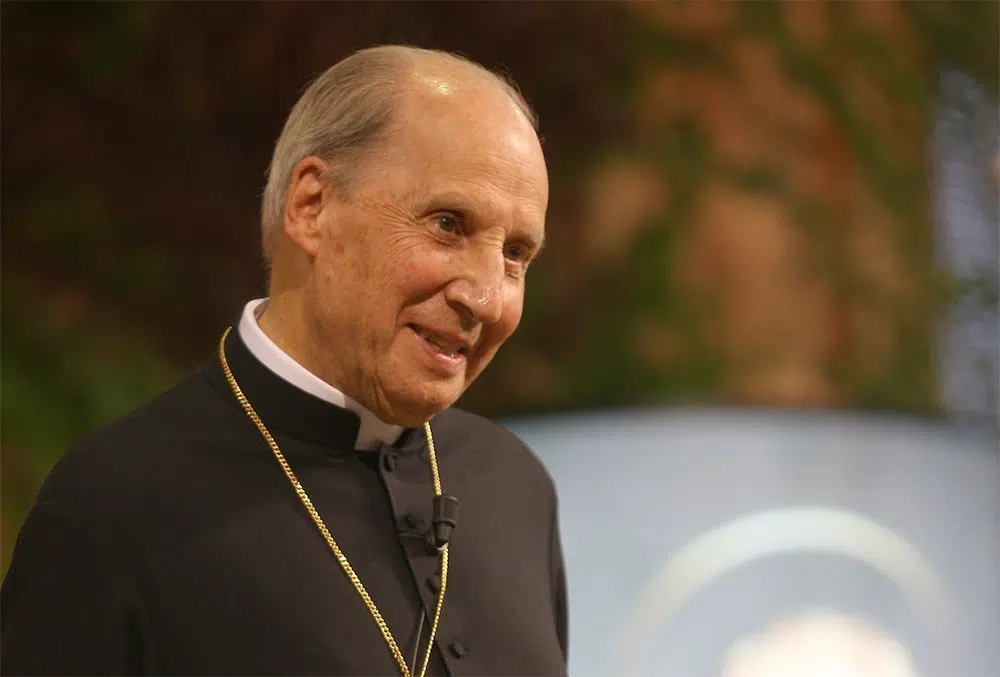
Monsignor Javier Echevarría at the shrine of Torreciudad alluded to the fact that it is the family home "where the various vocations in the Church are forged", and expressed the wish that families be "truly Christian, that they consider the call of some of their sons to the priesthood a great divine blessing".
Discernment of vocation in the Christian home
Pope Francis offers us in the apostolic exhortation Christus vivitten guidelines for reflecting on the feast, home education and facilitating the process of vocational discernment for children.
It is the privileged environment to listen to the Lord's call. and to learn to respond to it with generosity, because "it is the sphere in which one is loved for oneself, not for what one produces or for what one has".
The importance of education in the faith. It is there that one learns best the relationship with the living Jesus Christ. For this reason, they encourage us to pray together and to participate in the sacraments.
Training in virtues "so that those who are called can give their generous yes to the Lord and remain faithful to this yes". Among these virtues, he emphasized fortitude, "to be able to go against the current in the face of the welfare society".
The pope urges to live the experience of encountering Christto listen to his Word and to recognize his voice through discernment", open to the possibility of consecrating oneself to God in the priesthood or in the consecrated life.
They also advise parents to keep in mind in the education of their children that "we are not the owners of the gift but its careful stewards teaching them to recognize themselves as a gift and to accompany them in discernment, but not to make decisions for them".
Consider life as an offering. Instill that "I am a mission on this earth, and that is why I am in this world".
Forging in Charity
Forging children in charity because "the family is not a cell isolated in itself, which does not care about what happens around it. This charitable dimension begins in the extended family, caring especially for grandparents and the elderly, but it must be open to the needs of others."
Promote the knowledge of the different vocations. and to establish a culture of vocations. The Pope regrets that Christian families "oppose the vocation of their children to the priesthood or consecrated life or ask them to prioritize their professional future, postponing the call of the Lord". As for the vocation to marriage, "there is nothing more stimulating for children than to see their parents live marriage and the family as a mission, with happiness and patience, despite difficulties, sad moments and trials".
As a Church, "we have the mission of accompanying families who live in our communities. To reach out to families living in marginalization and poverty; to be very aware of migrant families; not to leave aside families that have suffered separation and divorce".
Bibliography:
- Synod of Bishops, 2001. - Spanish Episcopal Conference 2022. - Pope Francis Audience, 2019. - Post-Synodal Apostolic Exhortation Christus Vivit, Pope Francis, 2019.
Table of Contents
«It is our responsibility to the universal Church»: benefactors of the CARF Foundation
Margarita, Manuel, Alex, David, and Luis are some of the CARF Foundation's benefactors who are collaborating in the campaign. May no vocation be lost.They tell us why they collaborate with the universal Church in the comprehensive academic and spiritual formation of seminarians and diocesan priests.
Responsibility to the universal Church
Margarita and Manuel: «We learned about CARF through Alejandro Cantero, former president of the CARF Foundation who passed away a few years ago. He spoke with genuine enthusiasm about this wonderful work, which we witnessed on our first trip to Rome for an international meeting when we visited the Pontifical University of the Holy Cross and the International Seminar Sedes Sapientiae.
On this trip we were able to realize the true sense of universality of the ChurchThe priests and seminarians we met, young people of different races and cultures but with the same enthusiasm, with the same desire, to be formed as priests and then return to their countries of origin, where they will exercise their priestly work among their people and as formators of the seminaries.
«We check the atmosphere of joy and service that permeated the seminary, not only among the young people but also with their formators, who are dedicated to caring for their formation and their life of piety.
You can imagine that their stories were very diverse, as was their call to vocation, but we understood right away that We had a responsibility to the Church. We had lamented so many times about the lack of vocations and asked God for them, and now we saw that God does call young people, all over the world, but they need to be formed and formed well, and here we all had a responsibility, so that none of them would be lost due to lack of means.
Getting to know these young people, where they study, how they live and their sense of responsibility, making the most of these formative years, and living in gratitude for it, reaffirmed our desire to do our bit.
We can tell you that By collaborating with the CARF Foundation, we are working directly with churches around the world., priests are fundamental pillars, they are the ones who administer the sacraments and, therefore, where a priest carries out his work, the Church arrives.
The transcendental importance of priests
For his part, Luis, comments: «I learned about the CARF Foundation through the Foundation's magazine that was sent to my home. It motivated me to financially support the Foundation., the transcendental importance of priests inside and outside the Church.
Inside, for the administration of the sacraments and for the preaching of the Gospels (both decisive for the sanctification of all its members). And outside, for the propagation of the word of the Lord (both by word and example). The holier and better prepared they are, the more effective their work will be for everyone.
I would encourage people to invest in the formation of priests because of the above and the scarcity of financial means, which unfortunately the Church has, especially at this time".
"By collaborating with CARF, we help in a direct way with the Church around the world. Priests are fundamental pillars."
'Priests are God's staff'
Alex is a benefactor of the CARF Foundation who has collaborated, among other things, in the training of seminarian Jacobo Lama from the Dominican Republic, who studies at the Pontifical University of the Holy Cross in Rome and has just completed his studies.
Alex is dedicated to training people in their search for employment, a goal that he has also transferred to his work: «Priests and seminarians are going to work for God; they are going to be 'God's staff.' Therefore, without financial resources for their training, it would be very difficult for them to perform this work to the fullest,» he says.
"When I went to Rome, I was able to get an idea of the importance of the work carried out by the CARF Foundation and the human qualities of the seminarians who train there. Diocesan seminarians, who come from a wide variety of countries and who will later return to their respective dioceses to pass on the training they have received.
Dioceses that do not have the necessary financial resources, but are instead a wonderful source of vocations, a 'raw material' that is a gift from the Church and that we must care for at all costs. I have been there five times (the foundation has awarded me the medal they give after five international meetings) and each time I return more impressed and encouraged to continue lending a hand after looking out of this window from which you can see the universality of the Church.
"Putting human resources at the service of God."
I am dedicated to helping people find work and therefore the theme "employment" motivates my day to day. My collaboration with CARF is not unrelated to this because I cannot help but see all these seminarians as "God's staff", those who are going to be on the payroll full time, with an unattractive salary but who contribute for the maximum pension, without a doubt. A job with guaranteed joy, for them and for us. And in the most diverse, distant and unimaginable places.
Entrepreneurs must consider, among other things, the return on any investment we make (ROI), and investing in the training of seminarians (which is tax deductible) is probably the best deal you can make, as you get a hundredfold return. These days, we hear a lot about essential jobs. Being a priest, exercising the priesthood, is one of the few essential jobs that cannot be done remotely.
We have a significant shortage of priests, and it is probably the most difficult position to fill, as it is not a matter of having a good grade point average to enroll in a university or receive training. online. It's about vocation and God's calling. That's why, when a vocation appears, and even more so if it lacks financial means, we must pitch in to nurture it, train it well, and help it succeed.
We complain about the lack of priests but in CARF we have as many as we want, from all countries. They have the vocation. We have the means. It would be unforgivable to lose vocations for lack of economic resources".
"The world needs priests. It would be unforgivable if vocations were lost due to lack of economic resources."
David encourages collaboration with CARF for the good of the Universal Church. "Priests are very important to maintain Christian culture, traditions and faith, as well as contributing to the great social work that the Church and priests do in many underdeveloped countries," he says.
Giving time and money
David: «I learned about the CARF Foundation thanks to Alejandro Cantero, who at that time, in 2005, was the president of the Foundation. With patience and as if he had all the time in the world for me, he explained the Foundation's origins, history, and goals.
Among the aims of the Foundation are the integral formation of diocesan priests and seminarians from all over the world, especially from the most needy countries. In the first place, scholarships are given to seminarians who apply and are sent by the Bishops of the five continents.
Other specific purposes to which the CARF Foundation devotes its activities are the promotion and maintenance of the centers and institutions where priests and seminarians live or are trained: the Ecclesiastical Faculties of the University of Navarra and the Pontifical University of the Holy Cross.
After the extensive and complete presentation that Alejandro Cantero made to me, he proposed me to collaborate as a member of the Board of Trustees that governs the Foundation; and in spite of the great responsibility that it meant for me, I decided to accept the position. I knew from the previous explanations that the Foundation is a non-profit entity and I assumed from the beginning that this was going to cost me time and money; but the motivation for accepting the position was the observation of the need to defend my traditions, my beliefs and my culture, given my status as a Catholic and my faith.».
Changing the world
"I thought: from this Foundation we can change the world, and how! Later, while working at the CARF Foundation, I personally witnessed how two characteristics instilled by Baptism were fulfilled, namely: the priestly soul and the apostolate. Priestly soul, to become aware of helping your Church, that it may be Holy, Roman, and Universal.
Apostolate, according to the Gospel mandate: "Go into the whole world and proclaim the Gospel". And who better than priests to preach the Gospel. So I had only to help and contribute with my means and according to my possibilities to that priority work of the Church where you touch its heart, its spinal cord. As Catholic Theology says, the Church needs the Eucharist and the Eucharist needs the priests.
That firm decision to dedicate time and work to collaborate with CARF, sharing it with a demanding professional job and with the duties of a large family of six children in my case, is something that has done me a lot of good and that I would like to share with all those people who would like to help us as collaborators or benefactors, working on something so fascinating and for which God will reward us abundantly.
Some may dedicate a lot of time, others less, but the important thing is to carry this message in our hearts and take advantage of every opportunity to inform and enthuse others about the objective and the work we do.
An anecdote comes to my mind that I was told about a Brotherhood in Andalusia, which took an image in procession and to defray the expenses, they put underneath a jar with a cardboard that said: with these donations we cover the annual expenses. The way to collaborate is as follows: Those who have much, with much. Those who have less, with less. And those who have nothing, with nothing.
But everyone can pray and help spread the word, I might add.
In CARF even if you have nothing it does not matter, because we can all pray and ask God for the Church and to send us many and holy priests. This is how the world would change, spreading Catholicism, speaking the Truth in capital letters, with freedom and without impositions.
The good done to the universal Church
I would encourage many people to collaborate with CARF because of the good they do for the Universal Church and also for themselves. And it is very important to maintain the Christian culture, traditions and faith; besides contributing to the great social work that the Church and priests do in many underdeveloped countries.
Table of Contents
Sergio Rojas, priest: a Venezuelan vocation born far from God
Sergio Rojas did not grow up in a religious family, nor did he dream of becoming one. priestly vocation. He barely knew God, and his life did not revolve around faith. However, this priest from Venezuela discovered that God's call can come even when you are not looking for it.
His story is that of a priestly vocation unexpected, forged in a personal encounter with Christ and sustained, years later, by the concrete help of benefactors and friends of the CARF Foundation.
A priestly vocation that did not begin at home
The vocational story of priest Sergio Rojas does not begin in a parish or in a family especially religious. On the contrary. Although her family considered themselves Catholic, faith was not really part of their daily lives.
«I have always considered my vocation to be something very special,» he explains. And he says this with good reason: for years, God was practically a stranger to him.
The turning point came thanks to his best friend's mother. She was the one who first spoke to him about God in a personal and concrete way, and who introduced him to a community of Neocatechumenal Way. There began a journey of faith that, unbeknownst to him at the time, was planting the seeds of his priestly vocation.
When God bursts in without asking permission
Sergio had been walking in faith for barely three years when something unexpected happened. During some national Camino meetings, at the moment when vocations were being requested, he felt an inner restlessness that was difficult to explain.
«It was like a flame that burst into life,» he recalls. But along with that call came fear. He didn't feel ready. It seemed too soon. Too serious.
The question came up again some time later, in an even more direct way. A Mexican missionary nun, after meeting him, asked him a question that he couldn't get out of his head: «And you, when are you going to enter the seminary?».
From then on, the idea would not leave him alone. Until one day, before the Blessed Sacrament, he decided to stop resisting: «I challenged God. I said to Him, “If You want it, I want it.”».
That simple gesture marked the definitive beginning of his path to the priesthood.
From Venezuela to Pamplona: training to serve better
While in the seminary, his bishop made a decision that would change his life: to send him to Pamplona (Spain) to complete his training in the Bidasoa international seminar.
For this Venezuelan priest, My time in Spain was not just an academic experience. It was a deeply human and spiritual experience.
«In Bidasoa, I felt at home, despite being so far from my country,» he confesses. There he discovered something essential: «that the Church is not an abstract idea, but a universal family. People from very different cultures, languages, and realities, united by the same faith.».
That experience helped him better understand the world to which he would one day be sent as a pastor.
If Sergio took anything away from his stay in Pamplona, it was not a degree, but a way of living the priesthood.
«I trained myself to give my all to pastoral work,» he explains. He learned to understand the Church from within, to understand the different human realities he would encounter and to bear witness to Jesus Christ in the midst of them.
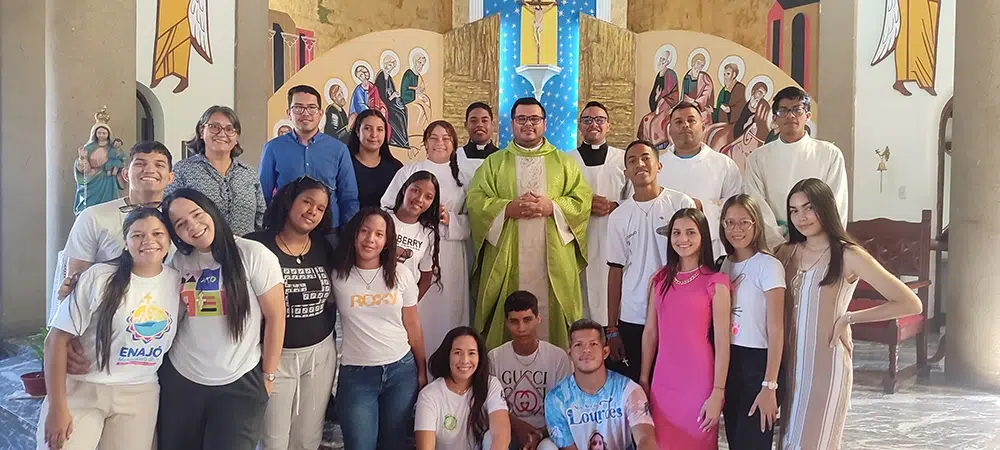
Father Sergio Rojas, priest of the Diocese of Margarita, accompanied by young people from the parish.
Among the aspects that most influenced his formation were constant spiritual direction, frequent Confession, and personal contact with Jesus in the Eucharist.
But there was one testimony that left a special mark on his priestly life: that of Father Juan Antonio Gil Tamayo, his formator, who lived through his illness with a serene and luminous faith.
«He showed us that spiritual strength allows us to look beyond suffering and discover the will of God even on the cross,» he recalls.
The priest today: serving and not isolating oneself
Father Sergio Rojas does not idealize the priesthood. He is well aware of the current challenges and difficulties facing the Church.
For him, the key is clear: prayer, dedication, and humility. The priest, he says, is called to serve, not to seek comfort or recognition.
He also insists on the importance of not living in isolation. «The priest must be with the people, know their reality, share their joys and sufferings.» But all this only makes sense if it arises from a living encounter with Jesus Christ. «Without prayer, the priesthood loses its essence,» he asserts. Venezuelan priest.
Gratitude to the CARF Foundation: support that makes vocation possible
Looking back, Sergio Rojas has no doubts: without the help of benefactors and friends of the CARF Foundation, his story would have been very different.
«Without you, I would not have been able to travel, study, or train in Pamplona,» he says gratefully. This is not a platitude, but a concrete reality: his priestly vocation He also benefited from the generosity of people who invested in his education.
That's why, he says, there will always be a prayer grateful to those who make it possible for other seminarians and priests to prepare themselves to better serve the Church.
Table of Contents
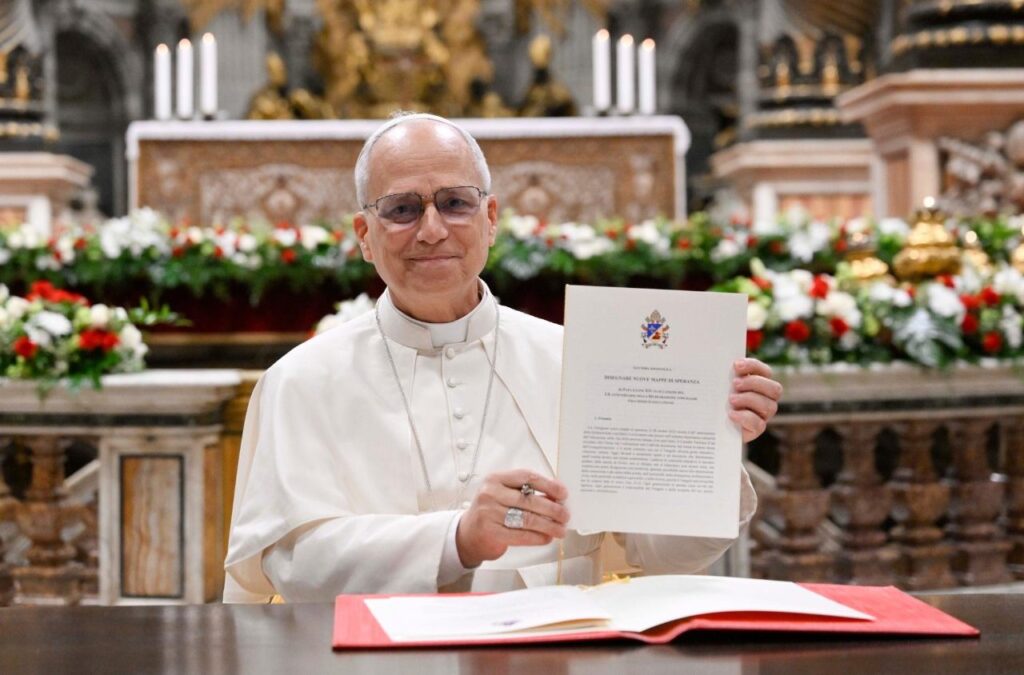
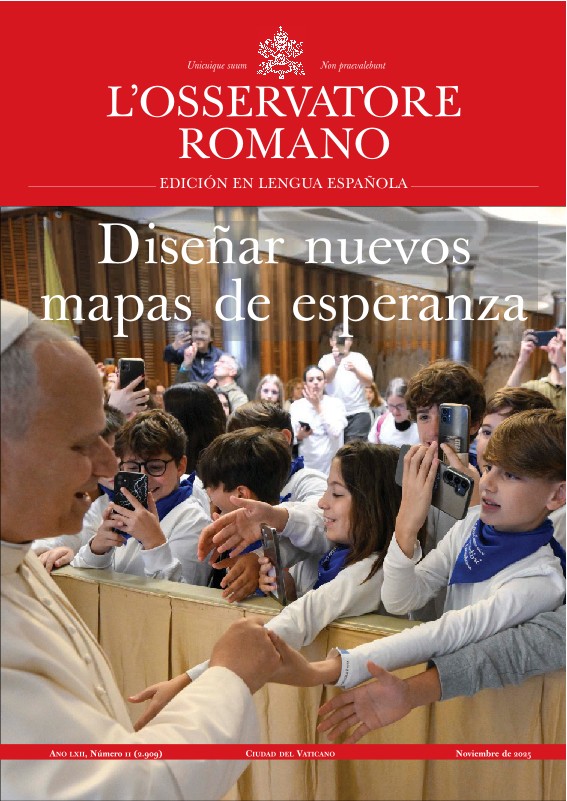
«Designing New Maps of Hope,» Apostolic Letter of Pope Leo XIV
In this apostolic letter, the Pope Leo XIV He speaks of education as «an act of hope and a passion that is renewed because it manifests the promise we see in the future of humanity.» As he reminded us in his Apostolic Exhortation Dilexi te, Education «has always been one of the highest expressions of Christian charity.» The world needs this form of hope.
In this context, the Holy Father asks educational communities to «disarm words, lift up their gaze, and guard their hearts.».
1. Foreword
1.1. Designing new maps of hope. October 28, 2025 marks the 60th anniversary of the conciliar Declaration. Most serious education on the extreme importance and relevance of education in human life. With that text, andThe Second Vatican Council reminded the Church that education is not an ancillary activity, but rather constitutes the very fabric of evangelization: it is the concrete way in which the Gospel becomes an educational gesture, a relationship, a culture. Today, in the face of rapid changes and disorienting uncertainties, that legacy shows surprising solidity.
Where educational communities allow themselves to be guided by the word of Christ, they do not retreat, but rather relaunch themselves; they do not build walls, but rather bridges. They respond creatively, opening up new possibilities for the transmission of knowledge and meaning in schools, universities, vocational and civic training, school and youth ministry, and research, because the Gospel does not grow old, but «makes all things new» (Ap. 21.5). Each generation hears it as something new that regenerates. Each generation is responsible for the Gospel and for discovering its seminal and multiplying power.
1.2. We live in a complex, fragmented, and digitized educational environment. That is precisely why it is wise to pause and take another look at the «cosmology of paideia Christian»: a vision that, over the centuries, has been able to renew itself and positively inspire all the multifaceted aspects of education. Since its origins, the Gospel has generated «educational constellations»: experiences that are both humble and powerful, capable of reading the signs of the times, of safeguarding the unity between faith and reason, between thought and life, between knowledge and justice. They have been, in the storm, an anchor of salvation; and in the calm, a sail unfurled. A beacon in the night to guide navigation.
1.3. The Declaration Most serious education has not lost its power. Since its reception, a constellation of works and charisms has been born that still guides the way today: schools and universities, movements and institutes, lay associations, religious congregations, and national and international networks. Together, these living bodies have consolidated a spiritual and pedagogical heritage capable of traversing the 21st century and responding to the most pressing challenges. This heritage is not immutable: it is a compass that continues to point the way and speak of the beauty of the journey. Today's expectations are no less than the many that the Church faced sixty years ago.
Rather, they have expanded and become more complex. Faced with the many millions of children in the world who still do not have access to primary education, how can we fail to act? Faced with the dramatic educational emergencies caused by wars, migrations, inequalities, and various forms of poverty, how can we not feel the urgency to renew our commitment? Education—as I recalled in my Apostolic Exhortation Dilexi te– «has always been one of the highest expressions of Christian charity» [1]. The world needs this form of hope.
2. A dynamic history
2.1. The history of Catholic education is the history of the Spirit in action. The Church, «mother and teacher» [2], not through supremacy, but through service: she generates faith and accompanies the growth of freedom, taking on the mission of the Divine Teacher so that all «may have life and have it in abundance» ( Jn 10:10). Successive educational styles have presented a vision of human beings as images of God, called to truth and goodness, and a pluralism of methods at the service of this calling. Educational charisms are not rigid formulas: they are original responses to the needs of each era.
2.2. In the early centuries, the Desert Fathers taught wisdom through parables and apothegms; they rediscovered the path to the essential, to discipline of speech and guarding of the heart; they transmitted a pedagogy of the gaze that recognizes God everywhere. St. Augustine, by grafting biblical wisdom onto the Greco-Roman tradition, understood that the authentic teacher arouses the desire for truth, educates freedom to read the signs and listen to the inner voice. Monasticism has carried on this tradition in the most inaccessible places, where for decades the classical works have been studied, commented on, and taught, so that without this silent work in the service of culture, many masterpieces would not have survived to this day.
«The first universities arose »from the heart of the Church,« and from their origins they revealed themselves to be »an incomparable center of creativity and dissemination of knowledge for the good of humanity." In their classrooms, speculative thought found in the mediation of the mendicant orders the possibility of structuring itself solidly and reaching the frontiers of science. Quite a few religious congregations took their first steps in these fields of knowledge, enriching education in a pedagogically innovative and socially visionary way.
2.3. Education has been expressed in many ways. In the Ratio Studiorum, the richness of the school tradition merges with Ignatian spirituality, adapting a curriculum that is as articulate as it is interdisciplinary and open to experimentation. In 17th-century Rome, St. Joseph Calasanz opened free schools for the poor, sensing that literacy and numeracy are a matter of dignity rather than competence. In France, Saint John Baptist de La Salle, «aware of the injustice of excluding the children of workers and peasants from the educational system» [4], founded the Brothers of the Christian Schools.
At the beginning of the 19th century, also in France, Saint Marcellin Champagnat devoted himself «with all his heart, at a time when access to education was still a privilege of the few, to the mission of educating and evangelizing children and young people» [5]. Similarly, Saint John Bosco, with his «preventive method,» transformed discipline into reasonableness and closeness. Courageous women, such as Vicenta María López y Vicuña, Francesca Cabrini, Giuseppina Bakhita, Maria Montessori, Katharine Drexel, and Elizabeth Ann Seton, opened paths for girls, migrants, and the least among us. I reiterate what I clearly stated in Dilexi te: «The education of the poor, for the Christian faith, is not a favor, but a duty» [6]. This genealogy of concreteness attests that, in the Church, pedagogy is never disembodied theory, but flesh, passion, and history.
3. A living tradition
3.1. Christian education is a collaborative effort: no one educates alone. The educational community is a «we» in which teachers, students, families, administrative and service staff, pastors, and civil society come together to generate life [7]. This «we» prevents the water from stagnating in the swamp of «it has always been done this way» and forces it to flow, to nourish, to irrigate. The foundation remains the same: the person, image of God (Genesis 1:26), capable of truth and relationship. Therefore, the question of the relationship between faith and reason is not an optional chapter: «religious truth is not only a part, but a condition of general knowledge» [8].
These words of St. John Henry Newman—whom, in the context of this Jubilee of the World of Education, I have the great joy of declaring co-sponsor of the Church's educational mission together with St. Thomas Aquinas—are an invitation to renew our commitment to knowledge that is as intellectually responsible and rigorous as it is deeply human. And we must also be careful not to fall into the enlightenment of a fides which is exclusively opposed to the ratio.
It is necessary to emerge from the shallows by recovering an empathetic and open vision in order to better understand how human beings are understood today, so as to develop and deepen their teaching. That is why desire and the heart must not be separated from knowledge: it would mean breaking the person. Catholic universities and schools are places where questions are not silenced and doubt is not prohibited, but rather accompanied. There, the heart dialogues with the heart, and the method is that of listening, which recognizes the other as a good, not as a threat. Heart speaks to heart was the cardinal motto of St. John Henry Newman, taken from a letter by St. Francis de Sales: «Sincerity of heart, not abundance of words, touches the hearts of human beings.».
3.2. Educating is an act of hope and a passion that is renewed because it manifests the promise we see in the future of humanity [9]. The specificity, depth, and breadth of educational action is that work, as mysterious as it is real, of «making the self flourish [...] is caring for the soul,» as we read in Plato's Apology of Socrates (30a-b). It is a «profession of promises»: it promises time, trust, competence; it promises justice and mercy, it promises the value of truth and the balm of consolation.
Educating is a task of love that is passed down from generation to generation, mending the torn fabric of relationships and restoring the weight of promise to words: «Every human being is capable of truth, yet the path is much more bearable when we move forward with the help of others» [10]. Truth is sought in community.
Representation of Maps of Hope: a map whose paths lead toward a sunrise symbolizing guidance, faith, and the future.
4. The compass of Most serious education
4.1. The conciliar declaration Most serious education It reaffirms everyone's right to education and points to the family as the first school of humanity. The ecclesial community is called to support environments that integrate faith and culture, respect the dignity of all, and engage in dialogue with society. The document warns against reducing education to functional training or an economic tool: a person is not a «skills profile,» not reducible to a predictable algorithm, but a face, a story, a vocation.
4.2. Christian education encompasses the whole person: spiritual, intellectual, emotional, social, and physical. It does not pit manual skills against theory, science against humanism, or technique against conscience. Rather, it calls for professionalism to be imbued with ethics, and for ethics not to be an abstract word, but a daily practice. Education does not measure its value solely in terms of efficiency: it measures it in terms of dignity, justice, and the capacity to serve the common good. This comprehensive anthropological vision must remain the central focus of Catholic pedagogy. Following the thinking of St. John Henry Newman, it opposes a purely mercantilist approach that often forces education today to be measured in terms of functionality and practical utility [11].
4.3. These principles are not memories of the past. They are fixed stars. They say that truth is sought together; that freedom is not a whim, but a response; that authority is not domination, but service. In the educational context, one should not «raise the banner of possession of the truth, neither in the analysis of problems nor in their resolution» [12]. Instead, «it is more important to know how to approach than to give a hasty answer as to why something has happened or how to overcome it. The goal is to learn to face problems, which are always different, because each generation is new, with new challenges, new dreams, new questions» [13]. Catholic education has the task of rebuilding trust in a world marked by conflict and fear, reminding us that we are children and not orphans: from this awareness, fraternity is born.
5. The centrality of the person
5.2. Catholic schools are environments where faith, culture, and life intertwine. They are not simply institutions, but living environments where the Christian vision permeates every discipline and every interaction. Educators are called to a responsibility that goes beyond their employment contract: their testimony is as valuable as their lessons. That is why training of teachers—scientific, pedagogical, cultural, and spiritual—is decisive. In sharing a common educational mission, a common path of formation is also necessary, «initial and ongoing, capable of grasping the educational challenges of the present moment and providing the most effective tools to address them [...].
5.1. Putting the person at the center means educating in the long view of Abraham (Genesis 15:5): helping them discover the meaning of life, inalienable dignity, and responsibility toward others. Education is not only the transmission of content, but also the learning of virtues. It forms citizens capable of serving and believers capable of bearing witness, men and women who are freer and no longer alone. And the training It cannot be improvised. I fondly remember the years I spent in the beloved Diocese of Chiclayo, visiting the San Toribio de Mogrovejo Catholic University, and the opportunities I had to address the academic community, saying: «No one is born a professional; every university career is built step by step, book by book, year after year, sacrifice after sacrifice.» [14].
This implies that educators must be open to learning and developing their knowledge, to renewing and updating their methodologies, but also to spiritual and religious formation and sharing [15]. Technical updates are not enough: it is necessary to nurture a heart that listens, a gaze that encourages, and an intelligence that discerns.
5.3. The family remains the primary place of education. The schools Catholic schools collaborate with parents, they do not replace them, because «the duty of education, especially religious education, belongs to you before anyone else» [16]. The educational alliance requires intentionality, listening, and shared responsibility. It is built with shared processes, tools, and verifications. It is an effort and a blessing: when it works, it inspires confidence; when it is lacking, everything becomes more fragile.
6. Identity and subsidiarity
6.1. Already the Most serious education recognized the great importance of the principle of subsidiarity and the fact that circumstances vary according to different local ecclesial contexts. However, the Second Vatican Council articulated the right to education and its fundamental principles as universally valid. It emphasized the responsibilities that fall on both parents themselves and the State.
He considered it a «sacred right» to offer education that would enable students to «evaluate moral values with a clear conscience» [17] and called on civil authorities to respect that right. He also warned against subordinating education to the labor market and to the often harsh and inhuman logic of finance.
6.2. Christian education is presented as a choreography. Addressing university students at World Youth Day in Lisbon, my late predecessor, Pope Francis, said: «Be protagonists of a new choreography that puts the human person at the center; be choreographers of the dance of life» [18].
Forming the whole person means avoiding compartmentalization. True faith is not an added «subject,» but rather the breath that oxygenates all other subjects. Thus, Catholic education becomes leaven in the human community: it generates reciprocity, overcomes reductionism, and opens up social responsibility. The task today is to dare to embrace an integral humanism that addresses the questions of our time without losing sight of the source.
7. Contemplation of Creation
7.1. Christian anthropology is the basis of an educational approach that promotes respect, personalized support, discernment, and the development of all human dimensions. Among these, spiritual inspiration is not secondary, but is realized and strengthened through contemplation of Creation.
This aspect is not new in Christian philosophical and theological tradition, where the study of nature also had the purpose of demonstrating the traces of God (vestiges of God) in our world. In the Collations in Hexaemeron, St. Bonaventure of Bagnoregio writes that «the whole world is a shadow, a path, a footprint.» It is the book written from outside (Ezekiel 2:9), because in every creature there is a reflection of the divine model, but mixed with darkness. The world is, therefore, a path similar to opacity mixed with light; in that sense, it is a path.
Just as a ray of light entering through a window is colored according to the different colors of the different parts of the glass, the divine ray is reflected differently in each creature and acquires different properties» [19]. This also applies to the plasticity of teaching calibrated according to different characters, which in any case converge in the beauty of Creation and its safeguarding. And it requires educational projects that are «interdisciplinary and transdisciplinary, exercised with wisdom and creativity» [20].
7.2. Forgetting our common humanity has led to divisions and violence; and when the earth suffers, the poor suffer most. Catholic education cannot remain silent: it must unite social justice and environmental justice, promote sobriety and sustainable lifestyles, and form consciences capable of choosing not only what is convenient, but what is just. Every small gesture—avoiding waste, choosing responsibly, defending the common good—is cultural and moral literacy.
7.3. Ecological responsibility is not limited to technical data. These are necessary, but not sufficient. We need an education that involves the mind, the heart, and the hands; new habits, community styles, virtuous practices. Peace is not the absence of conflict: it is a gentle force that rejects violence. An education for peace that is «unarmed and disarming» [21] teaches us to lay down the weapons of aggressive words and judgmental looks, and to learn the language of mercy and reconciled justice.
8. An educational constellation
8.1. I use the term «constellation» because the Catholic educational world is a living, pluralistic network: parish schools and colleges, universities and higher education institutions, vocational training centers, movements, digital platforms, learning initiatives.-school, university, and cultural ministries and pastoral care. Each «star» shines with its own light, but together they chart a course. Where there was rivalry in the past, today we ask institutions to come together: unity is our most prophetic strength.
8.2. Methodological and structural differences are not burdens, but resources. The plurality of charisms, if well coordinated, forms a coherent and fruitful picture. In an interconnected world, the game is played on two boards: the local and the global. We need exchanges of teachers and students, joint projects between continents, mutual recognition of good practices, and missionary and academic cooperation. The future compels us to learn to collaborate more and to grow together.
8.3. Constellations reflect their own light in an infinite universe. Like a kaleidoscope, their colors intertwine, creating new chromatic variations. The same is true in the realm of Catholic educational institutions, which are open to encountering and listening to civil society, political and administrative authorities, as well as representatives of the productive sectors and labor categories.
You are invited to collaborate even more actively with them in order to share and improve educational itineraries, so that theory is supported by experience and practice. History also teaches us that our institutions welcome students and families who are non-believers or of other religions, but who desire a truly human education. For this reason, as is already the case, we must continue to promote participatory educational communities, in which lay people, religious, families, and students share responsibility for the educational mission together with public and private institutions.
9. Navigating new spaces
9.1. Sixty years ago, the Most serious education It ushered in an era of trust: it encouraged the updating of methods and languages. Today, this trust is measured against the digital environment. Technologies must serve people, not replace them; they must enrich the learning process, not impoverish relationships and communities. A Catholic university or school without vision runs the risk of falling into soulless “efficiency,” into the standardization of knowledge, which then becomes spiritual impoverishment.
9.2. To inhabit these spaces, pastoral creativity is needed: strengthening teacher training in the digital sphere; valuing active teaching methods; promoting learning.-service and responsible citizenship; avoid any technophobia. Our attitude toward technology can never be hostile, because «technological progress is part of God's plan for creation.».
But it requires discernment in instructional design, assessment, platforms, data protection, and equitable access. In any case, no algorithm can replace what makes education human: poetry, irony, love, art, imagination, the joy of discovery, and even learning from mistakes as an opportunity for growth.
9.3. The key point is not the technology itself, but how we use it. Artificial intelligence and digital environments must be geared toward protecting dignity, justice, and work; they must be governed by criteria of public ethics and participation; they must be accompanied by theological and philosophical reflection that is up to the task.
Catholic universities have a decisive task: to offer «diaconia of culture,» fewer lectures and more tables where people can sit together, without unnecessary hierarchies, to touch the wounds of history and seek, in the Spirit, wisdom that springs from the lives of peoples.
10. The North Star of the education pact
10.1. Among the stars that guide the way is the Global Education Pact. I gratefully accept this prophetic legacy entrusted to us by Pope Francis. It is an invitation to form an alliance and a network to educate in universal fraternity.
His seven paths continue to be our foundation: putting people at the center; listening to children and young people; promoting the dignity and full participation of women; recognizing the family as the primary educator; being open to welcoming and inclusion; renewing the economy and politics in the service of human beings; caring for our common home. These «stars» have inspired schools, universities, and educational communities around the world, generating concrete processes of humanization.
10.2. Sixty years after the Most serious education Five years after the Compact, history challenges us with renewed urgency. Rapid and profound changes expose children, adolescents, and young people to unprecedented vulnerabilities. It is not enough to preserve: we must relaunch.
I ask all educational institutions to usher in a new era that speaks to the hearts of the younger generations, rebuilding knowledge and meaning, competence and responsibility, faith and life. The Pact is part of a broader Global Educational Constellation: charisms and institutions, although different, form a unified and luminous design that guides our steps in the darkness of the present time.
10.3. To the seven paths, I add three priorities. The first concerns the interior life: young people seek depth; they need spaces for silence, discernment, dialogue with their conscience and with God. The second concerns the human digital: let us educate in the wise use of technologies and AI, placing the person before the algorithm and harmonizing technical, emotional, social, spiritual, and ecological intelligences. The third concerns disarmed and disarming peace: we educate in nonviolent languages, in reconciliation, in building bridges and not walls; «Blessed are the peacemakers» (Mt 5.9) becomes the method and content of learning.
10.4. We are aware that the Catholic educational network has a unique reach. It is a constellation that spans all continents, with a particular presence in low-income areas: a concrete promise of educational mobility and social justice [23]. This constellation demands quality and courage: quality in pedagogical planning, in teacher training, in governance; courage to guarantee access to the poorest, to support fragile families, to promote scholarships and inclusive policies.
Evangelical gratuitousness is not rhetoric: it is a style of relationship, a method, and a goal. Where access to education remains a privilege, the Church must open doors and invent new paths, because «losing the poor» is equivalent to losing the school itself. This also applies to universities: an inclusive outlook and care for the heart save us from standardization; a spirit of service rekindles imagination and revives love.
11. New maps of hope
11.1. On the sixtieth anniversary of the Most serious education, The Church celebrates a rich educational history, but it also faces the urgent need to update its proposals in light of the signs of the times. The educational constellations Catholic communities are an inspiring example of how tradition and the future can be intertwined without contradiction: a living tradition that extends into new forms of presence and service. Constellations are not reduced to neutral, flattened concatenations of different experiences.
Instead of chains, we dare to think of constellations, in their intertwining full of wonder and awakening. In them lies the ability to navigate challenges with hope, but also with courageous reflection, without losing fidelity to the Gospel. We are aware of the difficulties: hyper-digitalization can fragment attention; the crisis of relationships can wound the psyche; social insecurity and inequalities can extinguish desire.
However, it is precisely here that Catholic education can be a beacon: not a nostalgic refuge, but a laboratory for discernment, pedagogical innovation, and prophetic witness. Designing new maps of hope: this is the urgency of the mandate.
11.2. I ask the educational communities: take apart your words, lift up your gaze, guard your hearts. Take apart your words, because education does not advance through controversy, but through the gentleness that listens. Lift up your gaze. As God said to Abraham: «Look up at the sky and count the stars» ( Genesis 15.5): know how to ask yourselves where you are going and why. Guard your hearts: relationships come before opinions, people before programs.
Do not waste time and opportunities: «to quote an Augustinian expression: our present is an intuition, a time that we live and that we must take advantage of before it slips through our fingers» [24]. In conclusion, dear brothers and sisters, I make my own the exhortation of the Apostle Paul: «You must shine like stars in the world, holding high the word of life» (Phil 2:15-16).
This is essential for moving forward together toward a future full of Maps of hope.
In conclusion, dear brothers and sisters, I echo the exhortation of the Apostle Paul: «You must shine like stars in the world, holding high the word of life» (Phil 2:15-16).
11.3. I entrust this journey to the Virgin Mary, Sedes Sapientiae, and to all the holy educators. I ask pastors, consecrated persons, lay people, those responsible for institutions, teachers, and students: be servants of the world of education, choreographers of hope, tireless seekers of wisdom, credible creators of expressions of beauty.
Fewer labels, more stories; fewer sterile contrasts, more harmony in the Spirit. Then our constellation will not only shine, but also guide us: toward the truth that sets us free (cf. Jn 8:32), toward the fraternity that consolidates justice (cf. Mt 23:8), toward the hope that does not disappoint (cf. Rm 5, 5).
St. Peter's Basilica, October 27, 2025. Eve of the 60th anniversary.
LEÓN PP. XIV
[1] LEÓN XIV, Apostolic Exhortation Dilexi te (October 4, 2025), no. 68. [2] Cf. JOHN XXIII, Encyclical Letter Mother and Teacher (May 15, 1961). [3] JOHN PAUL II, Apostolic Constitution From the Heart of the Church (August 15, 1990), no. 1. [4] LEÓN XIV, Apostolic Exhortation Dilexi te (October 4, 2025), no. 69. [5] LEON XIV, Apostolic Exhortation Dilexi te (October 4, 2025), no. 70. [6] LEÓN XIV, Apostolic Exhortation Dilexi te (October 4, 2025), no. 72. [7] CONGREGATION FOR CATHOLIC EDUCATION, Instruction «The identity of the Catholic school for a culture of dialogue»(January 25, 2022), no. 32. [8] JOHN HENRY NEWMAN, The idea of the University (2005), p. 76. [9] Cf. CONGREGATION FOR CATHOLIC EDUCATION, Instrumentum laboris Educating today and tomorrow. A passion that is renewed (April 7, 2014), Introduction. [10] His Excellency Monsignor ROBERT F. PREVOST, O.S.A., Homily at the Catholic University of Santo Toribio de Mogrovejo (2018). [11] See JOHN HENRY NEWMAN, Writings on the University (2001). [12] LEÓN XIV, Audience with the members of the Centesimus Annus Pro Pontifice Foundation (May 17, 2025). [13] Ibid. [14] His Excellency ROBERT F. PREVOST, O.S.A., Homily at the Catholic University of Santo Toribio de Mogrovejo (2018). [15] CONGREGATION FOR CATHOLIC EDUCATION, Circular Letter Educating together in Catholic schools (September 8, 2007), no. 20. [16] SECOND VATICAN ECUMENICAL COUNCIL, Pastoral Constitution on the Church in the Modern World, Joy and Hope (June 29, 1966), no. 48. [17] SECOND VATICAN ECUMENICAL COUNCIL, Declaration Most serious education (October 28, 1965), no. 1. [18] POPE FRANCIS, Address to university students on the occasion of World Youth Day (August 3, 2023). [19] Saint Bonaventure of Bagnoregio, Collations in Hexaemeron, XII, in Complete Works (ed. Peltier), Vivès, Paris, vol. IX (1867), pp. 87–88. [20] POPE FRANCIS, Apostolic Constitution The joy of truth (December 8, 2017), no. 4c. [21] LEÓN XIV, Greeting from the central loggia of St. Peter's Basilica after the election (May 8, 2025). [22] CONGREGATION FOR THE DOCTRINE OF THE FAITH AND CONGREGATION FOR CULTURE AND EDUCATION, Note Old and new (January 28, 2025), no. 117. [23] Cf. Statistical Yearbook of the Church (updated as of December 31, 2022). [24] His Excellency ROBERT F. PREVOST, O.S.A., Message to the Catholic University of Santo Toribio de Mogrovejo on the occasion of the 18th anniversary of its founding (2016).
Table of Contents
From Rio de Janeiro: José Gabriel's priestly vocation
In a neighborhood on the outskirts of Rio de Janeiro, Brazil, where houses age before they are finished and families struggle to get by as best they can, he was born. José Gabriel Silva Kafa, a student who dreams of consolidating his priestly vocation.
José Gabriel is 23 years old. He is a seminarian studying his third year of theology at the Ecclesiastical Faculties of the University of Navarra. He lives and receives comprehensive training at the Bidasoa international seminarin Pamplona.
A domestic faith without speeches
In his home, faith was not explained: it was lived. His father, a salesman, and his mother, a business administration graduate who devoted herself to the home, passed on their religion and faith with naturalness, without pretension or fanfare.
They never considered themselves a model family to be emulated; they simply took it for granted that belief in God and faith were part of everyday life. It was this stable environment that allowed José Gabriel to take God seriously without the need for dramatic breaks or episodes.
Adolescence in the parish
At the age of 14, he began serving as an altar boy. The sacristy, the altar, and his daily interaction with his parish priest gradually became the environment and place where he understood that the priestly vocation it wasn't an abstract idea.
His adolescence was spent between the parish, soccer, and diocesan gatherings: activities that he now remembers as the place where he discovered that faith could be a concrete way of being in the world.
The Confirmation course marked a turning point. There he met young people who were seeking God without reservations. That environment forced him to ask himself what he wanted to do with his own life. At eighteen, after beginning his studies in philosophy, he entered the seminary.
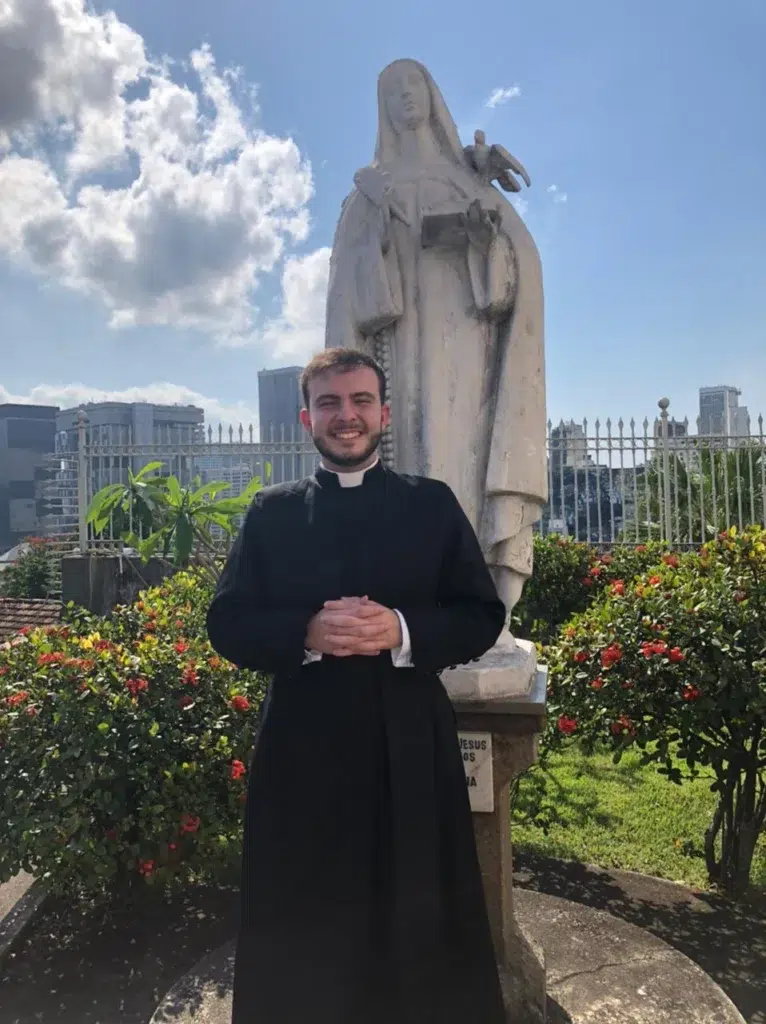
José Gabriel next to an image of the Virgin Mary in Rio de Janeiro, which accompanied the beginning of his priestly vocation.
The Diocese of Rio, a complex terrain
The Archdiocese of Rio de Janeiro, one of the largest in the country, has some 750 priests spread across 298 parishes. Of the more than six million inhabitants, 43.6% declare themselves to be Catholic, but the number of people without religion and who coexist with diverse traditions is increasing: Protestants, Umbanda spiritualists, Candomblé syncretists...
José Gabriel describes this situation without drama, but with great clarity. He says that evangelizing in his country means talking about God to a population that has learned to distrust, even in matters of the heart. «Many do not believe in love because they have seen how it breaks,» he explains. That is why he admires the work of his archbishop, who is present in very different neighborhoods and communities. That pastoral style—close, constant, without artifice—is the model he looks to in order to learn and improve as a future servant of God.
Evangelizing without techniques or slogans
When he talks about mission, he avoids clichés. For him, evangelizing consists of «living in a way that makes what you preach credible.» He is not referring to moral feats, but to consistency: a devoted life that is visible in everyday gestures. The simplicity of evangelizing by example without seeking to apply marketing techniques.
He believes that the trivialization of love and the fragility of the family have left deep wounds in many young people. That is why he insists that the Christian message can only be understood if it shows a love that is stable and capable of rebuilding.
José Gabriel during the interview he gave to the CARF Foundation in a classroom in Bidasoa.
Spain: solemnity and distance
His arrival in Spain led him to discover another way of living his faith. He appreciates the beauty of the liturgy and the intellectual seriousness of his new surroundings, but he perceives less community involvement than in Brazil. He does not express this as a criticism, but rather as a contrast: «Here, everything is well cared for and well celebrated, but sometimes there is a lack of closeness that motivates people to participate and serve.».
When asked about the kind of priest the Church needs today, he responds without embellishment: «Someone who truly loves his vocation, who studies seriously, and who prays without compromise. In a secularized context, people quickly discern whether a priest believes what he says or is merely fulfilling a role,» affirms José Gabriel Silva Kafa.
A story without fireworks
José Gabriel's journey is not based on striking miracles or extraordinary experiences. He was born into a family that was consistent in its Catholic faith, lived close to a lively parish, and underwent a slow process in which learned to listen to God amidst the daily noise.
Today, he continues on that path far from his country, in a seminary that—as he acknowledges—is also shaping him. His story is simple, but it makes it clear that a vocation can grow quietly and become solid over time.
Marta Santín, journalist specializing in religion.
Table of Contents
Enrique Shaw: the Argentine businessman who transformed his company with the Gospel
Enrique Shaw is one of those names that breaks the mold: a deeply humane businessman, a layman committed to the Church, and a family man who understood that holiness also plays a role in the office, in the factory, and in day-to-day management. His life not only left its mark on Argentina, but today inspires thousands of people who seek to live their faith in the midst of the world.
Declared Venerable by the Church in 2021, his cause for beatification is moving forward, driven by the testimony of those who knew him: a man who worked, led, and served as one who wanted to be like Christ. His figure challenges us to rediscover the role of the laity in the mission of the Church, a mission that the CARF Foundation supports supporting the training of seminarians and priests diocesan priests, who will guide as many people as he did, both humanly and spiritually.
Who was Enrique Shaw? A life of faith, work, and service
The Venerable Enrique Ernest Shaw was born in 1921. His mother died when he was very young, and his father decided to entrust his spiritual education to a priest of the Sacramentinos. That early education marked the beginning of a God-centered life.
He later joined the Navy and married Cecilia Bunge, with whom he had a large family: nine children. After leaving military service, he entered the business world, where he developed an innovative vision of Christian leadership. He was one of the founders of the Christian Association of Business Leaders (ACDE) in Argentina, and promoted spaces where ethics, social justice, and charity were lived out in concrete ways.
An entrepreneur who brought the Gospel to the workplace
Shaw believed that faith should permeate all decisions, including economic ones. He did not conceive of the company as a mere place of production, but as a human community where each person had dignity and rights. Some characteristics that defined his business style:
He promoted real improvements in working conditions for his employees.
It encouraged participation and internal dialogue.
He argued that businesspeople should put the common good before personal interests.
He promoted policies to support families and vocational training.
His leadership style anticipated what the Church would develop decades later as Social Doctrine applied to the world of work: a leadership that seeks prosperity without sacrificing humanity.
A coherent family and spiritual life
The venerable Enrique Shaw and his wife, Cecilia, on a day at the beach with their children. Family life had a profound impact on his journey of faith.
At home, the venerable Shaw lived his faith naturally and joyfully. His warmth, his ability to listen, and his constant search for holiness in everyday life left a mark on his wife, his children, and hundreds of people who crossed his path.
During his illness—a cancer that accompanied him in his final years—he continued to work, encouraging others and offering his suffering for the people he loved. Many testimonies highlight his serenity and his way of facing pain with hope and gratitude.
The cause for beatification of Enrique Shaw
In 2021, Pope Francis approved the decree recognizing heroic virtues by Enrique Shaw, granting him the title of Venerable. This is a decisive step in the beatification process.
The cause continues to move forward thanks to the testimony of those who witnessed his life and the spiritual fruits that his example continues to bear. For the Church, the venerable Shaw represents a model of the laity: a Christian who sanctifies work, accompanies others, and builds a more just society.
What Enrique Shaw inspires in lay people around the world today
His figure answers a question that many believers ask themselves today: How can we live our faith in a demanding professional environment?
Shaw proves that it is possible:
lead without abusing,
grow without stepping on,
lead without losing humanity and
work always seeking the common good.
In a world where competitiveness seems to prevail over the individual, his testimony brings the essence of the Gospel back to the center of professional activity.
The CARF Foundation: training those who will accompany and inspire the laity
Enrique Shaw's life shows how decisive it is to have a good Christian education, especially received from childhood and accompanied by trained priests.
Today, that same mission continues with strength in CARF Foundation, which helps seminarians and diocesan priests from around the world receive a comprehensive education: academic, human, and spiritual. They will be the ones who accompany lay people like Shaw, and who will enlighten businesses, families, parishes, and entire communities.
Your support makes it possible for this chain of training to continue unbroken.
Help train those who will lead the Church of the future.